


9,99 €
Mehr erfahren.
- Herausgeber: 50Minutes.com
- Kategorie: Fachliteratur
- Serie: Management & Marketing
- Sprache: Englisch
The SMART way to set objectives
This book is a practical and accessible guide to understanding and implementing the SMART criteria, providing you with the essential information and saving time.
In 50 minutes you will be able to:
• Understand the 5 criteria that make up the SMART method (Specific, Measurable, Attainable, Realistic and Time-Bound)
• Follow the steps and ask the right questions in order to always set objectives that are achievable
• Apply the model in many different areas, including project management, marketing and personal development.
ABOUT 50MINUTES.COM | Management & Marketing
50MINUTES.COM provides the tools to quickly understand the main theories and concepts that shape the economic world of today. Our publications are easy to use and they will save you time. They provide elements of theory and case studies, making them excellent guides to understand key concepts in just a few minutes. In fact, they are the starting point to take action and push your business to the next level.
Das E-Book können Sie in Legimi-Apps oder einer beliebigen App lesen, die das folgende Format unterstützen:
Seitenzahl: 21
Veröffentlichungsjahr: 2015
Ähnliche












SMART criteria
Key information
Names: SMART goals, SMART criteria, SMART method, SMART objectives, SMARTER methodUses:In management and project management, the SMART criteria are used to define objectives, as well as effective key performance indicators (KPI), and to facilitate their achievement.In the field of human sciences and personal development, they are used to set learning objectives.Why is it successful? The principle is simple: an objective must satisfy five criteria in order to confirm its relevance. It must be specific, measurable, assignable, realistic and time-bound. The mnemonic acronym SMART also allows you to keep in mind these elements, which help you to set realistic objectives.Key words:Key performance indicator (KPI): type of measurement for evaluating effectiveness or efficiency.Objective: the ideal outcome from implementing specific actions.Project management: organising all the actions that aim to meet a given objective.Introduction
In 1954, in his book The Practice of Management, Peter F. Drucker (business management consultant, 1909-2005) defined the concept of management by objectives (MBO), which is the setting of quantitative and/or qualitative objectives within a given time-scale. He also specified that employees must be involved in setting objectives to then be able to measure and evaluate their performance. Without formally using the SMART acronym, Drucker laid the foundations of this concept.
Business management
Throughout the 20th century, many authors examined the qualities required to be a good leader. This was the case with Kenneth Blanchard (American leadership and management expert, born in 1939) and Paul Hersey (American psychologist, 1931-2012), who defended the idea that a person who is able to set goals and adapt their leadership accordingly is a good leader.
It was not until George T. Doran (professor of management, 1939-2011) published the article, ‘There’s a S.M.A.R.T. Way to Write Management’s Goals and Objectives’ (Doran, 1981) that the concept of SMART objectives appeared. Doran states that not all objectives have to meet the SMART criteria and it is more useful to use them as guidelines.
Definition of the model
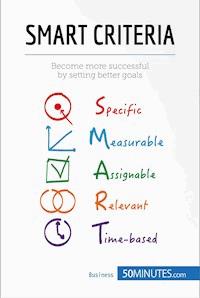
The SMART acronym refers to five concepts that must constantly be referred to when setting objectives, in order to validate their relevance. In order, the concepts are specific (S), measurable (M), assignable (A), realistic (R) and time-bound (T).




