


15,49 €
Mehr erfahren.
- Herausgeber: Nick Hern Books
- Kategorie: Geisteswissenschaft
- Serie: So You Want To Be...? career guides
- Sprache: Englisch
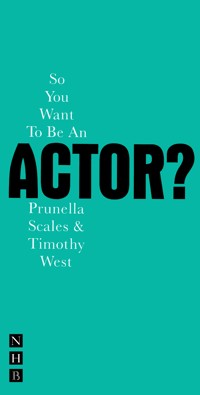
A handbook for aspiring actors by two of the best-known names in British theatre and television. So You Want To Be An Actor? by Timothy West and Prunella Scales offers practical advice and do's and don'ts to anyone thinking of taking up acting. The authors are passionate about actor training, know the profession inside out and have more than a hundred years' experience between them... Writing alternately throughout the book - and sometimes offering radically different opinions - they cover over sixty topics including: * Drama school * Auditions and interviews * Agents * Financial Security * Learning the lines * Working in television/radio * Touring * Media attention Charmingly informal but full of sound advice, So You Want To Be An Actor? is essential reading for anyone with their eye on a career in acting.
Das E-Book können Sie in Legimi-Apps oder einer beliebigen App lesen, die das folgende Format unterstützen:
Seitenzahl: 122
Veröffentlichungsjahr: 2014
Ähnliche



















SO YOU WANT TO BE AN ACTOR?
Prunella Scales and Timothy West
NICK HERN BOOKS
London
www.nickhernbooks.co.uk
CONTENTS
NOTE
PREPARATION
First thoughts about becoming an actor
How to go about it
To train or not to train
Drama School
Graduation
Unpaid Fringe productions
Agents
Advertising yourself
Auditions and interviews
Spreading yourself around
Financial security
Equity
Health
Physical well-being
Reading matter
Onward …
PRACTICE
What is acting for?
Approach to a character
Truth
Technical advice – shape
Use of language
‘R.P.’
Orchestral demands of text
Phrasing
Some principles of stress in spoken English
Some extra points in the speaking of verse
Soliloquy
Learning the lines
‘I would never say that … ’
Skills
Learning from other performances
Rehearsals
Small parts
Big parts
Costume
Research
Directors
Working with people you don’t get on with
Audiences
The different media
The camera
Working in film
Working in television
Working in radio
Commercials
Critics
PERSEVERANCE
The unpredictability of the business
Being out of work
The Actors Centre
Writing and devising
Teaching
Temporary jobs
Work you can’t afford to do
Touring
Regional theatre
Where to live
Public transport
Relationships
Children
Media attention
Publicity
Fan mail
Tipping
Branching out
Organisations and clubs
Committee work
Giving something back
Charities
Celebrities
When to stop
APPENDIX
Useful publications
Useful addresses
Drama training
Agents
Photographers
Theatre books
ABOUT THE AUTHORS
OTHER TITLES IN THE SERIES
COPYRIGHT INFORMATION
For the aspiring performer, there is no such thing as an absolute rulebook, no reliable common counsel. No two actors think alike, so what the undersigned pair have to say may often be mutually contradictory. Some of the advice may be bad. Some of it, on the other hand, may be so good that we wish we had taken it ourselves. But at least it has no pretence to canon law – it’s simply a set of individual opinions born of an aggregate of a hundred years in the business.
Prunella Scales
Timothy West
NOTE
As you will see, the two authors alternate throughout the book, distinguished one from the other by different typefaces.
This is Prunella Scales’s ‘voice’.
And this is Timothy West’s ‘voice’.
I
PREPARATION
FIRST THOUGHTS ABOUT BECOMING AN ACTOR
What gave you the idea? Did you go to the theatre much as a child? The cinema? Watch a lot of drama on TV, and wish you were doing it? Did you do many plays at school, or with amateur groups, and found you liked it, or were quite good?
All these are perfectly valid reasons for trying to go into the business. But above all, don’t do it as Second Best.
We will not insult the obvious intelligence you have displayed in buying this book by supposing that you believe the life of an actor is one long round of companionable jollity, a passport to fame, fortune, free sex and fashionable restaurants. It could be that you hold a more pragmatic view of your likely development: starting as a badly paid, unknown and unappreciated small-part player in some far-flung theatre never visited by casting directors, gradually getting better parts, achieving a modest foothold in television, developing by sheer hard work into someone who might one day be employed by the National Theatre or the RSC.
That sounds logical, but I’m afraid it very seldom works like that. No, your development will largely depend on luck, fashion, who you know, what you look like, and the general state of the business. It’s tough, but there it is. HOWEVER, before you cast this book away in despair – talent comes into it somewhere. So does your ability to work hard and variously, and to be easy to get along with.
Think very hard about it. Unemployment statistics in the profession are hard to ascertain accurately, but a recent Equity survey showed that only some 56 per cent of members earned less than £10,000 a year from performing, while around 35 per cent worked fewer than 10 weeks. Of course, that’s only Equity members (more about that later), and, among them, only those who responded to the survey.
If you honestly feel that you will have difficulty coping with lengthy periods of hardship and frustration, then you should seriously consider the alternative option of taking what my father (who worked in the theatre all his life) used to call a Proper Job. Then you can join one of the better amateur companies and carry on acting in your spare time. This is what I did, when I tried for a time to do a Proper Job. So what went wrong, you ask? Well, I simply found that my after-hours dramatic activity was eating up most of my energy, enthusiasm and, indeed, thought. So it seemed reasonable to try and get paid (modestly) for what I clearly cared about most.
The British actress Athene Seyler, in her book The Craft of Comedy (get it, if you haven’t got it), refers to an imaginary friend making the leap from amateur to professional theatre: ‘William … is marrying his mistress, as it were, and what has up till now been simply delight in the expression of his love for her, will turn into staid responsibility and monotony, with all the other cares attendant upon married life.’
HOW TO GO ABOUT IT
The best advice I could give a young person wanting to be an actor is, ‘Finish your education.’ Don’t go to a Child Acting School, but get as broad an education as you can, and don’t do ‘Drama’ as an academic subject. A professional actor doesn’t need to know about Drama, but about Life. You need to observe and understand ‘real’ people. If you go on to university, read English, History, Music, a foreign language, or even a scientific subject. Do as much acting as you can in your free time or out of school and university hours. An actor has to understand the circumstances and mind-set of every character he plays, so the fuller his experience and knowledge of people, the better.
If you plan to allow yourself a ‘gap year’ between school and university, this could well be used as an opportunity to broaden your knowledge of life and society, and to learn more about the sort of characters you hope to play as an actor. Get a job where you meet lots of different people, and which ideally gives you the chance to save some money for the future.
I have an ambivalent attitude to the study of Drama at university level. The late Professor Glynne Wickham, who founded the first-ever Drama Department at a British University (Bristol), used to greet his new students by telling them that if they had any idea of becoming actors then they shouldn’t be there at all – they should be getting vocational training up the road at the Bristol Old Vic Theatre School. His own Department was, he maintained, properly for the use of academics, writers, artistic directors, theatrical historians, dramaturgs and critics.
Wickham, who knew perfectly well that many of his students would go on to become actors, was being very shrewd. Among the alumni of his time at Bristol are in fact some of the most distinguished figures in our business. That distinction could well be due to their having been able to share their early adult life with students of every kind of subject: yes, ‘real’ people.
TO TRAIN OR NOT TO TRAIN
Forty years ago, the shrinking number of repertory theatres in this country still offered a core of actors continuous employment throughout a season, or perhaps a whole year, sometimes even longer. People starting their careers in one of the better Reps therefore had the opportunity to cut their teeth on the language of Shakespeare, Congreve, Sheridan, Wilde, Shaw, Coward, Rattigan and Agatha Christie, as well as translations of Chekhov, Ibsen and Molière. But learning the job just by doing it is no longer a real option, and only enrolment at a Drama School can provide some measure of that varied experience.
Drama Schools nowadays provide full tuition in performing before the camera and the microphone as well as on stage. However, there is a feeling among some senior television producers today that drama training of any kind works against the colloquial naturalism demanded for popular ‘soaps’, and that actors for such programmes are better recruited directly off the street.
This is fine, if you are prepared to go on doing that sort of thing for the rest of your life (or until the producers get bored with you), but if you later feel a thirst to explore different kinds of writing, perhaps in the live theatre, you could find yourself in difficulties given the vocal and physical scale, along with the stamina and preparation necessary to sustain a performance over two and a half hours.
This can only be learned by practice, and you may wish you’d gone to Drama School after all.
I didn’t go to Drama School, but Pru did.
It was the remarkable, though short-lived, Old Vic Theatre School in London, run by Michel Saint-Denis, George Devine and Glen Byam Shaw. At the age of seventeen and two months, with my very thick glasses and pigtails, I didn’t have a very good time there, but the training itself, based on Stanislavski, was illuminated for me some years later at The Herbert Berghof Studio in New York, run by the brilliant actress and teacher, Uta Hagen – more of this later.
At the Old Vic School, the teaching of Litz Pisk was revelatory, and I believe her book The Actor and His Body to be essential reading for all aspiring actors. In working with us on period dances, Litz would draw parallels between the costume, architecture and social attitudes of different ages. Two examples that have stayed in mind are: the correlation between the mediæval aspiration to Heaven echoed in both Gothic architecture and the vertical pointed ‘hennin’ worn by women on their heads, and the sexual hypocrisy of the Edwardian age as reflected in the mens’ stiff collars and the women’s high-buttoned jackets, over-emphasised breasts and exaggerated ‘bustles’ – the scaled-down remnant of the Victorian crinoline – sticking out behind.
DRAMA SCHOOL
In the relevant section of Contacts – (published annually by The Spotlight; get a copy if you haven’t one already) – Drama UK (formed from a merger of the Conference of Drama Schools and the National Conference of Drama Training) represents twenty nationwide drama schools. The list is reprinted at the end of this book. These are the leading schools of the country, offering accredited courses, most of which are now accorded degree status.
Obtaining funding to go to Drama School is easier than it used to be, although the funding system itself is more complicated.
Three schools – RADA, LAMDA and Bristol Old Vic Theatre School – are part of the National Conservatoire of Dance & Drama. If you get into one of these you may apply for a scholarship to aid with your tuition fees.
Almost all other Drama Schools are associated with Universities or Colleges of Higher Education. They offer degree-level courses. Consequently, students are eligible to apply for student loans.
Six schools – ALRA, Arts Ed, Guildford School of Acting (Acting course only), Italia Conti Academy of Theatre Arts, Mountview Academy of Theatre Arts and Oxford School of Drama – offer Dance and Drama Awards to selected students. D&DAs are scholarships provided by the government to allow ‘the most talented’ students to attend independent Drama Schools. The D&DAs are usually offered to students who would benefit from training but who wouldn’t be able to pay the fees. The D&DA scheme, therefore, makes access easier, although you can’t apply for help with living costs if your combined parental income is more than £30,000 a year (this was the figure in 2014/2015 academic year). But you should ask, if you go to one of these schools as a fee-payer, whether you can apply for a student loan.
Cygnet Training Theatre in Exeter is completely independent, so if you go there you’ll receive no public funding but may apply for a Professional and Career Development Loan.
Those schools are the training places responsible for turning out the vast majority of our leading performers.
Contacts then goes on to devote many pages to listing other organisations devoted to drama training, from fully-fledged schools to individual practitioners, speech therapists, dialect experts and the like.
Well, many of these institutions are entirely reputable, and a great number of the practising individuals offer expert and helpful guidance. Even so, so many retailers all laying out their wares for the budding trainee is rather confusing to say the least.
Choose carefully.
For some time I was on the Accreditation Panel of the National Council for Drama Training, and while I have seen some excellent teaching, and watched some excellent work over the years, I have to say – as a crazy idealist – that I’d like to see the number of accredited Drama Schools in the UK reduced to twelve: say six in London, and one each in Glasgow, Cardiff, Belfast, Birmingham, Manchester and Bristol. I feel there cannot possibly be enough really good teachers to spread the net much wider than this.
However, if you can get a place, and can spare the three years (or if you’re a post-graduate, two years) required for an Accredited Drama Training, it’s an opportunity to develop the skills you need for stage, screen and radio – a trained voice, singing, dance, fencing, gymnastics, learning various dialects, wearing of costume, make-up skills and so on.
Buy Contacts, study the list of schools, write to a few you like the look of and ask for a prospectus from each, or visit their website. Read this material carefully, and having done so, make a shortlist of three or four. If your application is granted, they’ll tell you the sort of thing they will expect you to prepare for the audition, and will warn you that they charge a fee. At your interview they will want to be convinced of your commitment, your health and physical fitness, your willingness to learn and to work hard, and not least, your ability to cover your maintenance costs and, if applicable, tuition fees.
Don’t expect to succeed on your first attempt. The demand to get into a reputable school gets fiercer all the time. (LAMDA, the one I know most about, takes only 3.5% of its annual applicants.) But let us suppose you’ve done your audition, had your interview, been accepted, had your funding guaranteed, signed your contract, and are now ready to start.




