


50,99 €
Mehr erfahren.
- Herausgeber: John Wiley & Sons
- Kategorie: Geisteswissenschaft
- Sprache: Englisch
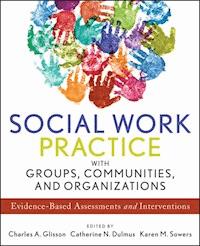
A solid, theory-to-practice guide to contemporary mezzo and macro social work
Written by a renowned team of scholars, Social Work Practice with Groups, Communities, and Organizations focuses on the contemporary theory and practice of social work. Each chapter delves deeply into the key theoretical considerations surrounding a particular practice area, exploring the clinical implications of each. Spanning the full range of both mezzo and macro practice areas, the authors thoroughly look at the assessment of and interventions with group, community, organizational, and institutional settings.
The most authoritative book in this field, Social Work Practice with Groups, Communities, and Organizations features:
- A focus on evidence-based approaches to assessment and intervention for each practice area discussed
- Comprehensive coverage of the most important new and emerging practice technologies in mezzo and macro social work
- Current and emerging demographic, social, political, and economic trends affecting mezzo and macro practice
- An array of pedagogical aids, including Key Terms, Review Questions for Critical Thinking, and Online Resources
- Content closely aligned with social work accreditation standards (EPAS)
Providing a solid review of the entire scope of contemporary mezzo and macro social work practice, Social Work Practice with Groups, Communities, and Organizations is both an indispensable educational text for students and a valuable working resource for practitioners who work with groups, communities, and organizations of all sizes.
Sie lesen das E-Book in den Legimi-Apps auf:
Seitenzahl: 585
Veröffentlichungsjahr: 2012
Ähnliche




















Table of Contents
Title Page
Copyright
Preface
About the Editors
Contributors
Chapter 1: Assessment of Groups
Historical Background
Summary of Current Evidence and Application to Group Assessment
Identified Needs for New Research
Key Terms
Review Questions for Critical Thinking
Online Resources
References
Chapter 2: Group Work: A Critical Addition to the Social Work Repertoire
Group Work: A New Method of Intervention with Deep Historical Roots
Group Work Models for Practice
Conclusion
Key Terms
Review Questions for Critical Thinking
Online Resources
References
Chapter 3: Assessment of Communities
Historical Background and Theory
Assessment in Practice: Discovering and Documenting the Life of a Community
Limitations of the Evidence
Implications for Social Work on Micro, Mezzo, and Macro Levels
Future Directions
Conclusion
Key Terms
Review Questions for Critical Thinking
Online Resources
References
Chapter 4: Intervention with Communities
Focus of Community Intervention: What Does Community Mean?
Historical Background
Current Evidence-Based Intervention with Communities
Limitations to the Evidence
Implications for Social Work
Conclusion
Key Terms
Review Questions for Critical Thinking
Online Resources
References
Chapter 5: Assessment of Organizations
Worker's Perspective
Management's Perspective
Funder's Perspective
Client's Perspective
Conclusion
Key Terms
Review Questions for Critical Thinking
Online Resources
References
Chapter 6: Intervention with Organizations
Social, Strategic, and Technical Dimensions of Organizational Context
Work Environments of Social Services Organizations
Using Planned Intervention to Change Organizational Contexts
Historical Background
From Organizational Development to Change Management
The ARC Model as a Framework for Implementing Organizational Interventions
Limitations of the Evidence
Implications for Social Work Practice
Conclusion
Key Terms
Review Questions for Critical Thinking
Online Resources
References
Chapter 7: Assessment of Institutions
Historical Background
Assessment and Early Institutions
Emerging Federal Role in Institutional Reforms and Assessment
Characteristics of Asylums
The Anti-Institutionalization Movement
Normalization, the Least Restrictive Environment, and Recovery
Current Frameworks for Assessing Institutions
Organizational Effectiveness
Quality
Evidence-Based Assessment of Institutions
Implications at the Macro, Mezzo, and Micro Levels
Conclusion
Key Terms
Review Questions for Critical Thinking
Online Resources
References
Chapter 8: Intervention with Institutions
Historical Background
Summary of Contemporary Evidence-Based Intervention with Institutions
Limitations of the Evidence
Implications for Social Work Practice
Conclusion
Key Terms
Review Questions for Critical Thinking
Online Resources
References
Author Index
Subject Index
This book is printed on acid-free paper.
Copyright © 2012 by John Wiley & Sons, Inc. All rights reserved.
Published by John Wiley & Sons, Inc., Hoboken, New Jersey.
Published simultaneously in Canada.
No part of this publication may be reproduced, stored in a retrieval system, or transmitted in any form or by any means, electronic, mechanical, photocopying, recording, scanning, or otherwise, except as permitted under Section 107 or 108 of the 1976 United States Copyright Act, without either the prior written permission of the Publisher, or authorization through payment of the appropriate per-copy fee to the Copyright Clearance Center, Inc., 222 Rosewood Drive, Danvers, MA 01923, (978) 750-8400, fax (978) 646-8600, or on the web at www.copyright.com. Requests to the Publisher for permission should be addressed to the Permissions Department, John Wiley & Sons, Inc., 111 River Street, Hoboken, NJ 07030, (201) 748-6011, fax (201) 748-6008.
Limit of Liability/Disclaimer of Warranty: While the publisher and author have used their best efforts in preparing this book, they make no representations or warranties with respect to the accuracy or completeness of the contents of this book and specifically disclaim any implied warranties of merchantability or fitness for a particular purpose. No warranty may be created or extended by sales representatives or written sales materials. The advice and strategies contained herein may not be suitable for your situation. You should consult with a professional where appropriate. Neither the publisher nor author shall be liable for any loss of profit or any other commercial damages, including but not limited to special, incidental, consequential, or other damages.
This publication is designed to provide accurate and authoritative information in regard to the subject matter covered. It is sold with the understanding that the publisher is not engaged in rendering professional services. If legal, accounting, medical, psychological or any other expert assistance is required, the services of a competent professional person should be sought.
Designations used by companies to distinguish their products are often claimed as trademarks. In all instances where John Wiley & Sons, Inc. is aware of a claim, the product names appear in initial capital or all capital letters. Readers, however, should contact the appropriate companies for more complete information regarding trademarks and registration.
For general information on our other products and services please contact our Customer Care Department within the United States at (800) 762-2974, outside the United States at (317) 572-3993 or fax (317) 572-4002.
Wiley publishes in a variety of print and electronic formats and by print-on-demand. Some material included with standard print versions of this book may not be included in e-books or in print-on-demand. If this book refers to media such as a CD or DVD that is not included in the version you purchased, you may download this material at http://booksupport.wiley.com. For more information about Wiley products, visit www.wiley.com.
Library of Congress Cataloging-in-Publication Data:
Glisson, Charles.
Social work practice with groups, communities, and organizations : evidence-based assessments and interventions / Charles A. Glisson, Catherine N. Dulmus, Karen M. Sowers.
p. cm.
Includes bibliographical references and index.
ISBN 978-1-118-17695-5 (pbk.)
ISBN 978-1-118-26489-8 (ebk.)
ISBN 978-1-118-24020-5 (ebk.)
ISBN 978-1-118-22723-7 (ebk.)
1. Social group work. 2. Social work administration. 3. Community organization. I. Dulmus, Catherine N. II. Sowers, Karen M. (Karen Marlaine) III. Title.
HV45.G57 2012
361.4–dc23
2011053076
Preface
The profession of social work spans more than 100 years. Over this period, the profession has changed in scope and depth. Despite the varied functions and methods of our profession, it has always been committed to social justice and the promotion of well-being for all. The profession has made great strides and is experiencing a resurgence of energy, commitment, and advancement as we face new global realities and challenges and embrace new and innovative technologies.
This book is designed as a foundational social work practice text for undergraduate and graduate students in social work programs. The text provides the foundation of skills required for beginning social work practice with groups, communities, and organizations. This book addresses Council on Social Work Education (CSWE)–required competencies for accreditation. Specifically, it addresses the following required accreditation competencies:
Educational Policy 2.1.2
—Apply social work ethical principles to guide professional practice.
Educational Policy 2.1.3—
Apply critical thinking to inform and communicate professional judgments.
Educational Policy 2.1.7
—Apply knowledge of human behavior and the social environment.
Educational Policy 2.1.9
—Respond to contexts that shape practice.
Educational Policy 2.1.10
—Engage, assess, and intervene with groups, communities, and organizations.
In considering how the field of social work has evolved over the past century, with the resulting explosion of new knowledge and technologies, it seemed imperative to create a text that provides a current prospective on social work practice. The content in this book is contemporaneous and is reflective of demographic, social, political, and economic current and emerging trends. Authors have paid close attention to contextual factors that are shaping practice and will have a future impact on practice.
We would like to thank our team of distinguished authors who have contributed chapters to this book. Their expertise and hard work has culminated in a substantial and relevant text. We hope that you find this work useful. We have endeavored to provide you, the reader and user, with a work that will guide you in your own studies and work in this wonderful profession.
Charles A. Glisson Catherine N. Dulmus Karen M. Sowers
About the Editors
Charles A. Glisson, PhD, is Professor in the College of Social Work at the University of Tennessee, Knoxville. He is Distinguished University Professor and Chancellor's Professor at the University of Tennessee, Knoxville. Dr. Glisson is the Director of the University of Tennessee, Knoxville College of Social Work's Children's Mental Health Services Research Center. Dr. Glisson's research focuses on the organization and delivery of social and mental health services to children and families. He has been principal investigator on multiple major research projects concerned with children's services funded by the National Institutes of Health (NIH). He has written numerous articles in major social work, mental health, and organizational research journals, and has made presentations throughout the country on the organizational context of social and mental health services. He has served on the editorial boards of numerous professional journals and served as a member of the Services Research NIMH scientific review group. Dr. Glisson is the founder and director of the Children's Mental Health Services Research Center, a research center funded by the National Institute of Mental Health. The center's goal is to implement high-quality research on social and mental health services for children with an emphasis on research designed to improve child welfare, juvenile justice, and mental health services to children and families at risk.
Catherine N. Dulmus, PhD, is Professor, Associate Dean for Research, and Director of the Buffalo Center for Social Research at the University at Buffalo, and Research Director at Hillside Family of Agencies in Rochester, New York. She received her baccalaureate degree in Social Work from Buffalo State College in 1989, a master's degree in Social Work from the University at Buffalo in 1991, and a doctoral degree in Social Welfare from the University at Buffalo in 1999. As a researcher with interests that include community-based research, child and adolescent mental health, evidence-based practice, and university-community partnerships, Dr. Dulmus' recent contributions have focused on fostering interdependent collaborations among practitioners, researchers, schools, and agencies critical in the advancement and dissemination of new and meaningful knowledge. She has authored or coauthored several journal articles and books and has presented her research nationally and internationally. Prior to obtaining her PhD, her social work practice background encompassed almost a decade of experience in the fields of mental health and school social work.
Karen M. Sowers, PhD, is Professor and Dean of the College of Social Work at the University of Tennessee, Knoxville. She is the University of Tennessee Beaman Professor for Outstanding Research and Service. Dr. Sowers received her baccalaureate degree in Sociology from the University of Central Florida, and her master's degree and PhD in social work from Florida State University. Dr. Sowers serves on several local, national, and international boards. Dr. Sowers is nationally known for her research and scholarship in the areas of international practice, juvenile justice, child welfare, cultural diversity, and culturally effective intervention strategies for social work practice, evidence-based social work practice, and social work education.
Contributors
Chapter 1
Assessment of Groups
D. Mark Ragg
Our understanding of group-level dynamics emerges through the careful observation of group interactions and the application of group-focused knowledge. This two-step process requires social workers to develop an awareness and appreciation of the interpersonal dynamics occurring among people. Social workers must then access knowledge to help explain their observations. Eventually, the knowledge can be applied toward understanding the dynamic forces that occur when people gather into groups.
Social work knowledge about groups has developed over the past century. Such knowledge emerged through many simultaneous processes. Initially, social workers and other professionals observed group phenomena. Observations lead to potential understandings through the development of theories that can be shared. Such theories provide the foundation for many group articles and textbooks. This level of knowledge is often referred to as “grounded theory,” meaning that the theoretical understandings are based on careful observation.
After theory development, knowledge building requires increasingly more rigorous observation. Such observations occur through empirical studies. These studies require social scientists to develop methods for careful and precise observation. In recent years, the technology for this level of observation has increased, resulting in multiple empirical studies of group dynamics. This level of knowledge building allows social workers to contrast grounded theory with rigorous observations.
This chapter operates in concert with the next chapter to highlight empirical observations that can solidify our understanding of groups. This chapter briefly explores the history of our theoretical understanding and common themes. The common themes are presented as considerations that can be used to assess group dynamics. These considerations provide a framework for understanding and applying the empirical information.
Historical Background
Our understanding of group dynamics is heavily influenced by the sociotechnical systems movement, the recreational movement, and the group psychotherapy movement. While there are other influences, these three movements have been instrumental in building our knowledge of how groups operate. A brief discussion of each movement is provided to identify diverse contributions and common dynamics that can be used for assessment.
The sociotechnical systems movement has a long history of using groups to humanize industrialized work settings. This movement began with the Hawthorne studies when researchers studied how the organization of work and working conditions influenced worker productivity (Mayo, 1933; Roethlisberger & Dickson, 1939). These studies found that the use of workgroups enhanced loyalty to the organization and resulted in superior productivity. Based on these findings, researchers recommended using groups in the workplace to counterbalance the dehumanizing aspects of industrialization.
A team at the Tavistock Clinic in England expanded the Hawthorne findings by conducting experiments on how groups can support workers and compensate for work conditions (Emery, 1978). These researchers argued that the workplace should be democratized by allowing teams of workers to cross-train for any job (on the team) and make critical production decisions (Herbst, 1962; Trist, Higgin, Murray, & Pollock, 1963). This democratization of production maximized interdependence, investment, decision making, and mastery among the workgroup members (Emery & Emery, 1974; Trist et al., 1963).
After the Tavistock contributions, much of the industrial group-work research focused on issues of leadership. Using groups to enhance productivity was an underlying theme of most sociotechnical systems research. Critical elements emerging from this knowledge base include valuing participation, democracy, self-direction, and mastery. Such concepts, while initially divergent in their application, are consistent with social work values. In the earliest application of group work, social workers were also interested in using democratic group processes and fighting the dehumanizing influence of industrialization (Konopka, 1963).
The second movement, recreational group work, focused initially on youth-focused social and recreational groups (Coyle, 1948). Social workers were using groups in their community and shelter practices to help youth and immigrant families adjust to the United States. Social workers subscribed to Dewey's (1933) assertions that small leisure groups should be part of a progressive educational system and Follett's (1920) arguments that groups are central to solving community problems. Social work allied easily with these philosophical positions and incorporated group work into community level activities.
Lesen Sie weiter in der vollständigen Ausgabe!
Lesen Sie weiter in der vollständigen Ausgabe!
Lesen Sie weiter in der vollständigen Ausgabe!
Lesen Sie weiter in der vollständigen Ausgabe!
Lesen Sie weiter in der vollständigen Ausgabe!
Lesen Sie weiter in der vollständigen Ausgabe!
Lesen Sie weiter in der vollständigen Ausgabe!
Lesen Sie weiter in der vollständigen Ausgabe!
Lesen Sie weiter in der vollständigen Ausgabe!




