


Erhalten Sie Zugang zu diesem und mehr als 300000 Büchern ab EUR 5,99 monatlich.
- Herausgeber: Luath Press
- Kategorie: Geisteswissenschaft
- Sprache: Englisch
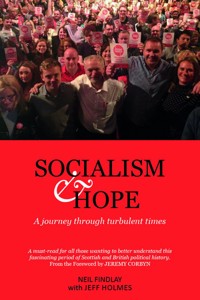
The last few years have seen a Scottish independence referendum, a couple of General Elections and a vote on whether or not we should remain in the European Union. Throw in two uncompromising Labour leadership battles at UK level and a couple in Scotland, and it would be true to say that nothing less than a political whirlwind has swept through the corridors of the Scottish Parliament since it 'reconvened' in 1999. Following the turbulent six years for which Neil Findlay has been a member of the Scottish Parliament for Lothian, Socialism & Hope tracks the highs and lows of his personal and political life. From standing in the 2014 election to become the Leader of the Scottish Labour Party, to acting as Jeremy Corbyn's Scottish campaign chief in the 2015 and 2016 leadership elections, Neil's political career has been tireless and active. This book, described by Jeremy Corbyn as 'an honest, frank and challenging – as well as humorous of course – account of his time […] at the forefront of Scottish politics', also includes Neil's inside view on the events of the 2014 Scottish Referendum and the rise of a more socialist Labour Party. With its entertaining narrative, it provides unprecedented and personal insights from within the political sphere itself. As well as surveying the past few years of political tumult, Socialism & Hope also looks forward to envision a society transformed by a revitalised Labour movement.
Sie lesen das E-Book in den Legimi-Apps auf:
Seitenzahl: 484
Veröffentlichungsjahr: 2017
Das E-Book (TTS) können Sie hören im Abo „Legimi Premium” in Legimi-Apps auf:
Ähnliche


















NEIL FINDLAY was born in 1969, the son of a bricklayer and a primary school teacher. Brought up in the working class village of Fauldhouse in West Lothian, after leaving school at 16 he was an apprentice and tradesman bricklayer for ten years with his father’s small business, became active in his local Labour Party and struck up a great friendship with Tam Dalyell MP. After returning to education, he worked in social housing before becoming a school teacher. A West Lothian Councillor for nine years, he was elected to the Scottish parliament in 2011, serving in various front bench posts and contesting the Scottish Labour leadership election in 2015. Scottish campaign manager for Jeremy Corbyn’s two leadership elections, Neil is current chair of the Scottish Parliament’s health and sport committee. He enjoys fishing, golf, gardening and going for a pint.
Socialism & HopeA journey through turbulent times
NEIL FINDLAY
with
JEFF HOLMES
First published in 2017
ISBN: 978-1-912147-27-4 eISBN: 978-1-912387-07-6
The author’s right to be identified as author of this book under the Copyright, Designs and Patents Act 1988 has been asserted.
© Neil Findlay 2017
This book is dedicated to Fiona, Chloe and all my family, friends, colleagues, neighbours and comrades whose friendship, humour, advice and help I have enjoyed over the years; also, to my great friend and mentor Tam Dalyell, who died the day after I finished writing. I miss him greatly.
Thanks to you all; live life to the full – you’re only here once!
Contents
Foreword by Jeremy CorbynMP
Preface
1:From Bangour to Holyrood
2:Referendum Diary: January2014
3:Referendum Diary: February2014
4:Referendum Diary: March2014
5:Referendum Diary: April2014
6:Referendum Diary: May2014
7:Referendum Diary: June2014
8:Referendum Diary: July2014
9:Referendum Diary: August2014
10:Referendum Diary: September2014
11:Leadership Declaration: October2014
12:Leadership Race: November2014
13:Leadership Race: December2014
14:Business as Usual: January–May2015
15:General Election Fall Out: May–June2015
16:Enter Stage Left: May2015–September2016
17:As One Parliamentary Legend Leaves Us, Another Emerges
Appendix: My World
Photographs
Foreword by Jeremy Corbyn MP
I AM DELIGHTEDto have been asked to write this foreword for my friend and comrade Neil Findlay.
Becoming leader of the Labour Party has given me the opportunity to meet people from across the Labour movement – and one of the personal highlights for me has been getting to know Neil. I value enormously the support and friendship he has given me.
Of course you know a true friend when they are prepared to be honest and forthright with you and tell you the things you sometimes don’t want to hear. Neil is one such person, as most people who know him will confirm: he is not one for pulling his verbal punches! When Neil calls he is always clear, of course very friendly, but always robust. So no one should be in the least bit surprised that this diary is an honest, frank and challenging – as well as humorous of course – account of his time in the Scottish Parliament and at the forefront of Scottish politics.
Neil has observed and been part of a tumultuous time in Scottish and British politics. In Scotland, unfortunately, the changing political landscape has seen difficult times for the Labour Party. One of the brighter spots amongst an often rather miserable period was Neil’s election in2011. He was elected on a platform of an uncompromising determination to create a better, fairer and more equal Scotland and Britain. Nobody should be in any doubt that he has used his position to throw himself with100per cent commitment into the campaigns and issues for which he cares passionately.
A tireless campaigner, Neil fights on the side of justice and against injustice at all times. He has supported and stood alongside blacklisted construction workers, unjustly sacked and victimised miners, local government workers and women who have been injured and left disabled by polypropylene mesh medical devices which were meant to make their lives better, not worse.
To state the blindingly obvious, Neil is a very active Parliamentarian, introducing a member’s bill to establish a lobbying register in Scotland, which was subsequently passed by the Scottish Government (though to his great regret significantly diluted).
During the2011–2016Scottish Parliament, Neil was also a key Shadow Cabinet Member, holding theSNPScottish Government to account for their failings in health and social care. Never one to think that holding them to account was simply about criticising the Government of the day, Neil always looked for positive and progressive alternatives, shown when he commissioned two radical reports into social care and the persistent scandal of stubborn health inequalities.
And whilst engaged with all of that, Neil also found time to be a key protagonist in the debate about Scotland’s constitutional future. He spoke at countless meetings, arguing with energy and conviction for Scotland to remain part of theUKbut within a federal and decentralised set up. Alongside his colleagues from across the broad left, he was part of the ‘Red Paper Collective’ and worked with leading Labour and Trade Union movement figures who argued for Scotland to stay tied to theUKfor reasons of solidarity and socialism.
He also found time to stand for the post of Scottish Party Leader and put up a brilliant fight, which, although ultimately unsuccessful, was very important in ensuring that a strong, socialist vision of Scotland was heard during that particular campaign.
Reflecting upon this rich experience, Neil’s book provides entertaining insights into remarkable and transformative political machinations over six years. What he has to say in relation to normal parliamentary dynamics is in itself interesting; against the backdrop of the Scottish Independence referendum, Brexit, his own Scottish Labour leadership campaign and the Labour leadership elections, Neil’s observations become a must-read for all those wanting to better understand this fascinating period of Scottish and British political history.
Our movement should value Neil for his energy, commitment and dedication as a trade unionist and socialist. However, there is much more to Neil. He is a thinker and someone who has the heart and the imagination to lead people out of drudgery and isolation to a better society.
I count Neil as a good and real friend and one who teaches us to think and act.
Jeremy CorbynMP
August2017
Preface
SOCIALISM IS ABOUToptimism and hope. And by God, over the last few years, as a member of the Scottish Labour party, that optimism has been tested. These years have taken us from a position of power to a point where people were questioning our continued relevance.
This existential crisis has been enough to take even the greatest optimist to the edge of despair.
However, politics is nothing if not unpredictable.
As this book goes to print, we enter into another Scottish Labour leadership election. It comes at a time when Labour is winning trust across the nations of theUKwith a policy manifesto that truly addresses the needs of our communities. A manifesto that embodies a vision of full employment, fairness, equality and, crucially, solidarity, it reflects the socialism that I have always believed in.
Throughout the20th century, it is the labour movement that has brought about radical social change – from council housing and the National Health Service, to devolution and the National Minimum Wage. I believe that, in a spirit of newfound optimism, Labour will build on these historic achievements and rise to the challenges of the future, with policies to ‘Transform Our Society For the Many, Not the Few’.
Neil FindlayMSP
August2017
1
From Bangour to Holyrood
WE ARE LIVINGthrough one of the most turbulent periods inUKpolitical history. The last few years have seen a Scottish independence referendum, a couple of General Elections and a vote on whether or not we should remain in the European Union. Throw in two uncompromising Labour leadership battles atUKlevel and a couple in Scotland, and it would be true to say that nothing less than a political whirlwind has swept through the corridors of the Scottish Parliament since it ‘reconvened’ in1999.
I’ve been anMSPsince2011, but things could have been so different had the navigation skills of a certain Lithuanian maritime skipper been more accurate. To explain, my great-grandfather Kazimere Dekyritis – my ma’s grandfather – had decided to leave his Baltic homeland in search of a better life. The family paid for passage to the United States and after being on the open seas for quite some time, were told the land they could see on the horizon was America when, in reality, they were a few thousand miles short – in Leith. From there, they moved on to Stoneyburn, in West Lothian, and the prospect of a future Congressman Findlay was forever lost.
Kazimere’s son Bernard broke his back in a mining accident before my ma was born, and found himself working nightshift in the lamp cabin handing out and taking in miners’ lamps, but by day he was a fixture at the street corner outside the Stoneyburn Co-op, collecting bookies lines long before gambling was legal. My ma and her siblings would jump on the bus to Blackburn to pick up lines and money from contacts there. It was a family concern.
My ma excelled at school and went to Edinburgh University to study, before attending Catholic Teacher Training College at Craiglockhart, and she taught in primary schools for40years. She was also anEISshop steward.
My parents were chalk and cheese. My da was a hairy arsed and hairy faced, larger than life character (I can’t recall seeing him in the flesh without his trademark beard) who loved the banter and camaraderie of the building site and the pub. He played the big drum in the Livingston and Pumpherston Pipe Band and was a world champion in1984. When he passed away, his legacy to me was three kilts and the highland dress to go with them, and I was a proud recipient.
As a kid from a church-going Protestant family, it couldn’t have been easy for him, in those days, hooking up with my Catholic ma. But it was the mark of him as a person and my two grannies and granda that they gave my parents their full blessing and support to marry and not once was religion an issue. It’s my da’s hatred of sectarianism that has instilled in me the same intolerance of religious bigotry and racism, and I thank him for that.
While my ma and da weren’t political, neither were they apolitical. Whether it was taking our old clothes in for needy kids in my ma’s school or raising money for a local charity, running the school badminton club or sitting on the St Kent’s SchoolPTA, their goodness, decency and humanity impacted on many people. They lived their lives with a commitment to their community, class, faith and family, and although they may not have thought it, they were the living embodiment of communitarianism and collectivism.
I have two siblings. Anna is the brainy Findlay. Always an A grade student, she went to Edinburgh and Strathclyde Universities before fulfilling her dream of becoming a stewardess with British Airways, where she worked with Tommy Sheridan’s wife, Gail. She travels the world and has visited all the places I’ve only ever read about.
My older brother John was the rebel. He always had attitude and girls telling him they fancied him and always had a new haircut/colour and new clothes. He was a skilled engineer, and a shop steward at one time, but his life changed dramatically in the late ’90s when he was diagnosed withMSat the age of30. He has battled this illness heroically and only recently had to give up work at the age of50. His stubbornness, feisty character and attitude have seen him through some tough times.
I was born in Bangour Village Hospital (once called Edinburgh District Asylum), near Broxburn, in March1969. It closed as a functioning hospital in2004, but has since seen use as a film location for the2005movieThe Jacket, which starred Keira Knightley and Adrien Brody. The hospital grounds were also used as the site for a counter-terrorism exercise run by the Scottish Government to test decontamination procedures in the event of a nuclear, chemical or biological incident.
Until I was five, we stayed in Blackburn, which lies halfway between Edinburgh and Glasgow, and has a population of around5,000. It grew exponentially in the early1960s as firms like British Leyland moved into nearby Bathgate. At its peak they employed around8,000but the closure of the factory in1986saw the population of Blackburn fall accordingly.
Even after moving to Fauldhouse in1974I continued to attend Our Lady of Lourdes Primary in Blackburn, because my ma taught there and it made things easier all round. My Aunty Mary lived a few minutes from the school and I would pal about with the McCafferty family. There were five brothers and one sister, so there was always someone to play with. They sold papers to workers at the huge British Leyland plant nearby at5o’clock each night and we would walk or cycle the mile to the factory gate and set up a wee metal stall and punt copies of theEvening Times. Someone else would be selling theEvening News. TheEvening Times, traditionally a Glasgow paper, sold more copies as many workers were ‘Glasgow overspill’. We sold dozens each night for5p and on the way home we would pass the queues of traffic from Blackburn Cross, backed up through the town to the factory gate. It was a busy, bustling town in those days.
We played badminton at the school club my da ran (I was County singles champion), football, hide and seek down the burn, kick the can; we went runs on bikes and swam in the ‘dookie’ – a wide and deeper part of the River Almond.
St Kentigern’s Secondary School wasn’t my favourite place and I showed little interest in my subjects. I was more interested in having a laugh and pissing about. I loved cooking. I enjoyed Mrs Jenkins’ food and nutrition class, but everything else was a chore. I was useless at maths and couldn’t grasp it at all. I got a dreadful report card in third year – all Ds and Es for attainment and effort and two As for cooking. My ma went mad, but I sat my exams and remarkably passed O-Grades in English, Chemistry, Food and Nutrition, Art and Arithmetic. We were all baffled.
Our John’s love of Mod and Punk music rubbed off on me and the hours that should’ve been spent poring over school books were taken up listening to The Jam, a band that wrote the soundtrack to my childhood, and even when I became heavily involved in politics they remained the perfect fit as Paul Weller’s beliefs just about mirrored my own.
Coming from a mining village, we were on the front line during the miners’ strike. My da would give striking miners a few shifts labouring, and donate to collections for pals on the picket line. My ma would take stuff into school for the kids of miners on strike and her union, theEIS, offered support too.
My best pal Jimmy’s da was responsible for pit safety, so he was given permission by the unions to work throughout the strike to prevent the pit flooding or being beyond use when it was over. In the end, Polkemmet was deliberately flooded by the Coal Board, with millions of tonnes of coal and hundreds of jobs lost in the process. It was an act of industrial vandalism. I watched every twist and turn of the strike on television and was engrossed by Scargill, Heathfield and McGahey. These men became my heroes: clever, working class, great orators and uncompromising leaders. This was my political awakening: I just couldn’t understand why Thatcher wanted to put my pals’ das, uncles and brothers out of work. What did she know about our lives, our community and communities like it? I really did grow to hate her because she was everything my ma and da weren’t, and everything I would come to oppose.
Of course the strike was lost and unemployment reached26per cent in my village, which was such a waste of talent. Young people went years without a real job – just a £20a week Youth Opportunities Scheme. When the pit closed, miners got their redundancy and without financial advice, many handed it over to greedy bookmakers or smiling publicans. Others were milked dry by ruthless fair-weather friends.
It was around this time I started going out, and I had my first alcoholic drink – a half pint of cider – in a bar in Edinburgh after the Christmas badminton tournament at Meadowbank Stadium. This was closely followed by my first big adventure to the centre of the West Lothian dancing scene – the Bathgate Palais. I would steal our John’s blue leather jacket before meeting up with my mates. We were on a strict budget of a fiver but it was enough to ensure a good night as long as we were careful. We loved the music at the Palais: Duran Duran, Spandau Ballet, The Smiths and U2, and the night always finished with the evocative Green Onions by Booker T and the MGs.
It was at the Palais that I met Fiona Miller – the girl I would marry. She went to Blackburn Academy and lived in Stoneyburn. On our first meeting, we shared a taxi home and she bought me a pizza – all to myself! We started going out and the first time I went to Fiona’s, my nerves got the better of me and I spilled scrambled egg all down the side of her sofa. I then tried to scoop it out without Fiona, her parents and two wee sisters seeing me. They said nothing at the time, but years later confessed they had all spotted me trying in vain to scoop the scrambled egg back onto the plate without making a mess or leaving any evidence.
But Scrambled-Egg-Gate didn’t prevent me enrolling on a catering course at West Lothian College in Bathgate. I was a decent cook and becoming a chef sounded interesting. It was long before the days of the celebrity chef, when there was far more to preparing meals than screaming and shouting at everyone. But the college was great. You got your chef’s whites, a set of knives and a waiter’s uniform. We learned the basics of the kitchen, the theory of catering and worked in the college restaurant both cooking meals and operating silver service.
I enjoyed the kitchen but needed to earn some money. Fiona was studying hairdressing at college and worked in a shop on a Saturday, and I was determined to pay my way. So after the first year of a two-year course, I left when I was offered a job at the brand new four-star Hotel de France in Edinburgh, owned by Rangers chairman David Murray. I was placed in the bistro and worked various shifts, but each presented its own problem. For a6am start, I had to stay with my brother in Whitburn and get the4.30am bus to be in on time, as there wasn’t any public transport from Fauldhouse at this ungodly hour. After six months, it was clearly unsustainable and despite so much support from my family, I quit. But my da had a plan. He offered me an apprenticeship as a bricklayer. It was a bit different from preparing stroganoff but I talked it over with Fiona and decided to accept. My brief career as a chef was over but I retain a lifelong interest in cooking.
I started as aYTSbricklayer on £27.50per week and even though I knew it wasn’t a ‘job for life’, it was undoubtedly one of the best things that has ever happened to me. The work was hard, bending and lifting bricks and concrete blocks all day, working in high summer heat and freezing winter frost. We did mostly private work; single houses, extensions, garages, garden walls, patios and the like. I met the best, brightest, funniest and most entrepreneurial people I have ever come across – many without a single academic qualification, but geniuses in the ways of the world, making money and in being all round good folk. I discovered comradeship, sharing, fairness and appreciating the rewards of hard work. I learned to treat people like I wanted to be treated myself. I learned my trade and how to work as part of a team. I could lay brick and blocks quickly and make money for the team. Mind you, winters were hell. We would often have to shovel snow out of deep muddy foundations before we could even think about building something. We had to lift frost-covered scaffolding poles with bare hands or set fires on the sand pile to defrost it. I hated winter so much.
After eight years on the tools, I decided to go to night school to study Higher English; probably to prove to myself that I wasn’t as daft as I thought, but I went for six months, got bored and decided to chuck it. My ma urged me to sit my exam, as it was paid for. It was still a few months away, and I was reluctant but agreed. I did zero revision and to my utter astonishment I got a C pass! What could I have achieved had I really put the time and effort in?
The following year I studied modern studies in the afternoon and history in the evening – and my da gave me one afternoon off a week. I achieved an A for modern studies and a B for history, and my ma, my sister and her partner Jim suggested I apply for university. Me, university? Aye, maybe to work in the canteen! But they were right. It was time to get off my arse and do something about it. I sent off applications and was accepted by Edinburgh, Glasgow and Strathclyde. I was now shitting myself, as three universities had called my bluff. My ma and Anna had gone to Edinburgh and advised me against following in their footsteps, telling me I’d hate it. Jim was at Strathclyde and gave it a glowing report, so I chose there.
At the time Fiona and I lived in a four-in-a-block council house in Lanrigg Road, in Fauldhouse: a real traditional council house, among the best ever built. It was a one-bedroom ‘upstairs’ flat with a coal fire and the rent was £21a week. Fiona was working in the Mitsubishi electronic factory, having been sickened by the derisory wages in hairdressing. We had a reasonable income, enough to pay the rent, run a banger of a car, go on holiday once a year and out at the weekend, so the time was probably right to go to university – and I’m glad I did. Strathclyde was unpretentious and had a broad mix of people. I still worked with my da during the summer holidays so I had the best of both worlds.
I was a teenager when I got into politics and joining the Labour Party seemed a logical move. It was1988and I had voted in my first election the year before – an experience I’ll never forget. The night before voting day, I came within a raised gearbox of getting myself killed. I was18and driving along in my wee Mini – my £300pride and joy – when I pulled out at a blind junction in front of a hulking great Nissan turbo. We collided and had I not been shunted across into the empty passenger seat, because the gearbox in the Mini wasn’t as high as other cars, I probably wouldn’t be here today. I was very lucky. I was charged and fined for driving without due care and attention, but I had no complaints. It was my fault. The car was a write-off and I got an awful fright, although not quite enough to make me vote Tory the next day!
Mind you, Anne Somerville would’ve made sure that didn’t happen. She was my pal John’s mum, and my earliest political influence. Annie was chair of the Fauldhouse Labour Party and was always talking politics. She influenced me the best way, by speaking to me rather than preaching.
I attended my first Labour branch meeting in the Fauldhouse Miners Welfare Club, the social and political heart of our community, where a thrusting young council leader called Jack McConnell was the invited guest. He talked of devolution and the need for a Scottish Parliament. Earlier that day I had listened to Dennis Canavan talk at an anti-poll tax meeting about organising working-class communities to resist the tax. My sympathies lay and still do lie more with the Dennis Canavans of the late ’80s – although I disagreed with him on his views about independence – than the Jack McConnells, but after that evening I was hooked.
I got drawn more and more into politics and helped out at council elections for Robert Lee and Alex Bell, and we won both battles easily. Fauldhouse was a solid Labour town back then. I was soon a delegate to my constituency party and met some great people, although one man more than most proved such an inspiration: myMP, the irrepressible Tam Dalyell. Through time, Tam would become my close friend and mentor, even though our backgrounds couldn’t have been more different. He was an Old Etonian living in a family ancestral home, The Binns, near Linlithgow, and went to Cambridge University where he chaired the Conservative Club before marrying Kathleen Wheatley, daughter of LabourMPand social housing pioneer John Wheatley. Kathleen had gone to St Mary’s Secondary in Bathgate with my ma.
Kathleen’s father held a lofty position in the first ever Labour government in the mid-1920s under Prime Minister, Ramsay MacDonald. He was Minister of Health in1924and was succeeded in the position by future Prime Minister Neville Chamberlain. The Conservatives had garnered the most votes in that election, but lost their parliamentary majority and a shared government was set up with MacDonald’s Labour Party, which was just24years old, and the Liberals, under the stewardship of Asquith. Because Labour had to rely on the support of the Liberals, it was unable to pass any socialist legislation in the House of Commons, the only significant measure being the Wheatley Housing Act, the brainchild of John Wheatley, which began a building programme of500,000homes for rent to working-class families. Wheatley’s Housing Act sparked a council housing revolution throughout the country, and changed people’s lives for the better.
Tam rarely missed a constituency party meeting and valued the opinions of members. He was also brilliant to listen to and learn from, and insisted that being educated at Eton and Cambridge had taught him to be unembarrassable. He would get into issues others wouldn’t touch with a barge pole. He led a one-man crusade in the ’70s against devolution, then had Thatcher on the brink of resignation over the Falklands. Once he got his teeth into an issue he didn’t let go. He was relentless, which made him so effective. He also had integrity by the bucket load.
During my second year at university Tam asked if I wanted to go to the Scottish Grand Committee of the House of Commons, in Kilmarnock. I was a bit puzzled, but accepted the invitation. After a bizarre day of standing around in my denim jacket and trainers and being introduced to variousMPs, including Donald Dewar, we started out on our journey home. A few miles from Fauldhouse, Tam asked if we could draw into a lay-by. I suddenly thought, ‘I know he went to Eton but bloody hell…’
But what followed was astonishing. He was considering standing down as anMPand wanted me to succeed him. I was26– the same age he had been when elected – and he told me I had made my mark and that he would help me. I was gobsmacked, but there wasn’t a snowball’s chance in hell of it happening. I wasn’t confident or knowledgeable enough and certainly didn’t believe it was the type of thing I could do.
Tam was a political giant; I was at university and Fiona and I had just had Chloe and were living in a one-bedroom council house. Fiona was working in the factory and we were just trying to get by, so it wasn’t an option. I don’t see it as an error of judgement on Tam’s part. He clearly didn’t view age as a barrier, as he had been in there as a young man and gone on to be a parliamentary legend. The answer was a firm ‘no’ and Fiona was the only person I told.
Whenever Tam stood up in parliament to argue or debate with anyone, on any subject, he was convinced he was right and would argue his case with tenacity, always fully briefed. He had the courage and confidence to face anyone. Me? I had gone to St Kentigern’s Academy, and great school though it is, it didn’t instil in me the self-belief of the Eton elite. Confidence is massive in life, although too much or too little can be a problem. It took me a while to become that near-confident person, and I’m convinced Tam was trying to bring it out in me, because he wanted someone local to replace him. He was always against candidates being parachuted in from other areas.
When I eventually became anMSP, the time was right. I was better prepared than I had been earlier. I had a university education, which obviously isn’t essential, as there are some great people out there who haven’t been to college or university, but that and a couple of different jobs had certainly helped me. I’d met many people, and also accrued a more developed socialist view of the world.
I was an active member of the Labour Party locally but never got involved in the university Labour club, as it was full of wannabes. Those who floated around student politics and the Labour club/NUSgang were people I had nothing in common with. They were clearly carving out some sort of political career, whereas I saw politics as a means of improving the lot of my pals, my family and my community. My socialism was developing not through text books or studying philosophers and economists but through observing the lives of people around me. I didn’t particularly realise it at the time but it was class politics I believed in. I didn’t study Marxism and say, ‘that’s the boy for me!’ Through time, I discovered that Marx’s philosophy chimed with me and my view of the world. It was class that determined almost everything in life: your school, where you lived, your career, how long you lived. Those with power and wealth went to private school, and through connections, had access to the best universities and jobs. They were healthy and lived longer than the poor and working class. Of course people could climb the social ladder but money didn’t necessarily change a person’s class because it was also a mind-set. A set of values and beliefs; a set of values that were ingrained in me and which I respected greatly. Fauldhouse for me epitomised those values – community, solidarity, people caring for each other – a tough place, yes, but with a huge caring, loving side to it. The people know who they are and are fiercely proud of being Scottish working class.
Mind you, the Labour Party and Marx were soon forced to take a back seat. I had graduated from university with aBAin geography and was proud of my achievements. It was1996and under normal circumstances I would’ve stayed on to do my honours, but our daughter Chloe came along.
To rewind a little, Fiona and I were overjoyed when we discovered she was pregnant and started planning for the new arrival. I was a little apprehensive at the thought of becoming a father, but also excited. When we told our parents, they were very happy and supportive. Mind you, criticism would come from a different, and unexpected quarter. After work one night, Fiona popped in to tell my Granny Lena the happy news. An hour later, she was standing in our living room in tears. There was no consoling her and it was a few minutes before her mumbled words started to make any sense. My granny had given Fiona the sternest of rows (think Alex Ferguson’s infamous hairdryer treatment – and multiply by ten!). Apparently she was furious with us for daring to have a child out of wedlock. Fiona was close to my granny and was stunned at being spoken to in such a manner. I was furious and called my granny to say I would be down to see her the following day, and I also told my da. He went straight over to have it out with her, and when I arrived the following day, she couldn’t apologise enough and explained that it was her old traditional views that had provoked the stormy reaction. I accepted her apology and normal service was resumed. Fiona and I married two years later, and if my granny wasn’t happy at the length of time we took to tie the knot, she never did say!
When the time came for Fiona to go into hospital to give birth, I was there throughout. It was a lengthy labour, but an experience I couldn’t miss. Thankfully everything went smoothly and baby Chloe came into the world at2.45pm on the16January1996.
Chloe’s arrival hastened the need to get a job. Fiona was still at the Mitsubishi factory in Livingston but we needed extra money in. We discussed how best I could use the qualifications from university but agreed I should go back on the tools with my da in the short term. It would bring in a regular wage while I looked around for something else. When I eventually started sending off myCV, I awaited the replies – but heard nothing. I then met a friend, Bryan Gunn, a former manager with Coca Cola, and explained my situation. He made a few minor adjustments to myCVand, lo and behold, I started to get interviews and job offers. The simple changes he made had a positive effect and I was offered a position with a local housing association. Result. I thoroughly enjoyed that job, even though it was completely different to anything I’d done before. I was working in Craigshill, Livingston, where my job was to help folk who simply needed a hand up, whether that be with benefits or to plan their budget, and make sure they were paying their rent. I also helped them navigate their way through a complex system. All the while I developed expertise in welfare rights, and I got a great sense of job satisfaction.
At the beginning it was tough and upsetting, going in and out of houses where some people didn’t even have carpets on the floor. Some of the young people I met were surviving on £30a week dole money, so you would try and help them make their money stretch till the next giro cheque. There were people who had been abused; folk with mental health issues, and also quite a few neighbour disputes to deal with. Some were complex, like an individual constantly claiming his neighbours were noisy when in fact he had mental health problems and was hearing noises.
We were also told of the drug dealer caught by police concealing heroin in a baby’s nappy.
Once we were called out to a house where a man had died and been lying for three weeks. I will never forget the smell when I walked through the front door. And then we had someone with a cannabis farm in his house, which we discovered because the trickle of water being used to feed the plants had overflowed, and flooded the house below.
But one of the most bizarre cases I heard of from a housing officer involved a guy living upstairs from his partner, and they had taken a power saw to the floor, cut a massive hole out and put a staircase in! No engineers involved, no planning permission. ‘Grand Designs’ indeed!
But there would also be the most heart-warming stories of people going the extra mile to help out their neighbours; people with little, working hard to raise huge amounts of cash for charity, and giving their money, possessions or time, firmly believing others to be much worse off than them.
Some of the stories housing officers could tell are just unbelievable. I worked with the housing association for around five years and while the work was good, the pay was much lower than other local housing associations or councils. I regularly pressed management for a wage increase and better conditions, and we joined the Transport and General Workers Union, but struggled as many of my colleagues refused to join. Management weren’t best pleased and after a while I moved on. I got a start with a sheltered housing association, but while it offered the best pay and conditions I’d ever had it was completely dull because everybody paid their rent on time and the neighbours all got on well, which meant there was little challenge. Not long after that, I began my teacher training. It had been on my mind for some time, and it was good to finally get started. The base for my training was Glasgow University. I say ‘base’ because the course runs for nine months, and half of that takes the form of a school placement. The training was tough, but enjoyable, and I managed straight As in everything I did – until the final piece of work. I’d had a run-in with one tutor about a placement issue, and she had been really intransigent about it, so I made a complaint. She, in turn, gave me a fail. Not even a B, C or a D, a complete fail. It was really infuriating because an ‘A’ would’ve seen me graduate with an Honours Degree with Distinction, but that fail meant I had to rewrite the whole thing. Still, I got my qualification in2003and in the same month I was elected onto West Lothian Council, and that threw up a new set of problems. I had completed my final placement at Taylor High School in New Stevenston, and they wanted me back. I wanted to return to do my probation year so I wrote to North Lanarkshire Council to inform them I was now a councillor, and that I also had my probation to do, and they insisted it wasn’t a problem. I would get time off for public duties and wasn’t to worry.
The General Teaching Council had other ideas, though. They wouldn’t allow me to do both as it was a one-year full-time probationary teaching proposition. I asked if I could do two years part-time, and they said no. I asked what would happen if I had been female and pregnant, or was in theTAand was forced to go abroad to participate in the Gulf War, or many other scenarios that would prevent me being there full-time. It mattered not, and I eventually got myMSPand the union involved, but still they refused to budge. In the end I had to resign my probationary post at Taylor High the week before I was due to begin. I had to register as a supply teacher and do my probation the old way – clocking up days on supply; so what should have taken around nine months, took three or four years. At one point I was ready to quit, but encouragement from my family kept me going. In hindsight it worked out well, as the supply system allowed me to do two days teaching and three at the council.
The two provided a good contrast and offered variety in my working life. I was teaching modern studies, which allowed me to bring my politics into the classroom and make it lively. It was the perfect combination.
At the time I didn’t realise it would take me a few years to clock up my probationary hours, so I approached it with great enthusiasm and worked at a number of different schools. Councillors can’t work in their own local authority area, so my training took place in Falkirk and North Lanarkshire. I was at Falkirk High School on and off for about three or four years. It was a good school with good kids, although it had quite a different culture from West Lothian; the pupils had a different accent and used different local slang words, which I love. It’s amazing how things can be so different just10or15miles apart.
I worked as a supply teacher, which can be quite tough, because in many ways they are the most abused in the education system. However, the opposite was the case at a school in Grangemouth. The head teacher was tremendously supportive and insisted on meeting us every morning. He would tell us we weren’t there to take rubbish; but to do an important job. What a revelation, because in some schools you would get grunted at and handed a timetable.
I am hopeless at maths, and think I may even have dyscalculia, a brain disorder that makes it difficult to understand arithmetical calculations, so if ever I received a timetable that said I was taking sixth year advanced higher maths, I would walk into the class and say, ‘I’m taking the class but I’m not quite sure where you’re up to at the moment.’ I would scan the classroom and pick out one of the brightest students and they would be in charge. They quite liked the idea of being teacher for a while, and it was my trick to overcome my complete inadequacy in that subject. They also respected honesty. Children are good at seeing through fake people, and I’m sure I would’ve been rumbled immediately. It’s important to have a bag of tricks when you’re a supply teacher because if you don’t catch the kids in the first few minutes of a lesson, it can be an hour of hell.
I also did a year at a primary school which turned out to be one of the best experiences of my life. I took a group of about10kids who needed extra assistance and different strategies to learn. I worked hard at developing a programme of outdoor education, and insisted that no matter the month of the year, we would be outside if possible. I was determined it was going to work and the kids bought into it from the beginning. We constructed a school garden, a greenhouse and bird boxes. We worked with older folk at a care home for dementia sufferers – and we won a photography competition organised by the local rotary club.
Meanwhile, the kids didn’t realise they were actually doing maths and English, but they would be measuring trees, logging the height of plants, and keeping a daily diary, so they were constantly learning and all coming to school regularly. Their behaviour and focus improved.
That lasted a year until budget cuts ended the post and the harsh reality was it ended the extra stimulus that some of the young people had benefited from. When I spoke to a former colleague later on, she said that education wise, the kids had gone backwards, which was sad to hear. It had been a satisfying year for me and, I hope, for the kids too but this was the reality of austerity politics impacting on the most needy.
My ma was a teacher and my da a brickie, and I’ve sampled both. To me, they are equally as important, although it was a bit warmer in the classroom! But I was soon on the move again. In2011, the opportunity to become a Member of the Scottish Parliament presented itself, and I grasped it with both hands. Mind you, with just12months until the next council elections, I decided to stay on as a councillor and do both jobs rather than resign and prompt a by-election.
Most people – a number of councillors becameMSPs at the same time – also remained in situ for that year. It worked out fine as my colleagues at the council took on part of my official workload. It did mean increased hours, but it was a case of managing your diary as efficiently as possible, which was helped by having a great team around me. I also decided to forego my council salary. Money has never been a key motivation for me, so that cash went back into the council pot.
At that time, we weren’t in the grip of grinding austerity so there was cash around and we could do things to improve communities. In Fauldhouse, I drove a project to build a partnership centre which means we now have a community centre, swimming pool, gym, library, housing office, twoGPsurgeries, a dentist and a pharmacy all in one brand new building. It cost £7.5million but it’s a tremendous facility and benefits everyone in the village.
I was also instrumental in setting up the Fauldhouse Community Development Trust. We were awarded a £500,000lottery grant, which meant we could bring together a whole range of projects in a new community hub. It’s run by locals and represents community working at its best.
Becoming a councillor was one of my better decisions. When Councillor Robert Lee was retiring I was asked to put my name forward. I’d stood before, in1999, in Armadale and Blackridge but only as we didn’t have a candidate, and also to gain experience. This time, I was elected as councillor for Fauldhouse with64per cent of the vote and a near700majority, which presented an opportunity to try and make a difference for the people of the town. When it came to the end of my term, I had no hesitation in standing again, and thankfully I topped the poll by500votes.
Having a good councillor who is active in the community and knows how to get things done is worth his/her weight in gold. I was pleased when theBBCrecently produced a short series called ‘The Council’, because it showed the type of work that council workers typically do and how, on a daily basis, they help ensure our society remains a civilised one. Because it is public services paid for collectively through our taxes that educate our kids, look after the elderly and keep our streets safe. If we allow these services to crumble through underfunding, we all pay the price.
When I half-heartedly put my name forward to be considered as a candidate for the Scottish Parliament, never for a second did I expect to be elected. Initially I didn’t believe the Labour party would allow someone who has always been firmly on the left to clear the vetting process, but to my great surprise I did. I then expected to finish 17th of the16people who moved forward to a ranking ballot of Lothian members. To my astonishment, and probably theirs too, I came third. That’s right, third. How on earth did that happen? But ultimately my fate lay in the quirks of the Scottish electoral voting system, which is now a hybrid of first-past-the-post and an Additional Member System. Previously, it was quite straightforward and whoever polled most votes won the constituency seat. That still happens, but a proportion of the seats are decided by a top-up system called the list. A party might win50per cent of the overall vote across the parliamentary region (in my case, Lothian), but on first-past-the-post votes they take just25per cent, so if you get50per cent of the vote across the region they top it up from the list to take you up to your50per cent. So as Labour seats were lost in constituencies across the Lothian region my chances on the list increased. In the end I was elected as a listMSPwith Labour colleagues Sarah Boyack and Kezia Dugdale – two people I had never met prior to turning up at the decleration of our result.
When I turned up for my first day at Holyrood I knew very few of my own party colleagues, never mind my opponents. There were none I regarded as close friends, just people I’d met once or twice, or had previously seen onTV. So I went into the Scottish Parliament with no real connections, which I think was a good thing.
My first job was to find a parliamentary researcher; someone I could work easily alongside and preferably someone who shared many of my beliefs and ideals. I had been introduced to Tommy Kane through a mutual friend, Alan Brown, but we got to know each other much better during a week-long charity cycle trip across Cuba five years later. Tommy is from a family of political activists and lives in Addiewell. He worked as a market trader, pipe fitter and in a tyre factory before returning to further education in his late20s, where he thrived. After gaining anHNChe went on to Stirling University and earned a PhD in sociology. An outstanding achievement. Tommy was as close to the perfect candidate as I could find. There was no interview, just a straightforward chat and an understanding of how we would work. We hit it off right away and he has worked with me since June,2011. We are both driven by a desire for justice and fairness for our class.
In2016Tommy joined Labour leader Jeremy Corbyn’s team of advisors, which was a well-deserved recognition of his talent and abilities. His role was to advise the Corbyn team on Scotland, but this didn’t mean an end to our working relationship as he is still with me part time.
There is plenty of ding-dong political debate in the Holyrood chamber and I enjoy it best when it’s lively and ‘robust’ and laced with a bit of humour. If you give it out you must be able to take it back and I try not to take it personally. The2011Scottish Government elections saw theSNPvoted in with their first ever clear majority – the first time a ruling party had secured a majority, which wasn’t meant to happen. The electoral system was designed to produce coalition governments and not a one-party majority. It was a remarkable achievement and almost inevitably there would be an independence referendum.
The Scottish Labour Party – dominant for the previous30years – had been trounced by theSNP. LabourMPs in the House of Commons reacted by pointing accusatory fingers atMSPs. Our Westminster cousins had long been portrayed by the media as the country’s political elite, and sadly many of them believed that: the clever folk, the people who did the politics. They believed it was the Z-Listers who walked the corridors of Holyrood. Perhaps some of my colleagues felt a bit intimidated after that, but my attitude was, ‘I have nothing to lose here – I am absolutely going to go for it.’ I’m convinced that helped me early on as I was willing to robustly take on the opposition, argue my case and do so with a bit of passion, and a slice of humour at times. My mantra was, ‘Why should I be scared of you lot?’
The primary function of anMSPis to represent those who voted you into office. Most people come to you with local issues. When I was a councillor I held regular surgeries – and still do – but over time technology has changed the way we operate. Why turn up at a draughty community centre on a wet Monday night when you can send an email straight from your phone? We have an office in West Calder where lots of people still drop in to speak to us, and it’s staffed all the time, but technology is without doubt changing the way we work. We receive on average around200emails per day.
In the summer of2012, I was privileged to be asked to go to Venezuela to be an observer at their national elections and saw it as a fantastic opportunity to learn how this complex South American country did their politics. Venezuela sits in one of the most heavily politicised regions in the world and the Socialist, Hugo Chavez had been in power for over a decade before his death from cancer which precipitated the election. We were there for a week and looked at every aspect of the election. Early polls suggested the Socialist candidate was12per cent ahead, but in the end Nicolas Maduro won by less than one per cent. Before we left, the situation had become extremely tense. Ten people had been shot dead and street violence was rife throughout the capital city, however there was no doubt the result was fair. As observers, we examined every aspect of the elections and signed off our report unanimously with just a few minor recommendations.
I returned to the day job at Holyrood where Parliament sits on Tuesday, Wednesday and Thursday afternoons. People probably see the chamber half empty and assume the rest of us are in the bar or having coffee, but what goes on in the chamber makes up only a fraction of what actually happens in Holyrood. Your time is taken up by dozens of meetings, covering a variety of topics. In2016I was elected as chairman of the parliament’s Health Committee. As a former Shadow Health Spokesman for Labour, that’s something I’m comfortable with and enjoy.
EachMSPis responsible for sorting out their own diary, and you put into it as much as you want. I like to have a wide range of interests and campaigns on the go. The thing that motivates me most is campaigning on grassroots issues, like with the mesh-injured women who are trying to get a faulty medical product banned, or to get justice for blacklisted construction workers, and that is the Tam Dalyell influence; the dogged campaigner who gets an issue and runs with it until he gets a result.
Some politicians adopt a tactic which sees them pick up on an issue that helps make their name, but an issue they will never resolve, so they can keep campaigning until the cows come home. I have no interest in that. The reason I campaign is to try and achieve a positive outcome, because ultimately people are hoping something will change for the better.
My office deals with thousands of cases every year and I’m fortunate to have a really good staff in Tommy, Marion Kirk (now retired), Andrew McGuire, Lesley Brennan and Frank Toner, as all go above and beyond to help people. As it turned out, I needed all their help, and more, when Scotland clicked into referendum mode in September,2014. The country was set to go to the polls to vote on their constitutional future for the first time since1979. It would prove to be quite a year.
2
Referendum Diary: January2014
‘Ladies and gentlemen, I Mary Pitcaithly, Chief Counting Officer at the Scottish Independence referendum held 18th September 2014 am pleased to confirm that all ballot papers have now been verified and counted and I am content the results are accurate. Accordingly, I hereby certify and declare… The total number of votes counted in the referendum for the whole of Scotland is 3,623,344. The turnout was 84.6 per cent. The total number of votes cast in favour of each answer to the referendum questions for the whole of Scotland is as follows…Yes – the number of votes is 1,617,989. No – the number of votes is 2,001,926. There were 3429 rejected papers.’
Mary Pitcaithly – Chief Counting Officer, Scottish Independence referendum September 18, 2014
1 JANUARY: This will be a momentous year no matter the referendum result. One way or another, Scotland is going to be a different place by the end of the campaign, so I will keep a diary of the year just for my own interest. Chances are no one will ever see it but I want to record it from my own perspective.




