


21,99 €
Mehr erfahren.
- Herausgeber: John Wiley & Sons
- Kategorie: Fachliteratur
- Sprache: Englisch
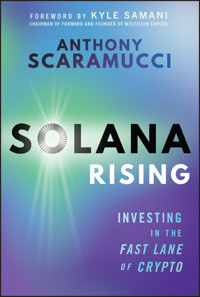
Discover the next huge opportunity in the cryptocurrency space: the Solana blockchain
In Solana Rising, founder and co-managing partner of SkyBridge Capital, Anthony Scaramucci, delivers an exciting and authoritative account of one of the true generational trades available in today’s market: the Solana blockchain. Representing digital liquidity, Solana offers its users the ability to tokenize and liquidize illiquid assets.
Perfect for intermediate-level crypto investors who are comfortable owning Bitcoin – and are now ready to take the next step into the world of Solana – the book explains how this blockchain works, why it’s so transformative, and how it accomplishes what it does.
Readers will also find:
- Discussions of the investors and players currently betting big on Solana
- A step-by-step guide to getting started with Solana and the role it should play in a crypto portfolio
- Advice for spotting new and emerging trends in cryptocurrency
Most of us missed the bulk, or even the entirety of, Bitcoin’s march from $0.01 to $100,000. Solana Rising is your opportunity to get in near the ground floor of a technology with even more potential.
Sie lesen das E-Book in den Legimi-Apps auf:
Seitenzahl: 273
Veröffentlichungsjahr: 2025
Ähnliche
















Table of Contents
Cover
Table of Contents
Title Page
Copyright
Foreword
Preface
Chapter 1: The Crypto Meteor
Chapter 2: Ethereum Killers
Chapter 3: Decentralized Nasdaq
Chapter 4: The Call
Chapter 5: The Summer of Solana—Go Ape!
Chapter 6: The Tweet Heard Around the World
Chapter 7: Tokenization: The Next Frontier
Chapter 8: The Meme King
Chapter 9: Shining a Light on Solana: How to Buy, Borrow, and Build
Helium: The Internet That's Yours
Hivemapper: Mapping the World, One Drive at a Time
BlackRock BUIDL on Solana
Chapter 10: You Can't à La Carte the Trump Buffet
Chapter 11: The Meme King Reacts
Chapter 12: Melania Meme
Chapter 13: Only in America
Chapter 14: The Future
Acknowledgments
About the Author
Index
End User License Agreement
Guide
Cover
Table of Contents
Title Page
Copyright
Foreword
Preface
Begin Reading
Acknowledgments
About the Author
Index
End User License Agreement
Pages
i
ii
v
vi
vii
viii
ix
x
xi
xii
1
2
3
4
5
6
7
8
9
10
11
12
13
14
15
16
17
19
20
21
22
23
24
25
26
27
28
29
30
31
32
33
34
35
36
37
38
39
40
41
42
43
45
46
47
48
49
50
51
52
53
54
55
56
57
58
59
60
61
62
63
64
65
66
67
68
69
70
71
72
73
74
75
76
77
78
79
80
81
82
83
84
85
86
87
88
89
90
91
92
93
94
95
96
97
98
99
101
102
103
104
105
106
107
108
109
110
111
112
113
114
115
116
117
118
119
120
121
122
123
125
126
127
128
129
130
131
132
133
134
135
136
137
138
139
140
141
142
143
144
145
146
147
148
149
151
152
153
154
155
156
157
159
160
161
162
163
164
165
ANTHONY SCARAMUCCI
SOLANA RISING
INVESTING IN THE FAST LANE OF CRYPTO
Copyright © 2026 by Anthony Scaramucci. All rights reserved.
Published by John Wiley & Sons, Inc., Hoboken, New Jersey.Published simultaneously in Canada.
No part of this publication may be reproduced, stored in a retrieval system, or transmitted in any form or by any means, electronic, mechanical, photocopying, recording, scanning, or otherwise, except as permitted under Section 107 or 108 of the 1976 United States Copyright Act, without either the prior written permission of the Publisher, or authorization through payment of the appropriate per‐copy fee to the Copyright Clearance Center, Inc., 222 Rosewood Drive, Danvers, MA 01923, (978) 750‐8400, fax (978) 750‐4470, or on the web at www.copyright.com. Requests to the Publisher for permission should be addressed to the Permissions Department, John Wiley & Sons, Inc., 111 River Street, Hoboken, NJ 07030, (201) 748‐6011, fax (201) 748‐6008, or online at http://www.wiley.com/go/permission.
The manufacturer's authorized representative according to the EU General Product Safety Regulation is Wiley‐VCH GmbH, Boschstr. 12, 69469 Weinheim, Germany, e‐mail: [email protected].
Trademarks: Wiley and the Wiley logo are trademarks or registered trademarks of John Wiley & Sons, Inc. and/or its affiliates in the United States and other countries and may not be used without written permission. All other trademarks are the property of their respective owners. John Wiley & Sons, Inc. is not associated with any product or vendor mentioned in this book.
Limit of Liability/Disclaimer of Warranty: While the publisher and the authors have used their best efforts in preparing this work, including a review of the content of the work, neither the publisher nor the authors make any representations or warranties with respect to the accuracy or completeness of the contents of this work and specifically disclaim all warranties, including without limitation any implied warranties of merchantability or fitness for a particular purpose. Certain AI systems have been used in the creation of this work. No warranty may be created or extended by sales representatives, written sales materials or promotional statements for this work. The fact that an organization, website, or product is referred to in this work as a citation and/or potential source of further information does not mean that the publisher and authors endorse the information or services the organization, website, or product may provide or recommendations it may make. This work is sold with the understanding that the publisher is not engaged in rendering professional services. The advice and strategies contained herein may not be suitable for your situation. You should consult with a specialist where appropriate. Further, readers should be aware that websites listed in this work may have changed or disappeared between when this work was written and when it is read. Neither the publisher nor authors shall be liable for any loss of profit or any other commercial damages, including but not limited to special, incidental, consequential, or other damages.
For general information on our other products and services or for technical support, please contact our Customer Care Department within the United States at (800) 762‐2974, outside the United States at (317) 572‐3993 or fax (317) 572‐4002.
Wiley also publishes its books in a variety of electronic formats. Some content that appears in print may not be available in electronic formats. For more information about Wiley products, visit our web site at www.wiley.com.
Library of Congress Cataloging‐in‐Publication Data is Available:
ISBN 9781394358595 (Cloth)ISBN 9781394358601 (ePub)ISBN 9781394358618 (ePDF)
COVER DESIGN: PAUL MCCARTHY
Forewordby Kyle Samani, Founder of Multicoin Capital
I was the first and largest investor in Solana, and I have been working closely with founders Anatoly Yakovenko and Raj Gokal since the earliest days. We lived through the highest of highs, like Summer of Solana, and the lowest of lows, including the collapse of FTX, something we now look back on as trauma bonding.
I have had the opportunity to speak with almost every L1 and L2 founder in crypto in the last ~10 years, so when I first met Anatoly and Raj, I knew they were different.
First, Anatoly was not an academic; instead, he drew on his experiences building high‐performance systems at companies like Qualcomm and Dropbox. Virtually all the other L1 founders of the 2018 era proudly showcased their academic credentials. Anatoly was the opposite. I found that refreshing.
Second, Anatoly made it clear that he did not want to innovate technically. Earlier in his career, he had tried to solve unsolved computer science problems and failed. He promised himself he'd never do that again and, after a period of time, vowed to focus only on using established techniques to boost system performance and outcome.
Third, Anatoly had a clear vision from the start. He wanted Solana to power a decentralized version of the Nasdaq, the stock market that revolutionized trading with electronic systems. His goal was a global platform for capital markets, open to everyone, everywhere, with instant, real‐time data. This would free investors from the restrictive, centralized, traditional finance exchanges of the past.
This approach was bold and unique; none of Anatoly's peers had such a clear focus. While others aimed to scale blockchains without pinpointing specific goals, Anatoly zeroed in on a concrete problem. Frustrated by the slow, laggy data from Interactive Brokers, he set out to build Solana as a system that delivers instant, permissionless access to real‐time market data for anyone, anywhere in the world.
Fourth, Anatoly and Raj prioritized enabling developers on Solana to generate revenue. This seems straightforward, but in 2018, when crypto was fixated on pure decentralization, their practical focus was unique. I found their commitment to creating tangible earning opportunities for developers both refreshing and visionary.
Ultimately, Solana's success hinged on these distinct qualities. It was a classic startup: scrappy, innovative, and lean. Anatoly and Raj worked to define the minimum viable product—the simplest version of Solana that could deliver real value—and focused on finding product‐market fit, meaning uses that people actually needed. While many crypto projects lost sight of the focus required for startups to thrive, Anatoly and Raj embedded these principles into Solana's core from the very beginning.
I've been working with Anatoly and Raj for more than seven years. They have become fabulously wealthy, but they still continue to fight every day. They still get their hands dirty, working with developers, testing applications, and cultivating the Solana ecosystem. And they've hired and built a stellar global organization, too.
The rest of this book will provide a detailed history of Solana and the people and companies that made its success possible. But before you read on, I'd like to share my thoughts for the future of crypto, and Solana's role in it.
Crypto systems have many unique properties, but the most important is that they enable people to self‐custody financial assets. As eloquently articulated by Yuval Noah Harari in Sapiens, financial assets do not exist in the realm of physics; they exist only in the realm of human fiction. Up until the advent of crypto, the fiction was rooted in government trust (either in the form of fiat or in the form of securities laws). Crypto enables humanity to have a global shared fiction that is rooted not in a government but in physics.
Crypto, at its core, is about freedom. It's about owning your money in a way that's never been possible before. Forget banks or governments holding your assets hostage. Solana lets you self‐custody your wealth, take it anywhere, and do whatever you want with it. Gift it, trade it, and use it as collateral, anytime, anywhere with no middleman or borders.
Solana's built to move value at lightning‐fast speed, whether you're buying coffee or trading billions in assets. It's collapsing commerce and Wall Street into one global, permissionless system. This has profound implications for global capital flows, access to financial markets, and commerce around the world. Crypto is strictly necessary for capitalism to permeate every last corner of the planet.
On the surface, crypto might seem like a casino, but don't be fooled by the wild prices swing, Meme activity, and at times chaotic vibe. Crypto, and Solana in particular, is shaking up the core rules of how money and society work. Crypto tackles hidden flaws in the traditional financial system that most people, especially in the United States, rarely notice. Yet those flaws hit hard in critical moments, especially when it's your money on the line.
Solana's mission is to power global Internet capital markets, making financial opportunities accessible to everyone, everywhere. When money can move instantly and freely across the Internet, it creates a new kind of market, one that's already taking shape. Today, billions of dollars flow through Solana's blockchain daily, and with new laws like the GENIUS and CLARITY acts, I'm confident we'll see that soar to trillions per day in the coming years.
Money is nothing, and simultaneously everything. Soon everyone in the world will have access to global money on Solana.
Preface
When I was kid, I used to watch Star Trek and call BS on Photon Phaser. No way! Would never happen. Teleportation? Yeah right. Flying cars? Still waiting. The future depicted in 1960s science fiction felt like a distant mirage, a realm of fantastical technologies. In 2001: A Space Odyssey, I saw talking telephones and HAL 9000, a computer with a voice and a mind of its own. These visions of tomorrow seemed impossibly far off, but a curious thing happened on the way to the future. Many of those things came true. FaceTime, which would've been unthinkable just decades ago, is now part of our daily lives. In fact, much of what was considered fantasy is now fact. We are living in the future of our past, standing on the cusp of a reality that would rival those depicted in cinematic fantasies. The Photon isn't here, for now at least, but other technologies are changing the world in which we live and work. And one of the most transformative technologies changing the face of money and commerce is the blockchain.
Blockchain technology is the foundation of a new economic paradigm. Period. Full stop. Bitcoin, the pioneer, was a quantum leap forward. It introduced the idea of a decentralized payment network that digitized value and created the equivalent of digital gold. For the first time, anyone, anywhere, could transfer value across the globe in a frictionless, instantaneous fashion, free of intermediaries. This was a paradigm shift for money itself, endowing individuals with financial sovereignty. No government. No banks. Just put pure blockchain. Following Bitcoin's trailblazing path, Ethereum took the revolution further. It introduced programmable money through smart contracts, enabling anyone to build businesses atop a decentralized, open‐source network. Ethereum transformed the blockchain into a platform for creating economies, fostering innovation, and empowering entrepreneurs worldwide. It was a second seismic shift, proving that blockchain technology could extend beyond simple payments and stores of value to redefine how we structure and scale commerce. Simply put, if Bitcoin represents the early Internet, functional but limited, then Ethereum represents the companies built on top of it, the Amazons and Netflixes of the world.
Now, a new chapter is unfolding with Solana, a blockchain so revolutionary it is unlocking possibilities once deemed unimaginable. Solana is the iPhone of blockchains. It's scalable, fast, and cheap, and its technology is redefining what a blockchain can achieve. Solana is a foundation for building companies that are reshaping commerce. Solana enables the creation of entirely new businesses and networks, transforming how we trade, invest, and interact with assets. From art to real estate to intellectual property and to financial instruments, Solana is digitizing and liquefying assets of all kinds, making them accessible, tradable, and dynamic in ways previously thought impossible. Solana is driving a new economy, one where decentralized networks empower individuals and businesses to innovate without the constraints of traditional systems.
Its blockchain is the promise of tomorrow. It is the real example of science‐fiction fantasies. And to me, it represented a generational investment opportunity.
I wrote this book, my second on crypto, to tell the story of the visionaries who built Solana and continue to push its boundaries. These are the stories of the people who saw the potential of the blockchain to change lives, democratize wealth, and create systems that are fairer, more transparent, and more accessible. They are builders of a virtual future on which the economies of tomorrow will rest. They are building global opportunities.
Bitcoin was a once‐in‐a‐generation trade, the investment equivalent of Halley's Comet. It transformed my firm, positioning us as forward‐thinking asset managers and ambassadors to a new financial world. When I first bought Bitcoin, I believed it was a singular moment, a generational investment that would go on to define my career. After all, how could one reasonably expect to repeat such a great trade? Then came Solana. It has offered me and my firm a second chance at a once‐in‐a‐lifetime opportunity. Solana combines the best of both Bitcoin and Ethereum, and our involvement has cemented SkyBridge's place at the forefront of innovation, ensuring we remain leaders in a rapidly evolving landscape.
This book is an invitation to you, the reader, to understand and seize this moment, too. After reading it, you will understand how Solana is reshaping how we live, work, and interact. The stories within these pages illuminate the path forward, showing how Solana is enabling entrepreneurs, creators, and investors to build a future that is decentralized, inclusive, and dynamic. You will learn how to own it, use it, and build on it. You will understand why it was able to overcome numerous near‐death experiences and why its journey is just beginning. You will learn the story of its founders and its early investors and the numerous challenges they overcame to create this incredible network. Most of all, you'll have a front row seat to a classic David versus Goliath tale.
We may not have flying cars, and teleportation seems a bit off, but the blockchain has brought to focus a future far more advanced than we ever could have imagined. The possibilities are endless. The technology is limitless. I was fortunate to ride the Bitcoin wave, and now, with Solana, I see a second chance to shape the future. After reading this book, I hope you, too, will recognize the opportunity. And seize it.
Chapter 1The Crypto Meteor
Sam Bankman‐Fried (SBF) leaned forward, his voice cutting through the hum of the penthouse dining room.
“What went down that day when the mobile brokers, Robinhood, the whole lot, yanked the plug on retail trading for those tickers?”
The dinner table went quiet, the kind of quiet that makes you notice the small sounds. SBF's knee was going to town under the table, a constant thump‐thump‐thump that sounded like an animal trying to free itself from a cage. His eyes, half‐hidden behind a mop of hair that looked like it had never met a comb, darted around the room, up, down, sideways, never quite landing on anyone for more than a split second. You could feel the skyline glittering through the windows of the 56th floor at Hudson Yards, but SBF's twitchy gaze was the real spectacle.
“Like, why did they freeze it?”
He didn't wait for an answer. In the same breath, he launched into the GameStop saga, when an army of retail traders, armed with Reddit threads and margin accounts, took on the Wall Street machine. It wasn't just a story; it was a new line drawn in the foundation of finance, a glimpse of a world where the little guy could take on and beat the establishment at its game, and SBF was narrating the opening salvo.
It was September 2021, and the occasion was the dinner following the SkyBridge SALT Conference, my firm's annual gathering that, in years past, had been held at the Bellagio in Las Vegas. SALT was a magnet for the cultural elite, the kind of event where you might spot a hedge fund titan swapping stories with a celebrity or a sitting senator. COVID had sidelined it in 2020, but now it was back and relocated to the heart of Manhattan, the nation's ground zero for COVID. The city was clawing its way out of the pandemic, and SALT's return felt like a victory lap. This dinner, held in a $50 million penthouse, was the culmination of that comeback, taking place in a room full of investors, visionaries, and one frenetic 29‐year‐old crypto wunderkind who seemed to vibrate at his own frequency.
The question hung in the air, unanswered.
“Why did they freeze it?”
SBF's knee kept pounding, and the silence stretched, but you could tell he already knew the answer, or at least thought he did. In his world, the old rules were crumbling, and he was ready to build something new on the rubble.
Tonight's dinner was different from previous ones. It was a collision of worlds, a moment when the old titans of Wall Street rubbed shoulders with the next generation of financial leaders. The past was crashing into the future. SkyBridge, the firm I'd built from the ground up in 2005, had always been a place for big ideas, but this? This was bold. It was our debut conference as a Bitcoin and crypto player, a pivot we'd announced earlier in 2020, and we were hosting the first major financial conference in New York since the pandemic had turned the world upside down. The stakes felt higher, the room felt stranger, and the possibilities felt bigger.
The usual suspects were there, hedge fund royalty and asset allocators who'd spent decades inventing and mastering new markets. But this time, they weren't the only ones commanding attention. The crypto crowd had arrived, and they didn't look or talk like anyone else in the room. Steve Cohen, the hedge fund legend whose S.A.C. Capital had rewritten the rules of the game, sat there, motionless, with a bemused smile on his face, his usual swagger replaced by something closer to awe. Dan Loeb, the sharp‐tongued maestro of Third Point, who could pen a lacerating letter to a CEO in the morning and then quote Kafka over vegan sushi by lunch, was uncharacteristically quiet, his jaw practically on the floor as he watched a kid in baggy shorts and a wrinkled T‐shirt, knees bouncing like he'd had one too many Red Bulls, explain a trillion‐dollar idea with the casual confidence of a professional magician.
But unlike years past, these Wall Street titans were joined by a new crop of investors eager to snatch the unofficial crown of Wall Street's new Masters of the Universe. Pantera's Dan Morehead, a grizzled Wall Street trader turned crypto king, held court in one corner. And then there were Anatoly Yakovenko and Raj Gokal, the brains behind Solana Labs, who'd later tip me off to the second‐best investment I'd ever make. The new breed wasn't the polished pitchmen of traditional finance, but they surely did have a story to tell. The old guard were traders with catlike reflexes and a gift for spotting and quickly devouring fleeting glimpses of value. The new guys were builders, dreamers, and people who spoke in code and saw the world not as it was but for what it could be.
And then there was SBF, the disheveled prodigy of the moment. “Look, you'll find all sorts of GameStop conspiracy theories online,” he said, softly looking up at the ceiling as if to signal the ridiculousness of it all. “None of 'em make sense. What happened shows why crypto works.” The room leaned in, eager to be let in on the secret, not so much about the Meme stock crash day, about which they knew plenty, but about something much, much bigger. It was the future, messy and raw, taking shape right before their eyes.
SBF had the most unusual and jarring way of communicating, a kind of tangle of cascading contradictions. He could unravel the most arcane financial concepts with the clarity of an MIT professor, but the words tumbled out in a chaotic stream of Valley Girl–like “ums,” “likes,” and nervous giggles punctuated by a jittery knee that seemed to have its own agenda. The effect was disorienting, like watching a master chef whip up a gourmet dish using nothing but a jar of Heinz ketchup and Ritz crackers. And yet, somehow, it worked, brilliantly.
For the next hour, SBF, as the world knew him, held the room in a trance. The press had slapped a bunch of grandiose and lazy labels on him. “Warren Buffett of Bitcoin,” “J.P. Morgan of Crypto,” but I never paid much attention to those monikers. The easy analogies sold his brilliance short. Still, when he spoke, you listened, because he wasn't just explaining crypto; he was revealing the future. And his future did not include the creaky, clunky machinery of stock trading, a system most people assumed was as solid as rock.
“Think about it,” he said, his tone half‐lecture, half‐stand‐up routine. “You go on your phone, buy a share of Amazon, and you're like, ‘Cool, I own it’. Except it takes two friggin' days to actually get it. And in those two days, that share passes through, what, 10 different companies? Ten!” He paused, letting the number hang in the air like some sort of insult. “You don't think about that when you're on Robinhood or E*TRADE, right? You see the little stock icon on your screen, and you're like, ‘Yup, that's mine’. But those companies? They're just a forward‐facing brokers. They're not the exchange, not the clearinghouse, not the market maker.”
The room was dead silent, forks frozen mid‐bite, iPhones untouched. SBF's knee kept bouncing, a constant drum of nervous energy. “So, for like 48 hours, you think you own that share. Your account says you do. But really, you're just hoping those 10 companies don't screw it up. You're trusting that none of them goes, ‘Whoops, sorry, we lost your share, good luck!’” He flashed a sheepish grin. “That's the dirty secret of the stock market. It's like that trust fall game you play at camp,” referencing the game where you back backward into the arms of a campmate, “but just with a dozen strangers.”
He barreled on, his cadence picking up steam, his eyes now darting like they were chasing his own thoughts. “Now, let's say that share of Amazon jumps a hundred bucks the first day. You're up 100, right? Except you're not, because the trade is not settled yet. If one of those 10 players fumbles, poof! Your profit is gone. And every one of those companies knows this, so they've got to keep a giant pile of cash, what they call ‘regulatory capital’, just in case someone drops the ball. It's like everyone's hedging against everyone else's incompetence.”
By now, his knee was practically a blur, as if it were acting out the frantic handoffs of a stock settlement, broker to clearinghouse to transfer agent, each step a potential fumble. The audience was riveted, not because SBF was polished (he was not) but because he'd taken something as mundane as buying a stock and turned it into a high‐stakes game of financial Russian roulette. In his telling, the stock market wasn't a bedrock of capitalism. It was like some rickety Jenga tower, one bad pull from collapse. And crypto? That was the fix, the sleek new system that could do in seconds what Wall Street took days to fumble through. He didn't need to say it outright. The room got the message. The future was here, and it was wearing cargo shorts. The Wall Street titans, the ones who could dissect a balance sheet in their sleep, sat there, in a state of quiet wonder, like they'd just been told a carnival barker rigged the market. It was like finding out your bulletproof vest was made of Kleenex.
SBF was just getting started, and now he was really going to rock their world. “On that day,” he continued, his voice a bit more focused, “those retail kids made so much money, they burned through the capital reserves of the weakest links in the clearing chain. Poof! Firms froze. Trades halted. Liquidations started. Why? Because if those traders kept winning, the system might not deliver. Your profits? Gone. Your account? Zeroed out. That's not a market. That's a shit show.”
He paused, letting the room stew in its own discomfort. These were the masters of the universe, guys who'd shorted the housing market, dodged the '08 crash, and still had their Hamptons estates. And here was this kid, in baggy shorts, telling them their world was a house of cards.
“But you know what didn't break that day?” SBF said, his voice rising, eyes glinting like he was going to let them in on a little secret. “While the stock market was choking on GameStop, while clearinghouses were hitting the panic button, you know what kept trading, no hiccups, no freezes, just pure, chaotic volume?” He stretched the word out, “Dogggeeee‐coin,” like he was savoring the absurdity.
The room laughed, nervous and disbelieving. Dogecoin? The crypto joke with a Shiba Inu mascot, dreamed up by two coders in 2013 to mock the Bitcoin hype? The coin Elon Musk had turned into a cultural relic by tweeting about it in the middle of the night? That Dogecoin? “Yeah,” SBF said, grinning. “That thing settled just fine. Instant trades, no middleman, no meltdown. Blockchain.”
The point landed like a gut punch. Wall Street's plumbing—its clearinghouses, its settlement systems—was creaking under pressure. Meanwhile, a cartoon dog coin, built on tech most of these guys had never heard of, was humming along. SBF's message was clear; the old world of equities was a dinosaur, and crypto, with its blockchains, was the meteor. Instant settlement. No counterparty risk. A system that didn't need a suit in a corner office to function.
Now, SBF was no saint. A year later, his empire, FTX, would implode in a spectacular mess of hubris, bad accounting, and missing billions. I'd later learn that the hard way, with my own firm caught in the fallout and my reputation collateral damage. But that night, in front of a room full of Wall Street's elite, SBF was a prophet. He saw the matrix of crypto—its tech, its promise, its flaws—clearer than anyone. And he wasn't just selling a dream; he was explaining a revolution.
Fortunately, it was a revolution my firm and I joined a year earlier. In December 2020, I made the call to pivot SkyBridge, my fund of funds shop, from Wall Street asset manager to crypto firm. We'd been pioneers, pooling smaller sums of money to give investors access to the best and brightest hedge funds in the world, Ray Dalio's Bridgewater and David Tepper's Appaloosa. But by 2020, that game was crowded. Copycats were everywhere. The edge was gone. Crypto, though? That was the new frontier. Bitcoin wasn't just digital gold; it was digital value. Portable, incorruptible, immune to the Fed's money‐printing binge. Blockchain wasn't a buzzword; it was a paradigm shift.
The Street wasn't ready. Warren Buffett called Bitcoin “rat poison squared.” Jamie Dimon sneered it was a “pet rock.” They weren't wrong about the risks. Those early days were rife with hacks, scams, and crashes that could make a grown trader cry. But the naysayers missed the bigger picture. Since 2008, central banks had been flooding the world with cash, devaluing every dollar in your wallet. The Fed wasn't just a policy wonk's problem anymore; it was a Main Street issue. People felt the squeeze, with groceries pricier and wages flat. Occupy Wall Street, the Tea Party, the rage at “the system”? That was the spark. Bitcoin was the resulting fire.
When COVID hit and the Fed pulled out the same crisis playbook, money printers went into overdrive, and the case for crypto went from compelling to screaming. My firm's bet on Bitcoin didn't just pay off; it obliterated the market. We weren't just ahead of the curve; we were drawing a new one. SkyBridge became a literal bridge to this wild, lucrative world, guiding traditional investors through the crypto jungle. We were more than just investors; we were ambassadors. And at the conclusion of every SALT, we hosted a small dinner with our top clients, only now, many of those were from the world of the coin.
That night, as SBF held court, one skeptic piped up. “Okay, Sam, outside of Bitcoin. But what's the next big thing in crypto?”
SBF didn't blink. “Solana,” he said. “The winner will be the fastest, cheapest system you can trust. That's the winner. That's Solana.”
Solana. The name hit like a sunbeam. If Bitcoin was Apple in 2007, Solana was Nvidia in 2012—raw, unpolished, brimming with potential. Solana wasn't just a coin; it was a network, a platform for apps, NFTs, DeFi, all moving at light speed. For SkyBridge, it was our next moonshot.
The story of Solana, and the brilliant people who built it, is the story of a generational trade. It's not just about tech or money; it's about rewriting the rules of finance. In the pages ahead, you'll meet the visionaries, the coders, and the colorful characters who made it all happen. You'll see why Solana is not just a bet; it's a glimpse of the future. And you'll learn how to use and invest in ways you never thought possible.
Hang tight. I'm going to take you on the ride of your life.




