


Erhalten Sie Zugang zu diesem und mehr als 300000 Büchern ab EUR 5,99 monatlich.
- Herausgeber: The History Press
- Kategorie: Geisteswissenschaft
- Sprache: Englisch
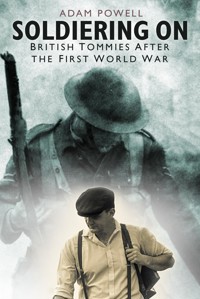
A month after the Armistice, Prime Minister David Lloyd George promised to make Britain a 'land fit for heroes'. At the time, it was widely believed. Returning soldiers expected decent treatment and recognition for what they had done, yet the fi ne words of 1918 were not matched by actions. The following years saw little change, as a lack of political will watered down any reform. Beggars in trench coats became a common sight in British cities. Soldiering On examines how the Lost Generation adjusted to civilian life; how they coped with physical and mental disabilities and struggled to find jobs or even communicate with their family. This is the story of men who survived the trenches only to be ignored when they came home. Using first-hand accounts, Adam Powell traces the lives of veterans from the first day of peace to the start of the Second World War, looking at the many injustices ex-servicemen bore, while celebrating the heroism they showed in the face of a world too quick to forget.
Sie lesen das E-Book in den Legimi-Apps auf:
Seitenzahl: 461
Veröffentlichungsjahr: 2019
Das E-Book (TTS) können Sie hören im Abo „Legimi Premium” in Legimi-Apps auf:
Ähnliche




















I dedicate this book to my late father Corporal Roy Powell, who served in the Second World War, and to Carmen and Francesca Powell for their love, support and patience.
First published 2019
The History Press
97 St George’s Place, Cheltenham,
Gloucestershire, GL50 3QB
www.thehistorypress.co.uk
© Adam Powell, 2019
The right of Adam Powell to be identified as the Author of this work has been asserted in accordance with the Copyright, Designs and Patents Act 1988.
All rights reserved. No part of this book may be reprinted or reproduced or utilised in any form or by any electronic, mechanical or other means, now known or hereafter invented, including photocopying and recording, or in any information storage or retrieval system, without the permission in writing from the Publishers.
British Library Cataloguing in Publication Data.
A catalogue record for this book is available from the British Library.
ISBN 978 0 7509 9272 5
Typesetting and origination by The History Press
Printed and bound in Great Britain by TJ International Ltd
eBook converted by Geethik Technologies
CONTENTS
Prologue
Introduction: ‘Gentlemen’ and ‘Players’: Britain on the Eve of War
PART I: COMING HOME
1 ‘The Deafening Silence’: The Armistice at the Front
2 ‘A Bit of Shouting’: The Armistice in Britain
3 ‘We Want Our Civvie Suits’: Demobilisation
4 Arrivals
PART II: UNFINISHED BUSINESS
5 ‘Out of Ireland’
6 The Russian Expedition
7 The Swollen Empire
8 ‘The Watch at the Rhine’: The Occupation of the Rhineland
PART III: ADJUSTMENTS
9 ‘The Chasm’: Coping with Civilian Life
10 ‘You Had a Good Job When You Left’: Veterans’ Employment
11 Sex, Morality and Marriage
12 Disabled Veterans
13 ‘The Cruelly Injured Mind’: Shell Shock
14 Pensions
15 ‘Homes for Heroes’: Veterans’ Housing
16 Back to the Land: Resettling Ex-Servicemen
17 ‘Silence and Thistles’: Returning to the Western Front
PART IV: LEGACIES
18 Radicals and Reactionaries: The Politics of the Soldiers
19 Speaking Up: Veterans’ Organisations After the War
20 Artists’ Rifles: The War and Culture
21 The Political Scene
22 To End All Wars: The Search for Peace
23 ‘Lest We Forget’: Reflections of Ex-Servicemen
Notes
Bibliography
PROLOGUE
The Grand Theatre, Wolverhampton, 23 November 1918. David Lloyd George, the prime minister, announced an election would be held only a month after the Armistice. He hoped for a thumping majority as the ‘man who won the war’. Lloyd George told the audience:
What is our task? To make Britain a fit country for heroes to live in. I am not using the word ‘heroes’ in any spirit of boastfulness, but in the spirit of humble recognition of fact. I cannot think what these men have gone through. I have been there at the door of the furnace and witnessed it, but that is not being in it, and I saw them march into the furnace. There are millions of men who will come back. Let us make this a land fit for such men to live in. There is no time to lose. I want us to take advantage of this new spirit. Don’t let us waste this victory merely in ringing joybells. Let us make victory the motive power to link the old land up in such measure that it will be nearer the sunshine than ever before, and that at any rate it will lift those who have been living in the dark places to a plateau where they will get the rays of the sun. We cannot undertake that without a new parliament ... We have seen places we have never noticed before, and we mean to put these things right.1
‘A fit country for heroes to live in’ soon became ‘a land fit for heroes’ in popular parlance. It has since descended into a cliché but was widely believed at the time. Soldiers expected decent treatment and recognition for what they had done – for they had marched into the furnace. Yet the fine words of 1918 were not matched by actions. The interwar years saw some improvements in the treatment of veterans but these were tepid reforms, hampered by inadequate funding and a lack of political will. The sight of soldiers begging in the street became commonplace in many British cities. Veterans were disproportionately unemployed; the disabled and shell-shocked often badly neglected.
Soldiering On examines how and why this happened. Books about soldiers in the aftermath of the First World War have tended to focus on one particular aspect of the ex-servicemen’s struggles, shell shock being a recent and fertile field; or they have looked at the politics of the period as a whole, with the veteran being relegated to little more than a footnote. There’s a need to look at the range of experiences returning soldiers went through in a single volume.
Soldiering On deals primarily with British Army veterans from 1918 to the eve of the Second World War, but also compares how other belligerent nations treated their ex-servicemen. The precarious state of Britain’s economy meant reconstruction plans were never properly implemented but other countries faced similar difficulties and managed rather better. The failure to support veterans adequately was a political choice as well as a financial challenge. True, ex-servicemen were treated better than in the Edwardian era, but that is not saying much. Unlike other European nations, the British Government had always relied on volunteers. A conscripted army meant young men across the social spectrum experienced some form of military service, but Britain recruited from a narrow base: the officers were upper-middle and upper-class products of the public school system; the men were from the lowest rungs of society. The Duke of Wellington said during the Napoleonic Wars, the ‘French system of conscription brings together a fair sample of all classes; ours is composed of the scum of the earth’.2 Little changed in the next 100 years. Ex-officers were sufficiently wealthy to look after themselves. Rankers were not expected to do anything except re-enlist until their health packed in, and then charity or the workhouse were the most likely destinations. They had no statutory right to a pension, regardless of how many years they’d served.
It was not until 1916 that the British Government introduced conscription. Britain now had an army comparable to other European nations but without the experience or institutions to reintegrate large numbers back into civilian life. There was another problem: the pre-war attitudes that had tolerated ex-servicemen begging on the street never fully disappeared. Rudyard Kipling summed up the public’s view of the ordinary soldier in his poem ‘Tommy’ (1890):
O it’s Tommy this, an’ Tommy that, an’ ‘Tommy, go away’;
But it’s ‘Thank you, Mister Atkins’, when the band begins to play.
Soldiers were necessary for fighting in remote parts of the Empire but in peacetime a pest, especially after a few drinks on a Saturday night. General Robertson, Chief of the Imperial General Staff, had joined the army as a private in 1877. His mother told him, ‘I would rather bury you than see you in a red coat.’3 But in the First World War, ordinary soldiers had come from all walks of life. Kitchener’s original volunteers were disproportionately middle class, improving the reputation of the average soldier among the public but not by enough for meaningful political reforms. The large amounts of money military charities raised after the war showed a degree of sympathy for the veteran, yet soldiers often found it difficult to obtain work, particularly in the old industrial heartlands. The disabled and shell-shocked often had to eke out an existence on inadequate pensions. British political attitudes during these years limited any changes that might have benefited ex-servicemen. All the main parties rhetorically committed to helping veterans but none were prepared to do much in practice. Nor was the main ex-servicemen’s organisation, the British Legion, able, and sometimes even willing, to force concessions from governments more concerned with balancing budgets.
But the interwar years were not always negative for veterans. Most managed to find employment, did not suffer from shell shock or beg on street corners. This isn’t minimising the traumatic effects of the war on many ex-servicemen but acknowledging that others went on to lead fulfilling lives. It is wrong to generalise about the 5 million British servicemen who survived the war; instead, one should look for discernible trends, while being aware that there were always exceptions. Just as experiences differed so did attitudes. Some hated their time in the army, while others regarded it as a worthwhile experience. Some grew disillusioned with the peace, particularly as Europe slid towards another war in the 1930s. But from letters, testimonies and interviews, most veterans remained proud of having fought in a war they regarded as just.
Finally, it is worth noting that the British Army was a truly multinational force taking in troops from across her huge empire. The men from the dominions of Canada, New Zealand, South Africa and Australia have received considerable attention – and their contribution was enormous. However, other men fighting in British uniforms – African, Caribbean, Asian and Irish – have often been ignored. This book helps redress this by showing how they were also profoundly affected by the First World War.
Introduction
‘GENTLEMEN’ AND ‘PLAYERS’: BRITAIN ON THE EVE OF WAR
‘The lost golden age … all the more radiant because it is on the other side of the huge black pit of war.’
J. B. Priestley1
The farthings and sovereigns,
And dark-clothed children at play
Called after kings and queens,
The tin advertisements
For cocoa and twist, and the pubs
Wide open all day
‘MCMXIV’, Philip Larkin2
When Queen Victoria died in 1901, Britain had the largest empire the world had ever seen. It had pioneered the Industrial Revolution. London was the centre of finance, sterling the world currency. Yet there was a sense that a golden age was ending. The Economist wrote of ‘a perceptible note of apprehension in the public mind.’3 There was an ambiguity about whether to embrace change or stick with what had served Britain so well.
International exhibitions are the face a nation wants to present to the world. The Paris Exposition Universelle in 1900, which finished two months before Queen Victoria’s death, was a consciously modern affair, introducing the escalator, the diesel engine and talking films to the public. But the British delegation constructed a mock-Jacobean manor house.4 Its designer, Edwin Lutyens, was a brilliant purveyor of nostalgia who would later play a major role in shaping First World War memorials. The stained glass was by William Morris, the tapestries by Edward Burnes-Jones, both members of a group that raged against the machine. At the start of a new century, the world’s first industrial nation chose to celebrate the age before steam.
Contrast this to the Great Exhibition of 1851 where the Crystal Palace in Hyde Park astounded foreign visitors with its daring. But if the mid-nineteenth century was an era of confident progress, Edwardian Britain was dogged by uncertainty. Britain was losing the economic race to Germany and the United States. The British economy was slow in diversifying during the Second Industrial Revolution (1870–1914) when technological developments boosted the chemical, electricity, petroleum and steel industries. Its manufacturing base was still reliant on old staples like textiles, coal and shipbuilding but even these were suffering from a lack of investment. A dangerous dependence on Germany for many imports was exposed during the war. The Times argued that, ‘Others have learned our lessons and bettered our instructions while we have been too easily content to rely upon the methods which were effective a generation or two ago’.5
The Boer War (1899–1902) revealed Britain’s military deficiencies and her unpopularity. ‘As a nation we are not greatly loved by the world at large,’ The Economist admitted.6 Lord Salisbury1 used the phrase ‘splendid isolation’ to describe Britain’s policy of staying out of European affairs, but being isolated was no longer an option. Nations were making alliances and rearming at an alarming pace and Britain wasn’t strong enough to stand alone. After some hesitation it allied with France, her traditional enemy, and Russia, the nation she had most feared only a few years before. This marriage of convenience was brought about by a mutual dislike of Germany. Unified in 1871, the German Reich had industrialised rapidly while building the best army in Europe. Now she looked for opportunities overseas. In an era where colonies defined a nation’s power, Germany wanted its ‘place in the sun’ but Britain and France had taken the lion’s share. Germany resented any lectures about aggression from the two nations that had conquered so much of the world; however, her decision to build a large navy was bound to alienate Britain. After all, Germany’s army was supreme, so why did it need a large navy? It was obviously aimed at Britain, the leading maritime power whose empire depended on her naval dominance. Relations with Germany grew frosty, exacerbated by the new Emperor, Kaiser Wilhelm II, an unstable man who, despite being part British,2 developed a loathing for his mother’s country. It was heartily reciprocated.
Britain was a deeply stratified society before the war, but many were starting to question their place in it. Militant trade unions were flexing their muscles – over 40 million days of work were lost through industrial action in 1912.7 Some wanted to improve pay and conditions, others hoped to bring down capitalism through strikes. Suffragettes turned to violence when peaceful tactics failed to secure women the vote. Shop windows were smashed, acid was poured into letterboxes and the Chancellor of the Exchequer’s country house was blown up. In Ireland, a civil war between Catholics and Protestants was looming, only delayed by the onset of the First World War. This was an era of Joseph Conrad’s The Secret Agent as well as The Wind in the Willows.
It was a country edging towards democracy. The last Reform Act (1884) gave the vote to ratepayers and homeowners: about 60 per cent of the adult male population. The idea that all men should have a right to vote was not yet fully accepted by the authorities. The link between the franchise and property ownership meant businessmen could vote multiple times if they owned premises in different constituencies. Female suffrage was given even shorter shrift. However, changes were happening, albeit glacially. In 1907 some women gained the right to be elected to local councils. In 1911 a large majority of MPs supported a private members’ bill to enfranchise 1 million affluent women, but parliamentary wrangling stopped the bill from becoming law. A franchise bill to extend male suffrage met a similar fate.
The election of a left-leaning Liberal government in 1906 exposed another constitutional problem. The Conservative-dominated House of Lords started blocking legislation, notably the People’s Budget (1909–10), which introduced progressive taxes to pay for an extension of welfare. It raised the question: could Britain be truly democratic if the hereditary aristocracy, the bulk of the Lords, held a legislative veto? The issue was rancorously settled a year later in favour of the House of Commons. The Lords became a revising chamber; it was a retreat for the ruling class, for it was still possible to talk of a ruling class or ‘The Thing’, as the radical William Cobbett called it. Britain was a country run by some 600 families who dominated politics, the economy, the professions, culture and fashion. It had never completely calcified. Successful industrialists had been entering its portals for decades, marrying their offspring to grander, if sometimes poorer, families, or buying landed estates and sending their children to the right schools. There were mavericks like the politician Joe Chamberlain or William Robertson, who went from footman to the army’s Chief of Imperial General Staff. But they were exceptional men, in both senses of the word. And ‘The Thing’ had an ability to co-opt them; to blunt any desire to change the system once they rose high enough to be able to do so.
For most, the class system ensured you remained where you were born. People could be instantly classified by their clothes, accents and even height, due to differences in diet. The huge wealth divide meant a solicitor or doctor could earn £1,000 a year, a maid perhaps £20. A middle-class lifestyle cost at least £160.8 For Britain’s working class, destitution, or the threat of it, was always present. In Seebohm Rowntree’s Poverty, A Study of a Town he found that 28 per cent of York’s population were living on less than was ‘necessary to enable families to secure the necessities of a healthy life’9 – half of them through low wages and a quarter through unemployment, disability or the wage-earner’s death. For millions just above the poverty line, an injury, a period of sickness or an economic downturn could bring disaster. There were many Leonard Basts, E.M. Forster’s struggling clerk in Howards End, who ‘stood at the extreme verge of gentility. He was not in the abyss but he could see it, and at times people whom he knew had dropped in, and counted no more.’10 Rowntree’s study shocked many readers and helped Winston Churchill leave the Tory Party and join the Liberals. ‘For my own part,’ he commented, ‘I see little glory in an Empire which can rule the waves and is unable to flush its sewers.’11
The disparities in wealth were starkly illustrated by the infant mortality figures. In 1910, 60 children per 1,00012 infants died in affluent Hampstead but it was 148 on the other side of London in Shoreditch.13 For Bournemouth, the figure was 77 per 1,000; for industrial Burnley, 172.14 This was higher than Afghanistan in 2017 (estimated at 116 per 1,000),145 the world’s worst country for infant mortality. After the Taliban’s disastrous rule and almost thirty years of war, Afghanistan’s rate was still better than areas of Edwardian Britain. The Boer War saw many potential recruits rejected on health grounds. In cities like Manchester, up to half the men16 who volunteered could not pass the low-level medical examination. As the working class made up 80 per cent of the population, the military implications were not lost on the government.
Class snobbery was pervasive. Even a sensitive liberal like John Maynard Keynes could note in his diary that he had to ‘go to tea now to meet some bloody working men who will be I expect as ugly as men can be’.17 E.M. Forster summed up this attitude: ‘We are not concerned with the very poor. They are unthinkable and only to be approached by the statistician or the poet.’18 Members of the propertied classes rarely spoke to their social inferiors other than as servants, shopkeepers or tradesmen. There was little social mixing even on the same sports teams. In cricket matches the ‘gentlemen’ (men from the middle and upper classes) had separate dressing rooms to the ‘players’ (men from the working class). On cricket scorecards, gentlemen were marked as ‘Mr’, a distinction not reserved for the plebeians. It wasn’t until 1952 that a ‘player’, Len Hutton, finally captained England.
There was a growth of working-class consciousness, mostly in the form of trade union activity. This culminated in 1914 with the Triple Alliance. Formed from unions representing miners, dockers, seamen, railway and transport workers it contemplated using a general strike as a political weapon. Many members were syndicalists who argued for the workers’ ownership of production. The formation of the Labour Party marked another political change. The first avowedly national party for the working class, it announced that some workers no longer believed their interests lay with Liberals or Conservatives. It made steady, if unspectacular progress, gaining twenty-nine seats in 1906 and forty-two by 1910. It supported the Liberal government in return for measures that would benefit the poor, like free school meals.
The liberation of women from their Victorian straightjackets did not start in the First World War. Attitudes were already changing. The ‘New Woman’ first made her appearance in the 1890s. Well educated, independent and sexually autonomous, she probably supported women’s suffrage and other radical causes. She may well have owned the new transport sensation: a bicycle. She was usually from a privileged background, unconventionality being a luxury the poor could rarely afford. With changing lifestyles, practicality now informed the fashion of the middle class. The traditional bustles were no longer in vogue, looser dresses were preferred.19 Hair was cut shorter for the same reason20 and straighter silhouettes replaced the ‘S’ shape of the Victorian age.21
The role of government had also changed by the eve of the war. Both main parties had differed little in the nineteenth century in their belief that the state was not there to help the vulnerable. Any straightened circumstances were largely their own fault. What they needed was correction not coddling. The mainstay of Victorian social policy was the Poor Law Amendment Act (1834), which forced the desperate into workhouses that were little better than prisons. The 1905–15 Liberal government passed legislation that marked the first major step towards a welfare state: pensions, labour exchanges, boards to enforce minimum wages, compulsory health insurance for workers earning less than £160 a year, limited unemployment pay, school clinics and health inspections, wage boards for the sweated industries. There was opposition: hereditarian doctors argued that this was money wasted on the ‘residuum’ of humanity; free marketers saw this as an assault on hallowed principles; the aristocracy resented the tax increase. The reforms themselves were limited in the scale and number of people who could qualify but a Rubicon had been crossed. More would follow after the war.
The years before the First World War were not the ‘long sunlit afternoons’ that are often portrayed. Shooting parties with the Prince of Wales, the Ascot opening day, debutante balls, they all happened, but there was political and social ferment too, which the First World War sometimes delayed, often amplified, though did not create. Some people feared and some people embraced these changes, but most recognised their world was changing nonetheless.
1 British prime minister from 1885–86, 1886–92, 1895–1902.
2 His mother was Queen Victoria’s eldest daughter.
PART I
COMING HOME
1
‘THE DEAFENING SILENCE’: THE ARMISTICE AT THE FRONT
‘Only those men who actually marched back from the battle line on 11th November, 1918, can ever know or realise the mixed feelings then in the hearts of combatants.’
Frank Crozier1
November 11, 1918. It was a grey, miserable day when Bugler Corporal Sellier sounded the end of the First World War. At least 16 million people had died and another 20 million wounded; the British losses alone totalled 722,785 servicemen.2 Yet the reaction to the Armistice was often more subdued at the Front than in Britain. Lieutenant Colonel Roberts noted this contrast: ‘One cannot but remark on the absolute apathy with which the end was received over here. England seems to have had a jollification, but here one saw nothing but a disinterested interest in passing events.’3 It seems surprising that soldiers were less enthusiastic than those out of danger. Brigade Major Oliver Lyttelton thought the feeling of anti-climax was widespread: ‘We rode round the troops; everywhere the reaction was the same, flat dullness and depression … This readjustment to peace-time anxieties is depressing, and we all felt flat and dispirited.’4 At Le Cateau, W.F. Browning ‘joined the queue and went up to the board, in silence like the rest and read the stupendous words “An armistice will be signed and fighting on the Western Front will cease today, November 11 1918 at 11 a.m.” Not a word was spoken’5 Deneys Reitz of the Royal Scots Fusiliers later commented, ‘A few cheers were raised, and there was a solemn handshaking and slapping of backs, but otherwise they received the great event with calm.’6 Colonel W.N. Nicholson wrote: ‘on our side there were only a few shouts. I had heard more for a rum ration.’7 Partly this was because men of that generation were not encouraged to show their emotions. They thought self-control a stoical response to life’s vicissitudes. It helped many cope with conditions in the trenches.
Soldiers also had to contend with a different range of emotions to civilians. Troops had been killed on the last day, and the sadness and anger were still palpable. There was confusion about what an armistice exactly was – a surrender or a temporary truce? The agreement stated that the Armistice was initially to last only thirty-six days and either side could renew hostilities if the terms were not carried out. This helps explain the decision by some senior officers to gain as much ground as was possible on the last day, as many didn’t trust the German High Command. These suspicions continued for weeks. When Brigadier General Hubert Rees returned from a prisoner of war (POW) camp in December he met people at the British Embassy in The Hague who firmly believed General Hindenburg, Germany’s Chief of the General Staff, ‘was collecting a great army near Hanover to renew the war’.8 But the price paid for fighting until the end was a heavy one. There were almost 11,000 casualties on the last day of the war, a higher rate than D-Day.9 Officially, the last British soldier killed was Private George Ellison. He’d been a pre-war regular and served since 1914, only to die at 9.30 a.m. on the day of the Armistice. Some British soldiers were killed even after the Armistice. In the Middle East and Africa, news of the war’s end sometimes took several days to reach the troops, enough time for a few more telegrams home.
Another reason for the ambiguous mood was that this wasn’t the decisive victory soldiers had hoped for. The Allies were pushing back the Germans, but the task remained unfinished. There was no equivalent of Waterloo. The Germans were still on foreign soil so the sudden ending frustrated some. One soldier complained, ‘Why the bloody hell couldn’t we have chased him right through Berlin while we had a chance …?’10 Others thought the Germans would not accept they had lost – and would be more willing to fight again. Hubert Essame, a battalion adjutant, ‘had an uncomfortable feeling that it would all have to be done over again’.11 Joe Cottrill, Siegfried Sassoon’s friend and a battalion quartermaster, presciently realised the dangers of an early peace even before the war had finished: ‘it must go on – in the interests of our own preservation – till we are in a position to make a peace which will give us a certainty of the war not being resumed as soon as Germany thinks she is strong enough.’12
‘Armistice? Armistake,’ was a joke doing the rounds.
Some soldiers remembered comrades who hadn’t made it, their sadness tinged with survivor’s guilt. Lieutenant Patrick Campbell recalled all the dead he had served with who he would soon be leaving: ‘we should become aware of their loss, we had hardly done so until now, we had still been with them, in the same country, close to them, close to death ourselves … they would stay behind, their home was in the lonely desolation of the battlefield.’13 These feelings explain why many veterans would return to the Front after the war. Sergeant Cude’s thoughts were with ‘the good chaps who were with us but have now departed for all time’. He added, ‘I have a keen sense of loneliness come over me, for in my four years out here almost, I have missed hundreds of the very best chaps that have ever breathed.’14
Others were so tired they couldn’t register much at all. Stuart Dolden wrote, ‘Frankly I had had enough, and felt thoroughly weary and in that respect I was not alone.’15 Gunner Pankhurst recalled: ‘We were so war weary that we were just ready to accept whatever came. When I read of the dancing in the fountains in Trafalgar Square … my mind always goes back to us few men and the quiet way we took the news.’ 16 Soldiers, often in the middle of their regular duties, like transportation or trench repair, had little time for contemplation. The enormity of what had happened would sink in later.
The sudden peace was strange. Soldiers had to adjust to walking upright along the front line, many still continued to lower their heads to avoid bullets hours after the fighting had ceased. When the guns stopped, the silence seemed overwhelming to those used to the sound of shot and shell; soldiers described it as ‘deafening’, ‘uncanny’ even ‘oppressive’. This was in contrast to the final barrage before 11 a.m. as the artillery let off unused ammunition. ‘It was the appalling new silence of things that soothed and unsettled them in turn,’ wrote Kipling in his history of the Irish Guards. ‘They did not realise till all sounds of their trade ceased, and the stillness stung in their ears as soda-water stings on the palate, how entirely these had been part of their strained bodies and souls.’17
Some were genuinely sorry the war was over. They would miss the intense bonds of friendship that cut across class barriers, which they would probably never experience again. Captain Herbert Read later wrote that it was only the ‘public-school snob’ or the ‘worse snob … from the fringes of the working-classes’ who could not ‘develop a relationship of trust and even … intimacy with his men’.18 Read described the unity in his company as ‘compact, unanimous’ forged in the ‘heat of combat’.19 The belief that it was a war worth fighting gave them a shared purpose. Sapper Arthur Halestrap spoke for many when he said, ‘Straightaway we felt we had nothing to live for. There was nothing in front of us, no objective. Everything you had been working for, for years, had suddenly disappeared. What am I going to do next? What is my future?’20 Fighter Pilot Cecil Lewis confessed ‘to a feeling of anti-climax, even to a momentary sense of regret … when you have been living a certain kind of life for four years, living as part of a single-minded effort, its sudden cessation leaves your roots in the air, baffled and, for a moment, disgruntled’.21 ‘What are we going to do now?’ was a common reaction. ‘It was like being made redundant,’ recalled one ex-serviceman, another felt like ‘we’d been kicked out of a job’.22
However, it would be wrong to run away with the idea that the end was greeted with universal disappointment. There were over 3 million men still in the British Army when the fighting stopped, so any generalisation is dangerous. Many soldiers later testified to the joy they felt at the end of the war. ‘This is probably the best letter you have received in a long while! No more war! For the present at any rate.’23 C.P. Blacker, near Mauberge, wrote of ‘Faces radiating with joy emerged from blankets and everyone struggled to their feet. Pandemonium!’24 Lieutenant A.S. Gregory wrote to his mother on the last day stating, ‘Never again, I hope, shall I wear tin hat and box respirator.’25
Many were relieved to have survived the conflict; the British Army had been experiencing huge losses in the last 100 days. Frederick Hodges’ first thought was, ‘I’m going to live. I was stunned, total disbelief, and at the same time a secret and selfish joy that I was going to have a life.’26 Soldiers could start to contemplate what many had not thought possible – a life outside the trenches. ‘Each man had but one thought in those miraculous first hours: “I – even I myself, here – have come through the war!” … So mad with joy we don’t feel yet what it all means.’27 Very lights were set off and alcohol was issued. Drink played a part in how great the celebrations were. Some regiments offered a double rum ration, though enough alcohol for a booze-up could be hard to obtain. If a British soldier had more than his share he might have to contribute it to the general fund. Captain G.B. Jameson remembered how the veterinary officer’s case of whiskey was broken into, he got drunk and went to sleep on a stretcher.28 But others could find nothing. Cecil Lewis was cut off in a remote village and had to settle for a bonfire of some old German Very lights,29 though some locals had saved a bottle or two for this occasion, often hidden for years from the Germans. There was music, flowers and dancing; sedate, respectable old women would hug and kiss British soldiers. George Littlefair remembered locals ‘coming out shoving drinks on to us, you know, happy that the war was over’.30 Private Doug Roberts was going to fetch a deserter from Dieppe with a sergeant, but knew the war was over when a Frenchman smashed the train window and threw in two bottles of wine. They never bothered about Dieppe or the deserter. When he went back to camp ‘everyone was getting drunk.’31 The luckiest were those on leave in Paris. The celebrations became legendary. As one journalist for The Times wrote, Paris ‘went charmingly off her head’.32 Tommies were welcomed by Parisiennes for their contribution to victory and British troops never went short of a free drink or a kiss. ‘Vive les Anglais!’ was yelled throughout the night, not a cry often heard in that city today.
But for some, alcohol couldn’t help lift their spirits. J.B. Priestley wrote thoughtfully, ‘I can remember trying to work myself up into the right Bacchanalian mood, trying to ignore the creeping shadows, the mysterious rising tide of regret and sadness, which I think all but the simplest men suffer on these occasions.’33
2
‘A BIT OF SHOUTING’: THE ARMISTICE IN BRITAIN
‘We have won a great victory and we are entitled to a bit of shouting.’
Prime Minister David Lloyd George, five minutes before the Armistice began1
The Daily Mirror reported that there had been quite a lot of shouting: ‘London went wild with delight when the great news came through yesterday. Bells burst forth into joyful chimes, maroons were exploded, bands paraded the streets followed by cheering crowds of soldiers and civilians and London generally gave itself up wholeheartedly to rejoicing.’2 It was understandable. Civilians were no less nationalistic than in August 1914 when crowds gathered in front of Downing Street to urge their leaders to declare war. And now the Allies had won, when for so long it seemed the Germans had the upper hand.
The British abandoned their customary restraint. Respectable businessmen banged on the side of buses with their shoes. Students burnt the Kaiser in effigy. American newspaperman, Edgar Bramwell Piper, saw revellers commandeer taxis and ‘pile in and on anywhere, preferably on top. One car, with a prescribed capacity for four, had exactly twenty-seven persons sardined in its not-too-ample proportions.’3 Crowds sang old favourites like ‘It’s a Long Way to Tipperary’ or new ones like ‘Good-bye-ee’. War worker Alice Kedge ran into the street after hearing the maroons1 and saw:
people everywhere, stopping the traffic, clambering over the trams, hanging out of windows, waving flags. I remember seeing the French tricolour and the American ‘Stars and Stripes’ as well as Union Jacks. We ‘choir’ girls linked arms and started singing at the tops of our voices. I can’t remember what we sang but we were soon leading a procession all the way down the Gray’s Inn Road towards Holborn.4
The epicentre was around Piccadilly and Trafalgar Square. There was a food fight involving Canadian troops. Someone lit a fire that scarred the base of Nelson’s Column. Young women were liable to be grabbed, kissed and even tossed in the air. Strangers embraced and, according to legend, openly had sex in the streets. It took four days for the Armistice celebrations to end. The police eventually had to clear out the hard-core revellers.
There was plenty of drink of course. Pubs ignored wartime restrictions and stayed open all night. Bramwell Piper thought that there were few displays of drunkenness on the street, though there was a lot in the city hotels and restaurants. Others remember plenty of windows broken and public vomiting. A parrot called Polly in Ye Olde Cheshire Cheese pub became a celebrity for her ability to imitate the sound of popping champagne corks. She reportedly did this 400 times before passing out with exhaustion. When she died in 1926, 200 newspapers gave Polly an obituary.5
Despite London’s wartime restrictions on lights, many shops and restaurants ‘did not trouble to draw blinds and curtains’6 reported the Daily Mirror but the coal shortage meant only half the lights could be turned on. The odd firework was let off but they were mostly confined to officially sanctioned displays, another of the many wartime regulations.
For the religious-minded, churches were packed for thanksgiving services. St Paul’s, despite its size, had to hold two. Lloyd George was mobbed and carried shoulder high as ‘the man who won the war’. The King and Queen received an even greater reaction. Crowds descended on Buckingham Palace chanting, ‘We want the king’ and singing the national anthem. George V had to make numerous appearances from the balcony, though no one in the noisy crowd could hear what he said. The royal couple was driven around London in an open carriage, cheered wherever they went. The King was genuinely moved. He had been an exemplary head of state and deserved the accolades. French Premier Clemenceau later said to Lloyd George that he envied him George V compared to President Raymond Poincare.2
Not everyone was in a celebratory mood. Mourners could be seen in the crowd. Arthur Conan Doyle had just lost his son Kingsley and was disgusted when he saw a ‘civilian hack at the neck of a whiskey bottle and drink it raw. I wish the crowd had lynched him. It was the moment for prayer, and this beast was a blot on the landscape.’7 Sir Henry Wilson, Chief of the Imperial General Staff, tried to comfort a sobbing woman. When he asked if there was anything he could do, she replied, ‘No. I am crying, but I am so happy, for now I know that all my three sons who have been killed in the war have not died in vain.’8 Many compared the celebrations to Mafeking Night in 1900, when its relief during the Boer War brought a sense of jubilation out of all proportion to its military importance. Winston Churchill thought the Armistice night celebrations were more muted:
Then the crowds were untouched by the ravages of war. They rejoiced with the light-hearted frenzy of the spectators of a great sporting event. In 1918 thankfulness and a sense of deliverance overpowered exultation. All bore in their hearts the marks of what they had gone through. There were too many ghosts about the streets after Armageddon.9
For soldiers in Britain, the reaction was mixed like at the Front. Plenty of Tommies were in the thick of the revelling, but some were in a more sombre mood. Lieutenant Ernest Parker wrote that:
Alas, I could not share their high spirits, for the new life which was now beckoning had involved an enormous sacrifice, and would be yet another challenge for those like myself who had the good fortune to survive the perils of the long war. Surrounded by people whose experiences had been so different, I felt myself a stranger and I was lost in thoughts they could not possible share.10
Siegfried Sassoon, embittered about the war, described the crowds as ‘all waving flags and making fools of themselves … a loathsome ending to the loathsome tragedy of the last four years.’11 Oswald Mosley, a wounded officer now working for the Ministry of Munitions, was appalled at the partygoers: ‘smooth, smug people who had never fought or suffered … laughing on the graves of our companions. I stood aside from the delirious throng, silent and alone, ravaged by memory. Driving purpose had begun; there must be no more war. I declared myself to politics.’12
Outside London, local officials were also organising impromptu celebrations. There was usually a street party or a parade, with a few speeches by local dignitaries. Some employers gave the rest of the day off. Those that didn’t often experienced widespread absenteeism. Who could concentrate on such a day? Town centres heaved as school children swelled the crowds. ‘In Sunderland impromptu fancy-dress parties were soon in full swing; in Blaina in South Wales ‘practically every house exhibited a flag.’13 Like London, there were church services and the bells rang for the first time since the Battle of Cambrai the previous December. There was also plenty of boozing. Soldiers on leave or recovering from wounds usually fared well. Pubs often ran out of beer.
‘Today we have seen the greatest event in the history of the world’14 commented the Lord Mayor of Cardiff with understandable hyperbole. ‘The cause of righteousness and justice has prevailed … and the liberty of humanity secured by our valiant and glorious defenders and noble allies.’ Boy scouts in Cardiff rode around on bicycles sounding the ‘all-clear’ with their bugles. The South Wales Echo reported that ‘a limbless soldier wheeled down St Mary Street, ringing a bell with the vigour of a muffin man’, while a young lieutenant ‘exhort[ed] the crowd outside the Queen’s Hotel to sing Rule Britannia’.15 In the railway town of Wolverton, a group of apprentices at the Carriage Works ignored the whistle to return to work for the afternoon shift. Having ‘organised a scratch band of bugles and drums’16 they encouraged their older workmates to join them. They then marched on the school and chanted, ‘let them out’. The teachers had little choice but to give pupils the rest of the day off. By the late afternoon Wolverton’s celebrations had become more official: there were flags, the town band marched and there was a parade by the Scouts and cadets. In Gravesend, Kent, Nell Elston recalled Armistice Day ninety years later. Four at the time, this was her oldest memory: ‘The town crier had brought the very welcome news that the Armistice had been signed … Women were out shouting in the streets and waving blankets.’ Nell was mainly worried that ‘her little brother was out in the street with no trousers on’. Then her mother said, ‘Your daddy’s coming home.’17 She had already lost three uncles on the Somme.
Mabel Brown, who worked for a local printer, thought of those who had lost relatives: ‘We’d got 1 or 2 girls in the department who, [sic] their brothers were not coming back … Give the girls their due … they rejoiced to think it was over and joined in with anything that went on. We thought they were wonderful the one or two that had lost brothers.’18 Some soldiers, like the poet Robert Graves, were in no mood to celebrate. In North Wales he was ‘walking alone along the dyke above the marches of Rhuddlan, cursing and sobbing and thinking of the dead’.19 Others wanted to finish the war with their comrades. Sergeant Major Arthur Cook was initially pleased to receive a ‘Blighty wound’ that got him back to England. However, he regretted not celebrating the Armistice at the Front: ‘What would I give to be with the battalion now!’20
1 The maroons were a signal for an air raid. Some people thought the German air force were about to bomb them again.
2 The French president was the head of state, the premier was the head of the government.
3
‘WE WANT OUR CIVVIE SUITS’: DEMOBILISATION
‘Send the boys home. Why in the world delay? The war is not officially ‘over’, but everyone knows that in fact it is over. Munition-making has stopped; motorists can joy ride; the King has had a drink; society has had its victory ball and is settling down.’
The Daily Herald, 7 December 19181
In the immediate aftermath of the war, no issue proved as controversial with soldiers as demobilisation. The challenge of moving 3.8 million soldiers2 back into civilian life was enormous, but the original plan proved flawed and provoked serious protests. The Minister of War, Lord Derby, had devised a demobilisation scheme which prioritised men deemed ‘pivotal’ for the transition from war to peace, like miners and agricultural workers. Policemen were also needed to maintain order; so desperate was the government that any soldier over 6ft could immediately sign up for the force.1 Lord Milner, Derby’s replacement, believed the ‘guiding principle was to demobilise in the way most likely to lead to the steady resumption of industry’.3 These groups were clearly vital to keeping the country running. What caused rancour was that troops who had jobs already waiting for them were also given priority; all they needed was a ‘slip’ from their former employer. Those who had volunteered at the start of the war had been out of the job market the longest and were less likely to obtain this slip – they would be punished for their patriotism. Some had joined straight from schools or interrupted university courses. The recent arrivals, mainly conscripts, could find ex-employers more easily. The scheme also lent itself to fraud: someone with a friend or family member in business could simply sign one, regardless as to whether the soldier had worked for them or not – ‘humbug and jobbery’ was Winston Churchill’s description of the scheme.4 Harry Wharton’s dad was asked:
Would he take two ex-officers to train for farming? This was when the war was over, he got this letter. And the old boy was clever enough to reply, he’d be very pleased to have these two boys, provided he could have his two sons home from France to help him. And we were sent home in the February.5
This ‘last in, first out’ principle clearly discriminated against those who had answered the call in 1914 and 1915. It angered veterans of the Somme and Passchendaele that more recent arrivals were going home first. Some had been ‘combed out’ of well-paid jobs in the final months of the war. Fears that those who returned last would find it most difficult to get work proved all too true.
Field Marshall Haig sensed trouble, believing the scheme was ‘based upon the necessity for a rapid reconstruction of the civil and commercial life … without any consideration of length of service overseas’.6 The reconstruction committees hadn’t taken soldiers’ feelings into account. In fairness, no one had expected the Armistice to happen so early and officials were simply not ready to start demobilisation in 1918 in sufficient numbers to satisfy the troops. The 4,000 a day demobilised in the first two months of peace still left huge numbers abroad. A fair amount of bureaucratic incompetence made matters worse. Soldiers had to have new work contracts verified by the Ministry of Labour. This could take so long that some men who’d found jobs on leave were shipped back to France before the process was complete. Lloyd George had said during the December general election that the troops would be home in a few weeks, raising impossible expectations. Not for the last time, the government would promise in haste and repent at leisure.
Another problem was the armed forces still had duties to perform. The Rhineland needed policing to ensure compliance with the peace terms; Britain’s Empire was increasingly restless. The collapse of the Ottoman Empire left a power vacuum the British and French were anxious to fill, but these new territories had been promised independence if they rose against their Turkish masters. Ireland was descending into violence and, most controversial of all, troops were being sent to intervene in the Russian Civil War.
The British Armed Forces had been remarkably disciplined when there was a war to win but being asked to guard distant oil installations or intervene in far-flung regional conflicts was another matter. They were anxious to get home. In Egypt, there was a mood of a defiance over the slowness of the demobilisation process. ‘Men did not trouble to salute officers in the streets and surly acquiescence to orders was a common feature in infantry regiments.’7 A Soldiers’ Council was formed, which established its own guards. Attempts at tightening discipline didn’t help. The army command thought this reversion to pre-war norms was necessary to stop the army from disintegrating. Parades and polishing were the order of the day and the easier relations that had developed between non-commissioned officers (NCOs), privates and even some junior officers were discouraged. But the army now consisted of better-educated, more independent-minded men. The pettiness grated and some were reluctant to put up with it. In Salonika, Colonel Alfred Bundy found that the men ‘now showed a degree of independence that was disconcerting’.8 Believing that strict discipline might be counter-productive he tried to reason with them, but was greeted with ‘catcalls and rude noises’. He suspected that they were a minority and it was only when he threatened to have people arrested and their demobilisation delayed that order was restored.
Boredom is a feature of any army, but purposeless boredom is particularly dangerous. The army did try to relieve this with football matches and some lectures but most men just wanted out. Trouble erupted two days after the Armistice, at a base in Shoreham; soldiers took to the streets of Brighton when an officer pushed a soldier into the mud. The army speeded up the demobilisation of the camp. At Folkestone the atmosphere was notably more tense. Men learned that they would be shipped back to France, and rumours circulated that Russia was the final destination, despite official denials. The rebels set up pickets to prevent any ship leaving port with soldiers on board. An officer who claimed to be a relative of Douglas Haig was manhandled. Thousands of men marched into town and held a mass meeting to demand speedier demobilisation. A compromise was reached and more leave was granted so men could look for work. No one was punished for this defiance. Similar demonstrations (and compromises) happened in Dover. It was becoming clear that Lord Derby’s plan was unworkable.
In December, men burnt down several depots at Le Havre that had become seriously overcrowded with inadequate food and sanitation. They were demobilised as fast as possible.9 At Calais in January at least 3,000–4,00010 mutinied over demobilisation and the appalling living conditions of the camps (some men were sleeping in tents in the middle of winter). Haig contemplated court martials for the ringleaders but was overruled by Churchill.11 Loyal regiments were ordered to fix bayonets and be ready to go in, but fortunately things quietened down enough for bloodshed to be averted. The authorities built new huts, improved the food and abolished weekend working.12
January 1919 was a turbulent month as widespread disobedience broke out. Osterley, Bristol, Kempton Park, Aldershot, Shoreham (again), Edinburgh and Maidstone all experienced trouble. In London, troops refused to board a train when they heard it was going to Russia, despite the earlier assurance that only volunteers would be sent. General Trenchard was beaten up when he tried to persuade men at Southampton docks to call off their strike. As a reprisal, around 100 men were hosed down and then made to stand outside on a cold January day.13 In February, 3,000 marched on Whitehall in an angry protest. Placards with ‘WE WANT OUR CIVVIE SUITS’ and ‘WE WON THE WAR, GIVE US OUR TICKETS’ appeared.
A pattern was emerging. The authorities mixed concessions, like better conditions, extended leave and speedier demobilisation, with the arrest of the ringleaders when they felt sufficiently in control. When they didn’t, the ringleaders were often the first to be demobbed to get rid of troublemakers. It needs emphasising that though these acts of defiance were widespread, they still involved a minority of the British Army. The government could call up loyal troops like guards regiments to quell the most violent demonstrations. Guards were moved home, as Charles Carrington wrote many years later:
… and paraded through London in fighting order, ostensibly to allow the Londoners to welcome their own familiar defenders, and with a secondary motive of warning the seditious that force would be met with force … it was a celebration, and at the same time a warning that there was still a disciplined army.14
The new Minister for War, Winston Churchill, faced a dilemma. He was the strongest advocate for intervention in the Russian Civil War and favoured a military solution to Ireland. A passionate believer in an expansive and expanding empire, Churchill knew he needed a large peacetime army to achieve this. He initially considered conscripting a million men but it was becoming clear no government could enforce such a measure. Churchill decided to bow to the inevitable and speeded up the demobilisation process. Priority was now based on the length of service and the number of times a soldier had been wounded. Demobilisation increased to 185,000 per week and by November 1919 the total British Army was less than a million. It took until 1922 for the British Army to return to something like its pre-war numbers of 230,000.15 Indiscipline diminished, especially as those who had remained had their pay doubled. The crisis was over but the process of returning men to civilian life had been unnecessarily long and bitter.
Some writers have speculated that Britain came close to a revolution in this period. Revolutionary activity had just toppled governments in Russia and in Hungary. In Germany and Italy there were serious outbreaks of political violence, with soldiers taking a leading role. It is true that members of the British Government were rattled, given the international situation. Some descended into hyperbole. Lloyd George told union leaders:
I feel bound to tell you, that in our opinion we are at your mercy. The Army is disaffected and cannot be relied upon. Trouble has occurred already in a number of camps. We have just emerged from a great war and the people are eager for the reward of their sacrifices, and we are in no position to satisfy them. In these circumstances, if you carry out your threat and strike, then you will defeat us.16
Churchill said that if only the troops had formed a ‘united resolve’ then no power ‘could have attempted to withstand them’.17 But there was no united resolve; anger was over specific grievances rather than against the whole system. Once these issues had been dealt with there was little trouble. British soldiers had not shown themselves keen on Bolshevik ideas spreading from Russia, but they had a strong sense of fair play and were sometimes prepared to use violence to achieve it.
1 This may be where the nickname ‘Old Bill’ originated, as so many ex-soldiers became policemen. ‘Old Bill’ was a popular wartime cartoon character, a wily old Tommy with a prominent moustache.




