


34,99 €
Mehr erfahren.
- Herausgeber: John Wiley & Sons
- Kategorie: Geisteswissenschaft
- Serie: A History of Spain
- Sprache: Englisch
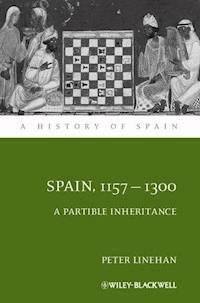
Spain, 1157-1300 makes use of a vast body of primary and secondary source material to provide a balanced overview of a crucial period of Spanish as well as of European history.
- Examines the most significant phase of Spanish mainland development
- Considers the profound intellectual consequences of Christian advances into Islamic Spain
- Explores the varying fortunes of the kingdoms of Castile and Aragon, and focuses on the reign of the learned Alfonso X of Castile
- Utilizes the vast body of primary and secondary source material published over the past 30 years
Sie lesen das E-Book in den Legimi-Apps auf:
Seitenzahl: 642
Veröffentlichungsjahr: 2011
Ähnliche




















Contents
Cover
Half Title page
Title page
Copyright page
Dedication
Preface
Chronology
Abbreviations
Tree showing some of those mentioned in these pages
Map of Spain in the thirteenth century
Chapter 1: 1157–79
Past and Present
After the Emperor
Two Royal Minorities
Chapter 2: The Age of Las Navas
Life, Law and Memory
Three Battles
Implications of the Vernacular
Castile Victorious
Chapter 3: 1214–48
Doña Berenguela and Son
‘The Gate is Open and the Way is Clear’
Towards Valencia
Conquest and Colonization
Toledo and Seville
After Valencia
The Mediterranean Dimension
Chapter 4: Some Permanent Features
Jews
Moors
Hunger, Kings and Capitals
Chapter 5: 1252–9
Alfonso X: Promising Beginnings
A Command Economy
The Law
Chapter 6: 1259–74
Toledo and Translations
International Complications
The Mudéjar Rising
The Alfonsine Histories
Chapter 7: 1275–84
A Reign in Ruins
France and Aragón
1282
Aragón Alone
The Learned King
Chapter 8: The Changed Balance
Castile after 1284
A Question of Alliances
‘Neither Truth nor Faith’
Epilogue
Bibliography
Glossary
Index
Spain, 1157–1300
A HISTORY OF SPAIN
Published
Iberia in Prehistory*
María Cruz Fernández Castro
The Romans in Spain†
John S. Richardson
Visigothic Spain 409–711
Roger Collins
The Arab Conquest of Spain, 710–797
Roger Collins
The Contest of Christian and Muslim Spain, 1031–1157†
Bernard F. Reilly
Spain, 1157–1300: A Partible Inheritance
Peter Linehan
Spain’s Centuries of Crisis: 1300–1474
Teofilo F. Ruiz
The Spain of the Catholic Monarchs 1474–1520
John Edwards
Spain 1516–1598: From Nation State to World Empire*
John Lynch
The Hispanic World in Crisis and Change, 1598–1700*
John Lynch
Bourbon Spain, 1700–1808*
John Lynch
Spain in the Liberal Age: From Constitution to Civil War, 1808–1939
Charles J. Esdaile
Spain: From Dictatorship to Democracy. 1939 to the Present
Javier Tusell
Forthcoming
Caliphs and Kings 798–1033
Roger Collins
* Out of print
† Print on demand
This paperback edition first published 2011 © 2011 Peter Linehan
Edition history: Blackwell Publishing Ltd (hardback, 2008)
Blackwell Publishing was acquired by John Wiley & Sons in February 2007. Blackwell’s publishing program has been merged with Wiley’s global Scientific, Technical, and Medical business to form Wiley-Blackwell.
Registered Office
John Wiley & Sons Ltd, The Atrium, Southern Gate, Chichester, West Sussex, PO19 8SQ, United Kingdom
Editorial Offices
350 Main Street, Malden, MA 02148–5020, USA
9600 Garsington Road, Oxford, OX4 2DQ, UK
The Atrium, Southern Gate, Chichester, West Sussex, PO19 8SQ, UK
For details of our global editorial offices, for customer services, and for information about how to apply for permission to reuse the copyright material in this book please see our website at www.wiley.com/wiley-blackwell.
The right of Peter Linehan to be identified as the author of this work has been asserted in accordance with the UK Copyright, Designs and Patents Act 1988.
All rights reserved. No part of this publication may be reproduced, stored in a retrieval system, or transmitted, in any form or by any means, electronic, mechanical, photocopying, recording or otherwise, except as permitted by the UK Copyright, Designs and Patents Act 1988, without the prior permission of the publisher.
Wiley also publishes its books in a variety of electronic formats. Some content that appears in print may not be available in electronic books.
Designations used by companies to distinguish their products are often claimed as trademarks. All brand names and product names used in this book are trade names, service marks, trademarks or registered trademarks of their respective owners. The publisher is not associated with any product or vendor mentioned in this book. This publication is designed to provide accurate and authoritative information in regard to the subject matter covered. It is sold on the understanding that the publisher is not engaged in rendering professional services. If professional advice or other expert assistance is required, the services of a competent professional should be sought.
Library of Congress Cataloging-in-Publication Data Linehan, Peter.
Spain, 1157–1300 : a partible inheritance / Peter Linehan.
p. cm. — (A history of Spain) Includes bibliographical references and index.
ISBN 978-0-631-17284-0 (hardcover : alk. paper) ISBN 978-1-444-33975-8 (paperback : alk. paper) 1. Spain—History—711–1516. I. Title. DP99.L66 2007 946’.02—dc22
2007026883
A catalogue record for this book is available from the British Library.
This book is published in the following electronic formats: ePDFs [ISBN 9780470695784]; Wiley Online Library [ISBN 9780470696538]
Dedication
To all my Spanish friends,but to some more than others
A strange period this, in which the most brutal of realities went together with the most mannered and delicate literary culture! (L. P. Harvey, Islamic Spain, 170)
Preface
Spain between 1157 and 1300 was a large land of mostly small places. The domus municipalis of Bragança, a place within our area until shortly before the beginning of our period, and an example of the sort of democratic gathering place distributed along the frontier where the clergy of Sepúlveda came together to harry their bishop up hill and down dale,1 measures just seventeen paces across from corner to corner.
As the enigmatic land of three religions whose Christian kings were neither anointed nor crowned, Spain tended to be thought of by northerners in vertical terms. But how the Greek geographer Strabo had done so was as ‘an ox-hide extending in length from west to east, its fore-parts towards the east, and in breadth from north to south’.2 And that was the basis of the description of the boundary of a property sold by Domingos Martins in 1220 as lying along ‘the road that goes from Coimbra to Málaga’,3 that is, along an Atlantic to Mediterranean axis. To that extent, the peninsula continued to think of itself horizontally, in accordance with a Visigothic orientation.
But only to that extent. For reasons to be explained I have refrained from treating the histories of the kingdoms of Castile and Aragón either as uncoupled parts of a Visigothic whole suspended in 711 or as anticipating the union of the two thrones in 1469. That strategy, by contrast with the procedure of Castile’s own thirteenth-century historians for whom all lordships other than Castile-León’s were illicit and therefore to be relegated to appendices,4 has determined the arrangement of the chapters of this volume. The same goes for Navarre and al-Andalus, whose incorporation into the story presents particular problems, as do the inter-relationships of its intersecting ethnic-religious and political planes.
One problem about the Crown of Aragón, as the battle of Muret demonstrated, is that the natural affinities of part of it were not with Spain at all but, despite the failure of all previous attempts to establish a regime straddling the Pyrenees, with Languedoc. Connoisseurs of the counter-factual may wish to reflect that it was only on account of a couple of chance deaths that Catalonia remained associated with Spain at all.5
On the face of it there is no better reason for running the histories of thirteenth-century Aragón and Castile together than for treating thirteenth-century Aragón and France likewise. An all-Iberia treatment in this period begs various questions, the artificiality of which will be referred to at various points in what follows.6
A different type of problem is the partiality of the chroniclers, which I hope I have had an eye for.
These days it is probably necessary to explain that the author of this book is a Christian. If a Muslim or a Jew had written it, it might have been a different book. But so might it have been if another Christian had done so. And all three of those hypothetical volumes would have been about the same place as this one.
I had not intended to crawl all over the political and diplomatic particulars of the Spanish kingdoms between 1150 and 1300 or to revisit facts of the matter already rehearsed in my contributions to three volumes of the New Cambridge Medieval History. But somehow narrative kept breaking in, with the consequence that the story sometimes gets chronologically ahead of itself.
The development (I had almost written the progress) of historical studies in Spain during the forty years since the death of Franco is probably already a subject for historical study. Scanning the shelves – and the tables and the floors – of Cambridge’s incomparable University Library in search of grain amongst the chaff, I observe the inexorable development (or progress) spreading fungus-like week by week. Blackwell’s ration of words might have been exhausted on the bibliography alone. In an exercise such as this theurge for completeness – for the latest monograph, the latest opened archive, the latest article – would be fatal. The cautionary tale of Lord Acton should remind us that history can only be done by cutting corners. So all sorts of interesting aspects of the period, all sorts of subjects – Berceo, Ramon de Penyafort, space (espacio, espace), Ramon Lull, pilgrimage, street-smells, castles and cathedrals, Military Orders, Vidal de Canellas, ‘Society’ itself7-will be found either to have been neglected or to be missing altogether. For what is not missing – and some will think the coverage of Alfonso X disproportionate; plainly I do not – I wish to thank friends and colleagues in Spain and elsewhere for keeping me in the picture by sending me copies of their works. For that and numerous other kindnesses I am indebted to Paco Bautista, Maria João Branco, Inés Fernández-Ordóñez, Raphael Loewe, Avi Shivtiel and Juan Miguel Valero. The late John Crook, Francisco Hernández, Magnus Ryan and Teo Ruiz all read drafts of part or all of the thing. None of what is wrong with it is down to them. As well as John Lynch, successive History editors at Blackwell, for whose departure from the firm I may be partly responsible, have been heroically patient with my dilatoriness.
The society organized for war, as it has so often been described, was also a society disorganized by war. Whether it was also a society in crisis I do not say, though since societies everywhere have always been in crisis I have avoided using the word in the pages that follow.
Biblical quotations are from the King James Version. Unless otherwise indicated, all other translations are my own.
PAL
1 April 2007
1 Below, 23.
2 The Geography of Strabo, 3.1.3, Loeb transl., II. 5.
3 ’… de strata que vadit de Colimbria ad Malaga’: Lisbon, Instituto dos Arquivos Nacionais Torre do Tombo, S. Cruz de Coimbra (Antiga C. E.), docs. partic. mc. 16, no. 13.
4 Below, 5, 163.
5 Below, 84.
6 Examples of twelfth-century battles being refought into the twentieth include the Aragonese Ubieto Arteta’s accusation of ‘pancatalanismo’ against M. Coll i Alentorn for laying claim to Huesca and other places which had always belonged to Aragón (Hist. de Aragón, 184 n. 14) and the Catalan Soldevila’s lament in 1962 at the ‘still disastrous consequences’ of Alfonso II’s cession of Murcia to Castile in 1179 (Hist. de Catalunya, 314; below, 35).
7 Over the previous thirty years historiographical fashions had changed, Beryl Smalley remarked in 1983. At the earlier date it had not been ‘thought desirable to add “and Society” to one’s title’: Study of the Bible, vii.
Chronology
1151treaty of Tudején1153Poblet established and affiliated to Cistercian Order1157Death of ‘the Emperor’ (Alfonso VII); accession of Sancho III of Castile, Fernando II of León1158May: treaty of Sahagún; August: death of Sancho III; succession of two-year-old Alfonso VIII1162August: Ramon Berenguer IV buried at Ripoll; primitive version of Gesta comitum Barcinonensium compiled there; accession of Alfonso II1164Order of Calatrava instituted1166March: Synod of Segovia1169November: majority of Alfonso VIII of Castile1170Alfonso VIII marries Eleanor of England; Order of Santiago instituted1172June–July: siege of Huete1174majority of Alfonso II of Aragón1177September: capture of Cuenca1179March: treaty of Cazola; May: papacy recognizes kingdom of Portugal1187loss of Jerusalem1188Cortes of León; Corts of Girona1192compilation of Liber feudorum maior completed1195July: battle of Alarcos1196April: death of Alfonso II of Aragón; succession of Pedro II; papacy recognizes kingdom of Navarre1204November: Pedro II crowned and knighted at Rome by Innocent III1207May: Cantar de Mio Cid written down1209–47Archbishop Rodrigo Jiménez de Rada of Toledo1210study of Aristotle’s works on natural philosophy banned at Paris1212July: battle of Las Navas de Tolosa1213September: battle of Muret; death of Pedro II of Aragón; succession of Jaime I1214September: death of Alfonso VIII1215Fourth Lateran Council1216–17papal confirmation of Order of Preachers1217June: death of Enrique I of Castile; succession of Fernando III1224Castilian Great Leap Forward commences1229December: reconquest of Mallorca1230combination of León and Castile1231reunion of Aragón and Navarre considered1234Ramon de Penyafort compiles Gregorian decretals;Fernando III’s imperial ambitions revealed; death of Sanç VII of Navarre; succession of Count Thibaut IV of Champagne as Teobaldo I1236June: reconquest of Córdoba1238September: reconquest of Valencia1247rebellion of al-Azraq1248August: establishment of Aigues-Mortes; November: reconquest of Seville1250translation of Lapidario1252May: Alfonso X succeeds Fernando III1254Alfonsine law-code, Fuero real1255Alfonsine law-code, Espéculo1256–8translation of Picatrix1256–65first version of Siete Partidas1257Alfonso X elected German emperor1258May: treaty of Corbeil1259February: translation of Libro de las Cruces1260summer: African crusade (capture and loss of Salé)1262mid-June: marriage of Infant Pedro of Aragón and Constanza of Hohenstaufen1262–72Alfonsine Astronomical Tables constructed1263July: Jewish-Christian debate at Barcelona1264–6Mudéjar revolt in Murcia and Andalusia?1265–74Alfonsine Cántigas de Santa María1270work on Alfonsine histories begins1272–3rebellion of Castilian nobility1274work on Alfonsine national history interrupted1275May: Gregory X rejects imperial claim of Alfonso X; death of Fernando de la Cerda1276July: abdication and death of Jaime I; succession of Pedro II1276–9intensive period of Alfonsine translations1277Alfonso X does to death Infante Fadrique and Simón Ruíz de los Cameros1278Infante Sancho co-rules with Alfonso X1282March: Sicilian Vespers;April: ‘Cortes’ of Valladolid’; rising of Infante Sancho; work on Alfonsine national history resumed1283October: General Privilege of Union of Aragón conceded1284April: death of Alfonso X; succession of Sancho IV1285spring: French crusade invades Corona de Aragón; November: death of Pedro III of Aragón; accession of Alfonso III1287January: conquest of Menorca;August: Privileges of the Union1291May: death of Alfonso III; Jaume II succeeds to thrones of Aragón and Sicily1295April: death of Sancho IV; accession of bastard childFernando IV1295summer: Cortes of Valladolid; Castilian coup d’état1301legitimization of Fernando IV1302treaty of CaltabellottaAbbreviations
ACArchivo de la catedralACAArchivo de la Corona de Aragón, BarcelonaAEMAnuario de Estudios MedievalesAHDEAnuario de Historia de Derecho EspañolAHNArchivo Histórico Nacional, MadridBAEBiblioteca de Autores EspañolesBCBiblioteca del CabildoBECBibliothèque de l’École des ChartesBFWBöhmerBHSBulletin of Hispanic StudiesBook of DeedsJaume I of Aragón, Llibre dels FetsBRABLBoletín de la Real Academia de Buenas Letras de BarcelonaBRAHBoletín de la Real Academia de la HistoriaCAIChronica Adefonsi ImperatorisCAXCrónica de Alfonso XCAXICrónica de Alfonso XICCCMCorpus Christianorum Continuatio Mediaevalis (Turnhout)CFIVCrónica de Fernando IVCHECuadernos de Historia de EspañaCICCorpus iuris canonici: see FriedbergCLCCortes de los antiguos reinos de León y de CastillaCLHMCahiers de linguistique hispanique médiévaleCLCHMCahiers de linguistique et de civilisation hispaniques médiévalesCMLucas of Tuy, Chronicon mundiCSIVCrónica de Sancho IVCSMCantigas de Santa MaríaDocs.JIDocumentos de Jaime I de AragónDrHRodrigo of Toledo, Historia de rebus HispanieEEAlfonso X, Estoria de EspañaEEMEn la España medievalEEMCAEstudios de la Edad Media de la Corona de AragónESEspaña Sagradae-spaniahttp://www.e-spania.paris-sorbonne.frF.FueroGEAlfonso X, General estoriaHSHispania SacraJEHJournal of Ecclesiastical HistoryLdfLlibre dels fets (orig. of Book of Deeds, ed. Smith & Buffery)Lucas of TuyChronicon MundiMGH, SSMonumenta Germaniae Historica, ScriptoresMHEMemorial Histórico EspañolMiöGMitteilungen des Instituts für österreichische GeschichtsforschungNCMHThe New Cambridge Medieval HistoryPart.Alfonso X, Siete PartidasPCGPrimera Crónica GeneralRABMRevista de Archivos, Bibliotecas y MuseosRdLARodríguez de Lama, Alejandro IVRdLURodríguez de Lama, Urbano IVREDCRevista Español de Derecho CanónicoRFERevista de Filología EspañolaRISRerum Italicarum ScriptoresSDSClDomínguez Sánchez, Clemente IVXLiber ExtraZuritaAnales de la Corona de Aragón (cit. by book and chapter)Tree showing some of those mentioned in these pages
Map 1 Spain in the thirteenth century.
Source: based on J. Edwards, The Monarchies of Ferdinand and Isabella (Historical Association pamphlet), p. 4.
Chapter 1
1157–79
Past and Present
In its description of the four major routes from France to Santiago de Compostela, the French author of the twelfth-century Pilgrim’s Guide contained in the so-called Liber Sancti Jacobi proceeded on the Guide Michelin basis that a country is what it eats and drinks. Accordingly, travellers through Navarre were warned against quenching their thirst from its rivers. Rivers in Navarre were poisonous. Further west the water was safer. There, though, fish and meat were both best avoided. Bread was another matter. Estella, for example, had excellent bread, wine, meat and fish. (But since Estella was more French than Spanish, that was not to be wondered at.)
The inhabitants of the regions through which travellers were condemned to pass were also evaluated. With their alarming grunts that passed for language, those of the bosky Basque country (apples and milk tolerable; high mountains; fine views of France from the top) were barbarians. The Navarrese were worse. Like the Basques, the Navarrese would kill a Frenchman for a penny. Like the Scots (to whom they were thought to be related), they went naked below the knees. A bestial people, they lived and ate like pigs, scooping up food from the common trough. Being more prone to bestiality than to theft, when they secured their mules they padlocked their haunches together rather than attaching their legs to a gatepost. Their very name betrayed the malignity of their origins (Navarrus: non verus: not straight; in a word, brigands). Once out of Navarre, matters improved, but only somewhat. For the Castilians were prone to viciousness, and even in Galicia (the region of this troglodytic peninsula which most nearly approximated to polite, that was to say to French, society), even there, the inhabitants were liable to fly off the handle.1
Most of which had been said before:
Northern Iberia, in addition to its ruggedness, not only is extremely cold, but lies next to the ocean, and thus has acquired its characteristic of inhospitality and aversion to intercourse with other countries; consequently, it is an exceedingly wretched place to live in.2
Observed from without, Spain was therefore an easy enough country to characterize. If Gervase of Tilbury, writing in the early years of the thirteenth century, was to be believed, what distinguished Spaniards was the tightness of their trousers (not a good sign in a land opposed to restrictions to procreation).3 And fifty years later or thereabouts, another Englishman, the monastic chronicler Matthew Paris, voiced the opinion (which he attributed to King Henry III) that, in addition to being the scum of mankind, Spaniards were deformed in appearance, despicable as to social graces, and detestable in their moral behaviour.4
From the opposite point of view the wider world was characterizable too. Indeed, to the high-ranking Castilian civil servant, Diego García, the opportunity proved irresistible. In 1217 he delivered himself of a virtuoso performance on the subject. It was not people’s moral behaviour that interested the chancellor of the king of Castile. In the case of the Scots, it was not even their dress. Rather than short-skirted, for Diego García Scots were, by definition, studious, just as Poles were serene, Normans amiable, Englishmen smart, Sicilians grave, Ethiopians pious, Hungarians bandits, and Irish dealers in tall stories. And so on, and so on, some of which may have borne a passing resemblance to early thirteenth-century reality, just as the author’s estimation of the inhabitants of the peninsula itself may have done, of Galicians as chatty, Leonese as eloquent, rural as great trenchermen, Castilians as warriors, as hard, Aragonese as constant, and Catalans as cheerful.
Lesen Sie weiter in der vollständigen Ausgabe!
Lesen Sie weiter in der vollständigen Ausgabe!
Lesen Sie weiter in der vollständigen Ausgabe!
Lesen Sie weiter in der vollständigen Ausgabe!
Lesen Sie weiter in der vollständigen Ausgabe!
Lesen Sie weiter in der vollständigen Ausgabe!
Lesen Sie weiter in der vollständigen Ausgabe!
Lesen Sie weiter in der vollständigen Ausgabe!
Lesen Sie weiter in der vollständigen Ausgabe!
Lesen Sie weiter in der vollständigen Ausgabe!




