


Erhalten Sie Zugang zu diesem und mehr als 300000 Büchern ab EUR 5,99 monatlich.
- Herausgeber: The History Press
- Kategorie: Geisteswissenschaft
- Sprache: Englisch
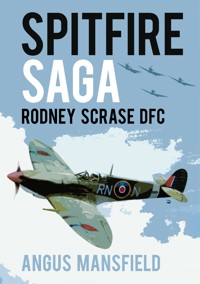
Rodney Scrase's life in the RAF began in an old airship shed where he took the King's shilling in May 1941. He learnt to fly at a BFTS in America and went on the fly Spitfires with No 72 and No 1 Squadrons, finally being awarded the Distinguished Flying Cross in 1944. He was released from service with a record of 4 destroyed and 3 damaged, having taken part in the invasions of North Africa, Sicily and Italy and a stint as an instructor in the art of air to air gunnery in Egypt before finishing the war flying escort missions with No 1 Squadron from Manston in Kent. Spitfire Saga uses Rodney logbooks and first hand interviews with him and several other pilots. Angus Mansfield presents the unique story of one man's experience of flying the most iconic aircraft of World War II. Complete with thorough historical context and a true insider view of life as an RAF fighter pilot, this book is an excellent addition to any history enthusiast's library.
Sie lesen das E-Book in den Legimi-Apps auf:
Seitenzahl: 561
Veröffentlichungsjahr: 2019
Das E-Book (TTS) können Sie hören im Abo „Legimi Premium” in Legimi-Apps auf:
Ähnliche


















This book is dedicated to the ground crews who so effectively provided the back up to their pilots, these chaps on the Squadron for years gave the Squadron its teeth. Not glamour but at all times complete support.
Rodney Scrase
Parts of this narrative have been published previously in Barney Barnfather: Life on a Spitfire Squadron by the same author. This is inevitable because Rodney Scrase and Barney Barnfather both flew with 72 Squadron. Their log books are of course different but in the period they flew together the ORB and developments in-theatre are the same.
Front cover: Painting of Rodney Scrase’s Spitfire by Barry Weekley
First published 2010
This paperback edition published 2019
The History Press
The Mill, Brimscombe Port
Stroud, Gloucestershire, GL5 2QG
www.thehistorypress.co.uk
© Angus Mansfield, 2010, 2019
The right of Angus Mansfield to be identified as the Author of this work has been asserted in accordance with the Copyright, Designs and Patents Act 1988.
All rights reserved. No part of this book may be reprinted or reproduced or utilised in any form or by any electronic, mechanical or other means, now known or hereafter invented, including photocopying and recording, or in any information storage or retrieval system, without the permission in writing from the Publishers.
British Library Cataloguing in Publication Data.
A catalogue record for this book is available from the British Library.
ISBN 978 0 7509 9100 1
Typesetting and origination by The History Press
Printed and bound by CPI Group (UK) Ltd
eBook converted by Geethik Technologies
CONTENTS
Abbreviations
Foreword
Chapter One
Love at First Flight
Chapter Two
The Early Years
Chapter Three
RAF Training, 1941
Chapter Four
Training Completed, January 1942
Chapter Five
A Week at the Bump, November 1942
Chapter Six
Operation Torch – North Africa, 72 Squadron
Chapter Seven
North Africa, January 1943
Chapter Eight
Invasion of Sicily, Operation Husky, June–August – 72 Squadron
Chapter Nine
Italy Invaded, September–December 1943 – 72 Squadron
Chapter Ten
The Landings at Anzio, Italy, January–March 1944
Chapter Eleven
Ismailia and Ballah, Egypt, March–October 1944
Chapter Twelve
Back to England, December 1944 – No. 1 Squadron
Chapter Thirteen
The End in Sight, January–September 1945 – No. 1 Squadron, Manston
Chapter Fourteen
1946 and Onwards
Acknowledgements
Epilogue, by Angus Mansfield
Acknowledgements to the paperback edition
ABBREVIATIONS
ACM
Air Chief Marshal
AFC
Air Force Cross
AM
Air Marshal
AOC-in-C
Air Officer Commanding-in Chief
ATA
Air Transport Auxiliary
AVM
Air Vice-Marshal
BAT
Blind Approach Training
CFI
Chief Flying Instructor
DFC
Distinguished Flying Cross
DSM
Distinguished Service Medal
EFTS
Elementary Flying Training School
F/Lt
Flight Lieutenant
F/O
Flying Officer
F/Sgt
Flight Sergeant
Gp
Capt Group Captain
MO
Medical Officer
ORB
Operations Record Book
OTE
Operationally Tour Expired
OTU
Operational Training Unit
P/O
Pilot Officer
RAAF
Royal Australian Air Force
RAFVR
Royal Australian Air Force Reserve
RCAF
Royal Canadian Air Force
RNZAF
Royal New Zealand Air Force
R/T
radio telephony
SAAF
South African Air Force
Sgt
Sergeant
Sqn
Squadron
Sqn
Ldr Squadron Leader
u/s
unserviceable
USAAF
United State Army Air Force
Wing
Cdr Wing Commander
W/O
Warrant Officer
FOREWORD
We met at the Operational Training Unit at Grangemouth and Balado Bridge where we both flew the Spitfire. Rodney had been trained in America and I had been a flying instructor at RAF College Cranwell before I managed to wrangle out of Training Command by way of a Night Fighter Training unit. It was easy to pick out the pilots who could fly a steady formation and Rodney was one of the best.
It was quite interesting to find out that we were both posted to No. 611 Squadron to learn all we could about the Spitfire IX before joining a ship waiting on the Clyde with a dozen other pilots. One of these was F/Lt Edward Mortimer Rose DFC & Bar, who had already won a DFC and Bar in Malta. He drew his revolver and fired at a nearby seagull perched on the mizzen mast but he missed! It was Mortimer who collided with Wing Commander Gilroy right over Souk el Khemis just as Rodney and I arrived there two months later. After an uneventful trip to Gibraltar we joined Wing Commander Gomez who was in charge of assembling both Hurricanes and Spitfires that had arrived by sea in wooden crates. We were detailed once or twice to join a party of aircraft on a ferry trip to Oran or to Maison Blanche, the main base for Algiers. We were both pretty pleased to be sent from Gibraltar to Algiers to await a posting to one of the ‘mobile’ fighter squadrons. We did not have long to wait. We flew to Souk el Arba and then by open truck to a new strip at Souk el Khemis. It was from this truck that we got our first glimpse of two Spitfires spinning into the ground followed by just one parachute. It was our friend from the ship on the Clyde: Mortimer Rose who had collided with the Wing Leader. Many years later ‘Sheep’ Gilroy blamed condensation on the inside of the cockpit after returning from a sortie at high altitude.
Shortly after joining the famous No. 72 (Basutoland) Squadron we all went back to Gibraltar to be re-equipped with Mark IX’s. Rodney and I thought a clever postings clerk in the Air Ministry had planned our route to No. 72 Squadron but we never breathed a word!
I returned to University in 1945 from my prisoner of war camp in Germany and as I walked down Kings Parade I wondered at old friends who had survived. I went one day to try the lunch in the Air Squadron Mess. There in the visitors’ book was a name I dearly wanted to find. Rodney had written in very small print, his decoration. He certainly deserved it and we have remained friends to this day.
Tom Hughes – August 2010
CHAPTER ONE
LOVE AT FIRST FLIGHT
How much I owe to my logbooks. Without the dates and cryptic notes which appear within, the memory of what happened over 60 years ago would be hard to disentangle. So for starters there is the first time I flew in a Spitfire. In my case this was on 16 September 1942. I was on a course at No. 58 OTU Grangemouth.
I had done a 35-minute Spitfire Check in a Master III. My instructor F/O Beardsley felt I was OK to go and I did. The next 55 minutes in a Spitfire Mark 1 was a gingerly completed exercise, doing circuits, pretending I was landing on top of a feathery white cloud and building up my confidence. At that stage there were no aerobatics and certainly no sideslip approach to a landing. But I got over the first stage and my landing was a three pointer. So I was away and my love affair with the Spitfire could truly be said to have begun.
Just a month later and doing a climb to 30,000 feet I came near to being a casualty. Something went quite wrong with my oxygen supply and I came around at 5,000 feet flying straight down towards the hills, fortunately in time for me to recover. I was in a bath of sweat but with the confidence that builds up after a narrow escape.
Next it was to discover the power of a Spitfire Mark IX. On a short-term attachment to 611 Squadron at Biggin Hill I gained some experience on type flying not only a later model, but one that was full of operational urge. The responses were immediate, the power inspiring and the confidence it built up in me was perhaps too soon for a new boy.
That confidence was to suffer a rude awakening when I joined my first squadron, No. 72 Squadron at Souk el Khemis in Tunisia. On my first day, 28 January 1943, we were driven down to dispersal to see the team taking off on a sweep as part of a wing. At less than 1,000 feet two Spitfires collided. The Wing Leader ‘Sheep’ Gilroy was hit from below by a very experienced pilot, F/Lt Mortimer Rose DFC. Gilroy baled out but Morty crashed and was killed. No fault was attributed to the Spitfires.
In February the Squadron returned to Gibraltar to collect our Mark IXs. On our return flight, 6 hours in all, in loose formation and with an overnight stop at Maison Blanche we arrived at Souk el Khemis in the midst of a heavy rainstorm. Landing on a darkened airfield was no fun: no lights but I had the thrill of a safe landing. Such was not to be the case for all my colleagues. One fatal casualty and a number of damaged new Mark IXs did not speak well for our skill as pilots. But the improved performance of the Mark IX spoke loud and clear about our ability to combat the enemy. They were flying from concrete runways on the outskirts of Tunis and Bizerte, we flew from muddy strips covered with Sommerfield tracking. This resembled chicken wire and did give us some help in taking off and landing but many were the occasions when an airmen sitting on your tail was a requirement when taxiing.
From Malta and later Sicily my love affair with the Spitfire built up. Partly this was a case of combat success but there was very much an improved awareness of what you could with the aircraft and how she would respond to your handling of the controls. Also in part it was due to the gradual reduction in enemy resistance.
One black mark was my hitting a tree at Cassala. I had a 90-gallon overload tank and just did not allow sufficient height over the airfield boundary. The undercarriage collapsed and the propeller blades were broken off. The aircraft was a ‘Gift of War’ with only a few hours flying time and was declared Category III damaged. Yes, I did feel I had let the plane and its donor down. For me, a bruised forehead and a bloody nose but I was back flying the next day.
17 September was a day to remember. As Black Two I was on patrol over the Salerno beaches. We engaged two Do 217 bombers that had discharged their 3000lb radio controlled bombs against our warships. I was having trouble with my supercharger and lost speed. Roy Hussey, my No. 1 carried on and shot down both of the Do 217s. As I got things back under control and rejoined him, I passed close by to one of the Do 217s on fire and with the crew baling out, one after the other. Poor chaps I thought.
In 1944 the bombing of Monte Cassino on 15 February will always be a sad memory. Flying at 15,000 feet as Red 1 in my own Mark IX–RN–N MH 669 I was leader of the escort to the Maurauders flying in two groups of six. We all saw clearly what was happening and my comments that this was a wonderful show were widely reported in the press back home. Little did we realise that it would be another three months before the Allies could finally break through on the road to Rome.
And that flight in 1944 was to be the end of my tour with No. 72 Squadron. I had completed 200 operational flights – in all 275 hours. Of that total 199 hours were in a Spitfire Mark IX, a love affair I hold very dear.
Rodney Scrase
CHAPTER TWO
THE EARLY YEARS
Rodney Diran Scrase was born on 8 April 1921 in South Croydon, the first of three boys to his parents Ralph and Adrienne. The Great War had come to an end on 11 November 1918 and his father had been in the British Army that had been sent to Salonika, Greece and Serbia to assist the Serbians. Once the war had ended he had been sent across with the 28th Division of the British Army to Constantinople. They had been despatched to serve as the Army of Occupation in Turkey. Ralph Scrase, with the rank of Company Quartermaster Sergeant, was stationed on the Asiatic side of the Bosphorus at Scutari.
The Army found themselves in some difficulty because of the language barrier. It had to find interpreters to help them communicate so adverts appeared in local papers inviting anyone who could speak French, Turkish and English to work for the British Army. As well as standard pay the interpreters would also receive supplies in kind: tea, coffee, sugar and flour. This was a sound proposal accepted readily by the families and daughters of professional people. Adrienne was the beautiful daughter of a Doctor of Medicine in Constantinople. She was from an Armenian family, aged 24 and a competent pianist but did not know what she wanted to do with her life so became an aide to the British Army now resident in her country as an interpreter.
Rodney’s father Ralph kept a diary in his Army Logbook:
MONDAY 18 MAY 1919
Our lady clerk Miss Adrienne Gasparian, an Armenian, commenced work today and I think she will be a great success. She has a very cheerful nature, is a nice respectable girl, in fact it is a treat to have her working in the same office. One would hardly know her for anything but an English girl. She knows thoroughly the Armenian, Turkish, German and French languages and is now learning English although she is already well versed in it and will no doubt improve greatly now that she will have English drummed into her ears all day long!
Their romance blossomed quickly.
THURSDAY 5 JUNE 1919
Adrienne was absent from duty today, as she is a witness in some lawsuit and had to attend the tribunal (Law Courts) at Scutari. I felt her absence most keenly as she is the ray of sunshine in the office – in fact I would go as far to say that whereas I was ‘dying’ to get home a few weeks ago, I shall now be very sorry to leave in one way, much as I desire to get out of the Army. I should be very happy if Adrienne could only come home to England with me but it seems so impossible and there are so many obstacles in the way of anything like that. My mind seems full all day long of nothing else but Adrienne, Adrienne, Adrienne. Perhaps it is because I am so young and consequently sentimental and emotional. Anyway it seems to me I’ve got a bad attack of lovesickness. And yet one can hardly contemplate really giving all one’s love to a person who it seems will be so impossible ever to gain for one’s own. For one thing she is an Armenian girl and her customs, habits, upbringing, may all be different to ours, although it does not seem so at present. Then I have reason to believe, judging from her conversation, that her parents are very conventional and strict and they could hardly be expected to give their daughter away to a perfect stranger and foreigner without being assured of her own happiness, not to mention such questions as financial standing and my own character, of which, even Adrienne knows very little. Yet again there is a question of religion, she belongs to the Armenian Church whereas I am a Wesleyan Non Conformist. There is then the question (one which should interest both parties when contemplating marriage to my way of thinking) of health and pedigree. As far as I am concerned I am in first class health and there is nothing to stand in my way as far as that is concerned, but of Adrienne I know practically nothing. I only know that her character and general disposition, so full of cheer and ‘bonhomie’ sympathy have attracted me to an extent more than I care to admit in as much I know I love her yet am restrained by the knowledge that if I show my love and gain hers for me, the obstacles in the way are so great, that our affections on each other would have been wasted and then our parting when I go home would be such a cruel tug to us both, especially for her being a girl if she did grow to really love me.
SATURDAY AND SUNDAY 7 AND 8 JUNE 1919
Two of the happiest days of my life, by some inexplicable means Adrienne has read all through this journal and has learned of my feelings and my own mind. After leaving Adrienne I went to see the photographer and left a film to be developed and printed. Then I went to the Naval and Military Club and had dinner. Afterwards I had a wash and brush up and had my boots cleaned and after looking in the shops I got on a tram for GHQ where I thought I would perhaps meet Adrienne again. Fortunately I noticed her in another tram going in the opposite direction just as my tram reached GHQ. We had previously arranged to meet at the Bon Marche and I was trying to meet her a little ahead of time. Anyway when she saw me Adrienne got off her tram and we walked together back to Pera and she took me to an Armenian theatre for a drama by Sir Arthur Conan Doyle. Of course I could not understand the ‘lingo’. After leaving the theatre we went by the ‘tunnel’ railway and caught the ferry to Adrienne’s home at Moda arriving there about 8 p.m. I was now introduced to her mother, a dear lady who I instantly began to like, and shortly afterwards to her father, whom I also like immensely. It is easy to see that they are good parents and that their little family forms a home where there is love and sympathy – just as it should be. Conversation with them was difficult because I don’t know Armenian, nor they English. They both know French however and I wished I had taken more trouble when at school to learn that language but I did not then realise how useful it would have been to me. However, Adrienne acted as interpreter and we were soon on good terms. It was so nice to feel myself in a real home again after so long in exile. Everything was quite cosy and snug. Just before dinner Adrienne and I went for a short walk down to the sea front and I wish it were in my power to express here on paper all my thoughts. If these pages were ever read by a third person they will have perhaps realised that there is something stronger than ordinary common acquaintance between Adrienne and I. We have both mutually realised that we have kindled in each other hearts the flame of love – deep soul-filling holy love. My heartfelt emotions are touched like they have never been touched before and I feel I know that in spite of all the obstacles Adrienne will one day be my beloved wife, the dear girl who will share my whole life. During our walk we discussed the matter and I learned what I had hoped to be the case and that is Adrienne returns my love to the full and that I am the first man to whom she feels she can be really happy with. Oh God! I am humbled to the dust. To know that I have won the love of such a pure noble girl fills me with thanks to thee Oh God and I pray that thou will help me to return her love and to be to her the man she thinks I am. The thought of her fills me with inspiration and the desire is so strong within me to possess her for my own dear wife. God grant that we may be guided right and that all obstacles may be overcome. She is for me, the one girl in the world with whom I can be truly happy. Her nature is exactly suited to me and I feel for her that awe and reverence and respect that is essential for true love.
Ralph and Adrienne became engaged on 16 August 1919. The parents of both were anxious about the developing relationship, so much so that Adrienne’s parents sent a good friend of theirs to London to find out what type of family the Scrases were. Ralph was one of seven children born to George Burton Scrase and Alice Sewell. They had been married at Horsham but moved to Burgess Hill where George became a Commercial Traveller with a pony and trap working for his brother Alfred in a mineral water business. Working as a traveller suited George and he built up an agency travelling for a number of firms. George and Alice had a large family of six boys and Ralph had been born on 15 September 1897. The family friend sent by Adrienne’s parents spoke well of the Scrase family and their standing in the community so they were married on 24 January 1920 in Croydon after their return to England.
Rodney arrived a little over a year later and was born on 8 April 1921 in South Croydon. He would be the first of three brothers, Roy was born on 29 August 1922 and Ralph arrived on 21 December 1923.
Adrienne’s parents were, by now, living with the Scrase family in Lansdowne Road Croydon, as they had had to leave Constantinople because of troubles there. Rodney slept in a cot at the end of his grandparents’ bed. Ralph worked for his father’s company, known as Sun D’or, but with several sons working for the same business it was not a job in which there would be opportunities for progress.
Croydon was an interesting and a very desirable place to live in the 1920s. Its fashion and architecture flourished when the suburbs were at the peak of their popularity between the world wars. Croydon began to expand massively in the late nineteenth century and this expansion reached a peak in the 1920s and 1930s, when families desperate for their own home away from the grime of London flocked to the fresh air and space outside the capital.
By 1927 a new opening arose and he was offered a job with H.S. Whiteside and Co. Ltd as Regional Sales Manager in the North of England. The Company H.S. Whiteside and Co. Ltd was a snack foods and confectionery manufacturer, their most famous products the Sun Pat Range of chocolate coated peanuts and raisins, and their peanut butter products.
Ralph Scrase’s job with H.S. Whiteside and Co. took the family from Croydon to Nottingham when Rodney was around seven and they lived in a rented house overlooking the Arboretum, a large park in Mansfield Grove. They lived happily there for almost ten years and Rodney attended the Mundella Grammar School. His father was then promoted and moved back to Dulwich in London, still with H.S. Whiteside and Co. Ltd, and based at the Park House Works in Camberwell.
There Rodney attended Alleyn’s school, an independent, fee-paying co-educational school situated in Dulwich, South London. It was originally part of the historic Alleyn’s College of God’s Gift charitable foundation, which also included James Allen’s Girls’ School (JAGS), Dulwich College and their feeder schools (JAPS and Alleyn’s Junior School). The official religion at the school was and is Church of England. At Alleyn’s Rodney joined the Officer Training Corps or Cadet Corps to gain his first experience of life in the Military.
In the summer of 1939 I went along to the Alleyn’s School notice board to see what Higher School Exam results I had achieved: four passes, sufficient to get a place at University. I had already planned on studying for a B.Com degree from the London School of Economics. In those days admission to University was relatively straightforward, you went along to the College in Houghton Street, Aldwych, and sat through a 20–30 minute chat with one of the Professors.
So Rodney went onto to study at the London School of Economics. There he learnt to row, Houghton Street was close to the River Thames and there had been a rowing club for the LSE established in 1895. The boathouse was actually at Chiswick and Rodney became captain of the club. With the outbreak of war students were evacuated to Cambridge. Rodney was in the rather unusual position of rowing at Cambridge University without quite belonging there. Most people at Cambridge rowed at some time during their career, even if only in a rugger boat. The LSE crew took to the water again, this time from Bonham’s Yard. They were not exactly in the class of the Phaeacians, but what they lacked in skill they made up for in enthusiasm. Other evacuated colleges did likewise and the Cambridge University Boat Club allowed them, together with the ‘Rob-nines’ (a composite town club) and the RAF to compete in the Inter College Bumps. The first of these occurred in the Lent term of 1940. The Bart’s eight registered two bumps in three nights, over Rodney’s London School of Economics boat and Christ’s boat.
Bumping races were typically raced over several days. Each day the boats were lined up bow-to-stern, along the bank of the river, with a set distance between each boat and the next (this was usually about one-and-a-half boat lengths of clear water). The starting positions were marked by a rope or chain attached to the bank, the other end of which was held by each boat’s coxswain. Boats waited along the bank, and were poled out just in time for the start, to avoid any drifting. At the start signal the coxswain let go of the rope and the crew started to row, attempting to catch the boat in front while simultaneously being chased by the one behind. A crew that caught the boat ahead of it was said to ‘bump’ it. A bump was made when any form of contact was made with the boat in front, or when the stern of the boat behind completely passed the bow of the boat in front.
It was a glorious day and at the start our coach and bank party leader – gave us some sage advice and stirring words of encouragement. It was almost Churchill-like. So with a clear aim in sight we waited for the gun to launch us into flight. And row we did. We looked marvellous for the first few strokes as we pulled away. Then something literally unheard of happened: a whistle was blown which was aimed at us, not the team behind.
Now whistles are used by bank parties to let their boat know they are gaining on the boat in front. One means you are one length behind, say 60ft – which means you are gaining on them. The boats start 90ft apart. Two whistles means a half a length – three means three-quarters and four means you are on them – then its continuous for bumps.
Now this one whistle was like a red rag to a bull and we stirred like a mighty beast and dug deep. One whistle, it was like a symphony to us. Another – still just one but we were keeping close.
That moment – that feeling is what the whole competition is all about. Brilliant.
While also at Cambridge, Rodney joined the Cambridge University Air Squadron. Marshal of the Royal Air Force, Sir Hugh Trenchard, had originally conceived the idea of University Air Squadrons. Cambridge University was the first squadron of its kind anywhere in the world, and was formed on 1 October 1925. All its members were undergraduates of the University, the very first member being G.H. Watkins, the famous explorer who pioneered expeditions on the Arctic air routes in Greenland.
Initially, the squadrons were equipped with such front-line aircraft as the Bristol F2B Fighter, still in service from the First World War, but these soon gave way to more modern training aircraft, such as the Avro 504N and the Avro Tutor, which became standard equipment for all University Air Squadrons until 1939. The Munich Crisis and the period of re-armament just prior to the Second World War required a massive increase in the number of pilot and officer recruits, and many more University Air Squadrons were formed before and during the war years to provide for this need. During the war most squadrons were flying de Havilland Tiger Moths, and these were supplemented with North American Harvards, a type that was to remain in University Air Squadron service to the end of the 1950s.
After two years at Cambridge and having earned his degree at the London School of Economics, Rodney volunteered to join the RAF. He was driven out to the airship sheds at Cardington where he took the King’s Shilling. He would receive instructions on becoming an active member of the service at a future date and actually enlisted on 6 May 1941.
CHAPTER THREE
RAF TRAINING, 1941
Rodney Scrase’s life in the RAF began at Cardington in May 1941. Then he became LAC Scrase with service number 1432590 – a number he would never forget.
It was another 3 months before his call up papers came through with instructions to proceed to No. 1 ARC (Aircrew Reception Centre) at Regent’s Park, London. Rodney was one of a group of fifty, all members of University Air Squadrons from Cambridge, Oxford and Edinburgh who had spent the previous academic year attending lectures, in his case at the Cambridge University Air Squadron. There he had a few brief flights in a Tiger Moth, and he underwent medical tests and interviews to judge his suitability for training as a pilot. Because of this he and his colleagues skipped attendance at an Initial Training Wing, which would normally have lasted between 6 and 8 weeks and where they would have been expected to undertake physical training, drills and ground school subjects – learning to fly without actually seeing an aeroplane. Memories of this early time are of living in a requisitioned luxury flat overlooking Regent’s Park and marching across Prince Albert Road to London Zoo’s restaurant for meals. The evenings were spent visiting London’s West End.
Within three weeks the group was transferred to No. 4 PD (pre-deployment) Wing at Wilmslow to be kitted out and provided with civilian suits and berets. They were to go to the USA to do their flying training at one of the six newly opened British Flying Training Schools (BFTS) there because of the lack of training airfields in England. It had been agreed by President Roosevelt in May 1941, well before the United States entered the war later that year after the Japanese attack on Pearl Harbor, that RAF pilots could be trained in the open and safe skies of the United States as opposed to the war torn skies in Britain and that such training would be carried out at these six British Flying Training Schools:
1 BFTS Terrell in Texas. Opened 9 June 1941
2 BFTS Lancaster in California. Opened 9 June 1941
3 BFTS Miami in Oklahoma. Opened 16 June 1941
4 BFTS Mesa in Arizona. Opened 16 June 1941
5 BFTS Clewiston in Florida. Opened 17 July 1941
6 BFTS Ponca City in Oklahoma. Opened 23 August 1941
After a few days leave he embarked on HMT Stratheden at Glasgow bound for the port of Halifax in Canada. From Halifax he went by train to Montreal and on to Toronto. When they arrived in Canada they were all amazed by the amount of fruit available to them, nobody had seen bananas or oranges for ages. From No. 1 Manning Pool he travelled by train down through the US via Detroit and Atlanta to his BFTS in Florida, a journey of two, maybe three days.
Training was similar at each BFTS and occupied 28 weeks. His flying training took place under the blue skies of Riddle Field, Clewiston. Clewiston is midway between Fort Myers to the west and Miami to the east. Billed as ‘America’s Sweetest Town’, Clewiston is a community of vast open spaces on the southwest shore of Lake Okeechobee in Hendry County that was a major producer of sugar cane. As it was about 50 miles from these resorts they used to hitch hike when leaving camp at weekends. There was always a camp bus to bring them back.
The base at Riddle had been constructed in record time. After being officially opened in July 1941, by mid-August construction had been started on almost every building associated with the airfield. The buildings were constructed squarely in the middle of a 4-mile tract that formed the airfield. The layout of the building complex was in the shape of a huge diamond, the ends of the diamond pointing north and south, with space earmarked at the northern end for any buildings required in the future. A large steel hangar to house about 30 aircraft was erected at the southwestern end. All the buildings were of concrete block construction on reinforced concrete foundations. The roofs were made of heavy slate over felt and the exterior of all the buildings was painted white. Between the two large barrack blocks for the cadets were outdoor recreational facilities: tennis courts, basketball and volleyball courts together with a swimming pool. The barrack block facilities were for cadets only, the facilities for about 100 or so instructors, mechanics and other technicians were located in private facilities away from the airfield. For the period the airfield was open, between 17 July 1941 and 25 August 1945, about 1,800 Royal Air Force cadets on 24 courses were to pass through Riddle Field. About 1,400 graduated as pilots, 300 as commissioned pilot officers and 1,100 as sergeant pilots. Those that did not qualify or who were ‘washed out’ were generally sent to Canada for record evaluation and placement either as bomb aimers, navigators, wireless operators or gunners.
The instructors at the Flying Training Schools were American civilians, very often chaps in their 20s, and who were always addressed very politely as ‘Mr’. At the BFTS there were perhaps four or five RAF personnel commanded by a CFI (chief flying instructor). At No. 5 BFTS it was RAF Wing Cdr Kenneth Rampling – a much decorated bomber pilot. A tall jovial man who was labelled a ‘regular guy’ by the Americans, he was keen to see course graduations take place on time. ‘Let’s move it on lads’ was on of his stock phrases and he encouraged the staff to get the cadets airborne from 6 o’clock in the morning until 7 or sometimes 8 o’clock in the evening.
The cadets were issued with a little blue book that gave them a very comprehensive view of life in America. It was not as hectic as life in the Hollywood movies but the outstanding hospitality the book warned them about measured up fully to expectations. The cadets mostly came from carefree undergraduate days and entered into flying with little knowledge but with immense enthusiasm. Some fell by the wayside and some had hair-raising experiences. They took back many things – amongst them a new vocabulary and a strange accent. There were new tastes like fried chicken and sweet potatoes and lots of memories. Swimming in the warm Atlantic, Saturday nights and Florida sunsets, the moon over Miami and the southern girls – the movies weren’t wrong about them. The one thing that dismayed them was the treatment of the young negroes who worked on the airfield. Most of these young workers were very helpful but poor and occasionally they would accept tips or items of clothing. The Americans treated them with disdain.
Rodney’s logbook records his first flight at No. 5 BFTS on 9 October 1941 in a PT17 Stearman. This was the primary training aircraft and the American Stearman Biplane was similar to the British Tiger Moth. Mr Clark was his instructor pilot on No. 3 BFTS Course. The sortie lengths were generally very short, 25 minutes on the first flight and only one sortie of over an hour up to his first solo sortie. This occurred after 11 hours and 54 minutes dual on 30 October for 16 minutes with a note ‘First solo – take-offs into wind’. The course progressed with glide approaches, turns, stalls, spins and onto instrument flying interspersed with solos over the next 10 hours. Mr Hunziker took his Progress Check after 40 hours in two parts.
His time on the course continued with ground school learning and actual flying. They were allowed off every other weekend when most of them spent time in Miami or West Palm Beach. The hospitality of the American people was tremendous. Frequently they would be invited to stay with American families in their homes. Most of them had swimming pools and tennis courts and they were nearly always assured of a marvellous weekend on these occasions. The trouble with the weekends away was that they did not get much money so they were so grateful to the families for their generosity.
Navigation and low flying with advanced aerobatics followed through November and in December he undertook some night flying before completing the Primary part of the course on 9 December 1941.
It was at this time, 8 December, that the Japanese raid on Pearl Harbor took place. We had been out for the day, and on returning to camp realised something exceptional was taking place. Armed people, their equivalent of our Dad’s Army, surrounded the camp. We had gone off for the week-end without identity documents and each had to be vetted back into camp by the RAF personnel.
Rodney moved onto the BT13A Vultee on 12 December and started to use the Link trainer for instrument flying practice. Cross-country flights entered the course syllabus with sorties of about 1 hour 30 minutes as the normal length and more instrument and night flying from December to January.
CHAPTER FOUR
TRAINING COMPLETED, JANUARY 1942
In late January, now with over 120 hours experience, Rodney progressed to the AT6, a far more advanced machine we know as the Harvard. The same round of exercises was now flown at an increased airspeed and more advanced manoeuvres introduced until his final sortie on 7 March 1942 at which time he had just over 82 hours dual and almost 98 hours first pilot time and 15 hours in the link trainer.
As we look back over the six months down here in the heart of Florida, surely long enough, we feel, to have qualified us as ‘crackers’ it is interesting to compare our experience with what we imagined it would all be like when we first learned we were coming here to train. Our idea about America then probably came from two sources. One was by now the quite famous ‘little blue book’ issued to us, which, along with its strict instructions for our deportment, gave us the impression that the USA was a land where the people were very different from us, and where we should feel that we were foreigners. The other source was the Hollywood flicks on which we had all been brought up from our cradles. From these we gathered that America was inhabited mainly by gum chewing gangsters and their speak easies, hot bands, dashing reporters with slouch hats and jitter bugs.
But now looking back, one feels that the diplomatic author of that little blue booklet was a little too apprehensive, we seem to have got by without causing an international incident and on the other hand we have not found life in America as hectic as they would have us believe, which is a good thing. As after all, we did come over here to learn to fly. In fact we found the people were really very much like us. They even spoke the same language as us practically, although some of us have had some difficulties with certain differences in pronunciation experienced with our instructors at one end of the intercom and us at the other. One thing the little blue book did not exaggerate. It warned us about American hospitality and boy it was right! We have been entertained right royally wherever we have gone, at Fort Myers, at Palm Beach, at Miami and even one man inadvertently at Tallahassee. To those that have shown us such good times we can only say ‘come over and be our guests’ after the war.
The Americans treated the cadets who trained in the USA like sons and brothers. A pilot who had completed his training at Clewiston wrote these words in 1942.
Wherever the British flag is flown
With the Stars and Stripes above
You’ll find a kindred unity
of friendship and of love;
Each British heart beneath those flags
Whoever it may be
Says ‘Thank you’ to America,
‘For what you’ve been to me.’
Our return to the UK was much the same as the outward journey. We returned to Halifax with a two-day stopover in New York. Of course we went to the top of the Rockefeller Tower, were bowled over by the glamorous Rockettes and wondered where we could ever expect to meet such tall sprightly lasses. On by rail to Moncton, our holding camp in New Brunswick, brought us face to face with reality. A heavy snow-fall to coincide with my 21st birthday meant we were locked in to camp as the sergeant on guard duty would not let us off base with dirty boots!
For our return to the UK it was a ten-day return in a fast convoy to the UK. Never have I seen such lovely green hills as we did cruising up the Clyde to Gourock, and once ashore the delightful accents of our welcoming committee of Scottish lasses serving tea and cakes made us realise we had been away for nearly 6 months.
Down to Bournemouth by rail to learn of my promotion to pilot officer, a new service number – 123465, and to order my uniforms from Gieves who had tailors on duty in a nearby shop. Also to learn of the procedure for pay and allowances, and to be told I now had a bank account with Glyn Mills Holt’s Branch in Kirkland House Whitehall. My first leave at home as a sprog pilot and the embarrassment of having to say to all the well-wishers that I was just a new boy.
My return to Bournemouth coincided with Fw190 bomber attacks on the town. So off we were sent to Harrogate. It was there I was told of my posting and not to a single engine AFU (Advanced Flying Unit). That was what I had selected and most of my colleagues were going to Tern Hill.
So off Rodney went to No. 12 (P) Advanced Flying Unit (AFU) at Grantham in Lincolnshire, on No. 10 Course, where he started to fly the twin engine Airspeed Oxford advanced trainer. No. 12 Flying Training School had been formed at Grantham back in 1938 and it was the first FTS to receive the North American Harvard Trainer. In 1939 it had been re-designated No. 12 Service Flying Training School and the Harvard had been replaced by Harts and Oxfords and concentrated on the training for twin engine pilots. The following year the training had been standardised on Oxfords and the unit was re- designated again to No. 12 (P) Advanced Flying Unit. It was conceived as a finishing school for pilots trained in North America or elsewhere in the Commonwealth who would have had no experience otherwise of flying in the often inclement European weather, the blackout over England or just basic map reading over a congested English landscape. After 40 hours flying on the Oxford that Rodney took in his stride, he moved to 1511 Blind Approach Training (BAT) Flight at Upwood in Huntingdonshire, for a further 11 hours, still on the Oxford. Returning to Grantham in July 1942 he completed his course with another 14 hours on the Oxford. Not all were as fortunate as Rodney. Under stress or inexperienced on type, it was all too easy for accidents to happen and though he never suffered the indignity himself, it was not unusual to see an accident on the ground when the hapless pilot, who may have been intent on pulling up the flaps, retracted the wheels instead and drop the Oxford onto its belly to the amusement of all onlookers.
Another incident at Grantham derived from its unsuitability for night flying. Like most RAF bases it was clearly marked on German maps and flare paths used for training inevitably made natural targets, as did slow, unarmed training aircraft doing predictable circuits. The night flying element of the course was therefore conducted from a nearby satellite where the flare path was delineated by paraffin flares and a chance light. Other facilities were however minimal. The tiny watch office on the field situated on the opposite side of the valley to Grantham was usually staffed by AFU pupils who approached the task with little enthusiasm because it was so boring. As the Oxfords endlessly pounded the circuit, there was little to do except wait for a request for landing when the pupil would scan the skies, and assuming there was no other traffic in the circuit, give the aircraft a green light to land. On one particular occasion just such a request to land almost led to an accident when a Lancaster bomber returning from a raid from the Ruhr requested permission to land thinking the satellite airfield was its home base. The bigger bomber only just got down on the satellite’s shorter runway with the crew cursing their navigator since he had managed to persuade the pilot that they were over their own base!
On arrival at Spitalgate, Grantham, I had made the case about what I thought was a mis-match in my posting. Half way through the course came news that I was to go to Tern Hill but only after I finished my training. At least I would be able to follow my preference.
When I finally got to No. 5 (P) AFU my BFTS friends who were just finishing the course told me it had been thought I had done a ‘runner’ and the RAF Police were out looking for me. I always took this as a bit of ‘let’s frighten the silly old sod’!
At the end of July he was posted to No. 5 (P) AFU at Tern Hill in Shropshire where he started to fly the Miles Master Marks I and III. Some of the sorties were flown from the satellite field at Calveley in Cheshire and the pace of the course was brisk. On 4 September he flew a Hurricane for the first time for 50 minutes. His first flight in a single engine fighter was something most pilots remembered for the rest of their lives and Rodney was no exception. His initial assessment of the Hurricane with the famous Merlin engine was that it was the most powerful engine he had encountered. The Miles Master was a wooden two-seat trainer powered by a Rolls-Royce Kestrel, Bristol or Pratt and Whitney radial engine, but the Hurricane and Merlin engine gave him 1,000hp for the first time and an airframe with which he was totally unfamiliar, except perhaps in theory.
In an unfamiliar cockpit and strapped in for the first time it was evident that there was something very different about the Hurricane straight away. Brakes released and a cautious taxi and Rodney recalled, ‘having to swing the tail from side to side’ in order to see ahead because forward visibility was non-existent over the nose while the tail was on the ground. Once the Hurricane had arrived cross wind for the final pre-take-off checks, he experienced a further impression of the power of the engine when it was run up to full throttle in order to test for magneto drop and pitch control; then a smooth opening of the throttle with the left hand and he was away. He felt like he had been dealt a swift blow on the back of the head as the Hurricane surged forward and he was away quicker than he thought and in a short time the wheels left the ground. Then came something that was a standing joke with old-hand Hurricane pilots, a climb like a porpoise because he had to manually raise the undercarriage and with an inexperienced pilot this inevitably meant a seesaw movement in the Hurricane until about 1,000 feet, when the undercarriage had been retracted. The drill was then to execute a dummy approach and landing onto cloud with wheels and flaps down for the approach and ‘landing’ at about 4,000 feet. It also showed him how quickly the airspeed fell away as the throttle was pulled back and a pronounced change in attitude as the flaps were lowered for a successful landing. Job done.
NO. 58 OPERATIONAL TRAINING UNIT
Rodney was shortly afterwards posted to No. 58 Operational Training Unit (OTU) at Grangemouth in Stirlingshire. Prior to the Second World War, aircrew completed their operational training on their squadrons but once the war had broken out and operations had begun, it became obvious that this could not be carried out by units and or personnel actively engaged on them. At first squadrons were removed from operations and were allocated to the task of preparing new pilots and/or crews, but before long these training squadrons were re-designated ‘Operational Training Units’.
The airfield had opened originally on 1 May 1939 as Central Scotland Airport. No. 35 EFTS had used it with their Hawker Harts and DH Tiger Moths and No. 10 Civilian Air Navigation School with Ansons. Until March 1941 the airfield was operational as it was also strategically vital for the protection of the Forth Bridge and Rosyth Docks, where many Royal Navy vessels were based or repaired, so 602 squadron Spitfires, 141 squadron Blenheims and Gladiators and 263 squadron Hurricanes were all stationed there. No. 58 OTU had been formed at Grangemouth on December 2 1940 with Wing Cdr J.R. Hallings-Pott DSO, posted in from 7 OTU at Hawarden, as chief flying instructor, bringing with him a wealth of experience in Spitfire training.
Rodney was posted to No. 26 Course at 58 OTU at Grangemouth where the new chief flying instructor was Sqn Ldr G.W. Petre. The large number of Polish pilots at Grangemouth necessitated a completely ‘Polish Squadron’, designated A Squadron. The British squadron, or B Squadron, had seven instructors; F/Lt Humphrey, F/Lt Tofield, F/O West, F/O Beardsley, P/O Porteous, P/O Pocock and Sgt Morrison.
10 SEPTEMBER 1942
Logbook: Master 111 P/O Pocock and Self. Circuits and Landings.
ORB: After 12 weeks of training at Grangemouth and Balado Bridge 40 pupils from Course 23 passed out on Monday 7 September. Course 26 arrived to start training on Tuesday 8 September. This course comprises 20 Officers and 22 sergeants with 12 British, 19 Polish, 3 American, 7 New Zealand and 1 Rhodesian.
After a short local check out over three trips in a Master III aircraft and a local navigation trip in a Dominie Rodney went solo in a Spitfire 1 X4899 on 16 September 1942. The Mark 1, equipped with a Rolls-Royce Merlin 11 engine, with a 1,030 hp, a single speed supercharger, glycol cooled and a two-position, variable pitch, three-bladed metal propeller with a top speed of 362mph at 19,000 feet and a service ceiling of 34,000 feet. It was able to climb at 2,500 feet per minute and could reach 20,000 feet in 9 minutes.
He was taken through the various cockpit instruments, knobs, levers and the operation of the reflector gun sight and firing mechanism with its fire safe switch. It was a vast array of gadgets and he had to identify each before he would be allowed to fly the Spitfire. After checking, and checking again, testing the controls, the radio, the oxygen and fuel states, practising rolling the Perspex hood back and forth, switching on the gun sight, testing the range bar, he was ready. With the propeller in fine pitch, he primed the engine, switched on, gave a nod to an airman by the external starter battery, he pressed the starter button and the Merlin engine burst into life. Recounting that moment, years later, some aspects of that first flight were as vivid as if they had been yesterday.
16 SEPTEMBER 1942
Logbook: Spitfire 1 – X4899- Solo 55 minutes.
I had done a 35-minute Spitfire Check in a Master III. My instructor F/O Beardsley felt I was OK to go and I did. The next 55 minutes in a Spitfire Mark 1 was a gingerly conducted exercise, doing circuits, pretending I was landing on top of a feathery white cloud and building up my confidence. At that stage there were no aerobatics and certainly no sideslip approach to a landing. But I got over the first stage and my landing was a three pointer. So I was away and my love affair with the Spitfire could truly be said to have begun.
One of the features of the Spitfire, he discovered, was the wonderful handling characteristic at low speeds and at high ‘g’ close to the stall. With full power in a steep turn, she would judder, but as long as she was handled correctly, she would not spin. Rodney recalled coming into land on that first flight some years later. He put the airscrew into fine pitch, lowered the undercarriage, turned cross wind, lowered the flaps and straightened out for a final approach before the Spitfire ‘floated’ down onto the grass airfield again for his ‘three pointer’. It was a description that many pilots would come to use about the Spitfire: she tended to ‘float’ because of her clean lines with a minimum of drag. She was an absolute delight to fly.
Just a month later and doing a climb to 30,000 feet I came near to being a casualty. Something went quite wrong with my oxygen supply and I came around at 5,000 feet flying straight down towards the hills, fortunately in time for me to recover. I was in a bath of sweat but with the confidence that builds up after a narrow escape.
11 NOVEMBER 1942
Logbook: Spitfire 11B – Grangemouth to Balado Bridge.
Rodney signed off his OTU course having flown 58 hours in a Spitfire. His wing commander signed off his logbook on 1 December and confirmed he passed as ‘average’.
ORB: Sqn Ldr G.W. Petre Chief Flying Instructor [CFI] has been posted to an operational squadron. A skilful pilot, a capable instructor and an outstanding gentleman, Sqn Ldr Petre was one of the most popular members of the station. Sqn Ldr P. Davies DFC who arrived from 52 OTU has filled his place as CFI.
The pupils of Course 26 completed their training at 58 OTU. 16 of the pilots of this course are proceeding overseas on completion of their embarkation leave.
From October, all Polish fighter pilot pupils had been sent to No. 58 OTU and it became the only operational training unit where British and Polish flying instructors worked alongside one another.
At the end of 1942, the OTU was able to summarise in its ORB: ‘A year of achievement, a year of development and a year of change. In the course of the last 12 months, 400 fighter pilots have passed out from Grangemouth, men of many nations, men of varying skill and character, all imbued with a high fighting spirit, trained to the last degree, replacing the gaps in the old established squadrons, forming new squadrons, serving at home and overseas. Some have given their lives, some are prisoners of war, and others have won renown with their skill and courage.’
Two of the pupils from No. 26 Course at Balado Bridge, Rodney and Tom Hughes, were both sent on attachment to 611 Squadron down at Biggin Hill. Born in 1922 in Rugby, Warwickshire, Tom attended the town’s famous school as a day pupil. Aged 18 in 1940, he had joined the RAF Volunteer Reserve as a pilot and started his flying training on DH Tiger Moths at 7 Elementary Flying Training School at Desford in Leicestershire that October. There he flew in a mix of civilian and service-registered machines before moving on to No. 8 Flying Training School at Montrose, Scotland, to fly Miles Masters.
Tom was assessed as ‘above average’ and was posted to the Central Flying School at Upavon, Wiltshire joining No. 82 Flying Instructors Course flying Airspeed Oxfords and Avro Tutors. After flying for a further 92 hours, and a total of just 202 hours flying, he qualified as a flying instructor on 15 June 1941. Tom then joined No. 11 Service Flying Training School at Shawbury, Shropshire, in June 1941, flying Oxfords. That October he was posted to the College Flying Training School at Cranwell, Lincolnshire, still flying the Oxford, but in December he had moved to the Advanced Flying Unit and started flying Masters as well. In March 1942, he had moved to 60 Operational Training Unit at East Fortune, Scotland, and started to fly a wider range of aircraft types, including the Bristol Blenheim and Bisley, Beaufighter II, DH Dominie, Fairey Battle and Miles Magister.
Finally in September 1942 he moved to 58 OTU at Grangemouth, Scotland, where he met Rodney. Tom now had over 900 hours on nine types of aircraft and was more experienced than some of the instructors. Here, after a few trips in a Master, he first flew a Supermarine Spitfire and gained a further 66 hours on Mark 1s and Mark 11s.
Little did Rodney know at this stage, but this was to be the start of a wonderful and long-lasting friendship with Tom, something that would last a lifetime.
CHAPTER FIVE
A WEEK AT THE BUMP,NOVEMBER 1942
In November 1942, with 345 hours flying experience I came to the end of my training and was assessed as ‘fighter pilot – good average’. And that was probably why I was sent on attachment to 611 Squadron at Biggin Hill to gain ‘some experience on type’. During a week stay I made two trips on a Mk IX – total flying time 1hr 25 minutes. Just about enough to have those responsible for postings to mark my records as ‘send him off to North Africa’, there to join one of the two squadrons which it was planned were to be equipped with a more effective Spitfire fighter than the Mk V.




