


Erhalten Sie Zugang zu diesem und mehr als 300000 Büchern ab EUR 5,99 monatlich.
- Herausgeber: The History Press
- Kategorie: Geisteswissenschaft
- Sprache: Englisch
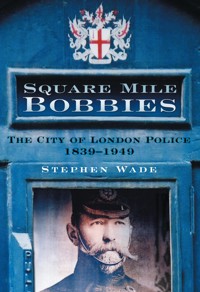
Square Mile Bobbies is a history and casebook of the City of London Police between 1839, when the force was first established after general recognition that London was not being policed effectively, and the Second World War. During this time the City Police were involved in a succession of major cases, from the attempted assassination of the Rothschilds in 1862 and detective's pursuit of forgers in 1873, to Jack the Ripper's brutal killing of Catherine Eddowes in 1888 and the notorious siege of Sidney Street in 1911.
Sie lesen das E-Book in den Legimi-Apps auf:
Seitenzahl: 247
Veröffentlichungsjahr: 2009
Das E-Book (TTS) können Sie hören im Abo „Legimi Premium” in Legimi-Apps auf:
Ähnliche














SQUARE MILE
BOBBIES
SQUARE MILE
BOBBIES
THE CITYOF LONDON POLICE 1839–1949
STEPHEN WADE
First published in the United Kingdom in 2008 by Sutton Publishing
The History Press
The Mill, Brimscombe Port
Stroud, Gloucestershire, GL5 2QG
www.thehistorypress.co.uk
This ebook edition first published in 2013
All rights reserved © Stephen Wade, 2008, 2013
The right of Stephen Wade to be identified as the Author of this work has been asserted in accordance with the Copyright, Designs and Patents Act 1988.
This ebook is copyright material and must not be copied, reproduced, transferred, distributed, leased, licensed or publicly performed or used in any way except as specifically permitted in writing by the publishers, as allowed under the terms and conditions under which it was purchased or as strictly permitted by applicable copyright law. Any unauthorised distribution or use of this text may be a direct infringement of the author’s and publisher’s rights, and those responsible may be liable in law accordingly.
EPUBISBN 978 0 7509 5340 5
Original typesetting by The History Press
CONTENTS
Introduction
1.
The Early Years (1839–1900)
2.
Murder at the Coffee House (1846)
3.
Murdered at Sea (1857)
4.
The Haymarket Killing (1858)
5.
Murderous Threats & Attacks on the Rothschilds (1862 & 1912)
6.
Robberies in the City (1865)
7.
The Cannon Street Murder (1866)
8.
The American Gang (1872)
9.
Jack the Ripper (1888)
10.
Forgers, Fraudsters & an Old Chartist (1850–1900)
11.
The Houndsditch Murders & the Siege of Sidney Street (1910–1911)
12.
The Police ‘Mutiny’ (1918 & 1919)
13.
The Matchmaker Libel (1928)
14.
Two Murders & A Suicide (1932)
15.
War, Women Officers & Issues (1940–1949)
Afterword
Acknowledgements
Sources & Bibliography
Wood Street police station, built in 1965. (Author’s collection)
INTRODUCTION
Today, an historian looking for physical evidence of the beginnings of the City of London Police has to look hard for very few remnants of the early history of their establishment around the Guildhall and Mansion House area. The little street of Old Jewry has nothing in it to recall the first police station; the coffee houses and inns mentioned here are no longer around. What we think of as Eastcheap and Poultry from the old books is a mass of high blocks, their windows sparkling with confident modernity. But by the Museum of London, just five minutes walk from the Wood Street police station, there is a piece of the London Wall exposed. Somehow this hints at the London beneath all the development: its stories, both tragic and comic, criminal and class-ridden. This book is an attempt to trawl for some of these police narratives, as dramatic as anything found in the Police News periodical of Jack the Ripper times.
The City of London Police has been in existence since August 1839. Clearly, there was a great deal to be done before they were a fully operational organisation. Reading the accounts of its progression from a group of new recruits and a commissioner to a massive force, with a Special Reserve Constabulary added to its corps, we are struck by the creative mix of tentative planning and the attention paid to regulations. But the force came through and has played a principal role in policing London ever since. One of the Ripper killings was on their ‘patch’ – that of Catherine Eddowes; while officers died in the notorious siege of Sidney Street. City men also travelled across the world in search of some of the brainiest villains, as their square mile which constituted the City of London was the financial hub of Britain, and of course, the City force experienced all the major social changes that impacted on police in their everyday work.
It would not be fair to say that the City of London Police have always been in the shadow of the Metropolitan force, but it is hard to escape the feeling that they are little known and have not gathered the patina of drama and adventure suggested by phrases such as ‘The Flying Squad’ or the epithets given to detectives such as ‘Fabian of the Yard’. There seems to be no reason why a similar one, such as ‘Smith of the City Force’ should not have the same effect. But the fact is that the City Police have just not had the press, yet there is no doubt that they have had controversy and have certainly been involved in a succession of major cases in the chronicles of crime.
The familiar blue lamp outside Wood Street station. (Author’s collection)
Their story begins in 1839 and since then, there have been thousands of aspects of the social history of the force that have opened up for anyone interested in the reasons why our police force has come to be what it is today. For instance, the City Police had its own hospital by 1865, in Bishopsgate. Highlights of the story are not all positive: there was a police strike in 1919 that tarnished their image and brought about a massive influx of special constables, many of whom were decorated and honoured publicly as if to shame the regulars.
Of course, they have not always had the City ‘square mile’ as their domain. This has been the case since 1993 and means that the modern force has had to deal with terrorism, while technology has also had a profound impact on the nature of all policing in London.
Although 1839 is the date of the force’s official existence, there have been law officers in London for a very long time. Even in the early Middle Ages, there was a common responsibility for all to keep the King’s Peace. But more prominent was the Watch and Ward system. The origins of this go back to 1285, during the reign of Edward I, in a law known as Statuta Civitatus London. From this thinking sprang the beginnings of a national constabulary responsibility, codified in the Statute of Winchester, an attempt to engage with difficulties concerning localities and their implementation of law where strangers were concerned. The heart of this was a division of society known as a ‘hundred’ which would have had the duty of sorting out unsolved crimes and making sure that men knew their responsibilities when it came to responding to a ‘hue and cry’ call.
The origins of the first watchmen can be seen in the creation of tithings within the hundred. A tithing was a ‘tenth’ of the hundred. From this idea came the grouping known as a peace guild, created in the reign of Charles I, whereby a constable was defined and differentiated from the watch. It is in this period that our commonest image of pre-police law officers arrives, as these were the ‘Charleys’ (named from Charles I) or watchmen who were constantly derided in the press and in the satirical cartoons throughout the eighteenth century and Regency years.
Before the professional police force was created by Sir Robert Peel in 1829, the original paid officers were the aldermen, who were at first a force with a complement of sixty-eight men. Their placements throughout London were decided by the concentration of population, with twelve in position at Smithfield Market and another twelve at the Station Houses. When Sir John Fielding and his novelist and magistrate brother, Henry worked hard to put more energy and organisation into the workings of the London magistracy, they also played a part in police work and, in a sense, had to be amateur detectives. But clearly in the years around 1800–1830, the arrangement for policing London was notably inadequate.
Charles Rouse: the last of the ‘Charleys’. His box stood on the Brixton road. (Author’s collection)
One of the first people to see this and try to remedy the situation was Patrick Colquhoun, who founded the Thames River Police. As a London magistrate who actually wanted to tackle crime efficiently, he looked at the links between crime and poverty, and in his creative and original work, A Treatise on the Police of the Metropolis, he pressed for a central police force. He also attempted to compile some criminal statistics, claiming, for example, that there were 115,000 prostitutes in the city.
Shortly after Colquhoun died, having seen most of his ideas rejected, the aldermen put together a document that can be seen as the first attempt to implement some of Colquhoun’s ideas. This was the Rules, Orders and Regulations for the Police of the City of London (1824). After that, it was only a matter of time before there was a general recognition that the vastly expanded city was not being policed efficiently and that there was a pressing need for change. When Peel came along and started work towards the first professional force, which was to become the Metropolitan Police, he wanted to amalgamate his men with the City personnel. The Corporation would have none of it, and again, it resisted Lord John Russell’s similar attempt in 1839. From these failures came independence. The City of London Police Act was created and a commissioner was appointed.
In this account of the force from then until the Second World War, the aim is to tell its history mainly through a casebook format. In each chapter, the case in question will be recounted, and the social history and legal developments incorporated. Some of the events are very famous in history, such as the Jack the Ripper killing which involved City detectives, or the attempt to assassinate the Rothschilds. But the officers of the City Police were engaged in so much more. A fairly typical occurrence was this, from a pursuit of some forgers in 1873:
Michael Haydon, an experienced officer in the City of London Detective Police, was put upon his track, and in Paris obtained such information as enabled him to trace the fugitive to a port whence he had reason for believing he had embarked on a vessel bound for Havannah… steps were taken, by the use of the telegraph and otherwise, to anticipate his arrival there…
This passage has many of the elements that led to such widespread media interest in the phenomenon of the detective (created in 1842 for the Metropolitan Police). Charles Dickens did more than most in the Victorian period to kindle interest in this new breed of men, and the above extract shows just how much the City officers had to contribute to the mythic and literary narrative that continued, deepening as the century went on, and eventually bringing the world such great fictional detectives as Sherlock Holmes and Sexton Blake.
Frontispiece for P. Colquhoun’s tract on the ‘Police of the Metropolis’, 1806. (Author’s collection)
By 1911, Captain Sir William Nott-Bower, commissioner of the City Police, gave his annual report and the figures are extremely informative regarding the nature of his force by the Edwardian years. The total number of officers of all ranks at that time was 1,166. It was a tough job, and as the police had their own hospital and convalescent home, he knew the figures of people having treatment. There had been 353 admissions to the hospital in 1911 alone, a figure that would impress today’s accountants! Nott-Bower also calculated days lost as 4,276. Even at this early date in the history of motoring, fourteen people had been killed by motor vehicles in 1910–11, and an incredibly high number of 595 injured.
The casebook here will be balanced by a social history of the City Police as well. I hope that the stories of high drama will help readers to see that the ‘other blues’ or ‘square mile cops’ have had just as much to cope with as their Metropolitan counterparts.
The crime historian often has to rely on ephemera to access the contemporary feel that a narrative of this genre requires. I have been fortunate in this particular collection of stories in that anecdotal tales have arrived across the decades, albeit second-hand and embellished.
1
THE EARLY YEARS
1839–1900
In the great Magna Carta of 1215 we have the words: ‘and the city of London shall have all its ancient liberties and free customs both by land and by water.’ From that point, and into the Medieval period, the enduring vision of law and order in the city is that of the constables from all wards entering armed into their streets at the curfew bell. In other words, London has always been extremely difficult to police. In the eighteenth century, as the city population expanded and the burgeoning middle classes needed more elbow room and therefore more protection to carry on their trades, the illicit practices of the receivers and thief takers meant that something more was needed than the Watch and Ward of the ‘Charleys’ (so-named during the reign of Charles I) who sat on a nightshift with a sword and lantern.
In the advances of the Fielding brothers, novelist Henry and blind brother John, we have the first significant attempts to do more towards moving to a tighter control of the ever threatening mob and street crime. In 1780, the Gordon Riots made the situation regarding protection of persons and property more acute. Newgate itself had been wrecked and the forces of law had cowered for some time in defeat.
But there was also another variety of crime in the eighteenth century that the City had to deal with, the crime within the broking community. In 1719,Daniel Defoe’s tract, The Anatomy of Exchange-Alley or A System of Stock-Jobbing, highlighted some of the worries that were to explode the following year in the South Sea Bubble, when fortunes were lost in speculation. Defoe wrote: ‘Tis a complete system of knavery; that ‘tis a trade founded in fraud, born of deceit, and nourished by trick, wheedle, forgeries, falsehood and all sorts of delusions.’
By the first years of the nineteenth century, there had been plenty of serious thought given to policing. The river police and a few night patrols helped, but a large-scale theoretical plan by Patrick Colquhoun had only been accepted and implemented in terms of settling the river police force. Colquhoun wished to establish a central group of police commissioners working directly for the Home Office. He wanted to reform the watch system and planned a method of paying police officers which would ease the burden on ratepayers. But he was before his time, and it took Sir Robert Peel to establish the Metropolitan Police in 1829.
This momentous year was the time in which the first professional police (the ‘Peelers’) appeared, but from the start, they were not to work in the City. The new force covered the parishes within 12 miles of Charing Cross. Peel knew that to include them in the City boundaries would have infringed upon the ancient chartered rights of the City, and he kept well clear of such an issue. There had been no change in the City government since Tudor times: the Lord Mayor and the guilds were the base of the structure. Central to the management of the city was the Guildhall which served several functions, including acting as a court and as a debating room. The Court of Common Council and the aldermen provided the unifying principle to the organic workings of the city and its rulers. For centuries, the City fathers, mayor and sheriffs had been at the hub of administration and law in this square mile. In some sense, the strength of this came from the small scale; the community was easily identified and watched. But in this also lay a weakness which was most apparent when it came to crime on their ‘patch’.
Therefore, when the two new police commissioners for the Metropolitan Police set up their base at Whitehall Place and the new constables were recruited, drilled and sworn in, London had a police force. As for the City, it would have to wait a little longer, still relying on the Watch and the Bow Street Runners. But we must recall that, in spite of common criticisms of these runners and of the supposedly ancient and useless ‘Charleys’ of the Watch, there had been a certain amount of visible control, at least on the surface. The problem was that historical process and social change had accelerated so drastically between about 1790 and 1830 that it was apparent that the City also needed a police force to equal Peel’s new men. The organisation of the City Marshall, his Under Marshall and six marshal men was looking outdated and inadequate in this restless, aggressive, and overcrowded urban world.
In these years, Britain had fought the wars with France and with Napoleon. There had been huge social problems as a result of this, including a fear of insurrection and sedition as the authorities felt that there could be a revolution in Britain, following on from France. The gap between rich and poor was immense; there was an increasing problem with poverty and beggary in the London streets and gangs and mobs were a constant threat to order and personal safety. In 1812 Spencer Perceval, the Prime Minister, had been shot dead, while in 1819 the Peterloo Massacre in Manchester had illustrated the paranoia of the government, as the crowd assembled to hear Orator Hunt speak was attacked by hussars. Eleven people were killed, and over 400 were injured.
In the 1830s, just as the new police were striving to be effective in a culture which both rejected and were largely suspicious of them, some massively important social movements developed. Chartism, the campaign to bring a reform of Parliament and the vote for the working man, accelerated and had a violent element known as the ‘Physical Force’ men, led by Feargus O’Connor. The Poor Law had been reformed in the New Poor Law Act of 1834, creating a Board of Guardians and Poor Law Commissioners, and there had been agitation and debate over Catholic emancipation in 1829.
There were more immediate and visible problems too. In 1831, a police constable was stabbed to death in Clerkenwell, and many more officers were attacked and abused. At the heart of the issue was the military nature of the new police, and therefore the fact that they were also linked in the public perceptions of them to espionage – the use of agents provocateurs by the Home Secretary during the suppression of sedition during the war years. In 1799 and 1800, the Combination Acts had made it illegal for small groups of people to gather on street corners. Journalists were always under the threat of prosecution as the perceived ‘police state’ intensified its work.
John Townsend: Runner and bodyguard to George III. (Author’s collection)
We can gather some idea of the fears felt by ordinary householders in London from a pamphlet written in 1831 entitled Householders in Danger from the Populace by E. Wakefield esq. of London. Mr Wakefield noted, ‘The moment that the system of pillaging the people seemed to be drawing to a close, a new apprehension sprung up, that the rich were about to be pillaged by the poor.’ He adds, ‘Because law ceases to be an instrument of pillage, must anarchy, riot and general scramble ensue?’ In other words, he was writing after the reforms of the ‘bloody code’ of the eighteenth century, which placed well over 200 capital crimes on the statute books. The wealthy naturally looked to the law to protect them and their property, but often saw the function of the officers of the law as being oppressive and brutal – meeting like with like.
Capital punishment and transportation meted out before Robert Peel’s reduction of the number of capital crimes appeared to many people to solve the problems of the mob and of gangs. This was largely because, for many of the underclass, prison was preferable to a life of mendicancy. The area between the Mansion House and Cheapside and Poultry was notorious at the time for disorder and threats of violence to persons. Historian Donald Rumbelow makes this clear in his book, I Spy Blue, when, by 1848, the windows of the Mansion House had been smashed so many times that a special lookout had to be hired to watch for the beggar women who daily milled outside… and who had … baskets of paving stones to hurl through the Lord Mayor’s windows…’.
The ‘drop’ at Newgate Prison, from an early Victorian print. (Author’s collection)
But crimes of violence were not the only cause for concern. Forgery and ‘clipping’ coins were common. In 1833, for instance, a certain Robert Spencer appeared in the Mansion House, the City court, charged with ‘having forged the acceptance of T.W. Coke Esq. of Norfolk, for the sum of 405 pounds’. Notes with practised forged signatures were found on the prisoner, and he had also sent begging letters. The Times reported the Lord Mayor’s comment that ‘a great deal of ingenuity had been practised in this case, and that ‘he believed a great deal of mischief was created by the facility of getting the handwriting of gentlemen of property’. Again, the Mayor noted that the abolition of capital punishment for forgery and uttering had encouraged crooks like Spencer to try their hand in the forgery business. But he did concede that the government had resolved that ‘forgers should undergo all the hardships of the convict’s life’.
There had been a lot of committees in the decade before the Police Act of 1829, all dedicated to forming some kind of police force. In the City, 1838 saw the arrival of a force of 500 men who formed the Day Police and Nightly Watch, with a superintendent in charge. But there was a clamour for more numbers and a stronger presence on the increasingly dangerous streets and alleys of the City wards, and in 1839, the City of London Police was created, with Daniel Whittle Harvey as the first commissioner.
Harvey was a complex man, with a chequered history. He was born in 1786 in Witham, Essex. His father was a merchant banker and his mother was a daughter of Major John Whittle of Feering House, Kelvedon. Harvey stepped into Feering House in 1807 and worked as a country solicitor after his marriage to Mary Johnston of Bishopsgate Street. He was often involved in litigation, including a case of slander with another lawyer, a man named Andrew. He was later admitted to the Middle Temple and applied for the Bar, but was rebuffed. Twice, over a period of twelve years, Harvey was rejected by the benchers, which even a Select Committee of the House of Commons could not change. The benchers thought him to be a man of questionable integrity; but as it happens, reports of the two trials he had been involved in were later deemed inaccurate, so Harvey was wronged and his career consequently suffered. The Select Committee of the Inns of Court reported on his case in 1834 and cleared his name.
Unlike Richard Mayne, his counterpart in the Metropolitan Police, Harvey was a man with a background in controversy and enmity. Mayne had been a provincial lawyer, working on the Northern Circuit, when called for an interview by Peel. Harvey had even been prosecuted for libel – successfully – in 1823, after stating that George III was insane. Harvey served a prison term in the King’s Bench.
Well before the establishment of the City Police, Harvey was busy in other things. He worked as a member of the Common Council of the City for ten years, and was elected MP for Colchester in 1818, and in 1835, for Southwark. He became a known radical and was often involved in sensational cases and in business until his appointment as Commissioner. He had taken possession of the Sunday Times and sold it for a profit and controlled the paper, the True Sun for seven years. As he was constantly in financial difficulties, the salary of Police Commissioner must have seemed to him a very attractive prospect. He had already taken on another role, as registrar of Metropolitan carriages, in 1839.
A satirical commentary on the new Police Act, 1829. (Author’s collection)
Harvey had support, however, where it mattered – among the members of the Corporation. Unfortunately, so that he could carry on with his expensive lifestyle, he wanted to be an MP as well, and Peel opposed this. It was specifically stipulated that the new commissioner could not have other earnings from that source. After all, there might have been awkward situations in the House if the commissioner and the Home Secretary were at odds on any matter. Harvey was sworn in as Commissioner on 11 November 1839. A report in The Times stated that Harvey was sworn in by Baron Rolfe and that ‘Mr Harvey has therefore entered upon the onerous duties of the office, and virtually vacated his seat for the borough of Southwark.’ The bill forming the City of London Police had been passed a few days previously, on 7 August.
One of Harvey’s first duties was to find places for the new stations. He advertised for property:
City of London police stations wanted to rent or purchase. A part of ground or buildings for the above purpose, between Queen Street, Budge Row and Upper Thames Street… also south of Fenchurch Street between Mark Lane and Minories; also east of Bishopsgate Street and north of Houndsditch near petticoat Lane. Any parties having suitable land or premises are requested to forward information to the Clerk of Works, Guildhall. 4 June 1840.
A constable from the 1860s. (Author’s collection)
The recruitment of men was, of course, the most pressing matter. Desirable men were required to be under 40 years of age, literate and physically fit. They needed to have basic arithmetical ability and possess a suit of clothes. In terms of pay, it is estimated that an average family could just about survive in 1840 on a guinea a week. Peel had started pay for his men at 3s a day. But the real difficulty was that the pay had to cover housing costs, clothing and medical bills. Harvey sensibly set about increasing his own constables’ pay by creating five groupings of pay levels conceived to reward the officers on merit. A dedicated and reliable man could earn the top of the scale – 22s 6d a week. By 1861 there was a desperate need for more men, but the guidelines then were that they should be under 40, over 5ft 7in tall and with the usual related qualities. The recruits struggled; many earned well below the 22s as there was a probation system whereby they earned much less.
The living conditions of the officers were generally poor. There were often sublet rooms and most men could only afford to have two rooms. One of the most insurmountable problems was that illness led the officers into money troubles; an officer would be fined a shilling a day if his illness was not related to police work, which was notably harsh. Their work was physically very demanding. They worked shifts of eight hours, but usually there was not much of a break between shifts. Often, the clothes supplied were inadequate and poorly made, which added to the general discomfort of the job. The most telling feature of the work was the general tendency for most men to stay in their post for around four years. Between 1840 and 1860, Harvey had over 3,000 men recruited, yet 2,562 of them left and 600 were sacked. Heavy drinking, insubordination and inefficiency were rife. Harvey’s answer was to employ part-timers who would be hired on a casual contract. Finding the right kind of man was very hard indeed; from his recruitment campaign in 1861, Harvey had 570 applicants and of these only thirty-eight were suitable, leaving him seven posts to fill.
‘What we want in our policemen’. (Punch, 1871)
In 1861, an anonymous correspondent to The Times, signing himself ‘a police constable’ wrote:
There is now a considerable deficiency in numbers in the Metropolitan police and the Commissioner of the City of London police is advertising for men; but if recruits arrive they will not remain unless greater encouragement is offered than the police now receive. At present a great number of men enter the police service as a temporary refuge in distress and do not even stay long enough to learn their duties.
Clearly, the recruitment situation was rather desperate, and it is impossible to see how Harvey could have altered things, given the general poor health of Londoners at the time and the prolonged economic distress under which they had to survive.
Structure and organisation soon developed and six divisions were created, each with a station. Harvey’s call for properties led in one instance to a public house, the Greyhound near St Bartholomew’s Hospital, being converted as the City’s first station. Others followed at Moor Lane, Bow Lane and Bishopsgate watch house. Harvey’s own offices were created at 26 Old Jewry, bought in 1842 and used by the detectives.
Harvey was destined to be embroiled in one argument or another, and many of his difficulties were due to the slow workings of law and administration at the time, famously parodied by Charles Dickens in Bleak House




