


18,49 €
Mehr erfahren.
- Herausgeber: The History Press
- Kategorie: Geisteswissenschaft
- Sprache: Englisch
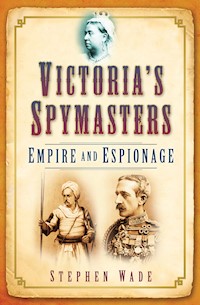
Covering the lives and achievements of five English intelligence officers involved in wars at home and abroad between 1870 and 1918, this exceptionally researched book offers an insight into spying in the age of Victoria. Including material from little-known sources such as memoirs, old biographies and information from M15 and the police history archives, this book is a more detailed sequel to Wade's earlier work, Spies in the Empire. The book examines the social and political context of Victorian spying and the role of intelligence in the Anglo-Boer wars as well as case studies on five intriguing characters: William Melville, Sir John Ardagh, Reginald Wingate and Rudolf Slatin, and William Robertson. Responding to a dearth of books covering this topic, Wade both presents fascinating biographies of some of the most significant figures in the history of intelligence as well as a snapshot of a time in which the experts and amateurs who would eventually become M15 struggled against bias, denigration and confusion.
Das E-Book können Sie in Legimi-Apps oder einer beliebigen App lesen, die das folgende Format unterstützen:
Veröffentlichungsjahr: 2011
Ähnliche
















VICTORIA’S
SPYMASTERS
VICTORIA’S
SPYMASTERS
EMPIREAND ESPIONAGE
STEPHEN WADE
First published 2009
The History Press
The Mill, Brimscombe Port
Stroud, Gloucestershire, GL5 2QG
www.thehistorypress.co.uk
This ebook edition first published in 2011
All rights reserved
©Stephen Wade, 2009, 2011
The right of Stephen Wade, to be identified as the Author of this work has been asserted in accordance with the Copyrights, Designs and Patents Act 1988.
This ebook is copyright material and must not be copied, reproduced, transferred, distributed, leased, licensed or publicly performed or used in any way except as specifically permitted in writing by the publishers, as allowed under the terms and conditions under which it was purchased or as strictly permitted by applicable copyright law. Any unauthorised distribution or use of this text may be a direct infringement of the author’s and publisher’s rights, and those responsible may be liable in law accordingly.
EPUB ISBN 978 0 7524 7588 2
MOBI ISBN 978 0 7524 7587 5
Original typesetting by The History Press
CONTENTS
Acknowledgements
Introduction
1. Intelligence in the Empire, c.1850–1918
2. Playing the Game
3. Robertson: From Staff College to the First World War
4. Wingate, Slatin and Egypt
5. Omdurman
6. Ardagh and the Anglo-Boer War
7. Sir Mark Sykes and the Diplomats
8. The Arab Bureau and the Sykes-Picot Agreement
9. Robertson and Intelligence after the Boers
10. Epilogue: MI5 and Spies
Destinations
Bibliography
ACKNOWLEDGEMENTS
Thanks are due to staff at the University of Hull Archives, and to the Sykes family at Sledmere, for permission to use the portrait of Mark Sykes and the illustration of Sykes’ Turkish Room. Conversations with staff at Sledmere led to some interesting ideas, so thanks are due to them. Other illustrations are from my own collection. In a broad survey such as this, one has to thank the experts whose work has opened up the questions and some of the answers regarding the story of military intelligence in these years: particularly Andrew Cook, Richard Deacon, Peter Hopkirk and Richard Holmes.
INTRODUCTION
Early in 2007, my book surveying the development of military intelligence in the British Army from the beginnings of the Great Game to the end of the First World War, Spies in the Empire, appeared from Anthem Press. That book emerged from my realisation that there was a glaring omission on the military history shelves: intelligence and espionage in the British Empire in those years. The decades between Waterloo and the Indian Mutiny have been traditionally termed ‘Years of peace’, as if there were an interim period in which nothing of any note happened. But, of course, as Ian Hernon’s valuable study, Britain’s Forgotten Wars (2003) makes clear, British servicemen were busy bolstering the margins of the red areas on the map all the time, in some remote corner or other.
But the gap was a commercial idea, too. The categories were (and still are) ‘Napoleonic’, ‘Empire’ and ‘First World War,’ and even John Keegan’s book, Intelligence in War, omits the later end of the nineteenth century in England, choosing instead to cover the achievements of Stonewall Jackson. Keegan wanted to focus on theory and influence, so that was understandable, but that lack of any general history made me gather information for this book.
It proved to be a gargantuan task. The sources and records are scattered everywhere, from obscure monographs to memoirs and letters. Those forty years included not only the miserable debacle of the Crimean War but also the under-resourced and terrifying confrontation with the sepoys in India and the arrogance displayed against the Zulu nation. But there was another story beneath the piecemeal assemblage of intelligence in both field and archive: it was a tale of individuals struggling against bias, denigration and confusion as the body of experts and amateurs which gradually became MI5, an intelligence corps per se, stepped into an identity.
Not only did the War Office show scant regard for the proper organisation of intelligence (something they could have learnt from Napoleon) but also for the higher echelons within the power machine, the movers and shakers of war, placing intelligence men on the margins until the hard lesson of the Boer Wars. Most of the time the staff relied in this field on locals and gentlemen scholars, or even farmers and settlers. John Dunn, Zulu general as well as interpreter and guide, epitomises this nonmilitary figure, having achieved marvellous feats in that intractable terrain: he met Queen Victoria and was lionised by the media.
To be fair, some of the great generals had an impact on intelligence work, notably Sir Garnet Wolseley. Paradoxically, some of his best bon mots and perceptions are tucked away in his journals, but we do have the well-documented gang of picked men around him in the Ashanti campaign to testify that he was in advance of his time in terms of such topics as local knowledge, astute deployment of field spies and so on. He saw that specialists and scholars had their value.
From that first extended essay in highlighting forgotten figures in this science, then, emerged the germ of a second book. Now I want to tell the stories of some key figures from that period whose names are not household words and who do not figure in the central narratives of popular military history. My aim here is to write their biographies and to explain what they contributed to the growth of intelligence studies and practice. I realise, naturally, that some of these men owe a great deal to their tutors, and there are some secondary figures here such as the strategists and ‘brains’ working from behind desks or in the classroom. Henderson, of the Boer Wars, is such a person, and also, of course, Baden-Powell, but the latter is all too well known thanks to Tim Jeal’s definitive biography.
Who are these men shaded and obscured by the scene-stealers of conflicts across the Empire? The first is Reginald Wingate, most celebrated for his achievements with Kitchener at Omdurman. But later in his life he was Governor General of the Sudan, and then High Commissioner in Egypt. He chose Rudolf Slatin, Austrian adventurer, who had been a prisoner of the Mahdi for years before he came out and won a considerable reputation both as soldier and as writer in the last years of the Victorian period.
Wingate, as we know from that classic of war reportage, With Kitchener to Khartoum (1898), by G.W. Steevens, was a man on top form in the march on Khartoum:
Whatever there was to know, Colonel Wingate surely knew it, for he makes it his business to know everything. He is the type of learned soldier in which perhaps our army is not as strong as it is on other sides. If he had not chosen to be Chief of the Intelligence Department of the Egyptian Army, he might have been a professor of oriental languages at Oxford.
Steevens is not above some hero worship, but that assessment is borne out by the evidence of Wingate’s character.
Then we have the second-in-command, Rudolf Slatin. Here was a man who did not fit any template or tradition at the time, yet he was invaluable as a source of knowledge about the enemy for Kitchener and his staff. His fascination goes beyond the battlefield, though: he was known by Queen Victoria’s court and circles, and he also became a contributor to rather high-class intellectual journals.
As for William Robertson, this man from a Lincolnshire farming family rose to become Chief of the General Staff, and we have pictures of him both reviewing troops and meeting high-ranking diplomats. His autobiography, shamefully out of print, is one of the most informative accounts of the stumbling and uncertain rise of the Intelligence Branch that we have today. Perhaps most valuable of all his contributions is his approach to that writing, because the style and manner are those of a bluff, forthright soldier who tends to think that he has seen a few remarkable things and that it should make a good read. How right he was, but also how he undervalued his own testimony to the men, places and ideas behind the intelligence work done in India in particular.
In John Ardagh we have a man much maligned in the aftermath of the war in South Africa, and here I am attempting a defence of him, as well as providing an account of his earlier career. In many ways, he was the ‘fall guy’ at a time when defeat and strategic failure were unthinkable in high places.
Finally, there is Mark Sykes, most famous (and infamous) for the Sykes-Picot Agreement of 1916, resolving the Middle East ‘Arab Question’ in a way that satisfied only Britain and France, and arguably an event which lead to all kinds of later problems. But a study of how Sykes worked in the diplomatic, military and indeed royal circles in the years up to and including the First World War illustrates the workings of intelligence centred on the Arab Bureau in particular. My biography will include his earlier military experience and travels in the East and the Middle East also.
This book has dual aims, however. To bring these people truly into consideration and to create a revisionist look at them, it is necessary to tell their lives more broadly, so I aim to balance the nature and the achievements equally of these characters where possible. It also means that some very major episodes in the colonial conflicts of the Victorian and Edwardian periods will have to be summarised, because above all this book is for the general reader with an interest in military history in the widest sense – from the work done in offices and classrooms to hand-to-hand fighting with the enemy.
The foundations beneath these stories are made of the very metanarrative of the years 1870 to 1918, and so world scale events in the context of diplomacy have their place too. What stands out when one reviews the intelligence systems in these years is the sheer multiplicity of definitions of what intelligence work constituted and who exactly did it. This is because for the latter decades of the nineteenth century there was a great deal of military and naval information which was accessible to anyone. Tsar Peter of Russia, in the Crimea, said that he learned all he needed to know of British strategy by reading The Times. There are stories of academics and politicians from good families visiting boatyards both in Britain and in Germany in the manner of tourists with notebooks.
Baden-Powell has not helped matters either. His influential essay, My Adventures as a Spy, highlights a practice of espionage at once ludicrously crass and simple and also very amateur. His account of going butterfly hunting and using nature drawings to hide sketches of gun placements is Boys’ Own stuff. Nevertheless, espionage had been, for some time before the Fenian movement and the Russian anarchists in the huge metropolis of London, taught some hard lessons in amoral ruthlessness; we had, in a sense, still to grow up in matters of military intelligence. When I was asked about my first book and I said that it was a history of military intelligence, many people replied, ‘Oh, and is there any?’ The image of the topic as textualised by the Punch cartoonist persists. There is also still too much of the Carry On pastiche in many people’s view of the officer class in the imperial years.
Victoria’s Spymasters is a work of discovery and also a plea for a second look at some people who made things happen, and more interestingly stopped even worse things happening (with the exception of Sykes). They all had to take severe criticism and they had to operate in an outmoded system of operations and command at times, but in the end, they were on the sides of the winners.
Along the road to these discoveries we inevitably have undercurrents and parallel stories, some of these relating to some massively important events in their own right. For instance, the impact of the Franco-Prussian War of 1870 was profound in the ranks of the British military establishment. Students at the Staff College went on battlefield tours to see the landscapes of tactics for themselves. Then there were the personalities: chiefly the diplomats, a body of men whose stories would fill a library with exciting tales and exotic scenarios, midnight intrigues and last-minute escapes. We have a suggestion of this in the life of Sir Howard Elphinstone, whose biography has recently been written by Martyn Downer: The Queen’s Knight (2007).
Victorian and Edwardian history has a superfluity of eccentric, wayward, egocentric, power-mad, inspired and possessed characters. Many of them were in the ranks of the diplomatists and spies. A few came up from lowly beginnings to positions of power in the security forces and in the new MI5, as Andrew Cook’s writings show. I hope that my biographies equally have something of a revisionist element, because I feel that history has dealt unjustly with some of my subjects. In the end, however, their actions will speak louder than any words written about them. If the present work achieves nothing else than helping readers look with fresh eyes at men who were in their time hugely important figures in the British Empire, then I will be satisfied.
A history of military intelligence in those eighty years embraces several major areas of interest and these provide the basis of the following chapters:
(1) The gradual emergence of the military intelligence arm of the military structure of the Empire.
(2) The influential individuals who played a major role in the professionalisation of intelligence.
(3) The failure of intelligence in several important campaigns, and the lessons learned.
(4) Foreign policy and the men who brought about reform.
Underlying all this, however, there is the undeniable hue of romance colouring the subject. The late Victorian novelists William le Queux, Rider Haggard and Conan Doyle have all played their part in creating this allure. But at the centre of the arena there is a mix of the romance of ‘spying’ and the straightforward military duties we would term ‘intelligence’. This means that the word espionage in the context of the Victorian imperial quest covers several elements, all a part of the scene as a whole. The sources of military information available during this period include activities as diverse as map-making and surveying; amateur scholars supplying cultural information; linguists and travellers who learned about the enemy, though in a desultory manner; personnel within the army, for a long period the ranks of the engineers; political officers on missions and, most fundamental of all, native ranks and civilians such as the ‘pundits’ employed by the administration of the Raj.
In practical terms this means that military intelligence for this seventy years was diverse, piecemeal, chaotic and massively amateur. What was needed was some method of classification and systemic implementation of knowledge. What happened was, until the last few decades of the century, very much a pragmatic process; ad hoc information was gained in any way possible. Of course there are several reasons for this slow and haphazard scale of change: the sheer vastness of the Empire, the pink on the map, was the main feature. In a world map included in a geography textbook published in 1908 the Empire’s pink stands out, bold and prominent: the Dominion of Canada; British Guiana; nine African possessions; India, Australasia and another forty islands and smaller places. The central geographical location of the following history, India, is explained in this way:
Our Indian Empire comprises the central and by far the most important of the three great peninsulas of Southern Asia, together with large territories on the eastern side of the Bay of Bengal. The total area of these vast dominions, most of which are under direct British rule, and the rest subject to British control, is upwards of 1,800,000 square miles, or more than thirty times as large as England and Wales, while the population is (according to the Census of 1901), 294,417,000.
From the early years of Victoria’s reign there had been a flowering of all manner of academic disciplines with the intention of listing, filing and describing the nature of the diverse range of peoples within this Empire. It was amateur, random and passionate. Very little in its aims had any link whatsoever with military intelligence. But as the century wore on, the high command was very gradually to see the usefulness of this vast store of knowledge.
Knowledge of language, culture and history was one thing worth attention, but at the basis of the whole enterprise was, before the arguably main turning point of the Crimean War, seldom related to direct information about the opposing armies in a war. In many ways, Britain learned the value of such activities from the Prussians and the French. It seems incredible to note now that the systems of Napoleon in this respect were so little noticed or studied. Napoleon’s method was to have a string of local and regional agents who in turn paid a set sum of money to their own agents. In that way, the obvious advantages of having native speakers of the language of the enemy was gained, and also local knowledge of topography, customs and political affairs was already in place to be exploited when the time came. As Edward Whitcomb has explained in the case of Napoleon’s information on Russia: ‘Bignon was appointed in December 1810 to obtain information on Russia. It was not until August 1811 that he was given 3,000 francs per month for espionage, and not until December 1811 that he was specifically instructed to establish a hierarchy or cell system.’
In other words, Napoleon was well aware of the need to make the diplomatic sources not only more reliable but better organised.
Yet, in spite of the general history involved, the preliminary considerations necessary for this historical survey must begin with the impact of the subject on the individual imagination. In an interview with The Times in April 2006, Peter Hopkirk stressed the importance of Rudyard Kipling’s novel, Kim, in this respect. Kim was published in 1901, when the great Mutiny of 1857 was still in the memory but far enough away to be reconsidered. Hopkirk explains the influence of the book in this way: ‘I used to dream of being sent on some secret mission by Kim’s spymaster, Colonel Creighton…Unfortunately, by the time I was old enough the British had left India.’ It is the imaginative pull of the Great Game that persists. The history around it also persists, as Hopkirk said in the same interview: ‘It’s extraordinary to see how history is repeating itself… Some of the players are different, but the Game goes on. Perhaps my books should be read as cautionary tales. Had the Soviet Union learned from the lessons of history, it would never have invaded Afghanistan.’
The mention of Russia is what completes the picture for the historian of the Victorian Great Game. The principal area of interest in this history has to be the three-edged combat zone of Russia, Afghanistan and British India, but as with all wars, other states and communities were drawn in. It is almost impossible now to imagine the sheer courage and sense of adventure in a political officer such as Captain James Abbott, a man who travelled from Herat to Moscow. His account of this journey, published in 1842, is one of the foundation texts of the military intelligence of that century. But there is more to the origins of the subject in the Indian continent than individuals. There are the families of administrators and their political officers, and these will form the basis of a main section of this book.
The individual imagination, powerful in the case of the lone adventurers, was always subject to the distortions of media representation later on, and so we have an inheritance of falsification; a view of spying within the Raj, for instance, that has generated myths and legends such as we find in the character and career of Sir Richard Burton. His image, as depicted in the brooding melancholic photograph of him in a long cape, taken around 1855, exemplifies this need to see political officers as especially Byronic figures, somehow doomed to be loners in both a physical and a spiritual wilderness. Burton and his personal qualities will recur throughout this history, not only in himself but in his nature as a template for that figure of mystery and intrigue. His biographer, Byron Farwell, crystallises this strange fusion of the eccentric and the rigidly professional in his personality: ‘He learned “mantih”, or eastern logic, in order to train his mind to think as an oriental. He mixed with Jat camelmen, studying their language and way of life.’ But he was capable of another cast of mind entirely: ‘Always fascinated by gold, he took up alchemy and tried his hand at producing gold from baser metals.’
There is also a theoretical dimension to this enquiry. The vastly influential classic work, On War, by Carl von Clausewitz, was published in 1830, just before his death. But the influence came much later; as Louise Wilmott has noted:
For some thirty years after his death in 1831, his ideas made little impact. More popular with the general staffs of European armies were contemporaries like Jomini who emphasised formal manoeuvres and rules of conduct, and who forsook the ambiguity and complexity which Clausewitz insisted were an integral part of war. This situation only began to change in the 1860s and 1870s.
The reason why military theory of an adventurous and intellectual turn did not have an impact on the British Army is not hard to find. Even after the triumphs of the war against Napoleon, little changed in the organisation of the structural nature of the army. In many ways, the concise statements made by Clausewitz on ‘Information’ were exactly what the first intelligence groups were to find out and understand: ‘Great part of information obtained in war is contradictory, a still greater part is false, and by far the greatest part is of a doubtful character.’
Basically, at the beginning of the period covered here, military intelligence meant finding out information by the traditional means: scouting, learning basic geography, questioning locals and, most of all, making sure that there were capable linguists in the regiment. At the heart of the whole enterprise was the officer class, and to understand the achievements of the political officers, it is essential to understand the means by which the officer class communicated, bonded and nurtured that special esprit de corps that would pay dividends in battle. One interesting method of gaining an insight into this mindset is to look at the publications of the regiments. For instance, The Journal of the Household Brigade of 1871 provides something profoundly important about the army’s sense of identity at the time of the Franco-Prussian War in Europe. The journal covers sports reports, lists of brigade masters of hounds, ‘the chase and the turf’, steeple chasing, pigeon shooting, theatricals, yachting, balls and concerts. Nothing could exemplify the spawning ground of the political officer as well as this: notice that the list of activities represents the enormous gap of time to be filled when an officer was at home, away from the front line of active service. But it was training in disguise: the sport, and other personal developmental activities, helped form an attitude. With all this in him, all the habits of endurance, teamwork and invention, out in India he would go shooting for weeks, and in between the sport there was ‘information’, and, of course, improvement in spoken Hindi, perhaps.
These officers were to cluster around the more charismatic figures out in the Empire, men such as John Nicholson, hero of the Mutiny, and Henry Lawrence, who had a group of protégés for whom he had a special regard and whose careers he nurtured. Charles Allen has defined this ‘band of brothers’ very clearly: ‘Such close friendships, between lonely men who lived many miles from each other, finding open expression only in the event of the death of one of their company, were very much the order of the day. This was a brotherhood of young men who shared a vocation: they saw themselves very much as a band of brothers, Paladins at the court of their master and mentor, Henry Lawrence.’
It is no accident that the date of 1873 is an important one for the history of military intelligence. As Sir George Aston wrote in his memoirs, ‘After 1870 the whole of Europe sat at the feet of the Germans as the most efficient soldiers in the world.’ A whole tranche of army reforms in Britain followed that key date, and as Aston notes:
Once started, the idea that the British Army was maintained, partly at all events, for waging war began to take root, with the obvious corollary that the more that it knew about foreign armies the better. The result was the establishment of an Intelligence Branch (under the adjutant-general of the forces) on a separate basis on the first of April 1873.
The military intelligence existing in the Victorian period has been overlooked in much military history in recent years. It is not an easy matter to explain this. Even John Keegan’s book on ‘knowledge of the enemy from Napoleon to Al-Qaeda’ avoids the British situation in this period and discusses Stonewall Jackson instead. It is tempting to say that the story of the secret services in the year between Victoria’s accession in 1837 and the establishment of the Intelligence Branch at Queen Anne’s Gate in 1873 is so piecemeal that historians can find no distinctive narrative.
It cannot be denied that from the early nineteenth century, when police informers and agents provocateurs were profitably employed by Lord Sidmouth to root out radicals in the working-class movements, to the Crimean War in 1853–56, all the varieties of intelligence gathering were rather ad hoc and rarely well organised. The foundation of the police force in 1829, by Sir Robert Peel, was seen by many as the first step towards a totalitarian regime in Britain, but no-one in the establishment complained when some of Feargus O’Connor’s ‘Physical Force’ Chartists were spied upon and monitored as they drilled on Woodhouse Moor in Leeds.
Throughout the century there was an overlap between military intelligence in the strict sense and all foreign affairs. There was also a blurring of distinctions when it came to understanding what the separate roles of the police were, as opposed to the army personnel, when the Fenians and Anarchists began to infiltrate London from the 1850s onwards. In fact, in much popular writing, police spies were seen as the lowest of the low, often depicted melodramatically as if they were products of the worst excesses of the French Revolution.
But the fact remains that from Waterloo to the Crimea, intelligence available to military commanders was often nothing more than hearsay given by travellers or even newspaper articles. Wellington was asked in 1851 about the Kaffir War, and he replied that he had ‘never had any information on the causes of the war… or the objects of the government in carrying it on…’. The Duke relied on newspaper reports during his last years as commander-in-chief, from 1842 to 1852.
Another reason why the subject has not been explored for some time is that the army tended to rely on the reports of English gentlemen who travelled in the dangerous regions where border disputes and potential invasions were always likely. The obvious example is Afghanistan, in the period from 1830 to the end of the century. Most of the intelligence work, when the Russians were seriously engaged in making incursions into India by way of Khiva and Bokhara, was done by bold individuals, either private citizens or young officers out to make a reputation.
In many instances, commanders of British forces would be learning desperately important information as they moved their forces around, hoping that the right characters would be on hand, or that sheer courage and reputation would see them through. One of the direst learning experiences was to be in the Zulu campaigns of 1879, when certain examples of the superiority of the intelligence gained by some of the Zulu Impis shamed the British forces, with their reputation for efficiency.
A typical example of the kind of wayward character who tended to figure prominently in intelligence gathering at the time was Charles Masson, a wanderer and scholar who actually travelled on foot across vast areas of Central Asia, and was only found out after many years of random information sourcing by Captain Claude Wade, political agent in Ludhiana. Masson was in reality a deserter from the East India Company called James Lewis. While Liuetenant Alexander Burnes had been cultivating the friendship of Dost Mohammed in Kabul, to maintain a buffer state against Russian designs on northern India, Masson/Lewis had been busy also. When the British government wrote to Dost Mohammed in a tone of haughty disapproval, with no real promises made about backing or supporting him in military terms, it emerged that Burnes’s spying and intelligence-gathering had been in vain: the Russians had been in touch with Dost first and alliances made. Masson blamed Burnes.
The affair highlights the failures and dangers of the methods at work at that time: it was desultory and pragmatic. If information was needed, a young officer would be sent to sort it out. The officers in question usually had command of several languages, had diplomatic skills, and preferably had a talent for making rough maps and accurate sketches as they moved along through potentially hostile terrain.
When some kind of system did appear on the table for discussion, it came from a man who was a mere retired major from the Bombay Sappers and Miners. This was Thomas Best Jervis. He had a passion for maps, and worked energetically to persuade the War Office that cartography should be more highly prized. In 1837 he was made surveyor-general of India, and was supposed eventually to succeed Colonel Everest, but he became tired of waiting for this chance and returned home. There he followed all kinds of practical geography, and wrote to Lord Aberdeen to insist that cartography would have helped immeasurably in recent foreign skirmishes.
It took the Crimean War to make heads turn and start listening to Jervis. Lord Raglan, in command of the expedition, was known to comment on his lack of knowledge of the theatre of war he was about to enter. Amazingly, Jervis obtained a detailed map of the Crimea from a contact in Belgium. The map had been made by the Russian general staff. Jervis was going to be listened to after that.
In 1855, the War Office eventually created a specific department for cartography and statistics. The Topographical and Statistical Department (T&S) was to be the first real step towards proper military intelligence within the military establishment.
It has to be asked, however, what kind of intelligence was going to be needed as the Empire expanded and British forces were continually packing up and setting off for distant shores? Clearly, accurate maps were useful, and so was general information about the cultures of the societies who would be hosting their military presence. But what about actual military policy, with some kind of system, in that respect? Britain had learned a hard lesson, and that was from the Prussian Wilhelm Stieber. When he came to the Great Exhibition in 1851, Stieber was seen by many as a ‘freelancer’; instead of being dedicated to the Prussian services he was in the pay of Russia. It became clear that Stieber had succeeded in operating as a double agent in many European cities, and when he finally surfaced in Russia after some years of absence, he eventually became the man who did most to initiate the feared Ochrana, the Russian secret police in the Tsarist Empire.
It had to be considered: if other powers could do this kind of covert work, why not Britain? Indeed, we were to learn that aspect of the Great Game in such figures as Major Henri le Caron, otherwise known as Thomas Beach from Colchester. Yet still it took twenty years from the creation of the T&S to the first formation of the Intelligence Branch. By that time, it was beginning to dawn on the leaders of the armed forces that military intelligence was a much more complex process than had previously been thought. As John Keegan points out in his book, Intelligence in War, the process involves acquisition, delivery, acceptance, interpretation and implementation. It was surely with a sense of shock and alarm that the commanding officers who controlled the British Empire when the Thukela garrison in the Zulu War Eshowe Campaign of 1879 were ready to move, that the Zulus were aware of their intentions. The journal of Lieutenant Hamilton at that time notes that some Zulu spies were captured and gave Colonel Pearson all kinds of startling information, including the fact that the British force was surrounded by 35,000 men.
Obviously, the Zulu had a full understanding of the five stages of intelligence: they had acquired knowledge of the garrison, delivered that information to the Impis generals, accepted the facts as true by observation, interpreted the facts and details in the light of what could be seen and counted, and finally implemented their strategy in response by gathering three Impis at the right place.
Of course, in 1873, the Intelligence Branch had a massive brief and a whole third of the earth to handle as its province, rather than a stretch of Natal. It seems odd now to read that the first staffing arrangements for the new Branch involved, for instance, two officers and a clerk to cover the Russian empire. The base they operated from consisted of a house in Adelphi Terrace and a shambling old coach house and stables tucked away in Whitehall.
The aims of the new Branch were expressed this way:
The preparation of information relating to the military defence of the empire and the strategical considerations of schemes of defence; the collection and distribution of all information relating to the military geography, resources and armed forces of foreign countries and the British colonies and possessions; the compilation of maps and the translations of documents.
The two officers and the clerk must have contemplated the map of Russia with a sense of awe and confusion.
By the end of the century, however, when London itself and even the person of the Queen were targets of enemies, there had been an expansion of the responsibilities covered by the Branch, and a sure liaison with the Metropolitan Police. When Sir William Melville, a top policeman in 1896, set to work in defending the capital city, he did so in tandem with the army. This was the man who first recruited the infamous Sidney Reilly, and so began the next age of the spy.
At the beginning of Victoria’s reign, the nature and composition of the armies who preserved the Empire is of particular interest with regard to the place of military intelligence. There were two armies, of course, when it came to India, the ‘Jewel in the Crown’, where most anxieties lay in terms of Russian expansionism. There was a force of a quarter of a million men serving the East India Company, and the 100,000 members of the British Army per se with headquarters at the Horse Guards in London. This duality was resolved after the Sepoy Mutiny of 1857 when the direct rule of India passed to the government from the Company. The British Army comprised thirty-two regiments and the engineers. The sappers were, it seems, a floating concept. They were so indefinable in the sense of what duties they performed that at most stages of a campaign they were seen as the home of whatever intelligence personnel might be identified in a particular setting.
As Jan Morris has pointed out, the fact that in most aspects the British Army had not changed attitudes and conduct since Waterloo was never going to help the receptivity needed for anything innovative to be done. New ideas were not apparent in dress, nor on the parade ground, and not even in marksmanship. Basically, ritual was at the heart of the army, and that had served well as a way of integrating men of all kinds and backgrounds, so why change the whole war machine? It was going to take a major war to highlight the need for proper, respected and effective military intelligence.
The final piece in the mosaic here is the place of the Foreign Secretary and of the general practice of diplomacy and intrigue. How the interests of administrators and military men could clash and cause havoc was seen in the Dost Mohammed affair, when Lord Auckland, in Simla, had failed to understand the relationship between the British buffer zone Sikh leader, Ranjit Singh, and the various aspirants to the government of Afghanistan. But on a more general level, much depended on the Foreign Secretary at home.
The most celebrated example is Lord Palmerston. In the Athenian incident of 1850, when a trader was trying to force some compensation from the Greek government, Palmerston sent a gunboat to sort it out, and his words of explanation are important in our understanding of how military intelligence and diplomatic intrigue were to become so complicated: ‘A British subject, in whatever land he may be, shall feel confident that the watchful eye and the strong arm of England will protect him against injustice and wrong.’
Palmerston’s statement would prove very difficult to enforce in the distant and dangerous borderland of the Kizilkum Desert and the Emirate of Bokhara, where British agents had been tortured and killed in the 1830s. But Palmerston showed what needed to be done in the role of relating foreign affairs to popular knowledge and support at home: he was skilled in media relations and he knew how to take the pulse of popular feeling about world affairs.
After the fiasco of the Crimea, the importance of the relationship between the implementation of foreign policy and the work done by the War Office on promoting military intelligence was to become increasingly centre stage in imperial politics. With hindsight, and with the sophistication that comes with more complex technological warfare, recent analyses of some of the major battles of the nineteenth century have expended pages of indignant commentary on military incompetence. A publication of 1903 has this comment on a Boer War confrontation: ‘In spite of much British bravery, the combat of Lang’s Nek was an unquestionable and severe defeat. But many noble deeds were performed.’ Now, as Saul David rightly comments on another imperial battle, ‘the British commander, Lord Chelmsford, had made the cardinal error of not according their (the Zulus) capabilities proper respect.’ In other words, in an age in which military intelligence is highly regarded and has become an academic and strategic discipline, the wars of the Victorian era, with their amateurish reliance on dash and valour, seem ludicrously simple and defeats are all too easily understood.




