


25,99 €
Mehr erfahren.
- Herausgeber: ibidem
- Kategorie: Geisteswissenschaft
- Sprache: Englisch
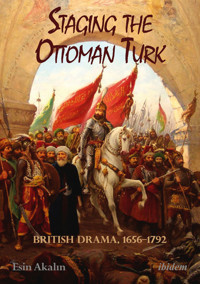
In the wake of the fear that gripped Europe after the fall of Constantinople (1453), the English dramatists joined most continental artists (literary and visual) in representing the Ottoman Turks in plays inspired by historical events. As the many subjective elements involved in the stereotyping of the Turks in these plays—revolving around complex themes such as tyranny, captivity, war, and conquests—arose from their perception of Islam, Ottoman milieu as a dramatic setting provided for the English audiences a common experience of fascination and fear of the Other. The Ottomans' failure in the second siege of Vienna (1683), however, became a factor in the reversal of trends in the representation of the Turks on stage. As the ascending strength of a web of European alliances began to check further the Ottoman expansion, what then began to dazzle the aesthetic imagination of the eighteenth century England was the sultan's seraglio with images of extravaganza and decadence. In this book, Esin Akalın draws upon a selective range of seventeenth and eighteenth century plays to reach an understanding, both from a non-European perspective and Western standpoint how one culture represents the other through discourse, historiography, and drama. The book explores a cluster of issues revolving around identity and difference in terms of history, ideology, and politics of representation. In contextualizing political, cultural, and intellectual roots in the ideology of representing the Ottoman/Muslim as the West’s Other, the author, ultimately, tackles with the questions of how history serves literature and to what extent literature creates history.
Das E-Book können Sie in Legimi-Apps oder einer beliebigen App lesen, die das folgende Format unterstützen:
Seitenzahl: 606
Veröffentlichungsjahr: 2016
Ähnliche




















ibidemPress, Stuttgart
Table of Contents
Acknowledgements
There are a number of people in my life to whom I owe gratitude for the support they gave while I was engaged in this study, which was originally a Ph.D. dissertation. I would like to begin by expressing my heartfelt thanks for the invaluable support, assistance, guidance and encouragement I received from Brian Corman, Domenico Pietropaolo and Roseann Runte.Words are not sufficient to express my thanks and appreciation to each one of them, who gave unselfishly of their time and energy.
To Brian Corman, always a source of advice and wisdom, I must extend my special thanks for his guidance. He has been most perceptive, challenging and a thorough reader. With the greatest warmth and regard, I thankRoseann Runte, who, with such generosity of spirit, provided me excellent feedback and most insightful comments during the entire process of writing this book. I am most grateful to Prof. Pietropaolo, whose positive attitude, thought-provoking questions and insightful comments were invaluable for my research.
I acknowledge with special gratitude andappreciation, the financial support provided to me by the Open Fellowships of University of Toronto, and a Travel Grant, which allowed me to do research at the British Library in London.
The most profound acknowledgementgoes to my family. My greatest debt, an incalculable one which I cannot begin to repay, is to my husband Oguz,my daughter Derya and my son Kaan. I dedicate this book to them.
Last but not least: thank you Mom and Dad (Guzin and Fethi Kismet) for sending me to the English High School for Girls in Istanbul.
PEACE!
Introduction
To the eye of the initiated this curtain produces only images
But to him/her who knows the signs, symbols of truth.
Sheik Kusteri[1]has founded his curtain
Making it a likeness of the world;
To watch it amuses those who are looking for entertainment,
But those who behold the truth learn a lesson from it.
(An "Ode of the Screen" to a Turkish Shadow Play)
Although the Ottoman[2]culture, before the mid-nineteenth century, engendered neither formal tragedy nor comedy (Halman 17),Karagoz(Turkish Shadow theatre), one of the three principal norms of popular performance tradition in the Ottoman Empire, evolved as a comic genre[3].The world ofKaragoz, the illusionistic art of the shadow play, reflected the multi-faceted feature of the Ottoman culture and incorporated a total of three hundred and fifty characters, both Muslim and non-Muslim, and non-Turkish but Muslim minorities as subjects. This was an assemblage from various provinces of the Empire such as the "Rumelili" or "Arnavut" (Albanian) from the Balkans, "Laz" from the Black Sea Shore, "Kastamonulu" from Central Anatolia, "Kurd" from South East Region, and so on. All of these figures made up a delightful assortment of characters wearing their local costumes and speaking their local dialects. The non-Turkish minorities of the empire such as the Arab, Armenian (Ermeni), Greek (Rum), Jew (Yahudi), French (Frenk),Levantine and Persian (Acem) each speaking with their own accent as residents of themahalle(quarter) ormerely as passers-by, reflected the Ottoman's diverse world onto theKaragozscreen. The tradition in the House of Osman was not a national, but a dynastic and multiracial empire in which the Turkish language played a significant role in creating unity. Its varied populations whether Turkish, Muslim, Christian or Jewish were above all else Ottomans, members of a single body politic. Although Islam was a powerful element in the collective consciousness of the empire, the Ottoman system transcended "above all else conceptions of nationhood, religion and race. Alone in its time, it thus gave recognition to all three monotheistic faiths" (Kinross 614). In essence, the world of the Turkish shadow theatre with its individual puppets, each representing the typical characteristics of various groups, was a microcosm of the cosmopolitan city of Istanbul.[4]In its early period of existence, Islam, aspiring to fight idolatry, forbade the representation of living things, especially human faces. Because its worship centred exclusively on the act of silent prayer, drama and music had no place in its liturgy. Representation and animation of human figures were considered an intrusion upon the creativity of God; and imitation of His creatures was the equivalent to sin. Despite the austerity and rigidity of the Orthodox Islamic views of plastic arts and drama, through the ingenuity of the human mind, Shadow Theatre flourished during the Ottoman Empire. As Nicholas Martinovitch points out, "the creative genius of the human spirit" in an effort toovercome religious constraintsproduced figures which were distortions and parodies of human figures. Moreover, by perforating the puppets, the creators found a way of eliminating their "animate" nature, which would otherwise advocate idolatry (Martinovitch 35).
During his campaign to Egypt, Sultan Selim is said to have asked a puppeteer of ahayal-i-zil[5]performance to go with him to Istanbul, so that his son Suleyman I could see the shadow play. During the reign of Suleyman the Magnificent,Karagoz, reflecting the cultural vitality of the empire, constituted not only a prominent part of the imperial life, but in displaying a broad spectrum of socio-political, psychological and moral issues, it also fascinated the Ottomanpopulace. As the neighbourhood (mahalle)displayed on theKaragozscreen reflected the social pattern of a traditional quarter in the city, the audiences witnessed a parade of images of all typical Ottoman inhabitants, who were noticeable through their ethnic and regional attributes. This was significant because the residents of themahallewere all subject to the decrees issued by the sultan. Their representation on the screen conveyed the reality that there was no distinct separation between the Turkish and non-Turkish/non Muslim populations, who freely mingled with each other. As Evliya Chelebi, the foremost Ottoman travel writer and cultural commentator reported,by the seventeenth century, although Hasanzade, a prominent master of the Turkish Shadow Theatre, incorporated three hundred skits in his repertoire, he had no authority to represent the Ottoman sovereign. The characters were all drawn from common people:
No player would have dared to present to the spectators the silhouettes of the Sultan, of the viziers or of any dignitaries of the Empire. All civil, military or religious authorities were banned from the Shadow Theatre screen either through fear or reverence. This of course did not prevent their being replaced by symbols, which were in harmony with the atmosphere of the 'mahalle' and which veiled their secret identity as well (Siyavusgil 25).
In an empire ruled by an absolute monarchy and a totalitarian regime, while the prohibition to portray the sultan or hisvezir, did not prevent their representation by symbols, eachKaragozshow, however, was "arisque-revue, as fearless as a militant newspaper" (And,Karagoz67). By a curious irony, though, as Western weekly papers recorded events from the Ottoman court,sultans,vezirs,agasandmuftis, all in their opulent costumes playing out all signifiers of Otherness, populated European stages. Thus, in addition to topical news and political history, a long dramatic tradition kept the Ottoman sultans and their affairs in the forefront of Western minds. Along with Renaissance travelers such as Sanderson, Sandys, Lithgow and so on, London dramatists like Peele, Marlowe, Shakespeare, Heywood and others produced the canonical version of Renaissance thought about Islam and/or the Ottoman Turk. Just like the travelogues, which were not simply a portrait of cities and landscapes in the Orient, but written with a conscious rhetorical effect, Renaissance drama presented a similar ideology displaying standard, received ideas about the Ottoman Empire. As the travelers drew their descriptions of the Ottomans (particularly the sultans and other dignitaries) from a distant and unreliable view of sights that were "forbidden" to the outsiders in the Ottoman Empire, the dramatists based their depictions on this collective store of "knowledge" about the Turks. The moral of Richard Knolles' massive edition of theGeneral History of the Turkes(1603), for example, attested to the fact that an "armchair" historian without leaving England could give an account of the historical events of Ottoman/Islamic culture though a collection of erroneous interpretations, representations, attitudes, interests and stereotypes.
Representation of the Ottomans on the English stage can be traced back to the tradition of the English folk plays and the Mummers'Plays with the part of the Turkish knight opposing St. George, performed by an actor in"Herod's vein"and in all likelihood, with a blackened face(Tiddy 14).Despite references to Turkish knights in romances or folk playsprior to the sixteenth century, for the Englishman the Ottoman, as Wood notes,"if he existed at all, was but a shadowy figure inheriting the opprobrium formerly heaped upon the Saracens by generations of crusaders"[6](Wood 1). The figure of the Turk[7]as a fixed type, loosely representing the "pagan" as such, or the idea of anti-Christian forces, was not simply restricted to allegorical treatments as in a Mummers'Play. Since the terms "Mohammedan", "Moslem", "Arab", "Turk" and "Saracen" were used almost interchangeably as mere theological abstractions within the universe of Western discourse, the distinction between Ottoman and Turk was also neutralized in eighteenth-century dramatic representations. Originally, the term Turk applied only to one of the nomadic peoples in Central Asia. As themillet(literally "nation") system of the multi-religious, multinational Ottoman Empire aimed to create one civilization, the Turk was regarded as only one of the representatives of the cultural mosaic of the diverse peoples of the Ottoman society. In the West, while the Turk was synonymous with Muslim, Islam was defined as Mohammedanism. Considering that even in the Age of Enlightenment theDictionnaire universeland theDictionnaire de l'académie françaisedescribed the word "impostor" as synonymous with Mohammed, the discursive confinement of the Islamic prophet as a "type" led to the polemic use of the term Mohammedanism, as "an insulting European designation" (Said 66). Despite its pejorative connotation, the incorrect definition of Islam was based on the assumption that "Mohammed was to Islam as Christ was to Christianity" (Said 60).Referring to the stereotypical notions generated about the complex society of the Ottomans, who"established one of the longest-lived (ca. 1300-1922), yet least studied or understood, dynastic states in world history"(Kafadar, xi) Naff writes:
While the Islamic image has always been distorted[8]or misrepresented in the West, the Islamic world of the eighteenth century—particularly the Middle Eastern heartland of the Ottoman Empire, its Arab and North African provinces...has been a prime victim (Naff 3).
In the course of the analysis of varies dramatic texts, this study aims to shed light on the politics of representation by contextualizing and analyzing the practices of representation of the Muslim/Ottoman Turk on the English stage. The opening chapter analyzes the problems of historiography of the Ottoman Empire in order to reach a historicized understanding of the complexity of Western values and attitudes towards the Muslim/Ottoman Turk. Itsets out the foundations of the ideological positions articulated by cultural, religious and historiographical strands in the plays. The following chapters will explore how the Ottoman milieu as a dramatic setting provided for the European audience s a common experience of fascination and fear of Other. With an awareness of how the dramatists operated within the discursive limits of the seventeenth and eighteenth centuries, each chapter offers a detailed consideration ofthe vital role that European drama played in the formation of Western assumptions and conclusions about the meaning of East/Ottoman/Muslim.
The first chapter, which offers a theoretical, discursive and historical basis for the analysis of specific representations of the Ottoman Turks, lays the foundations of successive chapters, categorized according to the reigns of the sultans depicted in the plays. Essentially, the relevance of the texts in the sphere of the ideological, formsan historical and analytical basis for the representations of Ottomans which have evolved across a range of generic forms.
The most important contextualizing factors which need to be acknowledged in addressing the politics of representation are (a) the relationship between dramatic representations of the Turks and their material world(b) discursive practices that produced knowledge about the Ottomans and their power (c) a cluster of issues revolving around matters of identity and difference. In this context, it must be emphasized that the endlessly repetitive, highly intertextual denial of Ottoman realities in these plays determines in advance the dramatization of the characters. In other words, it is the whole repertoire of imagery and visual effects that organizes the representation of the Ottoman Turks by channeling difference into dichotomies such as Self and Other, West and East, Christian and Muslim.Ultimately, in arguing not only how dialectics shape the representation of the Ottomans and constitute a force in the plots and the stagecraft, but also how they establish the "truth of the matter" (Hall 46), this study draws upon different methodologies by offering a selective overview of a range of theories and arguing for the importance of gleaning certain features from each.
In the representation of Ottoman Turks in English drama (1656-1792), the "Orient" is crucial in the ideological construction of the West. Yet, ironically, the decline of the Ottoman Empire from the eighteenth century onwards also seems to serve the ideological construction of a somewhat abstract, ageographical and ahistorical "Orient" by scholars of the twentieth century who have vigorously allied themselves with studies that explore the relationships among knowledge, power and politics. To offer a specific example, Edward Said's renowned book, to which this thesis owes a great deal, has its own cultural distortion and bias as it refers to the Ottomans only in passing. Said's amply documented scholarship which not only discusses the unified character of the Western discourse about the "Orient" from antiquity to the present, but which specifically deals with Islamic Orientalism, tells us nothing about the Ottoman Empire (1299-1922).Since there are already difficulties in overcoming the pervasive negative assumptions about the Ottomans embedded in Western understanding, the overgeneralization of the historical interactions of systems and cultures and an unwillingness to confront concrete realities of the past, make the Ottoman case particularly complex.Consequently, in analyzing the representation of Turks in English drama, the aim of this study is not only to seek a solution to the failings of a Eurocentric orientalist history, but also to overcome the historigraphical and methodological problems arising from the current counter-hegemonic"regime(s) of truth"(Foucault 1980, 131) which claim to give voice to the unvoiced.Orientalism as Said asserts, is a"corporate institution for dealing with the Orient—dealing with it by making statements about it, authorizing views of it, describing it".And, this study interrogatesthe relations of knowledge and power, culture and politics by anchoring its arguments in the empirical depths of the seven hundred years of the imperial experience of the Ottoman Empire, historiographically documented as "the Orient".
Chapter 1:Historical/Theoretical Perspectives
1.1.TheHistoricalBackground
In the sixteenth and seventeenth centuries the Ottoman state was a world empire which influenced directly or indirectly the lives of millions in theMediterranean, in EastCentral Europeand theMiddle East. Its geopolitical position, vast territory, ample human and economic resources, its magnificently efficient administration and its army, one of the best organized military machines of the early modern period, gave the Ottoman Empire the status of a world power
(Agoston 126).
Since its publication in 1978, Edward Said's account, inOrientalism, of the Western approach to the Orient has been both pivotal and a major incentive for the growth of work on colonial discourse. In seeking to trace the interrelations of culture, history and textuality, Said, in his widely read and greatly influential book, ultimately leaves the reader with the observation that:"Europe is powerful and articulate;Asiais defeated and distant"(Said 57).Said separates East and West from a wide range of perspectives—political, religious, economic, historical, cultural, etc.—which go back as far as Aeschylus'The Persiansand conclude with Kissenger, and claims that Orientalism is a"broadly imperialist view of the world"(Said 15). In discussing the East/West relationship from a"general and hegemonic context"(Said 9) Said draws attention to a"geopolitical awareness into aesthetic, scholarly, historical and philosophical texts"(Said 120). He claims that Western political and intellectual domination over the East has defined the nature of the Orient as weak and that of the Occident as strong. Said's model of "'fixity' in the ideological construction of otherness" (Bhabha 8) is for Bhabha[9]a"historical and theoretical simplification"(Bhabha 25). This applies to the Ottoman case from the point of view that Said's ahistorical and ageographical approach to the Orient does not do justice to the historical realities of theOttoman Empireas a world power in the sixteenth and seventeenth centuries.
What is essentially problematic inOrientalismis that it tells the reader nothing about centuries-old Ottoman imperial order. In exploring the relations of knowledge and power, and of culture and politics as the determining elements in defining the worlds of Islam and Christianity, Said refers to the Ottomans only in passing. In his introduction toOrientalism, which has widely informed studies of Western encounters with Islam from the time of the Crusades to the present, Said defines his premise with precision and clarity by stating that he will deal with theNear Eastwith occasional reference toPersiaandIndia. He indicates that in his work"a large part of the Orient seem[s] to have been eliminated"such as"Japan, China and other sections in the Far East—not because these regions were not important (they obviously have been)"(Said 17). In his amply documented book, Said begins by confronting the domination ofBritainandFranceof"theEastern Mediterraneanfrom about the seventeenth century on"(Said 17). He is almost apologetic about the fact his discussion will"not do justice to the important contributions to Orientalism of Germany,Italy,Russiaand Portugal"(ibid). Ironically, in his apparent chronological account of Orientalist/imperialist[10]exploration and expansion, Said, as he focuses on the British and French experience of the East, makes a conscious choice not to talk about theOttoman Empire, historiographically documented as "the Orient".The problem here is that the semantic domain of the concept of power includes the concepts of appropriation and domination, which turn up frequently in Said's characterizations of the will to power. Paradoxically, however, based on Said's own appropriation of the domain of the Orient, the six hundred years of the imperial experience of the Ottoman Empire is discarded outright or "when mentioned, is rendered unrecognizable or irrelevant" (Zilfi 4). However, the Ottomans who had excelled in statecraft and administration, financial policies, land and military organization, were a"centralized andself consciously imperial state"(Kafadar xi). As Francis Robinson writes inThe Illustrated History: Islamic World:
After taking Constantinople in 1453 the Ottoman Emperors Mehmet the Conqueror (r.1444-46/1451-81), Bayazid II (r.1481-1521), Selim (r.1512-20), and Sulayman the Magnificent (r.1520-66) conquered the fertile crescent, Egypt, and the Hijaz, thus gaining control of Mecca and Medina, Yemen, and North Africa up to Morocco (Robinson 65).
In 1453, the capture ofConstantinople, renamedIstanbul, was seen as the realisation of the"apocalyptic prophecies circulating"(Robinson 58) about the new capital of theOttoman Empire.Istanbul, the location (previously besieged by the Arabs in 668) betweenEuropeandAsia, symbolized the beginnings of the Ottoman Sultan's religious and political power in both the West and the East. In 1500s the Ottoman armies not only began to penetrate Eastern Europe, but with the conquest of Egypt in 1517, the office of the caliphate—reaching back to the Islamic Prophet—which was previously claimed by Mamluk Sultans, officially passed to the Ottoman Sultan.[11]This meant that from the sixteenth to the twentieth century, that is, until the 1922 abolition of the caliphate by Mustafa Kemal Ataturk, founder of the secularTurkishRepublic, it was the Ottoman Sultans who, as the heads of Islam, were the sovereigns of the Muslim world. As Lord Kinross writes:
Of more tangible significance was the transfer to Istanbul of the standard and cloak of the Prophet, relics whose possession symbolized the status of sultans as protectors of the holy places of Mecca, Medina and the pilgrim routes of the Hejaz, hence Islam in general (Kinross 170).
In this context, it is crucial to emphasize that it was only from the nineteenth century onwards that the Ottoman Islamic world system was overwhelmed by forces from the West, driven by capitalism and empowered bythe Enlightenment and the industrial revolution. As for 1798, it was a symbolic moment when not only did the leader's standards pass to Europe, but when Western standards, Western armies and Western capital overran the Ottomans with Napoleon's invasion of Egypt, which had been an Ottoman province since 1517.
The Ottoman success in withstanding the Western challenge had continued until the end of the seventeenth century.Yet, the Ottoman defeat at the second siege ofVienna(1683) against a combined Habsburg-Polish army and the subsequent treaty of Karlowitz (1699) marked the beginnings of the long and slow retreat of the Ottoman Sultanate from their European conquests. By the close of the eighteenth century,Western Europe, with its gun-power revolution and superior naval technology was invulnerable to the Ottoman power. Ultimately, as the Ottomans became politically and economically dependent onEurope, they began to adapt themselves to the challenge of Western superiority (Inalcik 1994, 3).
Although Said's main focus is on the post-Napoleonic period in which the European powers have begun the process of imperialism and colonization of the East, his work has been applied to the studies of Western encounters with Islam of different periods. In this respect, his overgeneralization of the Orient is problematic and his general claims, made through a rough historical overview, are misleading. Said's binary opposition of the East and West through configurations such as weak and strong, inferior and superior, etc. should be more"complex and multifaceted"as Vaughan has shown in her historicist analysis ofOthello, which exemplifies the English concern about the power of Ottoman Islamic imperialism (Vaughan 27). Renaissance curiosity and anxiety about the Ottomans produced an outpouring of texts in the form of travel narratives, historical and political studies, polemical and religious tracts, ballads, poetry, fiction and drama, perhaps the best way of conveying ideas and knowledge about the Turks, who inspired fear and fascination inEurope.
Throughout the sixteenth and seventeenth centuries, while the Christian West was conquering indigenous populations in theNew World, the Ottoman power had already pushed beyond theMediterranean, as far as the walls ofViennaand had even crossed theEnglish Channel. After Columbus'conquest ofAmerica, while the Europeans ventured across theAtlanticandPacificOceansand"took possession"(Greenblatt 9) of the peoples they encountered, the Ottomans with their formidable army held power overEurope, conquering, capturing and converting Christians to Islam in large numbers. If Christian Europeans, as Greenblatt asserts,"felt powerfully superior to virtually all the peoples they encountered"because of their conviction that they had the"absolute and exclusive religious truth"(Greenblatt 9), there were similar attestations to the Muslim sense of certitude and superiority over the Western world. By a curious irony, Said's radical theory and views about the Orient are clearly evident in the following statement, which represents a construct, not a reality, and his own stereotypical and mythic East of the past:
The other feature of the Orient was that Europe was alwaysin a position of strength, not to say domination. There is no way of putting this euphemistically…the essential relationship, on political, cultural and even religious grounds, was seen—in the West, which is what concerns us here—to be one between a strong and weak partner (Said 40).
Considering the political significance of the Ottoman-European trade relations and"the fierce competition among"(Naff 100) European countries to appear in treaties as the Ottomans'"most favoured nation", the essential relationship between the East and the West was one in which the Ottomans were"in a position of strength". Ultimately, in Eastern and Western commercial relationships, it was the Ottoman sultanwho was the"strong partner"as he ruled the Ottoman lands that extended from Istanbul to Aleppo, a crucial link in the silk route that led to China. Among these lands wereCairo, a trade centre;Jerusalem, theHoly Land;Algiers,"the whip of the Christian World, the wall of the Barbarian, terror of Europe"(Purchas 278) to name just a few. As the Englishman, Thomas Fuller wrote in awe:
[I]t is the greatest and best-compacted (not excepting the Romane it self in the height thereof) [Empire] that the sunne ever saw. Take sea and land together (as bones and flesh make up one bodie) and from Buda in the West to Taris in the East, it stretches about three thousand miles: little lesse in the extent thereof North and South. It lieth in the heart of the world, like a bold champion bidding defiance to all his borders, commanding the most fruitfull countreys of Europe, Asia and Africa: Onely America (not more happy in her rich mines then in her remoteness) lieth free from reach thereof.[12]
1.1.1.Ottoman-Venetian Relations
The Ottoman Empire had inherited the power of the Romans; Neither the Church nor a Christian prince had been able to resume the Roman conquest and unify the entire world. What was at stake in Venetian minds was to anticipate who would establish a universal monarchy. A vision of world history inspired by the prophecy of Daniel was then still popular in Europe. The four pagan monarchies—Babylonian, Persian, Greek and Roman—were to be followed by the establishment of the fifth empire
(Valensi 1990,180).
In assessing Ottoman-Venetian relations, it is imperative to expand the boundaries of Western historiography by incorporating theOttoman Empireinto the constructions of sixteenth-century world order as a major protagonist, and then to contextualize its role in a commercial zone that stretched from theMediterraneanto theIndian Ocean. As Palmira J. Brummett observes:
The success of the Ottomans in overcoming the military challenges of European states, in uniting theHoly Landto the rich agricultural heart-lands ofEastern Roman Empire, and in gaining effective control over the outlets to the eastern trade, focused the attention ofEuropein a dramatic fashion just when its internal social unity was being fragmented by Reformation. At the same time, the Ottomans developed a navy which threatened European control of the westernMediterranean. These accomplishments reinforced notions of the Ottoman state as a military juggernaut before all else—notions which were articulated in the European diplomatic correspondence and chroniclers for rhetorical political purposes (Brummett 180).
As a commercial empire, since the regime of the Venetian Empire rested upon capital investment in long-distance trade,Venicehad entered diplomatic relations with theOttoman Empirein the second half of the fifteenth century. In fact, among the earliest cultural links between theOttoman EmpireandEuropewere evidently those that were provided by Venetian traders and artists. Like the Genoese, Venetians first secured trading privileges in theOttoman Empireand Ottoman merchants were also a common sight in the Piazza San Marco, as, for instance, they are depicted in Bellini'sProcession Before San Marco. When Mehmet II, a man of culture, had invited Bellini to paint a portrait of him as well as the frescoes of theTopkapiPalace, the Ottomans with their ceremonial and elaborate costumes were a potent source of fascination and inspiration for the Venetian artist. By the fifteenth century, in the art ofItaly, and ofVenicein particular, Ottomans would most often be depicted through distinctive modes of dress, which included the turban and other headgear.
WhatVeniceknew about theOttoman Empire,"she owed to the quality of the dispatches and letters her ambassadors sent during their long sojourns in Istanbul"(Valensi 1990, 177). InVenice, for every patrician that embarked upon a career in politics, the position of "bailo"[13]inIstanbulwas the"most prestigious and most important"appointment for which he could hope (Valensi 1990, 177). Venetian ambassadors, bearing the title of "bailo" were the sons of all the most highly educated elite and thus belonged to Venice's erudite circles. As they"stood at an intersection of three spaces, those of empirical observation, political action and humanism"(Valensi 9) they were in a favourable position to appreciate Ottoman culture. Their residency inIstanbulallowed them to make sufficient contacts in the city and"personally collect the most accurate data on the most powerful empire of the times"(Valensi 1990, 176). As every Venetian ambassador was obliged to present a report before a public session of the Senate and in the presence of the doge, Contarini upon his return from Istanbul stated that the Republic has"before its eyes, as in a theatre, a representation of the world, nature, and the laws and styles of various peoples"(Valensi 41). Venetian fascination with the Ottomans resulted in the first instance from the extraordinary power of the Grand Signor and the vastness of his empire. As Valensi concludes, the collection of Venetianaccounts covering the Ottomans:
insisted on the comprehensiveness of every single part of the whole: the empire included'all of Greece','all of Asia Minor','all the coasts of Africa and the Mediterranean','all the borders of Venetian dominions'and so forth (Valensi 1990, 179).
As Paolo Contarini wrote in 1538:"a large part of Africa, the major part of Europe and a very large part of Asia find themselves today under the obedience of this Empire"(Valensi 180). For Barbarigo three elements made the Grand Signor invincible:"so many territories, so much money, and so much an abundance of obedient men"(Valensi 181). Apart from its opulence and exotic ambiance, theOttoman Empire, a military giant, was, by the sixteenth century, a source of great anxiety for theVenetianRepublic. Particularly in the years following Mehmet II's death in 1481, as the Ottoman fleet began to challengeVenicein the open seas, the Venetians had to demonstrate their effectiveness in meeting the crises of enormous Ottoman danger which had begun to play an increasingly important role in European politics. The Turks are the greatest fighters in the world"wrote Cavalli in 1560;"one should not fight them but fear them"(Valensi 181).
In the second half of the fifteenth century, as the Ottomans set out tomake the Mediterranean a Turkish lake, Venice, was the only important Christian power in the region. In that respect no other Christian power had"spent so heavily on defense and war against"(Hale 26) the Ottomans asVenicewhose fundamental basis of fortune and power was theMediterranean Sea.
TheOttoman Empire, which had occupied the heel ofItalyin the late fifteenth century and used the FrenchportofToulonas a naval base in the sixteenth, was in essence a military adversary to theVenetianRepublic. In 1453, following Mehmet II's conquest of Constantinople, although the Ottomans'trading, cultural and ambassadorial contacts with Venice had increased, the Venetians were evidently alarmed by the military strength of the Ottoman Empire, which aspired to bring the whole Mediterranean basin under one power.
In the sixteenth century theOttoman Empirenot only posed a serious threat to European sovereignty but also played a great role in rivalries for commercial hegemony in the economic space stretching fromVeniceto theIndian Ocean. The objectives of Ottoman expansion in its claims for universal sovereignty, Levantine power politics, and the struggle for control of oriental trade, however, were not different than those of"European voyages of discovery: wealth, power, glory, religious legitimation"(Brummett 2).
TheOttomanState's energies for territorial expansion were geared towards acquisition of fertile lands to broaden the tax-base that was used to support the ruling elite. Yet, theOttomanStatewas not merely a land-based military state. It was a sea-based power, whose motivation for expansion was directed towards dominating and controlling the trade centres and networks in various commercial zones. And these commercial zones were pivotal for the Venetians'own indigenous merchant networks in long distance trade. In this sense, as"a merchant state endowed with economic intentionality"(Brummett 3), the development of Ottoman sea power was crucial in the reconfiguration of the early sixteenth-century balance of power, which culminated in the subordination of the Venetian Republic.
In 1571, however, a Christian fleet led by the papacy, Venice and Habsburg forces sailing under the flag of the Holy Roman Empire virtually destroyed the ships of the Ottomans in Lepanto. This marked a crucial moment in the history ofVenetianRepublic. For the Venetian merchants and Genoese captains who competed with the Ottoman traders and ships for silk, spice and other goods in Aleppo and Damascus and Alexandria (all Ottoman provinces by then) the triumph in Lepanto, however, was only symbolical. Like the Venetians, the Ottomans were also a commercial power, whose military ruling class (members including the sultan, his sons and high-ranking dignitaries such as pashas, etc) accumulated wealth that could be and was invested in commercial enterprises. In other words, despite the tendency of European historians to dismiss Ottoman mercantilism in the international scene during the sixteenth century and its commercial hegemony fromGenoaandVeniceto theIndian Ocean, theOttoman Empirewith its ruling elite military class was a significant merchant state. As Brummett points out, theOttomanStateinvested part of its accumulated wealth in trading ventures for profit. Furthermore, the State competed with other states for the control of commercial revenues and designed its foreign policy with a clear purpose of gaining control of sources for commercial revenue rather than simply acquiring land with the intention of colonization and agricultural exploitation (Brummett 5).
Following the Western victory over the Ottomans in Lepanto, although major hostilities were suspended in the Mediterranean Europe and theOttoman Empire, another danger, piracy the"second form of war"(Braudel 865), persisted. In the first half of the fifteenth century Ottoman sailors were no match for the fleets of the Italian mercantile citiesGenoaandVenice, whose state-owned galleys provided unrivalled transport for freight traveling toAlexandria,SyriaandIstanbul. In the sixteenth century, however, with the decrease of the Venetian prominence among European countries and the Ottomans'quick revival of sea-power, the"Barbary states were in the same league as naval powers asEnglandand France"(Earle 46). As forVenice, not only had her immensely expensive war of 1570-73 with the Ottomans consumed her wealth, but theOttoman Empirehad now begun to engage in commerce in"Venice's traditional sphere of action"(Hale 38). Following their conquest ofSyria,PalestineandEgypt, the Ottomans made an alliance with theBarbarypirates, who placed much of the naval resources ofNorth Africaat their command. As doge Nicola Dona wrote:
In the days before the war with the Turks, all was grandeur, utility, emolument, commodity, honour...everyone was interested in sea voyages, in business, in everything appertaining to the existence and good ofthe fatherland (Chambers 194).
Ultimately, the Ottoman-Venetian wars, had not only increased the interest of the merchants of Marseilles, Ragusa and other places in the Levantine trade, but also had encouraged England to enter directly into trade with the Ottomans. As Nicolo Molin, the Venetian Ambassador toEngland, wrote to the Venetian Senate in late 1605 about his concerns about the piracies committed with"mixed crews of Englishmen and Turks"in theMediterranean:"...everything [was] weighed in the scales of Material interest."[14]This correspondence was essentially the embodiment, though simplified, of what was deemed to be the nature of England's'friendship'with the Ottoman Empire, which was one coveted by all the trading nations.
1.1.2.Anglo-Ottoman Relations
Knowledge of the Turks was"almost nil in medieval England"(Beck, 29) to the extent that even the fall of Constantinople in 1453 had"passed without notice in contemporary English chroniclers"(Wood 1). This was not surprising considering that the efforts of the last Byzantine Emperor Manuel Palaeologus to seek help from the English against theOttoman Empirewere"fruitless"mainly becauseEnglandhad no direct commercial nor diplomatic relations with the Byzantines (Wood 1). Yet the establishment of the Ottoman/Islamic power over what had been the Byzantine/Christian Empire was deeply seated in ideology. Soon, the danger which the Turk represented was revealed to the consciousness of the English, particularly when the Ottomans invadedEurope. Geographically, however, the English were outside the periphery of the Ottoman peril. Furthermore,despite the appeal of the East, with its silks, spices, oils, carpets and mohair, which led to a growing interest in the commercial links with theLevant,Englandwas reluctant to have diplomatic ties with the Ottomans, a nation that was notorious among the Christians as "heathen". As Chew writes inThe Crescent and the Rose:
The fact remains impressive that the English government did not enter into diplomatic relations with the Porte till a hundred and thirty years after the fall of Constantinople; and at a much later date James I was reluctant to receive an emissary from the Sultan on the ground that to welcome an infidel would be'unbecoming to a Christian Prince'(Chew 152).
England's first tentative approach to the Ottoman Empire had occurred in 1553 when Anthony Jenkinson had obtained from Suleyman the liberty to trade through the Ottoman dominions (Hakluyt 62-63). As Chew asserts:
Anthony Jenkinson's journey...was probably undertaken with a view of obtaining information regarding the possibility of initiating local trade inTurkeyand practicability of tapping some of the trade which came from the further East by way ofMesopotamiaor theRed Sea(Chew 151).
The nascent trade that had begun between the Porte andEngland, however, would cease for the next thirty years for variety of reasons. First, the discovery and the development of the route to the east round ofCapeofHopeby the Portuguese had facilitated the delivery of Oriental goods toEurope. Second—as discussed in the previous sectionon Venetian Ottoman relations—the peril of the Ottoman sea power had reached its zenith following the two wars with the Venetian Republic, which led to the Ottomans'loss of territory in the Aegean and the Mediterranean, such as Cyprus (1570). However, a more constant threat to the English was posed by the fleets ofBarbarycorsairs who had begun to disrupt trade initiatives by swamping the Mediterranean trade routes leading to the imperial capitalIstanbul,Izmir(Smyrna) and Ottoman provinces such asAleppoandAlexandria. During the suspension of trade with the Ottomans, although the English celebrated the Ottomans' defeat in Lepanto with bonfires and"a banqueting and great rejoycing"as the victory of the Venetians and the Spanish was of"so great importance to the whole state of the Christian commonwealth"(Lipson 335), England's interest in the Turk gradually continued to develop. Unlike France—and other stateslike Ragusa, Venice and Genoa—which had begun to establish themselves firmly at the Ottoman Porte through the Capitulations[15](1536), which provided them numerous legal and economic privileges, Anglo/Ottoman relations were delayed to the closing decades of the sixteenth century. It was only in1580 that the English began to push their ventures into the realms of distant power like the Ottoman Empire.
As Sir Thomas Shirley writes in theDiscours of the Turkes (1606-07), (Shirley 9-12) it was in the later half of the Elizabethan era that the relations between Protestant England and theOttoman Empirehad expanded. In Minchinton's view, the Mediterranean grain crisis of the 1560s had providedEnglandwith her entry into trade relations with powers in that region. Thus, the supply of grain for the Italians and the Ottomans had further fuelled the English commercial and economic interest in theOttoman Empire(Minchinton 7).Once the formal entry of Anglo-Ottoman economic and diplomatic relationship occurred following William Harborne's visit to Istanbul in June 1580, enabling the English to have official access to the Eastern Mediterranean, Elizabethans looked to draw the Ottomans into their export market.
Essentially, the English interest in the "Great Turke" which grew slowly, only began to assume true significance in the final decades of the sixteenth century when theOttoman Empireentered into a stable economic and political relationship withEnglandfollowing William Harborne's mission to the Sublime Porte (Burian 209). Although William Harborne was successful in receiving afavourable grant from the Sultan, a grant defining the"English liberties on the subject"at the Sublime Porte[16], it was the Venetian and the French ambassadors who would use their leverage against the English. The best means forEnglandto counter the hostility of the Venetians and the French, who jealously guarded their economic rights inIstanbul, was to create a merchant monopoly, the Levant Company, which was initially called the Turkey Company. During the reign of James I, despite the anti-Ottoman sentiments and rhetoric against the Infidel from his Majesty who considered himself one of the defenders of Christian Europe, the survival of the Levant Company founded in Elizabeth's reign became crucial to the development of English exports and power. The economic incentive to fuel commercial relations with the Ottomans was overwhelming for the English considering that a single voyage to their ports (such as Istanbul, Alexandria, Tunis, Algiers and so on) "held the prospect of a profit of up to 300%"(Eysturlid 617).
Despite such outstanding returns arising from the lucrative nature of maritime commerce in theMediterranean, which attracted wealthy investors inEngland, the risk involved in these voyages was too high. James I sought to end the English investments in pirate ventures, since they ledEnglandto have the reputation of a"nation of pirates"(Eysturlid 618).As for the Ottomans,their ships ranged from North Africa to Arabia and from the English Channel to the Spanish and Moroccan coasts; furthermore,their pirates captured single men and whole families, travelers and soldiers, traders and clergymen (Matar 1998, 5).
Since the first recorded visit of the Englishman, Anthony Jenkinson, toIstanbulin 1533 several merchants and seamen fromEnglandhad been captured and converted to Islam. The extant records, biographies and autobiographies of England's early modern history repeatedly refer to such British captivities and conversions in the sixteenth century; the Levant Company representatives inIstanbulurged Queen Elizabeth to protect her subjects from any future enslavement in the Ottoman Sultan's dominions.As Epstein quotes inThe Early History of the Levant Company,ransoming of the British captives had costEngland:
four thousand pounds, and yet divers to this day remain there unrescated of which some (the more to be pitied) have turned Turks (Epstein 242).
"Turning Turk" was not only a puzzling issue but a distressing one for Renaissance England considering the frequency of Christians renouncing their faith for Islam (Matar 1994, 33). One of the topics that Sir Thomas Shirley, an English traveler who had visited the Orient in the late sixteenth century, touched on in theDiscours of the Turkes(1606-07) was the issue that dominated the English Renaissance concerns of conversion. Although Shirley had no adequate reply, he analyzed the reasons for Christian conversions to Islam. From the beginnings of the Christian-Muslim encounter and the subsequent spread of the Ottoman danger, Islam was seen in the medieval way, as a movement of violence in the service of Anti-Christ. Since there were numerous incidents of English ships being captured by the Barbary corsairs, arrangements were made to redeem the Englishmen who were enslaved in Algiers"lest they follow the example of others and turn Turk"(Harrison 132).
In theCalendar of State Papers Domestic, James I, 1619-1629, it was cited that"the pirates ofAlgiersandTunishad grown so strong that in a few years they have taken 300 ships, and imprisoned many hundred persons."[17]TheCalendar of State Papers Domestic, Charles I, 1625-1626, stated:"The Turks are upon our coasts. They take ships only to take the men to make slaves of them."[18]Between1609-1616, it was reported that almost 500 British ships were pursued, captured and their crews enslaved by"Turkish pirates."[19]During the Jacobean period, the Englishmen themselves were also accused of committing piracies in theMediterraneanbecause of the"lucrative return it provided both business and government"(Eysturlid, 613). Yet, despite the epidemics of piracy in the open seas compounded by the problem of English conversions to Islam, the economic significance of British interaction with the Ottomans in theMediterraneanoutweighed its risks. Despite the stream of anti-Turkish rhetoric directed against the"enemy of all Christendom"(Eysturlid 625) and the English fleet's inability to suppress the menace of piracy, enslavement and/or conversion of captives to Islam, the visible result was the growth of Anglo-Ottoman trade; and this meant increased economic power for England.
1.1.3.Franco-Ottoman Relations
The Ottomans were first brought to the attention ofFrancethrough the crusading expedition of a large body of French knights to aid the King of Hungary against Sultan Bajazed I in 1396 and through the chronicling of the subsequent events. As Froissart wrote inLes chroniques, the battle in the Nicopolis Crusade was a complete victory for the Ottomans over the Western knights who had attacked with a rekindled crusading spirit (Kinross 69). This marked the ending of the last of the crusades with a catastrophic defeat by the Muslims in the heart of Christian Europe. As the biographer of Boucicault, Marshall of France, who was saved at the last moment, put it:"ces chiens de Sarracins, laids et horribles, qui les tenoient durement devant ce tyran ennemy de la foy, qui la seoit"(Rouillard 17).
According to Froissart's records in the chronicles, however, the Duke of Nevers, known as Jean sans Peur, and other prisoners kept by the Ottoman Sultan, were"treated with chivalry worthy of the most civilized prince". Although the French nobles had suffered certain difficulties from"lack of wine and from spicy food'hors de la nature de la France"they marveled at the size of the Sultan's army, the magnificence of his table"and his concern for justice. Through direct contact with theGrand Turk, the French nobles had realized that"this was not the barbarian enemy of popular imagination"(Rouillard 18). Later in 1453 when Mehmet II began his siege of Constantinople by controlling the Bosphorous and the Dardanelles, Charles VII who was retaking Bordeaux and Rouen from the English had"no desire to waste his strength on another Nicopolis"(Rouillard 22).
Up until the eighteenth century, the Ottomans had no permanent representation inEurope, unlike the Europeans with their permanent representatives in theOttoman Empire. By the sixteenth century, all the leading states of Christian Europe had been forced to take into account the Ottomans, from a military if not a diplomatic and commercial points of view. Francis I had done so voluntarily as he had sought help from Suleyman I after his capture atPaviain 1525. As Fatma Gocek writes:
The contact between theOttoman EmpireandEuropewas established in the one direction, fromEuropeto theOttoman Empire. As long as the Ottomans maintained their military superiority over Europe, this directionality did not create any problems in the Ottoman Empire(Gocek 3).
By the sixteenth century, the King of France soon established a permanent embassy inIstanbulwith the first French ambassador, Jean de La Forest arriving in the capital city in 1536. In 1535 France had formed an alliance with Suleiman through the initiatives of his Grand Vizier Ibrahim—"good friend"(Kinross 204) to the King of France—following the Ottoman conquests of Belgrade and Rhodes.The 1535 treaty, which permitted the French to carry on trade throughout the Ottoman Empire, marked the beginning of a system of privileges to foreign powers known as Capitulations and enabled France to be the predominant and unrivalled foreign influence at the Sublime Porte. In 1579, during the reign of Murad II, King Henri II ofFrancesent Ambassador Baron de Germigny toIstanbulto secure the renewal of Turco-French alliance, confirming the precedence of the French above other ambassadors in the Imperial Capital. The visit also confirmed the privileges of the French protectorate over all the Catholics in theLevantand the holy places ofJerusalemand Sinai under the Ottoman rule. Ultimately, France through her mediation had risen above the rest of Europe to an unchangeable position of influence and prestige at the Sublime Porte in Istanbul.
With no European power did the Ottomans have closer relations than withFranceas they shared a common bond of hostility to the House of Austria. At the height of Franco-Austrian hostility, the French ambassador had arranged for French ships to re-equip in theportofIstanbul, with the Ottoman fleet wintering inToulonin 1543-44. As Philip Mansel writes:
The'union of the lily and the crescent', as one French noble called it, became one of the fixed points in European politics—although the king of France, conscious of his titles of'Most Christian King'and'eldest son of the church', fearful of the criticism of Catholic Europe, evaded the written alliance repeatedly requested by the Sublime Porte [Ottoman government] (Mansel 1996, 44).
Thus, the traditional policy ofFrancewas to encourage theOttoman Empireto become engaged against the adversaries ofFranceand to cooperate with the Ottomans when French interests required it, but never enter into a formal alliance with them. For their part, the French ministers'and diplomats'main reason to befriend theOttoman Empirewas"the desire to protect and propagate Catholicism within its frontiers"(Mansel 1996, 45). Although theLevanttrade was a second cause, the principal motive for d'Andrezel was to ensure that"the power of the Turks remain[ed] an object of fear for the House of Austria"(Mansel 45). Despite their different customs, languages and religion both the Grand viziers and the Imperial ambassadors in their spectacular and highly ceremonial meetings at the Sublime Porte spoke the same language of"power, profit and monarchy"(Mansel 45). As a cycle of'embassy pictures'revealed the imperial city's political hierarchy and ceremonies, Western artists were commissioned to informEuropeof the"superiority of the ceremonial, customs and etiquette of the Ottoman court"(Mansel 49). In fact, in 1526, when Francis I sought the support of the Ottomans by asking the Sultan to attack the King of Hungary while he fought Charles V, Suleyman I's response to the King of France, revealed an Ottoman sense of superiority:
I who am the Sultan of Sultans, Soverign of Sovereigns, Distributorof Crowns to Monarchs over the whole Surface of the Globe, God'sShadow on Earth, Sultan and Padishah of the White Sea and the BlackSea, of Rumelia and Anatolia, of Karaman and the countries of Rum,Zulcadir, Diyarbekir, Kurdistan, Azerbaijan, Persia, Damascus, Aleppo,Cairo, Mecca and Medina, Jerusalem and all Arabia, Yemen and so manyother lands...[and] You, Francis, King of the Land of France, who havesent a letter to my Porte (Quoted from Clot, 131).
Suleyman, whose dynamic reign of forty-six years was the zenith of Ottoman political and economic expansion, was:
at least the equal of his Western contemporaries, Charles V, Francis I and Henry VIII. To the Western world, ignorant of the Ottoman laws and arts, but increasingly familiar with lavish descriptions of the Grand Turk at the head of his conquering armies...he came to be known as Soliman the Magnificent, and nowhere his reputation was greater than France (Rouillard 67).
In the sixteenth and seventeenth centuries, although the Ottomans had no permanent representation inEurope, Suleyman sent the first representatives to the King of France. The status of Ottoman diplomatic representatives sent toFrancewas restricted to dispatches or rather envoys recruited from heralds, chamberlains and so forth. These envoys, trained in the Palace held symbolic functions such as delivering or receiving letters, acknowledging treaties or attending the coronation ceremonies of European monarchs. The diplomatic contact which had begun with Suleyman's dispatch to Francis I in 1533 was followed by Selim II to Charles IX in 1571, Murad III to Henri III in 1581, Mehmet III to Henri IV in 1601 and to Louis XIII in 1607 and finally Mehmet IV to Louis XIV in 1669. Of these, the last Ottoman representative Suleyman Aga not only aroused great curiosity inFrancebut also invoked a new vogue'à la turque'at the court of Louis XIV. In 1669 (just before Louis XIV had ordered Molière to writeLe bourgeois gentilhomme) when the Ottoman Ambassador Suleyman Aga visited the French court, the Sun King went out of his way to impress the representative of theGrand Turk.In a fascinating welcoming ceremony, apart from a lavish feast prepared for the guest of honour, members of the court dressed themselves in fantastically elaborate costumes. As the Minister of Foreign Affairs, Hugues de Lionne wore a long garment"embroidered with a silver Saint-Esprit Cross"(Behdad 37) the King dressed himself in all of his diamonds and wore an "exotic" crown decorated with feathers. Sitting on a silver throne, Louis XIV:
Paraissait dans toute sa majesté, revetu d'un brocart d'or,Mais tellement couvert de diamants, qu'il semblait qu'il fut environné de lumière, en ayant aussi un chapeau tout brillant, avec un bouquet de plumes des plus magnifiques(Œuvres 10).
By the sixteenth century, general interest in theOttoman Empirewas so great inFrancethat the translations of the treatises written by the historian Paolo Giovio were published inFrancein 1538 and 1544 (Rouillard 17). Besides this principal source of historical knowledge of the Turks in mid-sixteenth century, a number of internal events of Suleyman's reign were also familiar to French readers through chroniclers or dramatists. The wide popularity of plays written about the Ottomans reflected the history of political, military, economic and cultural relations between the Ottoman Empire and Europe.
In French drama the image of the Grand Signor conveyed through a cycle of plays about Suleyman the Magnificent, beginning with Bounin'sLa soltane(1561), was in a constant state of flux between a powerful and rightful ruler and that of an unnatural despotic Eastern monarch. As Alain Grosrichard wrote inThe Sultan's Court: European Fantasies of the East:"From the end of the seventeenth century and throughout the eighteenth, a spectre hauntedEurope: the spectre of despotism"(Grosrichard 3). In analyzing Montesquieu's conception of the constituents and mechanisms of "oriental despotism", Grosrichard has explored the documentary strata of travel accounts and descriptions of theOttoman Empirein the seventeenth century. In spite of the fact that the concept of despotism had been around since Aristotle and was used through the Medieval and Renaissance periods with changing connotations, in the eighteenth century "oriental despotism" was particularly fashionable in France. For Grosrichard while Montesquieu had made the concept of despotism a permanent fixture in European political thought, "oriental despotism" was ultimately the concept of fantasy, the fantasy of pure power, through which Napoléon had pursued a mirage of Oriental glory by invadingEgypt. Napoléon's Egyptian campaign, characterized by extremes of violence, bloodshed and brutal methods of warfare was conceived in a spirit of rivalry to British imperialism inIndia. It also extended French military ambitions beyond the limits ofEuropetoAfrica. At last, the fully modernized forces of Napoléon clashing with the Ottoman troops, now lacking military discipline and strength, had marked the triumph of the French against the Ottomans and asserted the hegemony of a "superior" West over an "inferior" East. With the success of Napoléon's army, as a new French ambassador began to seal his country's influence at the Porte, the Ottoman Sultan was anxious to appoint a permanent Ottoman ambassador toParis, as he could not disguise his fascination with all things French.
1.1.4.Decline of the Ottoman Empire
The eighteenth century marked the culmination of a great transformation in Europe, a revolution in scientific ideas, in philosophical and social thought, brought on by relativism born of geographic discovery and a shift in the perception of the universe due to the progression from Copernicus to Newton.Furthermore,




