


9,99 €
Mehr erfahren.
- Herausgeber: 50Minutes.com
- Kategorie: Sachliteratur, Reportagen, Biografien
- Serie: History
- Sprache: Englisch
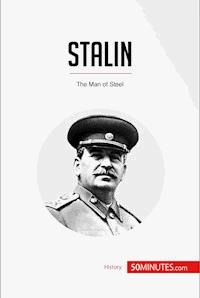
Keen to learn but short on time? Get to grips with the life of Stalin in next to no time with this concise guide.
50Minutes.com provides a clear and engaging analysis of the life of Joseph Stalin. Following the death of Lenin, who had overthrown the tsarist regime with the Russian Revolution, Stalin carefully eliminated his opponents and rose to power, immediately establishing a full dictatorship. Despite his many deplorable crimes, his contributions to Russian industrialisation and his success in the Second World War ensured his popularity for years after his death. However, when the Soviet Union fell in 1991, the full scale of the atrocities he committed became known throughout the world.
In just 50 minutes you will:
• Learn about Stalin’s early life and work for the underground Communist movement, including his exile to Siberia under the tsarist regime
• Understand his opportunism and successful elimination of the other candidates, ensuring he was elected as Soviet leader
• Discover the truth behind the many atrocities that were carried out under his reign, including organised famine, mass deportations and executions without trial, and the silencing of any opposition during the Great Terror
ABOUT 50MINUTES.COM | History & Culture
50MINUTES.COM will enable you to quickly understand the main events, people, conflicts and discoveries from world history that have shaped the world we live in today. Our publications present the key information on a wide variety of topics in a quick and accessible way that is guaranteed to save you time on your journey of discovery.
Das E-Book können Sie in Legimi-Apps oder einer beliebigen App lesen, die das folgende Format unterstützen:
Seitenzahl: 37
Veröffentlichungsjahr: 2017
Ähnliche











Stalin
Key information
Born: 18 December 1878 – officially 21 December 1879 – in Gori, Georgia (Russian Empire).Died: 5 March 1953 in Moscow.Known for:the establishment of Communism in the USSRthe implementation of a repressive dictatorial regimethe rapid industrialisation of the USSR and land collectivisationcontribution to the Allied victory in the Second World War (1939-1945)putting Eastern Europe under Soviet control and triggering the Cold War (1947-1991).Introduction
Iosif (Joseph) Vissarionovich Dzhugashvili, known as Stalin, is one of the best-known politicians of all time. General Secretary of the Communist Party of the Soviet Union from 1922, then leader of the USSR from 1924 until 1953, he successfully dominated his country, followed by half of Europe, as well as promoting the spread of Communism in the rest of the world.
Born to an impoverished family in deepest Georgia and expelled from his religious school, Stalin turned to crime at a young age. Following the Russian Revolution and the toppling of the tsarist regime, he successfully gained access to the elite circle of the new Socialist leaders before seizing power and establishing a repressive dictatorial regime. Under Stalin’s rule, the bright future that the Revolution had heralded turned into a nightmare. He became a symbol of extreme Communism and the embodiment of modern barbarism, and made the USSR a model of totalitarianism. His reign stands out for its length and the scope of his actions, making him one of the most influential politicians of the 20th century.
After his death, the revelation of the extent of his crimes destroyed what was, undoubtedly, the greatest utopia of the 20th century. However, years after his death, he still inspires a certain amount of fascination. After the fall of the Soviet Union, his popularity increased again in Russia, where his legacy was reconsidered and idealised.
The man of many surnames
Throughout his life, Stalin had many surnames and pseudonyms. He was called Sosso (a diminutive of Joseph) during his childhood, and then took the name of Koba (an honourable bandit from a Caucasian adventure novel) when he went underground. Finally, he took on the surname Stalin, composed from the Russian word ‘stal’ meaning ‘steel’: ‘Stalin’ means ‘man of steel’.
Biography
Joseph Stalin.
From the Church to Marxism
Stalin was born on 18 December 1978 to a poor family who lived in the town of Gori, Georgia. His mother, Ekaterine Geladze (1858-1937), was a devoutly religious, ambitious and protective woman who worked as a maid for wealthy families. Besarion Dzhugashvili (c. 1850-1909), his father, was a cobbler and a violent alcoholic. Although the couple had four children, only Stalin survived, despite his fragile health: the smallpox he had caught as a child left him with a scarred face that would be carefully covered up in official pictures, while an accident involving a horse-drawn carriage permanently injured his left arm.
He attended the religious school in Gori, then the seminary in Tiflis (modern-day Tbilisi, capital of Georgia), where he demonstrated a talent for studying. Although he was a voracious reader and a good actor, he was also a difficult, authoritarian, aggressive, arrogant and merciless child, who refused to obey anything. He got good academic results until 1897, when he became less interested in his studies and more interested in politics, and lost his Christian faith. He was expelled two years later, ending his mother’s dream of seeing him become a bishop.
From the underground movement to supreme power
Stalin then began to campaign as part of small underground socialist groups in working-class towns in the Caucasus, stirring up unrest and increasing calls for strike action. He was arrested in 1902 by the Okhrana (the tsarist secret police) and sentenced to three years in exile in Siberia. After his escape, he joined the Bolshevik movement (a political movement which aimed to trigger a socialist revolution in Russia with the help of the alliance of peasants and workers) and met Lenin (Russian socialist revolutionary leader, 1870-1924), its founder, for the first time in 1905. Between 1908 and 1913, Stalin’s involvement in armed robberies and extortion (known as ‘expropriation of expropriators’, intended to obtain money for the Bolshevik party) earned him several arrests and sentences, but also the recognition of his peers.




