


15,59 €
Mehr erfahren.
- Herausgeber: Birlinn
- Kategorie: Geisteswissenschaft
- Sprache: Englisch
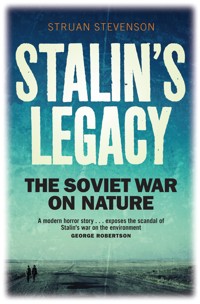
As undisputed leader of the Soviet Union, Joseph Stalin was directly responsible for the deaths of up to 60 million of his fellow citizens, a truly horrific figure which confirms him as one of the most notorious mass murderers in history. But Stalin not only waged war against his own people he and his successors regarded nature as an enemy that could be overcome by the might of Soviet technology and the brute force of slave labour. The building of vast networks of canals and the diversion of major rivers has created untold environmental damage, whilst Soviet nuclear and biological weapons programmes contaminated vast areas and caused unimaginable agony for human and animal life. In this book Struan Stevenson travels to the former Soviet republics of Kazakhstan, Uzbekistan, Turkmenistan, Kyrgystan and Tajikistan. From the Semipalatinsk region of east Kazakhstan, where over 600 nuclear tests were carried out between 1949 and 1990, to the Aral Sea, the desiccation of which has reduced what was the world's fourth largest inland body of water to half the size it was just 50 years ago, he presents a grim catalogue of environmental catastrophe. As well as talking with those whose lives continue to be cruelly affected by this terrible legacy, he also meets those who are trying to deal with its wider consequences as it threatens to impact far beyond the steppes of Central Asia. Despite almost insurmountable challenges, however, there ultimately is a strong message of hope as both local and international organizations face up to the effects of disastrous and inhuman Soviet policies.
Das E-Book können Sie in Legimi-Apps oder einer beliebigen App lesen, die das folgende Format unterstützen:
Veröffentlichungsjahr: 2012
Ähnliche




















Stalin’s Legacy
This ebook edition published in 2012 by
Birlinn Limited
West Newington House
Newington Road
Edinburgh
EH9 1QS
www.birlinn.co.uk
First published in 2012 by Birlinn Ltd
Copyright © Struan Stevenson 2012
Foreword copyright © George Robertson 2012
The moral right of Struan Stevenson to be identified as the author of this work has been asserted by him in accordance with the Copyright, Designs and Patents Act 198
All rights reserved. No part of this publication may be reproduced, stored or transmitted in any form without the express written permission of the publisher.
ISBN: 978-1-78027-090-6
ebook ISBN: 978-0-85790-236-8
British Library Cataloguing-in-Publication Data
A catalogue record for this book is available from the British Library
‘Once the class struggle has been won, Soviet humankind will be free to engage its final enemy: nature.’
Maxim Gorky (1868–1936)
Contents
List of Illustrations and Maps
Acknowledgements
Foreword
Introduction
One: Central Asia
Two: The Polygon
Three: The Nuclear Legacy
Four: Return Visit
Five: Anatoly Matushenko and the Birth of the Soviet Bomb
Six: Uranium Tailings
Seven: The Aral Sea
Eight: Desiccation
Nine: Vozrozhdeniye Island
Ten: Water Is Life
Eleven: Afghanistan
Twelve: Turkmenistan and the Golden Age Lake
Thirteen: Ili-Balkhash Basin
Fourteen: Rocket Launching in Kazakhstan
Fifteen: Other Environmental Catastrophes in the former USSR
Sixteen: The Lessons of History
Bibliography
Index
List of Illustrations
The first Soviet nuclear explosion, nicknamed ‘Joe-1’ by the Americans.
One of the many radioactive craters that have ruined farmland and water bodies in the Polygon.
A boy born to a Soviet pilot and his wife who were working on the nuclear tests in the Polygon, with a single eye in the centre of his forehead – a perfect Cyclops.
Some of the citizens of the Polygon have suffered terrible deformities due to the legacy of nuclear testing.
Angry Kazakh villagers from Sarzhal in the Polygon have called for more help for victims of the Soviet nuclear tests.
The Tsar Bomba – the largest, most powerful nuclear weapon ever detonated.
Struan Stevenson MEP, and UN Secretary General Ban Ki-Moon during a visit to Kurchatov.
Struan Stevenson Street in Znamenka.
Struan Stevenson with parents and children at the opening of the new Urdzhar School for Handicapped Children.
The rapidly receding shoreline of the Aral Sea has left many fishing boats strewn across the former seabed.
Struan Stevenson on one of the rotting hulks at Muynak harbour, which is now over 100km from the sea.
Changes in the water level of the Aral Sea.
With the wife of the akim of Muynak after being welcomed into the furnace-like interior of their home and naming their grandson ‘William Wallace’.
The Nurek dam in Tajikistan, currently the tallest in the world.
Struan Stevenson at the Nurek dam in Tajikistan, with the slogan ‘Water is Life’ painted over a tunnel entrance.
Struan Stevenson with Tajik president Emomali Rahmon at the Rogun dam.
Struan Stevenson with one of the less aggressive fighting dogs near Ashkhabad in Turkmenistan.
Maps
Central Asia
Kazakhstan
Radioactive hotspots in the Ferghana Valley
Landing areas of rocket’s detachable parts
Acknowledgements
My sincere thanks to Ben Acheson, who devoted much of his holidays and free time over a period of 18 months to researching, checking and correcting facts and suggesting improvements to this book; his invaluable insights and meticulous research have been an inspiration.
My great thanks also to the friends, advisors, collaborators, interpreters and co-conspirators who have accompanied me on many exciting, exhausting and sometimes dangerous expeditions to Central Asia and Russia: Kamila and Sulushash Magzieva, Elena Kachkova, Anna Dmitrijewa and Kimberley Joseph. Stalin’s Legacy would not have happened without you.
Map of Central Asia, including Kazakhstan, Kyrgyzstan, Tajikistan, Uzbekistan and Turkmenistan.
(Source: adapted from UN Map 37363 Rev. 7)
Foreword
This is a modern horror story about a ruthless regime using its own people like rats in an experiment. Told in very personal style by a campaigning Member of the European Parliament, the appalling legacy of what was Stalin’s Soviet Union is spelt out in graphic terms. It makes for uncomfortable but compelling reading.
At one of my early meetings as NATO Secretary General with the then new President Putin, he expressed his concern with the proliferation of nuclear and other lethal material. He was candid about his country’s record. ‘Many things happened as the Soviet Union broke up. We are still not able to say how much technology and material escaped or was sold.’ He saw proliferation as a key subject for NATO/Russia cooperation, and so did we.
The fact that the Soviet Union had huge capabilities in the nuclear, chemical and biological warfare field was never a secret. Indeed it was one of their boasts. What was unappreciated by everyone except a small Soviet elite was the brutal, merciless way in which Stalin had developed these capabilities using his own people and the land they lived on as a test-bed. Today the people of these lands still suffer the agonies left by a man completely careless of the humanity he abused.
Anyone who flies over modern Kazakhstan, as I have done, is struck by the mysterious straight lines criss-crossing thousands of miles on the ground. The observer will also see the Aral Sea, once a mighty internal ocean, now reduced to a miserable puddle surrounded by the concentric circles measuring the retreat of the water. In this book the mystery is dispelled. The perpetrator was not nature, it was an evil tyrant who used the periphery of his empire as a gigantic cruel laboratory.
Struan Stevenson not only takes us on a personal journey to explore and expose the scandal of Stalin’s war on the environment, but he usefully, and importantly tells us what needs to be done to avoid such outrages happening again.
Rt Hon. Lord Robertson of Port Ellen
KT GCMG HonFRSE PC
Secretary General,
North Atlantic Treaty Organisation 1999–2003
Introduction
An atomic lake, an imploded mountain, a disappearing sea, a top-secret biological weapons-testing site and hundreds of millions of tonnes of radioactive waste; contaminated food, deformed babies and widespread illness. Welcome to Central Asia, and some of the world’s greatest environmental disasters. As undisputed leader of the Soviet Union, Joseph Vissarionovich Stalin (18 December 1878 – 5 March 1953) introduced a policy of rapid industrialisation and the brutal collectivisation of agriculture that led to widespread famine and a catastrophic death toll. During the late 1930s, he launched the ‘Great Terror’, a campaign to purge the Communist Party of people accused of sabotage, terrorism or treachery. He extended it to the military and other sectors of Soviet society. In practice, the purges were indiscriminate; tens of thousands of innocent victims were executed, imprisoned in Gulag labour camps in Siberia and Central Asia or exiled. In the years which followed, millions of members of ethnic minorities were also deported. It is estimated that up to 60 million Soviet citizens lost their lives as a direct result of Stalin’s repressive reign, making him one of the greatest butchers in history.
But Stalin not only waged war on his own people. He and some of his immediate successors regarded nature as an enemy that could be overcome by the might of Soviet technology and the brute force of slave labour. Stalin ordered vast networks of canals and irrigation channels to be dug by hand in an attempt to transform deserts into lush pastures. He built gigantic dams and reservoirs, and diverted the course of major rivers. He used his own citizens as human guinea pigs for nuclear tests, and he conducted top-secret biological weapons experiments on islands that had been cleared of all animal and insect life.
The legacy of Stalin’s ill-considered environmental adventures has been devastating. In Central Asia, the Aral Sea has been virtually drained; toxic dust storms rage across the landscape; humans have been exposed to anthrax, typhus and other deadly bio-weapons; generations face illness and disease because of exposure to radiation; acute water shortages threaten regional conflict and the mass migration of environmental refugees. These are global issues with global consequences that may yet impact on all of us.
Since being elected to the European Parliament representing Scotland back in 1999, I have travelled extensively in Central Asia. Having discovered the horrific legacy of Soviet nuclear tests in the Polygon of East Kazakhstan, I have returned there many times. I wrote a book, Crying Forever, about my experiences, the sales of which have raised money which Mercy Corps has distributed to children’s hospitals, cancer hospitals, village clinics and other important projects in the region.
To show their appreciation, the Kazakhs have given me the Freedom of the City of Semipalatinsk, the main city of East Kazakhstan and the administrative centre of the nuclear-testing zone during Soviet times. I was the first and only foreigner ever to receive this honour; they also decorated me with various medals and honorary professorships and doctorates. In 2010, when Kazakhstan took over the rotating presidency of the Organisation for Security and Cooperation in Europe (OSCE), they invited me to become their ‘roving ambassador’ or personal representative of the chairman in office, with the special remit to draw up a report on the environment of the five Central Asian republics. My travels around Central Asia and the almost unimaginable environmental horror stories I uncovered, all arising from Stalin’s determination to conquer nature, are the subject of this book.
CHAPTER ONE
Central Asia
Kazakhstan is home to more than 100 different ethnic groups and 45 religions, all of which live at peace with one another. Indeed the countrys leader, President Nursultan Nazarbayev, now promotes racial and religious harmony as one of Kazakhstans greatest achievements. Nazarbayev himself was born on a collective farm, to scarcely literate parents descended from nomads, in the foothills of the Tien Shan Mountains. He joined the Communist Party in 1962, and as a steelworker earned a reputation for energy and leadership. He soon became first secretary of the Young Communists in his steel plant and steadily rose through the ranks of the Party until he was appointed secretary of the Central Committee of the Kazakh Communist Party in 1980. He became president of the newly independent republic after the collapse of the USSR.
Over half the population is of Kazakh origin, and Russians comprise just over a quarter of the population, with smaller minorities of Uzbeks, Koreans and Chechens accounting for the rest. Since gaining independence following the collapse of the Soviet Union in 1991, Kazakhstan has become a model of stability and prosperity in the region.
Kazakhstan is the ninth largest country in the world bigger than Western Europe but with a population of only 15.5 million people. It is rich in mineral resources and its oil reserves are said to be as big as those of Saudi Arabia, with exploitable deposits of coal, iron, lead, aluminium, zinc, uranium, silver and gold. Its landmass ranges from majestic mountains of Himalayan stature on the borders with Mongolia and China, to endless expanses of arid steppe, sparsely dotted by remote Kazakh villages. The country has more than 40,000 lakes, which are teeming with fish and home to immense flocks of flamingos. Its great rivers, like the Irtysh and the Ili, were once the watering places for the conquering hordes commanded by Genghis Khan.
Since independence, Kazakhstan has propelled itself into the premier league of economic tigers in Central Asia with year-on-year growth in excess of 10 per cent, despite a momentary slowing of the economy during the world recession. The EU is Kazakhstans biggest trading partner, and the state is pursuing a strategy of advanced social, economic and political modernisation which is creating a positive environment for investors. Massive investment is going into new, secure oil and gas transit routes to the West, to ensure a steady supply of hydrocarbons to European consumers.
Lesen Sie weiter in der vollständigen Ausgabe!
Lesen Sie weiter in der vollständigen Ausgabe!
Lesen Sie weiter in der vollständigen Ausgabe!
Lesen Sie weiter in der vollständigen Ausgabe!
Lesen Sie weiter in der vollständigen Ausgabe!
Lesen Sie weiter in der vollständigen Ausgabe!
Lesen Sie weiter in der vollständigen Ausgabe!
Lesen Sie weiter in der vollständigen Ausgabe!
Lesen Sie weiter in der vollständigen Ausgabe!
Lesen Sie weiter in der vollständigen Ausgabe!
Lesen Sie weiter in der vollständigen Ausgabe!
Lesen Sie weiter in der vollständigen Ausgabe!
Lesen Sie weiter in der vollständigen Ausgabe!
Lesen Sie weiter in der vollständigen Ausgabe!
Lesen Sie weiter in der vollständigen Ausgabe!
Lesen Sie weiter in der vollständigen Ausgabe!
Lesen Sie weiter in der vollständigen Ausgabe!
Lesen Sie weiter in der vollständigen Ausgabe!




