


5,00 €
Mehr erfahren.
- Herausgeber: Frekk Forlag AS
- Kategorie: Fachliteratur
- Sprache: Englisch
Almost a third of all young adults in the EU live at home. Europe needs entrepreneurs that create products that consumers want and thereby lift their friends out of unemployment.
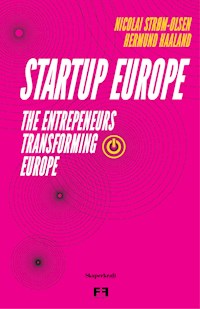
Startup Europe is a guide through European startup ecosystems and presents some of the continents promising entrepreneurs. It is the story of success, but also of transforming weaknesses into strengths. First and foremost, it's a passionate plea to strengthen Europe's competitive edge. Low competitiveness and youth unemployment is the stuff that tragedies are made of.
Das E-Book können Sie in Legimi-Apps oder einer beliebigen App lesen, die das folgende Format unterstützen:
Seitenzahl: 148
Veröffentlichungsjahr: 2018
Ähnliche



















STARTUP EUROPE
STARTUP
EUROPE
The entrepeneurs transforming Europe
Preface
INTRODUCTION
Part 1: ENTREPRENEURSHIP WORKS:
Chapter 1:
The Entrepreneurial Scene / Berlin
LGBTs, artists, and students have created a culture that many entrepreneurs find attractive. And with property prices among the lowest in Europe, it’s a boomtown for Europe’s new creative class.
Entrepreneur 1:
The Entrepreneurial Addict / Berlin
When Russian-born Gleb Tritus realized he could make money by optimizing text content on search engines online, he was hooked. The young serial-entrepreneur is now addicted to one thing: starting new ventures.
Chapter 2:
The Entrepreneurial State / Estonia
The Estonian government may have understood before anyone else that technology could make their country wealthy. After “Skype” and “Transfer Wise” became breakthrough hits, it became obvious to everyone.
Part 2: FROM CONCEPT TO INDUSTRY?
Chapter 3:
The Seeds Of Success / Lisbon
The entrepreneurs of Lisbon had a dream: that their city would become the California of Europe.
Entrepreneur 2:
The Persistent Logistics Expert
From a functional and modest Lisbon office, mathematician Filipe Carvalho is growing one of Portugal’s most successful IT startups through software that slashes both cost and pollution.
Chapter 4:
The Prototype Factory / Oslo
In Oslo more and more workshops are popping-up where one can produce less expensive prototypes.
Entrepreneur 3:
The Living Avatar
In less than a year Karen Dolva has gone from idea to market with her Avatar-robot. While the robot will move chronically sick children back to their classrooms, she moves the seed money that makes scaled production possible.
Part 3: WORK FOR ALL
Chapter 5:
The Miracle of Jobs
Through its tax and welfare policy the UK government is encouraging Britons to start businesses. Now, both unskilled workers and labour migrants are finding work at startups.
Entrepreneur 4: The Stubborn Biker
Failure is just something to learn from thinks Birmingham-based biker-turned-manufacturing entrepreneur John Miller. From a slow start in 1999, his company now makes composites for Formula 1 racing cars and spacecraft.
Part 4: APPENDIXES
Money makes the world go round
Research to the people – that's the thing
The entrepreneur who built Norway
STARTUP EUROPE
Almost a third of all young adults in the EU live at home. Europe needs entrepreneurs that create products that consumers want and thereby lift their friends out of unemployment.
In Tallinn young people from all over the world take part in a technological boom that has made Estonia the European country with the highest number of entrepreneurs per capita.
According to French economists at CEPII (Centre d’Etudes Prospective et d’Informations Internationales) Estonia will reach the level of the Nordic countries, measured by GDP per capita, in only ten years.
This boom has given the small Baltic country growing self-confidence after the fall of the Soviet Union. It is also an example of a growing gap between richer and poorer countries on the continent.
Emigrate or live with your mum
It is different elsewhere – in Spain, Italy, Slovenia, Portugal and even Sweden, many young people are struggling to get their adult-life going. In the EU every third male and every fourth female between the age of 25 and 29 live at home. The problem is worse in southern Europe.
Without work and living with mum well into their 20s makes it hard for many to create families of their own. It also destroys self-confidence.
With youth unemployment rates rocketing to between 20 and 50 per cent in several countries, the future looks grim. To realize their dreams many emigrate. In 2014 a million south and east Europeans moved to Germany. Almost two per cent of Portugal’s population has emigrated since 2010.
The political system is often a barrier. In Serbia we did not meet a single entrepreneur who didn’t mention corruption as a major problem. In Lisbon we continuously heard about an overwhelming bureaucracy and a political elite who cover-up the deficits of established, state-owned companies.
When citizens do not trust the state to manage public resources well, incentives to start new businesses vanish. Simultaneously, queues at social security offices grow.
Where jobs are created
However, in Berlin, angel investors look for good ideas and promising business talent. Youth unemployment in Germany is at a record-low 4.9 per cent. Fewer young people live at home now than in 2007. Here, the paradox is that fewer people start new businesses, but there is strong growth at technology-based startups and of female entrepreneurs.
The Minister of Commerce, Sigmar Gabriel, has a vision for Germany: Entrepreneurship is now defined as “a third career-path”. Since 2007 millions of Euros has been channelled to build incubators at universities combined with more scholarships for incumbent entrepreneurs.
Gabriel’s vision clearly indicates the direction Europe needs to follow. It is only when young people venture into the unknown in greater numbers, hire their peers, and create the services and goods consumers demand that new growth will come.
That’s exactly what’s happening in the United Kingdom. The country is experiencing a wave of entrepreneurship in almost all industries. Since 2011 unemployment has fallen from 8.5 to 5.1 per cent. As professor Mark Hart points out later in the book, the Brits are among the most entrepreneurial in Europe.
Entrepreneurs have created 40 per cent of the new jobs. The government has followed suit, unleashing tax-reforms giving incentives to invest in small and medium-sized businesses. Today, a swarm of business-angels hovers over the country.
Despite these success stories few European companies grow to be world-leading. Evidence of this is the fact that none of the world’s largest IT companies are European.
Don’t try this on your own
The reasons for northern Europe’s struggle are manifold. Many countries such as Norway, the UK and Germany face challenges in their school systems. Too few with good technical skills are educated, thus startups struggle to find competent employees. Schools also do not teach students to take risks.
In the south a major problem is that economies do not grow fast enough. Since 2010 all continents, except Europe, have experienced growth. Neither Greece, Portugal nor Italy has shown the competitive edge to succeed.
In Startup Europe we try to stimulate students, entrepreneurs and politicians to heighten their ambitions. For – should there be any doubt – weak competitive abilities and stagnant youth unemployment are the basis of a tragedy. And it will be tragic if Europe’s young get used to the idea that everything was better in the past.
PART 1
ENTREPRENEURSHIP WORKS:
Berlin and Tallinn have over the past 25 years transformed themselves from planned economies to dynamic societies. Entrepreneurs were crucial for their success.
Berlin
The Entrepreneurial Scene
LGBTs, artists, and students have created a culture that many entrepreneurs find attractive. And with property prices among the lowest in Europe, it’s a boomtown for Europe’s new creative class.
So there I was, in the basement of a club in Karl Marx Allé, Berlin. Getting in hadn’t been easy. Coming down the stairs, I’d had to weave through an uncommonly long procession of offers for free take-away from a dozen local restaurants. The establishment’s clientele were obviously frequent consumers of take-away food.
I received a name badge, some drink coupons, and a beer. The music got ever louder as the evening progressed. All around me, several hundred people, mainly in their 30s, mingled. It was a party. A “gründerfest”. In 2014, entrepreneurs (gründers) made up 2.8% of Berlin’s population. That makes Berlin the most enterprising city in the country, followed by Hamburg and Munich.
Everyone was here for the same reasons, we were mingling and networking. To simplify things, we’d been issued different coloured cords. Yellow was reserved for entrepreneurs, investors had been given white, and red ones had been given to service providers. Yellow cords were the most numerous, white the least. But even without the coloured cords, it was easy to see who was who. The yellows were dressed more edgily, the whites more conservatively. Red cords often dangled in front of a uniform of some sort.
As I looked around and saw all the drinks being picked up at the bar, it struck me: It would be impossible to get any closer to the cliché image of Berlin as the city where entrepreneurs party all night long while building-up their business. In Germany entrepreneurship has become cool – particularly for men (most entrepreneurs are still male) preoccupied with the preferences of German women. An AXA study from January 2015 showed that nearly half of all German women found entrepreneurs more attractive than regular employees. Only 13 per cent of women surveyed respected permanent employees more than entrepreneurs.
Positive perceptions notwithstanding, most of the people wandering alone around the room were wearing yellow cords. Reds stood in groups. Crowds had formed around white cords. It was time to start mingling and find someone to talk with. A man in a dark suit, red tie, and red cord saw my yellow entrepreneur’s cord.
“I can help make your business ideas a reality.” Willebrand from the Berliner Sparkasse was making a sale.
When he found out that I wasn’t a real gründer, but writing a book on entrepreneurship, he was a little disappointed. But it seemed he thought that all publicity is good publicity, because he continued to explain enthusiastically. Willebrand worked for the bank’s Firmen Center für Gründung und Nacthfolge (Business Centre for Establishment and Following Up).
“This branch’s main responsibility is aiding entrepreneurs. We help them set up a business plan, a liquidity budget, and we also have specialized loans for entrepreneurs. In addition, we offer free consultations on how to set up the financial aspects of the business.”
An Advance Warning of the European Crisis
The growth of the entrepreneurial scene has been a huge boom for Berlin. For a long period, the city was on the brink of bankruptcy. Until the division of Germany into the eastern Deutsche Demokratische Republik (DDR) and the western Bundesrepublik Deutschland (BRD), Berlin and the Ruhr region were the twin industrial powerhouses of Germany. But capitalist companies feared having their assets seized, and in 1945 key Berlin companies such as Siemens, Deutsche Bank, and AEG moved as far away from East Germany as they could, to the West German cities of Munich and Düsseldorf. Few new industrial businesses were established in West Berlin during the cold-war era.
After the fall of the Berlin Wall, much of the heavily subsidized, state-owned East German industry went out of business, having lost much of its competitive edge over the preceding 40 years. As a result, the number of jobs for unskilled workers fell drastically in the 90s, with a corresponding rise in unemployment. This bears obvious similarities to present-day Europe. The current situation, particularly in Southern Europe, is a carbon copy of the situation in Berlin during the 90s. Southern Europe is not supplying enough of what the world is demanding. But all of Europe will have to change in the coming years.
The world is in the midst of the 4th industrial revolution (see part 2). During the next couple of years digitalisation and automatization will change the way we work and live. If Europe does not manage the transition to a digital economy, unemployment and low growth will persist. Although there is an entrepreneurial boom in Berlin, the industrial core is still small. Unemployment is the second highest in Germany, five per cent higher than the national average, and over three times as high as in Bavaria. Berlin’s Gross Domestic Product (GDP) per capita is 90 per cent of the German average, and only 60 per cent of Hamburg’s. In this respect, the current entrepreneurial boom is just what the city’s business sector needed. Entrepreneurs are customers with unconventional needs. They eat take-away in the middle of the night and change offices every time the company expands. Several banks have specialized account managers and offers to reach entrepreneurs, who often lack liquidity, but not expenses.
Gradually, a number of businesses that help entrepreneurs survive and prosper have evolved. One such business is the real estate agent Colliers. Marcus Lehmann is head of the company’s rental division. He explains why newly established businesses move around a lot.
“Office space is a big problem for entrepreneurs in Berlin. It’s not that there isn’t enough space, but as the buildings in the reasonably priced areas of the city centre are old, rooms are often either too big or too small.”
Office-spaces may be well suited to a startup with five employees, but what to do when you grow to ten? If a business really takes off, the company may have to scale up to 50 employees within the space of a few years.
“I know a lot of companies that have offices in five or six locations around the city. It makes having meetings complicated, and a lot of time is spent travelling between offices. That’s the sort of thing we help our clients avoid.”
While some people try to sell services to growing enterprises, others want a potential slice of any new cake. These are “angel investors”. An angel investor doesn’t need to see immediate returns, and is willing to take more risk than other investors. Bernd Grosse Lordemann is an angel investor working for the film company DCM.
“We do film production, rentals, and angel investment. That is to say, we work on the creative, entrepreneurial side of the movie business. The owners of DCM have all sprung from the Berlin entrepreneurial scene, and they want to continue to be part of it.”
I was left wondering, do other European entrepreneurs with good ideas come to Berlin to participate in this sort of thing? This proved to be the case; Austrians, Serbs and Portuguese are here. Berlin is becoming a melting pot of entrepreneurial luck-seekers. No wonder, I was struck by how simple it was to get in touch with both investors and entrepreneurs.
Fewer entrepreneurs
Dr Marc Evers’ surroundings are completely different from a cellar club in East Berlin. He works on the fifth floor of a new building behind Berlin’s Stadtschloss (city palace), which is being built on the land of the old East German government headquarters. Here, you’ll find the Deutscher Industrie und Handelskammertag (DIHK: the Association of German Chambers of Industry and Commerce). Their main office is one of many in Berlin built after the capital was moved from Bonn in 1999. Evers works with entrepreneurship and innovation. Every year he makes a survey of entrepreneurship in Germany, and in 2014 he made a number of exciting discoveries.
First, the number of entrepreneurs in Germany had fallen. This is due to the fact that necessity driven entrepreneurs are decreasing in number.
Entrepreneurs of this nature start their own business because they can’t find suitable employment. When the job market is good, as it is in Germany now, this type of person prefers permanent employment to starting his or her own business.
Second, the number of opportunity-driven entrepreneurs had risen. These are people who start a business because they want to be entrepreneurs. Not to mention that since 2006 the number of IT-entrepreneurs had doubled. As women began thinking more highly of entrepreneurship, the number of female entrepreneurs rose significantly.
On the surface, these seem like positive developments. Fewer people are starting businesses because they have to, while more people are dreaming of realizing their own ideas. Berlin is a driving force at the centre of this development. According to DIKH-Berlin, entrepreneurs in Berlin created 33,800 new jobs in 2014 alone.
Cheap leases in trendy neighbourhoods
There are several reasons for these developments, but some facts are more relevant. Rent is cheap in Berlin. Admittedly, it is rising at record speed, but it is still lower than similar metropolises elsewhere in Europe or in the US. In addition, Berlin has excellent research and education infrastructure, including three universities and a number of research institutes.
This meant that in August 2015, an entrepreneur in Berlin could pay 1,000 euros a month for an apartment that would cost twice that amount in Oslo, London, or Paris. An entrepreneur making €1,500 net in Berlin has the same standard of living as a person making €2,500 in Oslo or €2,800 in London. Low rent is an important factor in making Berlin attractive to people with dreams. Berlin has become a city of immigrants. In 2012, there were almost 500,000 foreign nationals living in Berlin. Many of them are entrepreneurs. In fact, one in five entrepreneurs in Germany is an immigrant.
However, history is just as important. When the Wall divided the city, West Germans could avoid military service by moving to Berlin. That meant that the city attracted a fairly extensive alternative scene, including artists, LGBTs, and political non-conformists, who wanted to escape the conservative West. Over time, the finances of both students and LGBTs improved. Artists remained poor, but they started to attract people who wanted to live in a vibrant neighbourhood, and gentrification took off.
A 24/7 culture evolved. As a result, Berlin restaurants and bars close at 4 or 5 AM, unlike at 2 AM as they do in Munich. Entrepreneurs working till late at night can still grab a beer or a bite after work. Several Berlin companies cater to this flexibility; one of them is Foodora, a home-delivery service used by fancy restaurants.
A tolerant culture and cheap offices made starting business incubators and eventually coworking places easy. This led to a culture that many entrepreneurs enjoy.
The Grass Roots Movement in Kreuzberg
“For us, it all started in 2008. We were six self-employed people: a lawyer, a political consultant, a product designer, all of us looking for professional office space,” says CEO and co-founder of Betahaus, Max von der Ahé.
They were tired of sitting in cafés, but didn’t want to sit in regular offices either.
“A coworking space bridged that gap, but at the time, there weren’t a lot of places like this in Berlin.”
He pauses.




