


Erhalten Sie Zugang zu diesem und mehr als 300000 Büchern ab EUR 5,99 monatlich.
- Herausgeber: The History Press
- Kategorie: Geisteswissenschaft
- Sprache: Englisch
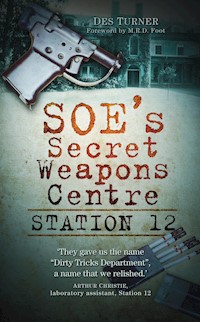
The full story of Aston House in the Second World War has never been told before. Its activities were top secret and as important to the Allied war effort as those of Bletchley Park, but in a different way. Situated near Stevenage, Aston House was one of many British country houses requisitioned during the Second World War by the Special Operations Executive (SOE). Born out of Bletchley Park, where it began life as SIS Section 'D' (for Destruction), Station 12's scientific and military personnel invented, made and supplied 'toys' for the Commandos, Special Boat Service, SAS, and resistance groups. Included in their deadly arsenal of weapons were plastic explosives, limpet mines, pressure switches, tree spigots, incendiary bombs, incendiary liquids and arrows, and a variety of time fuses. They worked on the tools for famous operations, such as the St Nazaire and Dieppe Raids, and the assassination of Himmler's deputy in Prague. Also revealed are the human stories of personnel stationed in this extremely remote village and the explosive pranks they played on each other, and certain visitors, which add some light relief to their destructive purpose.
Sie lesen das E-Book in den Legimi-Apps auf:
Seitenzahl: 454
Veröffentlichungsjahr: 2011
Das E-Book (TTS) können Sie hören im Abo „Legimi Premium” in Legimi-Apps auf:
Ähnliche



















DES TURNER
Foreword by M.R.D. Foot
First published in 2006
This edition published in 2011
The History Press
The Mill, Brimscombe Port
Stroud, Gloucestershire, GL5 2QG
www.thehistorypress.co.uk
This ebook edition first published in 2011
All rights reserved
© Des Turner, 2006, 2011
The right of Des Turner, to be identified as the Author of this work has been asserted in accordance with the Copyrights, Designs and Patents Act 1988.
This ebook is copyright material and must not be copied, reproduced, transferred, distributed, leased, licensed or publicly performed or used in any way except as specifically permitted in writing by the publishers, as allowed under the terms and conditions under which it was purchased or as strictly permitted by applicable copyright law. Any unauthorised distribution or use of this text may be a direct infringement of the author’s and publisher’s rights, and those responsible may be liable in law accordingly.
EPUB ISBN 978 0 7524 6818 1
MOBI ISBN 978 0 7524 6819 8
Original typesetting by The History Press
Contents
Foreword by M.R.D Foot
Acknowledgements
Introduction
1. The First CO’s Story
2. The Second CO’s Story
3. The Scientific Officer’s Story
4. The Laboratory Assistant’s Story
5. The First Aid Nursing Yeomanry Story
6. The Secretary’s Story
7. The ATS Driver’s Story
8. The Workshop Engineer’s Story
9. The Storeman’s Story
10. The Craftsman’s Story
11. The Design Office Story
12. Postscript
Appendices
A. Aston House Production
B. Site Plan of Aston House, 1945
Bibliography
Foreword
The Special Operations Executive (SOE), otherwise known as the Ministry of Ungentlemanly Warfare, had outstations all over Great Britain. In one of them, in Aston village near Stevenage, still more knavish tricks were invented during the last world war, to frustrate the knavish tricks of our enemies.
Des Turner lived through the war as a child in western Essex. When he moved to Aston forty years ago, the village had become a suburb of Stevenage new town. He heard vague tales of wartime secret goings-on at Aston House, lately demolished, and piece by piece put together its story. It was Station 12 of SOE; its tasks were to invent and to manufacture devices for undercover warfare. Here, time pencil detonators were made by the million to set off explosive charges planted by brave men and women on innumerable pieces of enemy equipment; here, the charges were prepared that destroyed the dry dock at St-Nazaire; here the Welbike, later renamed the Corgi minibicycle, was developed; here were dreamed up into reality no end of odd devices for improving the secret war.
The author has combined, with great ingenuity, recollections from long after the events by those who took part in them and what he has devilled out for himself in the archives written down at the time, many of which have now gone public at Kew. In the depth of the Cold War, all this sort of information had to be kept secret; hardly any of it appears, either in agents’ memoirs, or in the official histories written in the fifties, sixties or seventies of the last century. The modern age is more relaxed. A lot of what appears below used to be unpublishable; that makes it all the more interesting to read.
M.R.D. Foot
November 2005
Acknowledgements
I would like to thank the many individuals and organisations who have helped in the writing of this book.
In particular Colonel Leslie J. Cardew Wood who gave me such a wonderful start when he could so easily have refused because the Official Secrets Act still applied at that time. Although he did not of course reveal any secrets, he gave me some important leads and a wonderful insight into the way he ran Aston House and the fun he had doing it. His contribution forms the foundation of this book.
Johnny Riches for workshop memories and personal photographs. Cicely (Scottie) Hales for information on workshop materials, her personal photographs and for allowing me to photograph her souvenirs of Aston House. And it was she who introduced me to Jimmy Welch, the son of her ATS friend the late Mary Wardrope. Jimmy gave me his parents’ anecdotes of the design office and allowed me to copy photographs. Lucy Holdaway was also an ATS friend of Scottie’s who, with her two sisters, chauffeured the officers around in their staff cars. She also loaned photographs. Joe Wardle read my appeal in the British Legion magazine and volunteered his memories of the workshops and supplied me with photographs. Richard Bignell was located and introduced by Keith Bone, who spotted my appeal in a local Hertfordshire magazine Village Affairs, Richard provided memories of the stores and magazine areas and loaned photographs. I located Ishbel Orme and June Wilmers via the same magazine and they helped me with their experiences of FANY and loaned me photographs. Maurice Christie located me via the web and provided his father’s memories of the Aston House engineering laboratories and also photographs of Arthur Christie.
Dr John H.C. Vernon provided the text of his interview with Scientific Officer Colin Meek plus additional technical information and Margaret Meek added memories and photographs of Colin.
I would also like to thank Professor M.R.D. Foot for providing the foreword. Other agencies and individuals who helped were: the Public Record Office (National Archives); the Imperial War Museum in London and at Duxford; Stevenage Museum, especially its manager, Jo Ward, who inspired me to complete and publish a local history on Aston House, the forerunner of this book, for an SOE Exhibition held at that museum during January 2004; Stevenage Library; the Carpetbagger Aviation Museum; the Bletchley Park Trust; Past Times and Stakis Hotels for their very informative ‘Secret War’ weekend hosted by Colin Burbridge and Clive Bassett who also provided me with technical information on SOE weapons; John Amess; Lord Balniel; Lynette Beardwood (FANY); Wally Bennett; John Billington; Fredric Boyce; John and Anne Clarke; Jim and Vera Edwards; Durwood W.J. Cruikshank; Professor David Dilks; Judy Hull; Agnes Kinnersley; Dr David Malan; Nita Pulley; Edward Marriott; Peter Martineau; Robin Mills; Christopher Murphy; Phil Nussle; Jack Pallett; Betty Randles; Margaret Richards; Jennie Spicer; Peter Robins; Mark Seaman; Donald Sommerville; Michael Summers; Jack Whitney.
In addition, two anonymous collectors of SOE equipment kindly allowed me to photograph rare and valuable weapons without imposing copyright restrictions.
Patricia Crampton proofread both my local history edition and the drafts for this book and gave much advice and encouragement.
Finally I thank my wife Mavis for her tremendous support and encouragement and my three sons Ian, Jamie and Simon for help and support with this book and many local history projects.
Introduction
When I moved to Aston, near Stevenage in Hertfordshire, with my family in 1966, I was curious to know its history. There was very little written about it, so I decided to set about finding out what this small parish might reveal of its past.
During my early taped interviews with villagers it became clear that Aston House had played an important role during the Second World War. I was told stories of its being very ‘hush-hush’. – ‘Explosives are still buried there, you know.’ – ‘Winston Churchill came here.’ – ‘A German spy was caught.’ – ‘There was a big fire there one night and we thought the whole place would blow up, you see it was full of explosives.’ I was intrigued, to say the least.
The Second World War had a great effect on my life. As an impressionable young schoolboy in the Essex village of Ugley, I found the war frightening at times, but always very exciting. Our cottage was almost hit by a stick of jettisoned German bombs one night. We heard the air rushing through the fins as they passed low over our roof and my family and I dived to the floor. The air raid siren at nearby Stansted had not sounded a warning. The bombs landed around our village hall some 300 yards away and by sheer good fortune one bomb that landed very close to some sheltering village lads failed to explode.
I observed dogfights in the sky and fires caused by bombs. I cycled with friends to collect a piece of the latest crashed aircraft and it became a schoolboy hobby to collect bomb shrapnel and ‘chaff’ (strips of silver paper tape used to disrupt radio location, or radar as we know it today).
Then there was the build-up of tanks and military vehicles en route to the south coast for the D-Day landings; some would stop and park under the trees with camouflage netting over them. I watched the overhead air armada of bombers towing gliders to Arnhem, masses of them, some of which broke away and landed or crashed nearby. Then V-1 Doodlebugs (pilotless flying bombs) came over and when the engine cut they fell silently to earth, exploding on impact. One night a V-1 suddenly flew very low over our cottage. It was being pursued by a fighter aircraft that was machine-gunning it – now that was a shock! There was no time to dive to the floor and it exploded in the next village of Manuden. American servicemen were everywhere, so I became one of the ‘Got any gum chum?’ kids. One Yank gave me an orange. I hadn’t seen one for years, so you can imagine how delicious it tasted!
I watched a Spitfire shooting down a rogue barrage balloon that had broken from its mooring, but the most exciting and unbelievable event of all was to see a Horsa glider snatched up from a field by a Lancaster bomber that flew just above it and hooked it into the air.
With these vivid childhood memories in my mind, I wanted to know what had happened in Aston – the locals must have witnessed similar events to those I observed at Ugley? I learned that two USAAF Flying Fortress bombers collided and came down in the neighbouring village of Weston, with tragic consequences.1
But what actually happened at Aston House, I wondered. I didn’t realise just how difficult finding out was going to be.
‘Don’t tell dad – keep mum!’ was a slogan from a wartime propaganda poster and in the 1970s when I began my research it still applied. The ‘goings on’ at Aston House remained TOP SECRET. At first I was surprised and disappointed by the abrupt refusal of personnel involved to tell me anything about it, due to their having signed the Official Secrets Act. One exception was a former Aston House soldier who agreed to tell me some of his memories, but he insisted I must not write them down or reveal them to anyone and would only talk to me as we walked in a field, lest we be overheard!
Peter Martineau, then resident at Holders, a large house at Aston End, offered to help me by contacting the former adjutant at Aston House, Stanley Elton-Barratt, whom he knew as a business associate at the Bassett sweet company. The officer’s reply stated:
I was there first (Aston House) in 1940 as adjutant and then camp commandant until the end of the war so naturally knew much about its activities during that time and saw it grow from about a dozen officers and men to about thirty of the former and over a thousand other ranks, including 200 ATS. We had our own Military Police, (Bluecaps) who had their HQ at the guard hut by the main gates, also an army Fire Brigade but I am afraid before giving you any more information I must get in touch with the security authorities.
The subsequent letter stated:
I regret that I am not permitted to give you more information concerning Aston House.
This was very disappointing. I could not believe that it was still in the national interest to keep these secrets so long after the war had ended, so I wrote to my local MP for information about what I had identified as ISRB (Inter-Services Research Bureau) at Aston. The reply I received was as follows:
From The Minister of State
The Rt. Hon. Lord Balniel
Foreign and Commonwealth Office
London SW1
6 February 1973
Dear Mr Turner,
ISRB was the cover name for the Special Operations Executive (SOE) which came into being in July 1940 as the organisation responsible for the carrying out of and co-ordinating underground resistance activities in enemy occupied territories. SOE took over Aston House from another War Office branch known as MIR (Military Intelligence Research). A small Research Unit had been in existence there for studying weapons suitable for use in subversive warfare. This secret establishment E.S.6. (WD), which at the outset had a complement of a few specialist officers and men, was greatly expanded by SOE in the course of the war. By 1942 the number of personnel employed on communications (W/T) research and manufacture was 280 and on special weapons and explosives 600. The research activities were subsequently transferred elsewhere. The experimental and manufacturing workshops employing well over 1,000 men were engaged in the production of special devices for sabotage operations, and a wide range of miscellaneous items. All these were despatched, in some cases by parachute, to occupied territories in Europe and the Far East for use by the Resistance organisations formed and supplied by SOE.
I am afraid I cannot provide a list of types of weapons and associated equipment. But I hope that the above will be of some use.
Yours sincerely,
Balniel
This letter confirmed for the first time that Aston House was part of SOE and had played a vital role in the secret war. Many of those working there would have been completely unaware of SOE. They wouldn’t have known what it stood for anyway.
Now that I knew the reason for the top-secret security rating I became even more curious to discover what were the weapons and special explosives that were made there, and on what special operations they were used. Also if Aston House was part of SOE, a countrywide organisation that requisitioned many large country houses and estates, how did it link up?
The background was that in March 1938 a new department was created within MI6. Section D (D for Destruction) was given the task of developing plans for subversive operations in Europe. At the same time the GS(R) Department – later MI(R) Military Intelligence Directorate – of the War Office was examining the potential use of guerrilla warfare. The two groups worked together in the months leading up to the war. Section D began to establish ‘stay behind’ sabotage parties in those countries threatened by German invasion. Meanwhile MI(R) investigated the feasibility of ‘secret armies’ of guerrilla fighters to resist German occupation.
After the triumph of Germany’s armies on the continent and the Nazi occupation of most of Western Europe, Winston Churchill set up SOE to ‘set Europe ablaze’ by helping resistance movements and carrying out subversive operations in enemy-held territory.2
The Prime Minister has further decided after consultation with the Ministers concerned that a new organisation shall be established forthwith to co-ordinate all action, by way of subversion and sabotage, against the enemy.
War Cabinet Memorandum by the Lord President of the Council, Neville Chamberlain, 19 July 1940.3
Jack Pallett, a villager in Aston, gave me the next lead, producing a letter signed by the commanding officer of E.S.6. (WD), Major Wood.
War Department,
Aston House,
Stevenage.
20 January 1942
Dear Mr Pallett,
I wish to convey to you my thanks for the splendid way in which you helped to extinguish the recent fire which necessitated long hours of night work.
Your promptness in arriving on the scene, and the determination and cheerfulness with which you set about your task, was greatly appreciated.
Yours truly,
Major Wood, R.N.
Commanding E.S.6. (WD)
So the story was true; there had been a serious fire at Aston House during the war, and Jack had helped put it out. He was employed there and told me in his rich Hertfordshire accent:
There was a terrible fire there one night, good job Jerry won’t over, there was all these ’ere incendiary things, sheds and sheds of ’em. What caused it was the ’eat of the ’ot water pipes, an’ all this packed up ag’inst it. I think tha’s what started it. It even scorched the banks right down to the corner. The pond was emptied at the Dene and in the park during the fire. There was eight of us up there in the carpenters’ shop, makin’ ammunition boxes and detonator blocks an’ the likes of that. We knew what was up there.
I decided to try to trace Major R.N. Wood and searched Army records but found no trace of him. Some years later I had a wonderful piece of luck. Agnes Kinnersley, who had worked with SOE at Aston House and The Frythe during the war, visited Betty Randle’s Patchwork Studio, then at The Stables, Dene Lane, Aston. Obviously she talked about her wartime experiences at Aston and Betty, knowing of my interest in this subject, discovered that Agnes knew of the whereabouts of Major, now Colonel, L.J.C. Wood. Upon much closer examination of Jack Pallett’s letter (a poor copy) with a magnifying glass I realised that the initials R.N. were not Wood’s but were R.E., indicating Royal Engineers!
I wrote to Colonel Wood immediately and he kindly invited me to visit him at Oatlands Park Hotel in Weybridge, Surrey, where he was then residing. But our plans to meet were interrupted several times by his appointments for treatment of a severe disability, coupled with the fact, he told me later, that he kept putting me off to see how persistent I would be. Here are some extracts from letters I received from him before our first meeting.
29 August 1984
Dear Des,
I must make it clear that I am 86 and suffer from peripheral neuritis as a result of a truly representative collection of tropical diseases collected in India where I served as Colonel Q to Force 136 and built and became Director of the Special Forces Development Centre. This is a dying of the nerve endings – a kind of creeping paralysis which is incurable and progressive. I can walk short distances, say 25 yards with the aid of a walking frame – after that a wheel chair, so that to visit you in Aston would be very difficult. Nevertheless apart from my lack of mobility I am fit and normally work (writing and finance) up to midnight every night.
I don’t know what you really want from me?
However, when you visit I will tell about those sweet people, the Ashers, caretakers at Aston House when we took over, and who aided me when I decided to keep my own pigs. The Hun having a go at me with a stick of bombs in the early days and subsequent huge fun with two local ladies. (I had been over in France with their Deuxième Bureau just before the Germans invaded and some of them went over to Vichy – I was known to the Free French as Captain Blood!) Catching a red-hot spy on our own premises. Training Commandos in use of explosive devices we invented and made just before a raid – entertaining the heads of all the Commandos for a night (they said it was worse than Dunkirk!). I invented the totally illegitimate title of E.S.6. (WD) as a cover for us and got away with it. Dealing with greedy local senior people by illegitimate but very effective means. Maintaining secrecy by all manner of tricks. Staving off nosey-parker Generals from the War Office who tried to tell me how to run my establishment – plenty of rhymes of which I have copies and plenty of photos, (heaven knows how I will find them) – Oh! And the very happy Aston Ghost. That’s just a start. The only thing for you to do is come here . . .
12 October 1984
I very much regret that I cannot manage Saturday 16 October. I have been under the weather . . . With my sincere apologies for the behaviour of my body and legs . . .’
20 January 1985
I’ve failed you on photos at the moment. All I can find is one of the Ashers, myself testing our silent mortar (the one that removed the newspaper from the hands of the vicar while he sat in his garden!), one of my dog ‘Spats’, my ‘repaniel’ (half retriever, half spaniel), loved by the whole station and responsible for many good yarns, even the poor chap’s death was dramatic and as he would have wished it. I have another good one of Spats with Sergeant-Major Stallard and my formal farewell parade when I left for India. Some of my memories fall outside the scope of your ‘local history’, save for Aston’s direct and sometimes tragic connection (the son of one of my senior civilian staff came to Aston to be instructed before a raid on which he died), with some of the daring exploits of the War.
17 February 1985
I greatly enjoyed meeting you in person at last . . . I really enjoyed speaking into a recorder for the first time. In retrospect it was unbelievable that I should roar with laughter at some of my own stories when you played back some tapes this morning!
Thank you for the gift of the new book ‘SOE’ by M.R.D. Foot . . . I have had quite a bit of correspondence with him . . . He made no real mention of Force 136 operations in Burma which were pretty spectacular.
As ever,
Leslie
The sound recordings we made were produced over two wonderfully entertaining weekends at Oatlands Park Hotel. He was living in a cottage within the grounds of the hotel, occupying the whole of the ground floor, which was ideal for his wheelchair. He was totally self-sufficient but evening meals were cooked by the chef and brought over from the adjacent hotel by a waiter, his regular tip for this service being a large glass of vintage wine.
Soon after I arrived laden with recorders, mikes and cameras, we had lunch and he told me the itinerary for the day. He said ‘I usually have a sleep in the afternoon, you do what you like. We will have a glass or two of wine, the waiter will bring us dinner about seven, after that we will begin our chat about Aston.’ This we did, and talked until about three in the morning.
Aston House and The Frythe, Old Welwyn (Station IX), worked closely together, but a good deal of research, development and testing of explosives and special equipment was carried out at Aston. He said:
We invented, made, supplied and trained personnel in the use of ‘toys’ not only for the resistance but for all the special forces: Commandos, Small Boat Section, Airborne Division and Long Range Desert Patrol. We had about forty specialised army officers and civilians, guards and several hundred soldiers, FANYs and ATS [First Aid Nursing Yeomanry and Auxiliary Territorial Service – the women’s services; by WWII FANY had no nursing connections] and a few civilian technicians. We had magazines for explosives, and sheds in which to handle them and large storehouses for incendiaries and all the rest of our ‘toys’, and workshops wherein to experiment and manufacture. We designed and made up special explosive charges tailored for the job in hand and simple to place and fire by any commando or resistance worker. Many tons of explosives as well as the devices we supplied were dropped by parachute to the resistance to blow bridges on D-Day. The whole essence of helping the special forces was speed in both invention and supply.
Some of this may sound a little grim but I can truthfully say that we regarded the whole thing completely impersonally as tremendously funny and the more hideous the devices we invented and made to confound the enemy, the funnier we thought it. The same gaiety of spirit imbued the Commandos. I met nearly all the leaders and many of their officers and men when they came to Aston for last-minute briefing and training in demolitions, just before a raid. Most of what we did was bloody hard work but I will tell you about the fun we had.
He certainly did, I was in stitches most of the time. What a sense of humour and what a sense of fun!
Here was a very exceptional man who had packed so much into his life. To keep his brain exercised he learned and recited poetry; he loved the English language, the sheer beauty of the words; he was a man of great sensitivity. It is difficult to relate this to his wartime responsibility of innovating, designing and manufacturing devices with just one aim: to kill or injure enemy personnel. He also loved fly-fishing, was President of the Piscatorial Society when he retired from industry, and was an expert on the subject, writing articles in The Field magazine under the pseudonym ‘Black Pennel’. Leslie Cardew Wood was deeply religious and attended church every week. He told me that he fell out of his wheelchair one day onto the floor of the flat. He could not get back into the chair, could not get up. He tried pulling himself up on various pieces of furniture but they fell over. As he was becoming exhausted, he decided to pray. He said, ‘I prayed to God for help, I said, “God, I haven’t asked you for much lately but I really would like some help now please”, and do you know, I got straight up!’
When I was back home, Leslie would ring up and chat. He made light of his disability. I would ask him how he was. ‘I’m in awful pain at the moment but never mind that’, and he would always end with a joke, a funny story or odd ode. One I clearly remember went like this:
There was a young barmaid from Yale,
Whose breasts bore the prices of ale.
And on her behind, for the sake of the blind,
Was the same information in Braille.
It was like talking to Q – Ian Fleming’s fictional gadgeteer for special agent James Bond – but much more revealing, for here is the real Q. At least that was his code in India.
When the government began releasing SOE documents to the Public Record Office on 26 October 1999, I renewed my search for veterans of Aston House. The fifty-year rule of silence has ensured that most of the older staff have sadly died. Fortunately I did discover a few with valuable memories that I have included with those of Colonel Wood.
Notes
1. Amess, John, Mission 179.
2. Imperial War Museum, Secret War Exhibition.
3. Ibid.
The First CO’s Story
Lieutenant-Commander A.J.G. Langley was the first commanding officer at Aston House, having arrived with the initial party from Bletchley Park in November 1939. He invented the time pencil fuse and was also the first person to purloin and experiment with plastic explosive as a sabotage weapon.
John Langley was born on 9 September 1899 at Frogmore Farmhouse in the village of Sixpenny Handley, Dorset. While he was still young his parents emigrated to Canada, but later John was put on a ship back to England to get an education. At the age of thirteen he became a cadet at the Royal Naval Colleges at Osborne and Dartmouth and in 1915 he was assigned to HMS Lord Nelson as a midshipman. The ship joined the fleet that attacked the Dardanelles. John helped to operate a 9.2-inch gun inside its enclosed turret and suffered a permanently injured eardrum caused by the continuous explosions. When he was fifteen he experienced his first burial at sea, an event that soon became commonplace. Many of his fellow midshipmen were killed in the first attack on enemy positions at Gallipoli.
Promoted to sub-lieutenant, he was appointed first officer of HMS P 59, a small torpedo boat engaged in the anti-submarine campaign in the English Channel and in July 1918 he was appointed to HMS Tenacious, a large destroyer escorting convoys in the North Sea. Promotion to lieutenant in 1920 enabled him to serve on the battleship HMS Benbow. But alas, four years after the First World War, the Navy was forced to make financial cutbacks and Langley was very disappointed to find himself axed from the service that had become his whole life. He returned to Canada in 1923 and studied for a science degree at McGill University, Montreal. During his holiday break he worked with a survey party at Climax, on the southerly branch of the Canadian Pacific Railway in western Saskatchewan, surveying virgin prairie from Climax in the west to the White Mud River in the east, a distance of some fifty miles. After graduation John worked his passage back to England as a stoker on SS Metagama. Back in London he was awarded a fellowship at the Institute of Physics and learned to fly in his spare time, gaining a pilot’s licence in 1931, but he still longed for the sea and adventure and accepted an invitation from the Oxford Exploration Club to join them as mate on the schooner The Young Harp for a three-month voyage to the Canadian Arctic. It was a difficult and dangerous expedition that resulted in recognition, albeit many years later, by the Canadian government, which honoured Langley and his colleagues for the valuable work that they had done in the area by naming geographical features after each of them.
In 1936, Langley was back in London working at the Admiralty. He married ‘Toni’ Antionette M.P. Viguie, his French sweetheart of many years, and together they built a house in Kent and raised two children. This idyll was not to last long for Langley would soon be called upon to serve his country in naval uniform again, but this time his ships would be landlocked country houses. After the Second World War he established the Scientific Intelligence Section at the Defence Research Board in Ottawa, and later became a director of Computing Devices of Canada. He died in 1979, and his wife in 1983, they are survived by three daughters and nine grandchildren. This is Langley’s description of the changing times:
It was early in 1938 and I was frustrated. Not long previously I had spent a short holiday in Italy and Germany. In Italy Black Shirts were everywhere. In Germany Brown Shirts. Both countries were obviously being converted into efficient war machines. The dictators of both of them were clearly not doing that for fun. In 1936 the Italians had conquered Abyssinia; Hitler was already, in 1938, making threatening gestures towards Czechoslovakia, and Mussolini towards Albania.
Any innocent tourist – as I was – could see with half an eye that trouble was brewing. I hadn’t an idea of what our high-priced ambassadors and military attachés were reporting to London; if they had any grains of common sense, their reports must have been completely ignored.
When I got back to my London office I found the government continuing to lull the population into a spirit of comfortable complacency. The ship of state seemed to be calmed in the doldrums where it drifted about listlessly. There was little enthusiasm for anything to be found anywhere.
Much of the research being sponsored by the Admiralty was long-term; its results, if any, would not bear fruit for years. I am sure my chief was worried, but there was not much he could do about it. I tended to lose interest in it; my work seemed to me to be irrelevant to the tense situation on the continent. I grew restless. Surely somewhere, somehow, such capabilities as I had could be put to better use? I was accordingly in a receptive mood for suggestions when I received a rather strange telephone call.
‘Langley?’
‘Speaking.’
‘This is Slocum calling; you may remember me; we were together at the Naval Gunnery School after the war.’
‘Why, yes. What the hell are you up to now?’
‘I was axed as you were; I’m in the War Office now.’
‘An ex-naval officer in the War Office?’
‘Well, it’s a civilian department concerned with future planning. Lord Hankey thinks the future is not too bright.’
‘I couldn’t agree more.’
‘Anyway, I’ve a friend who wants a scientifically minded chap to do a bit of future planning. I’ve heard about you; how would you like to do a little research on what might happen if war breaks out? It could be a bit risky in the present climate of pacifism.’
‘Count me in; I was in Italy and Germany not too long ago; I’m certain that trouble is brewing.’
‘All right. I thought you’d be interested. I want you to see this friend of mine who would like to meet you. Can you be in the lobby of the St Ermin’s Hotel next Thursday at 10.30 a.m.?’
‘Sure’.
‘He’s a tall, thin, good-looking chap who will be wearing a carnation in his buttonhole. Keep all this under your hat.’
The proposition put to me by the tall man sporting a carnation in his buttonhole [Major Laurence D. Grand] was staggering, at any rate for me. I said I’d call him tomorrow morning to let him know my decision. I had to think of my family, my future, my pension, but I knew from the moment he shook my hand that I had met a man I would be proud to serve.
Thus it came about that I slipped quietly into the British Secret Service. I had been doing some temporary work for the Air Ministry that I could easily relinquish without causing the smallest flutter. My chief in the Admiralty accepted my resignation with a smile. ‘You are a lucky chap’, he said, ‘I’m sure we’ll meet again when war breaks out.’ I hadn’t said a word about where I was going, but he, I’m sure, sensed that I wasn’t taking up a post in some ivory tower. To my friends I was still a minor civil servant who, as the saying went, emulated the fountains in Trafalgar Square by ‘playing from ten to four’. I continued to catch the same train to London and the same train back home I had always taken. But now it was no longer play for me. It was all rather exciting in a James Bond-ish sort of way. (The James Bond stories were not written then but when they were I realised that their author had been one of my colleagues. No doubt his association with the SIS [the Secret Intelligence Service, MI6] had some influence upon his tales.)
The conditions of employment with SIS were simple. One was not officially employed by anybody. One was paid in cash; there was no security, no pension or health plan. One did not render any income tax return. Officially one had ceased to exist. An assignment would be given to fulfil as best one could, usually outside the law; if one was caught either by the police of one’s own country or the counter-intelligence organisation of another, one would be officially disowned. The conditions were not too comforting when one had a family to think of, but I was convinced that a European war was not far off and, when it broke out, everyone would be in much the same boat. I did take one precaution, though. I went along one day to a wholesaler in the City of London and bought a dozen fifty-pound cases of corned beef and half a dozen sacks of green coffee beans. With that and the large vegetable garden we had at home, I felt the family could tide over any drastic food shortages which might occur in the event of war. Of course the local villagers got to know about my purchases when the stuff was delivered; they thought we were crazy but a year later they abruptly changed their minds, and every now and again some friend would call diffidently on my wife to enquire whether she could spare a pound of coffee.
In London I was given a tiny office in an elderly, unassuming building on an elderly, unassuming street, ostensibly concerned with government statistics. It was one of the camouflaged SIS hideouts; there were others, I suspected, but where they were and what went on in them I never enquired. The less one knew, the safer one was. Secrecy is always difficult to maintain. Most people are so proud of having a deep secret that they almost invariably give away by one hint or another the fact that they are ‘in the know’. After that it does not take a counter-intelligence man long to nail them down. Stalin is alleged to have said that the only man who could keep a secret was a dead one; if he discovered someone on his staff who was in the least indiscreet, he had him bumped off or sent to Siberia. In more democratic countries the treatment for breaches of secrecy cannot be so drastic, the best one can do to guard against them is to confine secret plans to the fewest possible people, preferably chopping the plan up into small components and allowing each person concerned to know only one facet. In that way, if the person is caught, only a small piece of the whole is blown and the damage can probably be repaired without either the complete plan being abandoned or the other participants in it being discovered.
In those days I thought the Secret Service was rather old fashioned. Hardly any of the personnel I met had any technical or scientific knowledge; the sort of intelligence it gathered seemed to me to be very similar to that collected in World War I, if the account of its operations given by Somerset Maugham in his fascinating book Ashenden was any guide. I only saw the chief of the service [Admiral ‘Quex’ Sinclair] extremely rarely but I could not help but be reminded of the chief described by Somerset Maugham. However things were starting to change. My own chief [Major Laurence Grand], a brilliant engineer, had been recruited. The service had also taken on another outstanding executive engineer who, at that time, was busy having our embassies abroad fitted with radio communication facilities much to the disgust of some of the older ambassadors who were still living in the horse and buggy age and preferred to send their dispatches by courier rather than make use of these new-fangled gadgets. Nevertheless, change was in the air. When I joined in 1938 I could sometimes sense a feeling of veiled resentment at this ‘nuts and bolts’ character who had been thrust upon the service; by mid-1939 that attitude was rapidly changing. I am sure that the service was receiving more and more requests from the defence ministries for technical information about the latest Nazi weaponry; many such technical queries were unintelligible to the traditional intelligence officers who had to sink their pride and come along for advice from the despised ‘nuts and bolts’ section.
To begin with I had to adapt myself to a totally different world inhabited largely by rather strange people. Some were experts in this or that area; others had odd international connections, unspecified of course. They would occasionally disappear from their offices and reappear again as mysteriously as they had gone; sometimes they never reappeared. No one ever made any comments; no one asked any questions. Eventually a new face would appear in the vacant office and we would guess that he had the job of rebuilding the ‘X’ intelligence network, the previous one presumably having been ‘blown’ and the agents concerned having been quietly liquidated, perhaps after having been tortured to obtain confessions from them.
My own assignment was not too risky provided its objects could be kept secret and I didn’t do anything stupid if I had to go abroad. The objectives were probably inspired by Lord Hankey, a far-sighted statesman who felt sure Hitler would try to destroy us and would employ every subversive trick to do so. The tricks I was to study first were the sabotage attacks made, mostly against our shipping during the First World War, by German agents in foreign ports who concealed incendiary bombs with time-delay fuses in ships leaving for Britain, mixed high explosives in cargoes destined for Britain, usually arranged to go off when the cargo was discharged so that the wrecked ship would block the port, and so on. The examples were very varied. Having found out what they did twenty years ago, I had to imagine how they would update their sabotage weapons and what the latest models would be like. Finally one was asked to devise effective counter-measures.
I remembered a wise remark I had heard years previously: if you wish to defend yourself successfully, you must know how you are going to be attacked. Clearly, the heart of nearly all sabotage attacks is a time fuse that can be set to go off after an interval from half an hour to half a month. It must preferably be very small, easy to operate, easy to make, silent (no ticking from a clock), immune to vibration or bumping about, unaffected by changes of ambient temperature (to function equally well in the Arctic or tropics), have a good shelf life, be safe to handle and, finally, be constructed of common easily available materials in wide supply with no identification marks on them, so that if found by an enemy he would not be able to prove where it was manufactured.
That presented an interesting problem. I first of all researched everything I could find about what the Germans had used in World War I then what guerrillas had used in South America and the Middle East. I had to be most circumspect. The very word ‘sabotage’ was anathema to most respectable citizens in those days, even outwardly bloodthirsty military people would, at the slightest hint of anything of that sort, edge away muttering ‘Gad, sir, the fellow has no idea of Marquess of Queensberry rules.’
My own small office had no place in it to carry out experiments except an old fireplace. After much trial and error I evolved a little time fuse about the size of a pencil. It could set off incendiary bombs or high explosives. For its time delay it depended on a corrosive solution eating through a fine steel wire. I was desperately in need of some chemist who could experiment with solutions of the different strengths required for eating through the wire in different times. The date was now early 1939. The world still thought that Hitler could be peaceably restrained. Morally I was in the position of an anarchist wishing to blow up the Houses of Parliament and having to seek the help of some innocent academic who would more than likely report me to the police as soon as he realised what I was up to . . . then suddenly I remembered a professor of chemistry in the University of London whom I had met when I was doing some minor research work there. He’d been in World War I; he was a realist; he had a wry sense of humour and of adventure. Surely I could try him out very tentatively. My chief agreed.
And so it happened that, in an obscure corner of a university laboratory, thin steel wires were stretched in corrosive solutions of differing strengths to find out how long it would take for them to break. And then the solutions were doctored so that the time did not vary much when the solutions were at different temperatures. I never knew what the professor’s students thought he was doing; no doubt just another eccentricity of the old so-and-so.
By mid-1939 we had accumulated a good general grounding in sabotage methods and possible modern sabotage weapons. If I, with my meagre resources, working in a generally hostile environment, had been able to dream up better weapons than the Germans had twenty years ago, there was every reason to suppose that the Nazis would have done equally well if not better when working with enthusiastic official backing. We found out later that they hadn’t. That was probably because they had not worried about what to them would have appeared an utterly insignificant phase of warfare. You do not waste time on feather dusters when you are busy making sledgehammers capable of crushing entire nations at one blow. [Poland was crushed in eighteen days. A year later France was crushed in a month.]
Anyway, with the help of my immediate chief, we had now amassed enough information about sabotage to enable us to describe suitable counter-measures. A handbook containing these countermeasures was drafted; it would be issued to ‘naval boarding officers’ if war came. One of the duties of these officers would be to board all merchant ships just before they entered British ports, search out any sabotage devices and neutralise them. Prototypes of our ‘pencil time fuse’ were made secretly so that boarding officers could recognise the sort of device they might be looking for. Making them wasn’t difficult. All you needed, except for a little ampoule of corrosive liquid, could be bought at the local ironmongers or hardware store. Any chemist capable of doing a little glass blowing could produce an ampoule.
By this time, August 1939, I had made a number of useful contacts. My chief, who was wonderfully versatile and a most charming person, introduced me to the Director of Research, Woolwich Arsenal, another fine character who agreed with us that we were on the fringe of war and entered fully into the spirit of our operations although, officially, it was absolutely against all regulations for him to have anything to do with us. Other patriotic people my chief helped me to have on our ‘mobilisation list’ in the event of war were the director of a large international company [L.J.C. Wood], a first class mechanical engineer [Ramsay Green] who had lost a leg in World War I, and a Fellow of the Royal Society [Francis Freeth] who had been a consultant to a great corporation. And we could always depend upon our university professor [C.R. Bailey] to help us in any way he could. The ‘nuts and bolts’ section of the Secret Service, unknown to anyone but ourselves, was ready to go into action as soon as an emergency called for it. Although most of us felt that war was imminent despite the government’s complacent attitude, we did not realise how imminent it was, nor how soon our roles would be brutally reversed. From the purely defensive stance we had so far assumed, we were to be plunged suddenly into the thick of the attack.
My chief suspected, as did almost everybody else, that London might be heavily bombed as soon as war was declared against Germany. He had accordingly arranged for a fair-sized country house in a five-acre park thirty miles to the north of London [Aston House] to be requisitioned for us. At the outset of war the ‘nuts and bolts’ section of the SIS immediately occupied it and set about preparing it for our work. Our chief said that we should camouflage it under some sort of official cover. We should wear appropriate uniforms. Within a week a large official-style notice was erected at the gates of the estate:
WAR DEPARTMENT INTER-SERVICE EXPERIMENTAL DEPARTMENT
A high wire fence was put up around the park. Our company director and our university professor appeared as Army majors, I was granted wartime rank as lieutenant-commander RN; only our FRS remained a civilian, but as his appearance was so distinguished he added great cachet to the ‘management’.
The local villagers were naturally more than curious about what was going on in the old aristocratic home. To satisfy this we would arrange for one of our men to drift occasionally into the local pub where, after everyone had had a few pints of mild and bitter, he would let out – very confidentially, of course – that we were experimenting with special aircraft flares, special rockets for the Navy and special star-shell fillings for the Army. ‘But don’t whisper a word about it to anyone . . . We don’t want any German bombs dropped round here, nor do you . . .’
I cannot say for certain, but I believe that by subterfuge we really did keep secret the real purpose of our establishment. To support that story we bought a good supply of local fireworks that we would let off from time to time at night. When I was in Germany towards the end of the war, we came across, in a Sicherheitsdienst [Security Service] headquarters a list of British spies and saboteurs who should be shot on sight if taken prisoner on the continent, or in England when it was invaded. I was glad to find no mention of anyone in our section, although there were a number of people listed who worked in other intelligence sections.
One of the questions that intrigued us was what type of explosive enemy saboteurs would be likely to use. Dynamite is not normally too difficult to acquire, if necessary by stealing it from stocks kept at quarries or mines for blasting purposes. But that brand of dynamite is usually rather weak: it is far from having the punch of an undiluted high explosive. Also it is not too handy to carry around or make up into convenient charges for special purposes. Gun cotton, used for blowing up bridges and so on by the armed forces, was quite unsuitable for saboteurs even if they could have got hold of it. I had, however, heard of a new high explosive called ‘cyclonite’ which was said to look and feel like putty. I went to see my friend at Woolwich Arsenal to find out about it. ‘Sure,’ he said, ‘we have recently made some experimental batches.’
‘Have the Germans got it?’
‘Oh yes, they are usually well ahead of us in this field.’
‘Could I take out some samples?’ He looked at me with a grin.
‘You have a car here?’ I said ‘Yes.’
‘Well’ he said, ‘mine’s at the garage, maybe you could give me a drive home; they won’t search your car with me sitting in the front seat.’
So, after dropping him at his home, I uneventfully delivered a hundredweight of cyclonite (more commonly called plastic explosive) to our labs at Aston House. It indeed turned out to be the ideal explosive for saboteurs. From experiments we carried out in our remote deserted quarry, we soon knew exactly how much was needed to derail a train, to blow a sizeable hole in the side of a ship, to detonate an ammunition dump, to destroy an electrical sub-station, to shatter the tracks of a tank, in brief to do a great deal of damage behind enemy lines with not much more than what looked like half a pound of butter and a tiny pencil time fuse.
We worked feverishly through the Phoney War still thinking always of our defence. Then suddenly in May 1940 the Germans struck in the West. The French reeled in retreat. My chief asked me to rush over to Paris to try to make some arrangements with French military friends of his, for us to come to their assistance. But it was too late. The heart had been knocked out of the French. By the time I arrived in Paris the French government had fled south. It was hopeless. They were completely demoralised and disorganised. The Germans were not far away. I hurried to Le Bourget, hoping to get a plane from there to England. Le Bourget was deserted. A few disconsolate Allied military men and diplomatic couriers were wandering around the empty tarmac. Then I spotted a small passenger plane in the shadow of a distant hangar. Hurrying over I found the pilot and mechanic. They had for some reason been sent to Le Bourget a few days previously from Scotland. They were completely out of touch with the course of the war and had not been able to find anyone to give them orders. ‘Well, now you have,’ I said, and then explained the situation. ‘We take off for England immediately.’ ‘But we’ve no flight plan, no met forecast,’ objected the pilot. ‘Never mind,’ I said, ‘I’ll take full responsibility.’ I was in naval commander’s uniform. He gave in. We collected the other stranded people and took off.
We flew below the cloud which steadily got lower. At the French coast we skimmed over the chalk cliffs, then northwards close to the surface of the sea. The visibility worsened. In those days there was no radar. The pilot had told me that he had been ordered always to fly below the clouds when he left England because he might be shot down by British or German fighters if flying above them. ‘Never mind,’ I said. ‘In this fog at this height (we were about fifty feet above the sea) the risk of running into a ship or the cliffs of Dover is greater than being shot down. Up you go above the clouds.’ He hesitated. I was sitting in the co-pilot’s seat alongside him and reached for the joystick. I still had my pilot’s licence. Under my armpit in my shoulder holster was my little 0.38-inch, revolver. This was no time for dilly-dallying around. Maybe he saw my rather grim expression. Up we went. We weren’t shot down, of course, but we did have a little excitement when we finally saw land below us through a hole in the fog. We hadn’t a clue where we were. Those old-fashioned biplanes cruising at about a hundred miles an hour could get drifted far off course if you didn’t know the wind force and direction. To decide whether to turn left or right, we flipped a coin. We turned right and by great good luck spotted the windsock of some small airfield ten minutes later through a gap in the fog. It was not far from Dover. Had we missed it we might well have run out of fuel somewhere over the North Sea, to be seen no more.
On reporting the failure of my mission to my chief in London the following morning, he said he had expected it, but it was worth trying. ‘Go home for the weekend and report to me on Monday; I may have some news for you.’
‘The situation is like this,’ said my chief when I reported to him on Monday. ‘With Dunkirk behind us, there is not a single effective Allied soldier left in Europe to fight the Germans. Until we can land another Expeditionary Force, we have to rely upon the underground or clandestine resistance forces mounted by our defeated allies. As our position gets stronger, and I think the USA will eventually have to intervene, more and more French, Belgian, Danish and Norwegian brave men will become anti-Nazi guerrillas. They have two essential requirements: weapons to fight with and communications with Britain. The SIS Director of Communications will see to the second need. You will see to the first. Have you designed your time fuses and incendiary bombs so that they can be mass-produced? Can we get enough plastic explosive to keep our resistance friends busy?’ I replied in the affirmative to both questions.




