


9,99 €
Mehr erfahren.
- Herausgeber: The History Press
- Kategorie: Geisteswissenschaft
- Sprache: Englisch
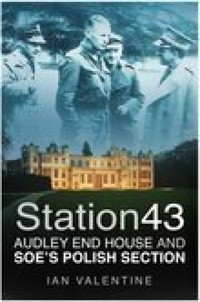
Audley End House in Essex - or Station 43 as it was known during the Second World War - was used as the principal training school for SOE's Polish Section between 1942 and 1944. Polish agents at the stately home undertook a series of arduous training courses in guerilla warfare before being parachuted into occupied Europe. In 1943, Audley End was placed exclusively under polish control, a situation unique within SOE. The training was tough and the success rate low, but a total of 527 agents passed through Audley End between 1942 and 1944. Ian Valentine has consulted a wide range of primary sources and interviewed Polish instructors and former agents who trained at Audley End to write the definitive account of this Essex country house and the vital but secret part it played in defeating Hitler. He examines the comprehensive training agents at Audley End and describes the work undertaken by Station 43's agents in Europe, set against the background of Polish wartime history. He also covers the vital link with the RAF's Special Duties squadrons, whose crews risked their lives dropping agents into occupied Europe. Station 43 breaks new ground in telling the hitherto until story of Audley End house and its role as a vital SOE training school.
Das E-Book können Sie in Legimi-Apps oder einer beliebigen App lesen, die das folgende Format unterstützen:
Veröffentlichungsjahr: 2004
Ähnliche




















STATION 43
STATION 43
Audley End House and
SOE’s Polish Section
IAN VALENTINE
This book was first published in 2004 bySutton Publishing Limited
This paperback edition first published in 2006
Reprinted in 2010, 2012
The History Press The Mill, Brimscombe Port Stroud, Gloucestershire, GL5 2QGwww.thehistorypress.co.uk
This ebook edition first published in 2013
All rights reserved
© Ian Valentine, 2010, 2013
The right of Ian Valentine to be identified as the Author of this work has been asserted in accordance with the Copyrights, Designs and Patents Act 1988.
This ebook is copyright material and must not be copied, reproduced, transferred, distributed, leased, licensed or publicly performed or used in any way except as specifically permitted in writing by the publishers, as allowed under the terms and conditions under which it was purchased or as strictly permitted by applicable copyright law. Any unauthorised distribution or use of this text may be a direct infringement of the author’s and publisher’s rights, and those responsible may be liable in law accordingly.
EPUB ISBN 978 0 7524 9537 8
Original typesetting by The History Press
Contents
Foreword
Preface
Acknowledgements
Abbreviations
Introduction
1 ‘Poland is Fighting’
2 Cichociemni, ‘Silent and Unseen’
3 Station 43
4 Special Duties Squadrons
5 On Dangerous Ground
6 Audley End and the Post-War Years
7 The Hope of the Polish Nation
Appendix I
Sabotage in Poland, June 1942–January 1943
Appendix II
Confirmed Sabotage/Diversionary Actions of the Zwizek Walki Zbrojnej (ZWZ) and the Armia Krajowa (AK), 1 January 1941–30 June 1944
Appendix III
Intrigue in the Middle East: The Case of Maczinski and Mikiczinski
Notes
Notes on the Sources
Bibliography
Foreword
This book is concerned with one of the most secretive and very distinguished military organisations during the Second World War. Although it was a British organisation, called Special Operations Executive, most of the involved volunteers came from the Polish Forces under General Sikorski’s command, stationed in Britain. Their mission was to be parachuted at night into Poland and inflict heavy losses, on unexpected targets, against the German war machine operating in occupied Poland.
The author of this book has collected many unique facts about Audley End House. Having worked as the site ranger in the grounds, Ian Valentine began gathering step-by-step information and material on this secret unit, named ‘Cichociemni’, which trained at Audley End, called Special Training School 43 during the war. The highly selected agents were trained in handling explosives, sabotage, ‘silent killing’, radio contact, shooting and many other duties in Underground operations. Out of 316 volunteers who were parachuted into Poland, 108 lost their lives. Important dignitaries, including Commander-in-Chief of the Polish Forces, General Sikorski, President-in-Exile, Władysław Raczkiewicz, and other generals such as Stanisław Maczek, Stanisław Kopanski and Stanisław Sosabowski visited Audley
End House from time to time.
I congratulate Ian Valentine on this effort in contributing highly towards SOE history and future generations.
Captain Alan Mack (Makowiak), ‘Alma’
Small-arms, PT and unarmed combat instructor, STS 43, 1942–4; wounded and POW at Arnhem, Operation ‘Market Garden’
Preface
Audley End House near Saffron Walden in Essex stands on the site of a Benedictine Abbey founded between 1139 and 1143. High boundary walls once enclosed fish ponds, dovecotes, granaries, a mill and a farm, all providing produce for the refectory table. Lifting a hatch in the anteroom adjacent to the dining parlour, one can still see what is thought to be part of the original monastic walls below. Visitors picnic beside what was once the largest of the monastic fish ponds.
In 1538, after the Dissolution, the buildings and lands were given to Thomas Audley, Henry VIII’s Lord Chancellor. Audley either demolished the abbey or converted it into a three-storey house. Thomas Howard, first Earl of Suffolk, began building the house in 1603 and set about the huge construction of new gardens. After being a royal palace for Charles II, the house and gardens gradually went into decline. However, in the early eighteenth century the restoration projects of Sir John Griffin Griffin, First Baron Braybrooke, began. Much of what the visitor to Audley End sees today is the result of the work that Sir John started. In 1763 he embarked on the rebuilding of Audley End. In the same year the great garden designer Lancelot ‘Capability’ Brown began his plans for redesigning the West Park, in a way that today is considered to be this nation’s greatest contribution to European art, a serpentine style often known as the ‘English Landscape Garden’. Brown created the sweeping carriage drives and demolished the remaining seventeenth-century garden walls, which opened up the view to the landscape beyond. He remodelled the canal into a serpentine lake and planted belts of trees.
Audley End House is well known for its Capability Brown gardens and its wonderful Robert Adam interiors. However, standing at the foot of the old Jacobean Mount Garden south of the house rests a modest memorial urn dedicated to a group of men and women who make up the secret history of Audley End House. During the Second World War the Eighth Baron Braybrooke’s residence was requisitioned and kept under a cloak of secrecy. Visitors walking in the gardens today may notice evidence of Britain’s efforts to repel the expected invasion by the German Army in the early days of the war. However, beyond the concrete tank-traps, the pillbox and bridges, in the dark interiors of the house resided a group of Polish soldiers training to be prepared to parachute into occupied Europe. Major A. Nosek, former chairman of the disbanded Koło Cichociemnych Spadochroniarzy Armii Krajowej (The Polish Home Army Parachutists’ Association), and himself a trainee at Audley End House in 1943, states, ‘Audley End House is such a splendid historical place, where kings and queens have stayed. When they looked down from heaven, I expect they were very surprised to see the arrival of young men speaking a strange language, but I’m sure they gave their approval when they saw what these men were doing.’1 It was this extraordinary work that had to be kept secret. Local people heard explosions in the grounds, and even Lord Braybrooke himself had difficulty in being allowed into his grounds. This book hopes to uncover the part that Audley End House played in Britain’s secret war.
Acknowledgements
Autor najserdeczniej dzikuje tym wszystkim osobom, które hojnie zaofiarowały informacje i pomoc w czasie zbierania materiału i pisania tej ksiki.
Special thanks to the people who knew Audley End House during the war and their families who spent time writing to me, relating their knowledge and generously lending me precious photographs and documents, including former FANY personnel: Elizabeth Austin, née Jessiman; Lord Braybrooke, JP; Anna Menzies Caldwell and her mother, Anne (Maureen) Menzies, née Booth; Mr J. Cottiss and his son, Mr M. Cottiss; Sir Douglas Dodds-Parker; Mr A.S. Fensome, Mr P.J. Fensome and Mr and Mrs B. Lincoln; Mr W. Leney; Mrs J.D. Fisher and her mother, Mrs Oughton; Mrs R. Harris and Mr and Mrs M. Harris; Vera M. Long; Captain Alfons Makowiak (Alan Mack); Major Antoni Nosek and family; Captain Antoni Pospieszalski (Tony Currie); Mrs Elizabeth Reynolds; the Hon. Mrs C. Ruck, OBE, née Neville; Lieutenant W. (Horace) Sidell and D. Sidell; Mrs A. Watts; Mr and Mrs Bronisław Wawrzkowicz and Teresa Miszewska; Margaret Wilson; and Second Lieutenant Kazimierz Zdaniewicz. Also, those who preferred not to have their names mentioned.
My thanks also to others who gave me valuable information, contacts and encouragement: Mr W. Bakiewicz; Warrant Officer (2nd) S.E. Barnes; Cris Betts; Jeff Bines; David Budd; Captain W. Cole and his daughter, Val Sandes; Emma Crocker, Curator of the Photograph Archive, and John Stopford-Pickering at the Imperial War Museum; Martyn Everett; Zofia Everett for translation and historical advice; Jonathan Falconer; Alison Fishpool and Geoff Mason at Frogmore Hall; Rosemary FitzGibbon for information on her uncle, Major Fergus Chalmers-Wright; John Gallehawk; M.R.D. Foot; Alexander Grocholski for information concerning his uncle, Count Stanisław Grocholski and Sir Peter Wilkinson; Jerzy Grochowski, son of Wanda Skwirut, and his wife, Ann; Matthew Grout for his historical advice; Mr R. Grove; Steve Harris (RAF Tempsford website: www.Tempsford.20m. com); Richard Holmes at the Essex Record Office; Ian Hook, Keeper of the Essex Regiment Museum; Bob Hughes; Roger Kirkpatrick; Ann Martin; Tom McCarthy; R.V.L. Noble; Mrs Pickering; Tim Padfield at the National Archives for allowing me to use information from public records in Crown Copyright; Ted Pretty for detailed post-war information about Audley End House; Søren Rasmussen (www.stengun.dk) for translation and information regarding the Danish section of SOE; Iga Szmidt at the Polish Library, London; John Shaw-Ridler; Roy Rodwell; Mr V. Selwyn at the Salamander Oasis Trust; Decia Stephenson, Archivist of the FANY for useful contacts; Flight Lieutenant T.C. Stevens; Dr K. Stoliski, chairman and Krzysztof Bozejewicz of the Studium Polski Podziemnej, the Polish Underground Movement (1939–45) Study Trust (SPP); Mr S. Thompson; Steve and Darren Todd, for putting me in contact with Mr Stevens; Susan Tomkins, Historical Archivist at Beaulieu; Hilary Walford; Teresa Widd; Stefania Ziomek; and Patrizia Zołnierczyk for historical advice.
At English Heritage, Dee Alston, historic contents cleaner, helped in matching rooms with photographs; Marilyn Dalton, the general manager at Audley End House (now retired), gave unlimited support and access to rooms and photographs; Richard Halsey, East of England Regional Director, Val Horsler, Head of Publishing and Alyson Rogers at the National Monuments Records (NMR) kindly granted leave to reproduce English Heritage photographs; Gareth Hughes, East of England Regional Art Curator, gave advice and entrusted the SOE archive to me; I also wish to thank Pat Payne for her photography, and Robin Steward and other staff at the Enquiry and Research Services, NMR. The house staff, room stewards and custodians at Audley End forwarded information and contacts, including Gillian Allcock, Jane Appleby, Val Collins, Liz Davidson, Joy Germany, Nicky Hazell, Linda Ketteridge, Vivien Kroon, Gerald Lowe, Matt Meyer, Chris Trigg and Mel Watling.
Those living in farms and halls in the Saffron Walden area who kindly replied to my letters were Mr P.M. Bell, Mrs Bradfield, Patrick Bushnell, Ian Haigh, Chris and Margaret Johnson, A.W. Pyatt, James Scruby, Michael Snow and Michael Southgate.
Thanks, finally, to my late father, who told me about his father’s experiences rescuing aircrews with the Sheringham lifeboat during the war. He also informed me of the many nationalities that served with the Allies, recalling one 15-mile flight he had in 1944 with the Air Training Corps in a Dominie flown by a Polish pilot, an experience he described as hair-raising. He took a trip in a Dominie again over fifty years later; as he wrote: ‘On Father’s Day 1998 I was privileged again to “fly like a wild bird down the long wind” over the skies of East Anglia.’
Abbreviations
AK
Armia Krajowa
AL
Armia Ludowa
CBE
Commander of the Order of the British Empire
CMG
Companion of the Order of St Michael and St George
CSM
Company Sergeant-Major
DFC
Distinguished Flying Cross
DMO
Director of Military Operations
DSO
Distinguished Service Order
EU/P
European Poles
FANY
First Aid Nursing Yeomanry
GHQ
General Headquarters
GROM
Operational Manœuvre Reconnaissance Group
JP
Justice of the Peace
KCMG
Knight Commander of the Order of St Michael and St George
MBE
Member of the Order of the British Empire
MC
Military Cross
NAAFI
Navy, Army and Air Force Institutes
NKVD
Narodny Komissariat Vnutrennich Dyel
NSZ
Narodowe Siły Zbrojne
OBE
Officer of the Order of the British Empire
ORP
Okrt Rzeczypospolitej Polskiej (Republic of Poland’s Ship)
POW
Prisoner of War
PPR
Polska Partia Robotnicza
PSL
Polskie Stronnictwo Ludowe
PW
Polska Walczy
RAF
Royal Air Force
RASC
Royal Army Service Corps
RNLI
Royal National Lifeboat Institution
RSHA
Reichssicherheitshauptamt
RT
Radio Telegraphy
SAB
Student Assessment Board
SBS
Special Boat Service
SD
Special Duties
SHAEF
Supreme Headquarters of the Allied Expeditionary Force
SIS
Secret Intelligence Service
SOE
Special Operations Executive
SPP
Studium Polski Podziemnej
SS
Schutzstaffeln
STA
Station
STS
Special Training School
SZP
Słuba Zwycistwu Polski
TWZW
Tajne Wojskowe Zakłady Wydawnicze
UB
Urzd Bezpieczestwa
USSR
Union of Soviet Socialist Republics
W/T
Wireless Telegraphy
WiN
Wolnoi Niepodległo
ZWZ
Zwizek Walki Zbrojnej
Introduction
In the winter of 2001 I began researching the wartime history of Audley End House. Armed with scraps of information and a few intriguing photographs, I found that the project soon grew. Serendipity helped. The chance meeting with a visitor to the house led to a wealth of first-hand information and a growing feeling of privilege that people were so willing to talk about their experiences.
In periods of lengthy research it was always pleasing when a verbal report of a particular episode could be cross-referenced and agreed upon by more than one source. Memories obviously change and fade over the sixty years since Audley End was a Special Operations Executive (SOE) training school. Consequently, a historical account of this period, partly based on verbatim reports, can never be a comprehensive study. Some parts of the SOE courses at Station 43, as Audley End was known, remain unclear, and I can only apologise if anyone feels that there are inaccuracies or omissions within the text. British servicemen and Polish instructors were at Audley End for a short period of time, and trainees for six months or less – the time it took to complete a course and get a mission. Also, many individuals still felt bound by the secrecy that was imposed upon them at the time they were there. However, I hope that a general impression of the achievements, willingness and bravery of the Polish soldiers, the training undertaken and life at Audley End House has been achieved.
The records of SOE in Poland at the National Archives are part of a fourth set of restricted files to be released into the public domain, and I have disseminated some files that relate directly to Audley End House, including training reports of seventy trainee agents in 1944, and other files that build up a picture of the work undertaken by the Polish Section of SOE.
Many publications have raised awareness of SOE achievements and losses. The Polish nation suffered greatly as a country before, during and after the war, which can only reinforce the efforts of the men and women who fought with the Armia Krajowa (Home Army), the largest Underground resistance army during the Second World War.
Although I use the term ‘agent’ throughout the text, it is important to stress that the Poles were never ‘spies’. SOE was not an espionage body, and the majority of operatives were drawn from a military background. Perhaps ‘freedom fighters’ would be a better description. Although many personnel – for instance, the couriers – did operate in civilian clothes, many of the soldiers worked with the Armia Krajowa in Poland in a loosely uniformed, paramilitary and partisan capacity. Their efforts culminated in the Warsaw Uprising in 1944.
SOE trainees had to pass strenuous courses. The courses at Audley End were no exception, and there were fatalities. Owing to the great risks involved, all agents were volunteers, but it was often difficult to find ideal candidates. Agents needed to be physically fit, self-reliant, courageous, disciplined, intelligent, experts in clandestine warfare and, as many would argue, ruthless.
With almost 100 acres to utilise for the purposes of training, Audley End House could accommodate a number of trainee agents. The nature of small-town England meant that local knowledge did know that something was going on in the Big House. Local people once saw some very outlandish behaviour as they looked on from the public road. Baroness Sue Ryder of Warsaw, herself in the FANY (First Aid Nursing Yeomanry), was attached to the Polish Section of SOE, and describes the activities that were seen in the West Park at Audley End:
No contact with local people in the area of a [training] station was permitted, and cover stories were given, though at times these must have struck the locals as somewhat less than convincing. A group of curious people gathered one day on the road outside Audley End House near Saffron Walden, Essex (then used as one of the training stations by the Poles), and gazed across the wide lawns as a number of Bods [agents] taking part in a training exercise and disguised as Germans held off an attack.1
One British soldier stated that ‘although the townspeople were officially ignorant of the activities at Audley End, they must have wondered at the civilian-dressed people in the dead of night moving round the fields’.2 They knew that there were questions that one did not ask. Other local people recall that they had no idea about Audley End during the war. People travelled considerably less than today, and obviously there were a fraction of the cars that are now seen on our roads. One elderly Essex farmer stated that he was unsure what was going on in the next village during the war, let alone within the private estate.
Despite the obvious secrecy that was imperative to every residence used by SOE, civilians and Regular Army occupied houses in the grounds. Everyone on site had to sign the Official Secrets Act, and some people are still reluctant to talk about what went on at Audley End during the war. Men from the British Army were stationed at Audley End House to guard the property and maintain its guise as an everyday army camp. They stoked the boilers, cooked for the Poles and the British, undertook administrative and quartermaster duties and ran the orderly room; they drove SOE trainees out on exercises and to the ‘holding stations’, where agents waited for their missions, and airfields when they had finished their training; they played football with the Poles and became their friends – one British soldier found a few of his Polish friends again in tragic circumstances in Germany at the end of the war. Despite the SOE directive that training at the special schools would be autonomous to the Poles, British soldiers taught trainees to drive and ride motorcycles. The British soldiers, local police and Home Guard also took part in training exercises in the Essex countryside. Their job was to stop the Poles completing their given tasks. The Poles treated these exercises very seriously and at times had to be reminded that, although the exercises had to be as authentic as possible, the men who were directed to stop them were allies and not German soldiers. When asked about the Polish desire for authenticity and rough-handedness in field exercises with the local constabulary, SOE trainee Bronisław Wawrzkowicz smiled and said, ‘Yes, we were known as “the Polish bandits”’. Their ferocity was caused by the fact that most of them had witnessed at first hand the ravaging of their country and had fought against the might of the German Blitzkrieg and Soviet occupation. Many had been in Soviet camps. Some had seen members of their family killed and others had no idea what the fate of their families was and would wait many years to find out.
The central theme of this book has to be Audley End’s position in history as the birthplace of many Polish Cichociemni agents, dedicated, fierce and resilient. However, it is important to remember the other people who were part of the lives of the Poles while they were in England: the civilians and British servicemen at Audley End and other Polish establishments; the women of the FANY, the civilian and military code-breakers and the men of the RAF Special Duties squadrons who risked their lives flying missions to the limit of their aircraft’s range. The missions that the Poles at Audley End undertook were taking place in a war that was pulling their homeland apart.
Ian Valentine
Ely, December 2003
ONE
‘Poland is Fighting’
It is easy to get embroiled in the understandably volatile and divided political opinion that still exists concerning British, American, Polish and Soviet relations during the Second World War. Nevertheless, it is important to attempt to look at the background to these views, as this is intrinsic to any document about Polish military involvement in the war. It is also easy to lapse into conjecture about events between the fixed historical dates. However, it is equally difficult to steer away from the vagaries of political double-dealings, polemics, incongruities and betrayal that occurred between the Allied political leaders, when so many Poles still have strong feelings about what happened to them during and after the war.
History can be approached on many levels. Historians draw on many discursive strategies: a fixed period of history can look very different between individual, social, cultural, political and ideological perspectives. An episode in war can be very different for two soldiers standing only yards apart. It is impossible to tidy these very different vantage points and bring them all together, as this leads only to historical reductionism and oversimplification. In this chapter, I am by no means attempting a comprehensive tract about Poland during the Second World War in so few words, only perhaps to express polarised issues about which many people of different generations still have very strong opinions. For instance, British soldiers at Audley End built up friendships with their Polish comrades in arms but could not march with them in any victory parade at the end of the war, a situation that many found difficult to accept. There was no date stamp to mark the end of the war for the Poles, a distinction discussed in the final chapter. Armistice Day marked the end of conflict for most servicemen and women in Europe (with the ensuing loss and bereavement that touched most people), but for many Poles the threat to their lives continued long after the war had finished, when they were tracked down by Communist Soviet–Polish security forces in their homeland. As this book looks at the wartime experiences of a few individual Polish servicemen who trained at Audley End, in what is inevitably a subjective account of the war at an individual and personal level, we should not lose sight of how the conflicts discussed below affected every Pole during and after the war, as well as all the other servicemen and civilians who were chained to political machinations that were out of their control.
Frontiers become ever fluctuating in the tide of history of many nations, changing with the direction of the prevailing political wind. Countries collide on borders like rifts in continental plates, and disputes about territorial ownership create conflicts and wars that still simmer and ignite today. Poland’s borders have changed many times in its history. For many hundreds of years Poland has fought to maintain or regain its independence. The country has been geographically landlocked when it was once sprawling and vast. It has been partitioned and divided by neighbouring countries so that Poland geographically no longer existed. Between 1762 and 1796 Catherine II, Empress of Russia, agreed a series of partitions that resulted in the once independent Poland becoming a protectorate of Russia by 1795. On 24 October of that year Stanisław August of Poland abdicated, and the country was partitioned for the third time among Austria, Russia and Prussia.
From 1795 to 1918, after the country had been partitioned three times, there were no ‘indigenous’ Polish people, only Poles who lived in Russia, Prussia (Germany) and the Habsburg Empire that later became Austria-Hungary.1 The partitions and the ensuing subjugation of the Poles created exiled communities in Europe. This subjugation created a strong distrust of the Germans and Russians in the collective Polish psyche. Stalin, the General Secretary of the Communist Party of the USSR, advocated overt suppression of the Polish language and culture, but the Polish contempt for the Russians was not always understood by Allied leaders during the Second World War, as cartoons in the newspapers of the day exemplified.
The regaining of territorial loss after the First World War was of great importance to Stalin, and the territorial dominance of the Soviet Union in Poland was central to this. Stalin’s ruthless nature and his mistrust of other nations, combined with fear of invasion from the West, help to explain why Polish nationals were executed or imprisoned during the Second World War, despite fighting the common enemy, Germany. Russia has fought many wars, in the East against Japan, in the Crimea, but predominantly in the West. Napoleon’s invasion, the First World War and Hitler’s invasion, all were fought in the west, and these were the most costly to Russia. To control Poland would help to secure Russia’s western border from attack.
The strategic importance of Poland to Hitler and Stalin was immense, and had been to others before them. Invading armies marching towards Russia would pass through Poland. Catherine II realised this and partitioned the country.
At the end of the First World War, Russia was wracked by internal revolution and was militarily weak. Poland was able to regain independence, and with it Russia lost control of an important buffer zone. Stalin’s motivation was twofold: to have a buffer against future invasion from the West and the influence of capitalism, and to regain what had been lost during the First World War. In 1920 Poland was at war with Russia, with Poland’s independence threatened again. The war, fought by many of the soldiers who passed through Audley End House during the Second World War, culminated in a Polish cavalry counter-attack at the battle of Warsaw that quelled the Red Army, but remoulded Poland’s frontiers so that the Lithuanian, Byelorussian and Ukrainian communities were split. The end of the war also reinforced Soviet suspicion that the Poles were dedicated to overthrowing them.2
In Germany at the beginning of the 1930s the popularity of the Nazi Party was growing. The word Nazi was drawn from Hitler’s NAtional SoZIalist Party. In the Reichstag elections of 1930 the Nazi Party won over six and a half million votes. However, Adolf Hitler was originally prevented from taking his seat owing to his Austrian citizenship. On 30 January 1933 Hitler became Chancellor, nationalist feeling grew and in March the following year the Nazis built the first concentration camp, at Dachau near Munich.
Poland signed a non-aggression pact with Germany in 1934. This was unsettling, as it created the impression to other European neighbours that Poland and Germany were allies with common goals. Lying innate was the German aim to reclaim territory, and the German minority in Poland saw Hitler’s rise to power as a step towards this.
By 1938 the threat of Hitler and Stalin was growing. Poland did not accept the German demand to reclaim the port of Gdask in Poland, annexed by the Germans and renamed Danzig. Gdask had a strong German population, going against the tentative appeasement of the 1934 non-aggression pact. After Chamberlain had maintained that Britain would support Poland’s independence, Hitler revoked the peace treaty with Poland. In September 1939 Poland was forcibly occupied by Germany and the USSR, according to an agreement between Hitler and Stalin, which had been signed on 23 August 1939 by German Foreign Minister Joachim von Ribbentrop and Soviet Foreign Minister Vyacheslav Molotov. Hitler’s main purpose was to ensure the Soviet Union’s neutral stance in an attack on Poland. Reinforcing Poland’s weakness within this political triumvirate, the ‘sleeping protocol’ to the pact was the partition of Poland between Germany and the USSR, tearing up Poland’s independence once more.
Two decades of European diplomacy that had sought to prevent another war came to an end. The German invasion of Poland triggered a war that many thought would not last long. British Prime Minister Neville Chamberlain thought the conflict would be over by spring the next year. Hitler’s Blitzkrieg (lightning war) raged through the heart of Europe. Divisions of Panzer tanks outnumbered the inadequate Polish forces and the Luftwaffe destroyed the Polish railway system. However, despite German strength, the Poles fought on but could not withstand Hitler’s attacks into Poland from Slovakia and East Prussia. The Polish hope that Britain and France would save them never happened, as there were no military plans to support Poland. Whether this was because of tardiness, deliberation that Britain would not be successful in helping the Poles, or the sheer speed and military superiority of the German advance is unclear, but, whatever the reasons, similar feelings of betrayal because of inertia would be felt by the Poles in Warsaw in 1944.
The Red Army invaded Poland on 17 September, despite Poland’s misplaced hope that it would offer the Poles military support against Hitler. The military defeat of Poland led to Polish prisoners of war in German hands and in Soviet camps, where the army officers were put into separate custody. The underlying secret pact between the Soviet Union and Germany was made flesh in the territorial sharing of Poland between the two powers. A further treaty expressed mutual responsibility for squashing Polish resistance. In February Stalin began deporting Poles to Siberia and eastern Russia, where the people who survived the journey worked as slave labour in camps such as the Pechora Lager in Siberia. Over one and a half million citizens of different ethnicities left their country. Polish citizens who were not deported were often put into prison camps in their homeland.
Poland was to suffer terribly under German occupation during the war, and endure a higher proportion of deaths than any other country. Six million Polish citizens were put to death in gas chambers and concentration camps, or executed on the spot. Hundreds of thousands were deported for forced labour. The Nazi intention in Poland was the complete ‘Germanisation’ of the country: cities, towns and villages were renamed in German; the Polish language was forbidden in public; members of the intelligentsia were murdered; Polish culture was denied; villages were razed to the ground for the least signs of resistance; and the Catholic Church was persecuted, resulting in priests being sent to concentration camps.
Recolonisation brought with it the Jewish ghettos and Polish resettlement in annexed regions. These Third Reich policies can be amalgamated into the one aim of Hitler: to annihilate the Polish nation so that the country no longer existed. Hitler’s ideology tried to persuade those he made powerless that their powerlessness was inevitable. To take away a nation’s language is to disempower it. His desire to ‘civilise’ condoned murder as a means to an end for eliminating people he saw as ‘savages’. In July 1942 the Germans began to deport the remaining population of the Warsaw ghetto to their deaths in the concentration camps and gas chambers. In April the Jews in Warsaw had defended themselves for six weeks against German tanks and artillery, with thousands of deaths on both sides. M.R.D. Foot states that a Pole, Witold Pilecki, let himself get arrested so that he could find out what life was like inside Auschwitz. This he did, setting up a resistance organisation within the camp. He escaped, but failed to convince the Armia Krajowa about the horrors of life in Auschwitz.3 As the war progressed, couriers also brought information concerning the camps to the Allies, including Polish courier Elzbieta Zawacka, the only female occupant of Audley End House who parachuted into Poland.
Before the First World War the partitioning of Poland had also given rise to the subjugation of the Jewish population in the country. Anti-Semitism in Poland was not new (it can be said that anti-Jewish prejudice was prevalent throughout Europe, including the British Nazi Party, and anti-Jewish views were expressed by writers such as Rudyard Kipling and G.K. Chesterton). Part of the Jewish population in Poland was concentrated in the lands occupied by Russia. Catherine II hailed Russian Orthodoxy as the only true faith, thus restricting the largest concentration of Jews in Europe to their own settlement and forbidding them to journey beyond it. Persecution and the ensuing Jewish insurrection resulted in a large Jewish emigration before the First World War. After the Polish–Soviet War anti-Semitism heightened, often with its roots in religion. The Polish Communist Party was largely Jewish, which created a hatred of Jews and Russians alike.4 Between the wars the Depression badly affected the Jewish community, but Jews were often scapegoated as being catalysts to economic decline. Large numbers of Jews emigrated before the outbreak of the Second World War, those remaining coming under the Nazis’ inconceivably evil solutions in their death camps.
Racial hatred has its roots in many facets of prejudice. Some experts argue that racial scapegoating deflects an unworthiness of self, a powerful force of prejudice, others that prejudice is caused by an unequal distribution of wealth – economic precursors to genocide. When individuals are prejudiced against the members of a group, they will often encode information consistent with their prejudice.
The Nazi propaganda machine exploited a negative representation of the Jews through their own media and language. The dominant Nazi discourse dehumanised the Jews as it dehumanised other faiths and races, and the more it was repeated the more it reinforced the prejudice. The Nazis knew that economic and other national deficiencies could be used in rallying ill feeling towards certain groups. The propaganda helped individuals justify their hatreds, and much of the German population began to view the Jews as Untermenschen, or subhumans.




