


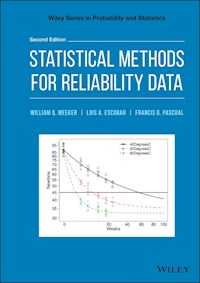
116,99 €
Mehr erfahren.
- Herausgeber: John Wiley & Sons
- Kategorie: Wissenschaft und neue Technologien
- Serie: Wiley Series in Probability and Statistics
- Sprache: Englisch
An authoritative guide to the most recent advances in statistical methods for quantifying reliability
Statistical Methods for Reliability Data, Second Edition (SMRD2) is an essential guide to the most widely used and recently developed statistical methods for reliability data analysis and reliability test planning. Written by three experts in the area, SMRD2 updates and extends the long- established statistical techniques and shows how to apply powerful graphical, numerical, and simulation-based methods to a range of applications in reliability. SMRD2 is a comprehensive resource that describes maximum likelihood and Bayesian methods for solving practical problems that arise in product reliability and similar areas of application. SMRD2 illustrates methods with numerous applications and all the data sets are available on the book’s website. Also, SMRD2 contains an extensive collection of exercises that will enhance its use as a course textbook.
The SMRD2's website contains valuable resources, including R packages, Stan model codes, presentation slides, technical notes, information about commercial software for reliability data analysis, and csv files for the 93 data sets used in the book's examples and exercises. The importance of statistical methods in the area of engineering reliability continues to grow and SMRD2 offers an updated guide for, exploring, modeling, and drawing conclusions from reliability data.
SMRD2 features:
- Contains a wealth of information on modern methods and techniques for reliability data analysis
- Offers discussions on the practical problem-solving power of various Bayesian inference methods
- Provides examples of Bayesian data analysis performed using the R interface to the Stan system based on Stan models that are available on the book's website
- Includes helpful technical-problem and data-analysis exercise sets at the end of every chapter
- Presents illustrative computer graphics that highlight data, results of analyses, and technical concepts
Written for engineers and statisticians in industry and academia, Statistical Methods for Reliability Data, Second Edition offers an authoritative guide to this important topic.
Sie lesen das E-Book in den Legimi-Apps auf:
Seitenzahl: 1316
Veröffentlichungsjahr: 2022
Ähnliche



















Table of Contents
Cover
Title Page
Copyright
Dedication
Preface to the Second Edition
Preface to the First Edition
Acknowledgments
Chapter 1: Reliability Concepts and Reliability Data
OBJECTIVES AND OVERVIEW
1.1 INTRODUCTION
1.2 EXAMPLES OF RELIABILITY DATA
1.3 GENERAL MODELS FOR RELIABILITY DATA
1.4 MODELS FOR TIME TO EVENT VERSUS SEQUENCES OF RECURRENT EVENTS
1.5 STRATEGY FOR DATA COLLECTION, MODELING, AND ANALYSIS
BIBLIOGRAPHIC NOTES AND RELATED TOPICS
EXERCISES
Chapter 2: Models, Censoring, and Likelihood for Failure‐Time Data
OBJECTIVES AND OVERVIEW
2.1 MODELS FOR CONTINUOUS FAILURE‐TIME PROCESSES
2.2 MODELS FOR DISCRETE DATA FROM A CONTINUOUS PROCESS
2.3 CENSORING
2.4 LIKELIHOOD
BIBLIOGRAPHIC NOTES AND RELATED TOPICS
EXERCISES
Chapter 3: Nonparametric Estimation for Failure‐Time Data
OBJECTIVES AND OVERVIEW
3.1 ESTIMATION FROM COMPLETE DATA
3.2 ESTIMATION FROM SINGLY‐CENSORED INTERVAL DATA
3.3 BASIC IDEAS OF STATISTICAL INFERENCE
3.4 CONFIDENCE INTERVALS FROM COMPLETE OR SINGLY‐CENSORED DATA
3.5 ESTIMATION FROM MULTIPLY‐CENSORED DATA
3.6 POINTWISE CONFIDENCE INTERVALS FROM MULTIPLY‐CENSORED DATA
3.7 ESTIMATION FROM MULTIPLY‐CENSORED DATA WITH EXACT FAILURES
3.8 NONPARAMETRIC SIMULTANEOUS CONFIDENCE BANDS
3.9 ARBITRARY CENSORING
BIBLIOGRAPHIC NOTES AND RELATED TOPICS
EXERCISES
Chapter 4: Some Parametric Distributions Used in Reliability Applications
OBJECTIVES AND OVERVIEW
4.1 INTRODUCTION
4.2 QUANTITIES OF INTEREST IN RELIABILITY APPLICATIONS
4.3 LOCATION‐SCALE AND LOG‐LOCATION‐SCALE DISTRIBUTIONS
4.4 EXPONENTIAL DISTRIBUTION
4.5 NORMAL DISTRIBUTION
4.6 LOGNORMAL DISTRIBUTION
4.7 SMALLEST EXTREME VALUE DISTRIBUTION
4.8 WEIBULL DISTRIBUTION
4.9 LARGEST EXTREME VALUE DISTRIBUTION
4.10 FRéCHET DISTRIBUTION
4.11 LOGISTIC DISTRIBUTION
4.12 LOGLOGISTIC DISTRIBUTION
4.13 GENERALIZED GAMMA DISTRIBUTION
4.14 DISTRIBUTIONS WITH A THRESHOLD PARAMETER
4.15 OTHER METHODS OF DERIVING FAILURE‐TIME DISTRIBUTIONS
4.16 PARAMETERS AND PARAMETERIZATION
4.17 GENERATING PSEUDORANDOM OBSERVATIONS FROM A SPECIFIED DISTRIBUTION
BIBLIOGRAPHIC NOTES AND RELATED TOPICS
EXERCISES
Chapter 5: System Reliability Concepts and Methods
OBJECTIVES AND OVERVIEW
5.1 NONREPAIRABLE SYSTEM RELIABILITY METRICS
5.2 SERIES SYSTEMS
5.3 PARALLEL SYSTEMS
5.4 SERIES‐PARALLEL SYSTEMS
5.5 OTHER SYSTEM STRUCTURES
5.6 MULTISTATE SYSTEM RELIABILITY MODELS
BIBLIOGRAPHIC NOTES AND RELATED TOPICS
EXERCISES
Chapter 6: Probability Plotting
OBJECTIVES AND OVERVIEW
6.1 INTRODUCTION
6.2 LINEARIZING LOCATION‐SCALE‐BASED DISTRIBUTIONS
6.3 GRAPHICAL GOODNESS OF FIT
6.4 PROBABILITY PLOTTING POSITIONS
6.5 NOTES ON THE APPLICATION OF PROBABILITY PLOTTING
BIBLIOGRAPHIC NOTES AND RELATED TOPICS
EXERCISES
Chapter 7: Parametric Likelihood Fitting Concepts: Exponential Distribution
OBJECTIVES AND OVERVIEW
7.1 INTRODUCTION
7.2 PARAMETRIC LIKELIHOOD
7.3 LIKELIHOOD CONFIDENCE INTERVALS FOR
7.4 WALD (NORMAL‐APPROXIMATION) CONFIDENCE INTERVALS FOR
7.5 CONFIDENCE INTERVALS FOR FUNCTIONS OF
7.6 COMPARISON OF CONFIDENCE INTERVAL PROCEDURES
7.7 LIKELIHOOD FOR EXACT FAILURE TIMES
7.8 EFFECT OF SAMPLE SIZE ON CONFIDENCE INTERVAL WIDTH AND THE LIKELIHOOD SHAPE
7.9 EXPONENTIAL DISTRIBUTION INFERENCES WITH NO FAILURES
BIBLIOGRAPHIC NOTES AND RELATED TOPICS
EXERCISES
Chapter 8: Maximum Likelihood Estimation for Log‐Location‐Scale Distributions
OBJECTIVES AND OVERVIEW
8.1 LIKELIHOOD DEFINITION
8.2 LIKELIHOOD CONFIDENCE REGIONS AND INTERVALS
8.3 WALD CONFIDENCE INTERVALS
8.4 THE ML ESTIMATE MAY NOT GO THROUGH THE POINTS
8.5 ESTIMATION WITH A GIVEN SHAPE PARAMETER
BIBLIOGRAPHIC NOTES AND RELATED TOPICS
EXERCISES
Chapter 9: Parametric Bootstrap and Other Simulation‐Based Confidence Interval Methods
OBJECTIVES AND OVERVIEW
9.1 INTRODUCTION
9.2 METHODS FOR GENERATING BOOTSTRAP SAMPLES AND OBTAINING BOOTSTRAP ESTIMATES
9.3 BOOTSTRAP CONFIDENCE INTERVAL METHODS
9.4 BOOTSTRAP CONFIDENCE INTERVALS BASED ON PIVOTAL QUANTITIES
9.5 CONFIDENCE INTERVALS BASED ON GENERALIZED PIVOTAL QUANTITIES
BIBLIOGRAPHIC NOTES AND RELATED TOPICS
EXERCISES
Chapter 10: An Introduction to Bayesian Statistical Methods for Reliability
OBJECTIVES AND OVERVIEW
10.1 BAYESIAN INFERENCE: OVERVIEW
10.2 BAYESIAN INFERENCE: AN ILLUSTRATIVE EXAMPLE
10.3 MORE ABOUT PRIOR INFORMATION AND SPECIFICATION OF A PRIOR DISTRIBUTION
10.4 IMPLEMENTING BAYESIAN ANALYSES USING MCMC SIMULATION
10.5 USING PRIOR INFORMATION TO ESTIMATE THE SERVICE‐LIFE DISTRIBUTION OF A ROCKET MOTOR
BIBLIOGRAPHIC NOTES AND RELATED TOPICS
EXERCISES
Chapter 11: Special Parametric Models
OBJECTIVES AND OVERVIEW
11.1 EXTENDING MAXIMUM LIKELIHOOD METHODS
11.2 FITTING THE GENERALIZED GAMMA DISTRIBUTION
11.3 FITTING THE BIRNBAUM–SAUNDERS DISTRIBUTION
11.4 THE LIMITED FAILURE POPULATION MODEL
11.5 TRUNCATED DATA AND TRUNCATED DISTRIBUTIONS
11.6 FITTING DISTRIBUTIONS THAT HAVE A THRESHOLD PARAMETER
BIBLIOGRAPHIC NOTES AND RELATED TOPICS
EXERCISES
Chapter 12: Comparing Failure‐Time Distributions
OBJECTIVES AND OVERVIEW
12.1 BACKGROUND AND MOTIVATION
12.2 NONPARAMETRIC COMPARISONS
12.3 PARAMETRIC COMPARISON OF TWO GROUPS BY FITTING SEPARATE DISTRIBUTIONS
12.4 PARAMETRIC COMPARISON OF TWO GROUPS BY FITTING SEPARATE DISTRIBUTIONS WITH EQUAL VALUES
12.5 PARAMETRIC COMPARISON OF MORE THAN TWO GROUPS
BIBLIOGRAPHIC NOTES AND RELATED TOPICS
EXERCISES
Chapter 13: Planning Life Tests for Estimation
OBJECTIVES AND OVERVIEW
13.1 INTRODUCTION
13.2 SIMPLE FORMULAS TO DETERMINE THE SAMPLE SIZE NEEDED
13.3 USE OF SIMULATION IN TEST PLANNING
13.4 APPROXIMATE VARIANCE OF ML ESTIMATORS AND COMPUTING VARIANCE FACTORS
13.5 VARIANCE FACTORS FOR (LOG‐)LOCATION‐SCALE DISTRIBUTIONS
13.6 SOME EXTENSIONS
BIBLIOGRAPHIC NOTES AND RELATED TOPICS
EXERCISES
Chapter 14: Planning Reliability Demonstration Tests
OBJECTIVES AND OVERVIEW
14.1 INTRODUCTION TO DEMONSTRATION TESTING
14.2 FINDING THE REQUIRED SAMPLE SIZE OR TEST‐LENGTH FACTOR
14.3 PROBABILITY OF SUCCESSFUL DEMONSTRATION
BIBLIOGRAPHIC NOTES AND RELATED TOPICS
EXERCISES
Chapter 15: Prediction of Failure Times and the Number of Future Field Failures
OBJECTIVES AND OVERVIEW
15.1 BASIC CONCEPTS OF STATISTICAL PREDICTION
15.2 PROBABILITY PREDICTION INTERVALS (
KNOWN)
15.3 STATISTICAL PREDICTION INTERVAL (
ESTIMATED)
15.4 PLUG‐IN PREDICTION AND CALIBRATION
15.5 COMPUTING AND USING PREDICTIVE DISTRIBUTIONS
15.6 PREDICTION OF THE NUMBER OF FUTURE FAILURES FROM A SINGLE GROUP
15.7 PREDICTING THE NUMBER OF FUTURE FAILURES FROM MULTIPLE GROUPS
15.8 BAYESIAN PREDICTION METHODS
15.9 CHOOSING A DISTRIBUTION FOR MAKING PREDICTIONS
BIBLIOGRAPHIC NOTES AND RELATED TOPICS
EXERCISES
Chapter 16: Analysis of Data with More than One Failure Mode
OBJECTIVES AND OVERVIEW
16.1 AN INTRODUCTION TO MULTIPLE FAILURE MODES
16.2 MODEL FOR MULTIPLE FAILURE MODES DATA
16.3 MULTIPLE FAILURE MODES ESTIMATION
16.4 THE EFFECT OF ELIMINATING A FAILURE MODE
16.5 SUBDISTRIBUTION FUNCTIONS AND PREDICTION FOR INDIVIDUAL FAILURE MODES
16.6 MORE ABOUT THE NONIDENTIFIABILITY OF DEPENDENCE AMONG FAILURE MODES
BIBLIOGRAPHIC NOTES AND RELATED TOPICS
EXERCISES
Chapter 17: Failure‐Time Regression Analysis
OBJECTIVES AND OVERVIEW
17.1 INTRODUCTION
17.2 SIMPLE LINEAR REGRESSION MODELS
17.3 STANDARD ERRORS AND CONFIDENCE INTERVALS FOR REGRESSION MODELS
17.4 REGRESSION MODEL WITH QUADRATIC AND NONCONSTANT
17.5 CHECKING MODEL ASSUMPTIONS
17.6 EMPIRICAL REGRESSION MODELS AND SENSITIVITY ANALYSIS
17.7 MODELS WITH TWO OR MORE EXPLANATORY VARIABLES
BIBLIOGRAPHIC NOTES AND RELATED TOPICS
EXERCISES
Chapter 18: Analysis of Accelerated Life‐Test Data
OBJECTIVES AND OVERVIEW
18.1 INTRODUCTION TO ACCELERATED LIFE TESTS
18.2 OVERVIEW OF ALT DATA ANALYSIS METHODS
18.3 TEMPERATURE‐ACCELERATED LIFE TESTS
18.4 BAYESIAN ANALYSIS OF A TEMPERATURE‐ACCELERATED LIFE TEST
18.5 VOLTAGE‐ACCELERATED LIFE TEST
BIBLIOGRAPHIC NOTES AND RELATED TOPICS
EXERCISES
Chapter 19: More Topics on Accelerated Life Testing
OBJECTIVES AND OVERVIEW
19.1 ACCELERATED LIFE TESTS WITH INTERVAL‐CENSORED DATA
19.2 ACCELERATED LIFE TESTS WITH TWO ACCELERATING VARIABLES
19.3 MULTIFACTOR EXPERIMENTS WITH A SINGLE ACCELERATING VARIABLE
19.4 PRACTICAL SUGGESTIONS FOR DRAWING CONCLUSIONS FROM ALT DATA
19.5 PITFALLS OF ACCELERATED LIFE TESTING
19.6 OTHER KINDS OF ACCELERATED TESTS
BIBLIOGRAPHIC NOTES AND RELATED TOPICS
EXERCISES
Chapter 20: Degradation Modeling and Destructive Degradation Data Analysis
OBJECTIVES AND OVERVIEW
20.1 DEGRADATION RELIABILITY DATA AND DEGRADATION PATH MODELS: INTRODUCTION AND BACKGROUND
20.2 DESCRIPTION AND MECHANISTIC MOTIVATION FOR DEGRADATION PATH MODELS
20.3 MODELS RELATING DEGRADATION AND FAILURE
20.4 DDT BACKGROUND, MOTIVATING EXAMPLES, AND ESTIMATION
20.5 FAILURE‐TIME DISTRIBUTIONS INDUCED FROM DDT MODELS AND FAILURE‐TIME INFERENCES
20.6 ADDT MODEL BUILDING
20.7 FITTING AN ACCELERATION MODEL TO ADDT DATA
20.8 ADDT FAILURE‐TIME INFERENCES
20.9 ADDT ANALYSIS USING AN INFORMATIVE PRIOR DISTRIBUTION
20.10 AN ADDT WITH AN ASYMPTOTIC MODEL
BIBLIOGRAPHIC NOTES AND RELATED TOPICS
EXERCISES
Chapter 21: Repeated‐Measures Degradation Modeling and Analysis
OBJECTIVES AND OVERVIEW
21.1 RMDT MODELS AND DATA
21.2 RMDT PARAMETER ESTIMATION
21.3 THE RELATIONSHIP BETWEEN DEGRADATION AND FAILURE TIME FOR RMDT MODELS
21.4 ESTIMATION OF A FAILURE‐TIME CDF FROM RMDT DATA
21.5 MODELS FOR ARMDT DATA
21.6 ARMDT ESTIMATION
21.7 ARMDT WITH MULTIPLE ACCELERATING VARIABLES
BIBLIOGRAPHIC NOTES AND RELATED TOPICS
EXERCISES
Chapter 22: Analysis of Repairable System and Other Recurrent Events Data
OBJECTIVES AND OVERVIEW
22.1 INTRODUCTION
22.2 NONPARAMETRIC ESTIMATION OF THE MCF
22.3 COMPARISON OF TWO SAMPLES OF RECURRENT EVENTS DATA
22.4 RECURRENT EVENTS DATA WITH MULTIPLE EVENT TYPES
BIBLIOGRAPHIC NOTES AND RELATED TOPICS
EXERCISES
Chapter 23: Case Studies and Further Applications
OBJECTIVES AND OVERVIEW
23.1 ANALYSIS OF HARD DRIVE FIELD DATA
23.2 RELIABILITY IN THE PRESENCE OF STRESS–STRENGTH INTERFERENCE
23.3 PREDICTING FIELD FAILURES WITH A LIMITED FAILURE POPULATION
23.4 ANALYSIS OF ACCELERATED LIFE‐TEST DATA WHEN THERE IS A BATCH EFFECT
BIBLIOGRAPHIC NOTES AND RELATED TOPICS
Epilogue
ACHIEVING HIGH RELIABILITY AT A COMPETITIVE COST
DESIGN FOR RELIABILITY AND ADVANCING ENGINEERING PRACTICE TO ACHIEVE HIGH RELIABILITY
DESIGN FOR RELIABILITY VERSUS RELIABILITY GROWTH
USEFUL TOOLS AND SOME SPECIFIC SUGGESTIONS
RELIABILITY IN THE ERA OF BIG DATA
STATISTICS IS MUCH MORE THAN A COLLECTION OF FORMULAS
STATISTICS IS NOT MAGIC
Appendix A: Notation and Acronyms
Appendix B: Other Useful Distributions and Probability Distribution Computations
INTRODUCTION
B.1 IMPORTANT CHARACTERISTICS OF DISTRIBUTION FUNCTIONS
B.2 DISTRIBUTIONS AND R COMPUTATIONS
B.3 CONTINUOUS DISTRIBUTIONS
B.4 DISCRETE DISTRIBUTIONS
Appendix C: Some Results from Statistical Theory
INTRODUCTION
C.1 THE CDFS AND PDFS OF FUNCTIONS OF RANDOM VARIABLES
C.2 STATISTICAL ERROR PROPAGATION—THE DELTA METHOD
C.3 LIKELIHOOD AND FISHER INFORMATION MATRICES
C.4 REGULARITY CONDITIONS
C.5 CONVERGENCE IN DISTRIBUTION
C.6 CONVERGENCE IN PROBABILITY
C.7 OUTLINE OF GENERAL ML THEORY
C.8 INFERENCE WITH ZERO OR FEW FAILURES
C.9 THE BONFERRONI INEQUALITY
Appendix D: Tables
References
Index
End User License Agreement
List of Tables
Chapter 1
Table 1.1 Ball‐bearing failure times in millions of revolutions
Table 1.2 Integrated circuit failure times in hours
Table 1.3 Turbine wheel inspection data summary at time of study
Table 1.4 Failure data from a circuit pack field‐tracking study
Chapter 2
Table 2.1 Illustration of probabilities for the multinomial failure‐time mod...
Table 2.2 Contributions to likelihood for life‐table data
Table 2.3 Contributions to the likelihood for general failure‐time data
Chapter 3
Table 3.1 Nonparametric estimates and approximate confidence intervals for t...
Table 3.2 Calculations for the nonparametric estimate of
for the pooled HET...
Table 3.3 Nonparametric confidence intervals for
and the pooled HET data
Table 3.4 Nonparametric estimates for the shock absorber data up to 12,200 k...
Table 3.5 Factors
for EP nonparametric simultaneous approximate confidence ...
Chapter 6
Table 6.1 Number of cycles (in thousands) of fatigue life for 67 of 72 Alloy...
Table 6.2 Summary of probability plot scales to linearize cdfs
Chapter 7
Table 7.1 Binned
‐particle interarrival time data
Table 7.2 Comparison of estimation results from the
‐particle interarrival t...
Table 7.3
‐particle pseudo‐samples constructed to...
Chapter 8
Table 8.1 Comparison of shock absorber estimates and confidence intervals
Table 8.2 Comparison of distribution fits to the ball‐bearing failure data
Table 8.3 Early production failure‐free running times for Component‐B
Chapter 9
Table 9.1 Examples of integer‐random‐weight and fractional‐random‐weight boo...
Table 9.2 The first 10 (of 100,000) rows of the matrix of bootstrap sample e...
Table 9.3 Approximate 95% confidence intervals, using different methods, for...
Table 9.4 Approximate 95% confidence intervals for the shock absorber Weibul...
Chapter 10
Table 10.1 Prior distributions for the bearing‐cage data analyses
Table 10.2 Example sample draws from the joint posterior distribution of the...
Table 10.3 Two‐sided 95% credible intervals for the Weibull distribution par...
Table 10.4 Rocket‐motor field‐performance data (in years since manufacture)
Table 10.5 95% confidence and credible intervals for the rocket‐motor Weibul...
Chapter 11
Table 11.1 Comparison of distributions fitted to the ball‐bearing failure da...
Table 11.2 Comparison of distributions fitted to the fan data
Table 11.3 Comparison of LFP model IC failure data analyses
Table 11.4 Alloy‐C strength data
Chapter 12
Table 12.1 Weighted logrank test results for the snubber and Part‐A examples
Table 12.2 Maximum likelihood estimates for the snubber life‐test data
Table 12.3 Snubber model‐fitting summary
Table 12.4 ML estimates for the Part‐A life‐test data
Table 12.5 Part‐A model‐fitting summary
Table 12.6 Simultaneous 90% confidence intervals comparing the Part‐A operat...
Chapter 13
Table 13.1 The geometric mean of
(expected number of failures) from
simul...
Chapter 14
Table 14.1 Comparison of requirements for a bearing demonstration test assum...
Table 14.2 Comparison of requirements for a bearing demonstration test assum...
Chapter 15
Table 15.1 Comparison of nominal 90% prediction intervals for a future beari...
Table 15.2 Comparison of approximate 90% prediction intervals for the number...
Table 15.3 Bearing‐cage data and future‐failure risk analysis for the next y...
Table 15.4 Comparison of approximate 90% prediction intervals for the number...
Chapter 16
Table 16.1 Device‐G failure times and cause of failure for devices that fail...
Table 16.2 Device‐G field‐tracking data ML estimates of the marginal distrib...
Table 16.3 Shock absorber data ML estimation results for modes 1 and 2
Table 16.4 Product‐E data ML estimation results
Table 16.5 Predicted number of additional Product‐E failures among units tha...
Chapter 17
Table 17.1 ML estimates for the computer program execution‐time example
Table 17.2 ML estimates for life versus stress Weibull regression relationsh...
Table 17.3 Laminate panel data lognormal model comparison using a Box–Cox
(...
Table 17.4 ML estimates for the laminate panel example for the lognormal reg...
Table 17.5 Laminate panel data lognormal model comparison using a Box–Cox
t...
Table 17.6 Glass capacitor life‐test failure times and Weibull ML estimates ...
Table 17.7 Weibull model comparisons for the glass capacitor data
Table 17.8 Glass capacitor life test ML estimates for the Weibull no‐interac...
Table 17.9 Glass capacitor Weibull model comparisons for the regression mode...
Chapter 18
Table 18.1 Device‐A lognormal ML estimates at each temperature
Table 18.2 Device‐A lognormal ML estimates at each temperature with an equal
Table 18.3 Device‐A lognormal model comparisons
Table 18.4 ML estimates of the Arrhenius‐lognormal regression model for the ...
Table 18.5 Summary of the prior distributions used in the Device‐A examples
Table 18.6 Lognormal model comparisons for the M‐P insulation with 361.4 kV/...
Table 18.7 Lognormal model comparisons for the M‐P insulation with 361.4 kV/...
Table 18.8 Inverse‐power lognormal model ML estimates for the M‐P data with ...
Chapter 19
Table 19.1 Individual lognormal ML estimates for the IC device
Table 19.2 IC device lognormal model comparisons
Table 19.3 Arrhenius‐lognormal model ML estimation results for the IC device
Table 19.4 LED ALT data lognormal model comparison
Table 19.5 Subset LED data. ML estimates for the lognormal regression model ...
Table 19.6 LED subset data lognormal model comparison
Table 19.7 Spring data Weibull model comparison
Table 19.8 Weibull model ML estimates for the Spring data
Chapter 20
Table 20.1 Commonly used degradation models
Table 20.2 Commonly used degradation models with explanatory variables
Table 20.3 Data collection plan for the Adhesive Bond B ADDT
Table 20.4 Adhesive Bond A Bayesian parameter estimates for the linear (in
)...
Table 20.5 A summary of the linear path normal distribution Bayesian estimat...
Table 20.6 Adhesive Bond B ADDT data Bayesian parameter estimates for the no...
Table 20.7 Adhesive Bond B ADDT data Bayesian parameter estimates for the no...
Table 20.8 Data collection plan for the Adhesive Formulation K
Table 20.9 A summary of the asymptotic‐path normal distribution Bayesian est...
Table 20.10 Adhesive Formulation K ADDT data Bayesian parameter estimates wi...
Chapter 21
Table 21.1 Alloy‐A RMDT data Bayesian parameter estimates with a weakly info...
Table 21.2 General methods for obtaining time‐to‐first‐crossing distribution...
Table 21.3 Device‐B ARMDT data Bayesian parameter estimates with a weakly in...
Table 21.4 Device‐B ARMDT data Bayesian parameter estimates with an informat...
Table 21.5 LED‐A ARMDT Data Bayesian parameter estimates with a weakly infor...
Chapter 22
Table 22.1 Simulated system repair times
Table 22.2 Sample MCF computations for simulated system repair times
Chapter 23
Table 23.1 Weakly informative prior distributions for the Backblaze‐14 GLFP ...
Table 23.2 Parameter estimates and 95% credible intervals for the Backblaze‐...
Table 23.3 Comparison of ML estimates for
Table 23.4 Weakly informative prior distributions for the connector stress–s...
Table 23.5 Comparison of Bayesian point estimates for
Table 23.6 Device‐J ML lognormal estimates and bootstrap 95% confidence inte...
Table 23.7 Device‐J Bayesian estimates and 95% credible intervals for the LF...
Table 23.8 Number of Kevlar vessels tested at each stress–spool combination
Table 23.9 Estimates and credible intervals for the Kevlar pressure vessels ...
Appendix B
Table B.1 Relationship between mathematical notation and
R
parameter names ...
Table B.2 Standardized pdfs, cdfs, and quantiles for commonly used location‐...
Appendix D
Table D.1 Failure and censoring times of diesel generator fans
Table D.2 Distance to failure for 38 vehicle shock absorbers
Table D.3 Percent increase in resistance over time of carbon‐film resistors
Table D.4 Life‐test comparison of two different snubber designs
Table D.5 Bearing‐cage fracture data
Table D.6 Bleed‐system failure data
Table D.7 Diesel engine age at time of replacement of valve seats
Table D.8 Locomotive age at time of replacement of braking grids
Table D.9 Temperature‐accelerated life‐test data for Device‐A
Table D.10 Computer program execution time versus system load
Table D.11 Low‐cycle fatigue life of nickel‐base superalloy specimens (in un...
Table D.12 Minutes to failure of mylar‐polyurethane laminated DC HV insulati...
Table D.13 Fatigue crack size as a function of number of cycles
Table D.14 Accelerated life‐test data on a new‐technology integrated circuit...
Table D.15 Percent increase in operating current for GaAs lasers tested at 8...
Table D.16 Normal distribution Fisher information, large‐sample approximate ...
List of Illustrations
Chapter 1
Figure 1.1 Histogram (a) and event plot (b) of the ball‐bearing failure data...
Figure 1.2 Event plots of the failure patterns for subsets of integrated cir...
Figure 1.3 HET crack inspection data in calendar time (top) and in operating...
Figure 1.4 Event plot of the turbine wheel inspection data.
Figure 1.5 Scatterplot of printed circuit board accelerated life‐test data w...
Figure 1.6 Alloy‐A fatigue crack size as a function of number of cycles (a)....
Chapter 2
Figure 2.1 Failure‐time cdf (a), pdf (b), survival function (c), and hf (d) ...
Figure 2.2 Bathtub curve hf.
Figure 2.3 Plots showing that the quantile function is the inverse of the cd...
Figure 2.4 The relationship between the parent pdf for
and the pdf for rem...
Figure 2.5 Partitioning of time into nonoverlapping intervals.
Figure 2.6 Graphical interpretation of the relationship between the
values...
Figure 2.7 Likelihood contributions for different kinds of censoring.
Chapter 3
Figure 3.1 Plot of the nonparametric estimate for the ball‐bearing failure‐t...
Figure 3.2 Plant 1 HET data.
Figure 3.3 Plot of the nonparametric estimate for the Plant 1 HET data with ...
Figure 3.4 Plot of the nonparametric estimate of the cdf of the IC failure t...
Figure 3.5 Pooling of the HET data in preparation for computing the nonparam...
Figure 3.6 Plots of the nonparametric estimate for the HET data along with p...
Figure 3.7 Plots of the nonparametric estimate for the shock absorber data a...
Figure 3.8 Basic parameters used in computing the nonparametric ML estimate ...
Figure 3.9 Plots of fraction failing versus hours of exposure (a) and the no...
Chapter 4
Figure 4.1 Exponential cdf, pdf, and hf for
0.5, 1, and 2 and
.
Figure 4.2 Normal cdf, pdf, and hf with location parameter (mean)
and scal...
Figure 4.3 Lognormal cdf, pdf, and hf for scale parameter
,
,
, and
and...
Figure 4.4 Smallest extreme value cdf, pdf, and hf with
and
1, 2, and 3....
Figure 4.5 Weibull cdf, pdf, and hf for
and
0.50, 1.0, 1.5, 2, and 3.0....
Figure 4.6 Largest extreme value cdf, pdf, and hf with
and
2, 3, and 5....
Figure 4.7 Fréchet cdf, pdf, and hf for
and
1, 2, 3.
Figure 4.8 Logistic cdf, pdf, and hf with
and
1, 2, and 5.
Figure 4.9 Loglogistic cdf and pdf for
,
, and
and
0.1, 0.3, and 1.7....
Figure 4.10 Threshold lognormal pdfs with
,
, and
1, 2, and 3.
Chapter 5
Figure 5.1 A system with two components in series.
Figure 5.2 Reliability of a system with
identical independent components (...
Figure 5.3 An RBD with two components in parallel.
Figure 5.4 Reliability of a system with
iid components in parallel (a) and...
Figure 5.5 RBDs of a series‐parallel system structure with system‐level (a) ...
Figure 5.6 RBDs of a bridge‐system (a) and a two‐out‐of‐three system (b) str...
Figure 5.7 Illustrations of a three‐state nonrepairable (a) and repairable (...
Chapter 6
Figure 6.1 Exponential plot (exponential distribution probability scale) sho...
Figure 6.2 Lognormal plot (normal distribution probability scale) showing lo...
Figure 6.3 A plot of the nonparametric estimate of
for the Alloy T7987 fat...
Figure 6.4 Weibull (a), lognormal (b), Fréchet (c), and loglogistic ...
Figure 6.5 Weibull (a) and lognormal (b) plots of the shock absorber data wi...
Figure 6.6 Weibull (a) and lognormal (b) plots of the HET data with nonparam...
Figure 6.7 Exponential (a) and lognormal (b) plots of the turbine wheel insp...
Figure 6.8 Simulated normal distribution data on normal distribution probabi...
Figure 6.9 Simulated exponential distribution data plotted on normal distrib...
Figure 6.10 Bleed‐system data: Weibull plot for all bases (a) and separate W...
Chapter 7
Figure 7.1 Exponential distribution probability plot (a) of the
200 sample...
Figure 7.2 Relative likelihoods
for the
,
, and
pseudo‐samples from th...
Figure 7.3 Relative likelihoods from 10 simulated samples of size
(top) an...
Figure 7.4 Relative likelihood for the diesel generator fan data after 200 h...
Chapter 8
Figure 8.1 Weibull relative likelihood (a) and likelihood joint confidence r...
Figure 8.2 Weibull (a) and lognormal (b) plots of shock absorber failure tim...
Figure 8.3 Weibull profile likelihoods
(a) and
(b) for the shock absorbe...
Figure 8.4 Contour plot of Weibull relative likelihood
(parameterized with...
Figure 8.5 Weibull profile likelihoods
(a) and
(b) for the shock absorbe...
Figure 8.6 ML estimate and pointwise Wald 95% confidence intervals for the W...
Figure 8.7 Weibull plot showing an ML estimate that does not go through the ...
Figure 8.8 Weibull plots of the bearing‐cage fracture data with Weibull ML e...
Figure 8.9 Weibull distribution 95% upper confidence bounds on
for Compone...
Chapter 9
Figure 9.1 Illustration of nonparametric bootstrap resampling for obtaining ...
Figure 9.2 Illustration of parametric bootstrap sampling for obtaining boots...
Figure 9.3 A scatterplot (a) of the first 1000 bootstrap estimates
and
f...
Chapter 10
Figure 10.1 Likelihood (top) and Bayesian (bottom) methods for making infere...
Figure 10.2 Contour plots of the Weibull distribution relative likelihood fo...
Figure 10.3 Sample draws from the weakly informative joint prior distributio...
Figure 10.4 Sample draws from the joint prior distribution for
and
(info...
Figure 10.5 Marginal posterior distributions and 95% credible intervals for ...
Figure 10.6 Marginal posterior distributions and 95% credible intervals for ...
Figure 10.7 Weibull plots of the bearing‐cage failure‐time data showing the ...
Figure 10.8 Marginal posterior distributions and 95% credible intervals for ...
Figure 10.9 Sample paths from a Markov chain with three different starting p...
Figure 10.10 Trace plot (a) and ACF plot (b) for the unthinned draws from th...
Figure 10.11 Event plot of the rocket‐motor field‐performance data (a) and a...
Figure 10.12 Comparison of the posterior and prior distributions for the roc...
Figure 10.13 Marginal posterior distributions for the Weibull distribution 0...
Figure 10.14 Comparison of the marginal posterior distributions of the rocke...
Chapter 11
Figure 11.1 Weibull plot of the ball‐bearing failure data showing the expone...
Figure 11.2 Lognormal plot of the fan failure data showing GENG ML estimates...
Figure 11.3 BISA cdf, pdf, and hf for shape parameter
0.5, 0.6, 1 and
.
Figure 11.4 Lognormal plot of Yokobori's fatigue failure data showing lognor...
Figure 11.5 A Weibull plot of IC failure‐time data with ML estimates of the ...
Figure 11.6 Parametrically adjusted Weibull plot of Vendor 2 circuit pack da...
Figure 11.7 Lognormal plots of the (unadjusted) nonparametric estimate of th...
Figure 11.8 Lognormal plot comparing the threshold lognormal and threshold W...
Figure 11.9 Histogram for binned strength readings on 84 specimens of Alloy‐...
Figure 11.10 Threshold profile and threshold Weibull plots of the Alloy‐C st...
Figure 11.11 Density‐approximation (top two rows) and correct likelihood
(...
Figure 11.12 Lognormal plot of the fan data comparing the threshold lognorma...
Chapter 12
Figure 12.1 Kaplan–Meier estimates for the failure‐time distributions of the...
Figure 12.2 Normal distribution probability plot showing separate fitted nor...
Figure 12.3 Normal distribution probability plot for the old and new designs...
Figure 12.4 Weibull plot showing ML cdf estimates for the three different op...
Figure 12.5 Weibull plot summarizing the fitted equal‐
models for the three...
Chapter 13
Figure 13.1 A Weibull plot showing the cdf corresponding to the planning val...
Figure 13.2 Large‐sample approximate variance factor
for ML estimation of ...
Figure 13.3 Simulation results for a proposed metal spring life test with a ...
Figure 13.4 Simulation results for a proposed metal spring life test with a ...
Figure 13.5 Simulation results for a proposed metal spring life test with a ...
Figure 13.6 Simulation results for a proposed metal spring life test with a ...
Chapter 14
Figure 14.1 Plots for Weibull distribution tests to demonstrate that reliabi...
Figure 14.2 Plots for lognormal distribution tests to demonstrate that relia...
Figure 14.3 Plots for the probability of successful demonstration for Weibul...
Chapter 15
Figure 15.1 New‐sample prediction.
Figure 15.2 Lognormal plot of bearing life‐test data censored after the
th ...
Figure 15.3 Calibration functions for predicting the failure time of a futur...
Figure 15.4 Illustration of the computation of predictive distributions and ...
Figure 15.5 Within‐sample prediction.
Figure 15.6 The predictive distribution and upper and lower prediction bound...
Figure 15.7 Illustration of staggered entry prediction.
Figure 15.8 Predictive distribution and 90% prediction interval for the numb...
Figure 15.9 Bayesian predictive distribution giving the upper and lower pred...
Figure 15.10 Joint posterior distribution of
and
with a weakly informati...
Figure 15.11 Comparison of Weibull, lognormal, and Fréchet cdfs...
Chapter 16
Figure 16.1 Event plot of the Device‐G data (a) and a corresponding Weibull ...
Figure 16.2 Weibull analyses of individual failure modes (a) and Weibull ana...
Figure 16.3 Event plot of shock absorber data (a) and Weibull analyses estim...
Figure 16.4 Weibull analyses of individual failure modes (a) and Weibull ana...
Figure 16.5 Lognormal (a) and Weibull (b) analyses of the Product‐E data est...
Figure 16.6 Scatterplots of pseudo data giving failure times for both failur...
Chapter 17
Figure 17.1 Scatterplot of computer program execution time versus system loa...
Figure 17.2 Computer program execution time versus system load with fitted l...
Figure 17.3 Scatterplot of low‐cycle superalloy fatigue life versus pseudo‐s...
Figure 17.4 Superalloy fatigue data with fitted log‐quadratic Weibull regres...
Figure 17.5 Plot of standardized residuals versus fitted values on log‐log a...
Figure 17.6 Scatterplots of laminate panel fatigue life versus stress with l...
Figure 17.7 Laminate panel data lognormal (a) and Weibull (b) plots. Laminat...
Figure 17.8 Laminate panel data lognormal plot with fitted regression model ...
Figure 17.9 Plot of the 0.10 quantile of fatigue life versus stress Box–Cox ...
Figure 17.10 Scatterplot of glass capacitor life test data (a). Weibull plot...
Figure 17.11 Weibull plot lines showing individual Weibull ML cdf estimates ...
Figure 17.12 Individual estimates of Weibull
plotted for each test conditi...
Chapter 18
Figure 18.1 Scatterplots of temperature‐accelerated life‐test data for Devic...
Figure 18.2 Weibull (a) and lognormal (b) plots for the Device‐A data with i...
Figure 18.3 Lognormal plot showing the ML fitted Arrhenius‐lognormal regress...
Figure 18.4 Plot of the standardized residuals versus fitted values on log‐l...
Figure 18.5 Lognormal plots of the Arrhenius‐lognormal log‐linear regression...
Figure 18.6 Scatterplot of minutes to dielectric breakdown of mylar‐polyuret...
Figure 18.7 Weibull (a) and lognormal (b) plots for the M‐P insulation data ...
Figure 18.8 Plot of the inverse‐power lognormal model fitted to the M‐P data...
Figure 18.9 Lognormal plot and ML fit of the inverse‐power lognormal model t...
Figure 18.10 Plot of the standardized residuals versus
(a) and probability...
Figure 18.11 Model for dielectric strength degrading over time with random i...
Chapter 19
Figure 19.1 Lognormal plots of the data at
and
for the IC device and ind...
Figure 19.2 A lognormal plot of the ML fit of the Arrhenius‐lognormal model ...
Figure 19.3 A lognormal plot showing the Arrhenius‐lognormal model ML estima...
Figure 19.4 Matrix plot of the first 1000 joint posterior draws (a) and a lo...
Figure 19.5 Scatterplot of the LED data showing hours to failure versus temp...
Figure 19.6 Contour plot of the 0.10 quantiles estimates from the regression...
Figure 19.7 Matrix scatterplot of the new spring ALT data (a). Weibull plot ...
Figure 19.8 Weibull plot of the spring data with individual nonparametric an...
Figure 19.9 Conditional model plots of the failure‐time distribution versus
Figure 19.10 Plot of spring ML estimates and 95% confidence intervals for th...
Figure 19.11 Arrhenius plot for a typical temperature‐accelerated failure mo...
Figure 19.12 Well‐behaved comparison of two products (a) and comparison with...
Figure 19.13 A step‐stress ALT (a) and a ramp‐stress ALT (b).
Chapter 20
Figure 20.1 Plot of percent increase in operating current for GaAs lasers te...
Figure 20.2 Possible shapes for univariate increasing (a) and decreasing (b)...
Figure 20.3 Adhesive Bond B ADDT data scatterplot (a) and Adhesive Bond A st...
Figure 20.4 Adhesive Bond A strength field data linear‐linear axes (a) and s...
Figure 20.5 Adhesive Bond A strength field data using a square‐root transfor...
Figure 20.6 Adhesive Bond A strength field data plot of residuals versus fit...
Figure 20.7 Adhesive Bond A estimate of fraction failing as a function of ti...
Figure 20.8 Adhesive Bond B ADDT data scatterplot on linear‐linear axes (a) ...
Figure 20.9 Adhesive Bond B ADDT data overlay of individual normal distribut...
Figure 20.10 Adhesive Bond B ADDT estimation using a square‐root transformat...
Figure 20.11 Adhesive Bond B ADDT data residuals versus fitted values (a) an...
Figure 20.12 Adhesive Bond B estimates of the degradation model showing frac...
Figure 20.13 Adhesive Bond B fitted linear degradation model, extrapolating ...
Figure 20.14 Adhesive Bond B ADDT estimation using a square‐root transformat...
Figure 20.15 Adhesive Bond B lognormal plot of the failure‐time cdf estimate...
Figure 20.16 Adhesive Formulation K ADDT data as a function of time linear‐l...
Figure 20.17 Adhesive Formulation K overlay of individual normal distributio...
Figure 20.18 Adhesive Formulation K ADDT Bayesian estimation for the normal ...
Figure 20.19 Adhesive Formulation K ADDT data residuals versus fitted values...
Figure 20.20 Adhesive Formulation K estimates of the degradation model showi...
Figure 20.21 Adhesive Formulation K fitted asymptotic degradation model, ext...
Chapter 21
Figure 21.1 Alloy‐A fatigue crack data (a) and the Paris model with fixed va...
Figure 21.2 Plot of Paris model with unit‐to‐unit variability in the initial...
Figure 21.3 Plot of Paris model simulation with unit‐to‐unit and a stochasti...
Figure 21.4 Posterior pairs plot for the Alloy‐A fatigue crack size BVN dist...
Figure 21.5 Posterior distribution evaluations of
(cdf draws) for the Allo...
Figure 21.6 Device‐B data at
,
, and
(a) and a ...
Figure 21.7 Device‐B data and fitted degradation model for the
sample path...
Figure 21.8 Device‐B ARMDT estimation with an informative prior distribution...
Figure 21.9 Device‐B ARMDT lognormal plot of the failure‐time cdf estimates ...
Figure 21.10 LED‐A relative light output at six conditions on square root‐li...
Figure 21.11 LED‐A posterior pairs plot (a) and ARMDT data and fitted degrad...
Figure 21.12 LED‐A ARMDT data and fitted degradation model showing extrapola...
Chapter 22
Figure 22.1 Event plot showing engine age at time of valve seat replacement ...
Figure 21.2 Cylinder replacement event plot showing replacement times and pe...
Figure 22.3 Event plot showing machine age at time of the maintenance action...
Figure 22.4 Comparison of MCF estimates for the braking grids from batches 1...
Figure 21.5 System E event plot showing system age at time of replacement fo...
Figure 22.6 Plots of System E MCF estimates with pointwise Wald 95% confiden...
Chapter 23
Figure 23.1 Weibull plot of the Kaplan–Meier estimate of the Backblaze‐14 da...
Figure 23.2 Weibull stress and lognormal strength pdfs (a) and a region of i...
Figure 23.3 Weibull (a) and lognormal (b) plots for connector stress. Weibul...
Figure 23.4 Lognormal plot of the Device‐J field data after 40 months (a), a...
Figure 23.5 Device‐J pairs plot of draws from the joint posterior distributi...
Figure 23.6 Device‐J pairs plot of draws from the joint posterior distributi...
Figure 23.7 Device‐J pairs plot of draws from the joint posterior distributi...
Figure 23.8 90% and 95% prediction intervals based on 55‐month data with wea...
Figure 23.9 Scatterplot of the Kevlar pressure vessels ALT data (a) and a We...
Figure 23.10 Kevlar pressure vessel pairs plot of draws from the joint poste...
Figure 23.11 Weibull plot showing estimates of the Kevlar pressure vessel cd...
Figure 23.12 Weibull plot showing a cdf estimate and 95% credible bounds for...
Guide
Cover
Table of Contents
Title Page
Copyright
Dedication
Preface to the Second Edition
Preface to the First Edition
Acknowledgments
Begin Reading
Epilogue
Appendix A Notation and Acronyms
Appendix B Other Useful Distributions and Probability Distribution Computations
Appendix C Some Results from Statistical Theory
Appendix D Tables
References
Index
End User License Agreement
Pages
ii
iii
iv
v
xxvii
xxviii
xxix
xxx
xxxi
xxxii
xxxiii
xxxiv
xxxv
xxxvi
xxxvii
1
2
3
4
5
6
7
8
9
10
11
12
13
14
15
16
17
18
19
20
21
22
23
24
25
26
27
28
29
30
31
32
33
34
35
36
37
38
39
40
41
42
43
44
45
46
47
48
49
50
51
52
53
54
55
56
57
58
59
60
61
62
63
64
65
66
67
68
69
70
71
72
73
74
75
76
77
78
79
80
81
82
83
84
85
86
87
88
89
90
91
92
93
94
95
96
97
98
99
100
101
102
103
104
105
106
107
108
109
110
111
112
113
114
115
116
117
118
119
120
121
122
123
124
125
126
127
128
129
130
131
132
133
134
135
136
137
138
139
140
141
142
143
144
145
146
147
148
149
150
151
152
153
154
155
156
157
158
159
160
161
162
163
164
165
166
167
168
169
170
171
172
173
174
175
176
177
178
179
180
181
182
183
184
185
186
187
188
189
190
191
192
193
194
195
196
197
198
199
200
201
202
203
204
205
206
207
208
209
210
211
212
213
214
215
216
217
218
219
220
221
222
223
224
225
226
227
228
229
230
231
232
233
234
235
236
237
238
239
240
241
242
243
244
245
246
247
248
249
250
251
252
253
254
255
256
257
258
259
260
261
262
263
264
265
266
267
268
269
270
271
272
273
274
275
276
277
278
279
280
281
282
283
284
285
286
287
288
289
290
291
292
293
294
295
296
297
298
299
300
301
302
303
304
305
306
307
308
309
310
311
312
313
314
315
316
317
318
319
320
321
322
323
324
325
326
327
328
329
330
331
332
333
334
335
336
337
338
339
340
341
342
343
344
345
346
347
348
349
350
351
352
353
354
355
356
357
358
359
360
361
362
363
364
365
366
367
368
369
370
371
372
373
374
375
376
377
378
379
380
381
382
383
384
385
386
387
388
389
390
391
392
393
394
395
396
397
398
399
400
401
402
403
404
405
406
407
408
409
410
411
412
413
414
415
416
417
418
419
420
421
422
423
424
425
426
427
428
429
430
431
432
433
434
435
436
437
438
439
440
441
442
443
444
445
446
447
448
449
450
451
452
453
454
455
456
457
458
459
460
461
462
463
464
465
466
467
468
469
470
471
472
473
474
475
476
477
478
479
480
481
482
483
484
485
486
487
488
489
490
491
492
493
494
495
496
497
498
499
500
501
502
503
504
505
506
507
508
509
510
511
512
513
514
515
516
517
518
519
520
521
522
523
524
525
526
527
528
529
530
531
532
533
534
535
536
537
538
539
540
541
542
543
544
545
546
547
548
549
550
551
552
553
554
555
556
557
558
559
560
561
562
563
564
565
566
567
568
569
570
571
572
573
574
575
576
577
578
579
580
581
582
583
584
585
586
587
588
589
590
591
592
593
594
595
596
597
598
599
600
601
602
603
604
605
606
607
608
609
610
611
612
613
614
615
616
617
618
619
620
621
622
623
624
625
626
627
628
629
630
631
632
633
634
635
636
637
638
639
640
641
642
643
644
645
647
648
649
650
651
652
653
654
655
656
657
658
659
660
WILEY SERIES IN PROBABILITY AND STATISTICS
Established by Walter A. Shewhart and Samuel S. Wilks
Editors: David J. Balding, Noel A. C. Cressie, Garrett M. Fitzmaurice, Geof H. Givens, Harvey Goldstein, Geert Molenberghs, David W. Scott, Adrian F. M. Smith, and Ruey S. Tsay
Editors Emeriti: J. Stuart Hunter, Iain M. Johnstone, Joseph B. Kadane, and Jozef L. Teugels
The Wiley Series in Probability and Statistics is well established and authoritative. It covers many topics of current research interest in both pure and applied statistics and probability theory. Written by leading statisticians and institutions, the titles span both state‐of‐the‐art developments in the field and classical methods.
Reflecting the wide range of current research in statistics, the series encompasses applied, methodological and theoretical statistics, ranging from applications and new techniques made possible by advances in computerized practice to rigorous treatment of theoretical approaches.
This series provides essential and invaluable reading for all statisticians, whether in academia, industry, government, or research.
A complete list of titles in this series can be found at http://www.wiley.com/go/wsps
Statistical Methods for Reliability Data
Second Edition
William Q. MeekerDepartment of StatisticsIowa State University
Luis A. EscobarDepartment of Experimental StatisticsLouisiana State University
Francis G. PascualDepartment of Mathematics and StatisticsWashington State University
This second edition first published 2022© 2022 John Wiley & Sons, Inc.
Edition HistoryJohn Wiley & Sons, Inc. (1e, 1998)
All rights reserved. No part of this publication may be reproduced, stored in a retrieval system, or transmitted, in any form or by any means, electronic, mechanical, photocopying, recording or otherwise, except as permitted by law. Advice on how to obtain permission to reuse material from this title is available at http://www.wiley.com/go/permissions.
The right of William Q. Meeker, Luis A. Escobar, and Francis G. Pascual to be identified as the authors of this work has been asserted in accordance with law.
Registered OfficeJohn Wiley & Sons, Inc., 111 River Street, Hoboken, NJ 07030, USA
Editorial Office111 River Street, Hoboken, NJ 07030, USA
For details of our global editorial offices, customer services, and more information about Wiley products visit us at www.wiley.com.
Wiley also publishes its books in a variety of electronic formats and by print‐on‐demand. Some content that appears in standard print versions of this book may not be available in other formats.
Limit of Liability/Disclaimer of WarrantyWhile the publisher and authors have used their best efforts in preparing this work, they make no representations or warranties with respect to the accuracy or completeness of the contents of this work and specifically disclaim all warranties, including without limitation any implied warranties of merchantability or fitness for a particular purpose. No warranty may be created or extended by sales representatives, written sales materials or promotional statements for this work. The fact that an organization, website, or product is referred to in this work as a citation and/or potential source of further information does not mean that the publisher and authors endorse the information or services the organization, website, or product may provide or recommendations it may make. This work is sold with the understanding that the publisher is not engaged in rendering professional services. The advice and strategies contained herein may not be suitable for your situation. You should consult with a specialist where appropriate. Further, readers should be aware that websites listed in this work may have changed or disappeared between when this work was written and when it is read. Neither the publisher nor authors shall be liable for any loss of profit or any other commercial damages, including but not limited to special, incidental, consequential, or other damages.
Library of Congress Cataloging‐in‐Publication Data is applied forHardback ISBN 9781118115459
Cover Design: WileyCover Image: Courtesy of William Meeker
To Karen, Katherine, Josh, Liam, and Ayla, and my parents.
W. Q. M.
To my grandchildren: Olivia, Lillian, Nathaniel, Gabriel, Samuel, and Jackson.
L. A. E.
To my parents and Brother Michael O'Keefe, F.M.S.
F. G. P.
Preface to the Second Edition
The first edition of Statistical Methods for Reliability Data (SMRD1) was published 23 years ago. We believe SMRD1 successfully met its goal of providing a comprehensive overview of statistical methods for reliability data analysis and test planning for practitioners and statisticians and we have received much positive feedback. Despite, and perhaps because of this, there were compelling reasons for a second edition (SRMD2). We (both the profession and the authors) have learned much since 1998. In our experiences consulting on reliability applications and in presenting on the order of one hundred short courses to both statisticians and reliability engineers in industry and government, we have gained a solid appreciation for what are the most important topics in the field of statistical methods for reliability, suggesting a slight change in focus for SMRD2. In teaching our respective university courses, we have discovered some improved methods for presenting some topics. These experiences helped us to develop our plan for SMRD2. For the SMRD2 project, Bill and Luis have been most fortunate to have Jave Pascual join them as a co‐author.
Goals for SMRD2
Our goals for the SMRD2 were to:
Update and improve or expand on various previously presented statistical methods for reliability data, using statistical and computational methods that have been developed or become readily available since SMRD1 was published.
Improve the organization of the material to make it possible to cover more and the most important topics in a one‐semester course.
Completely rewrite chapters where there have been important developments or changes in what are considered to be best practices in the analysis of reliability data.
Provide a more extensive treatment of the use and application of Bayesian methods in reliability data analysis.
Provide, via technical appendices, additional justification and theory underlying the statistical methods presented in this book.
Provide a webpage that gives up‐to‐date information about available software for doing reliability data analysis, supplementary information such as presentation slides, additional data sets, and exercises, as well as other important up‐to‐date information developed or coming to our attention after publication.
What Has Not Changed
In SMRD2, we have paid special care to retain the appealing features of SMRD1. Specifically, the special features of the book, listed in the preface of SMRD1 are still intact.
Important Changes in SMRD2
Important changes in SMRD2 include the following:
Although SMRD1 has been popular with both engineers and statisticians, in the preparation of SMRD2 there has been a concerted effort to look for ways to improve the presentation and usability of the book. Means for doing this have included additional words of explanation, additional examples using simulation to provide insights, moving some technical details to appendices, and omitting topics that, while of some technical interest, have had little or no value in practical applications.
We have added a section on the important topic of the distribution of remaining life to the chapter
Models, Censoring, and Likelihood for Failure‐Time Data
(
Chapter 2
).
We now include a section describing the important Fréchet distribution in the chapter
Some Parametric Distributions Used in Reliability Applications
(
Chapter 4
).
SMRD1 Chapter 5 (
Other Parametric Distributions
) has been eliminated, with the important and useful material being moved to either
Chapter 4
or the chapter
Special Parametric Models
(
Chapter 11
).
The chapter
Parametric Bootstrap and Other Simulation‐Based Confidence Interval Methods
(
Chapter 9
), has been completely rewritten to reflect many new developments since SMRD1 was published, including the use of the fractional‐random‐weight bootstrap and generalized pivotal quantities.
The chapter
An Introduction to Bayesian Statistical Methods for Reliability
(
Chapter 10
) replaces, updates, and expands SMRD1 Chapter 14. The chapter has been completely rewritten with a more modern slant on prior distribution specification and computational methods, with several illustrations of Bayesian applications. Then, in most subsequent chapters, Bayesian methods are integrated into the development and presentation of many statistical analyses where some prior information is available (and ignoring it would be wrong) or where there is other strong motivation to use Bayesian methods.
SMRD1 Chapter 10 has been completely rewritten to focus on
Planning Life Tests for Estimation
(now
Chapter 13
) and to improve clarity and usability of the material.
The material in the chapter
Planning Reliability Demonstration Tests
(
Chapter 14
) is mostly new, where the SMRD1 material (previously in a small part of SMRD1 Chapter 10) has been completely rewritten and generalized to allow planning demonstration tests for any log‐location‐scale distribution and tests that allow failures to occur (and still pass the test), providing demonstration tests that have much improved probability of successful demonstration (i.e., power).
The chapter
Prediction of Failure Times and the Number of Future Field Failures
(
Chapter 15
) has also been completely rewritten to reflect simpler and more direct methods to obtain prediction intervals in reliability applications. These include the use of
predictive distributions
for both non‐Bayesian and Bayesian prediction. Also, we now put more focus on the important applications of predicting the number of field failures and warranty returns.
Instead of one combined chapter on system reliability and the analysis of competing risks (SMRD1 Chapter 15), these topics are now covered more extensively in two separate chapters:
System Reliability Concepts and Methods
(
Chapter 5
) and
Analysis of Data with More than One Failure Mode
(
Chapter 16
), respectively.
The material on regression analysis of failure‐time data and accelerated life testing has been reorganized with many improvements and new examples, now in
Chapters 17
,
18
, and
19
.
We have added a completely new chapter,
Degradation Modeling and Destructive Degradation Data Analysis
(
Chapter 20
), to describe and illustrate the use of these important statistical methods.
To save space and improve organization, the two SMRD1 chapters on degradation modeling and analysis (SMRD1 Chapters 13 and 21) have been combined and completely rewritten to form
Repeated‐Measures Degradation Modeling and Analysis
(
Chapter 21
). To make inferences from repeated‐measures degradation data, we have replaced the previously used maximum likelihood and bootstrap methods for nonlinear mixed‐effects models with the more versatile Bayesian hierarchical models and inference methods.
Almost all of the figures in SMRD2 have been redrawn, both to improve quality and to introduce color (for the electronic versions of SMRD2). We have, however, continued to design our graphics so that having color is not necessary.
Numerous new references have been added or updated and the Bibliographic Notes and Related Topics sections at the end of each chapter have been expanded and reorganized to make it easier to find references and additional information for particular topics.
Many new data sets and examples have been added throughout SMRD2. We also have added many new applications to illustrate the use of the methods that we present. As in SMRD1, all of these applications are based on real data. In some of the data sets, however, we have changed the names of the variables and/or the scale of the data to protect sensitive information. The data in
Section 23.3
had to be simulated, but they reflect the interesting statistical aspects of the real applications.
Many new exercises have been added at the end of the chapters.
Some tables containing small reliability data sets remain in the chapters and in
Appendix D
. These data sets and all new data sets, used in examples and exercises, are available as csv files from the SRMD2 webpage.
What Was Dropped
Some material from SMRD1 Chapter 5 (Other Parametric Distributions) and Chapter 20 (Planning Accelerated Life Tests) has been dropped. As mentioned earlier, the useful material from Chapter 5 has been integrated into either Chapter 4 or Chapter 11. The important ideas behind planning accelerated life tests are illustrated and briefly described in some of the accelerated testing examples in Chapters 18 and 19 with a summary of the key points in Section 19.4.3. To save space for more important material, we have also dropped a few tables of lengthy data sets. These data sets (and many others) are, however, available on SMRD2's webpage.
Overview and Paths through SMRD2
There are many paths that readers and instructors might take through this book. Chapters 1–8 cover single distribution models without any explanatory variables. This is basic material that will be of interest to almost all readers and should be read in sequence. It is possible to do only a light reading of Chapter 4 (e.g., focusing on the Weibull and lognormal distributions) before going on to the important methods in Chapters 6–8. Chapter 5 introduces some important system reliability concepts. The material on the reliability of a series system is used in Chapter 16, but otherwise this chapter is not prerequisite for material in subsequent chapters.
Chapters 9–16 and Chapter 22 describe special but important topics in reliability data analysis. While the material in these chapters depends on earlier chapters, the order of reading is not important.
Chapter 9 explains and illustrates the use of parametric bootstrap and other simulation‐based methods for obtaining confidence intervals. These methods are becoming more popular, now that they are easy to use in certain software packages (e.g., JMP). These intervals, in general, have better statistical properties (i.e., coverage probabilities closer to nominal confidence levels) than the traditional confidence intervals methods based on Wald approximations. Although confidence intervals based on Wald approximations are usually sufficient for initial and other exploratory analyses of reliability data, we recommend using these more trustworthy methods before reporting final results. The simulation‐based methods in this chapter are also used in Chapter 15 to obtain prediction intervals.
Chapter 10 provides an introduction to the use of modern Bayesian methods in the analysis of reliability data. These methods are becoming increasingly popular, now that we have the software tools that make implementation possible without the need for complicated computer programming. Bayesian applications are illustrated in numerous examples in subsequent chapters.
Chapter 11 describes and illustrates several important statistical models that arise in applications. These include the limited‐failure population model (also known as the defective sub‐population model), truncated data, and maximum likelihood estimation for the generalized gamma, Birnbaum–Saunders, and threshold distributions.
Chapter 12 is a new chapter that describes nonparametric and parametric statistical methods for comparing two or more failure‐time distributions, extending methods in Chapters 3 and 8, respectively.
Chapter 13 focuses on test planning: evaluating the effects of choosing sample size and test length when the purpose is estimation. Chapter 14 covers reliability demonstration tests.
Chapter 15 shows how to obtain prediction intervals for failure times and for the number of failures in a future time interval. The latter application is important for warranty and other field‐failure prediction applications. We present both non‐Bayesian and Bayesian methods.
Chapter 16 describes statistical methods for estimating failure‐time distributions for individual failure modes and how to evaluate the effect of eliminating a failure mode.
Chapter 17 introduces models and methods for failure‐time regression analysis. Relatedly, Chapters 18 and 19 present physically based acceleration relationships and show how to analyze accelerated life‐test data.
The first two sections of Chapter 20 provide background and motivation for degradation analysis and degradation path models that are used for both destructive and repeated‐measures degradation data. The remainder of the chapter focuses on statistical models and methods for destructive degradation data. Chapter 21 describes statistical models and methods for repeated‐measures degradation data.
Chapter 22




