


89,99 €
Mehr erfahren.
- Herausgeber: John Wiley & Sons
- Kategorie: Fachliteratur
- Sprache: Englisch
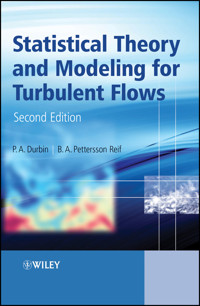
Providing a comprehensive grounding in the subject of turbulence, Statistical Theory and Modeling for Turbulent Flows develops both the physical insight and the mathematical framework needed to understand turbulent flow. Its scope enables the reader to become a knowledgeable user of turbulence models; it develops analytical tools for developers of predictive tools. Thoroughly revised and updated, this second edition includes a new fourth section covering DNS (direct numerical simulation), LES (large eddy simulation), DES (detached eddy simulation) and numerical aspects of eddy resolving simulation. In addition to its role as a guide for students, Statistical Theory and Modeling for Turbulent Flows also is a valuable reference for practicing engineers and scientists in computational and experimental fluid dynamics, who would like to broaden their understanding of fundamental issues in turbulence and how they relate to turbulence model implementation. * Provides an excellent foundation to the fundamental theoretical concepts in turbulence. * Features new and heavily revised material, including an entire new section on eddy resolving simulation. * Includes new material on modeling laminar to turbulent transition. * Written for students and practitioners in aeronautical and mechanical engineering, applied mathematics and the physical sciences. * Accompanied by a website housing solutions to the problems within the book.
Sie lesen das E-Book in den Legimi-Apps auf:
Seitenzahl: 656
Veröffentlichungsjahr: 2011
Ähnliche



















Contents
Preface
Acknowledgements
Part I FUNDAMENTALS OF TURBULENCE
1 Introduction
1.1 The turbulence problem
1.2 Closure modeling
1.3 Categories of turbulent flow
2 Mathematical and statistical background
2.1 Dimensional analysis
2.2 Statistical tools
2.3 Cartesian tensors
3 Reynolds averaged Navier–Stokes equations
3.1 Background to the equations
3.2 Reynolds averaged equations
3.3 Terms of kinetic energy and Reynolds stress budgets
3.4 Passive contaminant transport
4 Parallel and self-similar shear flows
4.1 Plane channel flow
4.2 Boundary layer
4.3 Free-shear layers
4.4 Heat and mass transfer
5 Vorticity and vortical structures
5.1 Structures
5.2 Vorticity and dissipation
Exercises
Part II SINGLE-POINT CLOSURE MODELING
6 Models with scalar variables
6.1 Boundary-layer methods
6.2 The k–ε model
6.3 The k–ω model
6.4 Stagnation-point anomaly
6.5 The question of transition
6.6 Eddy viscosity transport models
7 Models with tensor variables
7.1 Second-moment transport
7.2 Analytic solutions to SMC models
7.3 Non-homogeneity
7.4 Reynolds averaged computation
8 Advanced topics
8.1 Further modeling principles
8.2 Second-moment closure and Langevin equations
8.3 Moving equilibrium solutions of SMC
8.4 Passive scalar flux modeling
8.5 Active scalar flux modeling: effects of buoyancy
Part III THEORY OF HOMOGENEOUS TURBULENCE
9 Mathematical representations
9.1 Fourier transforms
9.2 Three-dimensional energy spectrum of homogeneous turbulence
10 Navier–Stokes equations in spectral space
10.1 Convolution integrals as triad interaction
10.2 Evolution of spectra
11 Rapid distortion theory
11.1 Irrotational mean flow
11.2 General homogeneous distortions
Part IV TURBULENCE SIMULATION
12 Eddy-resolving simulation
12.1 Direct numerical simulation
12.2 Illustrations
12.3 Pseudo-spectral method
13 Simulation of large eddies
13.1 Large eddy simulation
13.2 Detached eddy simulation
References
Index
This edition first published 2011© 2011, John Wiley & Sons, Ltd
First Edition published in 2001
Registered officeJohn Wiley & Sons Ltd, The Atrium, Southern Gate, Chichester, West Sussex, PO19 8SQ, United Kingdom
For details of our global editorial offices, for customer services and for information about how to apply for permission to reuse the copyright material in this book please see our website at www.wiley.com/wiley-blackwell.
The right of the author to be identified as the author of this work has been asserted in accordance with the Copyright, Designs and Patents Act 1988.
All rights reserved. No part of this publication may be reproduced, stored in a retrieval system, or transmitted, in any form or by any means, electronic, mechanical, photocopying, recording or otherwise, except as permitted by the UK Copyright, Designs and Patents Act 1988, without the prior permission of the publisher.
Wiley also publishes its books in a variety of electronic formats. Some content that appears in print may not be available in electronic books.
Designations used by companies to distinguish their products are often claimed as trademarks. All brand names and product names used in this book are trade names, service marks, trademarks or registered trademarks of their respective owners. The publisher is not associated with any product or vendor mentioned in this book. This publication is designed to provide accurate and authoritative information in regard to the subject matter covered. It is sold on the understanding that the publisher is not engaged in rendering professional services. If professional advice or other expert assistance is required, the services of a competent professional should be sought.
Library of Congress Cataloguing-in-Publication Data
Durbin, Paul A.Statistical theory and modeling for turbulent flows / Paul A. Durbin, Bjørn Anders Pettersson Reif. – 2nd ed.p. cm.Includes index.ISBN 978-0-470-68931-8 (cloth)1. Turbulence–Mathematical models. I. Reif, B. A. Pettersson. II. Title.QA913.D94 2010532'.0527015118–dc22
2010020346
A catalogue record for this book is available from the British Library.
Print ISBN: 978-0-470-68931-8ePDF ISBN 978-0-470-97206-9oBook ISBN: 978-0-470-97207-6
Set in 10/12pt Times by Laserwords Private Limited, Chennai, India
to Cinian and Seth
Preface
Preface to second edition
The original first edition intentionally avoided the topic of eddy-resolving, computer simulation. The crucial role of numerics in turbulence simulation is why we shied away from the topic. One cannot properly introduce direct numerical simulation or large eddy simulation without discussing discretization schemes.
However, large eddy simulation and detached eddy simulation are now increasingly seen as partners to Reynolds averaged modeling. This revised second edition contains a new Part IV on direct numerical simulation, large eddy simulation, and detached eddy simulation. In keeping with our original perspective, it is not encyclopedic. We address some of the key issues, with sufficient technical content for the reader to acquire concrete understanding. For example, dissipative and dispersive errors are defined in order to understand why central schemes are preferred. The notion of energy-conserving schemes is reviewed. Our discussion of filtering is brief compared to the development of large eddy simulation in other books. Given our concise treatment, we chose instead to focus on the nature of subgrid models. Although the material on simulation was appended at the end of the text as Part IV, it fits just as well before Part II.
Transition modeling is currently seen as a critical complement to turbulence modeling. The original text described the manner in which turbulence models switch from laminar to turbulent solutions, but that is not transition modeling. The research community has moved in the direction of adding either an intermittency equation or an equation for fluctuations in laminar regions. This revised edition discusses these approaches. Other, smaller, revisions have been made elsewhere in the text.
Ames, Iowa, 2010
Preface to first edition
This book evolved out of lecture notes for a course taught in the Mechanical Engineering department at Stanford University. The students were at M.S. and Ph.D. level. The course served as an introduction to turbulence and to turbulence modeling. Its scope was singlepoint statistical theory, phenomenology, and Reynolds averaged closure. In preparing the present book the purview was extended to include two-point, homogeneous turbulence theory. This has been done to provide sufficient breadth for a complete introductory course on turbulence.
Further topics in modeling also have been added to the scope of the original notes; these include both practical aspects, and more advanced mathematical analyses of models. The advanced material was placed into a separate chapter so that it can be circumvented if desired. Similarly, two-point, homogeneous turbulence theory is contained in Part III and could be avoided in an M.S. level engineering course, for instance.
No attempt has been made at an encyclopedic survey of turbulence closure models. The particular models discussed are those that today seem to have proved effective in computational fluid dynamics applications. Certainly, there are others that could be cited, and many more in the making. By reviewing the motives and methods of those selected, we hope to have laid a groundwork for the reader to understand these others. A number of examples of Reynolds averaged computation are included.
It is inevitable in a book of the present nature that authors will put their own slant on the contents. The large number of papers on closure schemes and their applications demands that we exercise judgement. To boil them down to a text requires that boundaries on the scope be set and adhered to. Our ambition has been to expound the subject, not to survey the literature. Many researchers will be disappointed that their work has not been included. We hope they will understand our desire to make the subject accessible to students, and to make it attractive to new researchers.
An attempt has been made to allow a lecturer to use this book as a guideline, while putting his or her personal slant on the material. While single-point modeling is decidedly the main theme, it occupies less than half of the pages. Considerable scope exists to choose where emphasis is placed.
Motivation
It is unquestionably the case that closure models for turbulence transport are finding an increasing number of applications, in increasingly complex flows. Computerized fluid dynamical analysis is becoming an integral part of the design process in a growing number of industries: increasing computer speeds are fueling that growth. For instance, computer analysis has reduced the development costs in the aerospace industry by decreasing the number of wind tunnel tests needed in the conceptual and design phases.
As the utility of turbulence models for computational fluid dynamics (CFD) has increased, more sophisticated models have been needed to simulate the range of phenomena that arise. Increasingly complex closure schemes raise a need for computationalists to understand the origins of the models. Their mathematical properties and predictive accuracy must be assessed to determine whether a particular model is suited to computing given flow phenomena. Experimenters are being called on increasingly to provide data for testing turbulence models and CFD codes. A text that provides a solid background for those working in the field seems timely.
The problems that arise in turbulence closure modeling are as fundamental as those in any area of fluid dynamics. A grounding is needed in physical concepts and mathematical techniques. A student, first confronted with the literature on turbulence modeling, is bound to be baffled by equations seemingly pulled from thin air; to wonder whether constants are derived from principles, or obtained from data; to question what is fundamental and what is peculiar to a given model. We learned this subject by ferreting around the literature, pondering just such questions. Some of that experience motivated this book.
Epitome
The prerequisite for this text is a basic knowledge of fluid mechanics, including viscous flow. The book is divided into three major parts.
Part I provides background on turbulence phenomenology, Reynolds averaged equations, and mathematical methods. The focus is on material pertinent to single-point, statistical analysis, but a chapter on eddy structures is also included.
Part II is on turbulence modeling. It starts with the basics of engineering closure modeling, then proceeds to increasingly advanced topics. The scope ranges from integrated equations to second-moment transport. The nature of this subject is such that even the most advanced topics are not rarefied; they should pique the interest of the applied mathematician, but should also make the R&D engineer ponder the potential impact of this material on her or his work.
Part III introduces Fourier spectral representations for homogeneous turbulence theory. It covers energy transfer in spectral space and the formalities of the energy cascade. Finally rapid distortion theory is described in the last section. Part III is intended to round out the scope of a basic turbulence course. It does not address the intricacies of two-point closure, or include advanced topics.
A first course on turbulence for engineering students might cover Part I, excluding the section on tensor representations, most of Part II, excluding Chapter 8, and a brief mention of selected material from Part III. A first course for more mathematical students might place greater emphasis on the latter part of Chapter 2 in Part I, cover a limited portion of Part II – emphasizing Chapter 7 and some of Chapter 8 – and include most of Part III. Advanced material is intended for prospective researchers.
Acknowledgments
Finally, we would like to thank those who have provided encouragement for us to write this book. Doubts over whether to write it at all were dispelled by Cinian Zheng-Durbin; she was a source of support throughout the endeavor.
We gratefully acknowledge the conducive environment created by the Stanford/NASA Center for Turbulence Research, and its director Prof. P. Moin. This book has benefited from our interactions with visitors to the CTR and with its post-doctoral fellows. Our thanks to Dr. L. P. Purtell of the Office of Naval Research for his support of turbulence modeling research over the years. We have benefited immeasurably from many discussions and from collaboration with the late Prof. C. G. Speziale. Interactions with Prof. D. Laurence and his students have been a continual stimulus. Prof. J. C. R. Hunt’s unique insights into turbulence have greatly influenced portions of the book.
Stanford, California, 2000
Part I
FUNDAMENTALS OF TURBULENCE
2
Mathematical and statistical background
To understand God’s thoughts we must study statistics, for these are the measure of his purpose
– Florence Nightingale
While the primary purpose of this chapter is to introduce the mathematical tools that are used in single-point statistical analysis and modeling of turbulence, it also serves to introduce some important concepts in turbulence theory. Examples from turbulence theory are used to illustrate the particular mathematical and statistical material.
2.1 Dimensional analysis
One of the most important mathematical tools in turbulence theory and modeling is dimensional analysis. The primary principles of dimensional analysis are simply that all terms in an equation must have the same dimensions and that the arguments of functions can only be non-dimensional parameters: the Reynolds number UL/ν is an example of a non-dimensional parameter. This might seem trivial, but dimensional analysis, combined with fluid dynamical and statistical insight, has produced one of the most useful results in turbulence theory: the Kolmogoroff −5/3 law. The reasoning behind the −5/3 law is an archetype for turbulence scale analysis.
The insight comes in choosing the relevant dimensional quantities. Kolmogoroff’s insight originates in the idea of a turbulent energy cascade. This is a central conception in the current understanding of turbulent flow. The notion of the turbulent energy cascade pre-dates Kolmogoroff’s work (Kolmogoroff, 1941); the origin of the cascade as an analytical theory is usually attributed to Richardson (1922).
Consider a fully developed turbulent shear layer, such as illustrated by Figure 1.8. The largest-scale eddies are on the order of the thickness, δ, of the layer; δ can be used as a unit of length. The size of the smallest eddies is determined by viscosity, ν. If the eddies are very small, they are quickly diffused by viscosity, so viscous action sets a lower bound on eddy size. Another view is that the Reynolds number of the small eddies, uη/ν, is small compared to that of the large eddies, uδ/ν, so small scales are the most affected by viscous dissipation. For the time being, it will simply be supposed that there is a length scale η associated with the small eddies and that η ≪ δ.
The largest eddies are produced by the mean shear – which is why their length scale is comparable to the thickness of the shear layer. Thus we have the situation that the large scales are being generated by shear and the small scales are being dissipated by viscosity. There must be a mechanism by which the energy produced at large scales is transferred to small scales and then dissipated. Kolmogoroff reasoned that this requires an intermediate range of scales across which the energy is transferred, without being produced or dissipated. In equilibrium, the energy flux through this range must equal the rate at which energy is dissipated at small scales. This intermediate range is called the . The transfer of energy across this range is called the . Energy cascades from large scale to small scale, across the inertial range. The physical mechanism of the energy cascade is somewhat nebulous. It may be a sort of instability process, whereby larger-scale regions of shear develop smaller-scale irregularities; or it might be nonlinear distortion and stretching of large-scale vorticity.
Lesen Sie weiter in der vollständigen Ausgabe!
Lesen Sie weiter in der vollständigen Ausgabe!
Lesen Sie weiter in der vollständigen Ausgabe!
Lesen Sie weiter in der vollständigen Ausgabe!
Lesen Sie weiter in der vollständigen Ausgabe!
Lesen Sie weiter in der vollständigen Ausgabe!
Lesen Sie weiter in der vollständigen Ausgabe!
Lesen Sie weiter in der vollständigen Ausgabe!
Lesen Sie weiter in der vollständigen Ausgabe!
Lesen Sie weiter in der vollständigen Ausgabe!
Lesen Sie weiter in der vollständigen Ausgabe!
Lesen Sie weiter in der vollständigen Ausgabe!
Lesen Sie weiter in der vollständigen Ausgabe!
Lesen Sie weiter in der vollständigen Ausgabe!
Lesen Sie weiter in der vollständigen Ausgabe!
Lesen Sie weiter in der vollständigen Ausgabe!
Lesen Sie weiter in der vollständigen Ausgabe!




