


Erhalten Sie Zugang zu diesem und mehr als 300000 Büchern ab EUR 5,99 monatlich.
- Herausgeber: The History Press
- Kategorie: Geisteswissenschaft
- Sprache: Englisch
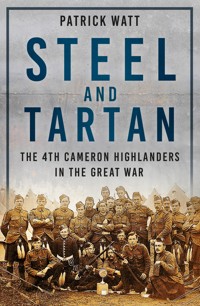
In the summer of 1914 Scotland prepared for war. Steel and Tartan charts the adventures of the 4th Battalion, Queens Own Cameron Highlanders – from their training in Bedford with the Highland Division through to five major engagements in France, including the Battle of Neuve Chapelle and the Battle of Loos, to eventual break-up in March 1916 at the hands of the British Army administrators. Of the 1,500 men who fought with the Battalion, over 250 were killed and either buried in one of the many British war cemeteries in France or else left where they fell, their names etched on one of the memorials to the missing. Using previously unpublished diaries, letters and memoirs together with original photographs and newspaper accounts, Patrick Watt tells the story of the gallant officers and men of the 4th Camerons: those 'Saturday night soldiers' who went so eagerly to war in August 1914.
Sie lesen das E-Book in den Legimi-Apps auf:
Seitenzahl: 475
Veröffentlichungsjahr: 2012
Das E-Book (TTS) können Sie hören im Abo „Legimi Premium” in Legimi-Apps auf:
Ähnliche




















‘It was pure Hell let loose – shrapnel bursting above our heads, shells dropping alongside of you and German machine guns and snipers picking off the men by scores. It was a pitiable sight to see some of the boys coming down the road without kilts, jackets, haversacks and drenched to the skin. Anyone who came out of it alive should be thankful. You will see it for yourself in the papers. I can’t explain it, and what’s more, I’m not going to try.’ (Festubert, 18 May 1915)
‘Cuimhnich air na daoin’e o’e d’thainig thu’
(‘Remember the men from whom you have come’)
Highland proverb
For my grandfather, Peter Bruce, who got me interested in the subject, and to the memory of all the officers, non-commissioned officers and men of the 4th Cameron Highlanders.
ACKNOWLEDGEMENTS
I would like to thank the following individuals and institutions who helped me in my research for this book: Karen Mee of the Special Collections Department of Leeds University for her assistance with the papers of the Liddle Collection; Sue Skelton of the Reference Department of Inverness Library for her wonderful help with the contemporary newspaper reports; Sabrina Rowlatt of the Imperial War Museum, Harry Brown of Bridgnorth, Shropshire for his permission to publish extracts from the papers of J.B. Mackenzie; Michael Roemmele of Perth for providing me with a photograph of his father; Stuart Farrell of Nairn for his fantastic assistance in providing me with images of the battalion Roll Book amongst other things; Dr Andrew Bamji of Queen Mary’s Hospital in Sidcup for providing details of my great-grandfather’s treatment there; and the extremely knowledgable and generous moderators of and contributors to the 1914–1918 online forum without whom research into all aspects of the First World War would be a hundred times more difficult to conduct.
I would also like to thank the Imperial War Museum who are the curators of the papers of 2nd Lieutenant M.S. Goodban, Lieutenant-Colonel Charles Bowdery, J.B. Mackenzie and S. Bradbury. Every effort has been made to trace copyright holders and the author and the Imperial War Museum would be grateful for any information which might help to trace those whose identities or addresses are not currently known. Likewise, the Special Collections Department of Leeds University who hold the papers of Hector Macdonald; the National Archives of Scotland who hold the wills of soldiers who died during the war; the National Archives in London who retain the battalion war diary, service and pension records, and medal index cards of First World War soldiers; and the staff of the National Library of Scotland.
In addition, I would like to thank everyone at Spellmount, The History Press, especially Shaun Barrington and Miranda Jewess for all their efforts in producing this work.
Finally, I would like to thank my friends and family, in particular Blythe Robertson, who acted as my proof reader and my mother Trish for enduring endless hours of rather one-sided conversations on the 4th Cameron Highlanders. Lastly, I would like to thank my wife, Hande Zapsu Watt, without whom I would never have had the inclination or patience to put all my research down on paper, and who now knows as much as anyone on the subject.
CONTENTS
Title
About the Book
Dedication
Acknowledgements
Introduction
1 Fourteen New Divisions
2 Preparing for War, August 1914 – February 1915
3 Arrival in France and First Blood, 18 February–9 March 1915
4 The Battle of Neuve Chapelle, 9 – 15 March 1915
5 The Battle of Aubers Ridge, 15 March – 11 May 1915
6 The Battle of Festubert, 11 May – 19 May 1915
7 The Battle of Givenchy, 19 May – 30 August 1915
8 The Battle of Loos, 1 September – 10 October 1915
9 The Winter Campaign, 11 October 1915 – 31 March 1916
10 The Camerons on the Somme and the Battalion Nucleus 1916 – 1917
Epilogue
Appendix 1 Order of Battle
Appendix 2 Officers and Men of the 4th Battalion, Cameron Highlanders
Appendix 3 Men not Mentioned
Appendix 4 Reinforcements
Appendix 5 Roll of Honour
Appendix 6 Officer Biographies
Appendix 7 Note on Service Numbers
Bibliography
Plates
Copyright
The battlefields of the Nord Pas de Calais, 1915.
INTRODUCTION
In February 1916 the future of the 4th Battalion, the Queen’s Own Cameron Highlanders was hanging in the balance. The War Minister Lord Kitchener and the Imperial Chief of Staff Sir William Robertson had visited the Adjutant General in St Omer on 9 February. Amongst other business, they had informed him that all under strength battalions at the front, without the prospect of adequate reinforcement, would cease to be fighting units and would be amalgamated with other battalions of the same regiment.
On 16 February, Lieutenant-Colonel Murdoch Beaton, commanding officer of the 4th Cameron Highlanders, was summoned to St Omer. Beaton was told, along with the commanders of other such distinguished battalions as the 4th and 5th Battalions, Black Watch, that their units were to be disbanded. As there were no other Territorial Force battalions of the Cameron Highlanders in France, the men of the 4th Battalion were to be sent as drafts of reinforcements to the 1st Cameron Highlanders, the only Cameron battalion more senior to them in France.
Beaton fought as hard for his battalion as he had done throughout the battles of 1915. The 4th Camerons had been in France for five days short of a full calendar year and had won the respect and admiration of all they had met, going ‘over the top’ five times, at Neuve Chapelle, Aubers Ridge, Festubert, Givenchy and Loos. In a passionate speech in the House of Commons, Annan Bryce, Member of Parliament for the Inverness Burghs, spoke of the ingratitude expressed by the breaking up of ‘a battalion that has won deathless renown on the fields of Flanders’.1
It was all to no avail, as one month later the 4th Cameron Highlanders sent 550 men to a holding unit called Number 1 Entrenching Battalion, with the task of building trenches in the vicinity of Poperinghe in Belgium. From there, they supplied drafts of men when required to the 1st Cameron Highlanders who were fighting with such gallantry on the Somme. As a concession from the Adjutant General, Lieutenant-Colonel Beaton was able to ensure that a nucleus of the battalion, three officers and 100 men, remained in Etaples. In August 1916, a formal request was lodged with the Adjutant General to reconstitute the battalion. It was turned down, but a further assurance was given that after the war the 4th Cameron Highlanders could be rebuilt in Inverness by its surviving members.
That February 1916, the 4th Cameron Highlanders moved south from Artois to the town of Corbie on the banks of the river Ancre, a tributary of the Somme. Whilst there, two photographs were taken, one of the officers, and one of the non-commissioned officers of the battalion. In the officers’ photograph, only five men remained from a similarly posed photograph taken exactly a year before, when the battalion left their training ground in Bedford for France. It was a similar story for the men.
In total, 1402 men had served with the battalion in France in 1915 and a further 180 had arrived as reinforcements in 1916, including many who had served more than one period in the trenches, and returned after being wounded. The battalion sustained 607 casualties, 257 of which had been killed in action or died of their wounds or disease, their bodies buried by their comrades in cemeteries in France or else left where they fell, their names etched on one of the memorials to the missing. The 4th Cameron Highlanders had sustained a casualty rate of 43 per cent in 1915, including 18 per cent of their number who had paid the ultimate sacrifice for their country.
Of the 930 men who left their training camp at Bedford in February 1915 only 220 remained with the battalion a year later. The officers fared equally badly. In total, 79 officers had served with the 4th Cameron Highlanders but by March 1916, 12 were dead and 25 were evacuated wounded. Of the original 30 4th Camerons officers who left Bedford, only five remained, with Lieutenant-Colonel Beaton himself being the only officer to have come through all five battles fought by the battalion. Of the 4th Camerons’ first year in France, they had spent 110 days in the front line and reserve trenches. The 4th Cameron Highlanders were one of the first battalions of the Territorial Force to see action in France and sadly, were one of the first to be disbanded. The part-time soldiers of Inverness-shire and Nairnshire had gone from being farm workers, servants, postmen and carpenters to seasoned veterans, and had earned the admiration of all for their bravery, attitude and determination.
This book is the culmination of five years research into the 4th Cameron Highlanders. My great-grandfather, Peter Bruce, joined the 4th Camerons on 31 March 1909. He worked full time for the shoemaker firm of Alexander Napier based in Nairn High Street, and carried on this trade into his military career. He served as the battalion shoemaker-Sergeant throughout 1915 and went to Etaples with the battalion nucleus in March 1916 before finally being transferred to the 6th Battalion, the Cameron Highlanders in June 1917. He was promoted to Warrant Officer Class II and was wounded in action on 29 July 1918 at Buzancy near Soissons. A shell had exploded in his trench, killing one man and injuring four others including Sergeant-Major Bruce, who was hit in the face by shrapnel. He was evacuated to King George V Hospital in Dublin before being transferred to Queen Mary’s Hospital in Sidcup, Kent, for surgery in February 1919. At Queen Mary’s, an army surgeon, Sir Harold Gillies, had founded a specialised clinic to treat victims of facial injuries caused by service in the First World War. In total some 5000 men were treated by this pioneering doctor and his team. My great-grandfather was operated on by Major Geoffrey Seccombe-Hett, a specialist in repairing damage to the nose, and made an excellent recovery. He was discharged from the army in September 1919 and returned home to Nairn and his wife and young daughter.
In trying to piece together what happened to my great-grandfather, I hit upon that brick wall for researchers of First World War soldiers: the destruction of service and pension records in a fire caused by German bombing in 1940. With no leads to go on I tried to gather as many clues as possible about his life from the details of the lives of those men who served with him in the 4th Cameron Highlanders. I found a variety of official papers, newspaper articles, diaries, photographs and publications detailing the actions of the men of the 4th Camerons from their creation out of the old Volunteer Force Battalion in 1908, up to their disbanding in March 1916 and beyond.
The title of this book is taken from the Reverend Dugald MacEachern’s work The Sword of the North: Highland Memories of the Great War. The Reverend MacEachern described how, during the night of 17 May 1915, the 4th Cameron Highlanders took the Southern Breastwork trench at Festubert against all odds, the enemy fleeing ‘before the onset of steel and tartan’.2 That phrase seemed to sum it up perfectly.
The 4th Cameron Highlanders had come a long way from the glens of Lochaber, the beaches of the Inner Hebrides, the farms of the Moray Firth coast and the county towns of Inverness and Nairn. They had seen such horrors and experienced such danger that even after years of reading their testimonies I struggle to comprehend what must have gone through their minds as they defended the Moated Grange at Neuve Chapelle, stormed the Southern Breastwork at Festubert or repelled countless bomb attacks at Loos. That my great-grandfather was there made it all the more real.
This is the story of the 4th Battalion, Queen’s Own Cameron Highlanders.
NOTES
1Inverness Courier, 24 March 1916, p.4.
2The Sword of the North: Highland Memories of the Great War, by the Reverend Dugald MacEachern, p.178.
1
FOURTEEN NEW DIVISIONS
Alexander Fraser – a future commanding officer of the 4th Camerons – was born in the Highland village of Beauly on 6 May 1865. His father, also Alexander, was an agent for the Commercial Bank of Scotland and his mother, Elizabeth Spray, was the daughter of the vicar of the Parish of Kinneagh in Ireland. Young Alexander led a privileged life, being educated at Inverness Royal Academy and Inverness College before progressing on to study law at Edinburgh University, graduating in 1890.
In the spring of 1883, shortly after his eighteenth birthday, Alexander Fraser joined the 1st (Inverness Highland) Volunteer Battalion of the Queen’s Own Cameron Highlanders. He joined as a private soldier and served with them in that capacity until leaving for university in 1887. On his arrival in Edinburgh, Fraser again sought out the military, joining a volunteer battalion of the Royal Scots, the Edinburgh Volunteer Regiment, with whom he served until November 1889.
After completing his degree, Alexander Fraser returned to the family home at 67 Church Street in Inverness and took up employment as a solicitor in 1890, and as a notary public two years later. The year 1890 also saw Fraser obtain a commission in the Inverness Volunteer Battalion as a 2nd Lieutenant. Clearly, he must have excelled in his new role as he was promoted full Lieutenant in 1892, Captain in 1898 and Major in 1905. Fraser took every opportunity to advance himself in his military pastime, undertaking qualifications in musketry, organisation and equipment, tactics and military topography.
In the meantime, Alexander Fraser met and married Isabella Menzies, the daughter of Colonel Duncan Menzies, the former commander of the 1st Sutherland Highland Rifle Volunteers. They moved after their marriage to the house Westwood on Drummond Road, a 20-room mansion in the south of Inverness. Alexander and Ella had nine children: Duncan Menzies in 1894, Elizabeth Sibell in 1896, Mary Millicent in 1898, Muriel Janet in 1900, Alexandra Dorothy in 1903, Eleanor Beatrice in 1905, Alexander Redmond in 1908, Margaret Iris in 1910 and Frances Alice in 1912.
Alexander Fraser’s private life couldn’t have been better and his professional life soon followed suit. Along with business partner David Ross, he founded the legal firm of Fraser & Ross where he became factor for the Highland estates of Culloden and Ferintosh. He became a prominent member of the local Freemasons, rising to become the Right Worshipful Master of St John’s Lodge in Inverness. He also took a keen interest in all things to do with the town, taking appointments with several organisations, including the Territorial Force Association for the county, as secretary of the northern branch of the Royal Arborical Society, as Clerk to the Deacons Court of the United Free High Church and as President of the Sanitary Association of Scotland.
In 1908 the Minister for War, Richard Haldane, decided to reform the organisation of the volunteer and militia units of the British Army. In their place would be a newly created set of 14 divisions of the Territorial Force. The 1st (Inverness Highland) Volunteer Battalion became the 4th Battalion, Queen’s Own Cameron Highlanders. The renamed battalion was to take its place in the newly created Seaforth and Cameron Brigade of the Highland Division.
On 12 February 1909 the commanding officer of the 4th Cameron Highlanders, Lieutenant-Colonel James Leslie Fraser, died after a long battle with illness. In his place, Alexander Fraser was promoted Lieutenant-Colonel commanding the battalion. One of his first tasks as commanding officer was to lead the Colour Party of the battalion to Windsor Castle where King Edward VII presented new Colours to each of the newly created Territorial Force battalions. Accompanying Fraser were Lieutenants Ronald MacDonald and Murdoch Beaton, and Colour Sergeants William Ross, Duncan Cameron and J. Angus.
The 4th Cameron Highlanders, as part of their obligation as members of the Territorial Force, had to attend up to 15 days annual training at a camp every summer. They were joined at these camps by the other members of their brigade, and in turn, by the remainder of the Highland Division. The camps took place at locations all over the Highland Divisional recruiting area, with training camps at Burghead in 1909, Aviemore in 1910, Tain in 1911, Burghead again in 1912, Dornoch in 1913 and Kingussie in 1914. At these camps, the men would practise marching, musketry, bombing, machine gunning and a variety of other skills.
In accordance with the Haldane Reforms, on 31 March 1908 all existing members of the Inverness-shire Volunteer Battalion resigned their positions and re-enlisted on 1 April. The men were then allocated a unique service number which would see them through to the renumbering of the Territorial Force in 1917. The new numbers were allocated in ascending order, starting from number 1 for the first man who re-enlisted on 1 April, up to approximately 1700 for those who enlisted on the eve of war in August 1914. Therefore, of the men who went to France in 1915, Company Quartermaster Sergeant Kenneth MacKenzie – who transferred from the Highland Volunteers on 1 April 1908 – was given the service number 3, and Private Angus MacDonald – who enlisted directly into the 4th Cameron Highlanders at Fort William on 9 May 1914 – was given the service number 1693. Some of the 1700 men who enlisted between 1908 and 1914 were, of course, no longer serving with the 4th Cameron Highlanders, having transferred to other regular or territorial units or resigned from military service.
The 1908 Regulations for the Territorial Force3 set out the organisation of a territorial force battalion such as the 4th Cameron Highlanders. Their total complement at full strength stood at 29 officers and 980 men organised into 8 companies named A–H based at locations throughout the recruitment area. The men of the 4th Camerons found themselves spread over one of the largest recruitment areas for any battalion of the British Army with A and C Companies based at Inverness, B Company at Nairn, D Company at Broadford, E Company at Fort William, F Company at Kingussie, G Company at Beauly and H Company at Portree.
As commanding officer, Lieutenant-Colonel Alexander Fraser found himself based at the battalion’s drill hall in Inverness along with the rest of the unit’s training and administrative personnel. In recognition for his 25 years service in the Volunteer Battalion and then the Territorial Force, Colonel Fraser was awarded the Long Service Medal, the Volunteer Decoration and the Coronation Medal of King George V, awarded in 1911. On 23 August 1913, 48-year-old Lieutenant-Colonel Alexander Fraser decided to resign his commission and concentrate on spending time with his young family and working on his numerous business affairs. Fraser did not retire completely from military life, however, as he joined the Reserve of Officers, meaning he was prepared to be called upon to serve his country in time of war. He would not be long parted from his battalion.
The new commanding officer of the 4th Cameron Highlanders was Lieutenant-Colonel Ewan Campbell. Colonel Campbell was born in Kingussie on 18 November 1856, the son of John Campbell, an innkeeper in the village, and his wife Margaret Aitchison. Campbell had strong connections to the 4th Cameron Highlanders, with both his brother John and eldest son, also called John, serving as officers.
The battalion he inherited had been well trained and disciplined by Lieutenant-Colonel Fraser and Ewan Campbell carried on his work admirably. The ‘Saturday night soldiers’ of the Territorial Force may have been looked down upon by the officers and men of the regular army but they were undoubtedly a source of pride in the towns and villages of Inverness-shire and Nairnshire. This pride followed the battalion for the next 18 months as it grew from an untried home defence battalion into an experienced and hardened military unit, the equal of any in the British Army.
NOTE
31908 Regulations for the Territorial Force, p.160–161.
2
PREPARING FOR WAR, AUGUST 1914 – FEBRUARY 1915
On 3 August 1914 the German Army swept through Belgium, Luxembourg and northern France with the aim of encircling Paris before moving their conquering armies across Germany to fight Russia on their eastern borders. This attack on neutral Belgium prompted the British government to declare war on Germany and prepare to despatch the British Expeditionary Force for service in France. As soon as war was declared, the government sent word to the units of the Territorial Force to mobilise for war.
Lieutenant-Colonel Ewan Campbell ordered that the eight companies of the 4th Camerons, who were spread all over the Highlands and Islands, muster in Inverness. On 5 August the five companies from Inverness, Nairn, Beauly and Kingussie went by train to Fortrose before marching to Cromarty, where their wartime posting was to man the coastal defences. The Portree, Broadford and Fort William companies joined up with the rest of the battalion on 7 August, having waited for the call to arms at their drill halls.
A list of the officers of the battalion in the early days of training was published in the Historical Records of the Queen’s Own Cameron Highlanders:4
Lieutenant-Colonel Ewen Campbell
Commanding Officer
Major Hector Fraser
Second in Command
Captain Garden B. Duff
Adjutant
Major John Lockie
Quartermaster
Captain Robert A. Lindsay (RAMC)
Medical Officer
Lieutenant John D. Macpherson
Transport Officer
2nd Lieutenant William MacKay
Signalling Officer
2nd Lieutenant Harold B. Law
Machine Gun Officer
Captain Murdoch Beaton
A Company (Inverness)
Lieutenant David F. MacKenzie
A Company
Lieutenant Ian MacKay
A Company
Lieutenant A.J. MacKintosh
B Company (Nairn)
Lieutenant Peter M. Cram
B Company
Lieutenant James H. Leigh
B Company
2nd Lieutenant William J. Shaw
B Company
Captain James MacPherson
C Company (Inverness)
Lieutenant Frederick W. Fraser
C Company
Lieutenant Charles Campbell
D Company (Broadford)
Captain Thomas Allison
E Company (Fort William)
Lieutenant Nigel B. MacKenzie
E Company
Major John Campbell
F Company (Kingussie)
Lieutenant John Campbell
F Company
Captain Roderick MacLean
G Company (Beauly)
Captain William MacKintosh
G Company
2nd Lieutenant Murdo MacKenzie
G Company
Captain Ronald MacDonald
H Company (Portree)
2nd Lieutenant Angus Ross
H Company
2nd Lieutenant Archibald M. Fletcher
H Company
Two thirds of the officers were Gaelic speaking, which was roughly the same proportion as the men, possibly the highest percentage in any battalion in the British Army. The majority of the officers were firmly middle class with a large number being made up of members of the legal and teaching professions. In the end, several of the battalion’s officers who mobilised in August 1914 would not serve in France; Captain William MacKintosh of Glenurquhart was left in Inverness as the officer commanding the Cameron Territorial Force Depot and Captain James H. Leigh was employed training recruits at the base. Others such as Captain Roderick MacLean and Lieutenants Peter Cram, A.J. Mackintosh and Murdo Mackenzie were ordered, in September 1914, to recruit and organise a second line unit, the 2/4th Cameron Highlanders5 to take on the home defence duties of the 1/4th if they were sent to France.
At Cromarty the 4th Cameron Highlanders spent most of their time digging trenches during the day and camping in the open fields during the night, only once or twice having to be turned out of their tents to defend their camp. Every instance was a false alarm. The first casualty of war occurred that week when an unnamed soldier sustained an unfortunate injury when he sat in a pan of boiling fat!
On 11 August, the battalion returned to Inverness to join up with the 4th, 5th and 6th Battalions of the Seaforth Highlanders with whom they were brigaded in the Seaforth and Cameron Brigade of the Highland Division. The Regimental Journal, The 79th News, reported that 6000 troops were concentrated in Inverness at this time, taking over all the available accommodation. The following day, Lieutenant-Colonel Campbell paraded the battalion in Bell’s Park and after a stirring speech asked for volunteers for service abroad. Over 80 per cent of the men volunteered to fight in France. When the deductions in manpower for those who did not volunteer for overseas service, those who were too young and those who were deemed medically unfit were taken into consideration, the 4th Cameron Highlanders stood at a strength of 600–700 men. It became clear that more recruits would be needed to send the battalion abroad at anything close to its full fighting complement of over 1000 men. This recruiting would have to be done away from their Highland home as, on 15 August, the Highland Division was ordered to their new training area at Bedford. The Bedfordshire Times and Independent reported the arrival of the Highland Division on 21 August 1914:
The Highland Territorials arrived in Bedford on Saturday and received a very hearty welcome from the townsfolk. At an early hour the southern side of the town presented an animated scene. The soldiers who had had a long and trying journey appreciated to the full the cups of hot cocoa generously provided by the people in the Southend District and wherever they were billeted.6
The 4th Cameron Highlanders and their colleagues in the Seaforth and Cameron Brigade were allocated billets in the district between Kimbolton Road and Bromham Road, some men settling in the grammar and high schools. Bedford High School was converted into the 4th Camerons’ headquarters and can be seen in a photograph of the officers before their departure to France.
The Inverness Courier of 13 October described how the townsfolk of Bedford embraced their Highland visitors, accommodating them in their houses and serving them hot coffee and cocoa as soon as they stepped off the train. The paper also told of the diversions available to the men; the local pubs closed their doors at 8.00pm, but the men were also entertained by concerts, boating on the river and walking the promenades, while the officers were made honorary members of the local libraries and clubs. Some of the men even went to the trouble of learning French!
In the opening two weeks of the war over 100 men volunteered for service with the 4th Cameron Highlanders at either their central depot in Inverness or the Company depots in their local towns. However, still more were needed, so brothers Lieutenant Ian MacKay and 2nd Lieutenant William MacKay were sent to the headquarters of the London Scottish Regiment in the capital which was being inundated with volunteers of Scottish origin who wished to join Highland regiments. Approximately 250 new soldiers were recruited this way between 4 and 11 September 1914. These London Scots would be subject to particularly heavy losses when the battalion finally made it to France, with one in every five being killed within a year.
The new recruits had to sign Army Form E.624 stating their agreement to serve at any place outside the United Kingdom in times of emergency. In recognition of this agreement, the soldiers were entitled to wear an Imperial Service Badge on the right breast of their tunic.
One of the men who volunteered in September 1914 was Max Alexander Roemmele. He had been born in Kirkintilloch, Dunbartonshire, in 1892 to German immigrant parents Carl Hugo Roemmele, an iron merchant from Stuttgart, and his wife Amelia Bost. In order to join the 4th Camerons, Roemmele travelled from Glasgow to Inverness and enlisted at the depot as Private Number 2223. On his return to Glasgow, proudly sporting his new uniform, his neighbours promptly reported him to the police as a German spy. Luckily, nothing came of it and Private Roemmele travelled to Bedford with the rest of the 4th Cameron Highlanders. While there, he applied for a commission in the battalion, which was accepted on 25 February 1915 and he served as an officer with distinction throughout the 1915 campaign.
In Bedford, the 4th Camerons embarked on a vigorous routine of training to prepare them for action at the front. One unidentified soldier, writing home to his friend in the Highlands, told of his daily routine in a letter reproduced in a local newspaper:
We are getting a lot of recruits just now coming down every day from Inverness; others have arrived from London, over 80 coming in one day. So great is the rush of recruits that there are not enough tunics to rig them out so they have to wear their own clothes. All the same they look quite a smart lot. We are kept hard at it every day. Up at 6am, physical culture until 8am, out again from 9.15am until 1pm, dinner then out from 2.15pm until 4pm. After that we are free for the night. We go to the baths 3 times a week and as the heat here is terrific you can be sure we enjoy a refreshing plunge. We had a ten-mile march the other night for recruiting purposes and I hear there is to be another shortly. Everybody is in the best of spirits and take the most arduous of duties good humourdly. We rebel sometimes all the same over the grub. We kicked up a dust the other morning over breakfast. We had cause too as you may guess, when I say that the Adjutant came up and gave us another breakfast. We have been asked if we are ready for active service and over 80% of the battalion has volunteered for the front. We expect to be sent when we have completed 3 months training. I have no idea whether we will ever see France for no one has any idea where we may be sent.7
Another member of the 4th Camerons, in a letter published in the Inverness Courier, gave a further account of the training in Bedford, describing how they spent their time: ‘Skirmishing overs fields, hedges, ditches, dykes and fences after an imaginary enemy whom we usually put to complete rout in the end by a bayonet charge.’8
It was whilst at Bedford on 4 September that a most unfortunate event befell the battalion when Lieutenant-Colonel Ewen Campbell fell from his horse and had to be hospitalised. It was initially thought that Campbell was making significant, if slow, progress and would be able to rejoin the battalion, but it was not to be, and on 10 November it was decided that he would need to be replaced as commanding officer. The only person deemed capable of leading the battalion was the former commander, Alexander Fraser. Since the outbreak of war, Lieutenant-Colonel Fraser had been in command of the 2/4th Cameron Highlanders in Inverness and was the natural choice to succeed Colonel Campbell, given his knowledge of the officers and men.
The Battalion continued its programme of training in Bedford. On Friday 9 October it suffered one of its first serious casualties when in one of C Company’s billets at 6 Albert Terrace, Union Street, Private Arthur Charker was stabbed with a bayonet by Private John Fraser during a fight. Six men of the 4th Camerons were in the billets and three – Charker, Fraser and John MacVinish – were drunk. MacVinish had wanted a fight but, as reported by Sergeant Kenneth MacKenzie at the inquest, had been quietened by the time MacKenzie left. However, ten minutes later, Sergeant MacKenzie returned as the disturbance had started up again and found Fraser and another man named Macdonald fighting. They were separated by some of C Company’s sergeants but Fraser grabbed a bayonet and Sergeant MacKenzie left to gather up men to place Private Fraser under arrest. It seems that Charker and Macdonald tried to take the weapon from Fraser and in the ensuing scuffle Charker somehow fell on the blade. All the witnesses at the inquest reported that Fraser and Charker were friends and that the incident had been out of character for both men. Fraser was charged with wounding and intent to cause grievous bodily harm but when he appeared in court on the following Monday morning it was announced that Private Charker had died, so the charge was changed to wilful murder. The case was heard on 16 October and Fraser pleaded guilty to a reduced charge of manslaughter. He was sentenced to 15 months hard labour.
During their time at Bedford the battalion underwent a structural reorganisation, changing from eight companies to four, A–D. The old A and D Companies merged to form A Company, B and C merged to become B Company, E and F became C Company and G and H became D Company. As some of the officers had been sent back to Inverness to raise the second line battalion, several of the men were commissioned from the ranks to take their places. The Historical Records of the Queen’s Own Cameron Highlanders showed the new posts for the battalion’s officers.9
Lieutenant-Colonel Alexander Fraser
Commanding Officer
Major Hector Fraser
Second in Command
Captain Garden B. Duff
Adjutant
Major John Lockie
Quartermaster
Captain Robert Lindsay
Medical Officer
Lieutenant John D. MacPherson
Transport Officer
Lieutenant Harold B. Law
Machine Gun Officer
A Company
Captain Murdoch Beaton
in command
Captain David F. MacKenzie
Lieutenant Ian MacKay
Assistant Adjutant
Lieutenant William MacKay
Signalling Officer
2nd Lieutenant Francis E. Laughton
2nd Lieutenant John D.M. Black
B Company
Captain James MacPherson
in command
Captain Frederick W. Fraser
Lieutenant Charles Campbell
Lieutenant William J. Shaw
2nd Lieutenant John F. MacLaren
2nd Lieutenant Frederick J. Kelly
C Company
Captain Thomas Allison
in command
Captain John Campbell
2nd Lieutenant Andrew Sutherland
2nd Lieutenant William Calder
2nd Lieutenant Ian T. Nelson
D Company
Major John Campbell
in command
Captain Nigel B. MacKenzie
Lieutenant Angus Ross
Lieutenant Archibald M. Fletcher
2nd Lieutenant Joshua Thompson
2nd Lieutenant Cameron R. Carruthers
At the end of October 1914 King George V inspected the Highland Brigade at Bedford. The King was met at the station by General Sir Bruce Hamilton, commanding the Highland Division, and General Bannatyne-Allason, commanding the Seaforth and Cameron Brigade. The troops of the Seaforth and Cameron Brigade, the Gordon Brigade and the Engineer and Artillery units mustered for review on the golf links just outside Bedford and the Argyll Brigade, the Army Service Corps and the Royal Army Medical Corps drew up in the pastures beside the course. The Division marched past the King with pipes playing, taking 80 minutes to complete the review.
From the middle of October onwards many of the officers and men of the 4th Camerons chose to make out wills in order to ensure their effects were disposed of as they wished in the event of their death. As always, Lieutenant-Colonel Alexander Fraser led by example. In his will dated 23 October 1914, Fraser left all his worldly possessions to his wife, Ella Menzies Fraser. The document was witnessed by Captain Thomas Allison and Orderly Room Sergeant James MacDonald.10 Some of the men wrote their wills right up to the time they were sent into battle, with Corporal Duncan Fraser of Beauly writing his on 19 February on board the troopship taking him to France. Lance Corporal John Hossack of Cawdor stipulated that he wanted to have his pocket revolver and diary sent to his father back home in Scotland.11
Although the main focus of the battalion’s time at Bedford was training, there was still time for the men to enjoy themselves. For the New Year of celebrations 1915, Hogmanay suppers were provided, the festivities costing £1000. Most of the funding had been raised in Scotland, and dignitaries such as the Lord Provost of Aberdeen and the editor of the Aberdeen Journal visited Bedford to see in the New Year with the troops. Dinners were given, reels danced, pipes played and Auld Lang Syne was sung in the market square at midnight, much to the delight of the onlooking locals.
Back in Scotland the 2/4th Battalion was not idle, recruiting and training men who would, in time, be sent to the front. One training initiative was the screening of a short recruiting film made by Gaumont of the 4th Cameron Highlanders in Bedford. Entitled The Highlanders at Bedford it was shown at the Central Hall in Inverness in the last week of November. Captain Ian Baillie of Lochloy near Nairn was present, and after each showing gave a stirring speech which prompted many of the watching men in the packed theatre to volunteer for service with the 4th Camerons. Adverts prompting men to do their duty and join their local battalion were printed every week in the Inverness Courier, Highland News, Northern Chronicle and many other local newspapers. Men flocked to the recruiting stations.
The 2/4th Cameron Highlanders were to be attached to 191 Brigade of the 64th (2nd Highland) Division. As a reserve formation, they recruited men who wished to serve both on home defence and those who volunteered for foreign service duty, and would be sent to the 1/4th Camerons when required. On 4 November Lieutenants Peter Cram and Murdo Mackenzie left Inverness for Bedford with 100 men of B Company, the 2/4th Camerons. They were tasked with forming a reserve at the Highland Division base, from where they could despatch reinforcements more quickly to France. From 6 December 1914 the battalion was under the command of Lieutenant-Colonel J.G.O. Fitzmaurice, and soon after the 2/4th Camerons recruited many officers and men who would later serve in France.
During the last months of 1914 the Bedford base was plagued by a measles epidemic. The 4th Camerons had been holding themselves ready to depart for the front since the end of October, but at the last minute the orders were cancelled, due to the outbreak. As many of the men hailed from the remote islands and glens of the Scottish Highlands, where measles was rare or unknown, they had little immunity to the disease. An article in the Bedfordshire Times in January 1915 reported that between 17 August 1914 and 9 January 1915 the Highland Division lost 27 men to measles, as well as 3 to scarlet fever, 3 to diptheria, 3 to pneumonia, 1 to uraemia and 2 to violence, including the 4th Camerons’ Arthur Charker. Of the 27 men killed in the measles epidemic,12 14 of them were 4th Cameron men, and in total the battalion had 141 confirmed cases. Men who were deemed susceptible to measles were moved to special huts at Howbury, and then if they contracted the disease, were moved to the measles hospitals at Goldington Road and Ampthill Road.13 The bodies of the men who died were either buried in a Commonwealth War Graves Commission plot in Bedford Cemetery or repatriated to Scotland for burial.14
As the epidemic had delayed the departure of the 4th Camerons to France, other troops of the Highland Division were sent in their place. The 4th Seaforth Highlanders, the 6th Gordon Highlanders and the 7th Argyll and Sutherland Highlanders departed to join other divisions across the Channel, and were replaced by their recently formed second line units at Bedford. In February 1915, after further training from platoon to division level, the 4th Cameron Highlanders were informed that they too were being detached from the Highland Division. They were chosen, along with the 4th Gordon Highlanders and the 9th Argyll and Sutherland Highlanders, to proceed to France immediately.
Before the departure the Provost of Inverness wrote to Lieutenant-Colonel Fraser on 12 February:
My dear Colonel Fraser,
Permit me, in the name of myself and the other members of the Town Council, as well as the whole of the community, to congratulate you and the battalion under your command on being selected for foreign service. It is a signal honour for you personally that you should have been selected to lead the battalion now going on active service, after your retiral from the active command; but it is not only an honour to you personally and the gallant 4th Cameron Highlanders, but also to the Town and County of Inverness, and I am sure I voice the feelings and the wishes of the whole community when I wish you in their name Godspeed.
May every officer and man uphold the worthy traditions of our Territorial Regiment, and be distinguished by gallantry in the face of our country’s enemy, and may you all return to receive the honour and thanks which you so well deserve at the hands of your home and country which you are going to defend. Your movements in the field will be followed by those at home with intense interest, and may God bless and protect you all.
I remain, yours very truly, John Birnie15
NOTES
4Historical Record of the Queen’s Own Cameron Highlanders, Vol.3, p.422.
5 From September 1914 the 4th Camerons were officially known as the 1/4th Battalion as second (2/4th) and third (3/4th) Battalions were raised in Inverness. For the purposes of this book where the 4th Cameron Highlanders are mentioned, the author means the 1/4th Battalion. The other units, and similar units in other Regiments, will be afforded the full double number if applicable.
6The Spirit of the Troops is Excellent, Derek Bird, p.22.
7 Article ‘With the Fourth Camerons’ in The Letters from Major Ian and Captain William MacKay, Craigmonie, Inverness, un-numbered pages between p.6–7.
8Inverness Courier, 20 October 1914, p.5
9Historical Record of the Queen’s Own Cameron Highlanders, Vol.3, p.424.
10 Lieutenant-Colonel Fraser’s will is held by the National Archives of Scotland under the reference number SC29/44/57 p.800–806.
11 Both these wills are held by the National Archives of Scotland under the reference numbers SC70/8/216/9/1-3 and SC70/8/172/23/1-3 respectively.
12 A list of the men killed before embarkation to France is given in the Appendix.
13 Bedfordhighlanders.blogspot.com
14 Of the men of the 4th Cameron Highlanders who were buried in Britain, 3 were buried in Auldearn, 1 in Kilmuir, 1 in Banchor, 8 in Bedford, 1 each in Moston St Joseph’s Roman Catholic Church, Kilmorack, Kiltarlity, Uig, Carinish, Tomnacross, Cromdale, Sleat, Drumnadrochit, Kilmarie, Laggan, Comely Bank in Edinburgh, Bressay and Brompton, 2 in Kilchrist, Kilchuiman and Kingussie and 3 in the cemetery in the Hebridean Island of Raasay.
1579th News, Issue of April 1915, p.89–90
3
ARRIVAL IN FRANCE AND FIRST BLOOD, 18 FEBRUARY–9 MARCH 1915
On 18 February 1915, the 4th Cameron Highlanders formed up for an inspection by Brigadier-General Bannatyne-Allason, commander of the Highland Division, and Brigadier-General Ross, commander of the Seaforth and Cameron Brigade. The same day, Lieutenant-Colonel Fraser issued orders that detailed procedures for the movement of the 4th Camerons to France the following day:
Routine: The Battalion will proceed abroad tomorrow. Reveille 3am. Breakfast 3.30am. The first party, which consists of A Company and all the cooks, all the signallers, one strong platoon of B Company and a detail of Transport will parade in Tavistock Street at 5am under Colonel Fraser.
The second party which consists of C Company, Machine Gun Section and one and a half platoons of D Company and a detail of Transport will parade in Tavistock Street at 7am under Major Fraser. Dr Lindsay will accompany the party. The third party consisting of B Company less one platoon and D Company less one and a half platoons and a detail of Transport, Medical Orderlies, Orderly Room Staff, CQMS’s and Quarter Masters Staff will parade in Tavistock Street at 8.30am. The third party will be under Major Campbell. The Quartermaster and Adjutant will go by this train. All officers will be in their Company lines at 3.15am and report to the Orderly Room that everything is going all right by 4.30am. Officers baggage will be at the Headquarters by 4.30am.16
The Battalion’s passing from Bedford and the Highland Division was recorded in a poem entitled ‘The Departure of the 4th Cameron Highlanders’ (‘Cha Til MacCruimein’ in Gaelic) by Lieutenant Ewart Alan Mackintosh of the 5th Seaforth Highlanders. Mackintosh was born in Brighton in 1893 and joined the 5th Seaforths on the outbreak of war. He was awarded the Military Cross for gallantry in the field in June 1916 and was killed in action on the second day of the Battle of Cambrai on 21 November 1917 whilst serving with the 4th Seaforth Highlanders. He is buried in Orival Wood Cemetery near Flesquieres.
The pipes in the street were playing bravely
The marching lads went by
With merry hearts and voices singing
My friends marched out to die
But I was hearing a lonely pibroch
Out of an older war
‘Farewell, farewell, farewell, MacCrimmon
MacCrimmon comes no more’
And every lad in his heart was dreaming
Of honour and wealth to come
And honour and noble pride were calling
To the tune of the pipes and drum
But I was hearing a woman singing
On dark Dunvegan shore
‘In battle or peace, with wealth or honour,
MacCrimmon comes no more’
And there in front of the men were marching
With feet that made no mark
The grey old ghosts of the ancient fighters
Come back again from the dark
And in front of them all MacCrimmon piping
A weary tune and sore
‘On the gathering day, for ever and ever,
MacCrimmon comes no more’17
These opening days of the 4th Camerons’ journey to the front and through the first battles of 1915 were chronicled by two A Company diarists, Private Montague Goodban and Private Charles Bowdery, and their prolific letter-writing officers, brothers Lieutenants Ian and William Mackay. These diaries and letters give a wonderful insight into the day-to-day activities of the 4th Camerons and, whilst being mainly concerned with the rudiments of an army on active service, are often tinged with moments of great humour and sadness.
Montague Sidney Goodban was born in 1891 in the London Borough of Paddington to Sidney Goodban, a china salesman, and his wife Elleanor. He was educated at St John’s College in Margate in Kent and on graduating began working for his father in the family’s china and glass shop at 129 High Street in Clapham. Goodban joined the 4th Cameron Highlanders at the recruiting centre in the first week of September 1914, drawn like so many of his countrymen to the ranks of a Scottish regiment.
Charles Dudley Bowdery was born in 1893 in Lambeth, London. In 1911 he lived at 52 Thirsk Road South West in Wandsworth with his mother Matilda and his sisters Gladys and Irene. As his diary shows, Bowdery was an intelligent man, which led to him taking employment as a clerk. Bowdery joined the 4th Camerons at the same time as Private Goodban and became one of the many London Scots in A Company.
The brothers Ian and William Mackay were born in 1883 and 1885 respectively, the sons of prominent solicitor William Mackay and his wife Margaret Elizabeth Mackay who lived at Craigmonie House in Inverness. They were educated at Inverness College and Edinburgh Academy before both went to Edinburgh University to study law. On his return to Inverness, Ian joined the Inverness Volunteers as a Private soldier and was commissioned as a 2nd Lieutenant on 20 December 1909 before being promoted full Lieutenant in March 1913. William joined the 4th Cameron Highlanders in 1913 and was promoted full Lieutenant in September 1914 whilst the battalion was based at Bedford. Both wrote detailed letters to their parents and sister Kathleen during their time in the trenches, describing in detail their parts played in battle, their social life in the army and their living conditions.
As the troops prepared to leave for the front, Private Bowdery’s girlfriend travelled from London to Bedford to spend one last night with him. He recalled in his diary entry for 19 February, the day of embarkation, how difficult it was saying goodbye:
Had a farewell breakfast at Smiths, Bedford at 3.30am. Paraded at Tavistock Street at 5am, entrained at 6am. Lillian saw me off from siding. Poor dear girl breaks down in tears on train leaving. My heart feels full. Saw last of Bedford at 6.40am arriving at Southampton at 12 noon after somewhat tiring journey.18
The 4th Cameron Highlanders embarked on the SS Empress Queen, the Archimedes and the Duchess of Argyll at 6.00pm along with the 4th Gordon Highlanders and the 9th Argyll and Sutherland Highlanders. Montague Goodban recorded in his diary that the crossing started out well enough but after a dinner of bully beef and biscuits had been served at 8.30pm the weather turned and it had its effect on the men, many of whom emptied their stomachs over the side of the ship, if they could make it there quick enough! They arrived at Le Havre at 1.00am on 20 February and after an early breakfast disembarked at 9.00am. The Battalion then marched 4.5 miles to rest at No1 Camp Le Havre, where the men spent the rest of the day having their first wash since leaving Bedford; it was to be their last for a month. Men were quartered 12 to a tent, and were roused for a 10.00am church parade. The Camerons, less two platoons under Captain David F. MacKenzie who were quarantined for scarlet fever, left the Le Havre camp at 2.15am the next morning and embarked by train for Merville at 7.20pm, having waited at the station all day. The journey to Merville took an unbearable 23 hours, as described by Private Bowdery: ‘34 men packed like sardines into a horse truck. Straw spread on floor. Spent a most uncomfortable time. Slept little. Never mind, still quite happy. Smoking and eating passes the time.’19 Private Goodban noted:
There is no thinking of going on holiday this time; we are packed in like sardines. The train is composed of horse boxes and we are packed 34 in each box and no light. What a game! We sort ourselves out and try to settle down but sleep is out of the question, such cries of ‘get off my ear’ and ‘whose ****** leg’s that in my dining room?!’ etc keep rending the air. However we pass the night singing and smoking and eating the 3 B’s.20
According to Bowdery, the train passed through Rouen, Beauvais, Amiens, Boulogne, Calais, St Omer and Hazebrouck before arriving at Merville at 6.30pm on Monday 22 February. From there they marched to La Gorgue, a distance of four miles, where they were billeted in a school with heaps of straw as their bed. At this time La Gorgue was approximately six miles behind the firing line, but had been occupied by the German Army at the start of the war, and bore the scars of the previous winter’s fighting. The 4th Cameron Highlanders were immediately posted to 24 Brigade in the British 8th Division where they were brigaded with the 1st Worcester Regiment, the 2nd East Lancashire Regiment, the 1st Sherwood Foresters, the 2nd Northamptonshire Regiment and the 5th Black Watch. Whilst in La Gorgue the two platoons detached the previous day rejoined the battalion.
The Cameron men spent the next few days searching La Gorgue for cafes, or as Private Goodban writes, ‘Estaminets’. Lieutenant Ian MacKay – in a letter to his parents of 23 February – described that time: ‘All the men are very fit and in high spirits and some of their efforts at French are very amusing. Most of them say ‘Oui, oui’ to everything and the Skyemen usually stare and say nothing.’21
Whilst billeted in La Gorgue, Private Bowdery saw one of the wonders of modern warfare – a dogfight in the air:
During the afternoon I witness a fight in mid-air between English and German aeroplanes. These fellows run great risks and from below one can watch the effects of shrapnel fire directed against them. None of them were hit but at any rate the Germans were driven off.22
On 25 February, a party of eight officers and eight sergeants were sent to spend the night with the Worcestershire Regiment in the front line trenches to gain an idea of how they operated. Lieutenant Ian Mackay was one of the officers selected, and he later described how, in the advance to the trenches, bullets were flying all around them. The trenches the Camerons viewed were 70–100 yards from the Germans, who kept firing all night. Mackay reported that the trenches were very muddy and it was bitterly cold at night but the Worcesters’ Captain shared his dug out with him and they managed to light a fire, cooking their own dinner. Even though he proclaimed the trenches to be a safe place, MacKay had a close encounter when a bullet passed straight through his glengarry (bonnet). He was undeterred by the incident. A sergeant from Inverness, eager to test the marksmanship of the Germans, raised his own on a stick, which instantly drew fire and left him with two holes in the headgear.
Whilst in these trenches Lieutenant Mackay got word that the 4th Camerons were moving closer to the firing line and he returned to join them in their new billets in Black Watch Lane, which they reached at 7.40pm on 26 February, eight days after their arrival in France. The officers were billeted in a cottage and the A Company officers formed their own mess there. Captain Murdoch Beaton, Captain David F. Mackenzie, Lieutenants Francis E. Laughton, John Black, Charles Campbell and the Mackay brothers all messed together.
On 28 February, the 4th Cameron Highlanders took their place in the front line trenches for the first time. In the sector running north from the village of Neuve Chapelle the trenches were known as A to F Lines. A and B Companies took over from two companies of the Middlesex Regiment and took their positions in part of the C Lines trenches just north of the Estaires to La Bassee Road. C and D Companies were in reserve billets in Cameron Lane, just behind the battalion Headquarters which were in a farmhouse in Rue Bacquerot, about 1000 yards behind the firing line.23 Lieutenant-Colonel Alexander Fraser had the honour of being in command of the whole sector.
The conditions in the trenches were particularly trying. There were no communication trenches linking the fire trench to the reserve positions and no duckboards providing flooring in the front line trenches. This lack of flooring – when combined with the snowfalls which peppered northern France in the first week of March 1915 – meant that the trenches became a quagmire. Ration parties were forced to move in the open at night under persistent rifle fire from the enemy positions.24
Private Bowdery described his first day in the trenches:
Well Sunday today, and who would have thought that I would see a Sunday as near the firing line as I am now. Nothing much doing in the early part of the day. Aha! We hear about 12 orders now that we are to go into the trenches this evening, my word the excitement in A Company. Now for fatigues, yes I thought, my name yes Bowdery, just give a hand with these blankets. Right-oh Sergeant off I trot, come back, more fatigue – rations this time. Eventually we are ready then comes ‘fall in’ and off we go for our first baptism of fire. We march to trenches through mud over our ankles. Eventually we get within the bullet area and my word don’t they whistle. Everyone keeps as low as possible and probably wonder if any are coming his way. We reach the trenches at last and we are told that we are safe enough if we keep low, which one might be sure we do with the result that our backs ache within about 5 minutes. At 10 o’clock pm I am put on Sentry, that is to look out over the top of the trench for Germans. One might guess that hearing the bullets whistling about I feel somewhat dubious about putting my head over, but I eventually get over that feeling and do my duty. Nothing happens.25
The Inverness, Broadford and Nairn men of A and B Companies spent that first day in the C Lines trenches and were relieved after two days by the Strathspey, Fort William and Portree men of C and D Companies. Each platoon had a front of about 100 yards to call their own.
The first casualties sustained by the 4th Cameron Highlanders were taken on 1 March. When the Machine Gun Section was retiring to their billets half a mile behind the trenches a shell came through the roof of the billet and exploded, killing Sergeant Ronald R. MacDonald and wounding Privates John Kowin, Albin Rous, William Feiling, Reginald Murray, Daniel Stanger and Robert Dingwall. A correspondent, writing to the Inverness Courier, described the explosion:




