


12,99 €
Mehr erfahren.
- Herausgeber: John Wiley & Sons
- Kategorie: Fachliteratur
- Sprache: Englisch
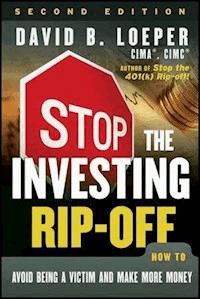
The questions every investor should ask before parting with their hard-earned cash This book serves as an advocate of the consumer and brings to light what insiders know about the side of the sales pitches that consumers don't, but need to hear. Stop the Investing Rip-Off reveals the questions every investor should ask during a financial sales pitch before they pull the trigger and buy the next mutual fund, stock, advisory service, or other investment product. Based on David Loeper's nearly twenty-five years of experience of seeing the inner workings of the industry, this updated edition of his classic book offers new strategies based on the performance of the stock market over the past two years. * Sheds light on the oft unseen deceit of the financial services industry * An updated and revised edition of the bestselling Stop the Investing Rip-Off * Written by David Loeper who is regularly quoted in Kiplinger's Money and Investment News and regularity contributes to Forbes Intelligent Investing Stop the Investing Rip-Off, Revised and Updated is filled with advice for investors who want to avoid becoming victims of smooth talking salespeople and the effective advertising and marketing campaigns designed to evade reality and prey on your emotional desires.
Sie lesen das E-Book in den Legimi-Apps auf:
Seitenzahl: 340
Veröffentlichungsjahr: 2011
Ähnliche
















Contents
Preface
Acknowledgments
Chapter 1: Major Brokerage Firms
We All Start Somewhere
Are You the Prey of Such a Hunter?
What You Need to Care about When Dealing with Brokers
Why the Firm Isn’t All That Important
Protecting Yourself
Track Records
Don’t Be Fooled
Chapter 2: Investment Advisers
A Cozy Relationship with You as the Third Wheel
Why You Should Not Judge a Book by Its Cover
Questions You Should Ask of Money Managers
Chapter 3: Hybrids—Advisory Services Provided through Brokerages
Beware of the Hidden Clause
The Best Test for Adviser Objectivity
Chapter 4: Discount Brokers
Discount Brokers Are Sales Organizations, Too
Bait and Switch
Buyer Beware: Discount Brokers Encouraging “Churning”
Questions to Ask to Get the Side of the Story You Don’t Hear
Chapter 5: Financial Planners and Wealth Managers
Peeling the Planner Onion
Verify Registration
Chapter 6: The Financial Press
“Rule of Rules of Thumb”
Questions to Consider about the Financial Press
Chapter 7: The Broadcast Media
Expert in Retrospect—Mind Games of Experts
In Bed Together
Chapter 8: Authors, Self-Help Books, and Financial Celebrities
Financial Authors
Financial Celebrities
Chapter 9: Mutual Funds and ETFs
Don’t Be Fooled by Fancy Charts
Don’t Be Sold by Magicians
Benchmarking, Star Ratings, and Peer Groups
“Peers That Are Not”
Chapter 10: Insurance Agents (and Insurance Companies)
Cut Through the Hype
How Much Is That Guarantee in the Window?
Stealing Your Bucket List from You
Emotions and Reason
Avoid Needless Risk
Equity Index Annuities—The Next Auction Rate Note Disaster?
What Is Often Presented about Equity Index Annuities
Raising the Concept of EIAs One Step Higher
A Deeper Look at Why Insurance Companies Offer EIAs
Questions to Ask Insurance Agents
Chapter 11: Your Company-Endorsed Retirement Plan Adviser
The Main Question to Ask (in Addition to the Questions in Other Chapters)
Chapter 12: Banks and Trust Companies
Don’t Trust Guarantees
Chapter 13: Software, Web Sites, and Financial Educators
Avoiding the Numbers Game
Heads or Tails
The Question You Must Ask to Protect Yourself
Chapter 14: Pitches They All Use to Sacrifice Your Life
Dumbfounded by Questioning
The Fallacy of Risk Tolerance in Setting Asset Allocation
The “Risk Tolerance” Game
False Precision
Be Careful of Making Needless Sacrifices to Your Life
We Have New Information and a New Confidence Level
Preparing for Bad Markets Takes More Than Simulating Them
Chapter 15: Resources to Protect Yourself
The Root of the Problem
Isn’t There a Law Against This?
Places to Go to Learn the Truth
Conclusion
Appendix A: The Other Millionaire You Make with 2.5 Percent Excess Fees
Appendix B: The Other Millionaire You Make with 1.5 Percent Excess Fees
About the Author
Index
Copyright © 2012 by Financeware, Inc. All rights reserved.
The first edition of this book titled, Stop the Investing Rip-off: How to Avoid Being a Victim and Make More Money, was published in 2009 by John Wiley & Sons, Inc., Hoboken, New Jersey.
Published by John Wiley & Sons, Inc., Hoboken, New Jersey.
Published simultaneously in Canada.
No part of this publication may be reproduced, stored in a retrieval system, or transmitted in any form or by any means, electronic, mechanical, photocopying, recording, scanning, or otherwise, except as permitted under Section 107 or 108 of the 1976 United States Copyright Act, without either the prior written permission of the Publisher, or authorization through payment of the appropriate per-copy fee to the Copyright Clearance Center, Inc., 222 Rosewood Drive, Danvers, MA 01923, (978) 750-8400, fax (978) 750-4470, or on the web at www.copyright.com. Requests to the Publisher for permission should be addressed to the Permissions Department, John Wiley & Sons, Inc., 111 River Street, Hoboken, NJ 07030, (201) 748-6011, fax (201) 748-6008, or online at www.wiley.com/go/permissions.
Limit of Liability/Disclaimer of Warranty: While the publisher and author have used their best efforts in preparing this book, they make no representations or warranties with respect to the accuracy or completeness of the contents of this book and specifically disclaim any implied warranties of merchantability or fitness for a particular purpose. No warranty may be created or extended by sales representatives or written sales materials. The advice and strategies contained herein may not be suitable for your situation. You should consult with a professional where appropriate. Neither the publisher nor author shall be liable for any loss of profit or any other commercial damages, including but not limited to special, incidental, consequential, or other damages.
For general information on our other products and services or for technical support, please contact our Customer Care Department within the United States at (800) 762-2974, outside the United States at (317) 572-3993, or fax (317) 572-4002.
Wiley also publishes its books in a variety of electronic formats. Some content that appears in print may not be available in electronic books. For more information about Wiley products, visit our web site at www.wiley.com.
ISBN-13 978-1-118-13306-4 (paper); ISBN 978-1-118-17781-5 (ebk); ISBN 978-1-118-17783-9 (ebk); ISBN 978-1-118-17782-2 (ebk)
This book is dedicated to my father, the late Kenneth A. Loeper, who taught me to make sure that no one pushes you around. His passion for living his life, his ethics and integrity, his strength and empathy taught me the real meaning of virtue and integrity. I miss you, Dad, and I only wish I could have written this while you were still with us.
Preface
According to the U.S. Department of Commerce, the financial services industry (banks, brokerage, and insurance) represents more than 7 percent of the nation’s gross domestic product (GDP). If you think about this, the cost of “these services” is staggering. How can it cost us 7 percent of our total output each year just to manage and service our wealth?
In 2009, the GDP for financial services was $828 billion. (We are excluding real estate from the calculation to focus on banking, brokerage, and insurance and exclude home ownership and direct real estate investing which would more than double the figure.) Total U.S. financial assets stood at $40 trillion in 2009, meaning that the financial services industry as a whole is skimming 2 percent a year out of everyone’s wealth.
Some of these costs are obvious, like ATM fees, insurance premiums, mutual fund expense ratios, brokerage commissions, or investment advisory fees. Some are hidden or at least require some extreme effort to discover. As I mention in my book, Stop the Retirement Rip-off, more than 80 percent of people do not know what, if anything, they are paying in fees for their 401(k) plan according to the American Association of Retired Persons (AARP) and a study by the Government Accountability Office (GAO). New rules are going to soon fix this retirement-plan hidden-fee problem starting in 2012 and 2013 when participants receive fee-disclosure statements for their 401(k) that will put a lot of people into Retirement Plan Sticker Shock.
The OTHER Millionaire You Make
Say you and your spouse are 25 years old. You are a teacher and your spouse is a police officer. Your combined incomes are $75,000. Things are tight, but your parents taught you the value of compounding, saving for a rainy day, and retirement. Both of you have retirement plans through your employers with matching contributions, and despite the compromise to your lifestyle, together you defer $5,000 a year to your retirement plans. This is a little less than 7 percent of your income; far below what many advisers and financial gurus would advise with their common rules of thumb. Your employers match some of your contributions, which adds another $2,000 a year to your retirement savings, bringing your total annual retirement savings to $7,000 a year. Both working for the government, your jobs are fairly secure and your incomes will likely adjust for inflation each year along with your savings and matching employer contributions.
Lesen Sie weiter in der vollständigen Ausgabe!
Lesen Sie weiter in der vollständigen Ausgabe!
Lesen Sie weiter in der vollständigen Ausgabe!
Lesen Sie weiter in der vollständigen Ausgabe!
Lesen Sie weiter in der vollständigen Ausgabe!
Lesen Sie weiter in der vollständigen Ausgabe!
Lesen Sie weiter in der vollständigen Ausgabe!
Lesen Sie weiter in der vollständigen Ausgabe!
Lesen Sie weiter in der vollständigen Ausgabe!
Lesen Sie weiter in der vollständigen Ausgabe!
Lesen Sie weiter in der vollständigen Ausgabe!
Lesen Sie weiter in der vollständigen Ausgabe!
Lesen Sie weiter in der vollständigen Ausgabe!
Lesen Sie weiter in der vollständigen Ausgabe!
Lesen Sie weiter in der vollständigen Ausgabe!
Lesen Sie weiter in der vollständigen Ausgabe!
Lesen Sie weiter in der vollständigen Ausgabe!
Lesen Sie weiter in der vollständigen Ausgabe!
Lesen Sie weiter in der vollständigen Ausgabe!
Lesen Sie weiter in der vollständigen Ausgabe!
Lesen Sie weiter in der vollständigen Ausgabe!




