


Erhalten Sie Zugang zu diesem und mehr als 300000 Büchern ab EUR 5,99 monatlich.
- Herausgeber: Birlinn
- Kategorie: Geisteswissenschaft
- Sprache: Englisch
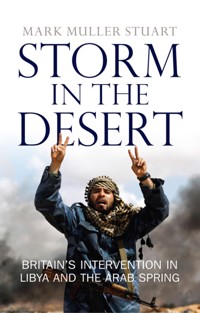
In this remarkable book, Mark Muller tells the story of British intervention in Libya and the Arab Spring from a unique civil society standpoint: he was there in Benghazi two weeks after the UN No-Fly Zone Resolution was passed, meeting with Rebel leaders to discuss how Western civil society might help them stabilise the country and resolve difficult legacy issues such as victim claims over Lockerbie and the supply of IRA Semtex. In an age when Western governments have become risk averse and distrusted in the Middle East, Muller documents how non-state mediators, non-governmental organisations, journalists, artists and like-minded diplomats, such as assassinated US Ambassador Chris Stevens, explore ways to support democratic movements and promote human rights in one of the world's most turbulent regions. Storm in the Desert describes a dramatic story of revolution and also the murky but sometimes inspiring role successive British governments have played in trying to contain conflict in the region. It gives a unique insight into the world of diplomacy and power politics and the way they impact upon ordinary human lives, suggesting that it is civil society not government that ultimately stabilises countries and unearths the truth about conflict and the ill-treatment of civilians at the hand of state forces.
Sie lesen das E-Book in den Legimi-Apps auf:
Seitenzahl: 891
Veröffentlichungsjahr: 2017
Das E-Book (TTS) können Sie hören im Abo „Legimi Premium” in Legimi-Apps auf:
Ähnliche




















Storm in the Desert
Storm in the Desert
Britain’s Intervention in Libya and the Arab Spring
MARK MULLER STUART
First published in Great Britain in 2017 by
Birlinn Ltd
West Newington House
10 Newington Road
Edinburgh
EH9 1QS
www.birlinn.co.uk
ISBN: 978 0 85790 927 5
Copyright © Mark Muller Stuart 2017
The right of Mark Muller Stuart to be identified as the authors of this work has been asserted by him in accordance with the Copyright, Designs and Patents Act, 1988
All rights reserved. No part of this publication may be reproduced, stored, or transmitted in any form, or by any means, electronic, mechanical or photocopying, recording or otherwise, without the express written permission of the publisher.
British Library Cataloguing-in-Publication Data
A catalogue record for this book is available on request from the British Library
Typeset by Biblichor Ltd, Edinburgh
Printed and bound in Britain by T. J. International, Padstow, Cornwall
To my son, Louis Muller Stuart, who aged eleven asked why it was necessary for me to go to Libya, after seeing violent images of the Libyan Revolution on television. This book is an attempt at an answer.
And to my daughters Charlotte, Isabella and my wife Catherine for allowing me to wonder afar without complaint.
And finally to my parents for being citizens of the world.
‘They make a desert and call it peace.’
Gaius Cornelius Tacitus (Senator and Historian of the Roman Empire) Ascribed to a speech by the Caledonian chieftain Calgacus addressing assembled warriors about Rome’s intervention into the affairs of other nations
Contents
Acknowledgements
List of Abbreviations
Introduction: Benghazi or Bust
Part 1: The Uprising
1 The Arabs Awaken
2 The Libyan Uprising
3 Memorandum of Misunderstandings
4 Libya, Bahrain and the ‘Responsibility to Protect’
5 Passing Through the Egyptian Revolution
6 Entering Rebel-Held Libya
7 Experiencing Rebel-Held Benghazi
8 Misrata and Negotiating with the NTC
9 Leaving Rebel-Held Libya
Part 2: The British Intervention in Libya
10 Towards a New MENA Policy
11 Bahrain
12 Stabilising Libya
13 Endgame in Libya
14 Whither the Revolution?
15 The Fall of the House of Gaddafi
16 Ambassador Stevens
Part 3: The Aftermath
17 Reflections for the Future
18 Terrorism, Democracy and the Right to Resist Oppression
19 The Rise of Non-State Mediation
20 The Power of Cultural Dialogue and Small Nation Diplomacy
Epilogue: Benghazi or Bust
Appendix: Report of the Northern Ireland Affairs Committee
Notes
Index
Acknowledgements
This book could and would not have been written were it not for the support I received from a number of institutions and individuals who have assisted me and my work in relation to the Middle East North Africa (MENA) region over the last two decades.
Firstly, thanks to the Human Rights Programme at Harvard Law School and its former academic director, Mindy Rosen, who gave me valuable time and space in 2012 to capture and record my memories of Benghazi during the Libyan Revolution through the form of a Senior Fellowship.
Secondly, thanks to all my friends and colleagues at Beyond Borders Scotland (BB), the John Smith Memorial Trust (JSMT), the Delfina Foundation (DF), the Bar Human Rights Committee of the Bar Council of England and Wales (BHRC), the Centre for Humanitarian Dialogue (CHD), Beyond Conflict (BC), the Kurdish Human Rights Project (KHRP) and Democratic Progress Institute (DPI), Inter-Mediate (IM), Doughty Street Chambers (DSC) and Traquair House for their unstinting support throughout this period. They all know who they are. Certain other institutions and individuals have not been named for operational reasons.
However, it would be remiss of me if I let this opportunity pass without recording my particular thanks to Allan Marson, Jessica Forsythe, Professor Brian Brivati, Paul Doubleday, David Marshall, Kirsten Winterman, Jenny Munro, Georgia de Courcy Wheeler, Emily Gifford, Sarah Macdonald, David Packard, Elliot Campbell, Dave Barras, Dave Angus, Gary Moore, Anna Irvin and Isabella Scott, David Steel, Jeremy Purvis, Stephen Gethins, Malcolm Fleming, Sylvia Whitman, Andrew Brown, Mark McLeod, the late Stephanie Wolfe Murray and all the interns for their contribution towards the work of Beyond Borders Scotland; Elizabeth Smith, Catherine Smith and David Charters at JSMT; Delfina Entracanales and Aaron Cezar at DF; Catriona Vine and Mustafa Gündogdu at KHRP and DPI; Sir Kieran Prendergast, Staffan de Mistura, Martin Griffiths, David Harland, David Gorman, Jonathan Powell, Teresa Whitfield, Roelf Meyer, Tim Phillips and Kerim Yildiz for their invaluable example and assistance in relation to my dialogue work with non-state organisations involved in the MENA region; Sydney Kentridge QC, Helena Kennedy QC, Michael Mansfield QC, Ben Emmerson QC, Kirsty Brimelow QC, Nick Stewart QC, Peter Carter QC, Michael Ivers QC, Sudhanshu Swaroop QC, Gareth Pierce, Louis Charalambous, Blinnie Ni Ghrálaigh, as well as all my former colleagues from the Chambers of Mark Muller, including Raj Rai, Edward Grieves, Ajanta Kaza, for their long-term support of my legal and human rights work in the MENA region; Jason McCue and McCue and Partners for their comradeship and company during a truly remarkable journey into the heart of the Libyan Revolution; Allan Little, William Dalrymple, Oscar Guadiola-Reveria, Jim Naughtie, Magnus Linklater, Robert MacDowell and all the other regular international BB participants and presenters who each year help bring to life the stories and tales of people from the MENA region at Beyond Borders’ various culture festivals held during the Edinburgh Festival; and of course to my family, Catherine, Isabella, Louis, Charlotte, Maria and Christopher.
Finally, a special huge thanks must be given to my editor, Mairi Sutherland, for all her advice and patience in helping to edit this book, including putting up with my never-ending travels with the United Nations; Christine Gilmore, Peter Sacks, Tertia Bailey, Mark Gorman and my wife Catherine Maxwell Stuart for reading the text; and to Neville Moir, Hugh Andrew and their team at Birlinn, without whose support this book would not have seen the light of day.
Abbreviations
AFRICOM
United States of America African Command
AKP
Justice and Development Party (Turkey)
ANC
African National Congress
AQIM
Al-Qaeda in the Islamic Maghreb
AU
African Union
BDF
Bahrain Defence Force
BDP
Peace and Democracy Party (Turkey)
BHRC
Bar Human Rights Committee of England and Wales
BHRWS
Bahrain Human Rights Watch Society
BICI
Bahrain Independent Commission of Inquiry
BM
British Museum
BMC
Benghazi Medical Centre
BRIC
Brazil, Russia, India and China
CHD
Centre for Humanitarian Dialogue
CIA
Central Intelligence Agency
COS
Commandement des Opérations Spéciales
CP
Close Protection
CSO
Civil Society Organisation
DDR
Disarmament, Demobilisation and Reintegration
DFID
Department for International Development
DPI
Democratic Progress Institute
DS
Diplomatic Security
ECHR
European Court of Human Rights
EOCCS
Executive Office of Cultural Relations and Civil Society
FBI
Federal Bureau of Investigation
FCO
Foreign and Commonwealth Office
FJP
Freedom and Justice Party
FSU
Former Soviet Union
GAM
Free Aceh Movement (Indonesia)
GCC
Gulf Cooperation Council
GIA
Groupe Islamique Armé
GPA
Global Political Agreement
HDI
Human Development Index
HMG
Her Majesty’s Government
ICC
International Criminal Court
ICISS
International Commission on Intervention and State Sovereignty
ICJ
International Court of Justice
IRA
Irish Republican Army
ISRT
International Stabilisation Response Team
JSMT
John Smith Memorial Trust
KADEK
Kurdistan Freedom and Democracy Congress
KHRP
Kurdish Human Rights Project
KRG
Kurdistan Regional Government
LAF
Legal Aid Forum
LCRA
Libya Claims Resolution Act
LIFG
Libyan Islamic Fighting Group
LSE
London School of Economics
MDC
Movement for Democratic Change
MECAS
Middle East Centre for Arabic Studies
MENA
Middle East and North Africa
MNLF
Moro National Liberation Front
MoU
Memorandum of Understanding
NATO
North Atlantic Treaty Organisation
NDP
National Democratic Party
NES
National Economic Strategy
NFSL
National Front for the Salvation of Libya
NGO
non-governmental organisation
NIO
Northern Ireland Office
NSC
National Security Council
NTC
National Transitional Council
NUG
National Unity Gathering
OIC
Organisation of the Islamic Conference
OSCE
Organisation of Security and Co-operation in Europe
PFLP-GC
Popular Front for the Liberation of Palestine – General Command
PFR
People’s Resistance Forces
PKK
Kurdistan Workers Party
PMOI
People’s Mujahedin of Iran
POAC
Proscribed Organisation Appeals Commission
PSD-10
Presidential Study Directive on Mass Atrocities
RAF
Royal Air Force
RARDE
Royal Armament Research and Development
RPG
Rocket-Propelled Grenade Launcher
R2P
Responsibility to Protect
SADC
Southern African Development Community
SAS
Special Air Service
SBS
Special Boat Service
SCAF
Supreme Council of the Armed Forces
SCCRC
Scottish Criminal Cases Review Commission
SCR
Security Council Resolution
SIAC
Special Immigration Appeals Commission
SRR
Special Reconnaissance Regiment
SRSG
Special Representative of the Secretary-General
SSC
Supreme Security Council
UAE
United Arab Emirates
UNDPA
United Nations Department for Political Affairs
UNHCR
United Nations High Commissioner for Refugees
UNSMIL
United Nations Support Mission in Libya
USDOS
United States Department of State
VTA
Victims of Terrorism in America
WGI
Worldwide Governance Indicator
WMD
Weapons of Mass Destruction
ZESN
Zimbabwe Election Support Network
Introduction: Benghazi or Bust
It was a classic breezy spring day in Benghazi as Qais Ahmad Hilal made his way towards Freedom Square by the quayside to finish yet another iconic image of the Libyan Revolution. ‘Good, the paint will dry quicker today,’ he thought to himself, as he added the last remaining touches to his most recent offering. Suddenly an unmistakable whistle rang out through the air. Qais only managed to turn his head before the sniper’s bullet entered his chest. He immediately dropped to his knees as if in prayer while horrified bystanders began to scream out in panic. As his shattered torso hit the ground the image behind him came into view. It was of Colonel Muammar Gaddafi’s vengeful figure cloaked in green, holding a black umbrella dripping with blood-red rain. Within seconds the ‘Graffiti King of Benghazi’, who for a few short weeks brought untold laughter to the people of his beloved city through his lampooning of the ‘Great Leader’, was dead. He was only twenty-nine years of age. Qais’s summary execution could not have been more telling or poignant.
Gaddafi had elected to send an assassin into Benghazi to execute not a rebel leader, but rather an unknown artist whose work had laid bare his inner core. Both men recognised the danger that artistic ridicule posed for a ruler who depended on fear to exercise power. Both knew that it was laughter rather than dissent that broke the spell of political invincibility. And both knew that only one man would survive this portraiture. That is why Qais had to die. Yet if Gaddafi thought he could cow the young people of Benghazi into submission he was in for a shock. The next day dozens of them presented themselves at the little blackened office by the courthouse in central Benghazi, offering to paint the city afresh with biting new images of the ‘Mad Dog’ of Tripoli. These young people came not by chance but by moral choice. Within hours of his death Qais’s image was to be found on the very walls he had sought to adorn. He joined a long line of honoured martyrs who gave their lives in defence of freedom and the so-called 17 February Revolution. The graffiti revolution had begun.
I first came across Qais’s images in Benghazi in early April 2011, two weeks after he was executed following the UN Security Council’s imposition of a no-fly zone in defence of the people of Benghazi against Gaddafi’s advancing forces. I had just completed a madcap thousand-mile dash across the desert from Cairo to Benghazi with Jason McCue, the London-based solicitor who had harried Gaddafi for over twenty years on behalf of the British victims of the IRA Semtex and Lockerbie attacks. His purpose in travelling to Benghazi was to initiate a private dialogue with the newly established rebel National Transitional Council (NTC) on some of the most protracted legacy issues that haunted UK–Libyan relations, including the Lockerbie bombing incident.
As chairman of the Bar Human Rights Committee of England and Wales (BHRC), I too was interested in testing New Libya’s stated commitment to the rule of law and to see how the BHRC might help it rebuild its shattered society. Yet these objectives quickly paled into insignificance after we encountered the brave people of revolutionary Benghazi. Their sense of defiance in the face of tyranny literally took one’s breath away. It was as if Hegel’s zeitgeist had infused itself into the soul of this ancient city as the hitherto repressed political aspirations of an entire continent suddenly, and miraculously, made themselves felt. Benghazi’s faith in the redemptive power of democracy, despite everything it had experienced at the hands of Gaddafi and the West, was both exhilarating and troubling. It was difficult to know whether what was happening in Benghazi was indicative of real change and the cunning of reason or just an idealistic pipedream. It felt as if fact and fiction were locked together in an intoxicating revolutionary waltz across an entire region with little or no thought given to the outcome of such a deadly embrace.
After coming across this lacerating image of Gaddafi, I resolved to talk to some of the artists holed up in that blackened office by the side of the revolutionary courthouse, because I wanted to find out who had painted it. I soon discovered that – like so many other key moments associated with the early part of the Libyan Revolution – Qais’s execution had passed from fact to fiction and into the stuff of myth and legend. Many of the young artists I met spoke of how Qais had died next to his artwork, while others closer to the family told of how he was shot in a car as he made his way to work. Whatever the real truth about the details of his execution, his personal act of defiance spoke to a city in the grip of a monumental struggle for freedom. Qais was an early legendary emblem of that struggle. Only time would tell whether his unquenchable belief in the power of democracy was misplaced or not. Yet it was increasingly evident that he was not alone in holding such a belief. All across the Middle East and North Africa (MENA) region a multitude of like-minded civil society activists were on the streets and taking inspiration from his and his comrades’ actions.
As I contemplated the significance of Qais’s sacrifice, I thought about an appropriate epitaph for Gaddafi’s obscene attempt to erase Qais and his work from Benghazi’s memory. ‘Benghazi or Bust’ came to mind. This was a throwaway quip I made to Jason McCue as we flew from London to Cairo on 1 April 2011. Yet it was also a phrase that continued to hang in my head as I tried to accustom myself to revolutionary Benghazi and get to grips with the deadly power struggle unfolding across the region. It was certainly ‘Benghazi or Bust’ for Gaddafi, the rebel leadership, and the ordinary people of the city. And for the embattled Mediterranean coastal town of Misrata, whose only hope of relief from Gaddafi’s assault was through the port of Benghazi. It was also ‘Benghazi or Bust’ for all those governments and international institutions that either tacitly supported the Gaddafi regime or backed the imposition of a no-fly zone, which included the relatively new and inexperienced Cameron and Obama administrations. Not only were huge geo-political and economic interests at play in Libya, but the possibility of a wider democratic dispensation across the region hung in the balance, as did the efficacy of the humanitarian doctrine known as the ‘Responsibility to Protect’ (R2P).
The stakes could not have been higher, whether for Libya, the fate of the Arab Spring more generally, or the future conduct of multilateral diplomacy within the international community. Benghazi was fast becoming key for each of the principal players involved in this multi-dimensional drama, and whoever lost control of it was, to all intents and purposes, bust. Thus, as I stood transfixed amid the beflagged streets of revolutionary Benghazi on April Fools’ Day 2011, it really did seem as if all roads in the Arab Spring, triumphant or treacherous, led inexorably to Benghazi. I realised then that whatever happened there over the course of the next few months, and possibly even years, was likely to change the West’s relation to Libya and the Arab region forever, whether any of these players realised it or not.
Was the wind of change blowing through the region an ill one or was it capable of ushering in a new era of democratic reform and hope? This question would haunt NATO after it helped rebels push back loyalist forces from Benghazi and finally oust Gaddafi from Tripoli in late August 2011. It was a question that remained largely unanswered a year after the rebel victory, when the militias refused to give up their weapons and cede power to the new civilian government following Libya’s first free and fair election in June 2012. And it was a question that became even more acute after another assassination on the streets of Benghazi on 11 September 2012, not far from where Qais fell. This time the assassin was not a Gaddafi loyalist but a radical Islamist who had helped bring down the former regime. More significantly, the victim was not a lowly artist but Chris Stevens, the US Ambassador to Libya, who had been instrumental in giving the rebels much needed support during the revolution. Stevens arrived in Benghazi the same week in April that I did but stayed, off and on, for the duration. He died in a hail of bullets and smoke on the anniversary of 9/11 in what later proved to be a pre-orchestrated jihadist attack on the US diplomatic compound in Benghazi.
Like Qais, Stevens passionately believed in the ability of ordinary Libyans to create a more stable, representative and constitutionally based government. He also believed the US needed to support the struggle for democratic reform in the region on a long-term basis. A few weeks later, President Barack Obama talked to the UN General Assembly about Stevens and the US’s unbroken commitment to reform in Libya. He spoke of how Stevens had loved the streets of Benghazi, ‘tasting the local food, meeting as many people as he could, speaking Arabic and listening with a broad smile’. Yet despite this unambiguous commitment to the ‘New Libya’, Stevens’s death quickly raised questions in the back of every Western policymaker’s mind. Was it really in the interests of the West to support largely unknown rebel movements against a set of aged, unrepresentative MENA elites, in the name of democratic reform? Or should it back the forces it knew in the name of regional stability, if only to head off the emergence of an altogether more hostile form of political Islam? Over the next five years this question, above all others, would bedevil the West’s relations with Libya, Bahrain and, above all, Egypt.
It was somewhat unsurprising, then, that within a day of Stevens’s tragic death the US Republican presidential nominee Mitt Romney used the circumstances of his execution to question the Obama administration’s entire Middle East policy, claiming that the jihadist assault on the compound of the US consulate in Benghazi typified the weak disposition of the Obama administration towards countering Islamic fundamentalism and supporting the US’s real allies in the region. Policy prescriptions in favour of democratic change, he implied, were nothing more than a dangerous delusion that put America, its officials and its allies in serious peril. Such sentiments chimed with the analysis of sceptical commentators like Robert Bradley, who believed the general liberal commitment to democratic change in the MENA region was delusional. What the West needed to do was work with its trusted allies and return to the tried and tested ways of traditional state diplomacy, based upon a clear-cut vision of geo-political and economic self-interest, backed up by the threat of military might. Any other approach was bound to lead to yet more chaos, in which Islamists would take advantage of the vacuum created by the West’s misguided policy, just as they had done in Tunisia and Egypt in elections in 2011 and 2012.
One could not have devised two more different and compelling narratives about what was unfolding in Libya and across the wider MENA region. Each narrative called for radically different policy prescriptions about how to respond to the winds of change sweeping through the region. Stevens’s view was based upon his long diplomatic experience in the region and of revolutionary Benghazi. Bradley’s reflections were based upon his counter-terror experiences in Tunisia and Egypt in the aftermath of the Arab Spring. So who was right? Certainly each narrative was open to criticism. Yet each also contained more than a germ of truth. What was telling, however, was how each man felt impelled to nail his colours to the mast. Neither sought to hide or nuance his position. That they did so was because the nature of the Arab Spring made it virtually impossible for those involved to sit on the fence or conceal where their ultimate allegiance lay. The tumultuous uprisings in Tunisia, Yemen, Egypt, Libya, and Bahrain forced Western states and civil society not only to articulate the principles they believed in but also to take a stand in support of those principles. The demand for international solidarity was not just for words but deeds. Like President Bush after 9/11, the people of Cairo, Manama, and then Benghazi, demanded to know in unadulterated terms if the West was ‘with us or against us’. The answer to this question would shape the future of the people of not only Benghazi but also the West, as the maelstrom that was the Arab Spring threw up profound questions about the West’s identity, values and relationship to the MENA region in an increasingly inter-dependent world.
In fact, the debate about how the West should react to the conflict in Libya and the Arab Spring more generally would continue to rage well into the next decade. It came to haunt President Obama throughout his second term, as more and more questions began to be asked about his administration’s decision to intervene in Libya. Then US Secretary of State Hillary Clinton’s alleged failure to properly protect and secure the US compound in Benghazi on the night of 11 September 2012 was used as a battering ram by the Republicans to smash Obama’s wider policy of engagement in the MENA region. It certainly formed the centrepiece of Donald Trump’s acceptance speech at the Republican Convention in late July 2016 when he was officially declared the Republican presidential nominee. He used this platform to attack Hillary Clinton – the Democrats’ presidential nominee – on her policy record in the Middle East in the most combative and unmistakable terms. ‘In Libya, our consulate, the symbol of American prestige around the globe was brought down in flames,’ he thundered, continuing:
America is far less safe and the world is far less stable than when Obama made the decision to put Hillary Clinton in charge of America’s foreign policy. I am certain it is a decision he truly regrets. Her bad instincts and her bad judgment . . . are what caused so many of the disasters unfolding today. Let’s review the record. In 2009, pre-Hillary, ISIS was not even on the map. Libya was stable. Egypt was peaceful. Iraq had seen a big reduction in violence. Iran was being choked by sanctions. Syria was somewhat under control. After four years of Hillary Clinton, what do we have? ISIS has spread across the region and the entire world. Libya is in ruins, and our ambassador and his staff were left helpless to die at the hands of savage killers. Egypt was turned over to the radical Muslim Brotherhood, forcing the military to retake control. Iraq is in chaos. Iran is on the path to nuclear weapons. Syria is engulfed in a civil war and a refugee crisis that now threatens the West. After fifteen years of wars in the Middle East, after trillions of dollars spent and thousands of lives lost, the situation is worse than it has ever been before. This is the legacy of Hillary Clinton: death, destruction and terrorism and weakness.
For Trump the lessons were clear: ‘To protect us from terrorism we must have the best, absolutely the best, gathering of intelligence anywhere in the world. The best. And we must abandon the failed policy of nation-building and regime change that Hillary Clinton pushed in Iraq, Libya, in Egypt, and Syria.’ For many observers, Trump certainly seemed to be right when he intimated that how the US chose to respond to the diplomatic, political, legal, security and moral challenges posed by the Arab Spring would define the political landscape in the MENA region for a generation to come. For many others, however, his historical account and political analysis were both unfair and widely off the mark.
This book seeks to explore the central policy dilemma that faces the UK and the West as a consequence of the Arab Spring and its interventions (and indeed, non-interventions) in the MENA region – namely whether it was and is wise to go out on a limb to back peoples seeking democratic reform at the expense of more immediate geo-political and security interests and concerns. It does this from an avowedly civil society perspective by drawing upon personal experiences of the Egyptian, Bahraini and Libyan protests and uprisings and by examining the UK intervention in Libya. The book is divided into three parts. Part One deals with the origins of the Arab Spring and the initial uprising in Benghazi. Part Two focuses on the UK’s civil intervention and non-intervention in Libya during the conflict and after it ended. Part Three deals with the aftermath and examines some of the wider policy lessons to be learnt from the Coalition intervention.
In more concrete terms the text tells the story of how Jason McCue and I came to go to Benghazi to meet with the NTC in an effort to secure compensation agreements for Lockerbie and IRA Semtex and other victims affected by the Northern Ireland conflict, as well as to try to help New Libya rebuild the rule of law. It describes some of the extraordinary characters who went on to frame the Libyan Revolution and documents the murky relationship that existed between Gaddafi and Britain’s political elite. More significantly, it sets out how the heroic people of Benghazi came to take on a ruthless tyrant in an effort to free their country from a corrupt government as part of a wider struggle for dignity and greater freedom across the region.
Elsewhere it charts how the debate over whether to impose a no-fly zone forced the UK to reconsider some of its more traditional diplomatic and political approaches towards the region and international security more generally. In particular, it reveals how the UK’s intervention altered the international diplomatic and legal architecture concerning the resolution of conflict; the fight against terrorism; the right to resist; the promotion of democracy; and the right to self-determination in the twenty-first century. In doing so it examines the rise of non-state mediation, civil society and cultural diplomacy as means of resolving conflict, in comparison with conventional diplomacy. The book ends with a tentative answer to the question of whether the West should support the cause for reform in the MENA region at the expense of immediate political and economic interests.
Yet, to be clear, I only decided to publish this book in the summer of 2016 after reading some of the submissions made by the Foreign and Commonwealth Office (FCO) and certain former UK coalition government ministers to the Foreign Affairs Select Committee inquiry into Britain’s intervention in Libya. Those submissions effectively claimed that the coalition government, through its stabilisation team, had done all it reasonably could to support the fledgling National Transitional Council in its efforts to stabilise and reconstruct Libya, both during and after the conflict. These are assertions with which I profoundly disagree. There are important lessons to be learnt from the UK’s half-hearted intervention in Libyan affairs which have been glossed over.
As a senior UN mediation advisor to the Department of Political Affairs who has been involved in a number of sensitive conflict resolution processes over the years, I am disinclined to put pen to paper about my mediation work, as I believe it is important to keep professional and diplomatic confidences in life, and I disapprove of kiss-and-tell memoirs. I decided to make an exception in the case of my experiences of Libya and certain other parts of the MENA region during the Arab Spring in the course of 2011. Firstly, because the nature of the work I undertook there was in my capacity as a human rights lawyer for the BHRC and as a dialogue expert for more open non-state organisations like Beyond Conflict. Secondly, because I believe civil society also needs to share its experiences of the UK’s intervention in Libya and the region if the UK is to successfully resolve fundamental policy dilemmas that it continues to face as a consequence of the Arab Spring. Thirdly, and most importantly, because I believe that the world needs reminding that the people who rose up in Benghazi in 2011 were not Islamic fundamentalists but ordinary people like you and me. If Libya is now a place of lawless disruption and an incubator for jihadist terror, it is not as a result of their aims and endeavours. This appalling state of affairs happened for other reasons, for which the UK Foreign Affairs Select Committee has rightly called our policymakers to account.
Thus, although a definitive history of the Arab Spring has yet to be written, there are tentative lessons that can, and should, be learnt now. What follows is neither an annotated nor an authoritative history of the Libyan Revolution or the Arab Spring. Nor is it an insider’s guide. None of what is conveyed here is based upon confidential archives or classified material. Rather it is a hastily compiled account written from the vantage point of a civil society activist who, like politicians and other policymakers involved in the Arab Spring, had to react to events as they happened. Some parts of the book are therefore autobiographical and read like a diary, while others are more akin to reportage, and the last part is more policy-orientated. In many ways it is a book that falls between all genres and professional stools. Nevertheless, I hope that it provides some useful initial insights into one of the most extraordinary political events of our time.
One matter, however, remains beyond contention. None of us involved in civil society could begin to explore what needs to be done were it not for the exploits of a remarkable group of journalists, film makers, photographers, artists, political activists, diplomats and lawyers who all put their lives on the line to bring out the truth about Gaddafi’s Libya. The story of what happened to the people of Libya during a few unforgettable weeks in the spring of 2011 could not have been publicly told or examined were it not for their extraordinary efforts. Their dispatches and individual plights pepper the pages of this book. The book is dedicated to all those who lost their lives trying to convey the truth about the Libyan and Arab Spring uprisings to a wider audience – people such as Qais Ahmad Hilal and my friend Marie Colvin, a journalist whose death in Homs in February 2012 must not be forgotten either by those on whose plight she reported or the international community at large, whose institutions remain tasked with ensuring peace and security in this deeply troubled but beguiling region. For whatever the prevailing political circumstances or exigencies may be, the primary responsibility of those in power or seeking to gain it should remain the protection of the fundamental rights of their citizens.
If this book does nothing else then, I hope it reminds the public about the courage of such women and men, and of the international community’s responsibility to protect not only civilians caught up in conflict but also civil society activists, human rights defenders and journalists who seek to report on their plight. When push comes to shove, it is not governments but civil society that invariably unearths the truth about conflict and the ill-treatment of civilians at the hand of state forces, as well as making peace and rebuilding shattered communities.
PART ONE: The Uprising
1. The Arabs Awaken
Like many people around the world I watched with something approaching awe as ordinary men, women and children took to the streets of the Arab world in the spring of 2011 to protest against a series of unrepresentative regimes across the MENA region including in Tunisia, Egypt and Yemen. By the time the protests erupted, many of the leaders of these regimes had ruled over the protesters’ lives for the better part of two generations, without so much as a free or fair election. The original catalyst of the Arab Spring and the demonstrations that took place in Tunisia in December 2010 could not have involved a more heartrending and tragic story. Who could have been anything other than moved at the plight of the Tunisian street vendor Tarek el-Tayeb Mohamed Bouazizi, who, having suffered years of poverty, state corruption and personal humiliation at the hands of officialdom, set himself ablaze on 17 December 2010 in the nondescript town of Sidi Bouzid, in an act of total despair, and protest against a world of unrelenting hopelessness.
This lonely act of self-immolation somehow spoke to millions of ordinary Arabs and their own experience of unbridled corruption and unresponsive government. It was an act that unleashed a wave of unparalleled protests in Tunisia and Egypt before spreading like wildfire throughout the rest of the Arab world, confounding the world’s politicians, diplomats, policymakers and spooks alike, all of whom had conspicuously failed to predict their occurrence. I can still recall the moment when I turned on my TV and watched wide-eyed as the tumultuous scenes from Tahrir Square beamed themselves from Cairo into my hotel room. It was late January 2011 and I was in New Delhi attending a legal symposium on the concept of equality with members of the Indian Supreme Court. Suddenly I was transported from the somewhat theoretical preoccupations of India’s finest legal minds towards a real-life struggle for equality unfolding before my very eyes, with deadly consequences for all those that rose up if they failed to prevail.
The spontaneous and authentic nature of the demonstrations was there for all to see and utterly compelling. There was nothing stage-managed or politically orchestrated about them whatsoever. More significantly, they did not appear to be directed towards Israel or the United States, or initiated by radical Islamic groups who too often relied upon the poverty and misery of the masses to elicit support for their ongoing campaign against the West. Neither did they appear to have much to do with the so-called ‘war on terror’ which had come to define much of the West’s relationship with the Middle East in the first decade of the twenty-first century. On the contrary, these protests appeared to be quintessentially Arab in terms of both their core focus and their demands, namely about corruption, democratic reform, equality and above all human dignity.
The fact that these protests came as a shock to the West says more about it than about what was unfolding in the Arab world. For those who had spent time working with civil society in the Middle East, however, the protests did not come as too much of a surprise. As chair of the BHRC and the Kurdish Human Rights Project (KHRP) as well as director of the Delfina Foundation, Beyond Borders Scotland, and the John Smith Memorial Trust (JSMT), I had worked for many years conducting numerous dialogue sessions, trial observations, training seminars and workshops in Syria, Iraq, Lebanon, Bahrain, Oman, Jordan, Egypt, Tunisia, Morocco, Israel and the Palestinian Occupied Territories. In doing so, I had noted the growing sense of frustration, hopelessness and lack of opportunity with which most ordinary Arabs had to deal. Many of the lawyers, human rights defenders, artists, writers and activists I met routinely evinced the same criticisms and calls for reform that were later voiced by the masses in the squares of 2011.
These calls for reform largely fell on deaf ears until, that is, Bouazizi voiced his criticism in fire. Even then Arab political elites resolutely failed to understand, let alone respond to, these calls for reform. The failure to grasp either the nature or extent of the outrage expressed by the masses was neither incidental nor without precedent. It formed part of a systemic failure on the part of Arab rulers and their Western allies to address the root causes of conflict in the Middle East or respond to the shifting tectonic plates within civil society that had been moving in favour of some sort of radical change for quite a time. The issue was not so much religion or political ideology, as some in the West would have the world believe, but rather, social justice. For these elites had forgotten the most elemental truth about any human society – and the truth that built America – namely that what most ordinary people want is simply the opportunity to live in peace with some prospect of personal happiness and prosperity for their children and themselves. The difference lies in the fact that whereas the American people were given the political tools by which to construct a law-abiding prosperous society the Arab people were not.
A Dangerous Lacuna
This was a truth that the Bush administration should have capitalised on in its response to 9/11. Instead it developed a counter-terrorism strategy that effectively designated half the Arab world as a threat to the security of the West and Israel. President Bush’s ultimatum, delivered in late September 2001, that member states of the UN must decide whether they were ‘with’ or ‘against’ America did nothing to engage with the complaints of the ordinary Arab on the street. Instead, this simple binary corralled governments into a counter-terrorism paradigm and dangerous diplomatic lacuna in which conflict was allowed to prosper. Countering terror became more important than countering the societal injustice that often gave rise to terror. Over the course of the next eight years more and more communities in the Middle East became personae non gratae as a result of their loose affiliation with certain radical movements, who enticed the population with commitments to overcome corruption and injustice.
The Bush administration’s heavy emphasis on proscription, which resulted in the exclusion of political movements that advocated radical change, locked it into a cycle of perpetual conflict. It made it virtually impossible for other Western leaders to advocate mediation as a tool for the resolution of conflict for the better part of a decade. As a consequence, no meaningful dialogue occurred with radical groups in the Middle East in the first decade of the twenty-first century. This, despite the evident support that movements like Hamas, Hezbollah, the Muslim Brotherhood and the Kurdistan Workers Party (PKK) enjoyed in the region. Unsurprisingly, new state actors like Turkey and Qatar soon emerged onto the scene to fill the mediation vacuum in a blatant attempt to extend their regional influence, something both would later try to do in 2011. The pendulum only began to swing back in favour of some form of dialogue and countering injustice after Barack Obama came to power in 2008, after Bush’s security-driven strategies in Iraq and Afghanistan lost favour with an increasingly sceptical public. Yet for many seasoned observers, the decade-long refusal of Western governments to engage with grass roots constituencies in the Middle East, and the radical groups that claimed to represent them, constituted one of the gravest failures of conventional state-driven diplomacy in the twenty-first century.
In the end it would take the Arab Spring of 2011 to reveal how redundant Bush’s counter-terror strategies were in addressing the underlying sources of political tensions in the Middle East. If Bush had paid more attention to the needs of ordinary Arabs earlier on he might have discovered that the Egyptian, Lebanese and Palestinian flirtation with resistance movements such as the Muslim Brotherhood, Hezbollah and Hamas had less to do with any ideological identification than with the social and economic support that these movements cleverly provided to ordinary people. The reason why Palestinians voted in droves for Hamas in 2006 was not out of religious fanaticism but because Fatah had conspicuously failed to improve the political or economic lot of the ordinary Palestinian. In reality, the supposed ‘radicalisation’ of sections of the Arab population did not rest with the innate pulling power of Al-Qaeda or global jihad. Rather, it reflected the failure of Arab and Western elites to provide the people of Palestine and Lebanon with a viable exit strategy after decades of repression, poverty and statelessness.
Thus it was not religion that brought ordinary Arabs onto the streets in the spring of 2011, but the refusal to countenance another decade of despair. What the Bush administration should have done was engage directly with those impoverished and marginalised communities rather than the state institutions that claimed to represent them. It should have diverted some of the billions of dollars ploughed into anti-radicalisation programmes in the UK and the MENA region into the economic and social infrastructure of MENA countries. The reason why it did not do so was because many of the state institutions it relied upon to further US strategic interests enjoyed little political legitimacy and were implacably opposed to any form of reform for fear of losing power. Thus, the cycle of despair for ordinary Arabs continued unabated for year after year without resolution in sight, despite occasional noises from the West about the need for democratic reform.
Ameliorating the ‘War on Terror’
It was within this arid and prescriptive diplomatic climate that a number of new mediation and civil society organisations stepped into the breach to try to overcome the growing lack of understanding between the peoples and cultures of the West and the Middle East. These new mediators filled the space vacated by conventional state diplomacy, pre-eminent among which was the Centre for Humanitarian Dialogue (CHD) in Geneva, for which I worked from 2005. Founded in 2001 by the former UN diplomat Martin Griffiths, CHD was instrumental in helping forge the peace in Aceh in 2005 and providing crucial advice to peacemakers in places like Nepal, South Sudan and the Philippines. Elsewhere it helped Kofi Annan broker peace between the presidential contenders in the Kenyan elections in 2008, after widespread violence had broken out following the incumbent president’s failure to accept the results. It also engaged in a number of confidential dialogue processes in the MENA region. It was one of only a handful of non-state organisations, along with Forward Thinking, the Berghof Foundation, Conciliation Resources and the Carter Centre, that actively sought to engage with radical and marginalised groups in the Middle East during this period. Today, CHD is involved in a quarter of the world’s conflicts and has helped spawn a welter of other dialogue organisations.
These dialogue organisations were joined in their endeavour by cultural bodies like the British Council, the British Museum, the Tate and the Delfina Foundation which reached out to countries scorned by the West, such as Syria. Their efforts stood in marked contrast to the focus of domestic human rights advocacy organisations in the UK during these years, which remained largely directed towards domestic legal issues concerning the ‘war on terror’. It was of course easy for cultural organisations to operate more freely in places like Syria, but this did not fully account for their presence. They had a deep-seated knowledge of the cultures of the Middle East and innately understood the pernicious effects that the debilitating language of the ‘war on terror’ was having on cultural relations. They understood the role that cultural diplomacy could play in healing misunderstanding between societies, if not governments. Yet there was an obvious limit to what these bodies could do in the Middle East without further support. Nevertheless, their experiences in the field meant they were altogether less surprised by what later occurred in 2011.
Take, for example, the Delfina Foundation, a small charity dedicated to promoting East–West understanding through the provision of artistic residencies that I helped co-found in 2006 with Delfina Entracanales. Delfina was an eighty-year-old Spanish millionaire who had previously provided studio spaces for some of the UK’s most avant-garde artists in the 1990s, which were located in converted factories in the East End of London. In the summer of 2006 I convinced her to travel with me to the Middle East to experience first-hand just how different the Middle East was from the Bush administration’s portrayal. My human rights work in Palestine, Syria and Iraq convinced me that more had to be done to ameliorate the growing cultural polarisation between the West and the civil societies of the Middle East, particularly after disturbing revelations came to light about Abu Ghraib, Guantanamo Bay, and the use of Central Intelligence Agency (CIA)-backed torture programmes at secret detention facilities. For me, this was not just a human rights story – it was a story about the alienation of cultures and peoples.
So, in the spring of 2006, Delfina and I travelled from Aleppo in the north of Syria across the Syrian Eastern Desert to Damascus, and from there on to Amman and Aqaba before traversing the Red Sea and carrying on to Cairo. As we did so, we witnessed how many young Arabs felt ostracised and marginalised from contemporary Western cultural discourse. Everywhere we went young artists also flocked to show us their work. Their sense of alienation and lack of opportunity was palpable but so too was their renewed hope as soon as new possibilities began to open up before them. They did not hate the West. They just wanted the West to stop hating them. I remember returning to Damascus a year later in 2007 after we set up the Foundation. We watched transfixed as dozens of young artists queued under a baking sun in the back streets of the old city to exhibit their wares, in the hope of securing one of just two residencies in London. I recall feeling embarrassed at being unable to offer more places, but as one young artist commented, ‘just the existence of the opportunity’ was enough to set their hearts alight.
These experiences taught me that what these young people wanted was not more ideology but the freedom to explore the world just like their counterparts were able to do in the West. They craved a different, fresher sort of discourse with the outside world. A discourse in which the reality of their existence was not expressed through sympathetic campaigners or human rights advocates from the West acting on their behalf, but through direct communication with the outside world via the liberating means of new media. As a consequence of these trips, the Delfina Foundation was formed. Over the next five years, Aaron Cezar, the Foundation’s talented executive director, built a world-class residency programme, teaming up with new cultural houses from across the Middle East and North Africa. As a result, numerous Middle Eastern artists came to London. But, more significantly, they went back to their countries with new ideas and experiences, including a growing understanding of the power of new media. The sheer power and potential of this type of cultural dialogue contrasted neatly with the failure of conventional diplomacy or international law to provide people with any meaningful redress against societal injustice or to increase the prospect of greater personal freedom. In short, what these young people wanted most of all was to take control of their lives both as an act of personal self-determination and in order to reclaim some sense of human dignity.
New Social Discourses
As it turned out, the hopes and aspirations of the young people we encountered were indicative of a much wider spirit of adventure spreading throughout Arab civil society. It was not long before these types of cultural exchanges began to replicate themselves on the Internet on a massive scale and within all sorts of different contexts and communities. More and more people harnessed the power of new media to enter into profoundly empowering discourses with other peoples and cultures from around the world. Between 2009 and 2011, these communications multiplied by their millions as huge numbers of Arabs became socially networked. As new media and mobile smart phones flooded the markets of the Middle East, whole communities began to connect with the West in ways that were far less susceptible to traditional monitoring by the authorities. A fresh and powerful wave of freedom of expression spread across the Arab world, under the ageing noses of a set of authoritarian leaders incapable of fully understanding the power of these applications. In the course of a single year in Tunisia the number of Facebook accounts doubled from one million to two million in a population of eleven million, a higher proportion than in most European countries. Many of these new Facebook accounts enjoyed over 10,000 subscriptions and included the unpaid collators and editors of cultural and political events on the streets of numerous Arab towns. Suddenly, ordinary Tunisians were connected up to hundreds of thousands of other like-minded people. As a result, new ideas spread about how to protest and express oneself politically, as people sought to experience some of the greater freedoms that the World-Wide Web promised them. A book from a Bostonian professor about how to protest in new and unpredictable ways became an Internet sensation.
More significantly, these discourses were rapidly taken up by innovative satellite TV channels, such as Al Jazeera, which began to use ‘citizen media reports’ in its nightly news bulletins. Within a year Al Jazeera had started to train citizen journalists to report on events happening in their local districts. By integrating new media into its 24/7 news coverage of the whole region it pushed the boundaries in news reporting, particularly through its exploitation of cell phone coverage. This form of reporting brought a focus and unity to a whole series of seemingly disparate events that were happening across the region. Ordinary people and communities now shared their experience of government. Thus while the self-immolation of Mohamed Bouazizi spoke directly to the sense of hopelessness that lay within ordinary Arabs, the social networks that had arisen during the previous decade gave each Arab a hitherto unheard of opportunity to express their individual and collective horror at his death. So when Bouazizi’s mother, Menobia, protested outside the Sidi Bouzid municipality her nephew uploaded images of the protest onto the Internet. It was the spark that lit a collective sense of outrage, mediated through millions of individual clicks on the Internet, which resulted in a multitude of people coming out onto the streets of the Middle East and North Africa in spontaneous gestures of defiance.
Many of these protesters were middle-class, well-educated and young, but with no jobs or housing opportunities to speak of. What they possessed, however, was an enhanced ability to organise politically and to express themselves through media such as Facebook, Twitter, the Internet, smart-phones and satellite TV. Thus, as people in Tunis and Cairo experienced the intoxicating feeling of self-empowerment through spontaneous popular protest, a revolutionary spirit was born which bypassed all political elites and conventions. This wind of change quickly proceeded to blow in every direction. After finding expression on the streets of Tunisia, Egypt, Yemen and Bahrain, it finally turned once more towards the West and blew across the desert from Cairo towards Benghazi in Libya, a town and country I knew very little about.
2. The Libyan Uprising
The Rise of Muammar Gaddafi
Like many Westerners I was familiar with aspects of Libya’s history. I knew Libya was another Arab state that had been ruled by the whims of one man for over forty years. I also knew of Gaddafi’s support in the 1980s and 1990s of certain terrorist and left-wing causes around the world. But I knew precious little about Libya’s internal political history, apart from Gaddafi’s well-known hatred of Benghazi. I was aware that Muammar Gaddafi seized power on 1 September 1969 after he overthrew the British-orientated Senussi monarchy in a bloodless coup, with the assistance of twelve other young military officers. This after the ageing King Idris left the country for health reasons, following his failure to unite a fractious country. It is remarkable to consider that Gaddafi was just twenty-seven years old when he seized control of the fourth-largest country in Africa endowed with a strategic position on the Mediterranean and one of the highest oil reserves in the world. Gaddafi saw himself as an Arab nationalist and regarded Egypt’s President Nasser as his ‘loving father’. As a consequence, he quickly closed the United States Air Force Wheeler military base outside Tripoli and the British bases in Cyrenaica. He followed this up by calling the bluff of Western oil companies to win higher revenues for every barrel of oil exported, to massive popular acclaim. Yet Gaddafi proclaimed this was to be no ordinary military coup but a thorough-going revolution in which the masses would henceforth rule over Libya ‘through popular will’. Fate may have appointed him the ‘guide and master’ of this revolution but it was the people who were to rule.
This narrative provided the ideological cover under which Gaddafi broke up the fledgling state structure that King Idris had created. Over the next ten years Gaddafi announced the suspension of all laws; the destruction of bureaucracy and the bourgeoisie; the dispossession of 40,000 merchants and shop owners; the abolition of most professional classes; and the arming of the people to defend ‘their’ revolution. Libya was henceforth to be ruled by 187 Basic People’s Congresses and forty-seven Municipal People’s Congresses. These in turn were to be guided by Maoist-style ‘revolutionary committees’ which would act to Gaddafi’s order in accordance with the Third Universal Theory as set out in his infamous Green Book (1975). This claimed to combine religion and nationalism to form a new political front against Western state-run capitalism. The revolution reached its apex in March of 1977 when Gaddafi declared the establishment of the Great Socialist People’s Libyan Arab Jamahiriya – a term which means ‘State of the Masses’. By this time over 100,000 professional Libyans had fled the country.
Not content with revolution at home, Gaddafi now sought to become the father of revolution abroad. Throughout the 1970s and 1980s Gaddafi supported a bewildering array of terrorist and liberation groups, in an attempt to cast himself upon the world stage as some sort of latter-day Arab nationalist ‘philosopher king’. In particular, Gaddafi bankrolled radical Palestinian groups, including the Popular Front for the Liberation of Palestine – General Command (PFLP-GC), which was later suspected of involvement in the Lockerbie bombing. After a series of IRA bombs went off in London in 1976, he declared in the newspaper al-Fajr al-Jadid (‘New Dawn’) that ‘the bombs which are convulsing Britain and breaking its spirit are the bombs of the Libyan people [. . .] We have sent bombs to the Irish revolutionaries so that Britain will pay the price of her misdeeds’.
Beyond the IRA, Gaddafi also supported the Italian Red Brigade, the German Baader-Meinhof gang, the Armenian Secret Army, the Filipino Moro National Liberation Front (MNLF), and the Free Aceh Movement (GAM) in Indonesia. He also backed the vicious Abu Nidal Organisation, whose party trick against members suspected of disloyalty included burying them alive, feeding them through a tube for a few days, and then firing a bullet down the tube once guilt was deemed to have been established.1 Gaddafi likewise developed close relations with a host of dictators including Nicolae Ceausescu in Romania, Imelda Marcos in the Philippines, Robert Mugabe in Zimbabwe and many more in Africa.
It was not long before the Jamahiriya found itself ostracised by the international community for bankrolling a number of terrorist attacks against Western interests and civilians. A range of targeted international sanctions was imposed on the regime, particularly in the aftermath of the Lockerbie bombing in 1988. This included a ban on air travel, trade, business contacts, foreign study and medical treatment. The UN sanctions had a huge impact. These measures soon began to cripple the economy and dent ‘Brother Leader’s’ self-image as a lion of Arabia, although Western oil companies continued to do business with the regime throughout this period. Between 1992 and 1998 Libya lost $24 billion and experienced a 200 per cent increase in food prices. Foreign investment in infrastructure projects stopped overnight. George Tremlett captured the decline of Libya in the 1990s in his book Gaddafi: The Desert Mystic:
Everywhere one goes in Libya, there is filth [. . .] rubbish is left wherever anyone chooses to leave it. There are vast piles of black plastic sacks, stinking with rotting garbage, abandoned furniture, beds, chairs, and old mattresses, and beside every highway, for miles on end, heaps of builder’s rubble, burnt out cars, derelict trucks and other vehicles, and, wherever one looks, dead cats and dogs rotting in the sun.2
It was only a matter of time before something had to give and that something turned out to be 9/11. With the advent of the ‘war on terror’ and the fall of Saddam Hussein in Iraq in 2003, Gaddafi knew the game was up. Thus, in a carefully choreographed set of political manoeuvres, mapped out and agreed with the US and UK in advance, Gaddafi consented to the extradition of two Lockerbie suspects. He also promised to give up his weapons of mass destruction (WMD) and fully co-operate in the ‘war on terror’ against Islamic fundamentalism, which threatened his own regime.
Moussa Koussa and the UK
The principal architect behind these deals and rapprochement was Moussa Muhammad Koussa, Gaddafi’s security chief, whom Jason McCue believed was behind the supply of Semtex to the IRA. He had issued a writ against him on behalf of IRA Semtex victims. Koussa was Western educated, attending Michigan State University where he read sociology before taking up a number of posts in various Libyan embassies across Europe. After a short stint at the Libyan Embassy in London he returned to Tripoli to become deputy head of the intelligence service by the late 1980s. He then served as deputy minister of foreign affairs from 1992 to 1994 before finally becoming head of intelligence between 1994 and 2009. It was Koussa who negotiated away Libya’s nuclear programme with MI6 officials in the Travellers Club in Pall Mall, London, following meetings between him, the CIA and Mark Allen, a top counter-terror MI6 agent, in the unlikely setting of the Bay Tree Hotel, Burford, in the sleepy Cotswold hills. At the Cotswolds meeting Koussa was played a ninety-minute covert recording of a meeting held between a Libyan scientist and the renegade Pakistani nuclear scientist, Abdul Qadeer Khan, in Casablanca in February 2002. That meeting was held with a view to Libya acquiring nuclear weapons. After hearing the tape Koussa was given an ultimatum from President Bush and Tony Blair. Either give up the nuclear, chemical and biological programme and come in from the cold or face the wrath of the US and the UN. Unsurprisingly, the meeting was accompanied by positive overtures towards Gaddafi as recorded in minutes later disclosed to The Times




