


32,99 €
Mehr erfahren.
- Herausgeber: John Wiley & Sons
- Kategorie: Fachliteratur
- Sprache: Englisch
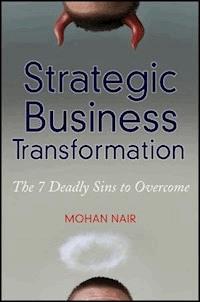
Strategic Business Transformation The seven deadly sins to overcome What can Gandhi, Mother Teresa and Nelson Mandela teach us about running businesses that face transformation in their markets. This book courageously offers that businesses that transform markets or respond to transformation know that they must transform themselves before they transform others. Great companies find a cause greater than themselves, organizes this cause into executable momentum and conquers the imagination of the market. Transforming your business requires a recipe powered by a cause not missions. Read and see how and why.
Sie lesen das E-Book in den Legimi-Apps auf:
Seitenzahl: 355
Veröffentlichungsjahr: 2011
Ähnliche



















Table of Contents
Cover
Title page
Copyright page
Dedication
Preface
Acknowledgments
CHAPTER 1 Overview
Strategy and Strategic Business Transformation
Why Another Book on Strategy?
If Dinosaurs Had Strategy Tools, Would They Have Survived?
Predicting Market Transformation
What Is Strategic Business Transformation?
Importance of the Transformation Effect
Markets in Transformation Are Re-creating Themselves
Summary and Observations
CHAPTER 2 Strategic Business Transformation: Seven Sins to Overcome
Ignoring the New Principles of Business Transformation
Driving without a Cause
Missing Market Momentum
Ignoring the Two Orders of Value
Overlooking Transformational Servant Leadership
Mistaking Capability for Strategic Competence
Expecting Flawless Execution without a Performance Platform
Seven Sins as a Framework for Strategic Business Transformation
Summary and Observations
CHAPTER 3 Sin #1: Ignoring the New Principles of Business Transformation
Aligning Transformational Leadership with Corporate Strategy
Gaining Integrated Strategic Insight with Transformational Leadership
Linking Strategic Insight with Servant Leadership
Summary and Observations
CHAPTER 4 Sin #2: Driving without a Cause
Transformation Needs Momentum, Not Movement
Death of Mission, Birth of Cause
Where Do Causes Come From?
Can an Organization Transform Markets without a Cause?
Summary and Observations
CHAPTER 5 Sin #3: Missing Market Momentum
Why Is Momentum in Markets Important?
Measuring Momentum of Markets and Companies
What Is Strategic Business Momentum?
New Customers in Old Clothing
Summary and Observations
CHAPTER 6 Sin #4: Ignoring the Two Orders of Value
Low-Order Value
Symbolic Value Propositions
Summary and Observations
CHAPTER 7 Sin #5: Overlooking Transformational Servant Leadership
Increasing Our Choices of Transformational Leaders
The Era of the Transformational Leader
What Is Transformational Servant Leadership?
Are Transformational Servant Leaders Born or Made?
Conditions That Bring Out Transformational Servant Leaders
Diary of a Transformational Servant Leader
Summary and Observations
CHAPTER 8 Sin #6: Mistaking Capability for Strategic Competency
Strategy as a Portfolio of Competencies
Identifying, Isolating, and Enabling Core Competencies
Difference between Recipe (Competency) and Ingredient (Capability)
Finding the Positive “Aftertaste” for Customers
Key Capabilities for Transforming Markets
Summary and Observations
CHAPTER 9 Sin #7: Expecting Flawless Execution without a Performance Platform
Two Elements of a Performance Platform
Four Dimensions of Corporate Performance Management
Educating the Enterprise about Transformation with an Eye to the Dominant Subsystem
Understanding the Organizational Dominant Subsystem Demands Observations
People Subsystem
Technology Subsystem
Process Subsystem
Basics of Business Intelligence
Summary and Observations
CHAPTER 10 Tales of Transformation
TriQuint Semiconductor
Starbucks
Southwest Airlines
Les Schwab Tires
Markets in Transformation or Ready for Transformation
Glossary
Suggested Reading
About the Author
Index
Copyright © 2011 by Emerge Inc. All rights reserved.
Published by John Wiley & Sons, Inc., Hoboken, New Jersey.
Published simultaneously in Canada.
No part of this publication may be reproduced, stored in a retrieval system, or transmitted in any form or by any means, electronic, mechanical, photocopying, recording, scanning, or otherwise, except as permitted under Section 107 or 108 of the 1976 United States Copyright Act, without either the prior written permission of the Publisher, or authorization through payment of the appropriate per-copy fee to the Copyright Clearance Center, Inc., 222 Rosewood Drive, Danvers, MA 01923, (978) 750-8400, fax (978) 646-8600, or on the Web at www.copyright.com. Requests to the Publisher for permission should be addressed to the Permissions Department, John Wiley & Sons, Inc., 111 River Street, Hoboken, NJ 07030, (201) 748-6011, fax (201) 748-6008, or online at http://www.wiley.com/go/permissions.
Limit of Liability/Disclaimer of Warranty: While the publisher and author have used their best efforts in preparing this book, they make no representations or warranties with respect to the accuracy or completeness of the contents of this book and specifically disclaim any implied warranties of merchantability or fitness for a particular purpose. No warranty may be created or extended by sales representatives or written sales materials. The advice and strategies contained herein may not be suitable for your situation. You should consult with a professional where appropriate. Neither the publisher nor author shall be liable for any loss of profit or any other commercial damages, including but not limited to special, incidental, consequential, or other damages.
For general information on our other products and services or for technical support, please contact our Customer Care Department within the United States at (800) 762-2974, outside the United States at (317) 572-3993, or fax (317) 572-4002.
Wiley also publishes its books in a variety of electronic formats. Some content that appears in print may not be available in electronic books. For more information about Wiley products, visit our web site at www.wiley.com.
Library of Congress Cataloging-in-Publication Data:
Nair, Mohan.
Strategic business transformation : the 7 deadly sins to overcome / Mohan Nair. — 1
p. cm.
Includes index.
ISBN 978-0-470-63222-2 (hardback); ISBN 978-1-118-13443-6 (ebk); ISBN 978-1-118-13444-3 (ebk); ISBN 978-1-118-13445-0 (ebk)
1. Organizational change. 2. Strategic planning. 3. Success in business. I. Title.
HD58.8.N35 2011
658.4'06—dc23 2011023739
ISBN 978-0-470-63222-2
To Mom, for her endless love and encouragement.
Preface
Transform. Easier said than done. We used to think that things could stand still, but not any longer. Governments can come and go in short time frames, but as we have seen recently, governments that had withstood multiple attacks can be brought down by a single voice via the Internet. Business is no different.
As the world changes at a rapid pace, some things have not changed—the need for community, the need to create value, the need to serve, and the need to create wealth. Business transformation used to be done once in the life of a business. Now, because of the rapid changes in the fundamental structures that support business, transformation is more frequent to keep up or lead markets.
Even though I had access to technology, this book was handwritten and started on a dinner table in my mother’s home far in the South Pacific. I needed to feel the pen in my hand and touch the paper to document the ideas in this book because everything around me is changing and I wanted one thing to remain just for a while. I remember the day I began. It was a great day when I put pen to paper rather than reach for my computer to communicate key messages to whoever would be willing to listen. In times of rapid structural change, we tend to reach for what we find familiar and somewhat everlasting. Business is no different.
The foundational ideas in this book have taken me some time to prepare. The first aspects of these ideas surfaced in the 1990s. The concepts expressed in this book have been implemented successfully in emerging companies as well as in established multi-billion-dollar businesses. In watching these implementations, I have learned they are not as clean as these chapters bound into a book. Rather, these ideas need to be executed well to be successful. In this book, I do not mention any of the companies that have used these methods and instead use other examples as a guide for our learning. By no means does this book imply that the companies mentioned in this book had used or should use these approaches. These companies are admired institutions that reflect the same framework of strategic design and I contend that this framework for strategic business transformation is valuable for your review and understanding.
It began as a book on leadership, but through the years I learned that corporations have two challenges in everything they do—finding leadership and developing strategy. After years of introspective thinking, learning, and corporate experience, I have decided to publish a practical framework for aligning strategy and leadership in the context of transformation.
Strategic Business Transformation is about realizing, responding to, and navigating through a major shift in market need. It is not about strategy but about business design to withstand shifts that break all the foundational understandings of the current market assumptions. Customers migrate to value in transformative markets, and they may not follow the rational rules of the markets of the past.
This book is about finding the correct angle of incidence into the new, forming markets before others realize its existence. When transformation begins in markets, it may be too late to build competencies that you need.
About This Book
To see lasting competitive advantage, we must start with understanding the new principles of transformation; find our core purpose, our cause; refine our understanding of the momentum of the new markets; develop a value proposition that attracts the target customers; build or buy or ally with competencies that produce this value proposition consistently; and form a performance platform so that you can produce this product or service every time, all the time. But to start this, you must have the strategic transformational leaders who have gone through their own change and who can understand and withstand personal and professional transformation because they have seen that service to the greater good is wealth enhancing in our new economy. Peter Drucker, the founder of modern management, stated that the purpose of business is wealth creation. Many have interpreted him to mean make money. I do not. I believe the purpose of business is to create wealth as defined by rational, emotional, and symbolic wealth. Rational wealth is money; emotional wealth is meaning; and symbolic wealth is the participation in something greater than us and in the service of others.
Although respectful of the rational, financial models of transformation, this book argues for the other side to be considered in an organized way. Strategic thinkers tend to be focused, unemotional, and execution focused during transformational times. These are valuable traits. Yet, as observed by Roderick Gilke, Ricardo Caceda, and Clinton Kitts:
… the area of the brain people tend to associate with strategic thought is the prefrontal cortex, known for its role in execution function. It allows humans to engage in anticipation, pattern recognition, probability assessment, risk appraisal and abstract thinking.
However, when we examined the best strategic performers in our sample, we found significantly less neural activity in the prefrontal cortex than in the areas associated with “gut” responses, empathy and emotional intelligence.
“When Emotional Reasoning Trumps IQ,” Harvard Business Review, September 2010, p. 27
So, leaders have to understand themselves and express their leadership, with service as fuel to actually transform their organization when markets transform. Market transformation can leave some businesses behind while lifting others to new heights. This book is not about specific companies but about the traits and insights that many companies have displayed during market transformation. No one company should be adored or followed for all that it does, but it should be understood for the strategies and the manner in which it performs its work to anticipate transformation and then serve the customers.
Purpose of This Book
In steady-state markets, the knowns dominate the unknowns. The known unknowns can be rationalized into predictable alternative responses. In transforming markets, the unknown unknowns dominate the market changes. The unknown unknowns in markets dominate the knowns. We are seeing structural shifts in markets and these shifts are accelerating transformation. Corporations that want to understand what the anchors are in transformation will find this book helpful.
Another finding in this book is that people have changed in their motivation to work in that they are now more interested in work-life balance, not just work. Many young people want to serve their community and want to work so that they can afford to serve. Corporations that want to engage them cannot appeal just to greed but must also appeal to service and to issues greater than those found in the corporation. People want to serve a good greater than themselves and not perpetuate business for its own survival and growth. They are also tired of imposters in business and will quietly respond to work demands but will not be motivated by the singular pursuit of wealth as motive without a defining principle beyond the work itself. Individuals go home daily to find purpose, and if organizations can integrate that purpose into work they will not be commenting about work-life balance but will be talking about community-job balance. And before we go into believing that all good things do not pay, the future workforce wants to be paid a good wage that grows and also serve the greater good using commercially viable skills and techniques and not just build their muscles at work and build their hearts in nonprofit volunteering. They believe that corporations can put heart and mind in the center of gravity of the activities in the company and find a cause to serve that transcends the day-to-day work. People want purpose at work as well as at home, and they want to integrate both in their day-to-day lives. Also, businesses cannot survive transformation if they focus on responding to wealth accumulation void of purpose and service. We understand this, but in the coming era organizations will not get alignment among the goals, the purpose, and the people without strategic design of the business to address the transformation taking place in the markets and in the individuals who serve these markets.
Essentially, as individual personal transformation is occurring, so is business transformation, and these are interconnected. We are seeing a transformation of principles in our world, and it influences the way wealth is created. Many organizations have found this recipe and have aligned themselves to it. They realize that being authentic is the new way of business, and they push forward for wealth and for purposeful outcomes to communities they serve. They start with creating the conditions where their customers are transformed for the better and they are transformed in service of their cause.
How to Read This Book
Chapter 1 defines Strategic Business Transformation and explains the motivation for such a book. The main focus of this book is the seven issues (or “sins”) that have surfaced as the reasons why businesses tend to fail in their attempt to address a transformative shift in the markets they serve. These seven “deadly sins” are addressed in Chapters 3 through 9. These sins can be overcome, not by dealing with them one by one but by considering the recipe of actions that need to be taken to solve them. If worked through, these issues can become the seven “guideposts” for navigating the strategic transformation of markets. Chapter 10 provides examples of people and companies who fit the transformational model.
The book also includes a glossary and section of suggested readings. The glossary is a collection of terms that I use in the book and may be good reference for you.
The chapters build on one another and are best read in serial fashion. The book builds to an understanding of the interrelationships among all the seven sins as a recipe for success, if overcome. These attributes, if aligned, hopefully give an organization the opportunity to anticipate the strategic variables that have yet to surface in a market yet to transform. This book provides a predictive tool and method to identify, understand, and drive to strategic destination while monitoring and managing the present demands of the business.
We Live in Exciting Times
I cannot imagine a more exciting time to be in business. It seems everything we consider anchors in our world has been transformed. We are searching for true north while we navigate through rough waters. However, I get the feeling that we are not trying to get back to where we were but that we want something greater. We have run the races of the past, and they did not make us whole. Now, history may not repeat itself and we have the opportunity to find new ways to find new markets that not just create wealth but create cultures that create wealth. This book is not a philosophical treatment on business but a practical, tested approach of wealth creation. It defines the wealth of an organization in both the explicit financial terms along with the wealth of service to the greater society. In fact, it declares that one will be challenged to create businesses in the next century that have one form of wealth or the other.
For the energy industry, transformation is constant and unpredictable. For the airline industry, things have really changed. What about education? What about health care? What about manufacturing? We are seeing the subtle dismantling of markets not just because the world is flat but because some markets are shrinking, while others are growing; some are going away, while others are being created. For strategists to see through the fog of the future, they must find markers that go beyond the traditional views and see the truth in our future and design their businesses to deliver truth before others can.
Mohan Nair
Acknowledgments
About 15 years ago, while on my journey to find a new way to understand strategy and leadership, I met with Rajmohan Gandhi, the grandson of Mohandas (yes, I was named after him) Karamchand Gandhi. In that meeting, I was so very excited to have dinner with him and our families. I wondered what to say, what to do, how to act, and so on. We entered the restaurant and before I sat down, in a very polite way, Mr. Gandhi asked me a question. He asked, since I was named after his grandfather, what was I doing to serve mankind? I rushed to tell him of all the boards I was sitting on, all the groups I was associated with, and even ventured to tell him that since I was president of an emerging business that creates jobs, I should justify my service to others. It was at that point that my journey got real. I was not doing anything for society as a whole. I was not building scale to my efforts to create societal wealth and financial wealth for others. Not the scale worthy of dinner conversation with Mr. Gandhi.
I have received many messages from many great minds like this over the years, and so this book is a celebration of the causes that others have taken. Many have helped me through the years, and it is traditional to acknowledge them in this section. I have so many friends and colleagues who have supported me in the creation of this book. I find it humbling to list them all, and it would take a chapter to describe their support and caring for my work. I thank you all for your friendship.
I would like to highlight a few who have been directly associated with the development of this book. I thank my acquisitions editor, Sheck Cho, and development editor, Stacey Rivera, and Chris Gage at John Wiley & Sons for their unique approach in guiding me through the design and delivery of this work.
I want to thank my family for their understanding of my journey through this book. I wrote this book in many places, such as restaurants, Starbucks, and even in my car while I was taking my daughter to her classes. Anushka, you are such a special person and a source of inspiration to me. This book will always remind me of our adventures through life.
I started composing the book at my mother’s home, and the chapters gained momentum because it was powered by her sense of service. I know that she is proud to see a book about transformation based on service beyond oneself.
Brad Anderson, former CEO and vice chairman of Best Buy, shared time with me for dinner, and he gave me more insight into the mind of a transformational leader in a few hours than I could have gathered in months. Professor Bala Balachandran, professor at Kellogg School of Management and chairman of Great Lakes University in Chennai, India, has watched me grow these ideas for years, and I appreciate his patience for my journey through ignorance.
I want to also thank Professor Philip Kotler, Kellogg School of Management, for his support of the ideas. Mark Ganz, CEO of Regence, has supported me for several years and embraced the framework many years ago. He had the courage and conviction to lead these ideas into practice as a true servant leader.
I started to write this book in 1992, and it is gratifying to see it finally come to the stage where it is deliverable as a practice, not just a good idea.
I offer this book in the hope that it helps you in building your future and to prove that companies can do good and do well at the same time. I offer this book as a guide to those who understand that to get through structural transformation in markets we must see more than basic strategy and finances but see humanity as customers and find the way to serve their transformation as strategy. Transformation in business depends on our personal transformation. I wish that for you as well.
CHAPTER 1
Overview
When markets transform, they leave some businesses behind while they lift others to new heights. There may be businesses that survive and grow for longer periods than others, but there is a proven single method that can guarantee continuous and permanent success. However, there are common ingredients that if combined into a unique recipe of capabilities can increase the chances of surviving and growing through a market transformation. This book is about understanding and acting upon strategic market transformations before they arrive, by understanding, anticipating, and designing your business using Strategic Business Transformation principles and techniques. It is about withstanding transformation and leading into it when the traditional anchors we hang on to become incompatible with the new market waves.
Lesen Sie weiter in der vollständigen Ausgabe!
Lesen Sie weiter in der vollständigen Ausgabe!
Lesen Sie weiter in der vollständigen Ausgabe!
Lesen Sie weiter in der vollständigen Ausgabe!
Lesen Sie weiter in der vollständigen Ausgabe!
Lesen Sie weiter in der vollständigen Ausgabe!
Lesen Sie weiter in der vollständigen Ausgabe!
Lesen Sie weiter in der vollständigen Ausgabe!
Lesen Sie weiter in der vollständigen Ausgabe!
Lesen Sie weiter in der vollständigen Ausgabe!
Lesen Sie weiter in der vollständigen Ausgabe!
Lesen Sie weiter in der vollständigen Ausgabe!
Lesen Sie weiter in der vollständigen Ausgabe!




