


23,99 €
Mehr erfahren.
- Herausgeber: John Wiley & Sons
- Kategorie: Fachliteratur
- Serie: MBA - Mastering Business in Asia
- Sprache: Englisch
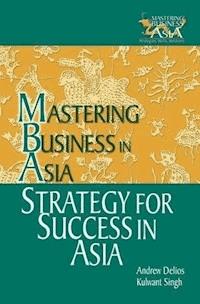
In order to achieve success, managers need to understand the strategic issues in Asia. Strategy for Success in Asia covers areas from the uniqueness of Asia like its economic and cultural diversity to the roles of governments and the importance of alliances. One of the first books to offer a perspective effective company strategy and how local and multinational companies can achieve strategic success in Asia. This important book is for anyone who has a stake in Asia or has plans to do business in it.
Sie lesen das E-Book in den Legimi-Apps auf:
Seitenzahl: 521
Veröffentlichungsjahr: 2011
Ähnliche



















Contents
About the Series
Preface
Acknowledgments
Chapter 1: Strategy
Thinking Strategically
A Framework for Thinking Strategically
The Determinants of Strategy
Strategy
Conclusion
Chapter 2: Strategy in Asia
What is Asia?
Culture and its (Limited) Impact
Major Differences in Strategy in Asia
Developing Strategy
Conclusion
Chapter 3: Strategies for Working with Governments in Asia
What Do Governments Want?
Government Policy
Measuring the Political Environment
Management of the Political Environment
Regional Cooperation and Globalization
Strategies for Working with Government
Conclusion
Chapter 4: Strategies for Profitable Growth
The Concept of Growth
Thinking Strategically about Growth
Successful Growth
Dealing with Deflation
Conclusion
Chapter 5: Strategies for Regional Expansion in Asia
The Concept of Regional Expansion
Defining Regional Expansion
Thinking Strategically about Regional Expansion
Locations for Regional Expansion in Asia
Conclusion
Chapter 6: Alliances for Success
Thinking Strategically about Alliances
Make, Buy, Or Ally?
Costs and Benefits
Partner Selection
Managing Alliances
Alliances in Asia
Conclusion
Chapter 7: Acquisitions for Success
Thinking Strategically about Acquisitions
Acquisitions in Asia
What Drives Acquisitions?
Value Creation in Acquisitions
Succeeding with Acquisitions
Conclusion
Chapter 8: Size and Scope for Success
What is Size and Scope?
A Conglomerate Approach to Strategy
Business Groups in Asia
Outsourcing
Conclusion
Chapter 9: Strategies for Success in Asia
The Asian Business Environment
Corporate Social Responsibility
Environmental Responsibility
Corporate Governance
Principles for Strategic Success
Conclusion
Index
Copyright © 2005 John Wiley & Sons (Asia) Pte Ltd
Published by John Wiley & Sons (Asia) Pte Ltd
2 Clementi Loop, #02-01, Singapore 129809
All rights reserved.
No part of this publication may be reproduced, stored in a retrieval system, or transmitted in any form or by any means, electronic, mechanical, photocopying, recording, scanning, or otherwise, except as expressly permitted by law, without either the prior written permission of the Publisher, or authorization through payment of the appropriate photocopy fee to the Copyright Clearance Center. Requests for permission should be addressed to the Publisher, John Wiley & Sons (Asia) Pte Ltd, 2 Clementi Loop, #02-01, Singapore 129809, tel: 65-6463-2400, fax: 65-6463-4605, E-mail: [email protected].
This publication is designed to provide accurate and authoritative information with regard to the subject matter covered. It is sold with the understanding that the Publisher is not engaged in rendering professional services. If professional advice or other expert assistance is required, the services of a competent professional person should be sought.
Other Wiley Editorial Offices
John Wiley & Sons, Inc., 111 River Street, Hoboken, NJ 07030, USA
John Wiley & Sons Ltd, The Atrium, Southern Gate, Chichester PO19 BSQ, England
John Wiley & Sons (Canada) Ltd, 22 Worcester Road, Rexdale, Ontario M9W ILI, Canada
John Wiley & Sons Australia Ltd, 33 Park Road (PO Box 1226), Milton, Queensland 4046, Australia
Wiley-VCH, Pappelallee 3, 69469 Weinheim, Germany
Library of Congress Cataloging-in-Publication Data:
ISBN 13 978-0-4708-2137-4
For our wives, Usha & Jane
About the Series
This exciting series provides comprehensive coverage of primary business functions, as well as vital business topics. Each subject is dealt with in a unique Asian context, making it an ideal addition to the business library of all business professionals and MBA students.
Each book is written by an Asian-based thought leader and includes the names of many top consulting companies, business schools and Asian corporate giants. The authors in the series draw on their wealth of experiences to provide a comprehensive overview of the subject and crucial strategic advice for Asia’s next generation of leaders.
Preface
Conversations about business strategy in Asia have progressed through three periods of hyperbole. In the first period, the 1970s to mid-1980s, pundits extolled the virtues of the “Japanese model” of business. Keiretsu, industrial policy, the pursuit of product quality and operational excellence at all cost, the sacrifice of profits for growth, and lifetime employment were the elements of the Japanese model that firms from other countries strived to emulate. The second period, the mid-1980s to mid-1990s, was one of rapid growth in East and Southeast Asia that led to praise for the “Asian values” business model. Confucianism, hard-working, disciplined, loyal, and cooperative employees and managers, heavy savings and investments, and the prioritization of economic growth ahead of all alternatives were central elements of the Asian business model that analysts and politicians used to explain the success of many of Asia’s firms. In the third period, from 1997 to the present, experts now recognize that the cozy Asian business model in which tight inter-firm, intra-firm, and government-firm relationships prevailed had systemic deficiencies that ultimately led to the onset of the Asian economic crisis in 1997 and the downfall of many Asian firms.
Unquestionably, there are aspects of truth in these statements, but these viewpoints exaggerated selected aspects and ignored contradictory evidence. Both the positive and negative accounts overstate the unique aspects of the Asian business model, while making attributions to business success that are strongly grounded in anecdote or fable, but weakly anchored to facts. Unfortunately, many books on strategy in Asia have reflected these perspectives.
The difficulty in understanding the reasons why businesses succeed, and do not succeed, is not constrained to Asia. In all parts of the world, businesspeople, public policy-makers, and academics alike struggle with trying to identify and implement the drivers of business success. This struggle is captured by the idea of corporate and business strategy. The study of strategy is about trying to understand why firms have different levels of success. Strategy formulation and implementation is about identifying the outcomes a leader wants his or her firm to achieve, selecting the best course for achieving these outcomes, and undertaking all the actions necessary to actually achieve the outcomes.
These ideas about strategy are not new. That said, the application of mainstream strategic concepts to firms in Asia does require some new thinking and some understanding of the context of business in Asia. We wrote Strategy for Success in Asia with that in mind.
In developing this book, we bring the most current ideas on business and corporate strategy to the competitive environment that underlies strategic issues in Asia. We base our arguments on established theory and rigorous empirical research, while making this book accessible to the busy reader. These objectives mean that in this book we apply ideas on strategy to the analysis of competitive conditions in Asia, with the core notion that business in Asia does have some unique characteristics. This, however, does not mean we think that business in Asia is one of a kind.
Strategy and business share common characteristics regardless of whether a firm is located in North America, Africa, Europe, or Asia. What does differ across these regions, and across the countries within these regions, is the national institutional landscape. A country’s institutions – its political, economic, societal, and technological environments, and its laws, rules, and regulations -define the conditions under which business occurs in that country. These institutions influence which strategies can be pursued successfully and which cannot. They define the level of government-firm interaction, the level of competition in a nation, the level of foreign participation in an economy, and so forth. As such, national institutional environments influence strategy and the types of strategies that can be implemented for success.
With development, many countries in Asia are undergoing rapid evolution in their national institutional environments, some of which were catalyzed by the Asian economic crisis, and others which were part of long-term reform plans. These changes in institutional environments have required commensurate changes in the types of strategies a firm can pursue for success.
In developing this book, we bring the national institutional context to the forefront of the discussion on strategy in Asia, while maintaining an anchor in time-tested concepts and thinking about strategy. We have also remained faithful to the business context in Asia. This book is designed to be consistent with these goals. Each chapter contains illustrations and cases drawn from countries across Asia. The structure of the chapters also reflects these goals.
Chapter 1 introduces the core concepts on strategy thinking that underlie the discussion in the rest of the book. These core concepts apply to businesses operating everywhere, but their application needs to consider the context of the business environment. Chapters 2 and 3 introduce the context of strategy in Asia by identifying the key points of difference between Asia and the rest of the world, and between Asian countries. We pay special attention to the roles of governments, given their influence in Asia and the rapid changes in government-firm relationships in many countries in the region.
In Chapters 4 and 5, we discuss strategies for growth in Asia. Decisions about growth, and the reasons why a firm’s management pursues growth, must withstand the scrutiny of a strategic analysis. Growth for its own sake has become more difficult since the Asian economic crisis, although opportunities for regional expansion in Asia have become more attractive since 1997.
In Chapters 6,7, and 8 we look at specific decisions for achieving success. These decisions include alliances and acquisitions, and in which industries a firm should operate. The individual decisions need to be considered in the context of a firm’s overall strategic intents, and we identify the means to do so in these chapters.
Chapter 9 presents our concluding thoughts on strategy in Asia. We make projections about future developments in national institutional environments in Asia, which in turn might alter the strategies and goals a firm pursues for its success. At the end, we return to several core ideas that we believe are fundamental to strategic thinking and consequently fundamental to the long-term success of any firm in Asia.
We believe that the core ideas of strategy are relatively simple, but easily overlooked in the complexity of running a business. A realistic description of strategy, adapted from a famous quote on war by the Prussian strategist Carl von Clausewitz, is that “everything in business strategy is simple, but the simplest thing is difficult.” Leaders must maintain their awareness of the big picture of Asia as they develop their firms’ strategies, but they must also combine this with a detailed understanding of their own firm and of the specific business challenges that they face. The integration of environmental, firm, and competitive contexts is central to the perspective of strategy we develop in this book.
Acknowledgments
Many people have made this book possible. Our thanks go to Nick Wallwork of John Wiley, who encouraged us to write the book. Janis Soo and Malar Manoharan, who each acted as editors for this series, provided great support and guidance, while maintaining patience with our efforts to complete our work in a timely manner. Robyn Flemming was the expert editor who worked with us to ready the text for publication.
We would like to thank the numerous research associates and assistants involved in the development of the text. Chan Kong Chung, Ajai Singh Gaur, Nguyen Hoang Phi, and Elizabeth Khoo each worked exceptionally well to help with the development of various parts of this book. Jennifer Ilkiw also contributed, although unknowingly through her assistance on another project.
Numerous colleagues provided support and valuable feedback on the book. Much of the material in Chapter 6 draws on joint research with Will Mitchell. The material in Chapter 3 owes a substantial intellectual debt to Witold J. Henisz, whose research and thinking is the foundation for much of the chapter. Conversations, consultations, and collaborations with Jaideep Anand had an unmistakable influence on the material we developed for Chapter 7. We received a great deal of intellectual and collegial support from our colleagues at the NUS Business School, particularly Nitin Pangarkar and Loizos Heracleous who helped develop some of the cases used in the book. Finally, we would like to thank Peter Alsop, who went beyond the call of friendship to preview various chapters and offer insightful, detailed, and challenging comments.
Most importantly, we thank our families for their continued support and encouragement, without which this project would not have been attempted, much less finished.
Kulwant Singh
Andrew Delios
CHAPTER 1
Strategy
This book focuses on strategy and strategic thinking in Asia. Leaders who think strategically will be better able to identify and exploit the myriad opportunities that exist in Asia, avoid the equally widespread risks, and develop strategies that can enhance the probability of success for their firms.
In this chapter, we develop a framework for leaders to think strategically about business, to help them focus on the key factors that determine success. This chapter provides an overview of strategy and the factors that determine business strategy. We focus our overview on a strategic thinking framework which provides a systematic way to evaluate core business issues and focuses on the key factors that influence business success. This framework will help managers to fulfill one of their primary responsibilities – the development of strategies that will move their firms toward success. The strategic thinking framework is not specific to Asia, but is applicable to all business contexts. Even so, this framework is particularly useful in Asia, and is especially appropriate for managers in Asia-based firms.
THINKING STRATEGICALLY
All choices have implications and all actions have consequences. Senior business leaders, in particular, regularly make decisions that have important, widespread, and long-term impact. Leaders must consider the impact and implications of their decisions. Doing so is, in effect, thinking strategically.
Strategic thinking is the process of considering the consequences of one’s actions. A business leader who thinks strategically is one who identifies a desired outcome, and evaluates alternatives and their consequences in selecting the choice that will best achieve that outcome. If the focus is on the firm’s success, a leader who thinks strategically first identifies measures of firm success, next considers alternative means for achieving this success, and then selects the strategy that is most likely to succeed. The strategic leader therefore knows what he or she intends to achieve, and selects from the many factors that influence success and from the alternatives available, the best means for achieving success.
Possibly the most fundamental of all questions in business is: “What determines business success?” This is an issue that is at the core of every senior manager’s job. A fair assumption, therefore, is that successful managers can and do devote considerable time and attention to understanding this issue from a strategic perspective. However, it is difficult to provide a clear or comprehensive answer to this question because of the complexity of business, the multiple external factors that impact business success, the multiple roles that leaders play in influencing firm performance, and the multiple paths that exist for achieving success. Another reason is that many managers are inclined to action, rather than to introspection or to retrospective examination of the reasons for their successes and failures. Relatively few leaders think systematically about the issue of business success, so that even the most successful managers may find it difficult to identify the reasons for their success.
Most explanations for firms’ success take the form of a list of resources, activities, functions, and environmental factors. Most of these are often unrelated, and some may appear to be almost random influences on business outcomes. It is usually difficult to explain how the factors in the list specifically influence success in a particular case. It is even more difficult to use this approach to generate insights and strategies to enhance future success. The fundamental problem with this approach – which we term the “laundry list” – is that it generates a random collection of generic factors, most of which are important to some extent in many situations, but which collectively, do not provide a meaningful or rigorous explanation for business success in a particular context.
Lesen Sie weiter in der vollständigen Ausgabe!
Lesen Sie weiter in der vollständigen Ausgabe!
Lesen Sie weiter in der vollständigen Ausgabe!
Lesen Sie weiter in der vollständigen Ausgabe!
Lesen Sie weiter in der vollständigen Ausgabe!
Lesen Sie weiter in der vollständigen Ausgabe!
Lesen Sie weiter in der vollständigen Ausgabe!
Lesen Sie weiter in der vollständigen Ausgabe!
Lesen Sie weiter in der vollständigen Ausgabe!
Lesen Sie weiter in der vollständigen Ausgabe!




