


Erhalten Sie Zugang zu diesem und mehr als 300000 Büchern ab EUR 5,99 monatlich.
- Herausgeber: Kamera Books
- Kategorie: Geisteswissenschaft
- Sprache: Englisch
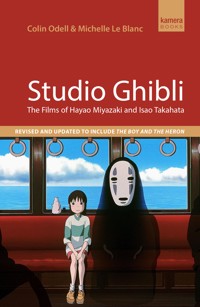
The animations of Japan's Studio Ghibli are among the most respected in the movie industry. Their films rank alongside the most popular non-English language films ever made, with each new release a guaranteed box office hit. Yet this highly profitable studio has remained fiercely independent, producing a stream of imaginative and individual animations. The studio's founders, Hayao Miyazaki and the late Isao Takahata, have created timeless masterpieces. Their films are distinctly Japanese but the themes are universal: humanity, community and a love for the environment. Studio Ghibli outlines the history of the studio and explores the early output of its founders. It examines all the studio's major works including Laputa: Castle in the Sky, Grave of the Fireflies, My Neighbour Totoro, Kiki's Delivery Service, Only Yesterday, Porco Rosso, Pom Poko, Whisper of the Heart, Princess Mononoke and Howl's Moving Castle, as well as the Oscar-winning Spirited Away. Also included are the more recent animations: Hayao Miyazaki's Oscar-nominated masterpiece The Wind Rises, Isao Takahata's The Tale of Princess Kaguya, Gor? Miyazaki's Earwig and the Witch and Hayao Miyazaki's latest box office success, The Boy and the Heron.
Sie lesen das E-Book in den Legimi-Apps auf:
Seitenzahl: 279
Veröffentlichungsjahr: 2023
Das E-Book (TTS) können Sie hören im Abo „Legimi Premium” in Legimi-Apps auf:
Ähnliche



















Praise for Studio Ghibli
‘One of the most authoritative texts available. Whether you’re a newcomer or a longtime fan, Studio Ghibli is well worth a read’ SciFi Now
‘A film that is well worth seeing at any stage in life’ The State Of The Arts
‘The authoritative English language text on Studio Ghibli’ Alternative Magazine Online
‘A competent portrait of a great studio’ SFX Magazine
‘An excellent overview’ Library Journal
‘A valuable beginner’s guide to their complex and beautiful world’ The List Magazine
‘These guys sure know their Miyazaki and associates... a useful starter’s guide’ DeathRay Magazine
‘Will make you want to see the films (again) with fresh eyes’ BookDragon
‘For someone just getting into anime or curious about Studio Ghibli, this would be a great book to pick up’ Anime News Network
For Marika, Hiroki, Maverick and Gracie.
And for Kirsty Ann, in memoriam. With much love to Graham.
Acknowledgements
Our thanks as always to the people whose enthusiasm and support have provided invaluable assistance in the production of this book. To all the people who have entertained us in Japan – Gavin and Hanako Bell, Ono Mio and family, Akayama Kenta, Akayama Kenji, Yaegeshi Kaori and Nakaya Kazutoshi and family. Thank you to Akayama Kenta for procuring DVDs for us and sending them from Japan. Thanks to all our language teachers – Yoshiko, Taeko, Mike and Miho – who have taught us Japanese with patience, good grace and humour. And thanks to all the people with whom we’ve enthused at length about Ghibli and Japan: Gavin & Hanako, John, Keith & Hill, Alastair, and Gordon.
Our love to Christine and Tony and Truus, Marc and Karol, as well as Gracie and Maverick, and Marika and Hiroki.
Thanks also to Anne Hudson, Hannah Patterson, Ion Mills, Clare Quinlivan, Elsa Mathern, Claire Watts and Ellie Lavender for their support with this book.
Special thanks to Yoshiko Miura and Hanako Bell for their advice and translation expertise.
Introduction
A teenage witch, her hair ruffled by the wind, rides her mother’s broom through the open skies. A giant robot unleashes molten destruction on the soldiers who have awakened him from centuries of slumber. A city worker recalls her childhood growing up in the 1960s. The skies above Kōbe are filled with buzzing agents of death, raining down fire upon a terrified population. A burgeoning writer seeks inspiration from a quaint antiques shop. A travelling warrior becomes infatuated with a feral wolf-child in a land scarred by war. A group of young people discover love and loss during their turbulent high-school years. A girl’s parents are turned into slobbering pigs. A father turns superhero, if only for a moment, when he stands up to a local biker gang. Two elated girls soar through the air inside a grinning cat bus, its headlight eyes tracing yellow streaks in the sky above the forest. Gods and monsters. Love and loss. Jubilation and despair. The horrors of war. Childhood wonder. The passion of life. Welcome to the heart-soaring, euphoric, whimsical, terrifying, compassionate and, above all else, emotional world of Studio Ghibli.
The remarkable films of Studio Ghibli show, without a shadow of a doubt, that cinema can be art. Often the terms ‘art’ and ‘cinema’ result in products that distance audiences, but Ghibli makes films that touch the soul, that can enrapture and delight everyone from toddlers to pensioners. Crucially, they retain the one thing that’s frequently lacking in commercial cinema – integrity. It is this, combined with an unprecedented box-office might in their native Japan and across the world, that has allowed the animators at Studio Ghibli to continue their work without compromising their artistic vision, telling the stories they want to tell, the way they want to tell them. Animation has often been dismissed, particularly in the West, as simplistic and aimed at children but, despite their appeal to children, Ghibli’s films are universal. Put simply, Studio Ghibli is the finest animation company today, a bold claim perhaps when comparing them with the mighty Pixar (huge Ghibli fans themselves), but one that is justified.
Studio Ghibli was founded in 1985 when Miyazaki Hayao brought together Takahata Isao and producer Suzuki Toshio in order to make animated films the way they wanted to make them. Years of working for various companies producing film and television programmes had left the trio eager for artistic freedom, unhindered by external studio pressures. Now, outside Hollywood, Studio Ghibli is the most profitable animation company in the world. In Japan their films top the box-office charts and run in cinemas for months on end. On the international stage they are highly regarded, having won numerous prestigious awards, including the Academy Award for Best Animated Feature for Spirited Away (2001), the only non-English-language film to have won in this category. Their artistry is an inspiration to filmmakers the world over. Despite making films predominantly for their home market, they are among the most critically acclaimed studios in the world.
WHAT IS AND ISN’T A STUDIO GHIBLI FILM?
Confusion often arises as to what is and is not a Studio Ghibli film. This is because Takahata and Miyazaki’s styles are so distinctive and the Ghibli brand so ubiquitous that many of the films the pair worked on prior to forming the studio are often claimed as Ghibli’s. This view is further clouded because an increasing number of these works are now released under the Ghibli banner, most notably Miyazaki’s Nausicaä of the Valley of the Wind (1984), Takahata’s Gōshu the Cellist (1982) and the pair’s breezy Panda Kopanda films (1972 and 1973), none of which are technically Ghibli films. Further confusion has been created by the addition of the Studio Ghibli logo, a profile of their mascot Totoro, to many of the films acquired later by the studio. In this book we will be covering the major pre-Ghibli works by Takahata and Miyazaki because they are crucial to understanding the artists’ development and the emergence of the Ghibli ‘house style’.
BACKGROUND
There are, of course, many people working for Studio Ghibli, but the most notable are its founders. Takahata Isao was born on 29 October 1935 in Ise, the city that hosts the most sacred shrine of Japan’s indigenous religion Shintō. Miyazaki Hayao was born in the modern capital Tōkyō on 5 January 1941. These were difficult and turbulent times for Japan; the long campaigns of World War Two had left the country devastated and hungry. Following Japan’s defeat in 1945 the country was occupied by the United States and, although it would eventually become one of the world’s leading economic powers, the early post-war years were particularly harsh.
Takahata attended the University of Tōkyō, graduating in French literature. It was French animator Paul Grimault’s unfinished Le Roi et l’oiseau (1948, but finally finished in 1980) that intrigued him as to the possibilities of working in animation. Perhaps it was for this reason that he applied for a job as assistant director at the fledgling Tōei Dōga studio, working on features and TV shows.
Miyazaki grew up with his three brothers, father and mother, the latter a freethinking spirit who inspired her sons to question everything. As a result of his mother’s long-term illness, the family had to move around the country seeking the best medical support, a situation many commentators have linked to the genesis of My Neighbour Totoro (1988). Miyazaki’s father worked for his brother at Miyazaki Airplane, and Hayao developed a love of flying machines. He began drawing what he saw, imagining new forms of aviation. These roots would later see him designing flying machines not only for his animated movies but also specialist modeller magazines. Miyazaki expanded his drawing skills from vehicles to people when, like many growing up in the post-war years, he became inspired by manga, Japanese comics that had been popularised by artist Tezuka Osamu. Initially, Miyazaki was only an enthusiastic hobbyist, but all that changed when, following graduation in political science and economics at Gakushuin University, he too joined the growing ranks of workers at Tōei Dōga.
Although Japan had made animated films (anime) before, the tidal wave of production really took off in the early 1960s, partly because of the work of Tezuka Osamu and partly on the back of what is often acknowledged as Japan’s first feature-length colour anime Hakujaden (Legend of the White Serpent, 1958). An offshoot of its parent company Tōei, one of Japan’s big movie studios, Tōei Dōga quickly established itself as a major player in the burgeoning market, making feature films and, most importantly, TV anime.
Work was very labour-intensive in the factory-like studio and the workers formed a strong union. It was through these union activities that Takahata met Miyazaki, the two of them being under the wing of Ōtsuka Yasuo, their mentor at the studio. It was Ōtsuka who recommended that Takahata be promoted to director on Horusu: Prince of the Sun (1968), his first feature. Takahata brought in Miyazaki as designer. Unfortunately, the film was a financial flop and Takahata eventually left Tōei along with some of the staff who had worked on Horusu, including Miyazaki. The pair continued to have a strong working relationship over the years although their paths would often diverge. Their first real breakthrough came with Panda Kopanda, which Takahata directed and for which Miyazaki provided the story, design and key animation. The mid-1970s were a particularly busy time for the pair as they fine-tuned their skills, notably on a series of immensely popular adaptations of classic literature for Nippon Animation. Miyazaki took the director’s chair, and a few more besides, in the ambitious science-fiction fantasy Conan, the Boy in Future (1978), working once more with Ōtsuka Yasuo, as well as Takahata.
As the pair’s reputations grew, opportunities arose to branch out into feature-film production. Takahata returned with Downtown Story (aka Chie the Brat, 1981) and the charming fable Gōshu the Cellist (1982). Miyazaki, meanwhile, had been given his first chance at feature directing on the action comedy Lupin III: Castle of Cagliostro (1979), but, despite the film’s critical success, it didn’t lead to any further film work so he returned to television animation. A slowdown in his animation workload led to Miyazaki drawing an ad hoc manga, Nausicaä of the Valley of the Wind. Partway into the series, Miyazaki had to suspend creating the manga because its success had led the magazine’s production company to green-light a modestly budgeted anime of the as-yet-unfinished saga. Miyazaki brought in Takahata to produce the film. Other people involved in the project, including composer Joe Hisaishi and Suzuki Toshio, would become crucial to the look, feel and running of Studio Ghibli. Nausicaä of the Valley of the Wind was an unqualified commercial and artistic success. The company that had bankrolled the film agreed to help fund a new venture, an animation studio where the artists and directors called the shots, where freedom of expression would be the driving force over commercial considerations. All the work would be produced in Japan and the studio’s employees would be treated as artists. Together with Takahata and Suzuki, Miyazaki formed Studio Ghibli.
With hindsight it is easy to see how Studio Ghibli became so successful, but the ride was not easy. Producing a quality animated film is very costly and has a long gestation time. A single failure at the box office would have signalled the end of the company and it was to be a number of years before Ghibli would enjoy financial security. Although regarded as classics now, the early films of Studio Ghibli did not match the box-office dynamite of Nausicaä of the Valley of the Wind. Laputa: Castle in the Sky (1986) and the double bill of Grave of the Fireflies (1988) and My Neighbour Totoro did reasonably well at the box office but were not stellar hits and the studio only started to show a respectable return on its product after the release of Kiki’s Delivery Service (1989). After that, a series of hugely successful films followed which, coupled with the revenue generated by merchandise sales following the belated accolades given to My Neighbour Totoro, enabled the studio to become buoyant enough to take financial knocks with experiments like the TV movie Ocean Waves (1993) and Takahata’s ambitious, all-digital My Neighbours the Yamadas (1999).
Ghibli had become a national treasure, its films frequently topping Japan’s box-office charts, its popularity also soaring in Western countries following an Oscar win for Miyazaki’s Spirited Away. One of the studio’s strengths is the diversity of its output. Western perceptions of animation are generally that the format is most suited to the child or family markets, and the most popular Ghibli films remain the fantasy animations, but anime is a remarkably diverse art form. An interesting aspect, which can sometimes appear strange to Western viewers, is that many of these stories are set in the real world. This is a common feature of anime but less so in Western cinema where these types of stories would often be produced as live-action films. The studio has made both original stories and adaptations in a wide range of genres – fantasies, adventures, biopics or dramas – with narratives that can be very simple or incredibly sophisticated. As Ghibli has become more renowned, its films have become more intricate and demanding and it is the quality of the productions – the studio’s commitment to artistry – that will ensure that its works remain timeless, even though animation techniques have altered dramatically in the years since Ghibli’s inception.
We purposely don’t make sequels of films that become hits… for better or for worse, we don’t take the easy route… We create films by working as hard as we possibly can and by pushing conditions to their limit. What we wanted to do was to create animation that has some meaning and was worth making. (Miyazaki, Animage, Tokuma Shoten, May 1991, reprinted Starting Point, 2009)
Each director develops stories around themes that interest them personally but the strength of their films lies in their clear ability to tell a story and tell it well. Although it was established with an aim of developing new talent, the studio’s output has been dominated by the films of its founders.
Miyazaki remains Studio Ghibli’s most renowned director and it is easy to see why. His films are wonderfully inventive, soaring flights of imagination that invoke a sense of wonder in the viewer. Working predominantly in the fantasy genre (with the exception of The Wind Rises [2013], itself heavily fictionalised), Miyazaki has explained that the joy of animation came from his ability to create worlds: ‘If I were asked to give my view, in a nutshell, of what animation is, I would say it is “whatever I want to create”’, (Miyazaki, Animation: Monthly Picture Book Special, March 1979, reprinted Starting Point, 2009).
Miyazaki’s films are beautifully crafted and his style highly distinctive. He has a very hands-on approach to the creative process and prefers traditional animation techniques, storyboarding his tales using pencil and paper. He doesn’t use a script; the narrative develops with the storyboards and he often doesn’t know how the plot will evolve. He understands how important it is that the worlds he creates are realistic (even in a fantasy context), and that the audience must believe them. Miyazaki often encourages his viewers to think like children, regardless of the age of his protagonists: to explore and question the world he presents. Adults may have to cast logic aside and accept his alternative, but clearly defined, vision. Miyazaki often fools us by establishing his films ostensibly in the real world and then demanding that we reject our notions of physics, biology and geography, albeit in a manner that is consistent with the world he is drawing us into, even if it appears to be familiar to us. He stated in an interview with Midnight Eye in 2002 that, ‘I try to dig deep into the well of my subconscious. At a certain moment in that process, the lid is opened and very different ideas and visions are liberated.’ Miyazaki’s films possess an honesty that makes even the most happy of endings credible because they do not detract from the precedents set in the narrative. Western fantasy cinema frequently demands both narrative and story closure – a resolution to the plot as well as confirmation that the future will be bright for the heroes. While most of Miyazaki’s films result in an optimistic conclusion, they don’t always offer an easy way out, for events of the past cannot be undone and the protagonists must strive to succeed in their future lives. Miyazaki creates well-rounded characters, who cannot simply be depicted as ‘good’ or ‘bad’; his ‘villains’ are not clearly defined as such, they are depicted as complex characters with believable motivations, if indeed they are present at all. My Neighbour Totoro, for example, features no characters with negative traits. Additionally, many of his lead protagonists are independent and highly capable girls or young women.
As co-founder of Studio Ghibli and Miyazaki’s colleague and close friend since their early days at Tōei, the importance of Takahata Isao’s influence on both Miyazaki and the studio cannot be underestimated. Known to his friends as Paku-san, his working method was completely opposite to Miyazaki’s; he was, in his friend’s own words, ‘the descendant of a giant sloth’. He was a perfectionist, taking his time to produce the highest quality and most detailed work he could. Miyazaki went on to note that ‘Suzuki san… and others realized they had to somehow corral the sloths and drive them towards the finish line.’ (Miyazaki 1990, reprinted in Starting Point, 2009)
When Suzuki Toshio engaged Nishimura Yoshiaki to produce The Tale of Princess Kaguya (2013), he knew that ‘in order to bring Takahata-san’s film to fruition, I needed someone who could stick with him 24 hours a day’. As a director Takahata was naturally closely involved with the creative process but had a more hands-off approach to the actual animation, preferring to use the creative talents of others. ‘If you want to make an animated film from your own drawings, I think you would become very narrow and limited by your own style and abilities. The role of the director is to gather very talented people, and to direct his vision.’ (LA Times, 21 October, 2014)
Takahata often, but not exclusively, chose to adapt literary works – whether from novels, manga or even comic strips – and many of these films are set in the real world. Additionally, his films are generally set in Japan and many reference Japanese culture, particularly its folk tales, poetry, mythical creatures and history.
Whereas Miyazaki’s drawing and animation style is distinctive and largely consistent across his entire output, Takahata was more willing to experiment with different approaches to animation and storytelling techniques. The visual style of Grave of the Fireflies is so different to My Neighbours the Yamadas or The Tale of Princess Kaguya that it would be difficult to recognise them as the work of the same director. His later films, in particular, rejected conventional anime styles, and he also approached the medium of animation as being far broader than traditional acetate cel work (although he was adept at using this process), unafraid to tackle new or radical techniques, such as the use of virtually drawn sketch frames imitating the style of ancient storybook prints, or using technology in My Neighbours the Yamadas to emphasise the cartoonish newsprint style of the original comics. This came at some cost in the time it took his projects to evolve. The Tale of Princess Kaguya, six years in the making, was meant to have double-billed with The Wind Rises but the delays in production meant that plan was halted.
In September 2013, Miyazaki announced his decision to retire from feature filmmaking. Despite announcing this after every film since Princess Mononoke (1997), he confirmed that The Wind Rises really was to be his final feature film. In August 2014, Suzuki Toshio made a statement indicating that production was likely to cease at the studio, at least for the time being. An internet uproar ensued as fans worldwide mourned the possible closure of the studio. However, their woes were a little premature. Like many studios, it is common practice to hire staff on contract for specific projects. Thanks to Ghibli’s continuous production schedule that lasted over 25 years, the studio had always been active. However, following the release of When Marnie Was There (2014), there were no further feature films in production, so Suzuki took the opportunity to take stock and evaluate the studio’s future. And Studio Ghibli was not to remain closed for long. Miyazaki once again came out of retirement and commenced production on a short film, Boro the Caterpillar, designed exclusively for the Ghibli Museum. He then announced in 2016 that he would be returning to feature film making with How Do You Live?, an adaptation of a 1937 novel by Genzaburō Yoshino, which initially had an estimated release date of 2020/2021, to coincide with the Tokyo Olympics. The studio opened up once more. In addition, Suzuki and Takahata took Dutch director Michaël Dudok de Wit under their respective wings to co-produce The Red Turtle (2016).
It was to be Takahata’s last production. He was diagnosed with lung cancer and passed away on 5 April 2018 at the age of 82. Miyazaki mourned his friend at a ceremony that was held at the Ghibli Museum later that year. Takahata’s legacy lies in a body of work that is innovative, intelligent and impassioned as well as demonstrating a sincere love of the animated form which inspired countless other filmmakers, not only within the studio that he helped found but also in his showcasing of animation from all over the world.
Miyazki worked on How Do You Live? for many years, without the constraints of a deadline. Release dates came and went. In the meantime, Miyazaki Gorō, Hayao’s son, made Ghibli’s first 3-D CGI feature, Earwig and the Witch (2020). Finally, and without any promotional material save a sole poster image, How Do You Live?, retitled The Boy and the Heron outside of Japan, was released in 2023, to much acclaim and the biggest box office opening weekend in Studio Ghibli’s history.
Following the success of The Boy and the Heron thoughts turned to the studio’s future. Nippon TV, who had had involvement with many of the studio’s productions over the years, including Ocean Waves (1993), became the studio’s largest shareholder in October 2023, turning Ghibli into a subsidiary. This marked a new era for the studio – what the future holds has yet to be seen.
THEMES AND MOTIFS
Many of the films of Studio Ghibli have common themes and motifs that make for a coherent worldview, even if the films themselves can be radically different in content or tone. Although the animations often share these common elements and usually a distinctive house aesthetic, they nevertheless retain the characteristics and interests of their respective directors.
Environmentalism
A key theme is that of environmentalism or, rather, the way that mankind interacts with nature, the way in which our environment is a living collection of interconnected beings that should be respected. Often Earth is portrayed as suffering as a result of human ignorance. What is particularly interesting is the way that this notion is explored from different angles and with different overall conclusions.
Nausicaä of the Valley of the Wind shows the devastating consequences of global pollution but also depicts groups of people who are still unwilling to take responsibility for their environment – using machinery to attempt to tame nature. Nausicaä herself is shown as trying, to the best of her ability, to understand the environment and live as harmoniously as she can within it. My Neighbour Totoro shows how respect for the environment can lead to harmony and reward, while its companion film, Grave of the Fireflies, shows the effect of war on a country. Only Yesterday (1991) depicts the gap between urban and country living and how the countryside is in decline through expanding wealth in an increasingly urbanised Japan. Pom Poko (1994) gives us just the tiniest glimpses of hope amidst a gloomy assessment of a natural environment in crisis. It posits that, in order for nature to have any chance of survival, it must adapt, even changing its very being. In Ponyo on the Cliff by the Sea (2008), the effects of consumption and the dumping of waste nearly prove to be Ponyo’s downfall right at the start of the film as she becomes trapped in a discarded jar and has to escape being dredged up with all the debris on the seabed. Interestingly, though, it is also the fantasy world in Ponyo that can have a detrimental effect on Earth’s environment – Ponyo’s desire to become human, and her use of magic to metamorphose, upset the world’s balance.
There is, however, a slight conflict in the way Ghibli debates the use of industrialism and machinery. In Laputa: Castle in the Sky, the mining village is seen as good because of its community work ethic, despite the fact that the residents are in some ways stealing from nature. Films featuring machinery in a good light acknowledge that it is inevitable that man and nature will have conflicting needs; it is more a question of how far humans are willing to tip the balance in order to fulfil their own selfish desires. Nausicaä may well be an environmentalist, but that doesn’t stop her from using a flying vehicle to get around – the crucial difference being that hers represents the least damaging method of air travel, whereas the Pejitan and Tolmekian are depicted using huge, air-polluting warships. Similarly, in Princess Mononoke, the women who work in Lady Eboshi’s factory are viewed as good community workers; it is what they are producing – weapons and iron – that places them in conflict with nature, for it is the deliberate destruction of the forest that is fuelling this new industrialism. Technology then, in and of itself, is not necessarily a bad thing, but we must consider how it’s used and to what extent. In Laputa: Castle in the Sky the robots are destructive but also capable of living closely with nature, tending the gardens. Both Laputa and Princess Mononoke show us what begins to happen when nature can’t coexist easily with humans. Pom Poko shows what happens when the battle, at least in some respects, is all but lost.
Flying
A running theme, particularly in Miyazaki Hayao’s films, is the joy of flying and flying machines. Flying offers a freedom unrestricted by gravity and allows the animator to work in a completely uninhibited environment. This offers the possibility of exhilaration and speed in the animation. Flying machines appear frequently in Miyazaki’s Ghibli and pre-Ghibli work, from the futuristic vehicles of Conan, the Boy in Future, the ornithopter in The Castle of Cagliostro and the wasp-like drones of Laputa: Castle in the Sky to the terrible warships of Howl’s Moving Castle (2004) and the runaway dirigible of Kiki’s Delivery Service. Porco Rosso (1992) is filled with aircraft, including the titular pig’s crimson plane. A pig not dissimilar to Porco Rosso’s main character, Marco, introduces the wonderful contraptions in Imaginary Flying Machines (2002), a short film that played as part of Japan Airlines’ (JAL) in-flight entertainment. The Wind Rises (2013) is about the (fictionalised) life of Horikoshi Jirō, a designer of Mitsubishi aircraft.
Similarly, the fantastical worlds of Studio Ghibli are filled with flying creatures – Totoro, the Baron from Whisper of the Heart (1995) and The Cat Returns (2002), the huge insects of Nausicaä of the Valley of the Wind or the dragons from Tales from Earthsea (2006) and Spirited Away. What is interesting about these creatures is the way that they interact with the humans in the story, serving as a metaphor for growing up or showing that sometimes freedom comes at a price. Often, as with Totoro or the Baron, they fly with the human characters to show them the world from a different perspective.
Children
A child or young adult functions as the central protagonist of many Ghibli films. This serves a number of purposes. Children are more open to the kind of fantastical worlds that are often portrayed, as in Spirited Away and The Boy and the Heron. Children are spirited and resourceful, more likely to face up to grave danger willingly because they have not yet developed the faculties to recognise threat, or are even excited by it. Mimi in Panda Kopanda is one such character, delighted with the thought that the intruder in her home could be an actual burglar! Similarly, a group of schoolgirls are thrilled to be captured by pirates in Porco Rosso – and go on to disrupt their dastardly deeds. Related to this is the sense of a child’s vulnerability in the face of adversity – it makes the tension more palpable to the viewer.
In many ways, the children in Ghibli’s films are a liberating force that allows anything to be possible. Having a child as a main character gives a younger audience a greater identification with the film, but also functions as an avatar for adult wish fulfilment, offering possibilities for a return to youth. The child has a privileged viewpoint that sees what an adult can’t, or won’t, see – for example, Shizuku’s observation of the cat that sits in her train carriage in Whisper of the Heart or the two sisters who can see the forest spirits in My Neighbour Totoro. Sometimes the child is used as a way of observing adult atrocities through younger eyes – such as the poison blighting the land in Princess Mononoke, the bombing of Kōbe in Grave of the Fireflies or the terrible war in Howl’s Moving Castle. Indeed, Howl himself embodies many of these characteristics with his initial unwillingness to grow up and accept responsibility.
Anthropomorphism, Zoomorphism and Metamorphosis
Anthropomorphism – animals adopting human characteristics – is a staple feature in animation, but the way Ghibli uses it is far more subtle than, say, the cute talking animals of Disney. Linked with this is zoomorphism – characters having the form of an animal. The balance between these is a key aspect of many of Ghibli’s films and often indicates shifts in character and meaning, especially when combined with the process of metamorphosis.
In the pre-Ghibli Gōshu the Cellist, Takahata anthropomorphises the animals who visit Gōshu nightly but they do retain their individual animal traits even as they converse or plead with the cellist. The relationships between forms are more subtle in Pom Poko where the level of anthropomorphism alters depending on the tanuki’s (raccoon-dogs’) state of mind, developing from realistic depictions, through stylised manifestations right up to full-scale transformation into human form, a form that at once shows the extent of their powers but also the lengths they need to go to in order to survive in the human world. The depiction of the grey heron in The Boy and the Heron is initially highly realistic but becomes increasingly fluid as we discover that the heron’s body is actually inhabited by a small man. In Kiki’s Delivery Service, Jiji the cat is notably feline but can converse openly with Kiki. Cats take human form through the figure of the Baron in Whisper of the Heart and also in the world of the Cat King in The Cat Returns. Anthropomorphism is taken to its limit in films like Spirited Away and Tales from Earthsea, where characters appear to be human, only to be revealed later as dragons adopting human form.
It isn’t just a question of animals taking on human traits, but also of humans becoming like animals. Porco Rosso’s Marco has zoomorphised into a bipedal pig and it is implied that this was a conscious decision on his part to remove himself from the rest of humanity. More directly, Chihiro’s parents’ greed in Spirited Away causes them to turn into devouring swine. Princess Mononoke doesn’t physically take on the looks of the wolves she runs with, but adopts their mannerisms and habits. With anthropomorphism in Ghibli’s films, the change is normally seen as either a conscious choice or part of the animal’s natural ability. In the case of zoomorphism, however, characters often have change thrust upon them through magic, circumstance or curses.
Metamorphosis is a vital element in many Ghibli films, either through deliberate use of magic to alter form (Yubāba in Spirited Away, Howl in Howl’s Moving Castle) or through the effects of mankind (the poisoned boar-god in Princess Mononoke). Metamorphosis is used to visually represent a character’s emotions, state of mind or well-being. Sophie in Howl’s Moving Castle is not only transformed into an old woman magically; in a crucial sense, the change is also brought about by her own lack of self-confidence. Similarly, Ponyo’s grasp of her magical ability to will herself into human form in Ponyo on the Cliff by the Sea manifests itself in her appearance, but also reflects the level of her fatigue and emotional state. In The Boy and the Heron Miyazaki’s depiction of the characters is highly sophisticated as we see younger incarnations of some of the protagonists in the other world.
Wind and Weather
Climate plays an important role for aesthetic, emotional or thematic reasons. The state of the weather and its relationship to the environment demonstrates the delicate balances in nature – the electric storms and desert wastelands of the ravaged Earth in Nausicaä of the Valley of the Wind, the heavy drops of rain in Grave of the Fireflies or the terrifying tsunami in Ponyo on the Cliff by the Sea. Moreover, the weather is often used to reflect the characters’ feelings – Mei and Satsuki’s despondent wait at the bus stop in My Neighbour Totoro is accompanied by a torrential downpour while a (short-lived) feeling of utter contentment is greeted by glorious sunshine as Haru relaxes in a field in The Cat Returns.




