


17,99 €
Mehr erfahren.
- Herausgeber: John Wiley & Sons
- Kategorie: Geisteswissenschaft
- Sprache: Englisch
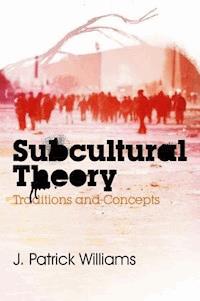
Subcultural phenomena continue to draw attention from many areas of contemporary society, including the news media, the marketing and fashion industries, concerned parents, religious, and other citizen groups, as well as academia. Research into these phenomena has spanned the humanities and social sciences, and the subcultural theories that underlie this work are similarly interdisciplinary. Subcultural Theory brings these diverse analytic issues together in a single text, offering readers a concise discussion of the major concepts and debates that have developed over more than eighty years of subcultural research, including style, stratification, resistance, identity, media and "post subcultures".
The text emphasizes methods, concepts, and analysis rather than mere descriptions of individual subcultures, all the while ensuring readers will gain insight into past and present youthful subcultures, including mod, punk, hardcore, straightedge, messenger, goth, riot grrrl, hip-hop, skinhead, and extreme metal, among others. The book closes with an assessment of the subculture concept as a viable and useful sociological tool in comparison with other fields of study including social movements and fandom.
Sie lesen das E-Book in den Legimi-Apps auf:
Seitenzahl: 420
Veröffentlichungsjahr: 2013
Ähnliche




















Subcultural Theory
Subcultural Theory
Traditions and Concepts
J. Patrick Williams
polity
Copyright © J. Patrick Williams 2011
The right of J. Patrick Williams to be identified as Author of this Work has been asserted in accordance with the UK Copyright, Designs and Patents Act 1988.
First published in 2011 by Polity Press
Polity Press
65 Bridge Street
Cambridge CB2 1UR, UK
Polity Press
350 Main Street
Malden, MA 02148, USA
All rights reserved. Except for the quotation of short passages for the purpose of criticism and review, no part of this publication may be reproduced, stored in a retrieval system, or transmitted, in any form or by any means, electronic, mechanical, photocopying, recording or otherwise, without the prior permission of the publisher.
ISBN-13: 978-0-7456-3732-7
A catalogue record for this book is available from the British Library.
Typeset in 10.5 on 12 pt Plantin
by Servis Filmsetting Ltd, Stockport, Cheshire
Printed and bound in Great Britain by MPG Books Group Limited, Bodmin, Cornwall
The publisher has used its best endeavours to ensure that the URLs for external websites referred to in this book are correct and active at the time of going to press. However, the publisher has no responsibility for the websites and can make no guarantee that a site will remain live or that the content is or will remain appropriate.
Every effort has been made to trace all copyright holders, but if any have been inadvertently overlooked the publisher will be pleased to include any necessary credits in any subsequent reprint or edition.
For further information on Polity, visit our website: www.politybooks.com
Contents
List of Figures and Images
Preface
1
Subcultural Theory
Defining subculture
Problems theorizing subculture
Outline of the book
2
Theoretical and Methodological Traditions
American traditions I – the Chicago School and urban ethnography
American traditions II – deviance and strain
British traditions I – the Birmingham School and cultural studies
British traditions II – from the Manchester School to post-subculture studies
Back to subculture – the symbolic interactionist tradition
3
Race, Gender, and Subcultural Experience
From tsotsis to gangstas: “a living record” of race and masculinity
Negotiating the masculine bias: gender and “the master’s tools”
Summary
4
Style
with Jeffrey L. Kidder
The meaning of style
From consumption to subcultural style
Homology: ideology, image, and practice
Semiotic homologies: teddy boys, skinheads, mods, and punks
Ethnographic homologies: rockers, hippies, messengers, and homegirls
The value of style: diffusion and defusion
Summary
5
Resistance
Power and hegemony
Multiple dimensions of resistance
Passive ↔ active
Micro ↔ macro
Overt ↔ covert
Summary
6
Labels and Moral Panics
From social reaction theory to a sociology of moral panics
From music-lovers to satanic killers: endless cycles of subcultural folk devils
Raves, drugs, and postmodern media
Summary
7
Identity and Authenticity
Insiders and outsiders
Status hierarchies
Identity and authenticity
Summary
8
Scales
Sociological scales
Spatial scales
Summary
9
Related Fields
with Elizabeth Cherry
Social movements
Collective identity
Lifestyle politics
Participatory cultures and fandom
Parallels
Tensions
Summary
10
A Final Note on Concepts
Notes
References
Index
List of Figures and Images
Figures
2.1
Merton’s strain theory
5.1
Three dimensions of resistance
7.1
Objectivist model of status hierarchy
Images
1
Girls standing outside a mosh pit at a hardcore show in Memphis, Tennessee
2
A bike messenger with all the typical accoutrements
3
A Danish punk flyer calling for an organized protest to protect a squat in Copenhagen
4
Members of the 501st Legion march down the streets of Atlanta, Georgia, at Dragon*Con
Preface
This book, while theoretically relevant to the study of most cultures marked as different from the so-called “mainstream” – whether by social status, ethnicity, language, taste, politics, or otherwise – focuses most on bringing together decades’ worth of studies on oppositional youth subcultures, which became so prevalent during the twentieth century. The reasoning behind this is twofold. First, while the concept “subculture” has been used in various ways to describe the culture of many types of social groupings, its application to youth has been profound, and some of the best descriptions of young people’s alternative methods of doing things have occurred within this tradition. Second, the idea of oppositional youth subcultures is close to my own heart. It is through my participation in the punk, straightedge, and extreme metal subcultures over more than two decades that I am the person I am today. Setting aside what I am supposed to know about primary and secondary socialization, I feel that my interactions with(in) these cultures during adolescence and through my adult life have been incredibly profound, leading me toward sincere critical thinking, a certain disregard for social standards or “rightness,” and a belief in the positive possibilities for social change.
Over the course of writing the text, however, I began to realize that explicitly signifying “youth subcultures” throughout the text would be counterproductive, mainly because of the diversity of types of people who participate in such cultures today. Go to a subcultural venue in almost any city and you’ll probably see more teenagers than anyone else, but there are other people to be seen as well. Subcultural affiliation is most likely to begin during adolescence, but its significance can last a lifetime. The concept of “youth subcultures,” so commonly used in social-science writing, rhetorically denies the continuing significance of subcultural participation to those of us who have accidentally grown up and grown older over the years. Thus, while the impetus behind the book (and its dedication) lies with all the kids who make subcultures real, its writing is intended to represent the larger landscape of social life.
1
Subcultural Theory
As I sat thinking about how to begin this book, a phone call reminded me that there had been another school shooting recently – November 2007 – this time at Jokela High School in Tuusula, Finland. Eighteen-year-old Pekka-Eric Auvinen killed eight people, injured several others, and then killed himself. A month earlier, fourteenyear-old Dillon Cossey had been arrested for planning an attack on Plymouth Whitemarsh High School in Pennsylvania. The day after the Finnish shooting, a Pennsylvanian reporter called me because of my research on the convergence of youth subcultures and digital culture. She explained that Auvinen and Cossey had communicated about twenty-five times on an internet forum and through instant messaging, and she wanted me to tell her more about “this tiny – but frightening – subculture [that] is thriving” online (Ruderman 2007). I spent the next half-hour in what I later considered a somewhat bizarre conversation about video games, internet forums, and youth subcultures. Why bizarre? Because I found myself going out of my way to dissuade the reporter from talking about these events as subcultural. As the quote from her subsequent news story (cited above) indicates, she decided to do so anyway.
I was not surprised, actually. What she described were two boys who were disturbed enough by their social interactions at school – which seem to have involved ridicule, hazing, and ostracization – that they decided violence was the most viable solution to their problems. But did that make them members of a “frightening subculture”? I thought not. What I feared was that the word “subculture” would be used, as it often is, in an uncritical fashion, that is, as a journalistic tool that took two deplorable acts of violence (one in the mind, the other acted out) and linked them to something that I have valued over the last twenty-something years. What I wanted was for this journalist to leave subculture out of the conversation, to not drag it through the mud. What I didn’t want was for the term to be reduced (as it often is anyway) to an attention-grabber in the Sunday paper.
My desire to avoid invoking subculture is certainly tied to my own history of subcultural participation – in punk and straightedge as a teenager, then as an amateur musician in the death metal scene for nearly a decade. As a suburban American teenager listening to British bands such as Crass and Subhumans, I learned, among other things, to object to cultural industries’ intentional appropriation of everyday culture for profit and to reflect on the relevance of class and gender in everyday life. American bands such as Seven Seconds and Minor Threat had taught me to put my thoughts into action and to live a life that I thought was positive and meaningful, regardless of what family and peers thought. I had learned to value directness, dissent, resistance, and in general an unwillingness to simply accept what I was offered by adults. Years later, after earning a Bachelor’s degree in cultural anthropology, I discovered the relevance of my so-called subcultural mindset to sociology. It was partly from this standpoint – as someone who still happily embraces his subcultural past – that I discussed the irrelevance of “subculture” for that Pennsylvanian news report on school shootings. To be sure, many of the people I’ve known who participated in subcultures were similarly ostracized or hazed during adolescence, or even earlier in childhood. For them, subcultures seemed to offer a solution to the problems faced in their everyday lives – a solution that did not involve physical retaliation against the popular kids. Subcultures were to them, and are to me, a resource from which to develop a positive self-concept, a confidence in non-normative thinking (although subcultural thinking can became myopic), and a network of support in a world that often feels alienating and unfulfilling.
Lesen Sie weiter in der vollständigen Ausgabe!
Lesen Sie weiter in der vollständigen Ausgabe!
Lesen Sie weiter in der vollständigen Ausgabe!
Lesen Sie weiter in der vollständigen Ausgabe!
Lesen Sie weiter in der vollständigen Ausgabe!
Lesen Sie weiter in der vollständigen Ausgabe!
Lesen Sie weiter in der vollständigen Ausgabe!
Lesen Sie weiter in der vollständigen Ausgabe!
Lesen Sie weiter in der vollständigen Ausgabe!
Lesen Sie weiter in der vollständigen Ausgabe!
Lesen Sie weiter in der vollständigen Ausgabe!
Lesen Sie weiter in der vollständigen Ausgabe!




