


33,99 €
Mehr erfahren.
- Herausgeber: John Wiley & Sons
- Kategorie: Fachliteratur
- Sprache: Englisch
An insightful look at leadership transition from the successor's perspective
Success and Succession examines the leadership transition process from the successor's point of view, and outlines the considerations and strategies that lead to a better future for the business. With a focus on practical planning and execution, this insightful guide provides insight into the strategies that smooth the transition and help the new leadership make better business decisions. You'll learn when and how to start planning, who you need on your team, and the obstacles you should anticipate along the way. You'll learn to navigate the uncertainty the process entails, and how to identify opportunities for reciprocal understanding and adopt workable approaches for successful resolution of a multitude of transition issues. Interviews with those at various stages of transition highlight the real-world application of these ideas, and give you an inside look at what worked, what didn't, and what they wish they had thought of.
The transition of leadership in an independent, non-public professional service business can be emotional and difficult for everyone. This book gives you a framework for smoothing the process and driving the best possible future of the business.
- Consider the complexities of succession and transition
- Balance conflicting dynamics of outgoing and incoming leadership
- Plan for operational, financial, and emotional obstacles
- Develop and execute a winning strategy for long term success
The transition from founder to successor is far from an academic exercise, and is not linear. Answers are hard to find, and the ebb and flow of the process requires patience, creativity, and willingness to try again. Success and Succession provides a unique strategy for success, from the perspective of incoming leadership.
Das E-Book können Sie in Legimi-Apps oder einer beliebigen App lesen, die das folgende Format unterstützen:
Seitenzahl: 360
Veröffentlichungsjahr: 2015
Ähnliche



















Table of Contents
Title Page
Copyright
Dedication
Acknowledgments
Introduction
Section I: Operational Challenges … and Solutions
Chapter 1: The Founder as the Sun
The Evolution of a Founder-Centric Firm
Is My Firm Founder-Centric?
Awareness
“The Painters”
Chapter 2: Replacing the Sun: A New Solar System
What Road Do You Choose?
Committing to the Road Less Traveled
Assessing the Client Experience
Welcome to McDonald's: May I Take Your Order?
Human Capital Framework
Improvement Matrix
Chapter 3: Ordering Off the Menu
Choices Have Consequences
The Easiest One
The Great “Current Income” Debate
Equity versus “Milking”
What Does a Successor Want off the Menu
Not Everyone Is William Wallace
Chapter 4: Setting a Vision, Together
STEP 1: Can We Work Together?
Step 2: Setting a Vision
Section II: Financial Challenges … and Solutions
Chapter 5: It's Always About the Money
An Ironic Twist
Management versus Equity
Value and Control
Distribution of Value as a First Step
The Founder's Financial Dilemma
The Successor's Financial Dilemma
Building for an Exit Doesn't Maximize Value
Hope Is Not a Strategy
The Great Risk Divide
Chapter 6: Splitting the Pies: Defining What Is Enough
Only One Thing Really Matters
Four Big Questions
Defining an Exit Date
Successor Concurrence
Non–Operator Owners
Mandatory Sales/Retirement
The Pie-Slicing Exercise
Slicing the Equity
Slicing Up the Cash
Avoid the Path to Neutral
Defining What's Enough—a Real Case
What a Successor Should Ask For
Chapter 7: Let's Make a Deal
Discounting Is the Name of the Game
External Capital
Lessons from Other Professional Services Businesses
Today's Landscape
It May Be Time to Consider a Sale or Merger
What Drives Value?
Is the Firm Still Just the Founder?
Is Your Firm Strategic?
Successor Considerations in a Merger or Acquisition
Been There; Done That
Why Deals Don't Get Done—or Shouldn't
Section III: Emotional Challenges … and Solutions
Chapter 8: It's Not Just an Office
Know Your Personality
The Office
Successor Surprises
The Fear of Being Wrong
Successors Don't Want to Admit Being Scared
It's Not a Light Switch
The Slow-Motion Effect
An Unfair Expectation: Successor as Advisor
Progress, Not Perfection
Chapter 9: Breaking Inertia
Do We Have an Inertia Problem?
The Four Choices
Is Doing Nothing a Risk?
How Does This Process Start?
Can the Successor Start the Process?
The Homework Assignment
Successors Should Ask Hard Internal Questions
Going All In
Showing Progress
Starting in the Future
What's Next?
Chapter 10: Derailed
The Fear of Failure—Again
Founderitis
Life After the CEO Job
Term Limits or Planned Rotation of Roles
Optimism Bias
Reality Distortion Field
Hitting the Pause Button
Necessary Endings
Chapter 11: Building a Legacy
What's in a Name?
What's Your Title?
Memorials
The Finest Legacy
Some Final Words
Bibliography
Supplemental Material
Client Touchpoint Exercise
Client Touchpoint Exercise
Human Capital Framework
Human Capital Framework
Role Transition Matrix
Role Transition Matrix
Pie-Splitting Exercise
Pie Splitting Exercise
Interviewee Biographies
About the Authors
Index
End User License Agreement
Pages
ix
x
xi
12
xiii
xiv
xv
xvi
3
4
5
6
7
8
9
10
11
12
13
14
15
16
17
18
19
20
21
22
23
24
25
26
27
28
29
30
31
32
33
34
35
36
37
38
39
40
41
42
43
44
45
46
47
48
49
50
51
52
53
54
55
56
57
58
59
60
63
64
65
66
67
68
69
70
71
72
73
74
75
76
77
78
79
80
81
82
83
84
85
86
87
88
89
90
91
92
93
94
95
96
97
98
99
100
101
102
103
104
105
106
107
108
109
110
111
112
113
114
117
118
119
120
121
122
123
124
125
126
127
128
129
130
131
132
133
134
135
136
137
138
139
140
141
142
143
144
145
146
147
148
149
150
151
152
153
154
155
156
157
158
159
160
161
162
163
164
165
166
167
168
169
170
171
172
1
61
115
173
174
175
176
177
178
179
180
181
182
183
184
185
186
187
188
189
190
191
192
193
194
195
196
197
198
199
200
201
202
203
204
205
206
207
208
209
210
211
212
213
214
215
216
217
218
219
220
221
222
223
Guide
Cover
Table of Contents
Introduction
Operational Challenges … and Solutions
Begin Reading
List of Illustrations
Chapter 2: Replacing the Sun: A New Solar System
Figure 2.1 The Operational Assessment Process
Figure 2.2 Assessing the Client Experience
Chapter 4: Setting a Vision, Together
Figure 4.1 Alignment Hurdle
Figure 4.2 Priority Matrix
Figure 4.3 Delegation Diagram
Figure 4.4 Shared Vision Sequence
Chapter 6: Splitting the Pies: Defining What Is Enough
Figure 6.1 Equity and Cash Exchange
Figure 6.2 Founder's Financial Life Cycle
Chapter 8: It's Not Just an Office
Figure 8.1 Risk Diagnosis
List of Tables
Chapter 3: Ordering Off the Menu
Table 3.1 The Role Transition Framework
Supplemental Material
The In-Office Meeting
Outside-the-Office Meeting
Consistent Communication
Social Meetings
The In-Office Meeting
Outside-the-Office Meeting
Consistent Communication
Social Meetings
Equity Value: What's Been Created
Equity Value: Future Value Created
Cash Splits
Equity Value: What's Been Created
Equity Value: Future Value Created
Cash Splits
Success and Succession
Unlocking Value, Power, and Potential in the Professional Services and Advisory Space
Eric Hehman, Jay Hummel, and Tim Kochis
Copyright © 2015 by Eric Hehman, Jay Hummel, and Tim Kochis. All rights reserved.
Published by John Wiley & Sons, Inc., Hoboken, New Jersey.
Published simultaneously in Canada.
No part of this publication may be reproduced, stored in a retrieval system, or transmitted in any form or by any means, electronic, mechanical, photocopying, recording, scanning, or otherwise, except as permitted under Section 107 or 108 of the 1976 United States Copyright Act, without either the prior written permission of the Publisher, or authorization through payment of the appropriate per-copy fee to the Copyright Clearance Center, Inc., 222 Rosewood Drive, Danvers, MA 01923, (978) 750-8400, fax (978) 646-8600, or on the Web at www.copyright.com. Requests to the Publisher for permission should be addressed to the Permissions Department, John Wiley & Sons, Inc., 111 River Street, Hoboken, NJ 07030, (201) 748-6011, fax (201) 748-6008, or online at http://www.wiley.com/go/permissions.
Limit of Liability/Disclaimer of Warranty: While the publisher and author have used their best efforts in preparing this book, they make no representations or warranties with respect to the accuracy or completeness of the contents of this book and specifically disclaim any implied warranties of merchantability or fitness for a particular purpose. No warranty may be created or extended by sales representatives or written sales materials. The advice and strategies contained herein may not be suitable for your situation. You should consult with a professional where appropriate. Neither the publisher nor author shall be liable for any loss of profit or any other commercial damages, including but not limited to special, incidental, consequential, or other damages.
For general information on our other products and services or for technical support, please contact our Customer Care Department within the United States at (800) 762-2974, outside the United States at (317) 572-3993 or fax (317) 572-4002.
Wiley publishes in a variety of print and electronic formats and by print-on-demand. Some material included with standard print versions of this book may not be included in e-books or in print-on-demand. If this book refers to media such as a CD or DVD that is not included in the version you purchased, you may download this material at http://booksupport.wiley.com. For more information about Wiley products, visit www.wiley.com.
Library of Congress Cataloging-in-Publication Data:
Hehman, Eric, 1974-
Success and succession : unlocking value, power, and potential in the professional services and advisory space / Eric Hehman, CFP, Jay W. Hummel, CFA, Tim Kochis.
pages cm
Includes bibliographical references and index.
ISBN 978-1-119-05852-6 (cloth) ISBN 978-1-119-07148-8 (pdf) ISBN 978-1-119-07135-8 (epub)
1. Executive succession. 2. Consulting firms–Management. 3. Business enterprises–Management. I. Hummel, Jay W., 1979- II. Kochis, Tim, 1946- III. Title.
HD38.2.H44 2015
001–dc23
2015019101
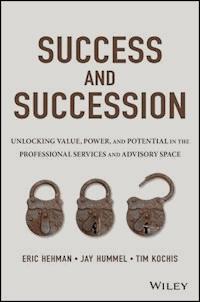
Cover image: Old Rusty Locks ©iStock.com/JuhaHuiskonen
Cover design: Wiley
To those who will strive to be the next generations of leaders.
Acknowledgments
Eric Hehman: To my wife, JayLeen, who has been the biggest blessing in my life and truly is my better half. Her confidence in me is unwavering and propelled me to take my initial job at Austin Asset as an unpaid intern. To my four young children: my hope is that someday, when they read this book, they will gain a deeper insight into their dad and know that even one person can make a difference in this world. To my parents, Curtis and Kathy, who modeled persistence and loyalty and inspired me to understand that slow and steady does win the race.
This story would not be possible without John Henry McDonald. His mentorship and partnership fueled my courage to be the leader I am today. To my partners at Austin Asset, Greg Van Wyk and Jonathan Davison, and our colleagues at Austin Asset, for joining me on this journey of building a business that we are all very proud of.
I am grateful to be surrounded by many wise mentors who challenge me to step beyond my limits: Larry Fehd, Tony Budet, Mark McClain, Jim Craver, Chris Hurta, Dave Helms, Rick Rhodes, Matt Burns, Trey Halbert, Matt Livingston, Jonathan Huffman, Mike Tipps, and Jeff Brown, when I needed your counsel, you were always there. Bits and pieces of each of you are in this book. To the members of my study group, Xcelsior, for their incredibly helpful constructive feedback over the last 10 years.
The beauty of a project like this is learning from your coauthors and being affirmed by their shared insights. Tim has been a mentor from afar for many years. Whether he knew it or not, his sharing of his experience with a young kid from Texas was a real help to me. And to Jay, that infectious spirit of enthusiasm whom I met four years ago. Our minds raced to the adventures we might share one day. One day has come, my friend.
And, finally, I am deeply grateful to the clients I have learned from and served along the way. Your trust has been an enormous honor, and I hope that I can repay that gift by helping to build even a better way to exceed your expectations.
Jay Hummel: My wife and I like to call our family “Team Hummel.” I could not have been blessed with better teammates than my wife, Valerie, and our two sons. Valerie's a rock star. She took care of a newborn and a two-year-old while I spent the weeks out of town doing my day job and most weekends at the neighborhood Starbucks trying to write. Her support never wavered, and if this book makes an impact, she's a big reason why.
I'm thankful for my friends Woody Taft, Jim Stengel, James Zimmerman, and Jim Bechtold, who inspired me to write this book when most people thought it was crazy. Thanks to Rob Densen, who challenged us on the original name of the book and graciously provided us with our final title. Chris Tankersley stepped up every time we asked him to help on draft formats even with unreasonable deadlines.
Tim agreed to write a book with two guys he barely knew. Thanks for taking a chance on us, Tim. We had a blast doing this together.
Last, thanks to my colleagues and friends at Envestnet, an amazing company with special people. Thanks to Jud, Bill, Jim, Zachary, and Lincoln, whose support of this effort has and will make a lasting difference.
Tim Kochis: Let me begin as close to the beginning as I can and thank my wife, Penelope Wong, not only for her patience and key advice throughout the effort to write this book but even more for her being at my side, every day, for the past 35 years of my professional career. I am also eager to acknowledge my colleagues at the old Kochis Fitz and the new Aspiriant for giving me the opportunity to experience these transitions of management and ownership, in very real terms, firsthand. With a few struggles here and there, the outcomes have been very good for me, and, I hope, even better for them.
Finally, I am eager to acknowledge Jay and Eric for the genuine pleasure of collaborating on this book. We weren't sure how a three-way responsibility for telling this story would play out, but we all quickly fell into comfortable patterns of contributing ideas, initiating drafts, negotiating differences, and editing to a final result, unified by a common purpose. We sincerely thank the many friends and industry colleagues for their wisdom and guidance in refining the views we present here. We owe them a huge debt for their gracious counsel, but take full responsibility for the miscues and inelegancies that may remain.
Most important, we thank and acknowledge the thousands of clients we have served and are serving, and the many more to come. Without them, there would be no reason to write this book. Fundamentally, this book is about them—and for them.
Introduction
This book grew out of an industry conference in 2013 in Dallas, Texas, hosted by financial industry journalist Bob Veres. Bob had asked Eric and Jay to come to Dallas to take part in a panel discussion, which he called the first of its kind, focused on successors talking to founders about the transition issues they faced in their businesses—from a successor's point of view. At the time, Jay was 33 and the president and chief operations officer (COO) of a large registered investment advisor and Eric was the 38-year-old chief executive officer (CEO) of Austin Asset.
Lesen Sie weiter in der vollständigen Ausgabe!
Lesen Sie weiter in der vollständigen Ausgabe!
Lesen Sie weiter in der vollständigen Ausgabe!
Lesen Sie weiter in der vollständigen Ausgabe!
Lesen Sie weiter in der vollständigen Ausgabe!
Lesen Sie weiter in der vollständigen Ausgabe!
Lesen Sie weiter in der vollständigen Ausgabe!
Lesen Sie weiter in der vollständigen Ausgabe!
Lesen Sie weiter in der vollständigen Ausgabe!
Lesen Sie weiter in der vollständigen Ausgabe!
Lesen Sie weiter in der vollständigen Ausgabe!
Lesen Sie weiter in der vollständigen Ausgabe!
Lesen Sie weiter in der vollständigen Ausgabe!
Lesen Sie weiter in der vollständigen Ausgabe!
Lesen Sie weiter in der vollständigen Ausgabe!
Lesen Sie weiter in der vollständigen Ausgabe!
Lesen Sie weiter in der vollständigen Ausgabe!
Lesen Sie weiter in der vollständigen Ausgabe!
Lesen Sie weiter in der vollständigen Ausgabe!
Lesen Sie weiter in der vollständigen Ausgabe!
Lesen Sie weiter in der vollständigen Ausgabe!




