


15,99 €
Mehr erfahren.
- Herausgeber: John Wiley & Sons
- Kategorie: Fachliteratur
- Sprache: Englisch
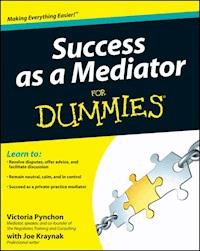
Everything you need to enter the exciting field of legal mediation
To be an effective mediator, it's essential to possess the ability to take control of animated situations, offer advice, and facilitate discussion—all the while remaining neutral without formulating biased judgment. Success as a Mediator For Dummies helps you acquire these attributes and much more.
Aspiring mediators will learn the importance of upholding an honorable reputation, the skills, personality traits, and characteristics of a good mediator, and how to effectively market a successful mediation career. Plus, you'll get practical advice about finding work in the field, realistic salary information, and tips on as tips on identifying whether you have the skills and tools to become a good mediator.
- The steps necessary to become a mediator (education, training, licensing, states-specific requirements, etc.)
- How your education and professional background can enhance your mediation work
- Sample rules and standards of conduct
- All the steps necessary to build and market a successful private practice in mediation, or flourish as a mediator in a law firm, corporation, school, or non-profit organization
Whether you have a background in law or an interest in legal careers, Success as a Mediator For Dummies gives you everything you need to enter the exciting field of legal mediation.
Das E-Book können Sie in Legimi-Apps oder einer beliebigen App lesen, die das folgende Format unterstützen:
Seitenzahl: 614
Veröffentlichungsjahr: 2012
Ähnliche



















Success as a Mediator For Dummies®
Visit dummies.com/cheatsheet/successasamediator to view this book's cheat sheet.
Table of Contents
Success as a Mediator For Dummies®
by Victoria Pynchon and Joe Kraynak
Success as a Mediator For Dummies®
Published byJohn Wiley & Sons, Inc.111 River St.Hoboken, NJ 07030-5774
www.wiley.com
Copyright © 2012 by John Wiley & Sons, Inc., Hoboken, New Jersey
Published by John Wiley & Sons, Inc., Hoboken, New Jersey
Published simultaneously in Canada
No part of this publication may be reproduced, stored in a retrieval system or transmitted in any form or by any means, electronic, mechanical, photocopying, recording, scanning or otherwise, except as permitted under Sections 107 or 108 of the 1976 United States Copyright Act, without the prior written permission of the Publisher. Requests to the Publisher for permission should be addressed to the Permissions Department, John Wiley & Sons, Inc., 111 River Street, Hoboken, NJ 07030, (201) 748-6011, fax (201) 748-6008, or online at www.wiley.com/go/permissions
Trademarks:: Wiley, the Wiley logo, For Dummies, the Dummies Man logo, A Reference for the Rest of Us!, The Dummies Way, Dummies Daily, The Fun and Easy Way, Dummies.com, Making Everything Easier, and related trade dress are trademarks or registered trademarks of John Wiley & Sons, Inc., and/or its affiliates in the United States and other countries, and may not be used without written permission. All other trademarks are the property of their respective owners. John Wiley & Sons, Inc., is not associated with any product or vendor mentioned in this book.
Limit of Liability/Disclaimer of Warranty: The publisher and the author make no representations or warranties with respect to the accuracy or completeness of the contents of this work and specifically disclaim all warranties, including without limitation warranties of fitness for a particular purpose. No warranty may be created or extended by sales or promotional materials. The advice and strategies contained herein may not be suitable for every situation. This work is sold with the understanding that the publisher is not engaged in rendering legal, accounting, or other professional services. If professional assistance is required, the services of a competent professional person should be sought. Neither the publisher nor the author shall be liable for damages arising herefrom. The fact that an organization or Website is referred to in this work as a citation and/or a potential source of further information does not mean that the author or the publisher endorses the information the organization or Website may provide or recommendations it may make. Further, readers should be aware that Internet Websites listed in this work may have changed or disappeared between when this work was written and when it is read.
For general information on our other products and services, please contact our Customer Care Department within the U.S. at 877-762-2974, outside the U.S. at 317-572-3993, or fax 317-572-4002.
For technical support, please visit www.wiley.com/techsupport
Wiley also publishes its books in a variety of electronic formats and by print-on-demand. Some content that appears in standard print versions of this book may not be available in other formats. For more information about Wiley products, visit us at www.wiley.com.
Library of Congress Control Number: 2012934423
ISBN 978-1-118-07862-4 (pbk); ISBN 978-1-118-20641-6 (ebk); ISBN 978-1-118-20642-3 (ebk); ISBN 978-1-118-20643-0 (ebk)
Manufactured in the United States of America
10 9 8 7 6 5 4 3 2 1
About the Authors
Victoria Pynchon is a mediator, author, speaker, negotiation trainer, consultant, and attorney with 25 years of experience in commercial litigation practice. She’s the co-founder of She Negotiates Training and Consulting with her business partner, Lisa Gates. A graduate of the University of California, San Diego, Victoria received her Juris Doctor degree from UC Davis School of Law (King Hall) and her Master of Laws degree in dispute resolution from the internationally acclaimed Straus Institute at the Pepperdine University School of Law.
Since earning her LL.M, she has served the mediation community as a member of the California State Bar’s Standing Committee on Alternative Dispute Resolution, as a board member of the Southern California Mediation Association, as chair of the ADR Committee of the Women Lawyers Association of Los Angeles, and as chair of the Federal Bar Association’s ADR Section.
Currently, she mediates and arbitrates complex commercial disputes with ADR Services, Inc., in Century City and the American Arbitration Association in downtown Los Angeles. She continues to serve as a Party Select Panel Mediator for the Los Angeles Superior Court and as a settlement officer with the U.S. District Court for the Central District of California. Victoria has taught deposition and trial practice for the National Institute of Trial Advocacy for more than a dozen years, business law to undergraduates at California State University at Northridge, and Employment ADR at the Straus Institute. She is a frequent speaker and lecturer at law firms, nonprofit organizations, universities, and in-house legal departments.
Victoria is also a prolific writer and author of The Grownups’ ABCs of Conflict Resolution. She writes the thrice-weekly She Negotiates blog at ForbesWoman and is a contributor to Forbes’s On the Docket legal blog.
Joe Kraynak is a professional writer who specializes in teaming up with experts in various fields to produce top-notch trade publications. Joe has coauthored numerous For Dummies titles, including Flipping Houses For Dummies, Bipolar Disorder For Dummies, and Food Allergies For Dummies. For more about Joe, visit JoeKraynak.com.
Dedication
To my husband, Stephen N. Goldberg.
Authors’ Acknowledgments
Thanks to our agent, Susan Lee Cohen of the Riverside Literary Agency, and to acquisitions editor Tracy Boggier and assistant editor David Lutton of Wiley, who ironed out all the preliminary details to make this book possible.
Heike Baird, our project editor, deserves a loud cheer for serving as a gifted and patient collaborator and editor — shuffling chapters back and forth, shepherding the text and graphics through production, making sure any technical issues were properly resolved, and serving as the unofficial quality control manager. Copy editor Todd Lothery earns the editor of the year award for ferreting out our typos, misspellings, grammatical errors, and other language foe paws (or is it faux pas?), in addition to assisting Heike as reader advocate. We also tip our hat to the production crew for doing such an outstanding job of transforming our text and graphics into such an attractive book.
This book could not have been written without the help of my many ADR teachers, mentors, and sponsors, most particularly attorney, mediator, author, and founder of Mediators Beyond Borders, Ken Cloke; University of Missouri School of Law Professor Richard Reuben; the co-directors of the Straus Institute, Peter Robinson and Tom Stipanowich; Pepperdine University School of Law Negotiation Professor Maureen Weston; and Straus Institute Adjunct Professor, Rev. Brian Cox, author of Faith-Based Reconciliation: A Moral Vision That Transforms People and Societies.
The mediation bloggers from whom I learned so much also deserve mention, particularly those who continue to inform my practice, most particularly Diane Levin of The Mediation Channel, Tammy Lenski of Conflict Zen and Making Mediation Your Day Job, John DeGroote of Settlement Perspectives, Stephanie West Allen of Idealawg and Brains on Purpose, and New York City detective and master mediator Jeff Thompson, who blogs at Enjoy Mediation and the ADRHub.
Others who have contributed directly and indirectly to the material contained in these pages include Lee Jay Berman, founder of the American Institute of Mediation; Jacob Ruytenbeek at PaperChace; Alexander Williams, III, Los Angeles Superior Court Judge (Ret.); Justice Victoria Chaney of the California Court of Appeals, Second District, and commercial arbitrator and mediator, Deborah Rothman who introduced me to the Fabulous Women Neutrals of Los Angeles who know who they are and how much they mean to my evolving practice.
I might have begun the writing of this book but I never would have finished it were it not for the writing skill, generosity, patience, quick wit, and organizational abilities of my co-author Joe Kraynak.
James Melamed, founder of Mediate.com; Kevin O’Keefe, founder of LexBlog; Caroline Howard and Kai Falkenberg at Forbes.com; my first publisher Ray Sobol, formerly of Janis and Reason Press; and the many hardworking people who manage to get the Los Angeles Daily Journal published every working day of the year, have all contributed to my still nascent writing career.
Lucie Barron, founder of ADR Services, Inc., deserves special praise not only for nurturing my career as a mediator by putting me on her esteemed panel of ADR providers but also for driving business my way whenever possible. Mike Powell of the American Arbitration Association has also been both mentor and sponsor for my work as an arbitrator to whom I owe more than he knows. Cathy Scott, true crime writer and lifelong friend, also deserves thanks for her undying support and inspiration.
Finally, I thank the friends and family who have given up hundreds of hours of my time that should have been devoted to nurturing those relationships. They certainly know who they are, but it would be thoughtless of me not to mention those nearest and dearest to me — my best friend and soul sister, Dr. Anne LaBorde, whose spirit and wisdom animates everything I do; my husband, attorney Stephen N. Goldberg, who continues laboring in the adversarial garden so that I can make what little contribution I can make to the consensual resolution of disputes; and my adult step-children, attorney Adam S. Goldberg and Julia Goldberg, Manager, Deloitte Consulting (Life Sciences and Health Care), both of whom have not only given me concrete reason to make the world a better place, but have also taught me how to lose gracefully at any board game ever invented.
Publisher’s Acknowledgments
We’re proud of this book; please send us your comments at http://dummies.custhelp.com. For other comments, please contact our Customer Care Department within the U.S. at 877-762-2974, outside the U.S. at 317-572-3993, or fax 317-572-4002.
Some of the people who helped bring this book to market include the following:
Acquisitions, Editorial, and Vertical Websites
Project Editor: Heike Baird
Acquisitions Editor: Tracy Boggier
Copy Editor: Todd Lothery
Assistant Editor: David Lutton
Editorial Program Coordinator: Joe Niesen
Technical Editor: Diane J. Levin
Senior Editorial Manager: Jennifer Ehrlich
Editorial Assistants: Rachelle S. Amick, Alexa Koschier
Art Coordinator: Alicia B. South
Cover Photos: © iStockphoto.com / Slavoljub Pantelic
Cartoons: Rich Tennant (www.the5thwave.com)
Composition Services
Project Coordinator: Sheree Montgomery
Layout and Graphics: Amy Hassos, Andrea Hornberger, Sennett Vaughan Johnson, Corrie Niehaus, Lavonne Roberts
Proofreaders: Lindsay Amones, Linda Seifert
Indexer: Cheryl Duksta
Publishing and Editorial for Consumer Dummies
Kathleen Nebenhaus, Vice President and Executive Publisher
Kristin Ferguson-Wagstaffe, Product Development Director
Ensley Eikenburg, Associate Publisher, Travel
Kelly Regan, Editorial Director, Travel
Publishing for Technology Dummies
Andy Cummings, Vice President and Publisher
Composition Services
Debbie Stailey, Director of Composition Services
Introduction
Welcome to the theory, practice, and business of mediation. Whether you’ve just taken your first 28-hour mediation course or completed your LL.M in dispute resolution, this book is your guide, reminder, resource, cheat sheet, and magic talisman to jump-start a new career or revive a flagging one.
If you, like me, have been foolhardy enough to launch yourself into a new career in an uncertain economic climate; if you don’t care how flooded with mediators the market supposedly is; if you believe you’ve been called to this work by your better angels; and if you could use the companionship of like-minded people and advice from battle-scarred survivors who are flourishing in their practices, you’ve come to the right place.
Within these pages you’ll find something I never did — easy-to-follow, comprehensive, field-tested principles and practices that set the standard all mediators should strive to meet. Because this profession is an accidental one, having grown out of informal neighborhood justice centers and formal courtroom practices, opinions about what “true” mediation practice really is are as plentiful as recipes for turkey stuffing.
I made my own way to mediation through the adversarial system, in which mediators focus on a single issue (usually money) and negotiate with each party in separate caucus, shuttling offers and counteroffers back and forth until the parties hammer out a deal. This approach remains the method of choice, at least in the Los Angeles market. Dissatisfied with the old settlement conference model in which judges lower everyone’s expectations before coercing them into settlements that satisfy no one, I returned to school to learn as much as I possibly could about collaborative models, in which the mediator teams up with the parties to develop solutions (often beyond the confines of money) to satisfy each party’s interests.
In short, I’ve studied and practiced all the approaches to mediation — directive, evaluative, facilitative, and transformative — and I know the strengths and weaknesses of each model. I’m also well-versed on the tools of the trade — the skills and techniques proven to be most effective in reopening the channels of communication, identifying issues and interests, engaging with the parties in collaborative problem-solving, and breaking through the parties’ inevitable impasse. I fill you in on all these facets of mediation in this book.
In addition, I present everything you need to know to turn your passion into a good-paying profession. You discover when and how to launch your mediation business, how to market yourself and your services, and how to network with clients and colleagues to generate business.
As you begin your own journey to success as a mediator, never abandon hope that your clients can, with your assistance, find their own way to resolution. Always create for your clients a safe space in which to explore their dispute, no matter how hostile they may be and how bleak the outlook. Listen for the cry for help buried deep within every accusation. Know that accountability, recognition, apology, forgiveness, amends, and reconciliation are the natural processes of humankind. If it weren’t so, competing needs would have doomed the human race to extinction long before humans started scratching numbers and letters on stone tablets.
Remember that you are the magic, that the entirety of your mindful experience is the technique, and that every conflict over which you preside presents you with the opportunity to bring peace into the world, or at least into your little corner of it.
About This Book
Achieving success as a mediator requires a two-pronged approach. You need to master your trade while at the same time strive to achieve commercial success, primarily through marketing and networking. When you’re a great mediator and everyone in your market knows it, you’ve reached the pinnacle of your profession.
Success as a Mediator For Dummies addresses both sides of success. If you’re just beginning to set your sights on mediation as a career, this book helps you get there. If you’re already in the field, this book makes you better at your profession. And if you have everything required to be a top-notch mediator but you have no idea how to manage and market a business, this book shows you how to shore up the business end of success.
Conventions Used in This Book
I use several conventions in this book to call your attention to certain items. For example:
Italics highlight new, somewhat technical terms, such as anchoring and logrolling, which I follow up with straightforward, easy-to-understand definitions.
Boldface text indicates key words and phrases in bulleted and numbered lists.
Monofont highlights web and e-mail addresses.
When this book was printed, some web addresses may have needed to break across two lines of text. If that happened, rest assured that I haven’t put in any extra characters (such as hyphens) to indicate the break. So, when using one of these web addresses, just type in exactly what you see in this book, pretending as though the line break doesn’t exist.
What You’re Not to Read
You can safely skip anything you see in a gray shaded box. I stuck this material in a box (called a sidebar) for the same reason that most people stick stuff in boxes — to get it out of the way so you don’t trip over it. However, you may find the brief asides in the sidebars engaging, entertaining, and informative.
If you’re exclusively looking for how-to information, you can probably skip the many examples in the book, but I wouldn’t recommend it. Seeing techniques and skills applied in real-world mediations is extremely valuable in learning when and how to use the techniques and skills to the greatest advantage.
Foolish Assumptions
In writing this book, I made a few foolish assumptions, mostly about your motivation and how much you already know about mediation:
You want to be a peacemaker, and you think you have what’s required to be an excellent mediator.
You want to make mediation your day job. You don’t merely want to be an excellent mediator; you also want to be a commercial success. The two really do go hand in hand. Without a lot of clients, you’re not going to get the experience you need to become a master mediator.
You’re dedicated to becoming the best in your field and your market. You’re reading this book, so you’re obviously driven to excel.
How This Book Is Organized
This book is organized so you can read it from cover to cover or skip around to only those parts, chapters, or sections that capture your interests or serve your present needs.
As you’ll soon discover, developing the skills required for understanding and practicing mediation — and doing it well — isn’t always a linear path. In the process of discovering new strategies and techniques, you often must skip back to review what you thought you already knew and understood. This book is optimized for skipping around to find exactly what you need whenever you happen to need it.
To further assist you in finding specific information, I divide the chapters into the following five parts.
Part I: Acquiring the Keys to Mediation Success
The chapters in this part help you build a successful practice on a firm foundation. You discover what “success as a mediator” means, find out how to choose a market that matches your interests and holds the greatest potential for your commercial success, and explore resources for obtaining the training required to pursue your chosen market.
Part II: Becoming a Master Mediator
Part II equips you with the tools of the trade, so you have everything you need to conduct an effective mediation:
Knowledge of the overall process.
What to expect, whether you’re mediating a litigated or nonlitigated dispute.
Various mediation styles, including facilitative, transformative, and evaluative, along with guidance on when and how to conduct mediation in joint session and separate caucuses.
Fundamental techniques, including anchoring, framing, trust-building, brainstorming, problem-solving, and logrolling.
A deeper understanding of the conflict dynamics that often lead to disputes and make them more difficult to resolve.
Part III: Improving Your Success Rate
Skills and techniques are useful only if you know when and how to apply them in real-world disputes. In this part, I present various situations that you have to navigate during a mediation. In every mediation, you need to establish and maintain your own authority while also helping the parties find the authority and wisdom within themselves to solve their own dispute on their own terms; help the parties sort out the often confusing differences among rights, remedies, issues, and interests; use your people skills to deal with the human factor; and help the parties identify and solve problems.
Because the parties will inevitably reach impasse — the chasm that neither party believes can be crossed — you need to know how to help the parties break through what appears to be an impossible barrier to the achievement of a mutually satisfactory resolution. The chapters in this part explain how to do all this and more.
Part IV: Launching Your Own Mediation Practice
As a mediator, you’re also a small-business owner, so you need to know how to set up shop, market yourself and your services, and grow your business through networking and referrals. The chapters in this part address the business end of mediation.
Part V: The Part of Tens
Every For Dummies title has a Part of Tens — a group of chapters, each of which provides a list of ten valuable tips, strategies, techniques, or related snippets of interest.
This particular Part of Tens presents ten practices of the super mediator, ten big mediation no-no’s, and ten tips for breaking through impasse.
Icons Used in This Book
Throughout this book, you’ll spot icons in the margins that call your attention to different types of information. Here are the icons you’ll see and a brief description of each.
Everything in this book is important (except for the stuff in the shaded boxes), but some information is even more important. When you see this icon, read the text next to it not once but two or three times to tattoo it onto your gray matter.
Tips provide insider insight from behind the scenes. When you’re looking for a better, faster way to do something, check out these tips.
This icon appears when you need to be extra vigilant or seek additional guidance before moving forward. Don’t skip this important information — I’m warning you.
Throughout the book, I provide plenty of examples to show you as well as tell you how to conduct an effective mediation. Look for the examples to see how it’s done.
Where to Go from Here
Success as a Mediator For Dummies is designed to take you from ground zero to master mediator. If you’re just getting started, check out the chapters in Part I. For techniques and skill-building, set your sights on Part II. For guidance on how to deal effectively with situations you’re likely to encounter, turn to the chapters in Part III. And when you’re ready to start building or expanding your mediation business, head to Part IV.
Otherwise, read the book from cover to cover, skip around using the table of contents as your guide, or consult the index if you need direction on a more specific topic.
Part I
Acquiring the Keys to Mediation Success
In this part . . .
To become a master mediator, you need to start by being a mediator, and that’s what this part is all about. Here I paint a picture of what success as a mediator looks like and describe some of the paths you can take to achieve that goal. I also assist you in selecting a mediation market that’s right for you and in obtaining the required training to pursue that market.
In short, the chapters in this part ensure that you build a successful practice on a firm foundation.
Lesen Sie weiter in der vollständigen Ausgabe!
Lesen Sie weiter in der vollständigen Ausgabe!
Lesen Sie weiter in der vollständigen Ausgabe!
Lesen Sie weiter in der vollständigen Ausgabe!
Lesen Sie weiter in der vollständigen Ausgabe!
Lesen Sie weiter in der vollständigen Ausgabe!
Lesen Sie weiter in der vollständigen Ausgabe!
Lesen Sie weiter in der vollständigen Ausgabe!
Lesen Sie weiter in der vollständigen Ausgabe!
Lesen Sie weiter in der vollständigen Ausgabe!
Lesen Sie weiter in der vollständigen Ausgabe!
Lesen Sie weiter in der vollständigen Ausgabe!
Lesen Sie weiter in der vollständigen Ausgabe!
Lesen Sie weiter in der vollständigen Ausgabe!
Lesen Sie weiter in der vollständigen Ausgabe!
Lesen Sie weiter in der vollständigen Ausgabe!
Lesen Sie weiter in der vollständigen Ausgabe!
Lesen Sie weiter in der vollständigen Ausgabe!
Lesen Sie weiter in der vollständigen Ausgabe!
Lesen Sie weiter in der vollständigen Ausgabe!
Lesen Sie weiter in der vollständigen Ausgabe!
Lesen Sie weiter in der vollständigen Ausgabe!
Lesen Sie weiter in der vollständigen Ausgabe!
Lesen Sie weiter in der vollständigen Ausgabe!
Lesen Sie weiter in der vollständigen Ausgabe!




