


21,99 €
Mehr erfahren.
- Herausgeber: John Wiley & Sons
- Kategorie: Geisteswissenschaft
- Sprache: Englisch
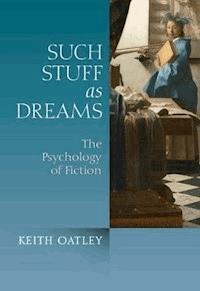
Such Stuff as Dreams: The Psychology of Fiction explores how fiction works in the brains and imagination of both readers and writers.
- Demonstrates how reading fiction can contribute to a greater understanding of, and the ability to change, ourselves
- Informed by the latest psychological research which focuses on, for example, how identification with fictional characters occurs, and how literature can improve social abilities
- Explores traditional aspects of fiction, including character, plot, setting, and theme, as well as a number of classic techniques, such as metaphor, metonymy, defamiliarization, and cues
- Includes extensive end-notes, which ground the work in psychological studies
- Features excerpts from fiction which are discussed throughout the text, including works by William Shakespeare, Jane Austen, Kate Chopin, Anton Chekhov, James Baldwin, and others
Sie lesen das E-Book in den Legimi-Apps auf:
Seitenzahl: 533
Veröffentlichungsjahr: 2011
Ähnliche




















Table of Contents
Cover
Title page
Copyright page
Dedication
Preface
Acknowledgments
1 Fiction as Dream
Fiction as Dream: Models, World-Building, Simulation
2 The Space-In-Between
The Space-in-Between: Childhood Play as the Entrance to Fiction
3 Creativity
Creativity: Imagined Worlds
4 Character, Action, Incident
Character, Action, Incident: Mental Models of People and Their Doings
5 Emotions
Emotions: Scenes in the Imagination
6 Writing Fiction
Writing Fiction: Cues for the Reader
7 Effects of Fiction
Effects of Fiction: Is Fiction Good for You?
8 Talking About Fiction
Talking About Fiction: Interpretation in Conversation
Bibliography
Name Index
Subject Index
This edition first published 2011
© 2011 Keith Oatley
Wiley-Blackwell is an imprint of John Wiley & Sons, formed by the merger of Wiley’s global Scientific, Technical and Medical business with Blackwell Publishing.
Registered Office
John Wiley & Sons Ltd, The Atrium, Southern Gate, Chichester, West Sussex, PO19 8SQ, United Kingdom
Editorial Offices
350 Main Street, Malden, MA 02148-5020, USA
9600 Garsington Road, Oxford, OX4 2DQ, UK
The Atrium, Southern Gate, Chichester, West Sussex, PO19 8SQ, UK
For details of our global editorial offices, for customer services, and for information about how to apply for permission to reuse the cop yright material in this book please see our website at www.wiley.com/wiley-blackwell.
The right of Keith Oatley to be identified as the author of this work has been asserted in accordance with the UK Copyright, Designs and Patents Act 1988.
All rights reserved. No part of this publication may be reproduced, stored in a retrieval system, or transmitted, in any form or by any means, electronic, mechanical, photocopying, recording or otherwise, except as permitted by the UK Copyright, Designs and Patents Act 1988, without the prior permission of the publisher.
Wiley also publishes its books in a variety of electronic formats. Some content that appears in print may not be available in electronic books.
Designations used by companies to distinguish their products are often claimed as trademarks. All brand names and product names used in this book are trade names, service marks, trademarks or registered trademarks of their respective owners. The publisher is not associated with any product or vendor mentioned in this book. This publication is designed to provide accurate and authoritative information in regard to the subject matter covered. It is sold on the understanding that the publisher is not engaged in rendering professional services. If professional advice or other expert assistance is required, the services of a competent professional should be sought.
Library of Congress Cataloging-in-Publication Data
Oatley, Keith.
Such stuff as dreams : the psychology of fiction / Keith Oatley.
p. cm.
Includes bibliographical references and index.
ISBN 978-0-470-97457-5 (pbk.)
1. Fiction–History and criticism–Theory, etc. 2. Fiction–Psychological aspects. 3. Psychology and literature. 4. Literature–Psychology. I. Title.
PN3352.P7O28 2011
808.3–dc22
2011002207
A catalogue record for this book is available from the British Library.
This book is published in the following electronic formats: ePDFs 9781119970927; Wiley Online Library 9781119970910; ePub 9781119973539
For Simon, Susan, Grant, & Hannah
and
Daisy, Amber, Ewan, & Kaya
Preface
This book is about how fiction works in the minds and brains of readers, audience members, and authors, about how – from mere words or images – we create experiences of stories that are enjoyable, sometimes profound.
The book draws on an idea developed by William Shakespeare, Samuel Taylor Coleridge, Robert Louis Stevenson, and others, that fiction is not just a slice of life, not just entertainment, not just escape from the everyday. It often includes these but, at its center, it is a guided dream, a model that we readers and viewers construct in collaboration with the writer, which can enable us to see others and ourselves more clearly. The dream can offer us glimpses beneath the surface of the everyday world.
A piece of fiction is a model of the world, but not of the whole world. It focuses on human intentions and plans. That is why it has a narrative structure of actions and of incidents that occur as a result of those actions. It tells of the vicissitudes of our lives, of the emotions we experience, of our selves and our relationships as we pursue our projects. We humans are intensely social and – because our own motives are often mixed and because others can be difficult to know – our attempts to understand ourselves and others are always incomplete. Fiction is a means by which we can increase our understanding.
In the last 20 years or so, several groups of researchers have worked on finding out how fiction works in the mind, and why people enjoy reading novels and going to the movies. At the same time research on brain imaging has started to show how the brain represents emotions, actions, and thinking about other people, about which one reads in fiction. In the research group in which I work, we have started to show how identification with fictional characters occurs, how literary art can improve social abilities, how it can move us emotionally, and can prompt changes of selfhood. You can read opinion, reviews, and research, etc., by our group in our on-line magazine on the psychology of fiction, OnFiction, at http://www.onfiction.ca/
I am both a psychologist and a novelist. Although, until recently, it has not been much studied in psychology, fiction turns out to be of great psychological interest. The idea behind this book was first published in Best Laid Schemes. In it I put forward the cognitive-psychological hypothesis that fiction is a kind of simulation, one that runs not on computers but on minds: a simulation of selves in their interactions with others in the social world. This is what Shakespeare and others called a dream.
In this book, I cover a field that has been laid out for fiction by writers from Henry James and E.M. Forster onwards, but I approach the field from a psychological direction. Among traditional themes, I deal mainly with four: character, action, incident, and emotion. Among techniques, I deal with metaphor, metonymy, defamiliarization, and cues (which Elaine Scarry calls instructions to the reader). Among traditional contents, I concentrate on dialogue and people’s presentations of themselves to each other.
The book is intended for general readers, psychologists, literary theorists, and students. I have preferred it to be brief rather than a tome, though it does contain pointers to research in a way that indicates the range of the field. In the book, I offer literary evidence in the form of quotations, and psychological evidence in the form of studies designed to move beyond mere opinion. But I have also imagined the book as having some of the qualities of fiction. That is to say I have designed it to have a narrative flow, and with some earlier parts leading to realizations that only come later. Within the narrative, I invite you to fill in some of the gaps between the paragraphs and sections in your own way.
The main text is designed for the general reader. There is also a parallel text in the numbered endnotes, in which I give the provenance of ideas and evidence from psychological studies, as well as more technical pieces of discussion.
In the book I cite a number of literary works, but some I refer to several times, and these are integral to the discussion. For them, I cite the relevant sections in the text, but the works as a whole can also be read alongside this book. For each of the reiterated works I give in an endnote, when it is first introduced, an internet address to a text available in the public domain.
The book’s cover shows a detail from Johannes Vermeer’s “The art of painting.” I chose it because to me Vermeer’s paintings, including this one, are theatrical events, instants suspended in time, dreamlike in that they include meaningful elements chosen to set off associations in the viewer in the same kind of way that objects and events set off mental associations in works of fiction. In this painting the central character is the muse Clio. She wears a laurel wreath and she carries a book and a musical instrument. Her eyelids are shyly lowered. Behind her is a map. On a stout table near her are an open manuscript and a mask. What might such elements suggest? It’s from settings like this that stories can be born.
I shall sometimes address you – dear reader – as “you.” And sometimes I shall talk of “we” (or “us”), meaning you and me.
I hope you enjoy the book.
Acknowledgments
The book arises from thinking a lot, reading a lot, discussing a lot, and from a series of psychological studies undertaken in the last 20 years in collaboration with people who started working with me as graduate students. These people are (in alphabetical order). Alisha Ali, Elise Axelrad, Angela Biason, Valentine Cadieux, Maja Djikic, Allan Eng, Mitra Gholamain, Alison Kerr, Laurette Larocque, Gerald Lazare, Raymond Mar, Maria Medved, Seema Nundy, Janet Sinclair, Patricia Steckley, and Rebecca Wells-Jopling. They have gone on to other things, including being professors, school psychologists, and psychotherapists. With two of them, Maja Djkic and Raymond Mar, who have stayed in Toronto, I continue to work closely. I thank also the members of a reading group that has met in Toronto, usually in the house of my partner (Jenny Jenkins) and me, for nearly 20 years (in alphabetical order this group is: Pat Baranek, Alina Gildiner, Sholom Glouberman, Susan Glouberman, Debbie Kirshner, Jenny Jenkins, Morris Moscovich, Berl Schiff [and me]). I also thank those in the community of researchers on the psychology of fiction and related matters with whom I have had enlightening discussions. Some I have known fondly for many years, others I have met for a few days at conferences, still others I have corresponded with by e-mail, but all have contributed to my thinking on the topics about which I write in this book: Lynne Angus, Jan Auracher, Bill Benzon, Nicholas Bielby, Brian Boyd, Jens Brockmeier, Jerry Bruner, Michael Burke, Nöel Carroll, Andy Clark, the late Max Clowes, Gerry Cupchik, Greg Currie, Ellen Dissanayake, Stevie Draper, Robin Dunbar, Judy Dunn, Charles Fernyhough, Jackie Ford, Fabia Franco, Don Freeman, Margaret Freeman, Nico Frijda, Simon Garrod, Melanie Green, Les Greenberg, Frank Hakemulder, Paul Harris, Jeannette Haviland-Jones, Geoff Hinton, Patrick Hogan, Norm Holland, Frank Kermode, David Konstan, Don Kuiken, Ian Lancashire, David Lodge, Carol Magai, Tony Marcel, Stephen Metcalf, David Miall, Jonathan Miller, Martha Nussbaum, the late Tony Nuttall, David Olson, Jaak Panksepp, Joan Peskin, Jordan Peterson, Paul Rozin, Tom Scheff, Jacob Schiff, Murray Smith, Ronnie de Sousa, Keith Stanovich, Gerard Steen, Brian Stock, Ed Tan, Michael Tomasello, Michael Toolan, the late Tom Trabasso, Reuven Tsur, Peter Vorderer, Willie van Peer, Sonia Zyngier, Lisa Zunshine, Rolf Zwann.
Valentine Cadieux, Frank Hakemulder, Jeannette Haviland-Jones, Patrick Hogan, David Miall, Dan Perlitz, Joan Peskin, Martin Peskin, Willie van Peer, and Ed Tan, all read two draft chapters; Brian Boyd, Maja Djikic, Jenny Jenkins, and Raymond Mar, read drafts of the whole book. Each of them has offered comments that let me know where I was going in worthwhile directions, and that identified places in which I needed to think some more. I very much appreciate their kindness and thoughtfulness; their suggestions have been extraordinarily helpful.
I warmly thank the excellent editorial staff at Wiley-Blackwell, Andy Peart, Annie Rose, Karen Shield, and Suchitra Srinivasan, as well as the assiduous picture researcher, Kitty Bocking. In addition, I would like to thank the ever helpful project manager Aileen Castell and Kathy Syplywczak for her skillful copy-editing. My profound gratitude goes to my spouse and principal editor, Jenny Jenkins, who – as always – has been kind, encouraging, and insightful.
1
Fiction as Dream
Figure 1.1 Frontispiece of the 1600 edition of A midsummer night’s dream.
Source: The Huntington Library, San Marino, California.
Fiction as Dream: Models, World-Building, Simulation
Shakespeare and Dream
“Dream” was an important word for William Shakespeare. In his earliest plays he used it with its most common meaning, of a sequence of actions, visual scenes, and emotions that we imagine during sleep and that we sometimes remember when we awake, as well as with its second most common meaning of a waking fantasy (day-dream) of a wishful kind. Two or three years into his playwriting career, he started to use it in a subtly new way, to mean an alternative view of the world, with some aspects like those of the ordinary world, but with others unlike.1 In the dream view, things look different from usual.
In or about December 1594, something changed for Shakespeare.2 What changed was his conception of fiction. He started to believe, I think, that fiction should contain both visible human action and a view of what goes on beneath the surface. His plays moved beyond dramatizations of history as in the three Henry VI plays, beyond entertainments such as The taming of the shrew.3 They came to include aspects of dreams. Just as two eyes, one beside the other, help us to see in three dimensions so, with our ordinary view of the world and an extra view (a dream view), Shakespeare allows us to see our world with another dimension. The plays that he first wrote when he had achieved his idea were A midsummer night’s dream and Romeo and Juliet.
In A midsummer night’s dream it is as if Shakespeare says: imagine a world a bit different from our own, a model world, in which, while we are asleep, some mischievous being might drip into our eyes the juice of “a little western flower” so that, when we awake, we fall in love with the person we first see. This is what happens to Titania, Queen of the Fairies. Puck drips the juice into her eyes. When she wakes, she sees Bottom the weaver, who – in the dream world – has been turned into an ass, and has been singing.
Titania: I pray thee, gentle mortal, sing again:
Mine ear is much enamour’d of thy note;
So is mine eye enthralled to thy shape;
And thy fair virtue’s force perforce doth move me
On the first view to say, to swear, I love thee (1, 3, 959)
Could it be that, rather than considering what kind of person we could commit ourselves to, we first love and then discover in ourselves the words and thoughts and actions that derive from our love?4
A midsummer night’s dream helped Shakespeare, I think, to articulate his idea of theater as model-of-the-world. Although perhaps not as obviously, Romeo and Juliet, which was written at about the same time, comes from the same idea. It starts with a Prologue, which begins like this.
Two households, both alike in dignity,
In fair Verona, where we lay our scene,
From ancient grudge break to new mutiny,
Where civil blood makes civil hands unclean.
From forth the fatal loins of these two foes
A pair of star-cross’d lovers take their life;
Whose misadventured piteous overthrows
Do with their death bury their parents’ strife (Prologue, 1).
A model is an artificial thing.5 So Shakespeare doesn’t start Romeo and Juliet with anything you might see in ordinary life. He starts it with someone who is clearly an actor coming on to the stage and addressing the audience in a sonnet. The sonnet form has 14 lines, each having ten syllables with the emphasis on the second syllable of each pair. So this sonnet reads: “Two house-holds both a-like …” This makes for a certain attention-attracting difference, because if you pronounce the verse in this iambic way, and make sure also to emphasize slightly the rhymes at the end of each line, it sounds different from colloquial English. The iambic meter seems almost to echo the human heart-beat: te-tum, te-tum, te-tum.
Lesen Sie weiter in der vollständigen Ausgabe!
Lesen Sie weiter in der vollständigen Ausgabe!
Lesen Sie weiter in der vollständigen Ausgabe!
Lesen Sie weiter in der vollständigen Ausgabe!
Lesen Sie weiter in der vollständigen Ausgabe!
Lesen Sie weiter in der vollständigen Ausgabe!
Lesen Sie weiter in der vollständigen Ausgabe!
Lesen Sie weiter in der vollständigen Ausgabe!
Lesen Sie weiter in der vollständigen Ausgabe!
Lesen Sie weiter in der vollständigen Ausgabe!




