



4,99 €
Mehr erfahren.
- Herausgeber: David De Angelis
- Kategorie: Ratgeber
- Sprache: Englisch
Of the norms presented here, which summarize an experience of more than thirty years, several are not part of any of the usual methods of suggestion, and among the rest some are modifications of norms followed in some of those. That a much better method of suggestion is possible than the usual ones should not be surprising. The means to give to the suggested idea or image the maximum intensity, and therefore the maximum effectiveness, have much more relation to psychology than to the ordinary medical knowledge: moreover very few physicians apply real cures by suggestion and these ones do it too rarely or do not study to go perfecting their procedures enough to be able to discover certain norms that only a long, varied and meditated practice of suggestion can teach. The advantages of the present method over the usual ones consist: in a constant harmlessness of the procedures in placing the sick person in that state of mind which is almost always indispensable; in a very great increase in the number and variety of cases in which results are obtained which no other cure can give; and in a much more frequent stability of the results obtained. If the book has a rather large number of pages, the norms, however, occupy only a small part of it, the largest part being occupied by explanations; moreover, many norms are only rarely applied, and some (as will result from what will be said about their office) are not indispensable except in cases that are difficult to treat, while in others an eventual neglect of some of them does not cause greater damage than a delay in obtaining the result. The health conditions in which I found myself during the preparation of the first edition induced me to finish it hastily, fearing that otherwise I would not have had the possibility. The additions and many modifications that I have introduced in this second edition will certainly make the book much more worthy of the favor that the first one received.
Das E-Book können Sie in Legimi-Apps oder einer beliebigen App lesen, die das folgende Format unterstützen:
Veröffentlichungsjahr: 2022
Ähnliche


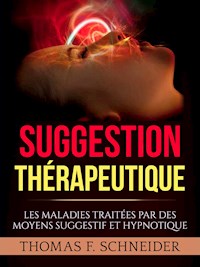

















SUGGESTION
THERAPEUTIC
DISEASES TREATED BY MEANS
SUGGESTIVE AND HYPNOTIC
THOMAS F. SCHNEIDER
Translation and Edition 2022 by © David De Angelis
All rights are reserved
WARNING
Of the norms presented here, which summarize an experience of more than thirty years, several are not part of any of the usual methods of suggestion, and among the rest some are modifications of norms followed in some of those. That a much better method of suggestion is possible than the usual ones should not be surprising. The means to give to the suggested idea or image the maximum intensity, and therefore the maximum efficacy, have much more relation to psychology than to ordinary medical knowledge: moreover very few physicians apply real cures by suggestion and these ones do it too rarely or do not study to go perfecting their procedures enough to be able to discover certain norms that only a long, varied and meditated practice of suggestion can teach. The advantages of the present method over the usual ones consist: in a constant harmlessness of the procedures in placing the sick person in that state of mind which is almost always indispensable; in a very great increase in the number and variety of cases in which results are obtained which no other cure can give; and in a much more frequent stability of the results obtained. If the book has a rather remarkable number of pages, the norms, however, occupy only a small part of it, the largest part being occupied by explanations; moreover, many norms are only rarely applied, and some (as will result from what will be said about their office) are not indispensable except in cases that are difficult to treat, while in others an eventual neglect of some of them does not cause greater damage than a delay in obtaining the result. The conditions of health in which I found myself during the preparation of the first edition induced me to carry it out hastily, fearing that otherwise I would not have had the possibility. The additions and many modifications that I have introduced in this second edition will certainly make the book much more worthy of the favor that the first one received.
SUMMARY
WARNING
CHAPTER I. Influence of a great narrowness of the field of consciousness on the attention paid by the patient to suggestion, and its importance.
CHAPTER II. Harmless methods and harmful methods to achieve a state of great narrowness of the field of consciousness, and to make it cease.
CHAPTER III. Other observations on the highly restricted state of the field of consciousness and the various methods of achieving it described.
CHAPTER IV. General rules for the application of any therapeutic suggestion.
CHAPTER V. Suggestions acting against physical states by direct action. Special rules for their application.
CHAPTER VI. Subconscious psychic facts.
CHAPTER VII. Suggestions acting against psychic facts by direct action. Special rules for their application.
CHAPTER VIII. Supplemental Standards.
CHAPTER IX. Applications.
CHAPTER I.Influence of a great narrowness of the field of consciousness on the attention paid by the patient to suggestion, and its importance.
1. Condition for the efficacy of an idea or image capable of exerting a curative action.
In order that an idea or an image capable of exerting a curative action may succeed in exerting it to some extent, or that it may succeed in exerting it to the greatest possible extent, it is necessary that, while suggesting it, it occupies the field of the patient's consciousness as much as possible on its own and without interruption. About the reasons for this - of which an approximate intuition is very easy to have - we will say when we mention the two main categories into which suggestions can be divided; because among those reasons there is some difference according to whether it is one or the other of those categories. Of course, the damage caused by the occurrence, during suggestion, of psychic facts different from the curative idea or image is all the greater the greater the frequency, duration, intensity, the possible depressing emotional power, and the possible opposition to the curative idea or image. Depressing emotional power and opposition to the curative idea or image are almost always found, because almost always those psychic facts consist of worries about illness or at least the memory of being ill and sometimes of painful feelings. The degree of intensity and the degree of the possible depressing emotional power are important because they make greater or lesser the degree of nervous energy that those psychic facts employ and therefore prevent it from being used in favor of suggestion. If the damage caused by the occurrence in the patient, during suggestion, of psychic facts other than the curative idea or image does not exceed a certain limit - which can vary greatly, according to the nature and severity of the illness and according to the individuality of the patient - it can be completely remedied by prolonging the suggestion; but if it exceeds this limit, then - depending on the extent to which this occurs - the suggestion, even despite the maximum prolongation practically possible, loses more or less its effectiveness or remains completely ineffective.
2. - The mental state of the sick person in relation to the above condition.
In order that the curative idea or image may occupy, during all that time in which it is suggested, the field of the patient's consciousness as much as possible by itself and without interruption, a necessary element (the only one with which we have to deal in this chapter) is evidently the existence in the patient of such a mental state, which presents to the production of psychic facts other than the curative idea or image the least possible tendency, that is, which presents as little as possible of its own activity.
3. - The way of speaking in suggestion, in relation to the above condition.
Another necessary element for the realization of the above-mentioned condition is obviously the use by the suggestifier of such a way of speaking (for continuity, pronunciation, voice, number and form of the sentences), which is the most suitable to keep the patient's attention fixed on the suggestion. The indications on this way of speaking are part of the general rules for the application of suggestion and therefore we will deal with them in their place (Chap. IV).
4. - The state of wakefulness in relation to the above condition.
When suggestion is applied while the patient is in a waking state, the damage resulting from the presence in him of psychic facts other than the curative idea or image always reaches a considerable degree, except for those rare hysterics who in the waking state present such a narrow field of consciousness that they are easily hallucinable by means of speech, and in whom consequently it is usually easy to obtain that the curative idea or image occupies the field of consciousness, completely or almost completely, alone and without interruption. Even if one succeeds in dominating the attention of the awake patient enough to prevent the production of psychic facts which have no relation to the suggestion, it is very difficult to dominate it in such a way as to prevent the patient from making, voluntarily or involuntarily, appreciations of the suggestion, consisting at least in perceiving the opposite between what is said to him and what he knows or thinks or feels about his state; appreciations which distract attention from the suggestion. Moreover, what he knows or thinks or feels about his state has almost always the disadvantage of constituting a depressing emotion, and always that, much worse, of being in contradiction with the curative idea or image; disadvantages that when they occur during the application of the suggestion are particularly harmful. But, even if one succeeds in preventing all this, one cannot prevent - except in those rare hysterics with a very narrow field of consciousness mentioned above - that at least that certain degree of spontaneous psychic activity persists, which is the minimum sufficient to exercise on the mental images an office of examination, criticism, and control (so that they are recognized as simple images instead of having that hallucinatory character that they have when they occupy the field of consciousness alone, as every treatise on psychology teaches). The application of therapeutic suggestion in wakefulness can have other serious drawbacks, as we will say in its place.
5. - States of great narrowness of the field of consciousness in relation to the above condition.
Since, therefore, the waking state - except in rare hysterics - does not lend itself well to the application of therapeutic suggestion, it is convenient to see if some other state lends itself better. Since such a state should offer the maximum possibility that the curative idea or image can occupy the whole field of consciousness by itself, it should be sought (as will become even more evident in the following) among those in which the field of consciousness is very narrow.
6. - Normal spontaneous sleep.
Among the states of great narrowness of the field of consciousness there is one known to all from personal experience, and that is normal spontaneous sleep. It presents the fact common to such states, that the mental images, instead of being recognized for what they are, have a hallucinatory character, because of the lack of that remaining psychic activity, which in the state of more or less normal wakefulness exercises on them an office of examination, criticism, control, and thus allows the consciousness a correct judgment. It is not uncommon for people in normal spontaneous sleep to be able to make themselves heard and understood by speaking without their waking up. In the same way that persons in such a state may experience, without waking up, those sensations which they usually misinterpret in transforming them into dream images (as: the sensation of the noise produced by the passage of a chariot, which they transform, for example, into a thunderstorm, or a sensation of coldness in the feet, which they transform, for example, into a walk in the snow) so it is also possible for them to hear without waking up words that are uttered in their presence; and since these (if the voice is sufficiently loud and the pronunciation sufficiently clear) constitute a set of sounds that has in a special degree a well-determined and precise meaning, they do not transform this set of sounds into erroneous images but interpret it precisely, that is, by means of those ideas or images that precisely correspond to it. This possibility of being heard and understood by people in normal spontaneous sleep can be ascertained, for example, with the following experiment. An imaginary fact is narrated in their presence; then they are awakened and asked what they dreamed. Some of them narrate that fact as their dream. It is advisable to repeat the narration several times without interruption, in the first one in a very low voice, and in each of the following ones in a slightly higher voice than in the preceding one, so that when the voice begins to be heard it has no more, or only a little more, than the necessary degree of intensity; for this greatly diminishes the probability for the first person to hear the voice and to provoke awakening. Moreover, it is advisable to wake up the subjects as soon as the narration has been repeated for the last time, and to question them immediately; because this greatly diminishes the probability that the images suggested will be erased too soon by spontaneous dreams or by those perceptions which follow the awakening. Even in some of those cases in which the subject does not remember having had the dream, it can be ascertained that the dream took place, by having recourse to one of the first four methods in-dicated in § 66 as suitable for making known psychic facts which have taken place in mental states followed by amnesia. When one succeeds, by speaking, in attracting the attention of a person in a state of normal spontaneous sleep without his waking up, it is very easy, because of the great narrowness of the field of consciousness, to keep his attention entirely and continuously on what is said; but it is evident that such a state is too difficult to use for therapeutic suggestion, because of the possibility that the patient does not hear the voice or at the first hearing of it wakes up, and because of the necessity of waiting for the time of its natural occurrence.
7. - Ability to induce a state of great narrowing of the field of consciousness, usable for therapeutic suggestion.
The above-mentioned obstacles which make normal spontaneous sleep too difficult to use for suggestion do not occur when a state of great narrowness of the field of consciousness is used to provoke it. Even if to provoke it one resorts to a method in which one does not make use of speech (as is the case in the first of the two methods mentioned in § 20) - so that one begins to speak only when one has to apply therapeutic suggestion, that is, after the state has already been provoked - the voice does not awaken the patient, because the patient's attention, if not to the voice, is however intensely directed to the person and to the work of the suggester in the moments immediately preceding that in which the state begins to occur. The methods still used today to bring about a state of great narrowness of the field of consciousness very easily cause drawbacks (§ 20). But these methods can be replaced by one that is always completely harmless, as can be seen from its description (§§ 8-12).
Summary.
The curative idea or image must, while being suggested, occupy the field of the patient's consciousness as much as possible on its own and without interruption (§ 1). To this end it must be suggested while the patient is in a state of great narrowness of the field of consciousness (§ 5). For the obstacles that make normal spontaneous sleep too difficult to use (§ 6), the suggestifier must himself induce by a harmless method a state having that character.
CHAPTER II.Harmless methods and harmful methods to achieve a state of great narrowness of the field of consciousness, and to make it cease.
8. - Material conditions in which the sick person must be placed.
The patient is placed in those material conditions which are the most suitable for promoting normal spontaneous sleep. To this end, and also to prevent that during sleep the position taken may cause him some fatigue, he is made to take a comfortable position as much as possible; therefore, if he is not in bed and if a bed or a suitable couch is available, it is good to make use of this and have him lie down telling him to take the position he prefers. Make him unfasten or remove anything that could tighten him in his sleep, making sure that he cannot feel cold in his sleep. He is made to close his eyes and also to make, if possible, that in the room there is only the amount of light that is needed so that, when the eye is a bit 'accustomed to it, you can notice any signs of restlessness of the patient and see what the clock marks. Being able to notice any signs of restlessness is necessary because they are almost always an indication that the patient's attention has been diverted from the suggestion because of internal or external sensations or spontaneous ideas or images, and therefore oblige one to speak, at least momentarily, louder than is sufficient when the patient is completely calm (§ 10), so that his attention will soon turn back to the suggestion: moreover, it is important because if signs of restlessness take place repeatedly during the therapeutic suggestion, it is prudent to give it a longer than normal duration to try to prevent it from remaining of too little or no effect (§ 1). Being able to distinguish what the clock is indicating is, of course, important so that the suggestion is not kept too short because the time already devoted to it is considered longer than it really is.
9. - Addressing the patient's attention.
Recommendation to be made to the patient. - In the first session (and, if it seems opportune, in other sessions as well), after having placed the patient in the material conditions indicated above, it is good to tell him that he must listen continually to what is said, even if it is always the same thing, adding that this will produce, more or less soon, a need to sleep, and that he must not resist this need because it is precisely sleep that is desired.
Idea to suggest. - Then one tries to keep the patient's attention focused on a single idea, which is extremely clear and simple so that it does not require the slightest effort of interpretation. This - in conjunction with the material conditions in which the patient was placed - tends to suppress in him, little by little and more and more stably, that variety of psychic facts which is proper to the waking state and to substitute for it that single idea, that is, it tends to produce in him, little by little and more and more stably, a state of great narrowness of the field of consciousness. The idea to be adopted is that of the state itself which is to be obtained, but presented under that name and appearance which conform to the habits of thought and language of the patient, namely as sleep.
Number of sentences. - It is almost always better to suggest this idea by means of very few, extremely simple alternating sentences. This is preferable to suggesting it by means of a single sentence, because the patient's attention, due to excessive monotony, would be less easily focused on it. If, however, the patient is restless or almost restless (which means that he does not pay attention to the suggestion, or only pays attention to it for a moment), it is preferable to suggest it by means of a single (shortest) sentence, because this - due to the continuous deviations of attention - does not appear to the patient as having an excessive monotony, but rather makes him/her feel the suggestion more easily, i.e., in this case, the constancy of form in the suggestion tends to make up for the great inconstancy of attention in the patient. When the patient shows himself to be more tranquil, one passes to the normal mode of suggestion.
Form of sentences. - The sentences must be given the form of an affirmation and not that of a command, because the form of a command makes the patient believe that the possibility of the production of sleep requires a certain effort on his part, which is harmful for the following reasons. If he does not try to make the effort he believes necessary, because he does not have the will, the idea that he does not make it acts as a counter suggestion to the suggestion of sleep. If he does not try to make it because he does not have the strength or because he does not understand how it should be, but he has the will to make it, this impossibility of making it, besides acting as a counter suggestion to the suggestion of sleep, becomes a cause of agitation. If, on the other hand, he, believing that he understands how the effort should be and having the will, tries to make it, this (perhaps more than anything else because of its unusual character) becomes, more or less, a cause of fatigue; moreover often, especially if sleep is delayed, he puts it into his mind that he is not fit for the effort, which acts as a counter suggestion to the suggestion of sleep and, moreover, becomes a cause of agitation; Moreover, sometimes, if sleep is delayed, he may think that the suggester may attribute to his lack or insufficiency of good will the lack of sleep, which may also become a cause of agitation. Moreover, the fact that the patient tries to exert an effort makes the production of sleep much less easy than when he listens to the suggestion with passive attention as he does if sleep is affirmed and not commanded.
Conclusion on the formulation of sleep suggestion. - In accordance with the preceding rules, the suggestion of sleep (unless the patient presents an incessant restlessness or almost, so that it is preferable to use a single sentence) will be formulated as follows: "She falls asleep. She is sleepy; she sleeps. She falls asleep; she is sleepy. She sleeps. She is sleepy; she falls asleep" and so on.
10. - Pronouncement and voice.
Pronunciation. One must speak with a clear and slightly slow pronunciation (as one does when it is very important that what one says be heard exactly) so that the patient can safely hear exactly at each moment of the sleep process. The sentences should be followed like the various periods of a speech, which leaves between them intervals that are sufficient to allow the patient to hear and understand perfectly at each moment and yet do not favor the possible tendency of his attention to be diverted from the suggestion.




