


36,99 €
Mehr erfahren.
- Herausgeber: John Wiley & Sons
- Kategorie: Fachliteratur
- Sprache: Englisch
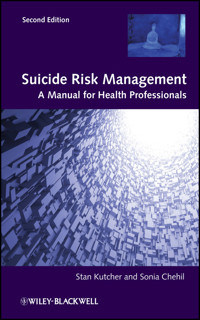
Suicide Risk Management: A Manual for Health Professionals is a short, clearly written book that provides practical guidance on how to manage the suicidal or potentially suicidal patient. Written by two expert teachers, the book has been used in courses for trainee psychiatrists and for health professionals throughout the world. Feedback from participants on these courses has informed revision of the new edition. This book is of interest for all mental health professionals who come into contact with patients who present with suicide potential, i.e. all mental health professionals, as well as general health professionals who are often the first point of contact for a suicidal patient.
The book opens with a review of the epidemiology, risk factors and associated aspects of suicide. It then presents two assessment tools: The Tool for Assessment of Suicide Risk (TASR) provides instruction on how to use it appropriately in the clinic. The Suicide Risk Assessment Guide (SRAG) acts as a self-study program to asess clinical evaluation skills. Both tools were created for use in the authors’ own practice and are now successfully taught to and used by health professionals around the world. Refined through actual experience, these proven tools help assess and evaluate patients with confidence.
Case vignettes allow the reader to practice using the information they have learned from the book.
Throughout the book, bulleted lists, tables and flowcharts effectively describe how to use the many factors to assess the risk of suicide in an individual patient.
Das E-Book können Sie in Legimi-Apps oder einer beliebigen App lesen, die das folgende Format unterstützen:
Seitenzahl: 202
Veröffentlichungsjahr: 2012
Ähnliche



















Contents
Cover
Title Page
Copyright
Introduction
Objectives
Chapter 1: The Importance of Suicide Awareness and Assessment
Why is it Important to Know About Suicide?
Challenges to understanding global suicide rates and suicide risk
Role of health professionals in suicide risk mgnt
What are Some of the Barriers to Detection and Prevention of Suicide?
Can We Always Predict Who Will or Who Will not Die By Suicide?
Chapter 2: Understanding Suicide Risk
Suicide: Protective Factors and Risk Factors
Age
Gender
Current Suicidality
Past Suicidality and Suicide Behaviours
Psychiatric History
Psychiatric Symptoms
Medical History
Family History
Personal History
Personality
By Knowing These Risk Factors, will I be able to prevent all patients from committing suicide?
What Can be Done?
Chapter 3: Suicide Risk Assessment
Introduction
Learning How to Assess Suicide Risk
Step I Being prepared
Step II Identifying ‘warning signs’ of suicide risk
Step III Evaluating current suicidality
Step IV Evaluating past suicide behaviours
Step V Evaluating suicide risk and protective factors
Step VI Identifying what's going on
Step VII Identifying targets for intervention
Chapter 4: Putting It All Together: Tool for Assessment of Suicide Risk (TASR)
Guide to the Tool for Assessment of Suicide Risk, modified version (TASRm)
Chapter 5: Special Topics in Understanding and Evaluating Suicide Risk
The Chronically Suicidal and the Frequent, Low-Lethality Self-Harming Patient
The Adolescent Patient
The Elderly Patient
Chapter 6: Suicide Prevention
Suicide-Prevention Strategies
Population Issues in Suicide Prevention
Individual Issues in Suicide Prevention
Chapter 7: Suicide Intervention
Step 1: Address the immediate safety of the patient
Step 2: Determine required level of care
Step 3: Acute safety planning in hospital or at home
Step 4: Identify areas for intervention
Step 5: Provide ongoing monitoring and evaluation
Chapter 8: Post-suicide Intervention: Caring for Survivors
What Can Be Done?
Chapter 9: Care for the Carer: Death of a Patient by Suicide
Health Care Teams, Colleagues and Health Institutions: What Can You do?
Chapter 10: Clinical Vignettes for Group or Individual Study
Cases: Suicide Assessment
Case One
Case Two
Case Three
Case Four
Case Five
Case Six
Case Seven
Case Eight
Appendix A: Tool for Assessment of Suicide Risk (TASR)
Appendix B: 6-ITEM Kutcher Adolescent Depression Scale: KADS
Appendix C: My Safety Plan
Index
This edition first published 2012 © 2012 by John Wiley & Sons, Ltd.
Wiley-Blackwell is an imprint of John Wiley & Sons, formed by the merger of Wiley's global Scientific, Technical and Medical business with Blackwell Publishing.
Registered office: JohnWiley & Sons, Ltd, The Atrium, Southern Gate, Chichester, West Sussex, PO19 8SQ, UK
Editorial offices: 9600 Garsington Road, Oxford, OX4 2DQ, UK
The Atrium, Southern Gate, Chichester, West Sussex, PO19 8SQ, UK
111 River Street, Hoboken, NJ 07030-5774, USA
For details of our global editorial offices, for customer services and for information about how to apply for permission to reuse the copyright material in this book please see our website at www.wiley.com/wiley-blackwell.
The right of the author to be identified as the author of this work has been asserted in accordance with the UK Copyright, Designs and Patents Act 1988.
All rights reserved. No part of this publication may be reproduced, stored in a retrieval system, or transmitted, in any form or by any means, electronic, mechanical, photocopying, recording or otherwise, except as permitted by the UK Copyright, Designs and Patents Act 1988, without the prior permission of the publisher.
Designations used by companies to distinguish their products are often claimed as trademarks. All brand names and product names used in this book are trade names, service marks, trademarks or registered trademarks of their respective owners. The publisher is not associated with any product or vendor mentioned in this book. This publication is designed to provide accurate and authoritative information in regard to the subject matter covered. It is sold on the understanding that the publisher is not engaged in rendering professional services. If professional advice or other expert assistance is required, the services of a competent professional should be sought.
Library of Congress Cataloging-in-Publication Data
Kutcher, Stanley P.
Suicide risk management: a manual for health professionals / Stan Kutcher, Sonia Chehil. – 2nd ed.
p.; cm.
Includes index.
ISBN 978-0-470-97856-6 (pbk.)
I. Chehil, Sonia. II. Title.
[DNLM: 1. Suicide–prevention & control. 2. Suicide–psychology. 3. Risk Assessment–methods. WM 165]
LC classification not assigned
616.85 08445–dc23
2011030220
A catalogue record for this book is available from the British Library.
This book is published in the following electronic formats: ePDF 9781119953111; Wiley Online Library: 9781119953128; ePub 978119954316; Mobi 9781119954323
Introduction
Understanding suicide is unachievable. The underpinnings of suicide are diverse and multifaceted, involving a unique fusion of biological, psychosocial and cultural factors for each individual. Suicide is not an event that occurs in a vacuum. It is the ultimate consequence of a process.
For many people who take the decision to end their own life we will never be able to answer the question ‘Why?' For some, self-inflicted death may be:
an escape from despair and sufferinga relief from intractable emotional, psychological or physical paina response to a stigmatizing illnessan escape from feelings of hopelessnessa consequence of acute intoxicationa response to commanding homicidal or self-harm auditory hallucinationsa manifestation of bizarre or grandiose delusionsa declaration of religious devotiona testimony of nationalist or political allegiancea means of atonementa means of reunification with a deceased loved onea means of rebirtha method of revengea way to protect family honourThis does not mean that health professionals should not know how to recognize, assess and manage the suicidal patient. Indeed, all health professionals should be proficient in this core competency as many of their patients may face the prospect of suicide at some time in their lives. Many patients who experience suicidal thoughts or make suicide plans will change their minds about committing suicide. Many people who attempt suicide and are not successful go on to live productive lives. For some, a suicide attempt is an event that leads to a first contact with a helping professional. Some of these individuals may be suffering from a mental disorder that will respond to appropriate and effective treatment. Some may be suffering from chronic physical disorders; others may be overwhelmed by life stressors. In any case, many of these individuals may consider suicide as a viable solution to their problems or the only means to ending their suffering. By being aware of suicide risk factors and knowing how to identify and provide appropriate targeted interventions for suicidal individuals, health professionals can assist in the patient choosing life rather than death.
Cultural, religious, geographical and socioeconomic factors all impact on the expression of suicidality and the completion of suicide. Thus, health professionals from various countries or regions may need to adapt some of the material in this book to reflect local perspectives. However, we all need to remember, whenever a clinician and a suicidal person interact, that careful, considerate application of suicide risk management will need to be applied – regardless of context. Contexts differ but people are similar.
Objectives
1. To provide information regarding the epidemiology, risk factors and associated aspects of suicide.
2. To provide information that will assist in the understanding and assessment of suicide risk.
3. To provide a continuous self-study programme pertaining to clinical evaluation of suicide, using the Suicide Risk Assessment Guide (SRAG).
4. To introduce the Tool for Assessment of Suicide Risk (TASR) and provide instruction on its appropriate clinical application.
Chapter 1
The Importance of Suicide Awareness and Assessment
Why is it Important to Know About Suicide?
Suicide is a significant public health problem worldwide. Suicide represents 1.4% of the Global Burden of Disease and accounts for nearly half of all violent deaths and almost one million fatalities globally each year. Although these numbers may seem alarming, it is widely believed that they are underestimates of the true global prevalence and global burden of suicide.
For every life lost to suicide there are many more left in the wake of the tragedy – parents, children, siblings, friends and communities.
‘For every suicide death there are scores of family and friends whose lives are devastated emotionally, socially and economically . . . Suicide is a tragic global public health problem. Worldwide, more people die from suicide than from all homicides and wars combined. There is an urgent need for coordinated and intensified global action to prevent this needless toll.’
Dr Catherine Le Galès-Camus, WHO Assistant-Director General, World Mental Health Day 2006
Lesen Sie weiter in der vollständigen Ausgabe!
Lesen Sie weiter in der vollständigen Ausgabe!
Lesen Sie weiter in der vollständigen Ausgabe!
Lesen Sie weiter in der vollständigen Ausgabe!
Lesen Sie weiter in der vollständigen Ausgabe!
Lesen Sie weiter in der vollständigen Ausgabe!
Lesen Sie weiter in der vollständigen Ausgabe!
Lesen Sie weiter in der vollständigen Ausgabe!
Lesen Sie weiter in der vollständigen Ausgabe!
Lesen Sie weiter in der vollständigen Ausgabe!
Lesen Sie weiter in der vollständigen Ausgabe!
Lesen Sie weiter in der vollständigen Ausgabe!
Lesen Sie weiter in der vollständigen Ausgabe!




