


18,99 €
Mehr erfahren.
- Herausgeber: John Wiley & Sons
- Kategorie: Geisteswissenschaft
- Sprache: Englisch
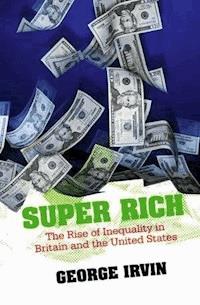
In the past 25 years, the distribution of income and wealth in Britain and the US has grown enormously unequal, far more so than in other advanced countries. The book, which is aimed at both an academic and a general audience, examines how this happened, starting with the economic shocks of the 1970s and the neo-liberal policies first applied under Thatcher and Reagan. In essence, growing inequality and economic instability is seen as driven by a US-style model of free-market capitalism that is increasingly deregulated and dominated by the financial sector.
Using a wealth of examples and empirical data, the book explores the social costs entailed by relative deprivation and widespread income insecurity, costs which affect not just the poor but now reach well into the middle classes. Uniquely, the author shows how inequality, changing consumption patterns and global financial turbulence are interlinked.
The view that growing inequality is an inevitable consequence of globalisation and that public finances must be squeezed is firmly rejected. Instead, it is argued that advanced economies need more progressive taxation to dampen fluctuations and to fund higher levels of social provision, taking the Nordic countries as exemplary. The broad political goal should be to return within a generation to the lower degree of income inequality which prevailed in Britain and the US during the years of post-war prosperity.
Sie lesen das E-Book in den Legimi-Apps auf:
Seitenzahl: 531
Veröffentlichungsjahr: 2013
Ähnliche




















Super Rich
Super Rich
The Rise of Inequality in Britain and the United States
GEORGE IRVIN
polity
Copyright © George Irvin 2008
The right of George Irvin to be identified as Author of this Work has been asserted in accordance with the UK Copyright, Designs and Patents Act 1988.
First published in 2008 by Polity Press
Polity Press 65
Bridge Street
Cambridge CB2 1UR, UK
Polity Press 350
Main Street
Malden, MA 02148, USA
All rights reserved. Except for the quotation of short passages for the purpose of criticism and review, no part of this publication may be reproduced, stored in a retrieval system, or transmitted, in any form or by any means, electronic, mechanical, photocopying, recording or otherwise, without the prior permission of the publisher.
ISBN-13: 978-0-7456-5887-2
A catalogue record for this book is available from the British Library.
Typeset in 11.25/13 pt
Dante by Servis Filmsetting Ltd, Stockport, Cheshire
Printed and bound in Great Britain by
MPG Books Ltd, Bodmin, Cornwall
The publisher has used its best endeavours to ensure that the URLs for external websites referred to in this book are correct and active at the time of going to press. However, the publisher has no responsibility for the websites and can make no guarantee that a site will remain live or that the content is or will remain appropriate.
Every effort has been made to trace all copyright holders, but if any have been inadvertently overlooked the publisher will be pleased to include any necessary credits in any subsequent reprint or edition.
For further information on Polity, visit our website: www.polity.co.uk
Contents
List of Figures
Introduction
1
Neo-liberalism and the Return of Inequality
2
Do We Need Fat Cats?
3
The Rise of Neo-liberalism
4
America, Europe and the Welfare State
5
Happiness and Pareto
6
What About the Middle Class?
7
The Rising Cost of Inequality
8
Is the Consumption Binge Sustainable?
9
In Defence of Equality
Notes and References
Bibliography
Index
List of Figures
1.1:
The share of income going to the top 1 per cent, including capital gains, 1913–2004
1.2:
2005 Distribution of income in the USA
1.3:
Selected US surveys of top CEO annual remuneration, 2005
1.4:
1980 and 2004 top income tax rates for selected countries
1.5:
Forward to 1913
1.6:
Percentiles, deciles, etc.
1.7:
The Gini coefficient
1.8:
Income mobility, late-1980s–mid-1990s (per cent of low-income families leaving low-income status each year)
2.1:
UK distribution of land, 2001
2.2:
Selected private equity deals in the USA
2.3:
How to ‘hedge’ using a ‘future’ contract
3.1:
The growth slowdown, 1960–1990
3.2:
Inflation in selected industrial countries, 1968–1990
3.3:
Unemployment rates in selected industrial countries, 1968–1990
3.4:
Change in GDP share of manufacturing profits
3.5:
Changes in government expenditure and top tax rates
4.1:
Median and average GDP comparisons
4.2:
US and EU employment rates by age group, 2005
4.3:
Gini coefficients by country
4.4:
Household income inequality (ratio of 90th to 10th percentile)
4.5:
Social expenditure versus child poverty
4.6:
Life expectancy at birth and health spending per capita, 2003
5.1:
Household income and ‘very happy’ people
5.2:
Income level per head and reported happiness for selected countries Happiness Index
5.3:
Per cent of population in Britain who think most people can be trusted
6.1:
US income inequality, Gini coefficient, 1947–2005
6.2:
Growth in real US household income, 1979–2003
6.3:
The growth of real US median family income, 1947–2005
6.4:
Annual US family income growth for the middle fifth, unadjusted and adjusted for family size, 1967–2004
6.5:
US average weekly hours compared to family work hours, 1975–2004
6.6:
Years it took for US median family income to regain prior peak
6.7:
Share of US median income received by low- and high-income OECD households, 2000
6.8:
US family income mobility over three decades
7.1:
Trust and economic inequality in forty-three countries (former communist countries excluded)
7.2:
Annual hours worked per full-time person in active labour force: 1983, 2000
7.3:
Selected employment rates for group 55–64
7.4:
Turnout in US and UK general elections, 1958–2005
8.1:
Average trade surpluses and deficits, 2000–2004 (US$ million nominal)
8.2:
Asset backed securities (ABS)
8.3:
Projected closure of US current account gap by 2020
8.4:
Country surpluses as a per cent of the US deficit in 2006
9.1:
Illustrative income, consumption tax rates and tax take from Frank’s 1999 proposal
9.2:
Equivalent income tax incidence of Frank’s proposal
Introduction
Equality is part of the quality of our life, like income, the environment and public services … Equality makes diversity possible, and makes it possible for everyone to count as a person.
Massimo Cacciari, quoted in Bobbio (1996: xiv)
The theme of this book is that it is not just poverty but growing inequality that should concern us; a less equal society is a less civilized society. I have chosen to write on inequality in the rich countries, particularly in the UK and the USA, where, following the neo-liberal revolution of the Reagan-Thatcher period, economic growth has made top income earners vastly richer while much of the population has struggled to maintain its standard of living. In both countries, too, there are signs that the issue of inequality may return to the political agenda, particularly if a prolonged recession occurs. The broad goal I suggest in the concluding chapter will seem revolutionary to some, but in reality it is both modest and feasible: namely, a return within a generation to the lower degree of income inequality which prevailed in the 1970s, taking the Nordic countries as exemplary of desirable levels of social provision.
Three qualifications should be added immediately. First, this book is written for a general audience, not just academics and researchers; I have tried to minimize economic jargon, though I cannot pretend to have eliminated it completely. Second, I hardly touch on inequality and poverty in the developing countries of Africa, Asia and Latin America; nor do I examine the complex interaction between economic growth, distribution and global climate change. I don’t wish to minimize the critical importance of these issues. Indeed, I hope that my focus on the growth of inequality in the world’s richest countries will help illuminate the wider picture. Third, some readers may feel that I have stressed the similarities of the UK and US experiences at the expense of highlighting the differences. There is a difficult balance to be struck here between the different historical trajectories, particularly as concerns the growth of left-of-centre political parties and institutions in the past century, and the convergence of the two countries both during and after the Reagan-Thatcher period. Suffice it to say that one cannot write about growing inequality without stressing this convergence.
After Tony Blair became leader in 1994, if the ‘new’ Labour Party in Britain could be said to have any policy towards inequality, it was one of emphasis on reducing poverty amongst society’s most vulnerable groups, children and the aged. Such an aim is admirable, and it is undeniable that under Blair and Brown, many of the very poor in Britain are today less poor. Equally, had a Labour government not come to power in 1997, interpolating the trend of the previous decade suggests that many more would be in poverty today. Nevertheless, whatever Blair and Brown’s intentions, it is also true that Britain’s rich have grown very much richer under Labour. Poverty may have fallen, but inequality clearly has not. If we focus on the top end of the distribution of household income (say, within the top decile), inequality has actually increased.
The US picture is bleaker and, in contrast to the UK, there has been no ideological ambiguity about poverty on George Bush’s watch; he has simply ignored it. Since the Reagan era, the divide between rich and poor has continuously deepened; in the world’s richest country, some 36 million people live below the poverty line. (The figure would be over 70 million were the EU definition of ‘relative poverty’ used.) A further 57 million are estimated to be ‘near poor’, bringing the total either in poverty or at risk of it to nearly one-third of the total population. Not only is climbing out of poverty more difficult in the USA, but swathes of ‘middle-class’ families are struggling to make ends meet. Moreover, there is a growing body of evidence drawn from Britain, America and elsewhere that suggests it is relative deprivation, not simply absolute deprivation, which matters in the rich countries of the West. There are fundamental implications here, I shall argue, for the way in which we think about designing social policy to achieve a ‘fairer’ society.
I started researching this book in 2006, a year in which the Guardian reported that London’s investment bankers had made record-breaking profits.1 Investment banks, hedge funds and private equity firms paid out nearly £9 billion in bonuses at the end of 2006 – just over 4,000 employees in the City (London’s Wall Street) received an extra £1 million each! As I finished the book, total City bonuses had nearly doubled; indeed, when added to ‘performance pay rewards’, the total for 2007 is likely to be £26 billion, enough to raise the income of the poorest-paid 20 per cent of British workers by £5,000 a year or to lift nearly everyone out of poverty.2
Headlines about extravagant bonuses no longer count as ‘news’; such pieces appear on a daily basis. Since the ‘Big Bang’ reform of London’s Stock Exchange in late 1986, the growth of the financial services sector has been precipitous. The evidence of Britain’s newfound fortune is everywhere: from the towers of Canary Wharf to the Victorian warehouses of dockland now transformed into luxury apartment blocks, to the astronomical property prices in London and the south-east of England. In the past two decades, the City has ‘generated wealth’ in the sense of attracting banks, brokerage houses and a host of talented young people from all over the world. This inflow of foreign capital has made it possible for Britain to leave behind its notoriously frail economy, plagued by fiscal and financial stop–go cycles, greatly easing Gordon Brown’s job when he was Chancellor and making him appear something of a magician. Doubtless the success of the City is one reason why New Labour has been deeply reluctant to do anything about the rise of the super rich. Witness the Chancellor, Alistair Darling, plugging a few tax loopholes in Britain’s laws affecting the non-domiciled rich while raising the inheritance tax threshold to assuage ‘middle England’, an act of such blatant opportunism that Polly Toynbee declared it to be ‘the death of social democracy’.3 New Labour has to date not countenanced raising the top rate of income tax or creating a new higher tax band, nor does it ever seem likely to do so.
There are a variety of reasons why inequality has grown so much since the 1980s in the United States and Britain – one should add that inequality has not grown to any comparable extent in continental Europe. An obvious starting point is the conservative political and economic revolution (or restoration if you prefer) under Thatcher and Reagan. The roots of the conservative revolution lie in the crisis of the 1970s. As corporate profits were squeezed and inflation rose, the foundations of the post-war social-democratic settlement began to crumble. Internationally, the fixed exchange-rate regime collapsed and the US trade-deficit pumped dollars abroad, setting the stage for a huge expansion in financial services. By the 1980s, deindustrialization and inflation undermined the bargaining power of organized labour and accelerated the casualization of the workforce. The crisis was particularly severe in the UK and the US. The conservative answer was to shrink the state and to ‘roll back’ the post-war institutions of social democracy and welfare. Capitalism appeared to find new dynamism in the 1980s and 1990s with the explosive growth of corporate mergers, private equity buyouts, the rise of the ‘high tech’ sector and of finance, particularly in the UK where finance overtook the manufacturing industry in generating GDP and employment. In the USA, the share of financial sector profits in total corporate profits rose from 14 per cent in 1981 to nearly 40 per cent at the turn of the new century.4
Financial sector growth brought an explosion in executive rewards. The earnings of Britain’s chief executive officers (CEOs), although they have grown less dramatically than in America, are far ahead of CEO earnings in the rest of Europe. In 2005, directors’ pay in Britain’s top companies rose by 28 per cent, more than seven times the average rate of pay and eleven times the rate of inflation. In the prior three years, directors’ pay rose by 16 per cent, 13 per cent and 23 per cent, while average earnings rose at around 3.5 per cent per annum. The average pay for a CEO in Britain’s top 100 companies was £2.4 million in 2005. Across the Atlantic, the average CEO of a Standard ' Poor’s 500 company received $15 million in total compensation in 2006.5
Peter Mandelson famously remarked to an American audience that New Labour was ‘intensely relaxed about people getting filthy rich’ as long as they paid their taxes. His comment has never been contradicted by anybody in the Labour Party leadership. Indeed, starting with the Commission on Social Justice set up under John Smith in the early 1990s, New Labour has moved away from seeking a more egalitarian distribution of income and wealth (i.e., ‘outcomes’) towards one of equalizing ‘opportunities’. Meritocracy, not equality, has been the rhetorical – and indefensibly shallow – flavour of the decade. Any suggestion that Labour should attack unjustifiably high levels of remuneration has been derided as old-fashioned and dismissed as the ‘politics of envy’; wealth creation and enterprise are sacrosanct and must be rewarded. Ideological support for the rise of inequality, once the preserve of the extreme right, seems to have colonized the full political spectrum. Nevertheless, there is some evidence that the tide may turn; e.g., a 2007 report for the Rowntree Foundation says: ‘There is considerable public concern regarding economic inequality, and certainly no evidence that people see the income gap in the UK positively.’6
The chapter sequence runs from the current situation and its historical roots to a section on the costs of inequality, an examination of what various authors proposed to do about it, the sustainability of financing US and UK consumption by means of foreign savings and, finally, to a defence of greater equality which is both theoretically rooted and practically feasible. The first two chapters summarize the empirical evidence on the distribution of income and wealth in the UK and the USA. There is a plethora of specialist material on this matter; I have tried to make the evidence accessible while providing relief to the reader by sprinkling the text with illustrative anecdotes. Chapters 3 and 4 are intended to provide a historical framework to the argument by looking at the following questions. What is neo-liberalism? Why was the conservative reaction greater in the USA and the UK than in continental Europe? What is the future of the European welfare state? Broadly speaking, I view neo-liberalism as a response to the vulnerability of American and British capitalism in the 1970s, and argue that the welfare state, far from being an unaffordable luxury, is vital to the success of a modern economy.
Do we need more growth? Chapter 5 looks at the ‘science of happiness’, the subject of much recent attention amongst social scientists. A number of these have reflected on the apparent paradox that, as America and Britain grow wealthier, their citizens seem not to grow happier; instead, they suffer in ever great numbers from anxiety and depression, as reflected for example in the alarming growth of binge drinking, road-rage and other symptoms of social malaise. For reasons which will become apparent, I consider the happiness literature to be something of a curate’s egg; the micro-analysis of happiness is in places useful, even if the overarching social theory implied is less than satisfactory.
I devote chapter 6 to the declining socio-economic fortunes of the middle class; more precisely, to that part of the middle class which finds itself slipping into the lower half of the ‘hourglass society’. Here I draw heavily on US evidence, partly because the American middle class is so (subjectively) large and because the mythology of upward mobility and meritocratic advance is so pervasive. In Britain, New Labour has sought to appropriate and implant this ideology. In fact, the evidence runs almost entirely in the other direction; in the USA, at least, the middle class swims against far more treacherous currents in the job market than it did two generations ago, and the prospect of disappearing beneath the waves into proletarian obscurity is correspondingly higher. Marx’s view that a communality of interests exists between ‘workers by hand and by brain’ seems apposite, even if the political alliance he supposed would result seems as distant as ever.
Chapter 7 considers the cost to society of growing inequality. There is a burgeoning literature on the subject, ranging from the traditional social sciences including social psychology, to social epidemiology and evolutionary biology. Here again, I mix academic evidence with anecdotal material, hoping this will help more than hinder. In discussing inequality, it is the importance of relative socio-economic status which stands out. In chapter 8, I move back to my own domain of economics where I try to tie together the themes of income and consumption growth, financial deregulation, diminishing household savings, global economic imbalance and looming recession. America’s propensity to spend more than its income is mirrored by a huge and growing current account deficit. This is not intended as a moral tale about profligacy. Rather, to the extent that global financial markets perceive the US deficit (and that of its UK cousin) to be unsustainable, there is a real danger that we are drifting into a financial and economic crisis of global proportions. Just as in the 1930s, to respond to the crisis by stringent economic belt-tightening would only make matters worse. Economists recognize the dangers, but policy-makers appear to believe that the problem is best resolved by trusting in the beneficent working of the free market. I argue that such a response is incoherent and irresponsible.
The final chapter puts the case for socio-economic equality. It is argued that the claim for meritocracy is empty unless young adults face a reasonably level playing field; in truth, the growth of inequality has tilted the playing field so violently that the veneer of legitimacy sustaining neoliberal ideology is being stripped away. To stabilize the tilt, much less to redress it, requires a major extension of social provision, particularly to preschool children, as well as the redistribution of income and wealth. I am hardly alone is proposing redistribution; Robert H. Frank, Juliet Schor and others have argued for a progressive tax on consumption. I argue that a far more radical redistribution is needed than what has been proposed by any of them.
It is worth recalling that the notion of ‘greater equality’ was once central to political discourse in Britain and shared across much of the political spectrum, from Butler to Gaitskell, in the post-war years. In the USA, although the notion of meritocracy has always held greater sway than in Britain, reducing inequality was one of the aims of FDR’s inter-war ‘New Deal’, and that goal was shared by the main parties until the 1980s. Indeed, income and wealth inequality fell steadily in both countries during the post-war period. Doubtless, political support for equality has been weakened by the neoliberal restoration, and some would argue that globalization has made the welfare state an anachronism. In my view, the challenge of globalization and the ‘knowledge economy’ can only be met by moving towards much greater socio-economic equality; to do so will require the sort of social transfers and investment which the Nordic countries have undertaken for several generations. The reader who has travelled the full length of the book will hardly be surprised to learn that I am unapologetically ‘old’ Labour and deeply sceptical about the ‘new egalitarianism’ favoured by some of New Labour’s academic advisers.
In writing this book. I wish to express my thanks to the International Centre for European Research (ICER) in Turin where I spent several months in early 2007 enjoying the support necessary to write the bulk of my first draft, as well as to my academic colleagues at the University of London, SOAS, who have helped me hone some of the main ideas. Particular thanks goes to those who read and commented on the manuscript at different stages: Norman Dombey, Barbara Ehrenreich, Laurence Harris, Alejandro Izurieta, Stuart Lansley, Michael Rustin, John Schmitt, Elaine Sharland, Jenny Shaw, John Grieve Smith, Bob Sutcliffe, Robert Wade and Richard Wilkinson. My editors at Polity Press have been hugely helpful, particularly Sarah Lambert and the copy-editor, Helen Gray. There are others I should add; inevitably, though, a list of names is marred by omissions, particularly of those who helped shape my views on inequality. My own father, the journalist Warren Irvin, was passionate about social justice; he died many years ago, but his influence is embedded in this work. I want to thank my own family, too: my adult children, Marc and Leonora, and my wife, Lindsay Knight. In particular, it is Lindsay – herself a journalist – who has provided not just loving support and encouragement, but long hours of proofing copy and invaluable suggestions about how the text might be improved. The usual caveat about errors applies. As in the past, it is to Lindsay, Marc and Leonora that this book is dedicated.
George Irvin
Brighton, December 2007
1
Neo-liberalism and the Return of Inequality
Not since the Roaring Twenties have the rich been so much richer than everyone else…[the] nation needs an administration that will offer solutions for the scourge of income inequality.
Editorial, ‘It didn’t end well last time’, New York Times, 4 April 2007
Is Criminality Redundant?
Max Hastings, a former editor of London’s respectably conservative Daily Telegraph, is not known for holding strongly socialist views, but the extent of inequality in Britain has led him to write:
Today’s filthy rich are wealthier, healthier and more secure than ever…It seems remarkable that any high roller these days resorts to fraud to enrich himself. It is possible to bank such huge sums legally that criminality seems redundant.1
There is now a voluminous literature on growing inequality in Britain and the USA, not to mention an avalanche of newspaper articles on City bonuses and ‘fat-cat’ salaries. For many years the conventional wisdom was that as countries grow richer, inequality at first rises but ultimately tends to fall when countries become fully industrialized.2 Over the past thirty years, however, inequality appears to have worsened for the OECD countries taken together. This result is most strongly influenced by what has happened in Britain and the United States where income inequality today has returned to levels last seen in the 1930s. Squaring this trend with conventional economic theory has required telling a story about the growing premium placed on highly educated labour (including top entrepreneurial talent) in the ‘new economy’ while bemoaning the lack of dynamism of ‘old Europe’. An alternative story is traced in this book which looks more closely at the changing political and economic landscape of the period.
The rollback of the ‘welfare state’ – particularly in the UK, but also of its weaker US version set up under Roosevelt’s New Deal – is the main legacy of the Reagan-Thatcher years, underwritten by subsequent governments in both countries and whose international expression is the Washington Consensus.3 The neo-liberal revolution of the 1980s had two critical implications for the way we think about economics. Not only did it coincide with the decline and demise of the ‘socialist’ (USSR-style) centrally planned economy, but in Europe neo-liberalism signalled the re-emergence of unfettered free-market capitalism as an alternative to the dominant postwar social democratic consensus. Social democracy was no longer seen as a ‘middle path’ between unfettered capitalism and state socialism; instead, it became a hindrance to capitalist hegemony.
Underlying the Reagan-Thatcher political project were structural changes in both the USA and the UK; notably, the decline of industrial capital and the trade unions, the rise of the international financial sector and the growing importance of the two-tier service economy; i.e, low-wage and low-skill (e.g, McDonald’s and Wal-Mart) and high-tech (e.g, Microsoft and Goldman Sachs). The much-hyped ‘new economy’ has helped to fragment labour markets, change the structure of remuneration, weaken job security, undermine the bargaining power of trade unions and spread neo-liberal ideology. Growing inequality fed back into the political consolidation of neo-liberalism in a variety of ways, ranging from the shift towards individual and corporate donations in the funding of political parties, the concentration of media power in the hands of fewer owners and the commoditization and repackaging of politics into sound-bites and spin. In short, the modern Anglo-American model has challenged the European ‘welfare state’ version of the market economy under which a relatively strong, democratically financed state mediates conflicts between capital and labour and guarantees political and social cohesion and high levels of public provision.
Lesen Sie weiter in der vollständigen Ausgabe!
Lesen Sie weiter in der vollständigen Ausgabe!
Lesen Sie weiter in der vollständigen Ausgabe!
Lesen Sie weiter in der vollständigen Ausgabe!
Lesen Sie weiter in der vollständigen Ausgabe!
Lesen Sie weiter in der vollständigen Ausgabe!
Lesen Sie weiter in der vollständigen Ausgabe!
Lesen Sie weiter in der vollständigen Ausgabe!
Lesen Sie weiter in der vollständigen Ausgabe!
Lesen Sie weiter in der vollständigen Ausgabe!
Lesen Sie weiter in der vollständigen Ausgabe!




