


Erhalten Sie Zugang zu diesem und mehr als 300000 Büchern ab EUR 5,99 monatlich.
- Herausgeber: Pocket Essentials
- Kategorie: Geisteswissenschaft
- Sprache: Englisch
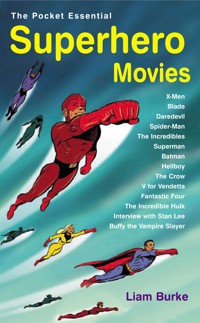
Includes an exclusive interview with Stan Lee, former president of Marvel Comics, creator of Spider-Man, the Fantastic Four, the X-Men, Iron Man, the Hulk, the Silver Surfer and Daredevil In 1978 Superman made audiences believe a man could fly. Since then, Superhero Movies have shown that man can not only fly, but swing from webs through New York's concrete canyons, turn monstrous shades of green if suitably vexed and dress as giant rodents to safeguard the city streets. Today, there are more Superhero Movies than ever before as the cinematic skies are filled with caped crusaders and nocturnal vigilantes that continue to delight and excite cinemagoers the world over. This book reveals the secret identity of the Superhero Movie, examining how cinema has come to represent the mythological icons of our age. Through detailed analysis and fascinating facts, Superhero Movies explores how, in a single bound, the Superhero has made the leap from the comic book page to the silver screen. So fasten your utility belt as you prepare to take flight with Superhero Movies.
Sie lesen das E-Book in den Legimi-Apps auf:
Seitenzahl: 217
Veröffentlichungsjahr: 2012
Das E-Book (TTS) können Sie hören im Abo „Legimi Premium” in Legimi-Apps auf:
Ähnliche




















Liam Burke
Superhero Movies
POCKET ESSENTIALS
Acknowledgements
I would like to thank the following people for helping to get this book off the ground: Graph-Man Andrew Rea, the inventor of Kryptopedia Gar O’Brien, my family for their unwavering support, and of course the legendary Stan Lee for his gracious contribution, giving this book its extra POW!
Dedicated to my Lois Lane, Helen; who now knows more about superheroes than any right-thinking person should.
Contents
Introduction: In a Single Bound? Superheroes on Screen
1. The Last Son of Krypton, Earth’s First Superhero
2. Supermen with Feet of Clay
3. Vigilante Justice
4. Family First
5. Strength in Numbers
6. Wonder Women
7. Supernatural Superheroes
8. Superbad
9. ‘Nuff Said!
10. Excelsior! A one-on-one with Stan Lee
In a Single Bound? Superheroes on Screen
Following a flurry of whizzing blue lights, the camera pans down from the stars to a lonely crystalline planet. Moving closer, a solitary dome is revealed amidst a cityscape built from large shards of glass. Inside, a stodgy-looking Marlon Brando, dotted with sequins, is passing judgement on an irate Terence Stamp. Not long after, this barren planet Krypton explodes; its sole survivor, an infant destined for Earth.
So opens Richard Donner’s 1978 film Superman, and with it the modern age of superhero movies. Recently, Superman returned to find he was not the only superhero flying the cinematic skies. Among the Man of Steel’s many rivals include his DC Comics stablemate Batman, who, after detoxing from an overdose of mid-1990s camp, has returned to his cape and cowl career with renewed vigour and purpose. A number of young turks have also been tugging at Superman’s cape, the most eager being the arachnid-themed wunderkind Spider-Man, who not only adopted Superman’s red-and-blue style, but seems intent on rivalling the Man of Steel’s film output. With blind vigilantes, schools of mutants and the occasional green goliath, the Last Son of Krypton now has a big super-family.
Today it seems that, after decades of struggle, caped wonders are making the leap to the screen in a single bound. But why has this super-surge taken place now, when supermen have been righting wrongs since the pages of Action Comics # 1 in 1938? These first superheroes helped allay the anxieties of comic-book readers in the lead up to and during World War II, allowing fans to identify with indestructible heroes such as Captain America who socked Hitler in the jaw on the cover of his very first issue – a full year before his country joined the war effort in the wake of Pearl Harbour. Though some of these early comic-book heroes, including Superman, Batman and Captain America, did make their way into radio, television and film serials, none would produce a superhero movie.
In the 1960s, comics again sparked a renewed interest in super-heroes with a Marvel Comics-led revival of these masked men. These new marvels, such as Spider-Man, Fantastic Four and X-Men, were high-flying heroes with real-world problems – the perfect foil for the silver screen. Yet only a few enjoyable but campy television series emerged, the most enduring example being the Adam West-starring Batman. While West’s Batman did produce a spin-off feature, it was merely an extension of the series rather than an entity of its own. Filmgoers would have to wait 40 years after the first comics to see a Man of Steel fly, and even this cinematic success only resulted in some increasingly anaemic sequels. In 1989, Tim Burton’s Batman proved successful in blazing a trail, as other gothic vigilantes (Darkman, The Shadow and The Phantom) subsequently made their way onto the screen. But these damp imitators and the justifiably derided Joel Schumacher-directed Batman sequels were Kryptonite to any respectable superhero’s big-screen ambitions.
However, with the dawning of the new millennium, the super-hero evolved. Gone were the lycra suits, risible puns and juvenile antics. Superheroes were new men; they were X-Men. In 2000, Bryan Singer’s X-Men, taking its serious approach from Superman and its black-leather style from Batman, was a superhero movie for a modern audience. Employing a realistic tone and reverence for its source material, X-Men appealed to fans and newcomers alike, which was reflected in its strong box office and glowing critical reception. But the mutants’ triumph was not enough to claim the superhero-movie coup d’état a success; in the past Superman and Batman had also shown promise as genre-starters only to later fizzle out. To build on the X-Men’s momentum, and to make the superhero movie a cinematic institution, another successful film was needed, and the friendly neighbourhood Spider-Man was more than obliging.
Released in 2002, Spider-Man not only echoed X-Men’s success but amplified it with a worldwide tally of $821 million. Since the success of Spider-Man, superhero movies have begun to go as readily with cinema popcorn as butter and salt; they have become the highlights of summer seasons, spinning off into endless series. These films manage to keep cinema tills ringing by providing some of the best big-screen spectacle since the first time Indiana Jones hung up his bullwhip. More than just popcorn-fodder, series such as X-Men and Spider-Man have rejuvenated and legitimised ‘the blockbuster’ after all the Phantom Menaces and world-ending asteroids saw the tradition become synonymous with over-stylised puff pieces; while recent franchise restarts Batman Begins and Superman Returns look set to continue the trend. So with movie studios and audiences now clearly cured of their fear of flying, the question still remains: why are heroes so super now?
A regularly cited reason for this rise of the superhero movie is the advancement of special effects. But although the contribution of digital technologies is not to be undervalued, with Spider-Man now able to seamlessly swing through pixel-populated environments, this argument fails to consider the science fiction and fantasy genres, equally reliant on special tinkering, thriving since Georges Méliès first took a trip to the Moon in 1902. Furthermore, the lack of digital technologies did not stop Ray Harryhausen from realising Sinbad’s seventh voyage, nor did Fritz Lang need an endless stream of ones and zeros to populate his futuristic Metropolis. From as far back as the 1950s and the George Reeves-starring Adventures of Superman television series, audiences believed a man could fly; recent computer-aided effects have just given him the lift he needed to soar.
A more likely motive for this superhero-movie boom is not the digital ones and zeros that make Superman fly, but rather the number of zeros on the box-office receipts after he’s come back down to Earth. Once X-Men scored a worldwide gross of nearly $300 million on a penny-pinching $75 million budget, movie studios began to see the financial incentive in keeping these heroes in subterranean lairs and figure-hugging jumpsuits.
Another probable reason for this super-surge is the lack of imagination endemic in Hollywood moviemaking, a business crippled by a creative cowardice that aims for the lowest common denominator, often resulting in the banal. The overriding practice seems to be, why have one good idea produce only one good film, when you can pillage it for a number of films? Thus audiences get force-fed pointless prequels, needless television remakes and more penguins on screen than on a melting Antarctic glacier. For now, Hollywood will continue to give every character ever to don spandex the cinematic treatment until Plastic Man becomes the subject of a big-budget trilogy. Fortunately, with a 70-year stockpile of stories and characters, superheroes can take this creative mining.
In fact superheroes, with their never-ending crusades for justice, are the gift that keeps on giving. Boy wizards may grow up and trips to Mordor come to an end, but decades after they first slipped on their capes, many superheroes are still flying through the same skies as when they began. These modern-day Sisyphuses’ perpetual conflicts are such a renewable source of energy that even Al Gore would have to approve, providing yet another reason for greedy film studios to forage through the pages of the nearest four-colour wonder for inspiration.
Yet cinema audiences are not the mindless demographics Hollywood would wish them to be, and no amount of manufactured hype will dupe filmgoers into paying to see the exploits of a caped crusader unwillingly. Nonetheless, audiences gladly continue to support the ongoing adventures of Superman and Batman while inviting new heroes, not only into their multiplexes but also into their living rooms, where the plainclothes superhumans of Heroes now reside. So where does this insatiable appetite for people with omnipotent powers come from?
Superheroes on the comic-book page first came to prominence in the prelude to World War II. That Superman could do the things in comics that people wished they could do in their everyday lives provided an escape for readers during an age fraught with peril. Today, with the events of 9/11 and the subsequent War on Terror, the world again finds itself in uncertain times as constant television images remind us how powerless we can sometimes be. If cinema represents for many the great escape, then, with horrors on our doorstep, the idea of taking that journey with heroes who can turn back time and always save the world seems like a tempting prospect.
Any one of these reasons could explain the recent, unprecedented success of superhero movies, with it more likely being a combination of all those mentioned and a few more not yet considered. Whatever the cause, today superheroes are everywhere; but who are these Men of Tomorrow?
In 2003, the American Film Institute (AFI) selected its 100 greatest movie heroes and villains. Leading the side of the angels was Atticus Finch, a character who wistfully intoned, ‘You never know someone until you step inside their skin,’ and for the villains, Hannibal ‘the Cannibal’ Lecter, a man who did just that. Cinema’s first superhero, Superman, came in at a respectable 26, Batman scraped into the top 50 at 46 with his arch-nemesis the Joker faring one better at 45 in the villains list, while the likes of Spider-Man and the X-Men failed to make the grade. Though Atticus Finch and Superman share a number of similarities – both fight for Truth, Justice and the American Way while using bespectacled mild manners to hide a hero’s resolve – no one is likely to confuse the gallant southern lawyer with the Last Son of Krypton. However, there were many heroes on the AFI list whose feats could be considered ‘super’: the Terminator is quite literally a Man of Steel, Obi-Wan Kenobi travelled through the stars and Indiana Jones has punched out as many Nazis as Captain America ever did.
So what makes these heroes ‘super’? Is it just the snappy dressing and subterranean lairs? The superhero goes beyond, or rather beneath, the hero’s mask. Superheroes are the continuation of a mythology that includes Achilles, Samson, Hercules, Robin Hood and Zorro. From the point at which Superman became the mythological icon of the twentieth century, a distinct superhero archetype was laid down. This broad archetype was quickly fashioned to a strict form by other entrants to the pantheon: Batman, Captain America et al. Consequently, one could propose a rigid model to which superheroes conform:
This superhero archetype began with the comic-book super-heroes and continued into their big-screen adaptations, with newly created cinematic heroes Mr Incredible, RoboCop, and Unbreakable’s David Dunn adhering to the formula. There are elements of these archetypal traits in all of cinema’s superheroes; but what is this superhero archetype that forms the basis of characters and films as varied as Superman, Hellboy and Buffy the Vampire Slayer?
Examination of this superhero archetype should begin, as these heroes do, with their origins. In superhero movies two events shape the character’s origin, which have been clearly identified in the truism Spider-Man follows fastidiously: ‘With great power comes great responsibility’. These events are the origin of the ‘power’ and the origin of the heroic ‘responsibility’. The origin of the ‘power’, or special abilities a hero will use, usually occurs first in the story. Like much of superhero lore, the origin is indicative of the times in which it was created. Thus, the origin of Superman’s power can be seen to epitomise the successful American immigrant experience of the early twentieth century, with Kal-El (Superman’s Kryptonian name) reinventing himself on US soil where he is openly accepted and cherished, whilst retaining elements of his native cultural identity. By the 1960s, rapid technological advancements meant that, for the first time, man had the ability to travel beyond his planet, or leave it in ruins. The manner by which heroes such as the Fantastic Four, Hulk and Spider-Man gained their powers articulated the growing public anxiety over space travel, nuclear attack and scientific research. America in the 1960s was also marked by the civil rights movement, and this concern too was expressed within the environs of the superhero genre, with the feared and hated X-Men found to represent those oppressed peoples. Furthermore, the enmity between pacifist Professor Xavier, leader of the X-Men, and the militaristic Magneto was seen to reflect the ideological opposition of Dr Martin Luther King and Malcolm X that existed at the time of the comic’s creation.
The eventual superhero movies, though faithful to the characters’ time-tested origins, have added their own inflections, contemporising antiquated concerns with modern ones. Thus in the film adaptation of 2002, Spider-Man does not gain his powers from a radioactive spider, but rather from one that has been genetically engineered, replacing the lessened danger posed by radioactivity with one of genetic engineering and its potential implications for our future society. Similarly, Bruce Banner no longer becomes the Hulk through exposure to gamma radiation alone; this transformation is now triggered by the reminder of childhood traumas, which unleash the primal monster. This need for the film to validate the Hulk’s physical transformation with a psychological motive is indicative of today’s more cerebral culture. Also, the X-Men films have used the idea of mutancy and alienation to present an allegory for gay rights. This parallel becomes particularly clear in X2: X-Men United when the teen mutant Iceman must ‘come out’ to his parents as a mutant, to which his mother responds, ‘Have you tried not being a mutant?’
The second event that anchors the superhero archetype is the origin of the hero’s ‘responsibility’. While this may take place concurrent to the origin of the power, it is a distinct, usually tragic, event. In the Spider-Man origin, for example, we see how, upon receiving his powers, Spider-Man does not immediately use his gifts in defence of Truth, Justice and the American Way, but rather to make some money and impress a girl (arguably the real American Way). His cavalier attitude to his gifts sees him allow a criminal, who he could easily have stopped, escape from the scene of a crime. When his uncle is shot and killed by what is later revealed to be the same criminal, Spider-Man learns that ‘with great power comes great responsibility’, and thus the (super)hero is born. Equally traumatic events have motivated many other heroes’ origins. Batman’s power comes from years of training and an impressive array of gadgets, but he was set on his heroic quest following the murder of his parents by a lowly criminal. Likewise, Daredevil’s powers may stem from his exposure to chemical waste, but his heroic impulse to fight crime comes from his father’s murder by mob enforcers.
Much like the origin of the power, the origin of the hero’s responsibility has been made more concise and subsequently more intense by its cinematic rendering. Where once these characters garnered their heroic responsibility at the hands of random criminals, the films have modified these criminal identities to that of villains the heroes will confront at the film’s climax. Consequently, in Batman, Bruce Wayne’s parents are not killed by the lowlife Joe Chill as they are in the comics, but rather by a young Joker who the adult Bruce Wayne, as Batman, will later face; Daredevil’s father is no longer murdered by average mobsters but the future Kingpin of crime in his formative years; and, in the latest cinematic amendment, the until-now ‘lone criminal’ who shot Spider-Man’s uncle was revealed to have had an accomplice in Spider-Man 3: the Sandman, one of the film’s villains. These alterations to the superhero origin provide a more symmetrical narrative that cinema audiences have come to expect, as opposed to the perpetual conflicts that mark comic superhero narratives. Like the re-contextualisation of the hero’s power, these changes are expected and befit the medium in which the superheroes now find themselves, allowing for a more cyclical superhero archetype.
Once a character takes on the mantle of a hero their identity is split between that of superhero and his secret identity. Secret identities are synonymous with the superhero archetype; for every caped crusader there is a hurried costume change in a phone booth, and with every nocturnal protector there must be an awkward daytime alter-ego. Often these two identities are locked in an antagonistic relationship: Superman struggles to find plausible reasons as to why Clark Kent is never around; rather than scour the city for dates as the playboy Bruce Wayne, Batman would prefer to stalk the night-time cityscape for criminals; and Spider-Man must engage villains with the much more deadly threat of school in the morning hanging over his head. However, no matter how cumbersome the secret identity may seem to the superhero, it is essential to the superhero archetype.
The success of the superhero lies in the contrast with his/her alter-ego. To see this archetypal trait manifest itself in superhero movies, one need only look at the prototypical hero Superman and his alter-ego Clark Kent. Their opposition stems from the contrast between Superman as the confident hero, the indestructible ‘Man of Steel’, and Clark Kent the clumsy, bookish coward. Thus, Kent’s weakness serves to highlight Superman’s heroism. Binaries such as Superman/Clark Kent permeate the superhero archetype: Bruce Wayne is a pompous, egotistical dandy while Batman is a dedicated silent avenger; Peter Parker is a shy, gawky teenager whereas Spider-Man is a cocky adventurer; and Bruce Banner is a frail, temperate, scientific genius but his monstrous alternate is the rampaging wall of green muscle known as the Hulk. It is interesting that few superheroes actually perform acts of social betterment when in their alias’s guise, with honest lawyer Matt Murdock (Daredevil) being one of the few exceptions. Most live meek, civilian lives that allow them to monitor when their Superhero identities may be needed; both Peter Parker and Clark Kent work for busy city newspapers and Bruce Wayne sits in the safety of his Batcave silently viewing monitors.
The superhero archetype relies on the secret identity, not just to accentuate the hero, but to ensure the hero’s image is not beyond the reach of the spectator’s self-identification. This aspect of the secret identity has been explored by philosopher and novelist Umberto Eco in respect to Superman. In his essay The Myth of Superman, he attests that by the way in which ‘Clark Kent appears fearful, timid, awkward, near-sighted and submissive, he personifies fairly typically the average reader [or viewer in the case of superhero movies] who is harassed by complexes and despised by his fellow man’. The hero’s all-too-human alter-ego allows for audience identification and is emphasised, even exploited, by superhero movies that wish to appeal to a larger audience than the comics on which they are based.
In superhero movies the protagonist is also supported in his quest by many allies who can generally be classified as teachers and helpers. Teachers include Ra’s Al Ghul who trained the young Bruce Wayne in martial arts as seen in Batman Begins, while helpers are typified by his butler Alfred and Police Commissioner Gordon who aid the adult Bruce Wayne as Batman in his vendetta against his city’s criminal fraternity. Another ally readily associated with superheroes is the sidekick, a young partner who parallels the hero. However, this character type is only found among older characters such as Batman and Captain America, created at a time when simpler plotting did not let the real-world irresponsibility of placing an adolescent in danger impede the story. That the image of a superhero flanked by a sidekick endures is largely due to the continuing influence of the 1960s Batman television series, in which the caped crusader never left the Batcave without his trusty ward Robin in tow. The only appearance of a traditional sidekick in a superhero movie would again come from the superhero genre’s very own Sherlock Holmes and Watson, Batman and Robin, with the Boy Wonder being added to the late 1990s Batman films Batman Forever and Batman & Robin. Although another unsuccessful element in a pair of films crippled by poor creative decisions, Robin fulfilled the role of the prototypical sidekick in being an adolescent whose origin and abilities parallel that of the main hero; whose presence could reiterate the hero’s origin for late-comers to the franchise; and who by echoing the hero’s archetype would become an integral part of it.
Even in the early days of comic books and serials, superheroes had more than just sidekicks for company, with damsels such as Lois Lane and Vicki Vale constantly in distress. Yet, early super-heroes seemed to have sublimated their sexual desire beneath a higher calling for justice. But as comics progressed with more complex narratives, and began to be adapted into other media that generally require a romantic element, the tricky issue of sexual desire needed to be negotiated within the fabric of the superhero archetype. While today superhero relationships are as much a part of the character on the page as they are on the screen, in many ways cinema is responsible for the superhero sexual awakening, with Superman, the most virtuous and dedicated of superheroes, found going on a date with Lois Lane in Superman, consummating their relationship in Superman II and, in Superman Returns, even fathering her illegitimate child. Cinema brought sex to superheroes and now cinema is using sex to sell superheroes. Whether it is Spider-Man’s swinging-in-the-rain kiss or Daredevil’s scantily clad, ninja-assassin girlfriend Elektra, relationships have not only become a central part of the superhero’s archetype, but also their movies.
While the hero’s relationship with his helpers, teachers and love interests bolsters the superhero archetype, no relationship is more central to defining the superhero than that of the hero and his villain. In many ways a superhero does not exist until the villain attacks, waiting like shadows in their civilian identities for the sound of screeching police sirens or the flicker of a familiar signal in the sky; a superhero without a megalomaniac to stop is just a weirdo in a cape. Also, it seems, the more sinful the villain, the more laudable the superhero – a street thug is ok, but a deranged scientist is better, while stopping a world-threatening evil will make you the flavour of the month around the Hall of Justice. The clothes may make the (super)man, but it is the villain that makes him a hero.
In superhero movies the duality of the hero and villain extend beyond the obvious opposition of good and evil. Two distinct categories of supervillain exist, both of which are locked in an antagonistic relationship with the hero – a relationship that defines them both. The first category is those villains who by their very nature are the antithesis of everything that epitomises the hero; the first entrant to this canon of antithetical villains being Superman’s arch-nemesis Lex Luthor. While Superman is deified for compassionately using his otherworldly physical powers, Lex Luthor uses his intellect to indulge his base human emotions of lust and greed, and his brains to combat the hero’s brawn. Other antithetical villains in superhero movies include honest lawyer Matt Murdock’s arch-nemesis, the criminal Kingpin, and Mr Glass, the fragile villain who the Unbreakable David Dunn must ultimately face.
The second category of villain is those who are cut from the same cloth as the hero, often sharing a similar background, but have taken an alternate path that now sets them against the hero. These villains, so like the heroes in all aspects but one, hold up a distorted mirror to the central protagonists, helping define by their contrast the superhero. Among the mirror villains seen in superhero movies are the Spider-Man foes the Green Goblin and Doctor Octopus who both, like Peter Parker, were scientists who took on creature-like identities once given powers by laboratory accidents, but unlike Peter they use their power irresponsibly for their own betterment. An unmistakable example of the mirror villain is Professor Xavier’s tainted reflection Magneto. This destiny-entwined pair, who once worked together to help the fledgling mutant race take its first steps in the world, now find that their diverging methods bring them into constant conflict. These villains are the protagonists’ darkest shadows, helping to sharpen our view of the hero by their contrast.
The hero/villain duality is so central to the superhero archetype that it would provide the basis of Unbreakable, a superhero movie with a hero that was the original creation of writer/director M Night Shyamalan (The Sixth Sense). The film is steeped in self-referential superhero rhetoric to the point that when the villain is revealed, he berates the hero and audience for not recognising it earlier, saying, ‘It all makes sense; in a comic you know how you can tell who the arch-villain is going to be? He’s the exact opposite of the hero.’ Superhero movies also intensify this relationship, with the villains becoming more actively involved in the hero’s origin than in their comic-book sources. Dialogue such as, ‘I made you, you made me first’ (Batman),‘What they did created me’ (V for Vendetta) and, ‘Now that we know who you are, I know who I am’ (Unbreakable) is littered throughout superhero movies, highlighting the central importance of this antagonistic relationship to the superhero archetype.
These various facets of the superhero archetype, from the traumatised childhoods to the love/hate hero/villain relationships, reappear across the many vigilantes, mutants, vampire slayers and spandex aficionados who populate the superhero movies. This book will use the archetype to unmask these superheroes and their films. Superhero Movies brings together superheroes from all walks of life for the first time: DC old-timers will rub shoulders with Marvel whippersnappers; comic adaptations will sit beside big-screen originals; it doesn’t matter whether they are green, blue or animated, if they have ever saved the day they are here.
First, some housekeeping: while Marvel and DC Comics may have copyrighted the term ‘Super Hero’, not all superheroes come from comic books, with some of the best superhero movies, such as Unbreakable and The Incredibles, realised straight for the screen. Hence this book, though making reference to the comic books that have inspired them, is about the films first.
The book itself is divided across eight chapters of thematically linked heroes, from Supermen with Feet of Clay to Wonder Women. Each chapter will focus on the most influential films in that area. One should note that ‘influential’ does not always mean ‘best’; for example X2: X-Men United




