


23,99 €
Mehr erfahren.
- Herausgeber: John Wiley & Sons
- Kategorie: Geisteswissenschaft
- Sprache: Englisch
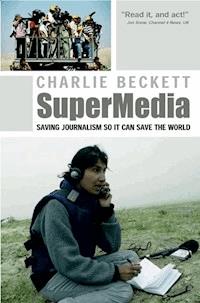
SuperMedia is a lively, engaging, and refreshingly-opinionated text offering informed discussion on the importance and future of liberal journalism as a healthy part of a flourishing society. * Examines the profound changes journalism is undergoing for social, economic and technological reasons * Explores the potential for a entirely new type of journalism which these changes create, discussing the impact of social networking sites and blogs on traditional journalism, and making the case that journalism could be the catalyst for change needed to solve many of the world's problems in a controversial manner * Written by a first class broadcast journalist, it provides a practical roadmap for identifying the issues and solutions that will ensure an open and reliable news media for generations to come
Sie lesen das E-Book in den Legimi-Apps auf:
Seitenzahl: 403
Veröffentlichungsjahr: 2011
Ähnliche



















Contents
Figures
Foreword
Acknowledgments
Introduction “The Dailyplanet.com”: Why We Must Save Journalism So that Journalism Can Save the World
1 “Help! Help! Who Will Save Us?”: The New Media Landscape
1.1 Introduction
1.2 The New News Media Landscape
1.3 Mainstream Media Fight Back
1.4 The New Threats to the News Media Business Model
1.5 What Is Happening to the Public Sphere?
1.6 A Second Chance in Second Life?
Chapter Summary
2 “Is It a Bird? Is It a Plane? No! It’s SuperMedia!”: Networked Journalism
2.1 Introduction
2.2 Where Does It Come From? The History of Networked Journalism
2.3 Networked Journalism – A Definition
2.4 What Networked Journalism Looks Like
2.5 How Networked Journalism Can Save the Media
2.6 The Business of Networked Journalism
2.7 Networked Journalism and Public Service
Chapter Summary
3 “Will Nobody Do Anything to Help?”: Networked Journalism and Politics
3.1 Introduction
3.2 Networked Journalism and US Politics
3.3 Africa: Networked Journalism, Governance and Development
3.4 Conclusion: Networked Journalism and Politics
Chapter Summary
4 Fighting Evil: Terror, Community, and Networked Journalism
4.1 Terror, Public Security, and Community Cohesion
Chapter Summary
5 We Can All be Super Heroes: Networked Journalism in Action: Editorial Diversity and Media Literacy
5.1 Editorial Diversity
5.2 Media Literacy
5.3 Media Literacy in Education
5.4 Media Literacy in Governance
5.5 Conclusion
Chapter Summary
Notes
Suggested Reading
Index
What They Say About SuperMedia
“Charlie Beckett provides a serious but accessible introduction to the challenges facing contemporary journalism, intellectually and professionally. Presenting an argument for the importance of journalism in society, whilst also recognising the impact of business and technology on that contribution, SuperMedia will be invaluable to media students wanting a cutting-edge survey from an experienced and reflective practitioner.”
Adrian Monck, head of the Department of Journalism and Publishing, City University, London
“The idea and practice of networked journalism needs this thorough examination and this manifesto in its favor. And I second Charlie Beckett’s contention that we in the news business and in society need networked journalism not just to protect but to expand journalism’s future.”
Jeff Jarvis, blogger and professor, CUNY Graduate School of Journalism
“Charlie Beckett knows the business from the inside, and in SuperMedia it shows. A powerful analysis of the great challenges facing all of us, whether reporters, readers, bloggers, or viewers. Read it, and act!”
Jon Snow, presenter, Channel 4 News
“This important book charts a course through journalism’s current crises of trust, economics, and technology and points to a way of reconnecting with a broad social purpose.”
Richard Sambrook, director, BBC Global News
This book is dedicated to the people who make up the story of my life: Erika and Roger Beckett, Anna Feuchtwang, and Billy and Isaac Beckett.
This edition first published 2008
© 2008 Charlie Beckett
Blackwell Publishing was acquired by John Wiley & Sons in February 2007. Blackwell’s publishing program has been merged with Wiley’s global Scientific, Technical, and Medical business to form Wiley-Blackwell.
Registered Office
John Wiley & Sons Ltd, The Atrium, Southern Gate, Chichester, West Sussex, PO19 8SQ, United Kingdom
Editorial Offices
350 Main Street, Malden, MA 02148-5020,
USA 9600 Garsington Road, Oxford, OX4 2DQ, UK
The Atrium, Southern Gate, Chichester, West Sussex, PO19 8SQ, UK
For details of our global editorial offices, for customer services, and for information about how to apply for permission to reuse the copyright material in this book please see our website at www.wiley.com/wiley-blackwell.
The right of Charlie Beckett to be identified as the author of this work has been asserted in accordance with the Copyright, Designs and Patents Act 1988.
All rights reserved. No part of this publication may be reproduced, stored in a retrieval system, or transmitted, in any form or by any means, electronic, mechanical, photocopying, recording or otherwise, except as permitted by the UK Copyright, Designs and Patents Act 1988, without the prior permission of the publisher.
Wiley also publishes its books in a variety of electronic formats. Some content that appears in print may not be available in electronic books.
Designations used by companies to distinguish their products are often claimed as trademarks. All brand names and product names used in this book are trade names, service marks, trademarks or registered trademarks of their respective owners. The publisher is not associated with any product or vendor mentioned in this book. This publication is designed to provide accurate and authoritative information in regard to the subject matter covered. It is sold on the understanding that the publisher is not engaged in rendering professional services. If professional advice or other expert assistance is required, the services of a competent professional should be sought.
Library of Congress Cataloging-in-Publication Data
Beckett, Charlie.
Supermedia: saving journalism so it can save the world/Charlie Beckett.
p. cm.
Includes bibliographical references and index.
ISBN 978-1-4051-7923-2 (pbk.: alk. paper) — ISBN 978-1-4051-7924-9 (hardcover: alk. paper)
1. Journalism—Social aspects. 2. Journalism. I. Title.
PN4749.B35 2008
302.23—dc22
2008009038
Figures
Figure 1.1Second Life: A second chance for journalism? Figure 2.1 The new Daily Telegraph newsroom with its “spoke” design to reflect the new reality of multi-platform production Figure 2.2 A Networked Journalism narrative – a warehouse fire Figure 3.1 CNN/YouTube debate – Candidates stand at their respective podiums during the CNN/YouTube Democratic Presidential Candidates Debate July 23, 2007 at the Citadel Military College in Charleston, South Carolina Figure 4.1 Palestinian children’s TV gets political: Tomorrow’s Pioneers on Al-Aqsa TV Figure 4.2Aljazeera: the typical newsroom design of a modern global broadcaster but with its own editorial take on the news agenda Figure 5.1 Virginia Tech – mainstream media makes its presence felt while the inside story was being told on the InternetForeword
First, let’s get this straight: No one says that amateurs will or should replace professional journalists. That’s not what networked journalism – the concept at the heart of this book – is about. Instead, networked journalism proposes to take advantage of the new opportunities for collaboration presented by the linked ecology of the Internet. Professional and amateur, journalist and citizen may now work together to gather and share more news in more ways to more people than was ever possible before. Networked journalism is founded on a simple, self-evident and self-interested truth: We can do more together than we can apart.
Indeed, pro and am are starting to work together. In the fall of 2007, I held a Networked Journalism Summit at the City University of New York Graduate School of Journalism, where I teach as an Assistant Professor. When I applied for the grant from the MacArthur Foundation that enabled us to hold the event, I thought our task would be to evangelize the idea. But by the time the conference came, it was clear that there were many efforts in networked journalism – most experimental – already underway. And so our job became to share best practices – some of which are in this book – and find next steps. One newspaper in Florida had invited readers to ferret out stories and scandals in volumes of data from a government storm-relief program. A New York radio station had mobilized its audience to find out which neighborhoods in the city were being gouged with prices of milk and beer. A Bavarian startup was publishing profitable local magazines made up of content from local neighbors. And out of the coming together of these best practitioners came more ideas and projects, including a cooperative that is building software to help gather data from the public in crowd-sourced reporting projects. The Internet’s power to connect us with information and each other makes all this possible.
But networked journalism is born not only of opportunity but also of need. News organizations – which enjoyed, if not monopolies, then at least protected positions as the proprietors of presses or broadcast towers – now find themselves facing unlimited competition not only for content and attention but also for revenue. They are shrinking. But they don’t need to. By joining and creating networks of journalistic effort – helping with curation, editing, vetting, education, and, yes, revenue – these news organizations can, indeed, grow. Newspapers can get hyper-local or international. TV stations can have cameras everywhere. Investigators can have many more hands helping them dig. News sites can become more efficient by doing what they do best and linking to the rest. Reporters can get help and corrections on their work before and after it is published.
The tools journalists can use are constantly expanding. Links and search enable journalism to be found. Blogs allow anyone to publish and contribute. Mobile devices help witnesses share what they see – even as it happens – in the form of text, photos, audio, and video. Databases and wikis enable large groups to pool their knowledge. Social services can connect experts and communities of information.
This, I believe, is the natural state of media: two-way and collaborative. The one-way nature of news media until now was merely a result of the limitations of production and distribution. Properly done, news should be a conversation among those who know and those who want to know, with journalists – in their new roles as curators, enablers, organizers, educators – helping where they can. The product of their work is no longer the publication-cum-fishwrap but instead a process of progressive enlightenment.
So the means, economics, architecture, tools, and technology of journalism all change. What I hope changes most, though, is the culture. I hope journalism becomes more open, transparent, inclusive, flexible. I do believe that journalism will be stronger and more valuable as a component of networks than it was as the product of professional priesthoods. I also believe the amateurs who help in this process will be stronger for learning the standards, practices, and lessons journalists have learned over the years. Both will be better off for realizing that we are in this together, we are members of the same communities. But even with all this change, the essential task of journalism is still unchanged: We want to uncover what the world knows and what the world needs to know and bring them together.
When I began exploring these ideas myself, about the time I started blogging as a print-turned-online editor in 2001 – see www.buzzmachine.com – I called this notion, as many did, “citizen journalism.” But I later recanted the phrase for three reasons. First, I believe, it is a mistake to define journalism by who does it, for that implies the certification – and thus risks the decertification – of journalists. Journalism should be defined by the act, and it is an act anyone can commit. Second, I recall a newspaper’s online editor approaching the microphone at a conference of her tribe and challenging me as I spoke on a panel: “I’m a citizen, too,” she said, tears in her eyes. Indeed you are, I replied, and the sooner journalists act as citizens in their worlds, the better both will be. Third, I came to see that the buzz-phrase “citizen journalism” could by no means capture the full power of collaboration now made possible by the Internet.
That power – the means, opportunities, and implications of networked journalism – is explored most ably in the pages that follow. Until this book, networked journalism has been the subject mostly of blog posts and conference panel discussions. The idea and practice of networked journalism needs this thorough examination and this manifesto in its favor. And I second Charlie Beckett’s contention that we in the news business and in society need networked journalism not just to protect but to expand journalism’s future.
Jeff Jarvis,
New York
December 2007
Acknowledgments
I would like to thank the following for their help: my researcher Holly Peterson, my assistant Laura Kyrke-Smith, and my personal editor Anna Feuchtwang. Thanks to journalist-professors Adrian Monck and Michael Parks for their feedback. To my new colleagues at the Media and Communications Department at the London School of Economics and the Journalism Department at the London College of Communication for the ideas I have stolen from them. To all the journalists and citizens who have taken part in the POLIS debates and research that have informed this book.
Finally, I want to pay tribute to the hundreds of fine journalists I have worked with over the past couple of decades at great news organizations such as the South London Press, LWT, the BBC, Channel 4 News and beyond.
Introduction
“The Dailyplanet.com”
Why We Must Save Journalism So that Journalism Can Save the World
Three scenarios convinced me that my trade had changed forever. The first was standing in my TV newsroom trying to decide whether to show the public a series of cartoons published in a Danish newspaper that had caused riots around the world. It was an acute ethical dilemma that raised profound political and editorial questions that could not be answered in the 45 minutes we had before we went to air. The second was standing next to the River Nile with Channel 4 News presenter Jon Snow in the run up to the G8 meeting of world leaders at Gleneagles in Scotland in July 2005. We were broadcasting the program live every night from Uganda in an effort to give the African perspective on world events. We took our state-of-the-art Outside Broadcast paraphernalia on the back of a huge flat-bed truck to locations such as a remote Ugandan village. There we found children were still dying of malaria because of a lack of something as cheap as anti-mosquito nets. I got off the plane from Africa that week and had to rush in to the studio to edit an extended program dominated by the bombing of London by British-born Muslims. The wrecked bus and smoking underground stations were all minutes from where I lived and worked. Three stories: the Cartoons, Africa, and the London Bombings. All with extraordinary resonances and in some way all linked. Something told me that these stories and the way we were telling them were quite different from anything that had been possible or predictable even just a few years ago. When I joined ITN’s Channel 4 News in 1999 the newsroom had only a couple of Internet terminals and mobile phones were still rationed. When I left to set up a new journalism think-tank at the London School of Economics in 2006 these had become the basic tools of all journalists, including those I met in Uganda. But more important than the change in technology was the new interconnectedness I detected. I was convinced that journalism was at a “tipping point.” This book is my manifesto for the media as a journalist but also as a citizen of the world. As a journalist you are constantly being told that the news media have enormous power to shape society and events, to change lives and history. So why are we so careless as a society about the future of journalism itself?
Lesen Sie weiter in der vollständigen Ausgabe!
Lesen Sie weiter in der vollständigen Ausgabe!
Lesen Sie weiter in der vollständigen Ausgabe!
Lesen Sie weiter in der vollständigen Ausgabe!
Lesen Sie weiter in der vollständigen Ausgabe!
Lesen Sie weiter in der vollständigen Ausgabe!
Lesen Sie weiter in der vollständigen Ausgabe!
Lesen Sie weiter in der vollständigen Ausgabe!




