


9,99 €
Mehr erfahren.
- Herausgeber: The History Press
- Kategorie: Geisteswissenschaft
- Sprache: Englisch
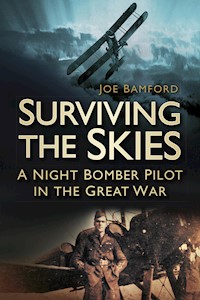
Captain Stephen Wynn Vickers joined the Cheshire Regiment in August 1914, but after being badly wounded he remustered to the RFC (Royal Flying Corps). While other young pilots were killed or injured almost as soon as they got their wings, Captain Vickers survived numerous crash and forced landings. He joined 101 Squadron in 1917 and completed seventy-three sorties over enemy territory before being repatriated in May 1918 and awarded the newly inaugurated DFC, as well as the MC. With the war drawing to a close, he became a flying instructor at an RAF station in Lincolnshire, but he did not live long enough to receive either his medals or the distinction that he deserved. Making use of an array of unpublished material, including original images and information collected directly from Vickers' family, former RAF air traffic controller Joe Bamford recounts on of the final original stories of the First World War night bombers.
Das E-Book können Sie in Legimi-Apps oder einer beliebigen App lesen, die das folgende Format unterstützen:
Veröffentlichungsjahr: 2012
Ähnliche




















DEDICATION
This book is dedicated to all the former members of the Manchester Bomber Command Association, especially Norman Jones, Jim Gardner and Alan Morgan, whose friendship I have treasured over the many years that I have known them.
Also to the memories of Stan Walker and Bryan Wild, two former RAF pilots, who over the years became great friends and shared many memories with me. The spirit and humility of all those mentioned above is typical of their generation, claiming that what they did in the Second World War was just a job that had to be done.
CONTENTS
Title Page
Dedication
Acknowledgements
Introduction
1. For King and Country
2. Up in the Clouds
3. A Founding Member
4. Into the Fray
5. Enemy Airfields and the Gotha Threat
6. Bureaucracy and Secrecy
7. The Hardships of Winter
8. New Year, New Airfields
9. A Storm from the East
10. A New Era Begins
11. Final Sorties
12. The Home Establishment
13. 48 Wing
14. The Spanish Grippe
15. Of Those Who Served
16. 101 Squadron Ninety Years On: A Day at Brize Norton
Plates
Copyright
ACKNOWLEDGEMENTS
Due to ill health and various other problems this book has been a long time in the making, but hopefully the information gathered over the last few years enhances what is probably one of the last stories to come out of the Great War. For that I have to especially thank Captain Vickers’ niece, Christine Farrell, his nephew, Michael Pratt, and his namesake, Stephen Vickers.
In 1998 I visited 101 Squadron at Brize Norton for the first time and was shown around by Flight Lieutenant Gary Weightman, who has written his own short version of the squadron’s operations entitled Lions of the Night. He has carried out considerable research into the squadron’s activities during the Great War and his account and enthusiasm to record the squadron’s history was a great inspiration.
Over ten years later, in June 2009, I was invited to visit Brize Norton again and on that occasion I was the guest of Flying Officer Jim Dickinson for the day. Some of the details of that visit are mentioned in the final chapter, but I would like to thank Flying Officer Jim Dickinson, Flight Lieutenant McFarland, Sergeant Paul Riley and Squadron Leader Curry. I would especially like to thank the commanding officer of 101 Squadron, Wing Commander Tim O’Brian, who made it all possible.
With huge cuts having been made in personnel, I understand that it is quite difficult for RAF units to accommodate requests for visits by individual civilians and organisations. However, the staff of 101 Squadron and RAF Brize Norton showed not only the kind of hospitality that might be expected of them, but went out of their way to ensure that I got all the information I required and that my visit was worthwhile.
There are many other individuals who have at one time or another been involved with this project, amongst them researchers Norman Hurst, John Williams, Tim Tilbrook and John Eaton from Stockport Heritage Trust, and the 101 Squadron secretary, Squadron Leader G.G. Whittle DFM (Retired).
Finally I would like to thank Arthur Lane, Norman Hurst and Tony Harman (Kodak franchise, Skipton) for helping to sort out and process many of the photographs that appear in this book. Due to their age, some of them needed to be enhanced and without their help the images would not have been suitable for publication.
INTRODUCTION
This is the remarkable story of Captain Stephen Wynn Vickers MC, DFC, an exceptionally talented airman but whose exploits and experiences have been overshadowed by the passing of time. Surviving the Skies is a detailed account of the circumstances that led up to Captain Vickers joining the Royal Flying Corps (RFC) and how he learned to fly. It also describes how he acquired the essential skills that allowed him to operate in one of the RFC’s most dangerous and specialist roles of night bombing.
It was Captain Vickers’ niece, Christine Farrell, who first brought him to my attention while I was getting some photographs copied for my first book, The Salford Lancaster. With her late husband Brian, who was a chemist, she worked as a dispensing technician in the local pharmacy and, having taken an interest in my photographs, told me that she had some of her late uncle who had been a pilot during the First World War. When Christine queried whether I would like to see them, there was no need for her to ask twice!
I was fascinated to see a number of photographs of her uncle posing by the side of a BE2c at Haggerston, an airfield in north-east England, and to learn that he had been awarded both the Military Cross (MC) and the Distinguished Flying Cross (DFC). Further research and a visit to the National Archives (formerly the Public Records Office) revealed that Captain Vickers had played a leading role on 101 Night-Bombing Squadron. He had been a founding member of the squadron and his exploits were well documented there, but like many others, in relation to the history of the RFC, he had been overlooked with the passage of time.
Christine Farrell also gave me access to other photos and family documents, and I soon discovered that Captain Vickers’ log book and records were in the possession of his nephew, Michael Pratt, who lives near Bristol. Michael was very co-operative and gave me a copy of his uncle’s log book, along with many other items that formed the basis of this account of his service with the RFC.
The story, however, is not just about Captain Vickers, but also of the other pilots, observers and airmen with whom he served with on 26 Reserve Squadron (RS), 58, 63, 11 (RS), 77, 36 and 101 Squadrons. It specifically details operations on 101 Squadron from its formation in July 1917 through to the end of May 1918 and the numerous sorties that Captain Vickers and some of his colleagues flew during that period.
Before Captain Vickers joined the RFC, he had served with the 11th Battalion of the Cheshire Regiment for seven months on the frontline in France. That in itself was not unusual, but the fact that he had been shot in the head while carrying out reconnaissance duties, surviving to later join the RFC, makes his story all the more remarkable.
It was only after extensive hospitalisation and rehabilitation that he made a full recovery and became fit enough to be transferred. After his flying training he continued to serve for another nine months through the winter of 1917–18, proving himself to be one of the RFC’s most able and dedicated night-bomber pilots. Recognised by many of his contemporaries as being an exceptionally brave and intelligent officer, Captain Vickers was eventually credited with seventy-three sorties over enemy territory.
The need for air support was so demanding that Vickers often flew two sorties in a single night, although in early 1918, and on five separate occasions, he took part in three attacks in one night, during which he destroyed a vital bridge that was being strongly defended by the Germans. On 3 June 1918 he was named amongst the first officers to be awarded the DFC: a new medal instituted with the formation of the Royal Air Force. Captain Vickers was also awarded the MC, along with the 1914–15 Star, the British War Medal and the Victory Medal.
During the period of the First World War, airmen in the RFC often used language and jargon which added colour and humour to the dangerous business of flying. The cockpit of an aircraft was often referred to as the ‘office’; sorties as ‘shows’ or ‘stunts’; enemy flak (anti-aircraft fire) was called ‘Archie’ (from the music hall song of the time) or sometimes ‘hate’; and even in the official records the Germans were regularly referred to as ‘Huns’. Seemingly, such language was used to maintain morale and as a psychological tool to maintain animosity towards the enemy. For the most part I have tried to avoid using such terminology, except when quoting from original sources or where I have thought that it was necessary.
On a final note, I apologise for any inconsistencies in the spelling of the towns and villages that I have mentioned in the countries of France or Belgium. Depending on what record or log book you examine, many of them are spelt differently and indeed some of the places mentioned do not appear at all in modern-day maps. Some may have been no more than hamlets, while it is possible that others were many miles away from the place that is mentioned in the script.
CHAPTER 1
FOR KING AND COUNTRY
Stephen Wynn Vickers was born on 9 October 1896 at 22 Roland Terrace, Hunslet, near Leeds, into a middle-class family whose main occupation was teaching. When he was just six years old his father, Joseph, was promoted to headmaster at a church school over 40 miles away, across the Pennines in Wilmslow, Cheshire. Within a short while, however, he was appointed to an even better position as the headmaster of Great Moor School in Stockport.
To begin with the family lived on Buxton Road, Great Moor, but soon they moved to a larger property that was more befitting the family’s new circumstances. By that time the Vickers family comprised six children, three daughters and three sons, with Stephen, who was known to the family as Wynn, being the oldest of all of them. The new family home was called ‘Ivy Nook’ and it was situated on Bramhall Moor Lane in the affluent suburb of Hazel Grove, 2 miles south-east of Stockport.
Originally known as ‘Bullocks Smithy’ and named after John Bullock, who had owned the land during the sixteenth century, the village was officially renamed Hazel Grove in 1835. During the census of 1901 Hazel Grove had a population of 7,934 and there is no doubt that those who lived there were generally regarded as being wealthy, with greater status than those who lived in other local towns. In local folklore it was even claimed that Hazel Grove was the only place around Stockport where the tram lines were polished, although this was probably something of an urban myth born out of a sense of snobbery and local humour.
Wynn was educated at Great Moor School where his father was the headmaster, but nepotism played no part in his upbringing and he was not given any special treatment. It is claimed that Wynn’s father encouraged him to study hard just like any other pupil and in 1906 the fruits of his efforts were rewarded when he attained a scholarship to attend Stockport Grammar School. Wynn’s father was not only a teacher but an influential member of the community, a point highlighted by the fact that he was also a senior member of the Masonic Lodge.
The young Wynn Vickers certainly had an inquiring mind and an aptitude to understand developments that were taking place in the fields of technology, engineering and powered flight. Various flying experiments with both gliders and powered flight took place in the immediate area around where he lived, and some of the trials and experiments involved a certain Alliott Verdon Roe, who lived only a short distance away from Stockport on Liverpool Road, Eccles.
A.V. Roe’s activities were well reported in the press, particularly details of what was claimed to be the first powered flight by an Englishman in his Roe 1 machine on 8 June 1908 at Brooklands. Unfortunately there were no official witnesses to confirm Roe’s achievement, a flight or ‘hop’ of just 75ft, and it was not considered worthy of recognition. Despite the dispute about whether or not he was the first Englishman to fly, he still he went on to influence a whole generation of young men like Wynn, who had become smitten by flying and had caught the ‘aviation bug’.
One such person was John Alcock, who also came from Manchester and lived close by in Chorlton. In 1919 he was to hit the headlines when, together with Arthur Brown, they became the first airmen to fly across the Atlantic. There were also a number of record-breaking flights that might have come to the attention of the young Wynn Vickers, such as that made by Louis Paulhan on 28 April 1910, who landed just a short distance away to the north-west of Hazel Grove in Didsbury, and where a blue commemorative plaque now marks the landing site between 25–27 Paulhan Road.
Paulhan was awarded Lord Northcliffe’s prize of £10,000 for becoming the first pilot to fly from London to Manchester, with only a single stop along the way. In Didsbury huge crowds awaited the arrival of Paulhan and his competitor, Claude Grahame-White, and when the Frenchman’s Farman biplane landed it was surrounded by hundreds of enthusiastic people.
Other local events concerning aviation also attracted popular attention and the following month, in May 1910, a Roe Triplane (manufactured by Alliott Verdon Roe) was displayed at the Manchester Industrial Exhibition in Rusholme. The exhibit won a gold medal and in September the same venue was used for what might have been every young boy’s dream, a model aeroplane show that was organised by the Manchester Aero Club.
If the new exciting era of aviation did not immediately influence Wynn Vickers’ future military career, then the Scouting movement certainly did. Formed in 1907 by Lord Robert Baden-Powell with the aim of giving young men the qualities of leadership, comradeship and responsibility, the Scouting movement was at that time closely akin to the military.
Wynn joined the Scouts when he was only thirteen years old and he was one of the original members of the Davenport Patrol that was founded by Mr Keith Nixon. When Mr Nixon moved away from the area the Davenport Scouts were disbanded, but Wynn, who was by then a Second Class Scout, joined St George’s, 3rd Stockport Troop. Over the next few years Stephen obtained his First Class Scout Badge and the King’s Scout Badge, and at the age of eighteen he received his Assistant Scout Master’s Warrant.
After completing a foundation course at Stockport Grammar School, Wynn continued his education at Owens’ College, Manchester. It had been founded in 1851 as a result of a legacy left by John Owens, the son of Owen Owens who was the owner of a cotton mill in Flintshire. When John Owens died in 1846 he left £96,942 for a college to be established specifically for the ‘instruction of young men’.
Initially, the college was based in the home of philanthropist Richard Cobden, but in 1873 it moved to larger premises in Oxford Road. It was eventually to become one of the founding institutions of Manchester University and after 1880 it was known as the ‘Victoria University of Manchester’. The aim was for Owens’ College to become a ‘Centre of Intelligence’, specialising in teaching Edwardian principles of knowledge that were generally based upon German culture and its understanding of science and philosophy.
Wynn was awarded the University Scholarship by members of the Hallam Trust and in 1913 he passed his entrance examination to join the Civil Service, although he did not take up a position and continued in education. He later joined the ranks of Manchester University’s Officer Training Corps (OTC), which had been formed in 1898 and had been originally called the ‘Owens’ College Company’. It later became known as the Volunteer Rifle Company, but in 1908, after the Territorial Force (Territorial Army from 1920) was formed, it became known as the Officer Training Corps.
It cost five shillings for the privilege of joining this elite force and cadets had to enrol for a minimum of two years. By 1914 the Manchester OTC had an establishment of 270 cadets, who were trained in the use of rifles and other firearms by veterans from the 6th Volunteer Manchester Regiment, based at Stalybridge. The skills that Wynn learned as part of this military organisation gave him a number of advantages over his fellow officers in the months and years ahead.
While the main summer camp of the Manchester University OTC was being held on Salisbury Plain, Wynn went off on a joint Scout and OTC camp at Abersoch in Wales. The training camp in Wales lasted six weeks, during which time, on 8 August, war was declared with Germany. As soon as the camp broke up, Wynn made his way to the main depot of the Cheshire Regiment at Chester Castle, where he offered his services and collected his enlistment papers. On the train on his way back to Stockport, Wynn was fortunate enough to meet up with his former Scout Master, Mr Nixon, who had founded the Davenport Scout Troop. Mr Nixon also happened to be a Justice of the Peace and he not only offered to sign Wynn’s enlistment papers, but to give him a glowing reference as well.
As soon as it became clear that war was about to be declared, the commanding officer of the Manchester OTC, Major Sir Thomas Holland, called for volunteers to join the Colours. As a result of his call to arms, 95 per cent of the cadets offered their services immediately and, as a consequence, most of them were destined to become officers and ‘leaders of men’. By October 1914, 240 of the Manchester cadets had been commissioned directly into the various local regiments and a small number directly into the RFC.
Wynn’s application to join the Army was processed very quickly and the warrant that authorised him to hold the King’s Commission was signed on 14 September by the commander of the 4th Division, General Sir Henry Seymour Rawlinson GCVO, KCB, KCMG, who would go on to command the British First and Fourth armies in France and become one of the finest field commanders of the Great War. Stephen Wynn Vickers became Second Lieutenant Vickers with immediate effect and was posted to the 11th Battalion of the Cheshire regiment on 19 September 1914.
The Cheshire Regiment, which was the oldest of all the county regiments in the British Army, had a fine tradition and history going back to 1688 when it had been formed on the Wirral by Henry, Duke of Norfolk, to resist any attempts by James II to take back the throne. It was then known as the 22nd Regiment of Foot and it was not until 1782 that it was named the Cheshire Regiment.
At the outbreak of the First World War the Cheshire Regiment consisted of just two regular battalions, but with a third held in reserve. The 1st Battalion was based in Ireland, with the 2nd Battalion stationed at Jubbulpore in India, before it was recalled back home and sent to France in January 1915. The 1st Battalion followed it to France in August 1915 and it was the part of the British Expeditionary Force (BEF) that was ordered to cover the retreat of the 5th Division. On 23 August the battalion was involved in some heavy fighting at the Battle of Mons and out of a force of twenty-seven officers and 924 men, only seven officers and 200 men answered the roll call the next day.
A small number of men from the ranks of the 1st Battalion, including three officers and fifteen non-commissioned officers (NCOs), were lucky enough to be retained in England and they were sent to the main depot at Chester. This small contingent of regulars formed the nucleus of the organisation that was responsible for training thousands of new recruits in the Cheshire Regiment.
The 11th Battalion was formed at Chester Castle on 17 September 1914 under the command of General Dyas and the recruits were sent to Codford Camp at Codford St Mary, situated a few miles to the north-west of Salisbury. In the years before the First World War most regiments in the regular army were made up of just two battalions, with the first normally being involved in the fighting and the second used to train the recruits. Once they were fully trained, soldiers were normally posted to the first 1st battalion that was serving overseas in India or the Far East. The mass recruiting programme of the First World War changed all this and, as Second Lieutenant Vickers soon discovered, there were not enough regular soldiers around to pass on their skills, experience and knowledge.
When he arrived at Codford Camp, Vickers soon discovered that most of the men lacked the most basic military skills that would help them to become an efficient fighting force. There were only a handful of men who had any knowledge of military procedures and it was not just those amongst the ranks that had to be trained, but the officers as well. The Battalion Diary records the fact that, with the exception of a single soldier who had previously served as a marine, Second Lieutenant Vickers was the only officer with any experience at all of drill and firearms.
At nineteen years old, Vickers found himself actively involved in the training of men who for the most part were much older and more worldly-wise than he was. His job was made worse by the fact that many of the recruits were angry because of the bad conditions that they had had to endure since joining up. There was a shortage of food, uniforms and tents and as a result they often went hungry and were forced to sleep out in the open. At this point most recruits were still wearing their civilian clothes that had became more ragged and dirty as each day went by. Many of them were fed up and the bad conditions and lack of organisation in the training programme only exacerbated the situation.
When a neighbouring battalion threatened to desert, further trouble was only narrowly avoided in the 11th Battalion when a Lieutenant Hill issued extra beer rations and persuaded the men to appoint a spokesman to air their grievances. The following day General Dyas consulted Lord Kitchener about the deteriorating situation at Codford, and the 11th Battalion was quickly moved away from the area and transferred to Bournemouth.
On 24 November, just over two months after being commissioned, Second Lieutenant Vickers was promoted to the substantive rank of lieutenant. At Bournemouth the 11th Battalion began its training programme and the troubles of the past were quickly forgotten. The men were given lectures and talks by officers who had served in France, many of whom had been wounded before being repatriated to England. There continued to be shortages of equipment, however, and rifles were in such short supply that the men had to be issued with ancient muskets that they had to use for both drill and target practice. The battalion remained in Bournemouth until April 1915 and, after having made many good friends in the town, Lieutenant Vickers was sorry to leave.
When the 11th Battalion marched out of Bournemouth for the last time on 20 April, Lieutenant Vickers was photographed at the head of the column, proudly wearing his officer’s sword on his right hip. He later had the photo turned into a postcard and sent it to his young sister, Muriel, who, although she had been christened Clara Muriel, was known in the family as Claire. Ten-year-old Claire was the youngest of his three sisters, with eighteen-year-old Mary the eldest, while Kathleen was eleven years old. Claire was only just recovering from an illness and her older brother probably wanted to console her as well as amuse her:
Dear Muriel,
I was very sorry to hear you had been in bed. Don’t I look big on the photo. It was taken as we marched out of Bournemouth. If you look carefully you will see my sword tucked away under my arm.
Despite the fact that he was a confident and mature young man, Lieutenant Vickers was still very close to his family. Now, as a soldier, he faced a very uncertain future and this must have strengthened the bond between them, particularly with his younger sister. She, together with the rest of the family, must have dreaded the prospect of their brother going to fight in France and what might happen to him once he was on the battlefield.
From Bournemouth the 11th Battalion moved to Flowerdown Camp in Wiltshire, where it became part of II Corps and Lieutenant Vickers was appointed as the officer in command of signals. His duties involved organising training courses in signalling and instructing the men in the use of semaphore and Morse code. Vickers was probably in his element, as he had experience of such things from his time in the Scouts and the OTC and he was very knowledgeable about the latest methods of signalling and communication.
He also used the semaphore characters in a rather novel and strange way when communicating with his family, again especially with his youngest sister. It seems that she was always plotting schemes to look after her big brother’s interest, and on at least one occasion she wrote to him using semaphore characters. In the letter Claire asked her brother if he would send her a handkerchief, but demanded that it should be one that he had recently used and carried about his person. Claire’s intention was to send the handkerchief to a clairvoyant who lived in Weymouth, she being a lady who claimed that she could tell her brother’s future from the very feel of an object that had been close to him. What Lieutenant Vickers thought about his sister’s idea we do not know, but Claire was obviously excited by communicating with him in what was effectively their own secret language. If the clairvoyant had genuinely read Vickers’ future and told him what she had predicted, he may not have been too keen to hear about it!
As the 11th Battalion prepared to leave for Aldershot and its final training programme before embarking for France, in May 1915 divisional manoeuvres were held at Flowerdown Camp. Just a few weeks later on 14 June, and while he was at Aldershot, Lieutenant Vickers received the devastating news of his father’s death. He had died that same day and, at the age of forty-nine, his death was somewhat unexpected to say the least. With an overseas posting to France imminent, the immediate welfare of his family must have been his greatest concern. He was granted immediate compassionate leave and allowed to travel north for his father’s funeral.
Joseph Vickers was buried at St Thomas’ Parish church, Norbury, Hazel Grove, on 18 June and although his funeral was a very sombre occasion, it was also a grand and impressive event. It was attended by hundreds of local people, including many of Mr Vickers’ former pupils from Great Moor School. Over 200 children were present, with the girls being dressed in white and displaying black sashes, while all the boys wore straw hats and displayed black armlets. There were large contingents of mourners from the Freemasons Lodge where Joseph Vickers had been a senior figure, and there were also representatives and mourners from the Headmaster’s Association and the National Union of Teachers.
Copy of a letter sent to the then Lieutenant Vickers from his younger sister Claire in April 1915. It is written in semaphore, which they used as a secret language, and reads: ‘Dorothy has had hers and Rosy Gills fortune told by sending a handekerchief to a woman in Weymouth. If you like I will get one with your future and character Au Revoir.’
Mr Vickers’ coffin, along with senior members of the family, was carried on a Windsor carriage and as the cortège approached Norbury Parish church the flag was flown at half-mast. The main party consisted of Lieutenant Vickers, his mother Annie, brothers Frank and Noel, and sisters Mary, Kathleen and Claire. They were closely followed by the other parties of mourners who were carried to the church in another six carriages. Following a traditional Church of England service, which was read by the Reverend G.N. Wilmer, the Reverend Forbes gave a Masonic address at the grave side.
In accordance with the custom of the Freemasons, Reverend Forbes and other members of the society dropped Acacia leaves onto the coffin as it was lowered into the grave, number A13D. In the mystic system of Freemasonry, the leaves represent the immortality of the soul and the perpetual renovation of the evergreen plant is also a reminder of the transitory nature of human life. There were a lot of floral tributes and amongst them the single most noticeable feature was a large bunch of red roses from his wife Annie and their children. The card that accompanied them contained a simple message saying that the flowers were to remind everyone of happier days.
After his father’s death, the fact that Lieutenant Vickers was not only the eldest brother but also the oldest male member of the family effectively made him the head of the household. With the loss of her late husband’s income, Annie Vickers was left in a much poorer financial situation and, being only on a junior officer’s pay, there was little that Lieutenant Vickers could do to make any substantial difference.
After giving the matter a lot of consideration, Annie Vickers was left with little alternative and she was forced to give up the family home and accept that Ivy Nook had to be sold. The house held a lot of happy memories for all the family, particularly the younger members who had grown up there, and all of them were devastated by the news that they had to leave.
Annie was forced to move in to a much smaller house in Countess Street and the change of circumstances meant that both she and her eldest daughter, Mary, had to continue working as teachers. When she had lived in Leeds Annie had been a student teacher at the local parish church school, but she had had to give up that position to follow her husband to Cheshire. Subsequently she had never completed her teacher training and that meant she had to work as an unqualified teacher and accept less money.
As Lieutenant Vickers returned to his unit he probably pondered over the future of his family and, with his younger brother Frank about to join the Army, he must have been aware that the male line of the family could be diminished even further. There was little that he could do and, regardless of his family circumstances, active service in France beckoned both him and his battalion. A few weeks after he returned to duty at Aldershot, the 11th Battalion of the Cheshire Regiment underwent the traditional inspection by Lord Kitchener for those units that were about to depart for France. Having passed this formality, the 11th Battalion was assigned as part of 75th Brigade, under the overall command of the 25th Division, and it embarked for the short sea voyage to France on 25 September 1915.
Through much of the winter of 1918 the 11th Battalion of the Cheshire Regiment helped to hold the line in the vicinity of Ploegsteert Wood in Flanders, Belgium, just 2 miles north of Armentières and 8 miles to the south of Ypres. Due to its distance from Ypres, the area was not officially judged to be part of the Ypres Salient and, although they were in Belgium, few soldiers would have made the distinction and some might have thought that they were fighting in France. The local village of Ploegsteert, which was situated to the west, was affectionately known by British troops as ‘Plug Street’.
During March 1915 the wood had been the scene of heavy fighting during the major offensive in the south, in what became known as the Battle of Neuve Chapelle. This was a period of innovation in warfare and aerial photography had been used for the first time by the RFC to map the battlefield. By the end of 1915 the area immediately around Ploegsteert was a relatively quiet part of the frontline as the war generally began to deteriorate into a state of static trench warfare. With the exception of a brief period in 1918, Ploegsteert remained occupied by the Allied forces throughout the war.
Time passed slowly between military duties and, like many other soldiers, Lieutenant Vickers wrote many letters to his family and friends, some of whom were women that he obviously had some affection for. On 1 November 1915 he wrote to a Miss Bridges who lived on Lowfield Road in his home town of Stockport. How close they really were is not known, but the letter reveals his doubts about the future, as well as giving an insight into army life. It contains some details that might not normally have got past the censor – number 2279 – who it is believed was a certain Lieutenant Vickers.
Dear Miss Bridge,
I am sending you a greeting from France and one for my mother. No one knows better than we do, here in the trenches, that an accident may happen to us any minute, as we see it happen to others day by day. I would not think of sending it to her, but you may give it to her, someday, if I don’t claim it.
We are very comfortable at present, in an old farm just behind the firing line, in Brigade reserve. We are not far from the woods and we send a fatigue party daily to cut timber. We have a big old fashioned open hearth in our room, so we get a champion of fire of foot-thick logs. Outside it is raining. The heavy rifle fire away to the right sounds like a load of bricks being tipped from a cart. A machine-gun, nearer, sounds as if someone is knocking at the door, while occasionally a shell shrieks overhead occasionally en route for the village. Still the soldiers in the barn next door are jolly enough.
They are having an impromptu concert, and they sing very well. Above another set of soldiers are sitting round a brazier, while old Matt Byrne tootles to them on a tin whistle. Another old soldier recites in a monotone a huge long poem called ‘The Day I Joined the Army.’ One verse amuses them immensely: ‘I saw a Boar behind a tree. He was a coward for he wouldn’t fight me. He ran like the Devil but he couldn’t catch me. And that’s how I got my VC’.
The fact that Lieutenant Vickers wrote to Miss Bridges so openly and trusted her with a ‘Last Letter’ to his mother, that was only to be opened in the event of his death, suggests that they were at least good friends, if not lovers. The letter to his mother, which probably contained his most intimate thoughts, was an important document that should probably have been left with a member of his family, such as his younger brother, Frank. However, after the recent tragic loss of their father the subject of ‘Wynn’s Last Wishes in the Event of His Death’ might have been too difficult for him or any other member of the family to think about.
It could have been the case that Lieutenant Vickers chose Miss Bridges to act as an intermediary so as to give her a role and as an excuse to maintain contact with her. As he mentioned in the letter, he was very aware of the fact that the chances of him being killed or wounded in action were quite high, especially as the 11th Battalion was regularly coming under attack. What he did not mention is that he sometimes worked extremely close to the enemy lines.
Extracts from the Regimental Diary note that, on 18 November, an unidentified aircraft, thought to be the enemy, passed dangerously low over their lines. Rifle and machine-gun fire was aimed at it but the aircraft managed to reach the safety of the German frontline. Very few of those fighting in the trenches at this time could tell the difference between a British aircraft and a German machine, and so for reasons of self-preservation most soldiers normally opened fire at anything that flew in the immediate vicinity of their trenches.
In most Regimental Diaries, despite risking their lives on a daily basis, very few soldiers, NCOs or officers were ever mentioned by name, but Lieutenant Vickers was on a number of occasions. The first time was on 19 November 1915, the day after the battalion had been buzzed by the enemy aircraft. The diary for the 11th Battalion recorded the fact that at 0445hrs, Vickers had accompanied Captain Lewis out into no-man’s land to inspect the conditions of some trenches after a period of very heavy rain.
They also examined over 60 yards (yds) of the enemy’s wire opposite ‘Trench 116’ and at one point Vickers and Lewis were so close to the German lines that they claimed they could clearly hear German soldiers talking. Lieutenant Vickers also said that he could hear virtually every movement the enemy made, including the footsteps of the soldiers as they trod on the noisy duckboards at the bottom of their trench. On their return they were able to report that the condition of the ground was dry and that the enemy sentry posts were sited between 15 and 20yds apart.
On 8 December Lieutenant Vickers sent his mother a postcard that was embroidered with red and green ribbon in the form of a Forget–Me-Not. The words were carefully chosen and taken from a poem written by a M.R. Livesey. The card and his kind words may have been meant as a gesture to sooth his mother’s pain after the loss of his father.
It’s the little things that brighten
All the dullness of the day,
It’s the little things that lighten
Burden’s carried through the day.
It’s the little things that ease us
When our lot is hard to bear
It’s the little things that please us
Though they’re neither here not there.
In the new year of 1916, Lieutenant Vickers wrote to his mother again to tell her about the events that had happened over the Christmas period. This rather long and detailed letter is dated 2 January 1916, and it quite clearly spells out the dangers that he had faced and some of the horrors of war.
My Dear Mother,
Thanks for your letter. Your parcels arrived intact and they were very nice too. I had a very useful parcel from Mrs Todd, one from Mrs Wood, one from Mrs Duncan and a parcel of woollens and a book or two from Mrs Freemantle, the sister of Mr Burrows, who was the vicar of St Pauls, Bournemouth. I did not get one from the H.G.W.U. Asst. Did they send it?
We spent a very quiet Christmas, except for a sing-song at night which went very well. We have had a really hard time. We have been in the trenches 12 days in the last 15, and we had a hot time from the Bosche point of view, and a cold damp one from Dame Nature. We have done an enormous amount of work, and lately we have all been on the go 19 of every 24 hours. But really you would be surprised how well we all look on it. I have grown a bit and I am getting fatter.
We were in the trenches on New Years Eve. At 1130 p.m. (probably midnight by the German watches) the Bosches poured a hail of lead into us for about 10 minutes, but did absolutely no damage. At midnight we returned machine-gun, rapid fire and rifle grenades for about 10 minutes, and the artillery of both sides joined in the strafe. We could see the exploding shells light up the inky blackness as they fell along the edge of the wood behind us, but they hurt no one. Both sides sent up light balls or Very lights (Fairy lights the men call them) and the whole place was as bright as day. I don’t think any previous New Year has had such a hot and bright reception.
We caught a German patrol cutting our wire in the night. It is fearfully hard to hit them in the dark, for as soon as we have located them they have cleared off. But we happened to send up a Very light just as they were getting over their own parapet. We saw one man throw up his arms and fall into the trench, and the next morning we saw one Hun still hanging on the wire. They took him the next night though.
I expect to get my leave (six days) in about a month, and then we will have a jolly time. Today I go to Divisional HQ on a short bombing course and it will do me the world of good to get into some kind of civilisation for a day or two. Remember me to all those who enquire about me for I have little time to write to them.
Your affectionate son




