


62,99 €
Mehr erfahren.
- Herausgeber: John Wiley & Sons
- Kategorie: Geisteswissenschaft
- Sprache: Englisch
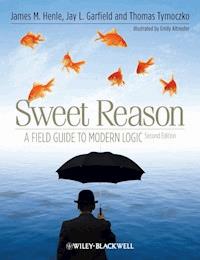
Sweet Reason: A Field Guide to Modern Logic, 2nd Edition offers an innovative, friendly, and effective introduction to logic. It integrates formal first order, modal, and non-classical logic with natural language reasoning, analytical writing, critical thinking, set theory, and the philosophy of logic and mathematics.
- An innovative introduction to the field of logic designed to entertain as it informs
- Integrates formal first order, modal, and non-classical logic with natural language reasoning, analytical writing, critical thinking, set theory, and the philosophy of logic and mathematics
- Addresses contemporary applications of logic in fields such as computer science and linguistics
- A web-site (http://www.wiley.com/go/henle) linked to the text features numerous supplemental exercises and examples, enlightening puzzles and cartoons, and insightful essays
Sie lesen das E-Book in den Legimi-Apps auf:
Seitenzahl: 487
Veröffentlichungsjahr: 2011
Ähnliche




















Contents
Preface
What Is Logic?
Chapter One
1.1 Introducing Formal Logic
1.2 Constants and Relations
1.3 Quantifiers and Variables
1.4 Introducing Informal Logic
1.5 Conclusions
1.6 Dialects of Logic
Chapter Two
2.1 Formal Inference
2.2 Informal Inference
2.3 Diagramming Arguments
2.4 Saying No
2.5 Metalogic
Chapter Three
3.1 Basic Sentential
3.2 Truth Tables
3.3 English to Sentential
3.4 Negating Statements
3.5 Rebutting Premises
3.6 Computer Logic
Chapter Four
4.1 Validity
4.2 The Logic of English
4.3 Negating Conditionals
4.4 Rebutting Inferences
4.5 The Logic of Sets
Chapter Five
5.1 Well-formed Formulas
5.2 The Shortcut Method
5.3 Local and Global
5.4 More on Trees
5.5 Rebutting Everything
5.6 Polish Logic
Chapter Six
6.1 Predicate
6.2 English to Predicate
6.3 Reading Between the Lines
6.4 Multi-valued Logic
Chapter Seven
7.1 Universes
7.2 Syllogisms
7.3 Validity
7.4 Diagramming Your Argument
7.5 Inductive Logic
Chapter Eight
8.1 Predicate Wffs
8.2 Outlining Your Argument
8.3 The Logic of Chance
Chapter Nine
9.1 Simple Deduction
9.2 Simple Strategy
9.3 Writing Your Argument
9.4 Basic Modal Logic
Chapter Ten
10.1 Sentential Deduction
10.2 Sentential Strategy
10.3 Arguing with Yourself
10.4 Sophisticated Modal Logic
Chapter Eleven
11.1 Predicate Deduction
11.2 Predicate Strategy
11.3 Why We Argue
11.4 Presidential Debating
11.5 The Logic of Paradox
Chapter Twelve
12.1 Deduction with Identity
12.2 Deduction, FMTYEWTK
12.3 Parliamentary Debating
12.4 Cathy, A Decade On
12.5 Incomplete Logic
What is Logic?
Answers to Odd-Numbered Exercises
Index
This edition first published 2011© 2012 John Wiley & Sons Inc.
Wiley-Blackwell is an imprint of John Wiley & Sons, formed by the merger of Wiley’s global Scientific, Technical and Medical business with Blackwell Publishing.
Registered OfficeJohn Wiley & Sons Ltd, The Atrium, Southern Gate, Chichester, West Sussex, PO19 8SQ, United Kingdom
Editorial Offices350 Main Street, Malden, MA 02148-5020, USA9600 Garsington Road, Oxford, OX4 2DQ, UKThe Atrium, Southern Gate, Chichester, West Sussex, PO19 8SQ, UK
For details of our global editorial offices, for customer services, and for information about how to apply for permission to reuse the copyright material in this book please see our website at www.wiley.com/wiley-blackwell.
The right of James M. Henle, Jay L. Garfield and Thomas Tymoczko to be identified as the authors of this work has been asserted in accordance with the UK Copyright, Designs and Patents Act 1988.
All rights reserved. No part of this publication may be reproduced, stored in a retrieval system, or transmitted, in any form or by any means, electronic, mechanical, photocopying, recording or otherwise, except as permitted by the UK Copyright, Designs and Patents Act 1988, without the prior permission of the publisher.
Wiley also publishes its books in a variety of electronic formats. Some content that appears in print may not be available in electronic books.
Designations used by companies to distinguish their products are often claimed as trademarks. All brand names and product names used in this book are trade names, service marks, trademarks or registered trademarks of their respective owners. The publisher is not associated with any product or vendor mentioned in this book. This publication is designed to provide accurate and authoritative information in regard to the subject matter covered. It is sold on the understanding that the publisher is not engaged in rendering professional services. If professional advice or other expert assistance is required, the services of a competent professional should be sought.
Library of Congress Cataloging-in-Publication Data
Henle, James M.Sweet reason : a field guide to modern logic / James M. Henle, Jay L. Garfield, Thomas Tymoczko ; with illustrations by Emily Altreuter. – 2nd ed.p. cm.Thomas Tymoczko listed first of prev. ed.Includes bibliographical references and index.
ISBN 978-1-4443-3715-0 (pbk.)1. Logic, Modern–20th century. I. Garfield, Jay L., 1955– II. Tymoczko, Thomas. III. Title.BC38.T86 2011160–dc22
2011015191
A catalogue record for this book is available from the British Library.
This book is published in the following electronic formats: ePDFs 9781118078631; ePub 9781118078686
To those taught us Logic, Gene Kleinberg,Nuel D Belnap, Jr and Hilary Putnam
Preface
This is an unusual introductory logic text. It teaches beginning students to understand logic not as a fixed body of knowledge or set of techniques, but as an active field of inquiry and intellectual controversy. We provide students with the tools to explore the nature of inference, the subtleties of language, and to test the bounds of rationality. This is a book designed to begin the education of logicians.
Sweet Reason goes deeper into the philosophy and applications of logic than standard texts. It is also more fun to read and more enjoyable to teach. We focus on the paradoxes at the heart of philosophical logic and the puzzles at the heart of mathematical logic. There are stories, there are entertainments, there are characters.
We present all the usual topics in first-order predicate logic. We also offer a unique and especially clean approach to analytic reading, writing and debate. The two areas, “formal” and “informal” logic, are thoroughly integrated in the text, each illustrating and informing the other.
We contextualize our presentation in the history and philosophy of logic, allowing us to introduce a variety of extensions to basic logic that take students to areas of exciting contemporary research: many-valued logic, modal logic, for example, and probability. Every chapter addresses both formal logic and critical thinking, as well as the philosophy of logic and its applications. Students learn more logic, enjoy it more and develop a deeper appreciation for logical inquiry through this integrated treatment of the discipline, and through exposure to controversy in the field.
Sweet Reason is ambitious but approachable and attainable. Novice logicians—that is, first-semester first-year students—do as well as philosophy majors and pre-law students. The mix of light and serious draws them in. The mix of formal and informal keeps them centered.
Not everything we teach fits within these covers. Our website contains a wealth of supplemental material, ranging from examples and exercises, to puzzles and curios, to extended discussions of history, philosophy, and mathematics. There are essays on religion, poetry, time travel, the tax code, and much more. Whenever a topic in the book is explored more deeply on the website, we place this logo in the margin of the text.
The website (sweetreason2ed.com) is constantly being updated, and will keep the volume current.
Problems of greater difficulty are specially marked:
1. (Ordinary problem)
2! (Hard problem)
3!! (Really hard problem)
4!!! (Absurdly hard problem)
This second edition of Sweet Reason is a wholesale revision of the first, reflecting our own (Jim’s and Jay’s) evolving pedagogy. We think that students and teachers alike will find it clearer and more enjoyable. We owe a lot to our late colleague Tom whose absence in this enterprise we feel keenly.
Colleagues near and far contributed much to the shape and content of this edition: Howard Adelman, Lee Bowie, Jill DeVilliers, Keith Devlin, Ruth Eberle, Lawry Finsen, Randy Frost, Michael Henle, Fred Hoffman, Murray Kiteley, Roman Kossak, Joe O’Rourke, Judy Roitman, Bob Roos, Lee Sallows, Dan Velleman, Stan Wagon, Marlene Wong, and Andrzej Zarach.
We are especially grateful for the support of students past and present, especially Gina Cooke, Kira Hylton, Marti McCausland, Cathy Weir, Theresa Huang, Julia Wu, Caroline Sluyter and all who cut their logical teeth on primitive versions of “Buffalo buffalo buffalo,” “The Digestor’s Digest,” and “Obscure British Novels of 1873.”
The second edition owes an incalculable debt to a talented team of student editors: Sarah Bolts, Ekaterina Eydelnaut, Caroline Fox, Emily Garvey, Penka Kovacheva, Juan Li, Sally Moen, and Katherine Peterson. Their many contributions include numerous problems, illustrations, and intelligent review.
We would like to salute here the late Jerry Lyons, our first editor and constant counsel. Perhaps there would have been a second edition, but without his encouragement and enthusiasm there wouldn’t have been a first.
Tom Tymoczko died in 1995 after a short illness. He was a remarkable philosopher who made important contributions to the philosophies of mind, epistemology, language, and especially the philosophy of mathematics. His work compelled attention for a variety of reasons. He combined an appreciation for the unchanging nature of his subjects with a sharp understanding of their mutability. His insight into mathematical practice could almost be described as hip. His ideas were clear and he wrote about them with great clarity. As colleague and friend, we miss him.
Jim Henle and Jay GarfieldJune 2010
How critical is Logic? I will tell you. In every corner of the known universe, you will find either the presence of logical arguments or, more significantly, the absence. (V.K. Samadar)
What Is Logic?
That’s hard to say.
Logic is about relationships among statements, about the abstract structure of statements, and about the nature of arguments. A logic is an attempt to understand when one statement follows from other statements, and why. Logic is not a settled body of knowledge, but a domain of inquiry, in which we encounter different logics for different purposes, and debates among logicians about the nature of these logics and their relative merits.
We’re going to show you a number of logics and introduce you to some of the challenges logic provides. You will encounter unfamiliar and sometimes perplexing ideas. You will learn a set of techniques for thinking and writing, and will gain a deeper appreciation of structure. You will think and write more clearly. You will debate more effectively.
You’re also going to have a lot of fun. Some of the deepest ideas of logic appeared first as paradoxes, some of them thousands of years ago. There is a great synergy between logical puzzles and logical insight. And there is pleasure in logic. The most powerful logical ideas are also the most enchanting, the most beautiful.
So, what is logic?
We’ll talk about that again at the end.
Chapter One
First, a word about this chapter. Let’s say you’re going to learn to swim. You’re 5 years old and a little afraid of the water. Your swimming teacher tells you not to be afraid, and picks you up and throws you into the pool!
You immediately start thrashing about with your arms and legs. You’re really scared, but after a few seconds, you notice that you’re not drowning, you’re keeping your head above water. In a few more seconds, you’ve made your way to the side of the pool and you’re hanging on to the edge trying to figure out what happened.
You didn’t drown because everyone is born with swimming reflexes and instincts. When your teacher threw you in, those reflexes took command and saved you. Now that it’s over, you’re not as frightened of the water. You’ve been in the middle of the pool and survived.
This chapter is a little like that first swimming lesson. You may never have studied logic, but you do, in fact, know quite a bit. If you didn’t, you could hardly speak, let alone make your way in the world.
We’re going to throw everything at you. You’ll be surprised at how easy it is to understand the symbols. It’s easy because the logical ideas represented by the symbols are basic ideas that you’ve worked with all your life.
Logic can seem scary at first. If you don’t know what they mean, strange symbols
can appear frightening …
But don’t panic. The “∀” symbol just means “everything.” You’ll see how it works in a moment. It’s not as mean as it looks.
1.1 Introducing Formal Logic
There was only one catch and that was Catch 22, which specified that a concern for one’s own safety in the face of dangers that were real and immediate was the process of a rational mind. Orr was crazy and could be grounded. All he had to do was ask; and as soon as he did, he would no longer be crazy and would have to fly more missions. Orr would be crazy to fly more missions and sane if he didn’t, but if he was sane he had to fly them. If he flew them he was crazy and didn’t have to but if he didn’t want to he was sane and had to. (Joseph Heller, Catch-22)
We begin with connectives, the logical operations that link sentences to each other. We don’t have many connectives; they’re all familiar to you. You know them as “and”, “or”, “not”, “if … then”, and “if and only if”. Connectives allow us to create complex statements from simple statements. Suppose A and B are statements. Then we’ll use
to say that both A and B are true. We’ll use
to mean that at least one of A, B is true (A is true or B is true or both are true). We’ll use
to mean that A is not true. We’ll use
to mean that if A is true then so is B. And finally we’ll use
to mean that A is true if and only if B is true, that is, A and B have the same truth value.
Let’s say we have these statements:
P: George is late to the meeting.
Q: The meeting is in Detroit.
R: George brings a casserole.
Example
How do we say that either George will be late or he’ll bring a casserole?
Answer:
Example
What does Q ⇒ P mean?
Answer: If the meeting is in Detroit then George will be late.
Example
Represent the following with symbols: The meeting is in Detroit and either George doesn’t bring a casserole or George is late.
Answer: Q ∧ (¬R ∨ P) Note the use of parentheses here. We’ll say more about this later.
Exercises Introducing Formal Logic
Odd-numbered solutions begin on page 350
Translate the following sentences using P, Q, and R from above.
1. George is late and the meeting is in Detroit.
2. If the meeting is in Detroit, then George brings a casserole.
3. Either George is late or he does not bring a casserole.
4. George brings a casserole if and only if the meeting is in Detroit.
5. If George does not bring a casserole, he is not late.
6. If the meeting is in Detroit then George brings a casserole, and if George brings a casserole then he is late.
7. The meeting is in Detroit if and only if both George is late and he doesn’t bring a casserole.
8. The meeting is in Detroit, and either George is late or he brings a casserole.
Determine the meaning of each of the following sentences.
Lesen Sie weiter in der vollständigen Ausgabe!
Lesen Sie weiter in der vollständigen Ausgabe!
Lesen Sie weiter in der vollständigen Ausgabe!
Lesen Sie weiter in der vollständigen Ausgabe!
Lesen Sie weiter in der vollständigen Ausgabe!
Lesen Sie weiter in der vollständigen Ausgabe!
Lesen Sie weiter in der vollständigen Ausgabe!
Lesen Sie weiter in der vollständigen Ausgabe!
Lesen Sie weiter in der vollständigen Ausgabe!
Lesen Sie weiter in der vollständigen Ausgabe!
Lesen Sie weiter in der vollständigen Ausgabe!
Lesen Sie weiter in der vollständigen Ausgabe!
Lesen Sie weiter in der vollständigen Ausgabe!
Lesen Sie weiter in der vollständigen Ausgabe!




