


Erhalten Sie Zugang zu diesem und mehr als 300000 Büchern ab EUR 5,99 monatlich.
- Herausgeber: The History Press
- Kategorie: Geisteswissenschaft
- Sprache: Englisch
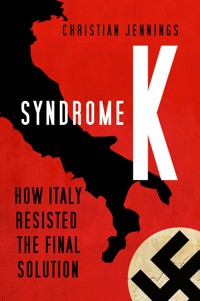
Syndrome K is the story of how 80 per cent of Italy's Jews escaped the Holocaust, with the help of their fellow countrymen, the Allies and even some Germans. From claiming sanctuary in the Vatican to pitched battles by partisans, and even inventing a highly contagious 'Jewish disease', it was an ingenious, covert and complicated effort – and one that saved the lives of thousands of people. Drawing on original archive material from Italy, Germany, the Vatican City, Switzerland, the UK and US, acclaimed historian Christian Jennings tells the whole story in English for the first time.
Sie lesen das E-Book in den Legimi-Apps auf:
Seitenzahl: 449
Veröffentlichungsjahr: 2022
Das E-Book (TTS) können Sie hören im Abo „Legimi Premium” in Legimi-Apps auf:
Ähnliche



















For Sylvia, who always strives to seek out the humanity and the good, both in history and in life. With thanks that reach to the stars.
Back cover quote: Caitlin Hu, ‘An Italian doctor explains “Syndrome K,” the fake disease he invented to save Jews from the Nazis’, Quartz Magazine, 8 July 2016. qz.com/724169/an-italian-doctor-explains-syndrome-k-the-fake-disease-he-invented-to-save-jews-from-the-nazis/.
First published 2022
The History Press
97 St George’s Place, Cheltenham,
Gloucestershire, GL50 3QB
www.thehistorypress.co.uk
© Christian Jennings, 2022
The right of Christian Jennings to be identified as the Author of this work has been asserted in accordance with the Copyright, Designs and Patents Act 1988.
All rights reserved. No part of this book may be reprinted or reproduced or utilised in any form or by any electronic, mechanical or other means, now known or hereafter invented, including photocopying and recording, or in any information storage or retrieval system, without the permission in writing from the Publishers.
British Library Cataloguing in Publication Data.
A catalogue record for this book is available from the British Library.
ISBN 978 1 8039 9069 9
Typesetting and origination by The History Press
Printed and bound in Great Britain by TJ Books Limited, Padstow, Cornwall.
eBook converted by Geethik Technologies
CONTENTS
Acknowledgements
Prologue The Postcard from the Train
1 The Piperno Family and the Jews of Rome
2 Mussolini is Listening to You
3 Rome, Repression and Resistance
4 The Papal Resistance to Hitler
5 Codes of the Holocaust
6 The Code-Breakers at War
7 On the Banks of Lake Maggiore
8 The Retata of Rome
9 Arrest and Deportation
10 The SS Network in Italy
11 Detention and Fighting Back
12 On the Run from Rome to Florence
13 Retaliation
14 Jewish Partisans in Italy
15 Liberation
16 The Diary of an SS Double Agent
17 The End in Northern Italy
18 The Selvino Camp
19 The German Aftermath
Epilogue What Became of the Other Characters in the Book?
Further Reading
Notes
ACKNOWLEDGEMENTS
Thanks must go, as always, to my outstanding literary agent, Andrew Lownie. I’m very grateful as well to Mark Beynon at The History Press, who saw the idea and story behind the book, and published it with verve, style and commitment. Along the way, friends and family have stood watch: Giulia Avataneo, Kat Sacco, my brothers Anthony and James, and sister Flora. I’m grateful, too, to David Kenyon, for his expert advice and help on things cryptanalytical.
Complex war crimes investigations, especially when dealing with a subject as monumental and epochal as the Holocaust, are always far from easy. In seventeen years on the road as a foreign correspondent, across countries such as Rwanda, Burundi, Democratic Congo, Kosovo and Bosnia, I was lucky to have good friends and colleagues. I learned rather a lot from them about writing and investigating such stories: Nerma Jelacic, Corinne Dufka, Beth Kampschror, Adam Boys, Peter Bouckaert, Elida Ramadani, Lejla Hadzimesic and Jonah Hull.
PROLOGUE
THE POSTCARD FROM THE TRAIN
Verona, December 1943
Nobody survived to tell the story of how Wanda Abenaim wrote the last message to her family. There would have been witnesses, that winter day at Verona Station, as the convoy of cattle cars clattered and rumbled through the city. But probably none of them remained alive for very long, because the train’s final destination was the camp complex at Auschwitz-Birkenau, and because Wanda was an Italian Jew who’d been betrayed. From the writing on the old postcard she wrote, it seems as though she had somehow managed to conceal a fountain pen somewhere on her person as the Schutzstaffel (SS) and Italian Fascist police arrested her. If she’d been writing the card in the cattle car, there would have hardly been space to move her arm or write, as there would have been so many people jammed into the carriage alongside her. But, from the look of the smeared ink, she may have licked her finger and smudged out the writing of the former address on the card. Writing diagonally on one side of it and straight on the other, she scribbled her message. She might have done this in the German lorry on the way to Verona Station or before she got on the train, and then dropped the postcard onto the railway tracks. Or maybe she had written it on the train itself and then, when it was done, reached up to the small window on the side of the railway wagon and pushed the slip of cardboard out, so it fluttered down and fell onto the tracks. As Wanda said on her postcard, she had no idea of her destination.
Other prisoners deported on German Holocaust transport trains from Italy had dropped last postcards, desperate messages written on pieces of paper or envelopes. On 18 October 1943, for instance, a railway worker at Padua Station had found a railway ticket, thrown from a train, which must have had an address and message on it, as the man forwarded it on to an unknown recipient. The train in question, passing through Padua on that day, was the first convoy of Italian Jews to leave Rome after the German roundup on 16 October. So, in December, as Wanda Abenaim’s train pulled out of Verona, one of the soldiers guarding the station, or a railway worker, must have found her postcard on the platform or the tracks. And somehow they forwarded it on or gave it to somebody, as it survives today. Written in ink are the following words:
My dear Signora,
With a heavy heart I leave my native land. I leave for distant lands alone, but I will be brave. Kiss my dear mother and brother and tell them to pray for me and that I will never forget them. I will do everything to send my news. I’m well. Tell Carlo to remember that those two are not with me, and that he should protect them and help them as if they were his. I hope we see each other again soon. I kiss and hug you. Ciao, your most affectionate Wanda.1
Over a week previously, the SS and Italian Fascist police had burst into the convent in Florence where she and other Italian Jews had been hidden by Franciscan nuns. They’d been betrayed.2 Wanda had had no news from her husband in Genoa, nor from his family, for three weeks. As the SS men shouldered their way into the convent, it’s uncertain whether they would have bothered giving Abenaim and the other Jews the customary slip of paper that was handed to other Jewish deportees in Italy as their flats, houses, offices and workplaces were raided by the Gestapo, SS and Italian Fascists. It was the official list of what Jews were allowed to take with them:
Together with your family, and any other Jews in your home, you are being relocated.
You must bring the following with you: food for at least eight days; ration cards, identity card, glasses, suitcases with personal effects, underwear and blankets.
Bring money and jewels.
Close and lock your flat, any sick people, however ill, cannot be left behind. There is an infirmary in the camp.
You have twenty minutes to be ready for departure.3
Only Wanda and one other family member would be taken away from the Franciscans in Florence. Nobody else was there. Her husband Riccardo was in Genoa, where he was the Chief Rabbi, and that was where her two brothers, Carlo and Ettore, and her mother were as well. Half an hour later, she and a group of other Jewish families were outside on the pavement, their suitcases at their sides. The group were herded onto lorries that took them first to a prison in Florence, and then on to Verona, 150 miles to the north. That December, with the Allied and American armies bogged down around Monte Cassino, south of Rome, both Florence and Verona were way behind the front lines of the German armies who had occupied Italy in that summer of 1943, after the Italians had surrendered.
On 6 December, Wanda was forced at rifle point onto the convoy of cattle cars waiting at Verona Station. Some of the cars would have been already full, for the train had formed up on Milan’s Platform 21, from which Holocaust deportations from that city took place. Prisoners arrested in other cities such as Turin and Genoa would have been transported to Milan. Deportation Convoy No. 5 would now pass from Milan to Verona, Padua and Treviso, on the west side of the Venetian lagoon, before heading east towards Tarvisio, the Austrian border at Arnoldstein, and thence Vienna. Thankfully, the 37-year-old Wanda didn’t have her two children with her. Raffaele, who was 5, and Emanuele, 13, were both in hiding in another convent on the hills above Florence.
At the same time, a 34-year-old Roman Catholic priest called Don Francisco Repetto was working with an organisation called Delegazione Assistenza Emigranti Ebrei (Delegation for the Assistance of Jewish Emigrants, DELASEM) in Genoa. Wanda’s children were just two of the hundreds of Jews whom Repetto had helped to hide – in Florence, in the towns and villages along the Ligurian coast, in the hills and valleys of the province of Cuneo that lay to the north of it, along the border that divides France from north-western Italy. Jewish families hid in family homes, churches, convents, seminaries, disused army barracks and farm buildings, until it was time to move them across the border into Switzerland or France, or stayed hidden in Italy itself. An Italian lawyer in Switzerland, Lelio Valobra, channelled money to DELASEM in Italy, which was working hand-in-hand with the Genoa curia.
The money came in from the United States via bank transfers to Geneva, from donations managed by the American Jewish Joint Distribution Committee. This paid for such vital things as false identity cards, food, transport, medical supplies, clothes, bribes to Italian Fascist and German officials – everything needed by the thousands of Jews on the run inside Italy. Up until the beginning of November 1943, the main liaison and point of contact for DELASEM and Repetto inside the Jewish community of Genoa had been their Chief Rabbi, Riccardo Pacifici, the husband of Wanda Abenaim.
But Fascist informers betrayed him for money to the Sicherheitsdienst (SD), the SS’s intelligence service. One SS Lieutenant who operated for them in Genoa and Milan was in charge of arranging the deportations of Jews from Genoa and Liguria, and also of appropriating their property on behalf of the SS’s economic department at the Reich Security Main Office in Berlin.
So when the Fascist informers told the SS that Rabbi Pacifici was focally involved in hiding Jews, this SS officer acted. Pacifici was arrested on 3 November, questioned in Genoa and then transferred to Milan, where he was put onto a deportation convoy heading for Auschwitz. He left Milan on Convoy No. 5 on 6 December, travelling through Italy, to Austria, and then a final destination at Auschwitz-Birkenau.
Meanwhile, British cryptanalysts at Bletchley Park in England had cracked some of the codes used on the Enigma machine by the Reichsbahn. This was the Third Reich’s railway system whose responsibilities included running the network of Holocaust transport trains: every time a convoy of cattle cars loaded with deportees left Turin, Vienna, Lublin or Munich for one of the camps in the Konzentrationslager (KL) network, messages announcing departure times, arrival times, destinations and number of prisoners were sent to the Reich Security Main Office in Berlin. The messages were first encoded on an Enigma machine, and the subsequent message encoded again, for security. This was a process known as ‘superencipherment’ but, although it guaranteed increased cryptographical security, it didn’t make the message uncrackable if somebody – in this case the British at Bletchley – knew what the coded Enigma settings were. And the men and women at ‘The Park’, as the British Government Code and Cypher School was nicknamed, had cracked three of the crucial code settings used by the Reichsbahn. Bletchley had named them Blunderbuss, Culverin and Rocket.
So, between this network of people so closely involved in the Holocaust in Italy, some details about some SS deportation trains were known. However, what neither the SS officer in Genoa, the OSS, Bletchley Park, DELASEM nor perhaps even Riccardo Pacifici knew was this. That, on 6 December at Verona, another party of Jews was forced aboard the cattle cars of Convoy No. 5, the same convoy as Rabbi Pacifici. Among them was his wife, Wanda Abenaim. Nobody knows if the couple were aware of each other’s presence on the train, or if they travelled up the line to death separated from each other.
Seventy-five years on from that frozen morning at Verona Station, little physical reminder remains of the fate of Riccardo Pacifici, Wanda Abenaim, or their uncle from Genoa, who was another rabbi. Riccardo arrived at Auschwitz on the night of 11 and 12 December 1943 and was immediately selected for the gas chamber.
Nowadays, a small brass plaque set in the pavement outside Galleria Mazzini commemorates the point where he was arrested in Genoa. ‘Qui e stato arrestato,’ it says, ‘3.11.1943, Reuven Riccardo Pacifici, Rabbino Capo di Genova. Nato 1904, Assassinato 11.12.1943, Auschwitz.’4 It’s a pietra d’inciampo in Italian, a stolperstein in German, just one of tens of thousands of such memorial stones set into pavements across Europe, outside houses, businesses and apartment buildings where Jews were arrested during the Holocaust.
Pacifici’s niece, Elena, was on the same deportation convoy as him in December 1943, and three years ago, DNA was used to help identify her remains, disinterred from a graveyard in the small Catholic cemetery in the village of Swierklany Dolne. It sits 30 miles west of the town of Oswiecim, where the camps of the Auschwitz complex stood.
Wanda Abenaim, Riccardo Pacifici, Monsignor Francisco Repetto and the SD lieutenant in Genoa – who was called Guido Zimmer – were just four people, four parts among thousands in the Holocaust in Italy, which lasted from August 1943 to April 1945. Yet they mattered so much, not just because of who they were, or what happened to them – especially those murdered in the concentration camp system – but because of what they did. They were all middle-level, mid-ranking officials, members of the religious curia, SD officers, etc. – but it was people like them who were the organisational cogs in the German implementation of the Final Solution in Italy, and the Allied and Italian resistance to it. These were people who did things.
Of the approximately 45,000 Jews who were physically present on Italian territory when the Germans occupied the country in August and September 1943, the majority were Italian. Some were refugees from other countries in Europe, such as Holland, Austria and Poland, where the Holocaust had swung into action from 1940 onwards. Adolf Eichmann and the SS had estimated that there were 58,000 Jews in Italy and Sardinia in January 1942, a number that would have dropped by the time the Germans occupied Italy in August 1943, as some Jews took refuge abroad. But Yad Vashem, the Holocaust Memorial Centre in Jerusalem, puts the total at 44,500 Jews present in Italy. By April 1945, just under two years later, about 8,400 had been arrested and deported, some 750–800 had survived the Holocaust and an estimated 7,680–8,000 had died.5 A further 36,820 had survived, whether by escaping, emigrating or hiding. Horrific as these figures are, they still represent the second highest survival rate of any national Jewish community in Europe – the highest was Denmark. At over 80 per cent, this rate was enormous, given the Germans’ huge efforts to implement the Final Solution in European countries. Faced with these figures, a mathematical statistical analyst could argue convincingly that the German implementation of the Final Solution had failed to achieve its objectives in Italy.
The spirits of 8,000 murdered Jewish people, along with partisans, communists, Roma, homosexuals and political detainees, would stand to temper the use of this word ‘failure’. But when compared to the percentage of Jews arrested in a country like the Netherlands, where 105,000 out of 150,000 Dutch Jews were deported and murdered in the KL network, Italy’s survival rate is astonishing. This book looks at the principal reasons why, through the eyes of some of the people of all ranks, levels of importance and nationalities who found themselves involved with the Holocaust in Italy.
Resistance to the Final Solution in the country can roughly be divided into the two areas of what the Italians and the Allies did to prevent it, slow it down or resist it, and a third area of the operational failings of the Germans – what they did that short-circuited or blocked their own plans.
The Italians’ greatest triumph was hiding their fellow countrymen everywhere they could, from churches and convents to farms and city apartments. Their next triumph lay in their partisan operations, which denied the Germans logistical stability in their areas of occupation in Italy to carry out the necessary round-up, arrest and deportation operations.
In other countries, such as France, Poland and Austria, the Holocaust was carried out once the Germans had invaded and pacified the country. The opposite was the case in Italy – the Allied armies were fighting their way up the country from July 1943 onwards, bombing railways, roads and logistical links, while behind the lines, thousands of partisans kept the Germans tied down. These resistance groups also absorbed Jews into their ranks, effectively hiding them. The Vatican was fundamentally involved in concealing Jews and supporting the resistance against Hitler, at the price of not speaking out vociferously and directly against the deportation of Rome’s Jews.
The Germans’ main failing was that their Gestapo and SS officials were often incompetent, while some were operating as intelligence agents for the Allies, and other Wehrmacht officers and diplomats were actively supporting operations to hide Jews. A huge Allied advantage was that they could read the codes both of their enemies and of neutral countries like Switzerland and, occasionally, the Vatican.
Predominantly, though, the Final Solution didn’t work in Italy because the Italian population decided to fight it, to resist it in any way they could. They had decided that enough was enough: that the Germans’ genocidal policies were not going to succeed in Italy, simply because Italians had decided that they wouldn’t allow it and were prepared to do whatever was required, however dangerous, however much bravery, intelligence or determination was needed to stop the Holocaust in its tracks.
Over seventy-five years later, signals that detail the operations of the Germans in Rome that summer and autumn of 1943, as they commenced the implementation of the Final Solution in Italy, are now spread across several countries, like four electronic winds. The original translations from the German, made long ago in huts at Bletchley Park, are all in archives now. So are the covert memos, the analyses, the explanations of how the Allies deciphered the codes of the German concentration camp system, enabling them to know how many inmates of each camp were dying, or being murdered, each day. The original signal translation ‘flimsies’ are stapled to pages of A4, as a form of frame. Many have disappeared, but many survive. They’re in Bletchley Park’s libraries; they’re in the American National Archives at College Park in Maryland; and they’re in the British National Archives at Kew. They’re also in Rome, and at the German Foreign Ministry in Berlin. Some are in Jerusalem, Istanbul and Prague. The Finns have some, too.
In two ‘record groups’ alone there are 6,300 messages. HW 19/237, now in the British National Archives, is just one subseries of messages intercepted by Bletchley, concerning the activities of the SD in Italy after the occupation of the country. In it, there are 1,500 decoded signals alone. In HW 238–240 there are an estimated 4,800 more. The signals, their transmissions and their contents were like a constant humming, electronic soundtrack to the daily operations of the Germans as they undertook the Holocaust, both in Italy and elsewhere.
And understanding how the Allies intercepted these signals, decrypted and translated them, and how they then acted on this intelligence, shines a (sometimes) clear light onto the tactical and strategic decisions made by the Allies regarding the Holocaust in Italy – what they knew, and what they did or didn’t, could or couldn’t, do to stop, resist or sabotage it. The British, for instance, knew a lot of what the Germans were doing in Italy when it came to the execution of the Final Solution, which is why they forwarded a selection of carefully screened pertinent information to their ambassador at the Vatican. This was censored and discreetly camouflaged so that it did not reveal the secret of Bletchley Park’s successes with the Enigma decrypts, which they code-named ‘Ultra’.
Even though both the Italians and Germans could read some British diplomatic traffic, neither side deduced that their enemies and other neutral protagonists knew what they, in turn, were doing when it came to code-breaking. The Germans, in particular, did not work out from the contents of the British diplomatic messages they intercepted that their enemies had been able to decrypt their own messages encoded on Enigma.
For example, the British were able to read Gestapo chief Herbert Kappler’s encrypted radio message from Rome to Berlin on 24 September 1943. This said that the Vatican had been ‘selling’ Portuguese, Spanish, Argentine and Mexican visas to Jews who wanted to smuggle themselves out on a train that was carrying Spanish diplomats from Rome back to Spain. As mentioned above, the British Government Codes & Cypher School, as Bletchley was formally known, had also managed by this point to decrypt some parts of the Enigma settings that were used by the German Reich Transport Ministry. This gave British code-breakers an additional advantage in gaining intelligence into the wider, logistical movements of Germany’s war-machine in action across Europe.6 When it came to the coded messages coming out of Rome by 17 October 1943, they left nobody in any doubt as to what was taking place:
The SD is now pillaging Rome … Himmler has sent SS men who have had experience of this work in Russia to Rome …
This was one Enigma-encrypted signal read by Bletchley Park on 17 October, sent back to the foreign ministry in Berne by the Swiss Ambassador to the Holy See.
While the Vatican knew the Germans’ intentions for Italy at the beginning of October, the Germans, for their part, still didn’t know whether the Pope would formally and strongly object to a round-up of Italy’s Jews. The pontiff was lobbying the United States to receive Jewish refugees and the Germans feared Italy’s Jews would escape, while Italy’s Fascist Republic had said it would assist the Germans in the execution of the Final Solution.
All of this had given the Vatican vital advance warning, in turn allowing most of Italy’s 38,000 remaining Jews to escape, hide, take cover or fight back. The Pope, meanwhile, was also circulating coded instructions and secret letters via his staff and his Cardinal Secretary of State, Luigi Maglione. These were sent and hand-delivered, not just to Vatican nuncios in European capitals, but to selected Catholic convents, churches and seminaries in Rome to put into operation plans to conceal thousands of the capital’s Jews. Adolf Eichmann later wrote in his diary that ‘the objections given and the excessive delay in the steps necessary to complete the implementation of the operation resulted in a great part of Italian Jews being able to hide and escape capture’.
The amount of solid operational, decipherable information in existence in October 1943 was small, but crucial: the intentions of the SS; German military deployments across Italy; what the Pope had said; when the German arrest operations would commence. But where effective cryptanalysis and subsequent intelligence deciphering came into its own was by allowing each protagonist a head start in predicting each other’s operational intentions and knowing what they were doing.
The British, for instance, knew the Germans were committed to the execution of the Final Solution in Italy and had undertaken its operational implementation. Short of invading the country – which they’d already done in September 1943 – and bombing railway lines ahead of Holocaust transport trains, which they’d also done, one of their most effective options was to persuade the Pope to protest to the Germans as vociferously as possible. This would slow down the German operation, as the Vatican’s protests would have to be transmitted via diplomats and generals to Berlin and back; it would hopefully buy the Vatican time to warn Jews and advise Catholic seminaries and convents to prepare to hide them. In the event, this plan worked out differently than expected.
Other Allied initiatives to help Italy’s Jews in some cases bore more fruit. These involved parachuting Jewish SOE agents into Italy to lead partisan resistance groups, who in turn would try to disrupt Holocaust transports from Florence, Rome, Milan, Turin and Trieste. The American OSS went one step further and put into action a plan to ‘turn’ as many as possible of the key SS and Gestapo officials operating inside Italy, in charge of implementing the Final Solution, into double agents.
There were nine such men in Rome, Turin, Milan, Berlin, Verona and Florence. By the war’s end, it became apparent that four, if not five, of them had actively been working on behalf of American intelligence or were about to do so. These are just some of the reasons why, in the final reckoning, only 8,000 of Italy’s 45,000 Jews were arrested and suffered the horrors of deportation and concentration camps. These were 8,000 stories of loss, death and disappearance, but around 37,000 stories of escape, flight, hiding, escaping, surviving and living to see the liberation of Italy – 37,000 stories of life.
Looking at the story of the resistance by Italian civilians and partisans, the cracking of Holocaust codes, the duplicitous accounts of the SS and Gestapo in Italy, the Allied military and intelligence operations, and the stories of some of Italy’s Jews, Syndome K investigates what really happened, how it happened and why it happened.
1
THE PIPERNO FAMILY AND THE JEWS OF ROME
‘We’re Italian first, Jewish second, monarchist third, and Fascist last.’ That was how Clotilde Piperno described herself and her family when people asked. A large middle-class clan of wholesale textile merchants, the Pipernos had always lived in Rome. They had a house near Piazza Giudea, within a few hundred yards of the Jewish ghetto. Since the 1500s, this had stood next to the River Tiber and the ruins of the old open-air Theatre of Marcellus, designed and built by the nephew of the Emperor Augustus and by Julius Caesar, just before the latter was murdered. Rome, ancient and modern, had surrounded each generation of the Pipernos at every step. There had been Jews in Italy since 200 BC, during the period of the Roman Republic. They were concentrated among communities of Sephardic and Ashkenazi Jews, who had originated in Spain and the lands of the former Holy Roman Empire, as well as Persian, Libyan and Italian Jews.
The Jews of Rome had always been forced to live in the cramped, crowded, walled ghetto, until Napoleon’s generals invaded Rome in 1798. In that year, the Roman Republic was formed and took over the Papal States: this made a huge and direct difference to the life of Clotilde’s great-grandparents, since one of the sweeping changes instituted under the new republic was to abolish the requirement for the city’s Jews to live in the ghetto.
This reprieve did not last long. In 1799, the Vatican states were introduced, and the Jews had to return to within their walled enclave. It was to be nearly 100 years before King Re Umberto finally tore down the ghetto in 1888. Clotilde’s father said that this king had brought them freedom from centuries of repression. He himself was to be decorated in 1866 for his part in the Third Italian War of Independence, fighting to push the Austrians out of north-eastern Italy.
On his return to Rome after the war, he married, and Clotilde was the first child. She grew up to see King Vittorio Emanuele III crowned in 1900, and by the time she married the son of another Jewish family from Rome, Italy was heading for another war with Austria. Her husband Giacomo became an officer – Jewish men formed the highest single percentage of commissioned ranks in the Italian Army, due to their educational advantages.
Lieutenant Giacomo was sent to fight against the Austro-Hungarians in the successive battles at the Isonzo River, north-east of Venice. For two years, the pride of the Italian Army hammered against the Austro-Hungarians in twelve confrontations, losing 300,000 men, and sometimes advancing less than a mile across the valleys and snow-covered mountain slopes before becoming bogged down in stalemate.
The twelfth and final battle of the Isonzo took place in October 1917 near the town of Caporetto. Austro-Hungarian units had been reinforced by German stormtroopers, including a company led by a young Lieutenant Erwin Rommel. Under cover of a massive phosgene gas attack, the Austro-Hungarians and Germans finally broke through the Italian lines. It was a staggering defeat for Italy. Half of Italy’s total casualties in the First World War fell at the Isonzo, and at Caporetto, 265,000 of the country’s soldiers were taken prisoner. But out of this chaos of defeat and imprisonment, Clotilde Piperno’s husband, Giacomo, returned safely to Rome.
One of the many casualties of the battles at the Isonzo was a young former journalist turned army sergeant called Benito Mussolini. He was born in 1883 in Forli, in the central Italian region of Romagna. His father was a blacksmith, his mother a schoolteacher. The former was an ardent socialist, and the young Mussolini grew up to the sound of his father’s opinions about nationalism, anarchism and socialism – he was named after the liberal Mexican president, Benito Juarez. Reportedly grumpy, shy and prone to hubris and violence, he became a schoolteacher in 1901.1 Radical socialist politics followed, before he volunteered for the army at the outbreak of the First World War. In February 1917, during a training exercise near the Isonzo, a mortar bomb exploded prematurely, leaving him invalided out of the army with forty-four pieces of shrapnel inside him. Despite his wounds, and Italy’s appalling defeats against the Austro-Hungarians, he was a staunch supporter of the war, and afterwards founded an ultra-nationalist, anti-socialist political movement along with a group of disaffected veterans. They called themselves the Fasci di Combattimento, after the Roman ‘fasces’, a bundle of rods and a single axe which had originally represented the power and discipline of Etruscan magistrates.
In October 1922, with a mass demonstration known as the March on Rome, Mussolini’s Fascist Party launched an insurrection in the capital, which called the bluff of the Liberal prime minister. He stood down immediately, and King Vittorio Emanuele III appointed Benito Mussolini the country’s youngest-ever prime minister.
Over the succeeding five years, helped by his security militia, known as the Camicie Nere, or Blackshirts, he created a one-party dictatorship and a Fascist state. He outlawed labour strikes and trade unions and strengthened the role of capitalist enterprises. He began to expand Fascism’s overseas empire, starting colonial wars to take over both Libya and Ethiopia and establish what he called Italian East Africa, merging Somalia, Eritrea and Ethiopia.
The Organization for Vigilance and Repression of Anti-Fascism (OVRA) was Mussolini’s secret police force, founded in 1927 following an assassination attempt against him. Its 50,000 agents were infiltrated into every level of public, political and domestic life. Their role was simple – to prevent any ‘actions directed to violently subvert the social, economic or national order or undermine national security’. They spied on everybody – from the Vatican and the police to factory workers and industrialists.
Mussolini rose to power on a new-found tide of economic and nationalist optimism that blamed the defeats of the First World War on socialists and the monarchist ruling classes. For families like the Pipernos, economic prosperity followed. Italy became self-supporting in terms of agriculture, and more cash was available for the commodities in which the Pipernos traded – textiles, cotton and wool. Wholesale manufacturing expanded, assisted by state subsidies, which had also helped Italy stave off the worst of the Great Depression. People had jobs, Italian industry was showcased abroad, and at home, enormous naval rearmament programmes created work.
Clotilde and Giacomo’s two sons, born in 1897 and 1902, were called Adolfo and Giacomo ‘Due’ (or Giacomo No. 2). They married two sisters from the same family, called Vanda and Nella Sed, and each of them in turn had two children. Giacomo’s first son, born in 1922, was called Piero.
Two photographs from the early 1930s show the family in Rome. In one, Nonna or Grandma Clotilde holds court in a rattan chair, sitting at a table in the garden of a large house. Around her are her boys and their wives. The atmosphere is elegant, relaxed, affluent, at ease. Everybody is smiling.
There were some 50,000 Jews in Italy at that time, who were descendants of one of the four main, long-established communities: Spanish and Portuguese Sephardi Jews, originally expelled from the Iberian Peninsula in 1492; French Jews, similarly forced out of their own country; Italian Jews, who had lived in the country since Roman times; and the Ashkenazi Jews of northern Italy. The Jewish communities had been assimilated into Italian society, at different levels, for hundreds of years. Within the Italian Fascist Party, there were leading Fascist theorists, such as the occultist, Fascist intellectual philosopher and antisemitic conspiracy theorist, Julius Evola, who thought that harsher laws needed to be introduced, as in Nazi Germany, to restrict the Jews’ activities.
Mussolini disagreed. He largely rejected Hitler’s views on race. In 1934, after a speech in Rome, he laid out his views on racial politics:
Thirty centuries of history allows us to look with supreme pity on certain doctrines which are preached beyond the Alps by the descendants of those who were illiterate when Rome had Caesar, Virgil and Augustus.2
Key figures within the Fascist regime were Italian Jews. These included Aldo Finzi, a politician and second-in-command of the air force; Giorgio Morpurgo, who led Italy’s mission in the Spanish Civil War; Renzo Ravenna, who became Mayor of Trieste; and the highly influential and wealthy banker from Turin, Ettore Ovazza, who ensured that all key positions in the Jewish community in Turin were held by Fascist supporters.
Ovazza had marched with Mussolini on Rome in 1922. He met him in 1929 when he was part of a delegation of Jewish war veterans visiting Rome. After meeting the dictator, he said:
On hearing my affirmation of the unshakeable loyalty of Italian Jews to the Fatherland, His Excellency Mussolini looks me straight in the eye and says with a voice that penetrates straight to my heart: ‘I have never doubted it’. When Il Duce bids us farewell with a Roman salute, I feel an urge to embrace him, as a fascist, as an Italian, but I can’t; and approaching him at his desk I say: ‘Excellency, I would like to shake your hand’. It is not a fascist gesture, but it is a cry from the heart … Such is the man that Providence has given to Italy.3
One of Mussolini’s close friends, as well as his propaganda adviser, mistress and biographer, was called Margherita Sarfatti. A Jewish art critic, she wrote a highly popular book about the dictator called Dux.
The Italian Fascist regime went further in its allegiance with Jews. It helped establish what would, one day, become the Israeli Navy. In 1943, an officers’ training camp was established at Civitavecchia, on the coast outside Rome, where naval personnel from Mandated Palestine, then under British control, came for training by the Italians. Mussolini thought that by doing this, he would be able to adversely affect the naval balance of power in the Mediterranean in his favour, against that of the British Royal Navy.
In this environment, the Piperno family felt safe, even when Clotilde’s second son Adolfo died in 1936, leaving his children to be brought up by his elder brother, Giacomo. Piero Piperno went to elementary school close to the family home, and then to one of the capital’s most well-known high schools, the Liceo Classico Ennio Visconti, 500 yards away from the house.
One day in November 1938, the cheerful, happy child found himself on his way to class. He was 16. Without warning, he and his 13-year-old sister Giovanna, along with forty-eight of his school friends and colleagues, were told to gather in the lecture hall of the building, a large, long room with Renaissance frescoes decorating the walls. The pupils waited. The headmaster entered. The children gathered there, he said, could no longer attend the school, take their exams or even appear on the official school roster. A law had been passed by the government, he explained to the shocked and horrified pupils. He was deeply saddened to have to tell them that, from now on, they were officially to be termed as ‘non-people’.
Piero and his sister ran home in tears. What was happening? they asked their mother and grandmother. Clotilde gathered the members of the family and told them that a law had been made by the Fascist government: as Jews, their lives were about to change. Their civil rights were now restricted, their books were to be banned and they couldn’t go to school. Papa Giacomo could not consider sending them to university. But why? the children asked. Why? Simply, said their grandmother, because we’re Jews. Their father’s business activities were to be closely monitored, and they were not going to be able to travel. Mussolini’s Racial Decree of 17 November 1938 had come into effect.
The children were not to know it, and their grandmother hadn’t mentioned it because she didn’t believe it but, for half of that year, there had been numerous articles in the newspapers and broadcasts on the radio that heralded the introduction of the Race Law. Earlier that year, several leading Fascists who styled themselves as ‘race scientists’ had published what they called a ‘Manifesto of Race’, which asserted that Europeans were to be considered superior to other races. These latter included Jews. This manifesto recommended the restriction of the civil rights of Jews, banned their books, both educational and cultural, and effectively excluded Jews from any form of public office and higher education. Additional laws stripped Jews of their assets, restricted their travel and finally provided for their confinement in internal exile, as had been done for political prisoners.
The Grand Council of Fascism had held a meeting on 6 and 7 October in Rome, where supporters of Nazi Germany had strongly supported the new law. Jews were no longer allowed even to marry Italians. In July, Pope Pius XI had made a speech against the decree, saying that ‘anti-Semitism is a movement with which Christians can have nothing to do … it is impossible for a Christian to take part in anti-Semitism, it is inadmissible … spiritually we are all Semites’. Cardinal Schuster, who was the Archbishop of Milan, went further, describing the law as racism, and therefore heresy, and an international danger – as much as Bolshevism.
Born in 1880, Alfredo Ludovico Schuster was a Benedictine, who served in Milan from 1929 until he died in 1954. He led the Milanese archdiocese during the entire war and, at the beginning of Mussolini’s regime, he was a supporter of Fascism. But after the annexation of Austria and the introduction of the Racial Laws in 1938 he became a supremely vocal critic of Il Duce. He made the comment about racism on 13 November 1938, four days before the law was formally announced, and one of Grandmother Clotilde’s relatives had heard about it and contacted the family in Rome. It was then that Nonna started to think about preparing an escape plan. As 1938 turned into spring 1939, and everybody could see the thunderous clouds of war thickening on the horizon, it was becoming increasingly difficult for the Piperno family to carry on making a living, legally at least.
Giacomo Piperno could no longer trade under his family business name. The imports of cotton, flax and wool he relied upon from Egypt, the Middle East and Spain had to pass through customs at the ports of Taranto and Naples – his family name barred him from access to them. He managed, in late 1938, to circumvent this by borrowing the name of a business colleague who was not Jewish.
However, his mother saw which way the wind of racial change was blowing and knew that it was time to find somewhere else to live, outside of Rome. Clotilde thought it was a good idea to try and buy a house in the countryside to which she, her children and her grandchildren could flee if they needed to. Several Jewish friends had done the same thing.
One of Clotilde’s brothers had a house on the outskirts of Siena, in Tuscany. It was big enough to accommodate the extended family and was in a small town from which the family could move easily without attracting attention. The local property agent was a business colleague of her brother’s and the purchase of a large farmhouse in the town of Monaciano could be handled in his name. The incriminating word ‘Piperno’ would not appear on any documentation.
For the time being, they were safe. The children, including Piero and his sister Giovanna, were receiving school lessons at home by now: they had no high school to attend, no university to look forward to. And then, one day, at the beginning of September 1939, their father Giacomo came into the family living room in their house in Rome, holding a newspaper. The headline announced in broad black type that Britain and France had declared war on Germany.
For the Jewish supporters of Benito Mussolini, the declaration of war was proof made manifest of everything they most feared. Il Duce would side with Hitler, in their mutually assuring ‘Pact of Steel’ – or Pact of Friendship and Alliance between Italy and Germany, as it was formally named. Italy would find itself dragged into a war for which it was hopelessly underprepared, against the rest of Europe.
In Turin, one of Mussolini’s most loyal and powerful supporters was the banker, Ettore Ovazza, who had sworn such unyielding loyalty to the Italian dictator and marched with him back in the 1920s. He and the Jewish community in Turin, a significant number of whom were members of the Fascist Party, met to decide what to do. It was inconceivable to them that they should not continue to support Mussolini, to continue their lives as before, despite the restrictions that the new racial law placed on them. After all, thought Ovazza, he was still financially supporting the Fascist Party of Turin, even though the perversities of the law made it illegal for the party to accept his contributions. He felt he had much in common with the country’s leader, and much in common with the business leaders in the country’s Jewish community. He had never met the Piperno family, but had he known them, he would have seen the same lines of history, upbringing and experience that made him who he was.
Born in 1892, he was one of three brothers in the Ovazza family, an immensely wealthy Jewish family who lived in Turin, the capital of the Piemonte region of north-western Italy. Along with Milan, the city was the centre of Italy’s economic heartland and the Ovazza banking dynasty functioned right in the middle of it. The Jewish community in Turin was some 5,600 strong at the turn of the century, and despite their strong religious differences from Roman Catholicism, they were completely integrated into the society of the city.
Ovazza and his brothers, along with his father, volunteered to fight as officers in the First World War, and Ettore fought on the same Isonzo River front and suffered the same humiliating defeat at Caporetto as Giacomo Piperno. He was a committed Fascist and saw the social turmoil and general strikes of the early 1920s as disastrous for Italy. The industrial socialism that Mussolini so despised affected the Ovazza family business. Ettore published a selection of letters about his experiences at Caporetto, which Mussolini read and praised.
In the 1930s, the gradual introduction of anti-Jewish legislation initially seemed to push the Ovazza family further towards Fascism. Ettore and some banking colleagues even founded a patriotic newspaper called La Nostra Bandiera (Our Flag), in which they combined stories of the Jewish military sacrifice in the Great War with encouragement to support Mussolini’s regime.
At this point, all of the key positions in the Turin banking industry were held by Fascists, whether they were Jews or not. Ettore even volunteered to serve in Abyssinia, and the government in Rome rewarded him and his family with preferential contracts and even invited him to be part of the Royal Honour Guard which took on the duty of overseeing the tombs of Italy’s monarchs in the huge church of the Superga, which sits on a hill overlooking Turin.
Then came 1938, and the passing of the Racial Decree. Although the clauses of the law that forbade Jews from marrying Aryans did not affect the family, the ones concerning education did. Ettore and his brothers could no longer send their children to the same schools as Italians and, crucially, could not employ more than 100 people in their banking institutions, nor could they still continue to be the owners of the numerous buildings that belonged to their bank.
By 1939 things had passed a line in the sand, when Jews were no longer allowed in shops or cafés, and – the Ovazza family included – couldn’t even undertake any form of skilled job. To his horror and disbelief, Ettore was expelled from the Fascist Party and his brother was removed from the army. Both of his brothers left the country, urging him to do the same, but he was reluctant to, as he couldn’t believe that all of the hard work on which he had focused his life in Italy, his military service, his commitment to Fascism and his devotion to the Jewish faith, would all come to nothing. So, he wrote a letter to Mussolini, in which he begged the dictator to reconsider his views and to change his mind:
Was it all a dream we nurtured?
I can’t believe it. I cannot consider changing religion, because this would be a betrayal – and we are Fascists. And so? I turn to You – DUCE – so that in this period, so important for our revolution, you do not exclude that healthy Italian part from the destiny of our Nation.4
Ettore Ovazza and his family were by no means the only affluent, middle-class Jewish families to feel a raw sense of smarting betrayal and humiliation at the passing of the Racial Laws. One other family who saw their life implode were the Montalcinis, and they had a daughter. From the day she was born, everyone who met her remembered her smile.
Virginia Montalcini was born in 1920 in the centre of Turin, just behind Largo Vittorio Emanuele II. Situated at the junction of four main roads, this open square dominated its surroundings with a 120ft-high statue of the first king of a united Italy, Vittorio Emanuele II. Unveiled in 1899 and erected at the behest of his son, King Umberto I, it rises on four Doric columns, and at the bottom of it are four monuments to the ‘Great Virtues’ of unity, brotherhood, work and freedom.
Every day, on the way to school, Virginia would walk past it. Her father, Eugenio, was a businessman, and her mother, Adriana, looked after the three of them. Virginia went to elementary school in nearby Corso Matteotti, a wide boulevard spread under chestnut trees, lined with large palazze, apartment buildings built in the mid-nineteenth century.
When she was 10, the society photographer from Turin’s newspaper, La Stampa, had come to the family house and taken a portrait photograph of her. Shortly afterwards, her parents accompanied her to the former Royal Palace of the Duchy of Savoy, in the city’s central Piazza Castello. Along with a group of other young girls, Virginia was presented to an aged, wealthy, old woman, a descendant of the House of Savoy, and ‘came out’ in Torinese society. That same year she celebrated her Bat Mitzvah, with the traditional photograph showing her, pensive and shyly beautiful, in a white dress and half-veil.
In 1933, when she was 13, she moved to the secondary school, and then to high school at the far eastern end of the boulevard. The Liceo Classico Massimo d’Azeglio was named after a nineteenth-century statesman and novelist from the Piemonte region, who also became Prime Minister of Sicily. The school was well known not just for its specialisation in Classics, but for the anti-Fascist stance of several of its leading professors. Everywhere Virginia walked, the history of her country, past and present, seemed to tower around her.
There were other children in the school from Jewish families, and one of them was a very bright, shy and nervous teenage boy, who excelled at chemistry and physics. The school bullies picked on him, not because he was Jewish, but because he was physically clumsy and very clever. His family lived in an apartment building on Corso Re Umberto, not far from Virginia’s home. He was a year older than her, and his name was Primo Levi. Both families were born into Turin’s professional and academic middle class, and both were easily and seamlessly integrated into society.
The Racial Laws changed that overnight. At the end of the summer of 1938, when Virginia came to enrol in her third year at the Massimo d’Azeglio high school, the school’s supervisors told her and her parents that she couldn’t, nor could Primo Levi, nor could the four other Jewish teenagers in her class, and the five in his. Forty-six schoolchildren deemed to be ‘of Jewish race’ could no longer attend the high school. They had become non-citizens. She could continue, however, to live in Turin.
2
MUSSOLINI IS LISTENING TO YOU
Clotilde Piperno, like everybody else, called them ‘delatori’ – informers. In Mussolini’s Italy, they were everywhere. They could be the concierge in the apartment building, the person sitting on the next seat on the train, the barman, the newspaper seller, the postman. There were people keeping their eyes and ears open for any anti-Fascist comments, anything critical of Italy’s economic prowess, its colonial wars, or the government; there were people ready to inform on neighbours, employers, colleagues and complete strangers. They were ready to sell or trade the most banal information about anyone who transgressed the myriad rules and regulations and regulations of OVRA – the secret police. OVRA was the Organizzazione per la Vigilanza e la Repressione dell’Antifascismo, or Organization for Vigilance and Repression of Anti-Fascism; its intelligence wing was known in an abbreviated form by some people as the ‘PolPol’ due to them being from the Polizia Politicale (Department of Political Police).
His official title as Leader of the Fascist Party, or Duce del Fascismo, might have appealed to his extraordinary vanity, but to huge numbers of citizens living in Fascist Italy, Il Duce was simply a brutal, intolerant dictator who ran a surveillance state. ‘Taci, Mussolini t’ascolta’ was a phrase used by everybody – ‘Shut up. Mussolini is listening to you.’ And if there was one section of the country’s population that he was listening to more than anybody else, it was the Jews – and those suspected of employing Jews, befriending Jews, hiding Jews, knowing Jews or sympathising with Jews. Next on the list were Communists, anti-Fascists and anybody critical of the glorious prowess of Italy and its empire, the Imperia Italiana.
Mussolini had only been prime minister for less than a year when in January 1923 he had famously sent a message to his undersecretary of state at the Interior Ministry, a former wartime pilot turned politician called Aldo Finzi. He came from a wealthy and long-established Italian Jewish family and was one of nine Jewish members of the National Assembly. Like the Pipernos and the Ovazza family in Turin, he was a loyal Fascist and remained one of Mussolini’s trusted confidants and supporters until the introduction of the Racial Laws in 1938.
Mussolini had ordered him to make sure that all of the transcripts of every single conversation intercepted in Italy through phone-tapping be sent to him, and to him alone. By the mid-1920s, some 400 stenographers worked for the Ministry of the Interior, transcribing what the citizens of the country said on their telephones. Il Duce wanted to know what his people were doing, and he wanted to be the first to know and to retain control over this information.
There were thousands of incidents involving delatori, the dreaded informers who would swap or barter or give information to OVRA, the PolPol, the Blackshirt militias or the Polizia di Stato, the state police. Everyone had a story; everyone knew someone who had had their fingers burnt when saying the wrong thing in the wrong place at the wrong time near the wrong person.




