


Erhalten Sie Zugang zu diesem und mehr als 300000 Büchern ab EUR 5,99 monatlich.
- Herausgeber: Saqi Books
- Kategorie: Geisteswissenschaft
- Sprache: Englisch
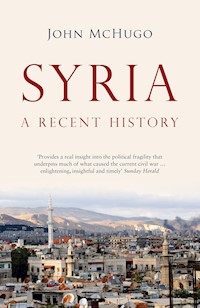
Syria's descent into civil war has already claimed an estimated 200,000 lives while nearly nine million people have fled their homes. This is now the greatest humanitarian and political crisis of the twenty-first century. In this timely account, John McHugo charts the history of Syria from the First World War to the present and considers why Syria's foundations as a nation have proved so fragile. He examines the country's thwarted attempts at independence under French rule before turning to more recent events: sectarian tensions, the pressures of international conflicts, two generations of rule by the Assads and the rise of ISIS. As the conflict in Syria rages on, McHugo provides a rare and authoritative guide to a complex nation that demandsour attention.
Sie lesen das E-Book in den Legimi-Apps auf:
Seitenzahl: 508
Veröffentlichungsjahr: 2015
Das E-Book (TTS) können Sie hören im Abo „Legimi Premium” in Legimi-Apps auf:
Ähnliche

















John McHugo is a Senior Fellow at the Centre for Syrian Studies at St Andrews University. A board member of the Council for Arab British Understanding and the British Egyptian Society, he is also chair of the Liberal Democrat Friends of Palestine. McHugo’s writing has featured in History Today, The World Today, Jewish Quarterly and on the BBC News website. His debut work, A Concise History of the Arabs, was published to critical acclaim in 2013. McHugo was shortlisted for the Salon Transmission Prize in 2014.
www.johnmchugo.com
‘Remarkably prescient … At the very start of this enlightening read, McHugo makes the point that to the English-speaking world, Syria is a far off country which relatively few people have made a serious effort to understand. In writing this insightful and timely book, he has gone some considerable way to rectifying this neglect.’ Sunday Herald
‘[A] very timely modern history of Syria ... provides the reader with a high level of sound analysis’ Journal of Peace Research
‘Tells us with inspirational force how the Syrians have found the ability to speak out’ Times Literary Supplement
‘A fascinating and timely study ... McHugo places developments in Syria and the wider region in a solid and coherent context, clearly explaining the developments of the past century. It should be a pleasure to read for both experts and a wider audience.’ Nikolaos van Dam, author of The Struggle for Power in Syria
‘McHugo uncovers uncanny parallels between the pacification strategies of the French in the 1920s and the Assad regime today, exposing the continuous role of violence in the region’s (flawed) state formation.’ Raymond Hinnebusch, Centre for Syrian Studies, University of St Andrews
‘A fluent introduction to Syria’s recent past, this book provides the backstory to the country’s collapse into brutal civil conflict.’ Andrew Arsan, St John’s College, University of Cambridge
ALSO BY JOHN MCHUGO
A Concise History of the Arabs
SYRIA
A Recent History
JOHN MCHUGO
SAQI
First published 2014 by Saqi Books
This paperback edition published 2015
Copyright © John McHugo 2014
John McHugo has asserted his right under the Copyright, Designs and Patents Act, 1988, to be identified as the author of this work.
This book is sold subject to the condition that it shall not, by way of trade or otherwise, be lent, resold, hired out, or otherwise circulated without the publisher’s prior consent in any form of binding or cover other than that in which it is published and without a similar condition including this condition being imposed on the subsequent purchaser.
ISBN 978-0-86356-160-3 eISBN 978-0-86356-763-6
A full CIP record for this book is available from the British Library.
Printed and bound by CPI Mackays, Chatham, ME5 8TD
Saqi Books 26 Westbourne Grove London W2 5RHwww.saqibooks.co.uk
To Benedict
You know and we know, as practical men, that the question of justice arises only between parties equal in strength and that the strong do what they can, and the weak suffer what they must.
Thucydides, The History of the Peloponnesian War
Contents
List of Maps
Chronology
Glossary
Preface
1 The Land that Once was Known as Shaam
2 French Rule, 1920–1946
3 From Independence to Hafez al-Assad, 1946–1970
4 Hafez al-Assad, 1970–2000: Foreign Policy Challenges
5 Inside the Syria of Hafez al-Assad, 1970–2000
6 Bashar al-Assad, 2000–: From Succession to Civil War
7 Drawing the Threads Together
Acknowledgements
Notes
Bibliography
Index
List of Maps
The Middle East showing modern political boundaries
Greater Syria showing the provinces of Syria and Aleppo and late Ottoman administrative boundaries
Greater Syria showing the partition by Britain and France after the Great War
The Mandate of Syria showing internal boundaries created by France
The independent state of Syria showing major towns
Chronology
331 BC
Alexander the Great of Macedon conquers Persian Empire, including Greater Syria
323 BC
Death of Alexander the Great – partition of Greater Syria between Ptolemaic and Seleucid dynasties
64–3 BC
Greater Syria comes under the sway of Rome
33 AD
Conversion of St Paul in Damascus
630S–40S
Arab Conquest and the coming of Islam to Greater Syria
661–750
Damascus-based Umayyad Caliphate
750
Establishment of Abbasid Caliphate which is based in Iraq
1098
Arrival of Crusaders in Greater Syria
1258
Sack of Baghdad by Mongols and execution of last Abbasid Caliphate
1260
Defeat of Mongols by Egyptian Mamluks at battle of Ayn Jalut and conquest of Greater Syria
1291
Eradication of last Crusader strongholds in Greater Syria
1400–1
Conquest and sack of Damascus by Tamerlane
1516
Conquest of Greater Syria by the Ottoman Emperor Selim the Grim
1683
Breaking of second Ottoman siege of Vienna and beginning of Ottoman decline as a military power
1798–9
Napoleon conquers Egypt and unsuccessfully invades Greater Syria
1831–41
Temporary Egyptian occupation of Greater Syria
1839 & 1856
Ottoman tanzimat decrees which attempt to reform the empire. Among the reforms is the abolition of subordinate status of Christians and Jews
1860
Druze defeat Maronites in war on Mount Lebanon and massacres of Christians in Damascus. Establishment of predominantly Maronite autonomous province of Mount Lebanon
1876
Establishment of first Ottoman parliament
1908
Young Turk Revolution
1914
Outbreak of Great War
1915–16
Execution of Arab nationalists in Damascus and Beirut by Turkish viceroy Jamal Pasha
1916
Sykes-Picot Agreement Outbreak of Arab Revolt in the Hejaz
1917
Balfour Declaration
British conquest of Palestine
1918
British-led conquest of remainder of Greater Syria. Arab armies take Damascus and are first to reach Homs and Aleppo
Armistice at end of Great War; establishment of Arab administration east of coastal mountains and river Jordan but subject to overall British control
1919
The Emir Faisal addresses Paris Peace Conference and pleads for establishment of Arab State
Syrian National Congress elected as a constituent assembly for Greater Syria
1920
Syrian National Congress proclaims Faisal King of Greater Syria
Allied powers agree to partition Greater Syria into French and British Mandates
Battle of Maysaloun – French take control of Syria
French set out to sub-divide their mandated territory, splitting “Greater Lebanon” from the rest of Syria and planning to divide the remainder of Syria into autonomous units which would be dependent on a French presence
Resistance in Alawi mountains; Ibrahim Hananu’s rebellion in countryside around Aleppo
1921
France and Turkey agree Syrian border with Turkey
1925–7
Great Syrian rebellion – initial Druze unrest in the Hawran area spreads across much of the country in response to demand for Syrian independence. French temporarily lose control of Hama and then Damascus. Revolt eventually crushed after arrival of French reinforcements
1928
Elections for constituent assembly; emergence of politicians who would form the National Bloc
1930
French accept Syrian constitution but insist it is subject to overriding authority of France as the Mandatory power
1932
Elections; organisational structure given to the National Bloc
1933
Failure of attempt to negotiate treaty between Syria and France
1936
Agreement of treaty with France giving Syria independence which is endorsed by a general election in Syria but which France fails to ratify following fall of the Front Populaire government
1939
Cession of the Sanjak of Alexandretta by France to Turkey (although in breach of terms of the Mandate)
Outbreak of World War II. Syria put under martial law and constitution suspended
1940
Fall of France. French administrators in Syria and Lebanon opt to support Vichy
1941
Free French promise Syria sovereign independence and, relying on British support, take control of Syria from pro-Vichy forces. Britain retains ultimate military responsibility.
1943
Elections return National Bloc to power under leadership of Shukri al-Quwwatli
Syrian government gives notice to French that Syria will amend its constitution to provide for complete independence from France
1944
French begin transferring government departments to Syrian control
1945
Syria declares war on Germany and Japan to become founding member of United Nations
French bombard Damascus and shell Syrian parliament in last-ditch attempt to retain their presence in Syria and Lebanon. British garrisons take control. French begin final dismantling of their presence in Syria.
1946
French and British troops leave
Syria now fully independent under leadership of President Shukri al-Quwwatli and his National Party
1947
Syrian parliamentary elections
King Abdullah of Jordan proposes creation of kingdom of Greater Syria
UN General Assembly resolves to partition Palestine giving date for end of British Mandate and triggering civil war in Palestine
Syria initially supports the establishment of the volunteer Arab Liberation Army to assist Palestinian Arabs
1948
State of Israel proclaimed in the teeth of Palestinian and Arab opposition. Syrian army intervenes.
1949
Coup by Colonel Husni Zaim. Unsuccessful attempt to negotiate peace with Israel but ceasefire agreed.
Coup by Colonel Hinnawi. Akram Hourani and the Ba’thist Michel Aflaq enter the cabinet for the first time. Election of constituent assembly.
Coup by Colonel Adib Shishakli
1952
Formation of Arab Socialist Ba’th Party by Michel Aflaq and Salah al-Din Bitar joining forces with Akram Hourani
Adib Shishakli assumes office of president
Overthrow of Egyptian monarchy by the Free Officers led by Nasser
1954
Fall of Adib Shishakli
Restoration of parliamentary rule
1955
Parliament elects Shukri al-Quwwatli as president
Anti-Communist Baghdad Pact
Israeli raid on Gaza
1956
Nasser nationalises the Suez Canal
Syria establishes diplomatic relations with USSR
Syria finally obtains modern armaments from the USSR
Tripartite invasion of Egypt by Britain, France and Israel
1957
Western-backed plots to destabilise Syria
Nasser sends troops to Lattakia to widespread Syrian acclaim
1958
Union with Egypt and establishment of the United Arab Republic
Dissolution of Ba’th Party and suppression of Communists and other political parties
Overthrow of monarchy in Iraq
1961
Military coup in Damascus takes Syria out of UAR
Election of new Syrian parliament
1963
Coup by Ba’thist, Nasserist and officers of other affiliations ends parliamentary rule
Syria put under Emergency Law
Suppression of abortive Nasserist coup consolidates power in the hands of Ba’thist officers
1964
Uprising in Hama
1966
Intra-Ba’thist struggle ends with purge of Michel Aflaq and old guard. Salah Jadid becomes de facto ruler of Syria
1967
Six Day War – following diplomatic crisis Israel attacks and defeats Egypt and Jordan then seizes Golan Heights
1969
The minister of defence, Hafez al-Assad, consolidates his position at the expense of Salah Jadid
1970
Hafez al-Assad seizes power
1971
Referendum (in which he is the only candidate) confirms Hafez al-Assad as president of Syria for his first seven-year term
1973
October 1973 War. Syria and Egypt attack Israel but are ultimately defeated. Syrian forces temporarily retake a large part of the Golan Heights but are pushed back almost to twenty-five miles from Damascus
1974
Disengagement of forces between Syria and Israel on Golan Heights
1975
Beginning of Lebanese civil war
1976
Syria intervenes in Lebanese civil war establishing broad control over most of the country.
Islamist-led discontent appears in Syria and leads to wave of terrorism, including assassinations of prominent Alawis
1977
Jimmy Carter inaugurated as US president. He begins a determined attempt to achieve peace in the Arab-Israeli dispute but eventually has to settle for a separate peace between Israel and Egypt due to the Israeli position. Syria left out in the cold.
1979
Iranian revolution
Egyptian-Israeli peace treaty
Aleppo artillery school massacre
1980
Outbreak of the Iran-Iraq War
1981
Israel illegally annexes Golan Heights and treats the area as its own sovereign territory
1982
Brutal and indiscriminate repression of Islamist uprising in Hama
Israel invades Lebanon, ratcheting violence in the Lebanese civil war up to new levels; siege of West Beirut; evacuation of PLO fighters from Lebanon; assassination of president-elect of Lebanon Bashir Gemayel; election of Amin Gemayel as president of Lebanon
1983
Hafez al-Assad seriously ill; Rif’at al-Assad rises to prominence
1984
“War between the brothers”: Hafez al-Assad removes his brother Rif’at from position of power
1987
Outbreak of Intifada in occupied Palestinian territories
1988
End of Iran-Iraq War
1989
Taif Accords provide framework to end Lebanese civil war
1990
Iraq occupies Kuwait
Syria temporarily rehabilitates itself with the USA and West by joining anti-Iraq coalition
Syrian troops crush General Aoun; Syria left with hegemonic position in Lebanon
1991
Iraqi forces driven from Kuwait by US-led coalition acting under UN Charter
Syria participates in US-led Madrid conference aimed at finally ending Arab-Israeli dispute
1992
Intermittent negotiations between Syria and Israel begin and continue until 1996 with US encouragement
1993
Oslo Accords produce framework to end Israeli-Palestinian dispute but ultimately fail
1994
Death of Hafez al-Assad’s son Basil in car crash
Israel-Jordan peace treaty
1995
Assassination of Israeli Prime Minister Yitzhak Rabin
1996
Election of hardline Israeli government led by Benyamin Netanyahu which does not recognise Syria’s right to the Golan Heights
1997
Israeli parliament votes to reiterate Israel’s assertion of sovereignty over the Golan Heights
1998
Hafez al-Assad’s health in obvious decline; rise of his son Bashar to prominence
2000
Israel withdraws from South Lebanon
Attempt to negotiate peace between Israeli Prime Minister Ehud Barak and Hafez al-Assad fails
Death of Hafez al-Assad from leukemia
Bashar al-Assad takes power
“Damascus Spring”
Ariel Sharon visits Esplanade of the Mosques in East Jerusalem triggering Second Intifada 2001 9/11
2001
9/11
Syria shares intelligence with Western powers and is thanked for helping to save American lives
US-led invasion of Afghanistan
2002
Girls given the freedom to wear the hijab at school
2003
US-led invasion of Iraq; demonisation of Syria because of its opposition to the invasion
Foreign fighters use Syrian territory to enter Iraq and join insurgency
USA passes Syrian Accountability Act
2004
Private banks return to Syria
2005
Assassination of Lebanese Prime Minister Rafiq Hariri;
Syria widely believed to be responsible
Syrian forces withdraw from Lebanon
2006
War between Israel and Hizbullah; Lebanon devastated
2007
Nancy Pelosi and other US parliamentarians visit Damascus; signs of thawing of relations between Syria and the West
2009
Opening of Damascus stock exchange
2010
Beginning of Arab Spring in Tunisia
2011
Arab Spring spreads to Syria; regime confronts protests with violence including lethal force
Opposition forms Syrian National Council
Syria suspended from Arab League
2012
Syria descends into civil war and the country disintegrates
Severe fighting in Homs, Aleppo and suburbs of Damascus
2013
Much of eastern Syria passes out of government control
Chemical attack in Damascus suburbs
2014
Regime’s military position appears to stabilise
Breakdown of Geneva II diplomatic initiatives
ISIS bulldozes sections of the boundary between Syria and Iraq and proclaims a caliphate
Siege of Kobane
Glossary
Alawi: a member of a secretive Muslim sect which dates from the eleventh century and predominates in the mountains east of Lattakia. The Alawis are also represented in parts of the countryside of the Orontes valley. There are also Alawis in Turkey.
Ba’th: an Arab nationalist party originally formed in Damascus in the early 1940s by Michel Aflaq and Salah al-Din Bitar. Its ideals are Arab unity, freedom from foreign domination, and socialism.
Druze: another secretive sect which is an offshoot of Islam. The Druze are predominant on the Hawran Plateau around Suwayda, south-east of Damascus, and in parts of Mount Lebanon. There are also Druze communities elsewhere in Syria and in the Galilee.
Hashemite: the name of an Arab dynasty descended directly from the Prophet Muhammad which provided the guardians of the Holy Cities of Mecca and Medina until they were forced out by Ibn Saud (the founder of Saudi Arabia) in 1924–5. The Hashemites led an Arab nationalist revolt against the Ottoman Turks during the Great War and briefly established a kingdom of Greater Syria centred on Damascus. More enduring Hashemite kingdoms closely tied to Great Britain were established in Iraq (overthrown in 1958) and Jordan. The Hashemite brand of Arab nationalism was secular but closely tied to British influence.
ISIS: the self-styled ‘Islamic State of Iraq and Shaam’, also known as ISIL (Islamic State of Iraq and the Levant), IS (Islamic State) and Da’ish (its Arabic acronym). It gained traction among Sunni Arabs in Iraq as a reaction to the sectarianism of the government of Nouri al-Maliki. It expanded into eastern Syria as the forces of Bashar al-Assad withdrew from many areas and established itself in the provincial capital of Raqqa in the spring of 2013. Following its seizure of Mosul in June 2014, its leader, Abu Bakr al-Baghdadi, proclaimed himself Caliph. It uses extreme violence to instil fear and bolster its control.
Mandate: a novel concept in international law established by Article 22 of the Covenant of the League of Nations in 1919. A Mandate was granted to an “advanced nation” to provide “tutelage” to peoples formerly ruled by Turkey or Germany but who were not deemed to be ready “to stand by themselves under the strenuous conditions of the modern world”. The intention was that the Mandatory (that is, the power which was granted the Mandate) would prepare the people under its tutelage for full independence. The principle of “the well-being and development” of a people placed under a Mandate was considered to be “a sacred trust of civilisation”. Syria and Lebanon were placed under French Mandate, while Britain was granted Mandates over Palestine and Iraq.
Maronite: a member of a Christian sect predominant in parts of Lebanon but also with followers scattered throughout Greater Syria. This sect has retained its own traditions and autonomous structure while being in communion with the Roman Catholic Church since the time of the Crusades.
Millet: a Christian community granted internal self-government by the Ottoman sultan, often (but not necessarily) through the leaders of the clerical structure of their church. The Ottoman Jews were also given the status of a millet.
Mukhabarat: an Arabic word for intelligence services – especially the much feared intelligence agencies of the Syrian government.
Notable: a term used to denote important and influential quasi-aristocratic families which provided the backbone of society in Greater Syria during the Ottoman era and later. Notable families provided many administrators and religious leaders. They were based in the principal cities but were often major landlords in the countryside. They were essentially intermediaries of power between the government and the peasantry.
Salafi: literally “a follower of the forefathers”. The term is generally used for a Sunni Muslim who follows a rigid and literalist form of Islam and tries to base his life as closely as possible on that of the Prophet and his Companions in the seventh century. Hence, “Salafism”. Rather confusingly, the term is also sometimes used for a follower of the reformist and open-minded school of modernist Islam established by the Egyptian reformer Muhammad Abduh at the dawn of the twentieth century, and which he called the Salafiyah. This is very different indeed from Salafism.
Sanjak: a Turkish word for a province.
Syriac: an ancient Semitic language still spoken by a few small pockets of Christians in Syria, Iraq and south-eastern Turkey who are followers of the Syrian Orthodox Church. Once it was the lingua franca of the Fertile Crescent and it has a rich literary heritage. Aramaic, the language spoken by Christ, is a variant of Syriac.
Takfir: declaring another Muslim to be an apostate and therefore worthy of death. Hence “takfiri” – someone who does this.
Tanzimat: a series of nineteenth-century Ottoman reforms.
Taqiyya: a doctrine followed by Shi’is and Alawis under which it is permitted, when need arises, to dissemble about one’s true religious beliefs in order to avoid persecution by the Sunni Muslim majority.
Uniate: a term to denote a Christian who belongs to an autonomous church with its own traditions which is in communion with the Roman Catholic Church.
Wahhabi: a strict, puritanical Muslim sect founded by Muhammad Ibn Abdul Wahhab in Central Arabia in the mid-eighteenth century. It is the prevailing ideology of Saudi Arabia. Today, it overlaps with Salafism which Saudi Arabian Wahhabis seek to export to Muslim communities across the world.
Yishuv: a Hebrew word used to denote the Jewish community in Palestine before the establishment of the state of Israel.
THE MIDDLE EAST SHOWING MODERN POLITICAL BOUNDARIES
Preface
I
The sufferings of the Syrian people since their country descended into civil war in 2011–12 need no recapitulation. The statistics, even if provisional, are terrible. Nobody knows for certain the numbers of dead or injured. Accurate statistics are hard to come by in a war zone, and the numbers are bound to rise. As of December 2014, estimates of those killed have reached 200,000.1 Out of a population of almost 22.5 million people, over 3.2 million have fled the country,2 while 6.45 million are internally displaced and 4.6 million ‘in need of humanitarian assistance in besieged/hard to access areas’.3
To the English-speaking world, Syria is a far-off country which relatively few people have made a serious effort to understand. The “Arab Spring” aroused great interest and excitement, but as the crackdown on protesters in Syria evolved into civil war and a man-made humanitarian crisis began, disaster fatigue seemed all too often to be the general reaction to what was happening. Despite energetic advertising campaigns by relief charities, at first only occasional incidents such as the death of the Sunday Times reporter Marie Colvin in Homs in February 2012 brought the unfolding catastrophe home.
For a couple of weeks, the use of chemical weapons in the Damascus suburbs of Ain Tarma and Zamalka which killed hundreds of people on 21 August 2013 shook the world, but it was not enough to persuade British Members of Parliament to give their government the discretion to use force for humanitarian intervention. It was the same with other major world players. As soon as agreement was reached with the Syrian government about the decommissioning and destruction of its chemical weapons, the issue largely faded from the headlines. The killing of Syrians by conventional weaponry and their deaths by starvation, disease and hypothermia did not capture our attention in the same way. Soon enough, public compassion had moved on to fresh humanitarian disasters in other parts of the world.
Following the failure of the talks in Geneva between the Syrian government and opposition politicians on 15 February 2014, the international mediator, Lakhdar Brahimi, stated that he had no alternative but to apologise to the Syrian people.4 The fighting does not yet seem to have run its course. When the conflict ends – and no one can say when that will be – the world will be presented with yet another traumatised Arab nation. In 1947–9, the majority of the indigenous Arabs of Palestine were forced to flee their homes. Many of them and their descendants are refugees to this day. Among many people in the West, their story remains a taboo topic. But the Palestine problem is just one cause of instability in the region. In the mid-1970s, Lebanon exploded into a civil war which lasted until 1990 and whose embers smoulder still. Then, following the US-led invasion in 2003, Iraq disintegrated along sectarian and ethnic lines. Each of these countries borders Syria, and their tragedies caused severe problems for the Syrian government of the day and Syrian society as a whole. Now it is the turn of Syria itself to look destruction in the face after decades of draconian rule by a government that overreacted to the smallest signs of dissent.
Is the sequential implosion of these closely connected Arab countries just a coincidence? Or is there a deeper, underlying cause that brought conflict to them? In either case, what lessons can be learned? This book provides pointers towards an answer to these questions by reviewing the history of Syria since the Great War of 1914–8, whose one hundredth anniversary the world commemorated in 2014. While the descent into civil war in 2011–2 was certainly the result of failings by the Syrian leadership, there is also an element of culpability and negligence which must be spread much more widely.
The effect of the actions of outside powers on Syria over the last century cannot be overlooked. The country’s borders were decided by France and Britain in the immediate aftermath of the Great War. Those two nations thus took upon themselves the momentous responsibility of deciding who was – and who was not – a Syrian. France had a vision of a permanent French presence in Syria, something that conflicted with its “sacred trust of civilisation”5 to prepare the Syrian people for full, sovereign independence. Furthermore, although this book is not about the Arab-Israeli conflict, its enormous and deleterious effect on Syria cannot be avoided. That conflict was not created by Syrians but they, like their Arab neighbours, had no choice but to assimilate and digest its consequences – something that put both leaders and people under immense strain which has lasted to the present. The Cold War did not help, either. All too easily forgotten today, the global tussle for supremacy between the USA and the USSR turned Syria into a pawn. It was to be moved and, when expedient, sacrificed on the chess board of global politics. In fact, today’s Syrian civil war could be said to be the last proxy conflict of the Cold War. The alternative view, which is even more disturbing, is that it is the harbinger of the revival of the Cold War which has now begun in Ukraine. It is not an exaggeration to say that the actions of the great powers in the aftermath of the Great War and over the following decades deprived the people of Syria of any chance of a normal development to nationhood.
But the major international players were not the only ones who have played games in Syria. As will be seen, certain Arab states, particularly Iraq, Jordan, Egypt, Saudi Arabia and latterly even Qatar, have treated Syria as a ball to be prised from their opponents. It has been the same with non-Arab Iran and Turkey. In each period covered by this book, the impact of wars and foreign affairs will be considered before turning to the developments which actually took place inside Syria. This may seem unusual for the history of a country, but in this case it is only logical. Events happening outside Syria circumscribed the freedom of action open to its rulers and foreclosed the options available to them. This does not excuse or justify some of the actions those rulers took, but their actions cannot be examined in isolation from what was going on between Syria and its neighbours.
One of the greatest tragedies in the history of Syrian politics is what happened to Ba’thism. Initially a nationalist movement which seemingly cared deeply about social justice and healing the rifts in society throughout the Arab world, it had the added advantage for Syrians of having been conceived and born in Damascus. The way in which Ba’thism morphed into the dictatorship of the Assads is an object lesson for other Arab countries at the present time. Another salutary example is the chaos of parliamentary life in Syria under the Mandate and the years after independence. The glimpses of that chaos which this book contains are a dire warning. It led to impatience with elected politicians and is part of the story of descent into dictatorship.
Religious politics in Arab countries didn’t use to be as important as many people now assume, but they gained in significance as a reaction to the failures of the Ba’thists and other Arab nationalists, and were also linked to the profound sense of alienation from the West which occurred for reasons which this book will make painfully clear. Islamism is not well understood in the West. It is ultimately a quest for authenticity and identity. Values such as honesty, justice and mercy are at the heart of Islam, with the result that the kind of indiscriminate violence practised by some Islamist groups is incompatible with the Muslim ideal of Jihad. Many Syrians may well want a form of democracy that acknowledges in some way the Islamic roots of the majority of the population. Such a democracy could not be more different from the kind of rule offered by militant organisations like al-Qa‘ida or ISIS, which are infamous for their brutality and intolerance.
Hafez al-Assad never envisaged the establishment of a democracy in Syria which might threaten his position. If his son ever did so, he left it as a can to be kicked down the road until it was too late. For both father and son, democracy and Islamist militancy were twin threats. To tar the advocates of the former with the brush of the latter was highly expedient. The increasing prominence of militant groups among those fighting the Assad regime today is just part of the price Syrian society has paid for this cynicism.
II
I first went to Syria in November 1974 when I was twenty-three years old and studying Islamic history at postgraduate level at the American University in Cairo. I had planned a week walking in the mountains which run parallel to the coast. Armed with a sleeping bag and ground sheet, I got off the bus at the crossroads below the famous Crusader castle of Krak des Chevaliers. The dark, green hills rising before me had more in common with the Brecon Beacons in Wales than what I had been expecting: the stark rocks of the Arabian desert which I had seen in the film Lawrence of Arabia. Rain threatened, and I was only too happy to accept a lift from a taxi driver taking the local vet to visit a sick cow. Ibrahim, the farmer who had summoned the vet, insisted I stay the night as soon as he had greeted us. He was a stocky man in his sixties who wore a white cloth wrapped round his head and the sherwal, the traditional black pants of a farmer, tight round the ankles but baggy from the knees upwards.
Western visitors were rare in the mountains then, although that was not so in the years before 2011 – and plenty of hotels have been built since my visit. We communicated that night in a mixture of Arabic, French and English, for Ibrahim had served in the army during the French Mandate and was proud of his French, whilst Karim, his eldest son, was studying English at Aleppo University and was painstakingly ploughing through Thomas Hardy’s The Mayor of Casterbridge with the same difficulties I was experiencing with classical Arabic works. Towards the end of the evening, when we had got to know each other as well as two people can in such a short time, Ibrahim asked me, “In the West, are there still people who live like us?” I told him there were hill farmers in Wales and in remote parts of England and Scotland, but I wondered how long they could survive in a modern economy. We could detect a sadness in each other’s eyes which betrayed our shared regret for the passing of old ways and disquiet at the uncertainties and brutalities of the modern world.
Much earlier, when questioned about myself, I had said I was doing a Master’s degree in medieval Islamic studies, which I hoped would lead to a career as a university lecturer. This met with approval, but when I mentioned I was working on a book by the eleventh-century Muslim thinker Abu Hamid al-Ghazali, my hosts did not seem interested and had hardly heard of him. The oval nostrils on Ibrahim’s Semitic nose flared ever so slightly and he interjected, “Yes, they have built a mosque here. There has to be one, of course”.
A silence followed. Eventually, Ibrahim broke it himself. “It goes back to Nasser. When he ruled Syria as well as Egypt,6 he thought he would become the great leader of the Arabs. He wanted everyone to think of themselves as the same – as Arabs, not Christians or Muslims. Here you are in the Wadi al-Nasara, which means the Valley of the Christians. He wanted it to be called ‘Wadi al-Nadara’, ‘the valley of the beautiful view’. He could do this by adding just one dot above an Arabic letter in the name on the map. But it did not work. It is still known as Wadi al-Nasara.”
Before I met Ibrahim I assumed everyone who wore clothes like his was a Muslim, but I could not have been more wrong. In the morning before I left, two other farmers dressed in the same way called by. They had heard that there was a visitor who lived in Egypt and they wanted to hear about the millions of Egyptian Coptic Christians about whom I knew shamefully little. Ibrahim’s family would normally read a story from the Bible together before they went to bed, and I have no doubt his religion, and the identity which flowed from it, were important to him. I had stumbled across a part of the mountains where most people were Christian. Over the following two days as I headed north, I would stop to talk to boys and girls walking home from school who confirmed this, since their first question was about my nationality, but they then immediately asked me my religion and proudly told me theirs. I couldn’t help noticing the little Orthodox Church in almost every village.
Ibrahim and his two sons honoured me as a guest in a traditional Arab way. They slept on mattresses on the floor beside me, because they were concerned I might feel lonely so far from home. They even lent me a white nightgown for the occasion. I experienced their hospitality, their generosity and their courtesy – three great Arab virtues. However, I did not meet Ibrahim’s wife or daughter, except when they brought in breakfast in the morning and arrived to sweep the floor. Their heads were wrapped in scarves and their arms covered to the wrist: the traditional dress of the mountains for Christian and Muslim women alike. This was a peasant society in which the sexes were segregated to a greater extent than would generally have been the case with peasants in Western Europe. It was a cultural norm that was not a badge of religious identity.
Ibrahim’s eyes were moist as I left. Karim accompanied me on the first leg of my journey when I left in the morning. We walked up the green hillside through a mist, spotting the carcass of the cow which the vet had been unable to save lying in a ravine with its stiff legs stretched up to the sky. Quite suddenly, we found ourselves under the walls of the castle where we said goodbye. Karim talked to me about fasq, which was a new Arabic word for me and which he did not know how to translate into English. He eventually settled for “moral degeneration”. Moral degeneration was the great threat to the modern world, this young Christian Syrian said, then told me it came from the West. I thought guiltily of the trickle of Westerners who came to Egypt as discreet sex tourists: something Muslim friends in Cairo had not hesitated to point out to me. The West, I was beginning to realise, lacked moral authority in the eyes of many Arabs. It might have great power, but it did not necessarily command respect.
My memories of the following days are less clear, and I never achieved again that rare feeling that I had arrived a total stranger and parted a true friend. The next night I was put up by a Christian carpenter who had seven children and was home for a holiday from his work in Saudi Arabia. He was very different from Ibrahim. He talked chiefly about money (a topic Ibrahim did not mention once) and was dazzled by how much he was paid for putting in the wooden fixtures on new buildings in Jeddah. Despite this, he told me he was a shiyou’i – a word which, when I was able to look it up in a dictionary, I discovered meant Communist. A day later, I reached Masyaf on the edge of the mountains. This time, I was put up by a young soldier who was obsessed with getting into the Syrian special forces. He said that the secret to beating the Israelis would be to become even tougher than they were.
Masyaf was the point at which I gave up the walk, and shared a taxi down into the plain with an old Ismaili man who told me how wonderful it was to be an Ismaili since there was a tremendous feeling of brotherhood between Ismailis all over the world. The same, of course, goes for the followers of all religious sects. Today the Ismailis (a Shi’i sect who are the spiritual followers of the Aga Khan) are the most peaceable of people, but that was not always so. The Assassins were Ismailis, and it was from their jagged citadel above Masyaf – a puny castle compared with the imposing Krak – that their emissaries set out across Greater Syria to spread terror into the hearts of rulers, Muslim and Christian alike, a thousand years ago.
The taxi dropped me at a village beside an irrigation canal where the people were celebrating the anniversary of the “Corrective Movement” which had brought Hafez al-Assad to power as ruler of Syria exactly four years earlier. At that time, his name meant almost nothing to me. There were bright lights strung between the trees along the canal, while the villagers sat on rows of kitchen chairs and listened to speeches delivered through a megaphone. I continued onwards, by a mixture of hitch-hiking and walking, through the rich agricultural plain of the Ghab before finally taking a bus to Aleppo.
There was generally no mains electricity or water in the mountains or elsewhere in the countryside, and I had been privileged to have the briefest of glimpses of a vanishing way of life. Systematic work was underway to change it for ever. There were trenches being dug beside the roads, and pipes and cables laid in them. I continued to see children in quasi-military school uniforms carrying satchels or clutches of books as they walked along the road on their way back from school in the middle of the day. I was also impressed by the large areas of brown, barren land being planted with trees. Syria seemed to me to be on the move and destined for a better future. Sadly, I could not have been more mistaken.
On that trip I was entertained by Orthodox Christians, Ismaili Muslims and Sunni Muslims (I did not knowingly meet any Alawis or Druze). What struck me most was the great similarity between them all. Whatever differences their religions might have, the likenesses were far greater. Whenever I have returned to Syria (the last time was in December 2014) I have observed exactly the same thing. At the moment many Syrians are being forced back into their sectarian identities – as is also happening in some other Arab countries. Although conflicts open sectarian wounds, change people permanently for the worse and leave them with hatreds which can endure for generations, I refuse to believe that in Syria the secularism based on mutual respect between members of different faiths has ended. But I also know that many would now call this belief of mine an act of faith. Only time will tell.
III
This book is a narrative history of Syria that broadly follows the chronological sequence of events. In the earlier chapters these coincide more or less with great landmarks in world events. The first chapter deals with the period up to 1919–20, and tells the history of Syria before and during the Great War. It also covers what happened to it in the immediate aftermath of that conflict and ends with the French conquest in 1920. The second chapter covers French rule until the final French soldiers and officials left in 1946. This was the era of the struggle for independence. Chapter Three covers the years after independence. Readers with knowledge of Middle Eastern history might expect it to end with the Six Day War of 1967 in which Israel seized the Golan Heights from Syria. However, the logical turning point in Syrian history occurred three years later when Hafez al-Assad took power in 1970. Chapter Three therefore covers the post-independence era up to that year. Chapters Four and Five cover the rule of Hafez al-Assad. They do not end with the US-led invasion of Iraq in 2003 or another significant event in Middle Eastern history around that time. Instead, they conclude with the transfer of power to Hafez al-Assad’s son Bashar in 2000. Chapter Six deals with the era of Bashar al-Assad and includes the descent of Syria into civil war from 2011 onwards.
John McHugo, January 2015
Note on Terminology
The name “Syria” is used exclusively for the modern state of Syria, and the French Mandate which preceded it. The use of the name “Greater Syria” to describe a much larger area is discussed in Chapter One.
In this book, people are frequently described by their religion: as Muslims, Christians, Jews, Alawis, Druze, etc. It is important to stress that references to religion (and sects) are invariably to them as badges of identity which give them an almost tribal quality. Unless indicated otherwise, a reference to someone belonging to a religion or sect is thus not an indication of devoutness (or the lack thereof). Doubts about religion in the Arab Middle East are generally something for the private, rather than the public, sphere. Some of the actors who play a role in this book may have been agnostics or atheists, but that is irrelevant to the identity they possess as members of what Westerners might call their “faith community”.
Please note that I refer to Arab Christians of the Greek Orthodox faith as “Orthodox” to avoid the possible confusion that they might be ethnically Greek which, of course, they are not. However, I refer to the “Syrian Orthodox” when I wish to indicate the distinct branch of the Orthodox family of churches which uses the ancient Syriac language in its liturgy. When I use the words “secular” and “secularist” I am referring to the view that religious affiliation should be irrelevant: a view which does not necessarily imply any hostility to religion as such.
For the sake of simplicity, I refer to the state of Jordan throughout, even though during the period of the Palestine Mandate it was “Transjordan”.
CHAPTER ONE
The Land that Once was Known as Shaam
I
In Arabic, Bilaad al-Shaam means “the land of Shaam” or possibly “the towns of Shaam”, but in its literal sense it means “the land to the left”. It acquired this name because an Arab who stands in the middle of Arabia facing north has Shaam to his left. Shaam stretches along the eastern shore of the White Sea, as the Arabs call the Mediterranean, for some 500 miles from the deserts of the Sinai Peninsula until the ground rises to the plateaux of what is now southern Turkey. It is also considered to extend into Anatolia until it meets a natural frontier in the Taurus Mountains. Today, Shaam (or Greater Syria, as it used to be called in the West – and that is the name we will use in this book) is divided between Syria, Lebanon, Israel, Palestine and Jordan, and includes part of southern Turkey. The lines on the map which give these modern states their rather rigid political frontiers were only drawn in the twentieth century.
Rain from the White Sea waters Greater Syria’s green coastal plain and the belt of mountains behind. Every winter, the mountains turn white. In spring and summer, they slowly disgorge their snow melt into rivers, some of which flow eastwards into the arid lands beyond. Several millennia ago, one of these gave life to the city of Shaam itself, which is better known as Damascus, and enabled its inhabitants to surround it with orchards and farms. Damascus was a beautiful city, so beautiful in fact that when the Prophet of Islam beheld it at around the end of the sixth century, he is said to have gasped in amazement and turned back. No one, he said, can enter Paradise twice. Slightly over half a millennium earlier still, Paul, the apostle of Christianity to the Gentiles, experienced his conversion “as he neared Damascus”:1 an experience which temporarily blinded him. He was baptised while staying in the city. By then, it was already ancient. It claims to be the oldest known continually inhabited city in the world, but Greater Syria also contains other cities that make this claim: Aleppo in the north and Jericho in the south, near the Dead Sea.
Damascus itself is mentioned by name about thirty-five times in the Old Testament or Hebrew Bible and twenty in the New Testament. It lies at the centre of Greater Syria. More than anywhere else Damascus has been its political and cultural centre, but its preeminence has never been guaranteed. Nor has the unity of the land itself, although south of Anatolia most of its people today speak closely related Arabic dialects (save, of course, in Israel where Hebrew is now the majority language). If in the past they described themselves as Shaamis, by and large they were only making a statement about where they happened to come from; and it might indicate either Damascus or the wider land of Greater Syria. This did not mean they had no sense of identity. On the contrary, they identified themselves by their family, their tribe (many, but by no means all, Shaamis had a tribe) and their religion (everyone in Greater Syria without exception had a religion). These identities were very strong. Even today, it is common for ordinary people to be able to trace their ancestry back several hundred years.
Throughout history, Greater Syria has been vulnerable to invasion from all points of the compass, while its geography makes central control extremely difficult. As a cursory glance at a map will show, it contains the land route between Africa and Eurasia. It has constantly been ruled and occupied (and sometimes partitioned) by strong rulers who came from elsewhere. The Pharoahs had a strategic interest in it, and their people depended on its food if the Nile flood failed – as did later rulers of Egypt, who followed the Pharoahs in invading it on many occasions. There were also invaders from the North and East: Hittites, Assyrians, the Achaemenid Persians, and then Alexander the Great of Hellenic Macedonia, who came overland across Anatolia and took over the Achaemenid Empire in the fourth century BC. Following his death in 323 BC, Greater Syria was partitioned between two successor states established by his generals, but fell under the sway of Rome in 64–3 BC. Later Persian empires, the Parthians and the Sasanians, invaded in their turn. Then, in the 630s and 640s, the Arab conquerors came from the south. This ended a thousand years of Greek cultural domination, and led to the overwhelming majority of the population adopting the Arabic language and a sizeable majority of them converting to Islam. These were processes which took hundreds of years.
After the Arab conquest, Greater Syria became the centre of the great Arab empire of the Umayyad Caliphate, which was based in Damascus and lasted from 661 to 750. It left posterity the first two stunning examples of Islamic architecture that endure to this day: the Dome of the Rock in Jerusalem and the Umayyad Mosque in Damascus.
Later, there was a series of invaders from the West. These were the Crusaders who arrived in Greater Syria in 1098 and were only finally driven out in 1291. They were warriors from Western Europe who were inspired by an ideal of Holy War approved by the Pope, and hoped to reconquer lands which had once been part of Christendom from their Muslim rulers. Today, they have left few visible traces save for vast fortifications. But even these are indistinguishable to the non-specialist eye from those built by the Crusaders’ opponents, and many were extensions or refurbishments of earlier castles. They have also often been transformed beyond recognition by subsequent rulers. There are even a few localities where people remember today that they have Crusader blood, although they have long since abandoned their Frankish language in favour of Arabic, and sometimes converted to Islam.
The Crusaders were finally crushed by the ruthless Mamluks, a cast of slave warriors which ruled Egypt and perennially replenished itself with recruits purchased as boys in the Caucasus and elsewhere. The Mamluks also fought off another invasion from the East, the Mongols of Hulagu who briefly took Aleppo and Damascus after sacking Baghdad in 1258 and executing the last true caliph.
Another scourge from the East was Tamerlane, whose armies reached Damascus in 1400–1. He massacred the population and kidnapped its craftsmen to decorate his capital in far-off Samarkand. The Mamluks reasserted themselves and won Damascus back, but eventually they, too, had to bow the knee after they were defeated by a fresh invader from the north, the Ottoman Turks. Their sultan, Selim the Grim, conquered Greater Syria and Egypt in 1516. This conquest occurred when the Ottoman Empire was at its height. It had already taken most of the Balkans, including Hungary, and wrestled with the European powers for the control of the Mediterranean. It dreamed of scaling the walls of Vienna (which it besieged in 1529 and 1683) and of planting the flag of Islam in Rome itself. However, in the eighteenth and nineteenth centuries the empire decayed until Greater Syria was one of its last remaining possessions outside its Anatolian heartland. The Ottomans still retained it when the Great War began in 1914.
Although interest in the modern state of Syria has not been widespread in the West, Europeans and Westerners generally have had an intense fascination with Greater Syria. Until quite recent times, memories of the Crusades were generally stronger in Europe than among Arabs. But above all else for Westerners, Greater Syria was the land of the Bible. Christian pilgrims from Europe had been going there since the early centuries of Christianity to visit Palestine where Jesus had lived, died and, his followers believe, risen from the dead. Another major connection with Greater Syria for Europeans was its importance in the history of Classical times. It was a rich part of the empire that was much more significant to the Romans than the lands inhabited by the uncouth Celts who painted themselves with blue woad. As the steamship, telegraph and railway made Greater Syria more accessible in the nineteenth century, visitors from across the Mediterranean came to gape at the splendours of its ruined temples, amphitheatres, colonnades and tombs. These often seemed eerily familiar, particularly when giant Latin inscriptions on granite porticoes or tablets by the side of the road recorded the deeds of gods, emperors and other eminent personages in letters which were still so clear that they might have been carved yesterday.
Europeans also came for trade, particularly to the ports and the great inland entrepôt of Aleppo, a wealthier, more cosmopolitan and, at various periods, larger city than Damascus. Greater Syria had been the western end of the old silk route, and goods from the east were still transported to Europe via the valley of the Euphrates before they were taken by camel and mule to Aleppo and its port of Alexandretta next to Antioch. This route was a rival to the southern one which came up the Red Sea to Egypt. In addition, as the nineteenth century wore on, silk, cotton, tobacco and grain were cultivated for export to Europe. European powers jostled for position, and were helped by the divisions among the peoples of Greater Syria: divisions they were not above fostering for their own ends.
The late nineteenth century and the first years of the twentieth were the age of European imperialism. Europe burned bright with nationalism, and pride and prestige were important for every European nation state that sought to project its influence overseas. Elements of genuine altruism were blended somewhere into this heady brew, giving the European nations a strong self-belief and what would transpire to be a very dangerous sense of their own righteousness. They became envious of each other as they competed to acquire colonies in Africa and Asia. This rivalry could drift into mutual demonisation and was an important part of the run-up to the Great War. The clock was ticking towards a European conflict that would become global.
Ottoman Turkey was a natural focus for European ambition, but its lands in Asia – including Greater Syria – were saved from dismemberment. This was not because of the Ottomans’ now faded military might but the constraints of the European balance of power. The Europeans stalked each other, always anxious to prevent their rivals from stealing a march on them. They had also extracted trade privileges which the Ottomans were too weak to resist. These included tax and customs rates which were more favourable than those paid by native merchants. Local Christian and Jewish traders were generally the ones who benefited by establishing links with the foreigners. It was often more advantageous for a merchant in Aleppo, Beirut or Damascus to become the agent of a French or British company than to trade on his own account.
The four powers with the greatest interest in the Ottoman Empire (and therefore in Greater Syria) were Britain, France, Germany and Russia. The last two need only be mentioned briefly. Russia proclaimed itself the protector of the Orthodox Christians in the empire. It also had territorial ambitions in the empire, but not in Greater Syria itself although it established strong links with the sizeable Orthodox communities there. After the Bolsheviks came to power in 1917, it renounced these interests. Russia then becomes largely absent from our story until it re-enters it in the form of the Soviet Union during the Cold War, which lasted from the late 1940s to the end of the 1980s. Germany had no territorial ambitions in the Ottoman Empire, and for that reason was able to pose as the Ottomans’ ally and friend with some degree of conviction. It would be this friendship, and the links Germany had established with the Ottoman military, that led to the disastrous Ottoman decision to enter the Great War as Germany’s partner in November 1914.
The ambitions and policies of Britain and France require more attention. In the second half of the nineteenth century, Britain took Egypt and Cyprus from Ottoman control and was already the paramount power in the Persian Gulf. Britain’s policy now was generally to prop up the Ottoman Empire so as to prevent France, Russia or another rival acquiring its territories and threatening the Suez Canal, which opened in 1869, or Britain’s other strategic interests. However, if war eventually came and the Ottoman Empire was dismembered, Britain would have its own objectives to pursue: to control the southern parts of Greater Syria and Iraq as part of a land bridge from Egypt to India, as well as the Iraqi oil wells near Basra. It was vital to British interests that no other power should acquire these areas.
France’s interests in Greater Syria were more extensive than those of Britain. It was the main market for the raw materials exported from the area and it had invested more money in Syria’s railways, urban utilities and other infrastructure. France saw itself as the protector of the Catholics in the Ottoman Empire, and had done so for much longer than the Russians had deemed themselves the guardians of the Orthodox. The powerful Maronite Christians centred on Mount Lebanon, whose Catholicism can be traced back to the Crusades, were France’s most significant Catholic clients, but they were by no means the only ones. In the eighteenth and nineteenth centuries large numbers of other Christians in Greater Syria had converted to Catholicism while maintaining their own self-governing churches. This was what the Maronites had done centuries earlier. These self-governing Catholic communities were known as Uniates. In the Greater Syria of the late nineteenth and early twentieth centuries, many Uniates were prosperous and self-confident.
They were particularly important in Aleppo. In 1849, crosses were carried publicly in processions in the city and traditional Arab celebratory gunfire was heard when the authorities recognised the Melkites, one of the largest Uniate groups, as a separate millet or religious community.2 Uniates frequently engaged in trade between Greater Syria and the West. They represented Western companies and could often speak European languages, especially French. French was also the lingua franca of merchants engaged in international trade throughout the area, and the primary language in which European technical knowledge and the thought of the modern world were disseminated to the elite of Greater Syria and the Ottoman Empire as a whole. Many of that elite could speak and read French, and write well in it too.
These religious, cultural and commercial interests fitted in neatly with the French belief in the uniqueness of the values of France’s civilisation, and the desire to spread these values through its self-appointed mission civilisatrice or “civilising mission”. In Greater Syria, the mission civilisatrice was linked in many French minds with the idealised memories of the Crusades which swept France in the nineteenth century. During the French Second Empire (1852–70) Partant pour la Syrie, “Setting off for Syria”, was used more frequently than the Marseillaise as the national anthem. It was a song about the wish of a Crusader to be the bravest knight and to marry the most beautiful girl in the world, a wish God grants him as a reward for his valour.
It may seem trite to mention this song, but it illustrates an important point. Although there were Western scholars, traders, diplomats, soldiers, clergymen and travellers who had genuine knowledge of Greater Syria, the images Western minds had of the area were also formed by reimagined memories of the past. These were frequently seen through rose-tinted spectacles, and were tinged with both a nostalgic romanticism and the harder edge which the rather intense nationalism of the era added to European perceptions.
II
The mountainous spine which runs parallel to the coast of Greater Syria contains many remote and inaccessible areas. Save for a few gaps, it cuts off the lands behind from the sea. Throughout history, the great inland cities to the east have been natural rivals, especially Damascus and Aleppo but also the smaller Homs and even smaller Hama. Each was surrounded by its own hinterland and had a strong sense of its own identity. The physical geography thus lent itself to divisions among the people or peoples who lived there.
The greatest marker of identity was religion. At the time of the Arab conquest in the seventh century, Greater Syria had been an overwhelmingly Christian country but had been torn apart by heresies, schisms and religious persecutions. When the Ottoman Turks conquered it in 1516–17, Christians may have still made up a third of the population. As the modern era dawned, a lower Christian birth rate and greater Christian emigration, as well as the trickle of conversions to the dominant faith of Islam across the centuries, had led to a further decline in the proportion of Christians. However, they remained numerous and are generally considered to have formed 20 per cent or so of the population in 1914. Although there were still Christians working the land, the cities contained many who were prosperous, well educated and influential. Aleppo at that time was approximately one third Christian.




