


51,99 €
Mehr erfahren.
- Herausgeber: John Wiley & Sons
- Kategorie: Fachliteratur
- Serie: Wiley Finance Editions
- Sprache: Englisch
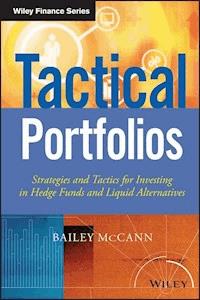
Take an active management approach with liquid alternatives to increase R.O.I. Take advantage of inefficiencies in the market by investing in alternative assets. Hedge fund and private equity investment diversifies your portfolio and helps shield you from market volatility, allowing your more passive assets to work the long game. In Tactical Portfolios: Strategies and Tactics for Investing in Hedge Funds and Liquid Alternatives, author Bailey McCann guides you through the principles of hedge fund investment and the associated philosophies of risk management strategies. McCann's background in reporting and analyzing government policy and regulatory issues positions her as a valuable source of strategic investment advice. As Senior Editor of Opalesque's Alternative Market Briefing, her take on the market is read by every one of the top 100 hedge fund managers on a daily basis. In Tactical Portfolios: Strategies and Tactics for Investing in Hedge Funds and Liquid Alternatives, McCann goes in-depth on important topics. * Strategies for equities, managed futures and fixed income * What to expect and common misconceptions * Investment mechanics of specific strategies * Valuation, red flags, and regulatory changes If your passive approach has failed to produce the desired results, liquid alternative investment may be the answer. While long/short will always be around, external forces can change its impact on your portfolio and it may be time to expand your investment arsenal. Tactical Portfolios: Strategies and Tactics for Investing in Hedge Funds and Liquid Alternatives will help you get the most out of any market.
Sie lesen das E-Book in den Legimi-Apps auf:
Seitenzahl: 385
Veröffentlichungsjahr: 2014
Ähnliche



















Founded in 1807, John Wiley & Sons is the oldest independent publishing company in the United States. With offices in North America, Europe, Australia, and Asia, Wiley is globally committed to developing and marketing print and electronic products and services for our customers’ professional and personal knowledge and understanding.
The Wiley Finance series contains books written specifically for finance and investment professionals as well as sophisticated individual investors and their financial advisors. Book topics range from portfolio management to e-commerce, risk management, financial engineering, valuation, and financial instrument analysis, as well as much more.
For a list of available titles, visit our web site at www.WileyFinance.com.
Tactical Portfolios
Strategies and Tactics for Investing in Hedge Funds and Liquid Alternatives
BAILEY McCANN
with contributions from Opalesque Editors
Cover image: top: © Fanatic Studio / Jupiter Images bottom: © Photodisc / Jupiter Images
Cover design: Wiley
Copyright © 2014 by Bailey McCann. All rights reserved.
Published by John Wiley & Sons, Inc., Hoboken, New Jersey. Published simultaneously in Canada.
No part of this publication may be reproduced, stored in a retrieval system, or transmitted in any form or by any means, electronic, mechanical, photocopying, recording, scanning, or otherwise, except as permitted under Section 107 or 108 of the 1976 United States Copyright Act, without either the prior written permission of the Publisher, or authorization through payment of the appropriate per-copy fee to the Copyright Clearance Center, Inc., 222 Rosewood Drive, Danvers, MA 01923, (978) 750-8400, fax (978) 646-8600, or on the Web at www.copyright.com. Requests to the Publisher for permission should be addressed to the Permissions Department, John Wiley & Sons, Inc., 111 River Street, Hoboken, NJ 07030, (201) 748-6011, fax (201) 748-6008, or online at http://www.wiley.com/go/permissions.
Limit of Liability/Disclaimer of Warranty: While the publisher and author have used their best efforts in preparing this book, they make no representations or warranties with respect to the accuracy or completeness of the contents of this book and specifically disclaim any implied warranties of merchantability or fitness for a particular purpose. No warranty may be created or extended by sales representatives or written sales materials. The advice and strategies contained herein may not be suitable for your situation. You should consult with a professional where appropriate. Neither the publisher nor author shall be liable for any loss of profit or any other commercial damages, including but not limited to special, incidental, consequential, or other damages.
For general information on our other products and services or for technical support, please contact our Customer Care Department within the United States at (800) 762-2974, outside the United States at (317) 572-3993, or fax (317) 572-4002.
Wiley publishes in a variety of print and electronic formats and by print-on-demand. Some material included with standard print versions of this book may not be included in e-books or in print-on-demand. If this book refers to media such as a CD or DVD that is not included in the version you purchased, you may download this material at http://booksupport.wiley.com. For more information about Wiley products, visit www.wiley.com.
Library of Congress Cataloging-in-Publication Data:
ISBN 978-1-118-73162-8 (Hardcover) ISBN 978-1-118-73158-1 (ePDF) ISBN 978-1-118-73163-5 (ePub)
Contents
Introduction
Preface
CHAPTER 1 Hedge Fund Strategies and How They Work
Investor Evolution
Major Fund Strategies
Summary
Notes
CHAPTER 2 Emerging Managers Benedicte Gravrand
What are Emerging Managers and Who Invests in Them?
Summary
Notes
CHAPTER 3 How to Approach Investing in Hedge Funds: Investment Structures
Allocation Types
Summary
Notes
CHAPTER 4 How to Approach Investing in Hedge Funds: Service Providers and Due Diligence
Meet the Service Providers
Moving Beyond the Checkbox Risk Assessment
Summary
Notes
CHAPTER 5 Regulatory Regime Changes and Impact
DODD-Frank Act
FATCA
Jobs Act
AIFMD
MiFID
EMIR
Summary
Notes
CHAPTER 6 Managed Futures Mark Melin
Exploring Different Ways to Trade Managed Futures
Strategy Risk Considerations
How to Evaluate a CTA
The P(A|B) Method to Analyze and Supervise a Managed Futures Investment
Uses of the P(A|B) Method in CTA Rankings/Risk Analysis
What about Managed Accounts?
Summary
Notes
CHAPTER 7 Investment Mechanics
Diversification: Real and Imagined
The Hedge is the EDGE’Types of Hedges
Tail Risk Hedges for Retail Investors
Derivatives
Summary
Notes
About the Author
About the Contributors
Additional Resources
Index
List of Tables
Chapter 1
Table 1.1
Chapter 2
Table 2.1
Table 2.2
Table 2.3
Table 2.4
Table 2.5
Table 2.6
Table 2.7
Table 2.8
Table 2.9
Table 2.10
Table 2.11
Table 2.12
Chapter 4
Table 4.1
Chapter 5
Table 5.1
Chapter 6
Table 6.1
List of Figure
Chapter 2
Figure 2.1
Figure 2.2
Figure 2.3
Figure 2.4
Chapter 4
Figure 4.1
Figure 4.2
Figure 4.3
Chapter 6
Figure 6.1
Chapter 7
Figure 7.1
Figure 7.2
Guide
Cover
Table of Contents
Introduction
Preface
Chapter
Pages
vii
xi
1
2
3
4
5
6
7
8
9
10
11
12
13
14
15
16
17
18
19
20
21
22
23
24
25
26
27
28
29
30
31
32
33
34
35
36
37
38
39
40
41
42
43
44
45
46
47
48
49
50
51
52
53
54
55
56
57
58
59
60
61
62
63
64
65
66
67
68
69
70
71
72
73
74
75
76
77
78
79
80
81
82
83
84
85
86
87
88
89
90
91
92
93
94
95
96
97
98
99
100
101
102
103
104
105
106
107
108
109
110
111
112
113
114
115
116
117
118
119
120
121
122
123
124
125
126
127
128
129
130
131
132
133
134
135
136
137
138
139
140
141
142
143
144
145
146
147
148
149
150
151
152
153
154
155
156
157
158
159
160
161
162
163
164
165
166
167
168
169
170
171
172
173
174
175
176
177
178
179
180
181
182
183
184
185
186
187
188
189
190
191
192
193
194
195
196
197
198
199
200
201
202
203
204
205
206
207
Introduction
In just one decade, stocks have halved two times. After reaching a new high in the first quarter of 2000, the MSCI World stock index found a bottom in September 2002 following the dot.com crisis. The index, which captures large and mid-cap stocks, lost over 48 percent while hedge funds (as measured by the HFR Weighted Composite Index) were up net of fees 2.1 percent. When the global financial crisis took stocks down over 50 percent from their tops in early 2007 through October 2009, hedge fund investors were reaping over 6 percent during the same time.
Helped by floods of quantitative easing, many global stocks have reached new highs in 2013.1
You would think that investors would now “hedge their bets” and move to hedge funds to protect their assets and establish a meaningful diversification. The “smart” money has done this, maintaining a significant allocation to hedge funds.
INVESTORS EXIT HEDGE FUNDS AT FASTEST RATE IN FOUR YEARS
“Investors exit hedge funds at fastest rate in four years”, says a Reuters headline on January 13th, 2014. The article refers to the SS&C GlobeOp Capital Movement Index which calculates monthly hedge fund subscriptions (in-flows) less redemptions (out-flows). With −3.56 percent, December 2013 showed the biggest drop since September 2009. The article continues that “while the end of the year period usually sees a pick-up in redemptions as investors look to move money around their portfolio ahead of the New Year, December’s reading is notably high. In the same month last year the index measured minus 2.61 percent.”2
For 2013, SS&C GlobeOp’s Hedge Fund Performance Index was up 12.32 percent, which is about half of the return of the MSCI World Index. So, hedge funds have performed well, but maybe not good enough?
Today (January 14th, 2014), as I write this introduction, another interesting story: “Global stocks fall on concerns about earnings”—is angst coming back to the markets?3 Right now, we don’t know what will happen and may soon enter an environment where investors wish they had invested more in hedge funds and absolute return strategies than in long-only equity.
Alexander Ineichen, one of the most well-known researchers on hedge funds globally, offers the following advice: “Equity investors have been dancing on thin ice and might continue to do so. It’s difficult to say how long the ice holds. I’m quite certain though, that at one stage a hedged approach will reveal itself as more intelligent than a long-only approach. Again. To stick with the metaphor: A long-only investment style is like dancing on thin ice, while a long/short investment style is like dancing on thin ice wearing swimmies: it might look odd at times but it’s safer.”4
LEARNING FROM YALE: 51 PERCENT ALLOCATION TO ALTERNATIVE INVESTMENTS
Yale’s $20bn endowment has included alternative investment strategies for over 20 years now. The so-called “endowment model” aims to achieve superior returns by shifting a significant portion of investments away from traditional stocks and bonds into carefully selected alternative investments like private equity, hedge funds, real estate, and others.
While the global financial crisis also managed to drawdown the value of Yale’s endowment 24.6 percent in the fiscal year ending June 2009, the endowment model is still regarded the most viable proposition for long-term investors. How does Yale invest? For 2014, Yale’s investment targets include a massive 51 percent allocation to alternatives, while only 17 percent is reserved for international and domestic U.S. equities.5
Yale’s investment team, made up of 26 experts, are of course, not the only institutional investors who look to create tactical portfolios using alternative investments for both return and diversification goals. Ninety-four percent of institutional investors surveyed by Russell Investments said they already allocate to some form of alternatives, on average 22 percent of total assets. This already represents a significant allocation, which over time will only continue to go up. In the last three years, alternative mandates accounted for over 40 percent of all institutional hiring activity made during this period.
HEDGE FUNDS, EMERGING MANAGERS, LIQUID INVESTMENTS, AND MANAGED FUTURES
With an average allocation of probably in the single digits, private investors, together with a lot of their investment advisers, stand on the other side in this game of investing. There is a lot to catch up, and like in sports, a good start is always to look at the rules, and how the other players play the game.
When I started to research and publish about hedge funds and alternative investments in early 2003 under the umbrella of my company Opalesque, little did I know that hedge funds would grow from around $600 billion at that time to close to $3 trillion. Still, compared to endowments, family offices and foundations, hedge funds and alternative investment are largely underrepresented in the portfolios of insurance companies, private and public sector pension funds, sovereign wealth funds, and, of course, of private investors.
Liquid alternatives are one of the fastest growing sectors of the financial industry globally. Depending on the respective regulatory framework of the funds, liquid alternatives are mostly offered in a mutual fund format. They often have smaller minimum investment thresholds, making investments in alternative strategies easier for many investors. The investment options for professional and retail investors are growing rapidly, but still, the number one requirement when selecting any alternative investment is to understand the strategy.
In this respect, managed futures are probably among the least understood investment strategies, even for many institutional investors. On the other hand, managed futures have been around for decades, and many programs have been going for long periods during which they have proven their value of adding true diversification to a portfolio during periods of market stress and crisis.
We wrote this book to help you to better understand and utilize the new options tactical portfolios of alternative investments are offering you. Myself and the editorial team of Opalesque are at your disposal—you can email us any time your questions, suggestions and feedback at [email protected].
Matthias Knab
Founder and CEO of Opalesque
NOTES
1. MSCI World, www.msci.com/products/indices/performance.html.
2.www.reuters.com/article/2014/01/13/us-hedge-funds-data-idUSB REA0C1GK20140113.
3.www.livemint.com/Money/t9gCdLJUksAnPkDPca2EUP/Opening-Bell-14-January—Global-stocks-fall-on-concerns-abo.html.
4.www.opalesque.com/RT/ZurichRoundtable2014.html.
5.http://news.yale.edu/2013/09/24/endowment-earns-125-return.
Preface
Tactical Portfolios is a book designed to help investors, investment advisors, and anyone interested in alternative investments understand what hedge funds and liquid alternatives are and what they do. The book attempts to show different strategies hedge fund managers employ and how they work in a portfolio. We also walk the reader through the various service providers and regulations impacting the industry in the wake of the financial crisis.
The book closes with a discussion of what diversification and hedging really are in an effort to help investors avoid the potentially fatal flaw of exposure risk. I hope you find the text valuable and easy to read.
I would like to thank all of the managers who have been generous with their time and expertise, as well as the Opalesque editors, Opalesque Publisher Matthias Knab, and Olivier Blanchard, who gave me great starting advice for this book. Finally, I’d like to thank E’lona McCann for her advice and support.
Bailey McCann
January 2014
CHAPTER 1Hedge Fund Strategies and How They Work
Until recently, most investors maintained a traditional portfolio construction of 60 percent in stocks, 20 to 30 percent in bonds, and the rest in cash. That 60 percent was managed passively, using the buy and hold method, with bets placed only on the long side of the trade. That means that investors’ only hope was for equities to go up in perpetuity, which as we all know, never actually happens. Markets correct, outside events force sell offs, companies go bust. This is where alternatives come in, helping some of the biggest players in the market mitigate losses during those tough times.
Lesen Sie weiter in der vollständigen Ausgabe!
Lesen Sie weiter in der vollständigen Ausgabe!
Lesen Sie weiter in der vollständigen Ausgabe!
Lesen Sie weiter in der vollständigen Ausgabe!
Lesen Sie weiter in der vollständigen Ausgabe!
Lesen Sie weiter in der vollständigen Ausgabe!
Lesen Sie weiter in der vollständigen Ausgabe!
Lesen Sie weiter in der vollständigen Ausgabe!
Lesen Sie weiter in der vollständigen Ausgabe!
Lesen Sie weiter in der vollständigen Ausgabe!
Lesen Sie weiter in der vollständigen Ausgabe!




