


98,99 €
Mehr erfahren.
- Herausgeber: John Wiley & Sons
- Kategorie: Fachliteratur
- Sprache: Englisch
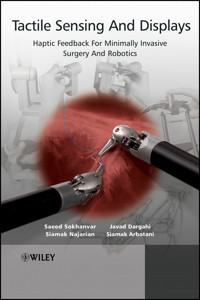
Comprehensively covers the key technologies for the development of tactile perception in minimally invasive surgery
Covering the timely topic of tactile sensing and display in minimally invasive and robotic surgery, this book comprehensively explores new techniques which could dramatically reduce the need for invasive procedures. The tools currently used in minimally invasive surgery (MIS) lack any sort of tactile sensing, significantly reducing the performance of these types of procedures. This book systematically explains the various technologies which the most prominent researchers have proposed to overcome the problem. Furthermore, the authors put forward their own findings, which have been published in recent patents and patent applications. These solutions offer original and creative means of surmounting the current drawbacks of MIS and robotic surgery.
Key features:-
- Comprehensively covers topics of this ground-breaking technology including tactile sensing, force sensing, tactile display, PVDF fundamentals
- Describes the mechanisms, methods and sensors that measure and display kinaesthetic and tactile data between a surgical tool and tissue
- Written by authors at the cutting-edge of research into the area of tactile perception in minimally invasive surgery
- Provides key topic for academic researchers, graduate students as well as professionals working in the area
Sie lesen das E-Book in den Legimi-Apps auf:
Seitenzahl: 454
Veröffentlichungsjahr: 2012
Ähnliche



















Table of Contents
Title Page
Copyright
Preface
About the Authors
Chapter 1: Introduction to Tactile Sensing and Display
1.1 Background
1.2 Conventional and Modern Surgical Techniques
1.3 Motivation
1.4 Tactile Sensing
1.5 Force Sensing
1.6 Force Position
1.7 Softness Sensing
1.8 Lump Detection
1.9 Tactile Sensing in Humans
1.10 Haptic Sense
1.11 Tactile Display Requirements
1.12 Minimally Invasive Surgery (MIS)
1.13 Robotics
1.14 Applications
References
Chapter 2: Tactile Sensing Technologies
2.1 Introduction
2.2 Capacitive Sensors
2.3 Conductive Elastomer Sensors
2.4 Magnetic-Based Sensors
2.5 Optical Sensors
2.6 MEMS-Based Sensors
2.7 Piezoresistive Sensors
2.8 Piezoelectric Sensors
References
Chapter 3: Piezoelectric Polymers: PVDF Fundamentals
3.1 Constitutive Equations of Crystals
3.2 IEEE Notation
3.3 Fundamentals of PVDF
3.4 Mechanical Characterization of Piezoelectric Polyvinylidene Fluoride Films: Uniaxial and Biaxial
3.5 The Anisotropic Property of Uniaxial PVDF Film and Its Influence on Sensor Applications
3.6 The Anisotropic Property of Biaxial PVDF Film and Its Influence on Sensor Applications
3.7 Characterization of Sandwiched Piezoelectric PVDF Films
3.8 Finite Element Analysis of Sandwiched PVDF
3.9 Experiments
3.10 Discussion and Conclusions
References
Chapter 4: Design, Analysis, Fabrication, and Testing of Tactile Sensors
4.1 Endoscopic Force Sensor: Sensor Design
4.2 Multi-Functional MEMS−Based Tactile Sensor: Design, Analysis, Fabrication, and Testing
References
Chapter 5: Bulk Softness Measurement Using a Smart Endoscopic Grasper
5.1 Introduction
5.2 Problem Definition
5.3 Method
5.4 Energy and Steepness
5.5 Calibrating the Grasper
5.6 Results and Discussion
References
Chapter 6: Lump Detection
6.1 Introduction
6.2 Constitutive Equations for Hyperelasticity
6.3 Finite Element Modeling
6.4 The Parametric Study
6.5 Experimental Validation
6.6 Discussion and Conclusions
References
Chapter 7: Tactile Display Technology
7.1 The Coupled Nature of the Kinesthetic and Tactile Feedback
7.2 Force-Feedback Devices
7.3 A Review of Recent and Advanced Tactile Displays
Chapter 8: Grayscale Graphical Softness Tactile Display
8.1 Introduction
8.2 Graphical Softness Display
8.3 Graphical Representation of a Lump
8.4 Summary and Conclusions
References
Chapter 9: Minimally Invasive Robotic Surgery
9.1 Robotic System for Endoscopic Heart Surgery
9.2 da Vinci™ and Amadeus Composer™ Robot Surgical System
9.3 Advantages and Disadvantages of Robotic Surgery
9.4 Applications
9.5 The Future of Robotic Surgery
References
Chapter 10: Teletaction
10.1 Introduction
10.2 Application Fields
10.3 Basic Elements of a Teletaction System
10.4 Introduction to Human Psychophysics
10.5 Psychophysics for Teletaction
10.6 Basic Issues and Limitations of Teletaction Systems
10.7 Applications of Teletaction
10.8 Minimally Invasive and Robotic Surgery (MIS and MIRS)
10.9 Robotics
10.10 Virtual Environment
References
Chapter 11: Teletaction Using a Linear Actuator Feedback-Based Tactile Display
11.1 System Design
11.2 Tactile Actuator
11.3 Force Sensor
11.4 Shaft Position Sensor
11.5 Stress–Strain Curves
11.6 PID Controller
11.7 Processing Software
11.8 Experiments
11.9 Results and Discussion
11.10 Summary and Conclusion
References
Chapter 12: Clinical and Regulatory Challenges for Medical Devices
12.1 Clinical Issues
12.2 Regulatory Issues
12.3 Medical Device Approval Process
12.4 FDA Clearance of Robotic Surgery Systems
References
Index
This edition first published 2013
© 2013, John Wiley & Sons Ltd
Registered office
John Wiley & Sons Ltd, The Atrium, Southern Gate, Chichester, West Sussex, PO19 8SQ, United Kingdom
For details of our global editorial offices, for customer services and for information about how to apply for permission to reuse the copyright material in this book please see our website at www.wiley.com.
The right of the author to be identified as the author of this work has been asserted in accordance with the Copyright, Designs and Patents Act 1988.
All rights reserved. No part of this publication may be reproduced, stored in a retrieval system, or transmitted, in any form or by any means, electronic, mechanical, photocopying, recording or otherwise, except as permitted by the UK Copyright, Designs and Patents Act 1988, without the prior permission of the publisher.
Wiley also publishes its books in a variety of electronic formats. Some content that appears in print may not be available in electronic books.
Designations used by companies to distinguish their products are often claimed as trademarks. All brand names and product names used in this book are trade names, service marks, trademarks or registered trademarks of their respective owners. The publisher is not associated with any product or vendor mentioned in this book. This publication is designed to provide accurate and authoritative information in regard to the subject matter covered. It is sold on the understanding that the publisher is not engaged in rendering professional services. If professional advice or other expert assistance is required, the services of a competent professional should be sought.
Library of Congress Cataloging-in-Publication Data
Tactile sensing and displays : haptic feedback for minimally invasive surgery
and robotics / Saeed Sokhanvar ... [et al.].
p. ; cm.
Includes bibliographical references and index.
ISBN 978-1-119-97249-5 (hardback)
I. Sokhanvar, Saeed
[DNLM: 1. Surgery, Computer-Assisted–methods. 2. Touch Perception.
3. Tactile Feedback. 4. Robotics–instrumentation. 5. Surgical Procedures, Minimally
Invasive–instrumentation. 6. User-Computer Interface. WO 505]
617.90028'4–dc23
2012026217
A catalogue record for this book is available from the British Library.
Print ISBN: 9781119972495
Preface
Minimally invasive robotic surgery (MIRS) was initially introduced in 1987 with the first laparoscopic surgery, a cholecystecotomy. Before introduction of surgical robots, numerous laparoscopic procedures had been performed with the development of newer technology in conjunction with increased skills acquired by surgeons. This type of surgery is known as minimally invasive surgery (MIS) because incisions are smaller, with the conferred benefits that include less risk of infection, shorter hospital incarceration, and speedier recuperation. One of the present limitations to MIS, however, is that the equipment requires a surgeon to move the instruments while, at the same time, viewing a video monitor. Furthermore, the surgeon must move in the opposite direction from the target on the monitor to interact with the correct area on the patient in order to achieve a reasonable level of hand–eye coordination, tactile and force feedback, and dexterity. Other current drawbacks of laparoscopic surgery include restricted degrees of motion, increased sensitivity to hand movement and, perhaps most significantly, lack of tactile feedback. Although this latter aspect has been studied by many researchers, no commercial MIS or MIRS with tactile feedback is currently available. One of the main reasons for this is the sheer complexity of such systems. However, with the advent of recent advancements in miniaturization techniques, as well as acceptance of surgical robots by many surgeons and hospitals, it seems that now is the right time for a leap into the next generation of minimally invasive surgical robots augmented with tactile feedback.
The objective of this book is to provide readers with a comprehensive review of the latest advancements in the area of tactile sensing and displays applicable to minimally invasive technology and surgical robots, into which the latest and most innovative haptic feedback features will eventually be incorporated. Readers will not only learn about the latest developments in the area of tactile sensors and displays, but also be presented with some tangible examples of step-by-step development of several different types. Haptics, as we know it today, is a multidisciplinary area including, but not limited to, mechanical, electrical, and control engineering as well as topics in psychophysics. Throughout this book, readers will become acquainted with the different elements and technologies involved in the development of such systems. The regulatory aspects of medical devices, including MIS systems and surgical robots, are also discussed.
This book is organized into 12 chapters. Chapter 1 introduces tactile sensing and display systems. Chapter 2 introduces a wide range of tactile sensing technologies. Chapter 3 discusses the piezoelectric polymer PVDF, which is a fundamental composite of several tactile sensors presented in this book. Chapter 4 details the design and micro-manufacturing steps of an endoscopic force sensor as well as a multi-functional tactile sensor. Chapter 5 provides a study on the force signature of different soft materials held by an endoscopic grasper. Chapter 6 focuses on the hyperelastic finite element modeling of lumps embedded in soft tissues. This model uses the Mooney–Rivlin model to investigate the effect of different lump parameters such as size, depth, and hardness on the output of endoscopic force sensors. Chapter 7 provides a review of tactile display technologies. Chapter 8 introduces an alternative tactile display method called a grayscale graphical softness tactile display. Chapter 9 briefly reviews the current state of MIRS. Chapter 10 deals with teletaction and its involved elements. Chapter 11 discusses the design, implementation, and testing of a closed loop system for a softness sensing display. And, finally, Chapter 12 provides a review of the latest regulatory issues and FDA approval procedures.
The authors are deeply indebted to many people for their help, encouragement, and constructive criticism throughout the compilation of this book.
Saeed Sokhanvar Javad Dargahi Siamak Najarian Siamak Arbatani
About the Authors
Saeed Sokhanvar received his B.Sc. and M.Sc. in Mechanical and Biomechanical Engineering from University of Tehran and Sharif University of Technology in 1990 and 1994, respectively. Then he worked for several years in the area of medical devices. He received his PhD in the area of tactile sensing for surgical robots from Concordia University, Canada. While working on his PhD he received several major awards for academic excellence, such as Postdoctoral Fellowship from the Natural Science and Engineering Research Council of Canada (NSERC), a Precarn Graduate Scholarship, a J.W. O'Brien Graduate Fellowship, and an ASME-The First Annual ASME Quebec Section Scholarship, among many others. He then joined MIT's BioInstrumentation Lab as a senior postdoctoral research fellow and worked on projects such as early diagnosis of diabetes and needle-free injection systems. In 2009 he joined Helbling Precision Engineering, a medical design and development firm, in which he has contributed to research and development of a number of medical devices, including drug delivery systems, and minimally invasive surgical tools. In addition to several patents & patent applications, he has published more than 20 papers in renowned journals and conferences.
Javad Dargahi serves as a Full-Professor in the Mechanical and Industrial Engineering Department at Concordia University in Montreal, Canada. He received his B.Sc. and M.Sc. degree in Mechanical Engineering from University of Paisley, UK and his Ph.D. degree from Glasgow Caledonian University, UK in the area of “Robotic Tactile Sensing”. He was a senior postdoctoral research associate with the Micromachining/Medical Robotics Group at Simon Fraser University, Canada. He worked as an Assistant Professor in the Biomedical Engineering Department at Amirkabir University of Technology, as an Engineer in Pega Medical Company in Montreal and as a full-time lecturer in the Engineering Department at University of New Brunswick. His research interests are design and fabrication of haptic sensors and feedback systems for minimally invasive surgery and robotics, micromachined sensors and actuators, tactile sensors and displays and robotic surgery. In addition to several patents and patent applications, Prof. Dargahi has published over 160 refereed journal and conference papers. He is author of two new books published by McGraw-Hill. One of his books “Artificial Tactile Sensing in Biomedical Engineering” was the runner-up in the Engineering & Technology category of the Professional and Scholarly Excellence Awards, which are known as the “Oscars” of the Association of American Publishers in 2009. His second book “Mechatronics in Medicine” was published in 2011. Dr. Dargahi has been principal reviewer of several major NASA proposals in the area of “Crew health and performance in space exploration mission”.
Siamak Najarian serves as the Full-Professor of Biomedical Engineering at Amirkabir University of Technology, Iran. He has completed his Ph.D. in Biomedical Engineering at Oxford University, England and had a postdoctoral position at the same university for one year. His research interests are the applications of artificial tactile sensing (especially in robotic surgery), mechatronics in biological systems, and design of artificial organs. He is the author and translator of 35 books in the field of biomedical engineering, 11 of which are written in English. Prof. Najarian has published more than 200 international journal and conference papers in the field of biomedical engineering along with the two international books in the same field. One of his books entitled “Artificial Tactile Sensing in Biomedical Engineering” achieved the rank of finalist at the 2009 PROSE Awards among all the entries in Engineering and Technology category (published by McGraw-Hill Publication).
Siamak Arbatani received a scholarship to conduct his MSc degree in the Mechanical Engineering Department at Shiraz University. He completed his degree with the rank of 2nd best student in the entire department. He worked for the Concept Software Company in USA for a couple of years. Mr. Arbatani joined as a PhD research associate with Dr. Dargahi's research team in January 2011. His research interest is in the area of haptic feedback in robotic assisted minimally invasive surgery, specifically in the development of state of the art haptic displays.
Chapter 1
Introduction to Tactile Sensing and Display
1.1 Background
Throughout the ages, humans have become accustomed to the environment by using their five senses: sight (vision), hearing (audition), touch (taction), smell (olfaction), and taste (gustation). Most of us subjectively experience the world through these five dimensions, although only two of these, sight and hearing, have been reliably harnessed for the work of objective scientific observation. For the senses of smell, taste, and touch, however, objective and accurate measurements are still being sought. This chapter will deal mainly with the under-represented sense of touch, which perceives temperature, force, force position, vibration, slip, limb orientation, and pain. The sense of touch confers upon us a haptical experience without which it would be difficult to write, grasp a light object, or to gauge the properties of objects [1]. Given the importance of touch (tactile sensing) in scientific work and daily life, researchers have been striving to understand this sense more thoroughly, with the goal of developing the next generation of tactile-based applications. Though the concept of replaying audio and visual recordings is quite familiar to us, the applications and devices for gathering tactile information and rendering it into a useful form is not, as yet, well understood or characterized.
A conceptual comparison between collecting and displaying information for visual, auditory, and tactile systems is shown in Figure 1.1.
Figure 1.1 Collecting and displaying visual, auditory, and tactile information
Viewed objectively, touch is perceived when external stimuli interact through physical contact with our mechanoreceptors. Contrary to our other senses, which are localized in the eyes, nose, mouth, and ears, the sense of touch is a whole-body experience that comprises arrays of different nerve types and sensing elements. Our skin is capable of sensing force, the position of applied force, vibration (pulsation), softness, texture, and the viscoelasticity of any object with which it comes into contact. This permits us to determine things about any object we touch, such as mass distribution, fine-form features, temperature, and shape. To some extent, these senses that are felt by the fingers can be simulated by using signals from tactile sensors in order to provide proportional input control to any grasping application [2]. Although touch is a whole-body experience, research on touch-based (haptic) systems focuses primarily on the hand and particularly the fingertips, which contain the greatest number of tactile receptors. Tactile information is gathered by stroking the fingers across an object to provide information about its texture, or by pressing on an object in order to determine how soft or hard it is, or moving fingers around the perimeter of an object to gather information about its shape [3]. Generally, the ways in which the human hand and fingers gather tactile information have been duplicated by researchers when developing touch sensors for similar purposes.
Lesen Sie weiter in der vollständigen Ausgabe!
Lesen Sie weiter in der vollständigen Ausgabe!
Lesen Sie weiter in der vollständigen Ausgabe!
Lesen Sie weiter in der vollständigen Ausgabe!
Lesen Sie weiter in der vollständigen Ausgabe!
Lesen Sie weiter in der vollständigen Ausgabe!
Lesen Sie weiter in der vollständigen Ausgabe!
Lesen Sie weiter in der vollständigen Ausgabe!
Lesen Sie weiter in der vollständigen Ausgabe!
Lesen Sie weiter in der vollständigen Ausgabe!
Lesen Sie weiter in der vollständigen Ausgabe!
Lesen Sie weiter in der vollständigen Ausgabe!




