


4,99 €
Mehr erfahren.
- Herausgeber: BookRix
- Kategorie: Lebensstil
- Sprache: Englisch
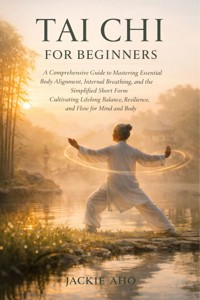
Discover the ancient art of Tai Chi and transform your health, balance, and inner peace with this comprehensive beginner's guide.
Whether you're seeking gentle exercise, stress relief, or a deeper mind-body connection, this step-by-step manual teaches you the essential foundations and the complete Simplified 24-Form.
Inside you'll master:
• Proper body alignment and posture for maximum benefits
• Internal breathing techniques to cultivate vital energy (Qi)
• The complete 24-Form with detailed, easy-to-follow instructions
• Mind-body integration practices for lasting wellness
. Fall prevention and balance improvement strategies • Stress reduction through mindful movement
• Techniques suitable for all ages and fitness levels
Perfect for seniors, wellness seekers, and anyone looking to reduce pain, improve flexibility, and find calm in a busy world.
No prior experience needed—just a willingness to move gently and breathe deeply.
Start your journey to lifelong vitality and inner peace today.
Buy your copy now!
Das E-Book können Sie in Legimi-Apps oder einer beliebigen App lesen, die das folgende Format unterstützen:
Veröffentlichungsjahr: 2026
Ähnliche


















Tai Chi for Beginners
Introduction
🌟 Chapter 1: The Essential Foundation: What is Tai Chi?
🍃 Chapter 2: Preparing the Vessel: Body Alignment and Posture
🌬️ Chapter 3: The Breath and the Mind: Internal Practice
🌊 Chapter 4: Core Movements and Transitions: The Building Blocks
💫 Chapter 5: Learning the Short Form: Introduction to the Sequence
🛠️ Chapter 6: Troubleshooting and Refinement: Deepening Your Practice
🌄 Chapter 7: Practice Routines and Integration into Daily Life
🚀 Chapter 8: Continuing the Journey: Next Steps in Tai Chi
Appendix
Tai Chi for Beginners
A Comprehensive Guide to Mastering Essential Body Alignment, Internal Breathing, and the Simplified Short Form: Cultivating Lifelong Balance, Resilience, and Flow for Mind and Body
Jackie Aho
Copyright 2026
All rights reserved. No part of this publication may be reproduced, distributed, or transmitted in any form or by any means, including photocopying, recording, or other electronic or mechanical methods, without the prior written permission of the publisher, except in the case of brief quotations embodied in critical reviews and certain other noncommercial uses permitted by copyright law.
Health and Medical Disclaimer
The information provided in this book, Tai Chi for Beginners, is intended solely for educational purposes related to the practice and philosophy of Tai Chi Chuan. It is not intended to be a substitute for professional medical advice, diagnosis, or treatment.
Always consult with a qualified healthcare professional, physical therapist, or physician before starting any new exercise program, including Tai Chi, or if you have any pre-existing health conditions, injuries, chronic pain, or are pregnant. This is particularly important if you suffer from conditions such as severe joint instability, dizziness, heart conditions, or severe osteoporosis.
The author and publisher are not medical professionals. By engaging in the exercises and practices described herein, you acknowledge that you are doing so at your own risk.
Safety and Practice Disclaimer
Tai Chi Chuan is a gentle, low-impact art, but improper execution or attempting movements beyond one's current physical capability can result in injury.
Listen to Your Body: This guide repeatedly emphasizes the principle of "never practice into pain." If any movement causes sharp, stinging, or persistent pain, stop immediately and modify the posture.
Proper Environment: Ensure your practice space is clear of hazards, and your footwear is appropriate to prevent slips or falls.
Modification is Key: The depth of squats and the range of motion described are recommendations. If you have limited mobility, practice the movements at a higher stance and reduced range until your strength and flexibility improve naturally.
Introduction
The alarm clock blares at 6:00 AM, the to-do list for the day is already running through your head, and the tightness in your shoulders feels like a permanent fixture. You scroll through social media, maybe grab a quick coffee, and prepare to launch yourself into another day defined by speed, complexity, and constant mental chatter. Sound familiar? For many of us living in the modern world, this relentless pace has become the default, leading to an epidemic of stress, poor posture, chronic pain, and a deep, underlying feeling of disconnection—from our bodies, from our breath, and from the quiet center within ourselves. We are seeking a way back to balance, a method to navigate the chaos without being consumed by it. We try the gym, we try meditation apps, and while they offer fleeting relief, they often feel like more things we have to squeeze into an already overflowing schedule. The search, however, often leads to an unexpected, ancient, and beautifully simple practice: Tai Chi Chuan.
Tai Chi, or T'ai Chi Ch'uan (meaning "Supreme Ultimate Fist"), is one of those words that many people have heard, but few truly understand. To some, it conjures images of groups of elderly people moving in slow, synchronized silence in a misty park at dawn. To others, it sounds like an exotic martial art involving impressive, gravity-defying maneuvers. The truth, as is often the case with powerful, enduring traditions, lies somewhere wonderfully in the middle—and yet, far exceeds both of those limited images. At its core, Tai Chi is a system of profound self-cultivation that seamlessly weaves together gentle physical movement, deep diaphragmatic breathing, and focused, meditative intent. It is an art form, a moving meditation, a system of preventive medicine, and a highly sophisticated martial art, all rolled into one fluid, continuous practice. It is not about doing more; it is about learning how to simply be more present, more balanced, and more resilient. This guidebook, Tai Chi for Beginners, is your first step onto this incredible path, designed to be the friendly, knowledgeable companion you need as you begin to explore the immense potential held within these seemingly simple movements.
The real genius of Tai Chi lies in its accessibility and its deceptively powerful depth. Unlike high-impact exercises that can wear down the joints and cause injury, Tai Chi is inherently gentle. It requires no special equipment—just comfortable clothes and enough space to extend your arms. It doesn't ask for a sudden burst of strength or speed; instead, it demands patience, softness, and consistency. You might look at a practitioner slowly shifting their weight and think, "That's easy," but as you begin to practice the forms yourself, you quickly realize the immense concentration and physical control required to move with such deep relaxation and unwavering balance. It is a mirror for your internal state; if your mind races, your body tenses. If your body is stiff, your mental flow is interrupted. Tai Chi compels you to reconcile these two halves, fostering a genuine, integrated harmony between mind and body—the very definition of true health and vitality. It is a slow, steady journey of self-discovery, where every single movement teaches you something new about your structural alignment, your breathing patterns, and your relationship with gravity.
This book is dedicated to you, the absolute beginner. You might feel awkward, stiff, or even a little intimidated by the history and philosophy. That is perfectly normal. The most important lesson you will learn in Tai Chi is to release the need for perfection. This practice is not about the destination; it is entirely about the journey. Our goal is to demystify the art, strip away the jargon, and present the foundational principles in a clear, conversational, and highly practical manner. We will not rush you through complex sequences. Instead, we will dedicate enormous time to the basics: how to stand, how to breathe, how to shift your weight, and how to relax while moving. These fundamentals are not just prerequisites; they are the heart of the practice. Even masters return to these basic principles every single day. By committing to the content in this guide, you are not just learning a sequence of movements; you are installing a new operating system for your body and mind, one that prioritizes flow over force, softness over stiffness, and calm presence over anxious speed.
☯️ Unveiling the Supreme Ultimate: Defining Tai Chi
When we talk about Tai Chi, we are fundamentally talking about Tai Chi Chuan (Taijiquan). The term T'ai Chi (or Taiji) itself translates to "Supreme Ultimate," and it represents the ancient Chinese cosmological concept of the unity of Yin and Yang, the ultimate source of all existence. It is the perfect, dynamic state of balance between opposing forces: darkness and light, yielding and firm, passive and active. The "Chuan" part means "fist" or "boxing," indicating its origins as a martial art. Therefore, Tai Chi Chuan is literally "Supreme Ultimate Boxing"—a system of self-defense and self-cultivation based on the ultimate principle of balance and harmonious change.
What makes it fundamentally different from virtually every other physical discipline is its methodology. Instead of building muscle through external tension and heavy lifting, Tai Chi cultivates internal strength and elastic power through deep relaxation and the coordination of breath and movement. It employs circular, flowing, non-strenuous movements designed to gently open the joints, loosen the tendons, and, most importantly, circulate Qi (pronounced "chee").
The Three Pillars of Tai Chi Practice
All genuine Tai Chi training rests upon three interconnected pillars. Neglect any one, and the entire structure of the practice becomes unstable:
Yi (Intent/Mind): This is focused awareness. Tai Chi is never mindless exercise. Your mind must be attentive, guiding the movement rather than just letting the body flop through the motions. This is the difference between movement and moving meditation. The mind leads; the body follows.
Qi (Life Energy/Breath): This is the vital life force believed to circulate through the body along specific pathways (meridians). Tai Chi movements and deep abdominal breathing are specifically designed to cultivate, gather, and circulate this energy, leading to greater health and vitality.
Jing (Physical Relaxation/Muscles): This is the physical body. The goal is profound relaxation (Song). When muscles are tight, they block the flow of Qi and restrict movement. The softer the muscles, the deeper the stretch and the more powerful the internal energy flow.
Understanding these three components is your first step toward true Tai Chi practice. Without focused Intent, the Qi becomes sluggish. Without deep Relaxation, the body cannot follow the Intent and the Qi remains blocked.
⏳ A Legacy of Longevity: The History of Tai Chi Chuan
Tai Chi did not spring up overnight. It is the culmination of centuries of Chinese martial arts, Daoist philosophy, and traditional Chinese medicine (TCM). While its exact origins are shrouded in legend and debate—the most famous involving the mythical Daoist sage Zhang Sanfeng—its recognizable history solidifies within the villages of 17th-century China.
From Village Secret to Global Phenomenon
The most historically verifiable and influential origin points to the Chen Village (Chenjiagou) in Henan province. The Chen family created and meticulously guarded a unique style of boxing that blended ancient martial techniques with the principles of Daoyin (calisthenics) and Tuna (deep breathing), emphasizing spiral power and softness.
It wasn't until the 19th century that Tai Chi truly began to spread. A scholar named Yang Luchan (1799–1872) traveled to Chen Village and, after years of intense study, brought the art out of the village and into Beijing. Yang refined the style, gradually making the movements more expansive, slower, and smoother, primarily to eliminate the complex, jarring martial bursts that might frighten or confuse the average public. This refinement led to the creation of the now globally ubiquitous Yang Style—the foundation for the simplified forms taught to most beginners today.
Following Yang Luchan, other prominent families developed their own variations, each emphasizing slightly different qualities:
Chen Style: Retains the martial origins, featuring alternating slow, gentle movements with powerful, explosive releases (fa jin). It emphasizes Silk Reeling (Chan Si Gong), the spiral movement essential for generating internal power.
Yang Style: The most widespread style, known for its large, open, elegant, and evenly paced movements. It is the ultimate style for health cultivation and longevity.
Wu Style: Known for smaller, compact movements, sometimes practiced on a slight incline to challenge the balance.
Sun Style: Characterized by agile steps where the foot often closes beside the other before stepping out, combined with quick, light movements.
The evolution of these styles is a testament to the art's adaptability. Each style is a different route up the same mountain—the fundamental principles of softness, continuity, and internal alignment remain the same. As a beginner, you should not worry about choosing the "perfect" style; rather, you should focus on mastering the universal fundamentals, which this book will provide.
🧘 The Transformation: Why Practice Tai Chi?
The benefits of a regular Tai Chi practice are so profound and far-reaching that Western medical science has spent the last few decades catching up to what Chinese practitioners have known for centuries. It's often described as "medication in motion," and the impact touches every level of your being.
1. Physical Health and Structural Integrity
The physical improvements are often the most immediate motivation for beginners, particularly those dealing with the aches and stiffness of modern life.
Exceptional Balance and Fall Prevention: Tai Chi is globally recognized as one of the most effective exercises for improving balance, especially in older adults. The constant, subtle weight shifting, combined with the focus on the rooted stance, strengthens the ankle and hip stabilizers and improves proprioception (the body's awareness of its position in space). This leads directly to a massive reduction in the risk of dangerous falls.
Self-Correction Tip: When practicing weight shifts, imagine your feet are measuring out a fine liquid that cannot be spilled. This encourages slow, controlled movement.
Joint Health and Flexibility: The movements are low-impact, using the body's natural range of motion. Unlike static stretching, Tai Chi gently and continuously lubricates the joints (knees, hips, shoulders) through constant, circular movement. This can be profoundly beneficial for managing arthritis and general joint stiffness.
Core Strength and Posture: You won't be doing sit-ups, but your core will work harder than ever. The instruction to "sit down" into your stance and the requirement to keep the torso upright and centered naturally engage the deep abdominal and back muscles. This improves spinal alignment and eliminates the slumped posture common from prolonged sitting.
Cardiovascular Health: While low intensity, Tai Chi is a moderate-intensity aerobic exercise. Studies show it can lower blood pressure, improve cholesterol levels, and enhance circulation, particularly benefiting individuals with heart conditions when performed regularly.
2. Mental Clarity and Emotional Balance
The integration of the mind (Yi) is what separates Tai Chi from mere slow calisthenics. The mental benefits are often what keep practitioners coming back year after year.
Stress and Anxiety Reduction: The requirement to focus exclusively on the movement and the breath acts as an active meditation, pulling the mind away from worry and rumination. The slow, deep, diaphragmatic breathing activates the parasympathetic nervous system (the "rest and digest" system), counteracting the effects of the chronic "fight or flight" stress response.
Improved Concentration and Memory: Tai Chi demands single-pointed focus to execute the complex, coordinated movements. This constant mental effort strengthens cognitive functions, improving concentration, task management, and memory retention.
Cultivation of Patience and Presence: The slow speed forces a confrontation with impatience. Tai Chi teaches you to slow down, to observe, and to accept where you are right now, a skill that translates powerfully into managing the frustrations of daily life.
3. Energy Cultivation and Vitality
Perhaps the most unique and profound benefit is the cultivation of Qi (life force energy).
Enhanced Energy Levels: Counterintuitively, the gentle exercise, because it removes physical tension and blockages, often leaves practitioners feeling energized and refreshed, not tired. By regulating the breath and opening the body's energy pathways (meridians), Tai Chi encourages the free flow of Qi, bolstering the immune system and overall vitality.
Improved Sleep: The relaxation response induced by the practice helps to reset the nervous system, leading to deeper, more restorative sleep.
A Sense of Integrated Wholeness: The practice breaks down the arbitrary barrier we often feel between our mind and body. Through consistent, integrated practice, you begin to experience yourself as a unified whole, leading to a deeper sense of grounding and well-being.
📖 How to Use This Guidebook: A Roadmap for the Beginner
This book is structured as a clear, step-by-step curriculum designed to take you from knowing nothing about Tai Chi to confidently performing your first basic form. Do not rush. The single greatest mistake a beginner makes is trying to learn the entire sequence before mastering the foundation.
Here is a brief overview of how we will progress:
Chapter 1 (The Essential Foundation): You are here! We established the why—the philosophy, the history, and the profound benefits.
Chapter 2 (Preparing the Vessel): We move into the how to stand. This is the critical chapter on structure and alignment. You will learn about rooting, the proper knee angle, and the concept of "sinking the Qi." Spend extra time here. A poor foundation will always lead to poor movement.
Chapter 3 (The Breath and the Mind): We address the internal work—the Yi (Intent) and the breath. You will learn specific breathing techniques that activate the energy center (Dantian) and focus your mind.
Chapter 4 (Core Movements and Transitions): We start moving! This chapter introduces the essential building blocks: the weight shift, the cat step, and the fundamental circular actions (Silk Reeling) that define Tai Chi's power generation. These are drills, not form movements, but they are essential.
Chapter 5 (Learning the Short Form): The payoff! We will break down a concise, beginner-friendly form (e.g., the 10-Movement Yang Style Short Form), teaching each posture slowly and detailing the necessary transitions.
Chapter 6 (Troubleshooting and Refinement): Now that you're moving, we address the inevitable mistakes. This chapter is your self-correction manual, focusing on principles like slowness, continuity, and internal checking.
Chapter 7 (Practice Routines and Integration): We move Tai Chi off the mat and into your life. We offer practical advice on setting up a routine, practicing mini-forms, and applying Tai Chi principles to sitting and walking.
Chapter 8 (Continuing the Journey): The final chapter looks forward, introducing concepts like Push Hands and longer forms, providing inspiration for the decades of practice ahead.
A Note on Technique and Terminology
Throughout this book, we will use simplified, descriptive language to explain concepts, but we will also introduce key Chinese terms (like Qi, Dantian, Song) and their Pinyin spellings. This is important because these terms precisely describe concepts for which there is no direct English equivalent. For example, Song means far more than just "relax"; it implies a deep, pliable, elastic release of muscular tension, a state we will strive for in every movement.
Crucial Advice for the Beginner:
Be Gentle with Yourself: The movements will feel awkward and unnatural at first. This is because you are retraining habits that have developed over a lifetime. Avoid self-criticism. Every clumsy movement is a learning opportunity.
Focus on Sinking and Softness: If you feel tension in your shoulders or tightness in your knees, stop and consciously sink your weight and soften the area. The greatest danger in Tai Chi is trying to use muscle force.
Practice Consistency over Perfection: Ten minutes of mindful practice every day is vastly superior to a two-hour session once a month. Daily engagement builds new neurological pathways and muscular memory.
Listen to Your Body: Tai Chi should never cause sharp pain. If a posture hurts, modify it. Reduce the depth of the squat, reduce the range of motion, and practice within the limits of your comfortable range. Pain is a signal, not a goal.
You are about to embark on a journey that millions around the world have found to be transformative—a practice that restores health, sharpens the mind, and connects you to a timeless flow. Approach this guide with an open mind, a beginner's heart, and a spirit of playful curiosity.
🎯 The Beginner's Mind: Setting the Right Expectations
Before we even discuss the first posture, we must address the most crucial tool you bring to the practice: your attitude. In Zen Buddhism, there is a concept known as Shoshin or "Beginner's Mind." This means approaching every task, even those you have done a thousand times, with the openness, curiosity, and lack of preconceptions of a true novice. For Tai Chi, this mindset is essential.
In a culture that prizes instant results and visible achievements, Tai Chi asks you to do the opposite. You will not see dramatic muscle gains. You will not necessarily break a sweat (at least not in the early stages). The results of Tai Chi are often subtle, internal, and slow to accumulate, like the erosion of a riverbed. You may wake up one morning and suddenly realize that the chronic back ache is gone, or that a stressful situation that used to send you spiraling now only causes a slight ripple. These are the profound, cumulative victories of the practice.
The Four Key Expectations to Release:
Release the need for speed: You will naturally want to rush to the next posture. Resist this urge. If you speed up, you lose the connection between the Yi (mind) and the Jing (body). True practice requires you to move only as fast as your mind can guide the energy.
Release the need for deep squatting: Many beginners, in an effort to look "authentic," immediately try to squat too low. This strains the knees and introduces tension, which defeats the entire purpose. Your form should look effortless, not strained. Start high, where your knees are comfortable, and let your stance deepen naturally over months, even years, of practice.




