


24,99 €
Mehr erfahren.
- Herausgeber: John Wiley & Sons
- Kategorie: Fachliteratur
- Sprache: Englisch
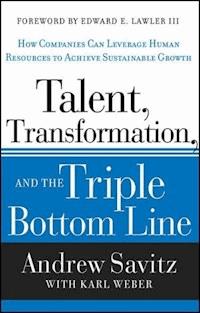
HR Professional's guide to creating a strategically sustainable organization Employees are central to creating sustainable organizations, yet they are left on the sidelines in most sustainability initiatives along with the HR professionals who should be helping to engage and energize them. This book shows business leaders and HR professionals how to: motivate employees to create economic, environmental and social value; facilitate necessary culture, strategic and organizational change; embed sustainability into the employee lifecycle; and strengthen existing capabilities and develop new ones necessary to support the transformation to sustainability. Talent, Transformation, and the Triple Bottom Line also demonstrates how leading companies are using sustainability to strengthen core HR functions: to win the war for talent, to motivate and empower employees, to increase productivity, and to enliven traditional HR-related efforts such as diversity, health and wellness, community involvement and volunteerism. In combination, these powerful benefits can help drive business growth, performance, and results. * The book offers strategies, policies, tools and specific action steps that business leaders and HR professionals can use to get into the sustainability game or enhance their efforts dramatically * Andrew Savitz is an expert in sustainability and has worked extensively with many organizations on sustainability strategy and implementation; he and Karl Weber wrote The Triple Bottom Line, one of the most successful books in the field * Published in partnership with SHRM and with the cooperation of the World Business Council for Sustainable Development * Forward by Edward Lawler III This book fills a gaping hole in both the HR and sustainability literature by educating HR professionals about sustainability, sustainability professionals about HR, and business leaders about how to marry the two to accelerate progress on both fronts.
Sie lesen das E-Book in den Legimi-Apps auf:
Seitenzahl: 570
Veröffentlichungsjahr: 2013
Ähnliche


















Table of Contents
TITLE PAGE
COPYRIGHT PAGE
DEDICATION
ABOUT THE AUTHORS
FOREWORD
PREFACE
PART ONE: TRANSFORMATION, TALENT, AND HUMAN RESOURCES
CHAPTER 1 TRANSFORMING GE
Ecomagination: Why GE Is Turning Green
People Movers: How HR Is Leading the Way Forward
Healthymagination: Improving Health Care for GE Employees and Society
Eight Lessons for Business Leaders, Sustainability Professionals, and HR
The New Winning Strategy: Leveraging HR for Sustainable Growth
CHAPTER 2 SUSTAINABILITY
Sustainability Milestones: The Brundtland Commission and the Dow Jones Sustainability Index
The Age of Sustainability: Trends and Realities
The Triple Bottom Line: How to Define and Measure Sustainable Growth
The Sweet Spot: How to Develop Sustainable Business Strategies
Sustainability and Profitability: How to Grow Your Sweet Spots
Transformation: The Business Benefits of Sustainability
Revving Up: Where HR Meets Sustainability
PART TWO: FROM TRADITIONAL HR TO SUSTAINABLE HR
CHAPTER 3 EMBEDDING SUSTAINABILITY IN THE WORKFORCE LIFE CYCLE
Building Sustainability into Core HR Processes
CHAPTER 4 EMPLOYEE SELECTION AND SUSTAINABILITY
Johnson & Johnson: When HR Fails the Sustainability Test
Recruitment: Winning the Global War for Talent
Hiring the Workforce of Tomorrow
The Value of Values Alignment
CHAPTER 5 CAREER DEVELOPMENT AND SUSTAINABILITY
Onboarding and Sustainability
Training for Sustainability
Developing Tomorrow’s Leaders
Evolving Employee Assistance
Compensation and Incentives for Sustainability Performance
Nonfinancial Incentives for Sustainability Performance
Retention and Sustainability
Compliance, Discipline, and Sustainability
CHAPTER 6 WORKFORCE MANAGEMENT AND SUSTAINABILITY
Performance Appraisal: Evaluating and Rewarding Sustainability Performance
Workforce Planning: Meeting Your Future Needs
Labor Pool Analysis: Understanding a Changing Workforce
Termination and Sustainability
Sustainable Retirement and Postretirement
CHAPTER 7 HR DELIVERABLES AND SUSTAINABILITY
The Care and Feeding of Employees
How Sustainability Is Expanding HR’s Responsibilities
Wages and Benefits Policies: The Return on Investing in Employees
Employee Wellness Programs and Sustainability
Creating Better Working Conditions
PART THREE: ORGANIZATIONAL DEVELOPMENT AND CHANGE: HR’S ROLE IN BUILDING SUSTAINABLE COMPANIES
CHAPTER 8 SUSTAINABILITY AND ORGANIZATIONAL CAPACITY
Organizational Capabilities: Levers for Sustainable Success
Innovation
Collaboration
Long-Term Orientation
Outward Focus
Interdependent Thinking
Learning
Adaptability
CHAPTER 9 SUSTAINABILITY AND CULTURE CHANGE
The Three Levels of Organizational Culture
Why Traditional Corporate Cultures May Resist Sustainability
When Culture Sabotages Sustainability: Why BP Cannot Operate Safely
When Culture Advances Sustainability: How AEP Created a Zero-Harm Culture
Lessons on Culture Change from BP and AEP
Evaluating Your Organization’s Culture
CHAPTER 10 HOW TO GET WHERE YOU WANT TO GO
Why Change Occurs: Danger and Opportunity
Three Dimensions of Sustainable Change
Ad Hoc Change
Systematic Change
Sustainability and the Classic Change System
Top-Down Change Versus Bottom-Up Change
Appealing to Hearts
Talking About Change
Jump-Starting Sustainable Change
PART FOUR: SUSTAINABILITY AND EMPLOYEE ENGAGEMENT
CHAPTER 11 HOW SUSTAINABILITY AND ENGAGEMENT CAN TRANSFORM YOUR BUSINESS
The Link Between Sustainability, Engagement, and Profit
How “Acme Corporation” Leveraged Sustainability for Greater Profitability
The Golden Triangle: Seeing the Entire Business Case for Sustainability
How Starbucks Creates Value from Values
Measuring the Impact of Sustainability on Employee Engagement
How HR and Sustainability Professionals Can Work Together
Getting Started with Sustainability and Employee Engagement Programs
Strategic Volunteerism as a Starting Point
Employee Engagement, Sustainability, and Transformation
ACKNOWLEDGMENTS AND THANKS
INDEX
Cover design: Faceout Studios
Copyright © 2013 by John Wiley & Sons, Inc. All rights reserved.
Published by Jossey-Bass
A Wiley Imprint
One Montgomery Street, Suite 1200, San Francisco, CA 94104-4594—www.josseybass.com
No part of this publication may be reproduced, stored in a retrieval system, or transmitted in any form or by any means, electronic, mechanical, photocopying, recording, scanning, or otherwise, except as permitted under Section 107 or 108 of the 1976 United States Copyright Act, without either the prior written permission of the publisher, or authorization through payment of the appropriate per-copy fee to the Copyright Clearance Center, Inc., 222 Rosewood Drive, Danvers, MA 01923, 978-750-8400, fax 978-646-8600, or on the Web at www.copyright.com. Requests to the publisher for permission should be addressed to the Permissions Department, John Wiley & Sons, Inc., 111 River Street, Hoboken, NJ 07030, 201-748-6011, fax 201-748-6008, or online at www.wiley.com/go/permissions.
Limit of Liability/Disclaimer of Warranty: While the publisher and author have used their best efforts in preparing this book, they make no representations or warranties with respect to the accuracy or completeness of the contents of this book and specifically disclaim any implied warranties of merchantability or fitness for a particular purpose. No warranty may be created or extended by sales representatives or written sales materials. The advice and strategies contained herein may not be suitable for your situation. You should consult with a professional where appropriate. Neither the publisher nor author shall be liable for any loss of profit or any other commercial damages, including but not limited to special, incidental, consequential, or other damages. Readers should be aware that Internet Web sites offered as citations and/or sources for further information may have changed or disappeared between the time this was written and when it is read.
Jossey-Bass books and products are available through most bookstores. To contact Jossey-Bass directly call our Customer Care Department within the U.S. at 800-956-7739, outside the U.S. at 317-572-3986, or fax 317-572-4002.
Wiley publishes in a variety of print and electronic formats and by print-on-demand. Some material included with standard print versions of this book may not be included in e-books or in print-on-demand. If this book refers to media such as a CD or DVD that is not included in the version you purchased, you may download this material at http://booksupport.wiley.com. For more information about Wiley products, visit www.wiley.com.
Library of Congress Cataloging-in-Publication Data
Savitz, Andrew W.
Talent, transformation, and the triple bottom line: how companies can leverage human resources to achieve sustainable growth / Andrew W. Savitz with Karl Weber ; foreword by Edward E. Lawler, III. – 1st ed.
p. cm.
Includes bibliographical references and index.
ISBN 978-1-118-14097-0 (cloth), ISBN 978-1-118-22549-3 (pdf) – ISBN, 978-1-118-23890-5 (epub) – ISBN, 978-1-118-26357-0 ( mobipocket)
1. Management–Environmental aspects. 2. Personnel management–Environmental aspects. 3. Sustainable development–Management. 4. Social responsibility of business. I. Weber, Karl, 1953– II. Title.
HD30.255.S28 2013
658.4'083–dc23
2012042029
This book is dedicated to my parents, Herb and Adel,
and to my brothers, Peter, Matt, and Jon.
It’s for my family–Penny, Noah, Zuzzie, and Harry–and for yours.
ABOUT THE AUTHORS
Andy Savitz is an internationally known expert on sustainability and was one of the lead partners in the Sustainability Services practice at PricewaterhouseCoopers, the global advisory services firm. He has worked with many companies to help them improve their financial, social, and environmental performance, and wrote The Triple Bottom Line (2006), one of the most successful and highly acclaimed books on sustainability. Andy worked extensively with the Society for Human Resource Management and with numerous companies and organizations in developing the guidance, strategies, and tools in this book, and to demonstrate why human resources is a critical and often underutilized asset to all organizations, small and large, that want to move toward sustainability. Andy now runs Sustainable Business Strategies (www.getsustainable.net), an independent consultancy based in the Boston area. He lives in Brookline, Massachusetts, with his wife and three children.
_________________
Karl Weber is a writer and editor specializing in business and current affairs. In addition to his collaboration with Andy Savitz on The Triple Bottom Line, Weber’s recent projects include the New York Times best seller Creating a World Without Poverty, coauthored with Muhammad Yunus, winner of the 2006 Nobel Peace Prize (2008), and its sequel, Building Social Business (2010); the New York Times number-one best seller What Happened: Inside the Bush White House and Washington’s Culture of Deception, by Scott McClellan (2008), which Weber edited; and two best-selling companion books to the acclaimed documentary films Food Inc. (2009) and Waiting for “Superman” (2010), both of which Weber edited. He has also collaborated with the noted consultant Adrian Slywotzky on several books, including Demand: Creating What People Love Before They Know They Want It (2011). Weber lives in Irvington, New York, with his wife, Mary-Jo Weber.
FOREWORD
HAVING SPENT MANY YEARS researching, teaching, and writing about the challenges facing contemporary business leaders, I’ve become convinced that sustainability is one of the most crucial. To remain viable, organizations must find ways to foster social and environmental prosperity while creating economic prosperity. To paraphrase economist Jeffrey Sachs, they must transform themselves from wealth-creating organizations into commonwealth-creating organizations—a new requirement we might refer to as the sustainable effectiveness imperative.
Many factors have led to this imperative. Among the most important is the fact that both our natural environment and our social fabric are under enormous stress around the world. In the American Southwest, water scarcity is threatening the livelihood of the farmers who produce one-quarter of the food eaten in North America. In sub-Saharan Africa, poverty, famine, and HIV/AIDS are continuing to run rampant. In the fast-growing countries of Asia and South America, economic development is exerting enormous pressures on air and water quality.
For better or worse, for-profit companies and other organizations find themselves in the spotlight because of sustainability challenges. Some have helped create these problems as by-products of their business activities; most find themselves in a position to help address environmental and social problems. Many organizations are trying to understand the business risks and opportunities inherent in supporting sustainability. In any case, the perception is growing that businesses must play a role in solving the planet’s environmental and social problems.
This is why the Center for Effective Organizations has made sustainability research one of our top priorities. It is also why I focused on the concept of sustainable effectiveness in my most recent book, Management Reset, coauthored with Christopher G. Worley (Jossey-Bass, 2011). As Worley and I explain, sustainable effectiveness means creating the values, processes, capabilities, mind-set, and culture that are needed for organizations to succeed in the long term. We show how to create value, organize work, treat people, and guide behavior in ways that will enable growth, prosperity, and sustainability.
The transition to what I call a sustainable management organization (SMO) is crucial for any company that hopes to achieve lasting success. SMOs incorporate sustainability into everything they do, from setting strategy, goals, and objectives, to measuring and reporting, to the way they think about and work with their stakeholders. Ultimately, sustainable management is about changing an organization’s identity, mind-set, and culture in ways that have a profound effect on the daily actions, thoughts, and beliefs of an organization’s leadership and its employees.
I’m delighted to see that Andy Savitz, a well-known consultant and expert in the field of sustainability, has tackled one of the key pieces of the sustainability puzzle: the vital role of human resources in helping organizations make the transition to sustainable management. With coauthor Karl Weber, Andy wrote The Triple Bottom Line: How Today’s Best-Run Companies Are Achieving Economic, Social and Environmental Success, and How You Can Too (Jossey-Bass, 2006), based largely on his work as a leader of the global sustainability practice at the accounting and consulting firm PricewaterhouseCoopers.
Working with organizations, Andy has seen the very limited role human resource (HR) departments often play in helping their organizations move forward on sustainable management. In order to change this, he worked for two years with the Society for Human Resource Management to define, explain, and find ways to greatly enhance the HR role in sustainability. He also began to consult directly with a number of for-profit companies and nonprofits to test his ideas and approaches and conferred with HR and sustainability professionals about the potential links.
The result of this work is the book you hold in your hand. In this new work, Andy asks: How can employees be involved in increasing a corporation’s Triple Bottom Line? How can HR facilitate their involvement, both through its traditional roles and through new roles that Andy dubs “sustainable HR”?
These are some of the same questions we’ve been working to answer here at the Center for Effective Organizations and that we will continue to focus on in the future. I hope this book will help put these important issues high on the agenda of HR and sustainability professionals in organizations of every kind.
In the years to come, HR professionals should play a prominent role in creating the SMOs of the future. The insights and ideas provided in Talent, Transformation, and the Triple Bottom Line offer a powerful starting point for them. This book is also a valuable resource for managers and company leaders focused on sustainability. It contains many useful ideas about how to work closely with their colleagues in HR to guide the cultural, managerial, organizational, and strategic changes their organizations need to make.
My work and that of much of the Center for Effective Organizations has shown that sustainability is of growing concern to business leaders and top talent everywhere. For that reason alone, mastering the challenges of sustainability needs to be a high priority for every HR professional. Talent, Transformation, and the Triple Bottom Line provides a valuable tool kit for beginning the process.
Edward E. Lawler IIIDistinguished Professor of Business, University of Southern California Marshall School of BusinessFounder and director of the university’s Center for Effective Organizations
PREFACE
OUR FIRST BOOK, The Triple Bottom Line: How Today’s Best-Run Companies Are Achieving Economic, Social, and Environmental Success—and How You Can Too (Jossey-Bass, 2006), introduced thousands of readers from the business world and elsewhere to the concept of sustainability. In its opening pages, we suggested the following simple definition: a sustainable corporation is one that creates profit for its shareholders while protecting the environment and improving the lives of those with whom it interacts.
We illustrated this idea with the image of the Sweet Spot—overlapping circles whose intersection shows where an organization’s business interests and the needs of society meet. We argued that in order to thrive in the twenty-first century, companies need to find their own Sweet Spots and migrate toward them.
We also explained the Triple Bottom Line, which is a way for well-managed and successful companies to measure not just the profits they generate but also their environmental and social performance. And we showed why sustainability requires companies to identify a wide range of stakeholders to whom they may be accountable, develop open relationships with them, and find ways to work with them for mutual benefit. In the long run, this transparent, systematic, and cooperative approach to management will create more profit for the company and more social, economic, and environmental prosperity for society.
Sustainability is not about altruism or philanthropy. It’s about how companies can find ways to turn environmental and social challenges—either their own or those of their customers or other key stakeholders—into business opportunities. Turning responsibility into opportunity is the core idea behind the Sweet Spot, and it’s one that today’s smartest companies are increasingly embracing.
In the years since The Triple Bottom Line was published, much has happened. Environmental, social, and economic pressures on businesses have intensified. A global recession, a financial market meltdown, revolutionary uprisings and upheavals in the Middle East, continuing economic crisis in Europe, and political gridlock in the United States have revealed the fragility of the economic platform on which world prosperity is built. The unmet challenges of climate change, ongoing weather-related shocks ranging from droughts and hurricanes to tsunamis, loss of biodiversity, the gradual disappearance of rain forests and coral reefs, and dwindling supplies of vital natural resources underscore the urgency of the environmental problems that threaten the planet. Persistent malnutrition and poverty, rising levels of obesity and other chronic diseases, the threat of novel pandemics, child labor, and the lack of human rights for many are but a sample of the growing risks to the safety of human societies and the well-being of millions of individual men, women, and children around the world.
In combination, these trends make it clear that governments, international agencies, and nonprofit organizations cannot secure the world’s future unaided. Businesses have an enormous role to play in ensuring that free, humane, and equitable societies and a livable planet will be available for generations to come, and they are increasingly being asked, indeed expected, to play this role. This means that the message of sustainability is now more important than ever before. In short, we are living today in the age of sustainability, with risks and opportunities that no business or organization can afford to ignore.
Businesses themselves are facing a growing array of challenges as well. The Occupy Wall Street movement, which originated in 2011 as a protest against the concentration of wealth and power in the hands of major banks and other large financial institutions, reflects a broader critique of the perceived arrogance and selfishness of big business leaders, who appear unwilling or unable to address festering problems like worsening long-term unemployment, income stagnation, and deepening inequality. The megacompensation of many CEOs, sometimes unrelated to performance, helps fuel the fire.
In the 2011 update of the respected Edelman trust survey, the number of informed Americans who said they generally trust business “to do what is right” fell by 8 percent to just 46 percent—eight points below the number of Americans who express such trust in government and just 5 percent more than the number who profess trust in notoriously corrupt business in oligarchic Russia.1
Between 2010 and 2012, the slow recovery from the worldwide recession of 2008–2009 hampered business growth, depressed overall demand, and made it harder for most companies to pursue ambitious plans for innovation, expansion, and improvement. Meanwhile, health care costs in the United States and the rest of the world continued to rise, adding to employment costs and discouraging companies from hiring. Stagnant job growth has kept wage increases under control and in some cases has temporarily relieved the pressure many companies were feeling from the intensifying war for talent in today’s demanding, technology-driven world. But the corollary is growing dissatisfaction on the part of millions of workers, many of whom are clinging to jobs they dislike, solely because of the uncertainties of the job market and the inadequacy of the social safety net. A January 2010 survey by the Conference Board, I Can’t Get No … Job Satisfaction, That Is, found that Americans’ job satisfaction had reached its lowest level in twenty-two years—just 45 percent as compared to 61.1 percent as recently as 1987.2 (In 2011, the figure inched back up to 47.1 percent.3)
So even as businesses join government and other institutions in facing a mounting array of environmental and social problems, they are also being forced to struggle against some of the most difficult economic challenges in memory. At times like these, the additional challenge of sustainability can appear to be a dangerous distraction to organizations that are struggling to survive.
We’ve found that despite these difficult short-term impediments, many business leaders recognize that sustainability, though deeply challenging, is also an essential requirement for long-term success. In the years since we wrote The Triple Bottom Line, the need for sustainable growth, already the subject of widespread discussion and debate at that time, has become if anything even more widely accepted and practiced by companies in almost all industries. Many of the world’s leading corporations have publicly embraced sustainability as a guiding principle and have begun to develop new strategies and to reorganize their operations around it. They are creating sustainability departments, redefining jobs, and hiring growing numbers of sustainability-minded and sustainability-trained professionals. Sustainable business practices are being established and applied in most business functions ranging from operations, logistics, and supply chain management to finance, reporting, marketing, and sales. And a host of sophisticated measurement systems and educational programs designed to disseminate, promote, and enhance sustainable performance are achieving widespread popularity.
Yet despite the adoption of more sustainable practices within companies, one important group of business leaders has remained largely uninvolved in the transformation: human resource (HR) professionals. This is surprising, even paradoxical, because the HR function represents one of the crucial links between businesses and the society they serve. HR professionals are largely responsible for recruiting talent, analyzing workforce trends, shaping employment policies and procedures, and helping manage many external impacts of their organizations, from outsourcing to downsizing. In many companies, HR leaders are also deeply involved in corporate philanthropy, employee volunteerism, legal and ethical compliance, and community relations.
These and other traditional HR roles are central to the challenges that companies face when it comes to embracing and embedding sustainability—which means that when issues included under the umbrella of sustainability are being considered, HR should have a seat at the table and a role to play—in some cases, a leading role. But all too often, HR professionals are on the sidelines. And all too often, newly created sustainability departments and professionals are struggling with aspects of their assignment that require HR knowledge, involvement, and leadership to succeed.
Many companies are tackling sustainability in an ad hoc fashion, relying on internal volunteers or adding responsibility for environmental and social issues to the portfolios of one or a few managers who happen to have some relevant knowledge or interest. Other organizations, particularly larger ones, are taking more formal steps, creating departments dedicated to sustainability issues and job titles like “vice president of sustainability” or “chief sustainability officer.”
Unfortunately, we’ve observed that many of the new sustainability specialists have a limited understanding of the importance of HR and the unique insights, experiences, and skills that HR experts can bring to the effort. Careers in sustainability most commonly begin with training and experience in environmental sciences, biology, ecology, or the technologies that address environmental issues. Sometimes they emerge from the corporate communications, public relations, marketing, compliance, or legal functions. Yet the profound transformation that will increasingly be required of companies—reshaping business cultures, values, systems, policies, and processes to meet the demands of the age of sustainability—requires skills that few, if any, of this new cadre of sustainability professionals possess. Leading cultural and organizational change, for example—moving minds, hearts, and hands—requires social, psychological, behavioral, and human relationships skills that these more technical areas do not usually address.
By contrast, HR leaders, daily immersed in the tasks of building a loyal, diverse workforce with the skills, knowledge, aptitudes, and attitudes required for business success in an increasingly competitive world, have the expertise that sustainability specialists generally lack. They know how to embed organizational goals and objectives into performance measurement, how to develop employee and organizational capabilities like innovation and collaboration, how to facilitate cultural and organizational change, and how to measure and broaden the impact of initiatives on employee engagement, morale, and productivity.
Business leaders who are charged with the responsibility for making the transformation from traditional to sustainable ways of doing business can learn much of what is necessary to make that transformation from their colleagues in HR. They would be well advised to leverage the knowledge, experience, and skills of HR to advance sustainability within their organizations. And both sustainability and HR leaders, as well as the organizations they work for, stand to benefit enormously from an alliance between them.
We’ve written this book in large measure to bridge the gap between sustainability and HR. In its pages, we show how HR professionals can take a leading role in helping their organizations successfully develop the culture, values, motivation, capacities, and talent needed to achieve and maintain success as measured by today’s Triple Bottom Line. We describe and illustrate the impact of sustainability on the practice of HR, explaining the new challenges it creates for HR professionals as well as the surprising ways the sustainability movement can facilitate, empower, enhance, and expand many of the traditional functions of HR. And we offer case histories from a variety of companies that illustrate how sustainability experts and HR leaders can join forces to promote positive change and unleash the productive, creative energies of the many employees who are ready and eager to incorporate sustainability into their jobs.
We hope this book will provide HR professionals, sustainability specialists, and business leaders of all stripes with a clearer understanding of one another’s roles; an increased willingness and ability to work together to benefit their organizations and the world in which we live; and new ideas, strategies, tactics, and tools that they can begin to use immediately.
The book is organized to make it easy for you to use it as a reference, to read specific parts, or to read through the entire book to follow our developing argument about sustainability and the special strengths that HR professionals bring to the table (see Figure P.1).
Figure P.1 Overview of the Book
Part One of the book establishes the foundation for the rest, starting with this preface. We then recount the story of how one iconic global corporation, GE, has been transforming itself into a sustainable enterprise for the twenty-first century, with important implications and valuable lessons for leaders, including HR professionals, in other organizations, large and small. We follow the GE story with a chapter that defines sustainability, explains why it is crucially important for today’s businesses, and highlights the role of HR in the transformation that is already under way in many leading companies.
The rest of the book examines the specific ways in which the traditional (one might say “core”) roles of HR can be linked to sustainability. Part Two looks at HR processes around the employee and workforce life cycle, from prehiring to retirement; and what we call HR “products,” which are outcomes called for by HR-related policies and that HR professionals are expected to deliver to the organizations for which they work. Throughout Part Two, we focus on how HR processes and products can be modified or enhanced to support, accelerate, or lead the organization’s movement toward sustainability. We show how some of today’s best-run companies are thereby turning traditional HR into sustainable HR.
Part Three expands the traditional playing field for many HR professionals by considering a role for which they are uniquely well suited: that of change agent. Organizations facing the new demands of sustainability are under increasing pressure to change along several dimensions. These might include making organizational changes, rethinking corporate strategy, developing new and enhanced capacities, and changing their corporate cultures. Because HR leaders have special knowledge and expertise in regard to human talent as well as organizational effectiveness, behavior, and development, they have the potential to play a leading or supporting role in all these forms of change. In Part Three, we offer specific advice as to how HR professionals can help spearhead the changes required to move toward sustainability.
Finally, in Part Four, we explore yet another frontier for HR leaders who commit themselves to helping their organizations become more sustainable: achieving higher levels of employee engagement through sustainability, as well as the improved productivity, customer satisfaction, and profitability that generally result. We’ll recount the stories of organizations that have used sustainability initiatives as powerful tools to engage their employees, and offer a number of specific recommendations as to how HR leaders can help jump-start such programs within their companies. In the process, the traditional HR function can be transformed into a new, sustainable form of HR, offering new benefits to organizations.
_________________
The age of sustainability is here. Some companies, industries, and individual businesspeople have done more than others to adapt to it and benefit from it. Now is the time for HR professionals to join the ongoing revolution—and, we hope, to help lead their organizations to increasing success in the remarkably challenging, dynamic, and exciting new world emerging around us.
Andrew W. SavitzKarl WeberNovember 2012
Notes
1. Richard Edelman, 2011 Edelman Trust Barometer Executive Summary, Edelman, 2011, 2, http://edelmaneditions.com/wp-content/uploads/2011/02/trust-executive-summary-final.pdf.
2. John M. Gibbons, I Can’t Get No … Job Satisfaction, That Is, Conference Board, 2010. Available at http://www.conference-board.org/publications/publicationdetail.cfm?publicationid=1727.
3. Rebecca L. Ray and Thomas Rizzacasa, Job Satisfaction: 2012 Edition, Conference Board, June 2012. Available at http://www.conference-board.org/publications/publicationdetail.cfm?publicationid=2258.
PART ONE
TRANSFORMATION, TALENT, AND HUMAN RESOURCES
CHAPTER 1
TRANSFORMING GE
Building a Sustainable Corporation from the People Up
FOUNDED IN 1892 BY THOMAS EDISON, General Electric (GE) is one of America’s and the world’s oldest, best-known, most successful, and most closely watched corporations. After generations of being a leading industrial corporation and a symbol of technological prowess and intelligent management, GE ascended to even greater reputational heights under the leadership of Jack Welch, probably the most iconic—and at times controversial—CEO of the past fifty years. With almost as many public images as Madonna, ranging from the ruthless “Neutron Jack” to the inspirational great communicator known for his sound-bite summaries of business strategies (for example, “Be number one or number two in the market, or get out”) to the scornful scourge of tree huggers, Welch became an adviser to presidents, a cheerleader for contemporary capitalism, and the global image of American industry.
Welch finally stepped down as CEO on September 7, 2001, after a very public competition for his throne among three worthy candidates, from which GE veteran Jeff Immelt emerged victorious. The company was flying high. Under Welch, corporate revenues had grown from around $26 billion to nearly $130 billion. At around $400 billion, GE’s total market capitalization was near its all-time high and over thirty times its $13 billion value when Welch had taken command in 1981.1 Succeeding Welch in the CEO’s office must have been like taking over Babe Ruth’s spot in the New York Yankees’ lineup: exhilarating, electrifying, intimidating.
Fortunately, Immelt understood that simply trying to replicate Welch’s style or match his achievements would be a formula for disaster. He also understood that the world in which Welch had been so successful, and which Welch and GE had in turn helped to shape, was rapidly changing. Even if Immelt had wanted to operate like a Jack Welch clone, it would scarcely have been possible in this new era.
Lesen Sie weiter in der vollständigen Ausgabe!
Lesen Sie weiter in der vollständigen Ausgabe!
Lesen Sie weiter in der vollständigen Ausgabe!
Lesen Sie weiter in der vollständigen Ausgabe!
Lesen Sie weiter in der vollständigen Ausgabe!
Lesen Sie weiter in der vollständigen Ausgabe!
Lesen Sie weiter in der vollständigen Ausgabe!
Lesen Sie weiter in der vollständigen Ausgabe!
Lesen Sie weiter in der vollständigen Ausgabe!
Lesen Sie weiter in der vollständigen Ausgabe!
Lesen Sie weiter in der vollständigen Ausgabe!
Lesen Sie weiter in der vollständigen Ausgabe!
Lesen Sie weiter in der vollständigen Ausgabe!
Lesen Sie weiter in der vollständigen Ausgabe!
Lesen Sie weiter in der vollständigen Ausgabe!




