


Erhalten Sie Zugang zu diesem und mehr als 300000 Büchern ab EUR 5,99 monatlich.
- Herausgeber: The History Press
- Kategorie: Fachliteratur
- Sprache: Englisch
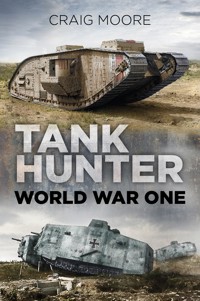
The First World War's fierce battles saw the need to develop military technology beyond anything previously imagined: as exposed infantry and cavalry were mowed down by relentless machine-gun attacks, so tanks were developed. Here author Craig Moore presents every First World War tank, from the prototype 'Little Willie', through the French heavy tanks to the German light tank. He gives a focused history of the development of this game-changing vehicle and the engagements it was used in – vital battles such as the Somme and Cambrai. Stunningly illustrated in full colour throughout, Tank Hunter: World War One provides historical background, facts and figures for each First World War tank as well as the locations of any surviving examples, giving you the opportunity to become a Tank Hunter yourself.
Sie lesen das E-Book in den Legimi-Apps auf:
Seitenzahl: 345
Veröffentlichungsjahr: 2017
Das E-Book (TTS) können Sie hören im Abo „Legimi Premium” in Legimi-Apps auf:
Ähnliche



















Artwork Disclaimer
All the illustrations in this book are an artist’s impression of the tank, armoured fighting vehicle, artillery tractor or supply vehicle. They are not to be viewed as accurate engineering drawings. The camouflage livery patterns and colours used are the artist’s best guess from studying black and white photographs and surviving tanks. The illustrations are by David Bocquelet.
Acknowledgements
I would like to thank the following people who have helped provide information that was used in writing this book: Herbert Ackermans, Pierre-Oliver Buan, David Bocquelet, Mikhail Blinov, Rob Cogan, Len Dyer, Charles R. Lemons, Ed Francis, Andrew Hills, Marcus Hock, Doug Hone, Christophe Mialon, Sue Moore, Matt Newton, Nathaniel MacDonald, Pascale Mathieu, Steve Osfield, Ralf Raths, Lucian Stan, Yuri Pasholok, Clark Ward. Charlie Webb and Steven J. Zaloga.
Front cover illustrations. Top: Male Mark V* tank, serial No. 9543, serving in ‘B’ Company, 15th Battalion, under Lt R.P. Foster, with identity number 037. Photographed on 8 August 1918 in a ‘tank park’ in the village of Villers-Bretonneux, France (AWM E0 5426). Bottom: Sturmpanzerwagen A7V tanks No. 543 ‘Hagen’ (foreground), No. 505 ‘Baden I’ (behind) and No. 503 ‘Faust’ (far background) at Finkelberg Training Area near Saarburg on 1 October 1918 (AWM H1 3452).
First published in 2017
The History Press
The Mill, Brimscombe Port
Stroud, Gloucestershire, GL5 2QG
www.thehistorypress.co.uk
© Craig Moore, 2017
The right of Craig Moore to be identified as the Author of this work has been asserted in accordance with the Copyright, Designs and Patents Act 1988.
All rights reserved. No part of this book may be reprinted or reproduced or utilised in any form or by any electronic, mechanical or other means, now known or hereafter invented, including photocopying and recording, or in any information storage or retrieval system, without the permission in writing from the Publishers.
British Library Cataloguing in Publication Data.
A catalogue record for this book is available from the British Library.
ISBN 978 0 7509 8659 5
Typesetting and origination by The History Press
Printed in Turkey
eBook converted by Geethik Technologies
CONTENTS
Introduction
THE TANKS
‘Little Willie’
‘Mother’
Mark I Tank
Mark II Tank
Mark III Tank
Mark IV Tank
Mark V Tank
Mark V* Tank
Mark V** Tank
Mark V Composite Tank
Mark VI Tank
Mark VII Tank
Mark VIII Tank
Mark IX Infantry Carrier
Medium Mark A Whippet Tank
French Schneider CA Tank
French Saint-Chamond Tank
French Renault FT Tank
Sturmpanzerwagen A7V Tank
German LK II Light Tank
A7V Flakpanzer Anti-Aircraft Tank
A7V Überlandwagen
British Supply Tanks
Schneider CD Supply Vehicle
Gun Carrier Mark I
US Holt Gas-Electric Tank
US Steam Tank (Track Laying)
US Model 1917 6-Ton Light Tank
US Model 1918 Ford 3-Ton Light Tank
US Skeleton Tank
Killen-Strait Armoured Tractor
Russian Tsar Tank
THE BATTLES
The First Tank Battle
The Battle of Cambrai
French Tank Battles
The First Tank v. Tank Battles
Beutepanzern
Mark IV v. Mark IV Tank Battles
The Battle of Amiens
American Tank Battles
Tank Banks
Presentation Tanks
Bibliography
INTRODUCTION
The First World War lasted from 28 July 1914 to 11 November 1918. The first few years of fighting in north-west Europe was a stalemate with soldiers living in squalid conditions in defensive trenches, a few 100yd apart from the enemy. When the men went over the top to take part in an attack, modern machine guns slaughtered thousands within minutes, for very little ground captured.
Tanks revolutionised warfare. They could crush, cut and rip up the layers of barbed-wire fences in no-man’s-land. The tank’s weapons could silence German machine guns and fire into their trenches as they drove over and along them. Supporting infantry could then occupy and hold the captured territory as the tanks continued the push forward.
There were lots of problems that had to be solved. The tanks were mechanically unreliable; their crews fought in extreme heat and noise while breathing in poisonous exhaust gases from the engine. The caterpillar tracks could negotiate rough ground but they had their limits. Waterlogged, muddy, slippery tracts of land that had been pummelled by artillery bombardment were difficult for them to cross. Large numbers ditched and had to be left in deep craters. Any stationary tank became a target for German field guns and artillery.
This book will show you where you can go to see surviving First World War tanks. Please remember though, and this may sound strange, tanks move; they are often loaned to other museums as temporary exhibits. Some may not be on show because they have been moved to the workshop for restoration.
Before you visit a location or museum to see a particular tank, contact it first and check to see if the tank you want to see is still on public display.
The chapters at the beginning of the book concentrate on the history of early tank development and the different types used during the First World War. The later chapters cover some of the important battles of the war where tanks were used on the battlefield.
‘LITTLE WILLIE’
The first tank prototype was designed under the auspices of the British Admiralty not the Army, which surprisingly had nothing to do with it. Winston Churchill, 1st Lord of the Admiralty at the time, had grown impatient at the way the war was going in France and was convinced there were better ways of conducting it. He formed the Landships Committee, which included Royal Navy engineers, and told it to come up with a solution. This is why lots of the terms used to describe tank components were those used in the Navy, such as decks, hatches, sponsons, cupolas, cabins and hull.
In February 1915 the committee granted William Foster & Co. of Lincoln the contract to build the first prototype British tank. Part of the requirement was to utilise an extended agricultural tractor crawler track system developed by Bullock Creeping Grip Tractor Company of Chicago, USA.
The task of designing the first Landship fighting vehicle was shared between William Tritton, the Managing Director of William Foster & Co., and Walter Wilson, a British Navy officer assigned to the company, who was also an engineer.
The first prototype, named by the company the ‘Number One Lincoln Machine’, was completed on 9 September 1915. It had a turret fixed to the top of a riveted steel box body and the front metal plates were angled to help the vehicle negotiate undulating terrain.
The American tracks were set back from the front of the vehicle; they were too short and not strong enough to cope with the 16-ton vehicle weight. Modifications were made but cross-country performance during tests was poor.
The ‘Number One Lincoln Machine’ tank prototype was designed to have a rotating turret on the top. During trials it was found that the tracks were too short at the front. It had difficulty getting out of ditches.
The ‘Little Willie’ tank prototype did not have a turret. The tracks had been lengthened at the front of the vehicle to help it climb out of ditches.
William Tritton and Walter Wilson worked on a solution to the track problem. They developed a new wider, longer and stronger system that ran the length of the vehicle.
A track frame was built, with a series of rollers mounted on the frame for the track to run on. To stop the tracks getting clogged with mud, openings were cut into the frame that acted as mud chutes.
The track drive sprocket wheel was at the rear. The track tension could be adjusted by repositioning the front idler wheel, one on each side. There was no suspension and hence the ride was very bumpy.
To enable the tracks to be fully tested the turret was removed and the circular hole in the roof was plated over. It was at this stage that the Number One Lincoln Machine was renamed. It was given the derogatory nickname ‘Little Willie’ after the German Kaiser Wilhelm II’s eldest son, Crown Prince Wilhelm.
The Prince was causing some problems for the Kaiser. In an interview in October 1914 he stated, ‘Undoubtedly this is the most stupid, senseless and unnecessary war of modern times …’ It was hoped that this new fighting machine would also cause the Kaiser a few problems. (The second, bigger tank prototype that followed was called ‘Big Willie’, but this was later changed to ‘Mother’.)
The ‘Little Willie’ prototype can be seen at The Tank Museum in Bovington.
The ‘Little Willie’ tank prototype. The driver sat on the right and the commander on the left. The hole in the middle was for mounting a machine gun. The tracks were wide to help disperse the weight of the vehicle on muddy, waterlogged ground.
The engine was fitted at the rear of the vehicle. It was a British Daimler 13-litre straight-six petrol engine. That sounds extremely powerful but it could only produce 105hp at 1,000rpm. The transmission only had three options: first, second and reverse gears.
As this new armoured fighting vehicle did not have wheels, the design team had to work out how it was going to be steered. Agricultural tractors used steering brakes; to turn right the driver pulled the right lever and to turn left he applied the left track brake lever.
It was felt that the longer tracks on the tank needed the additional help of two large wheels, and these were placed on a frame that protruded from the rear of the hull on a hydraulic arm. It was hoped that this would act like a rudder fitted to the back of a boat. When going over very uneven ground the rear steering wheels could be raised.
‘MOTHER’
The next prototype started to look like British tanks that fought in the First World War. Walter Wilson wanted to give the tank better cross-country performance and he enlarged the track frame used on the ‘Little Willie’ prototype, making it a rhomboid shape. He also fitted a lengthened track to go all around the outside of the frame that enabled the vehicle to cross enemy trenches.1 It still had the rear steering wheeled trailer that could be raised or lowered.
The prototype was finished by December 1915. At first it was known as the ‘Wilson’ in the factory, although officially it was designated ‘His Majesty’s Land Ship Centipede’. It was also known as ‘Big Willie’ because it was bigger than the ‘Little Willie’ prototype, and eventually, ‘Mother’, because from this design lots of other tanks were spawned. It was transported from William Foster & Co.’s factory in Lincoln to Hatfield Park in Hertfordshire, where it underwent trials.
The Royal Navy had a stock of 6-pounder cannons that were a 1915 modification of the French Hotchkiss 75mm gun. It had a muzzle velocity of 606yd/sec (544m/sec) and a maximum range of 4.26 miles (6.86km). The gun barrel length was 7ft 5in (2.28m).
However, fitting a 6-pounder gun in a turret was impractical. It would have been located above the very hot and noxious engine, which would have made working the cannon uncomfortable for the gun crew. The other major concern was that a turret would have raised the tank’s centre of gravity too high and caused it to topple over when negotiating undulating landscapes found on battlefields caused by shell craters.
Eustace Tennyson d’Eyncourt, Director of British Naval Construction, suggested using side-mounted sponsons that gave each weapon a 110-degree traverse. A curved armoured gun shield was fitted to the cannon. When the gun was moved in the sponson’s aperture the shield sealed off the crew compartment.
The gunner moved the weapon manually. He had a folding stock under his right arm that he moved to his left or right and up and down to elevate or depress the gun. He had a pistol grip with a trigger to fire the gun when it was on target. To find his target the gunner used a telescopic sight fitted to the gun mounting that looked through a small vertical slit.
Compared with modern tanks there appears to be a lot of room inside both ‘Little’ and ‘Big Willie’ but it has to be remembered that they were designed to have a crew of eight. The sponsons helped increase the space available slightly but they were fitted with bulky machine guns and cannons.
The same British Daimler straight-six 13-litre petrol engine, producing 105hp, which was fitted to ‘Little Willie’ was also used in its bigger brother. The engine was moved more towards the centre of the vehicle, while the radiator and cooling fan were mounted at the rear of the engine.
The engine had to cope with an increase in vehicle weight from 16 tons to 28 due to the addition of sponsons, weapons, ammunition, and the increased size of the track frame and track. Additional gearboxes were added to give four forward gears and two reverse gears.
The first cross-country trials took place in the grounds of Hatfield House on 29 January 1916 and they went well. These were repeated four days later in front of an audience of government officials and senior officers, including Field Marshal Kitchener. ‘Mother’ managed to successfully negotiate all the obstacles placed in her way: trenches, lines of barbed wire, hills, waterlogged ground and large holes dug to have the same characteristics of an artillery shell crater.
The Army Council placed an order for 100 tanks ten days after the last presentation. The contract was split between William Foster & Co. of Lincoln and the Metropolitan Carriage, Wagon and Finance Company of Birmingham. Seven may have been built by Robey and Company in Lincoln but this has not been confirmed by surviving documents. Unfortunately, ‘Mother’ was cut up for scrap metal after the war.
On 29 January 1916, the ‘Mother’ prototype successfully underwent cross-country trials in the grounds of Hatfield House, Hertfordshire.
_____
1 Edwin Wheelock of the US Pioneer Tractor Company claimed that he invented the Rhomboid-shaped track system, not Walter Wilson. He also claims that in a meeting in London in April 1915 with Col Sir Henry Capel-Lofft Holden, Director of Mechanical Transport, at the War Office in London, the company’s representative, Francis J. Lowe, handed over the only blueprint copy of the design to Walter Wilson, who was also at the meeting, for further evaluation. The US Pioneer Tractor Company never received the blueprint back or any orders from the British government. No documentary proof has yet been found to substantiate this claim.
MARK I TANK
The first production tank was only given the designation ‘Mark I’ after new versions were built. The Metropolitan Carriage, Wagon and Finance Company of Birmingham had a large production capacity; it built seventy-five tanks of the original 100-tank order at its Oldham Railway Carriage & Wagon Company factory, while the remaining twenty-five tanks were built in William Foster & Co.’s factory in Lincoln.
The Mark I tank needed good quality armour plate to protect the crew, and the standard steel plate used on the ‘Mother’ prototype was not good enough. Two thicknesses were used: 10mm to cover important areas and 6mm for non-vital ones. The steel was cut and drilled in a soft state by the manufacturer and then hardened by heating and cooling rapidly while being pressed flat.
The War Office wanted to create six tank companies equipped with twenty-five tanks each, so it increased the initial order from 100 to 150. However, this caused a problem: there were not enough 6-pounder guns available to equip all the vehicles.
A decision was made to fit seventy-five with a pair of 0.303in (7.62mm) Vickers water-cooled machine guns in each sponson and the remaining seventy-five with a forward-facing 6-pounder (57mm) gun and a side-facing 0.303in (7.62mm) Hotchkiss air-cooled machine gun in each sponson. The machine gun-only tanks were called Mark I Female tanks and those armed with two 6-pounder guns and three machine guns were called Mark I Male tanks.
There was a gun port at the front of the tank situated between the driver and commander. It was covered with a movable armoured plate and was used to enable a 0.303in (7.62mm) Hotchkiss air-cooled machine gun to be fired forward.
To modern eyes it may seem strange to build a large tank armed only with machine guns. You have to remember that in 1915 the enemy did not possess any tanks, so they only had to deal with infantry and machine-gun nests. The Male tank’s 6-pounder guns were intended to be used against enemy fortified positions.
Eight Mark I tanks fought in Gaza and they formed ‘E’ Company, Heavy Branch Machine Gun Corps (later renamed the Palestine Tank Detachment). They left England in January 1917 and were to be part of the British Egyptian Expeditionary Force that was going to attack the Turkish soldiers of the Ottoman Empire in what was then called Palestine.
After arriving in March 1917 they were transported to the British Army positions outside Gaza. The four Male gun tanks were called ‘Sir Archibald’, ‘Otazel’, ‘Pincher’ and ‘Ole Luk Oie’. The four Female machine gun-only tanks were called ‘War Baby’, ‘Kia Ora’, ‘Nutty’ and ‘Tiger’.
These were not deployed in a close group as a hammer to smash through enemy front lines. The senior officers disregarded the advice given to them by the young officers who commanded the tanks and instead they were used in pairs, spread apart.
The Turkish Army used artillery to stop the tanks, although the desert sand also helped the enemy. It got into the mechanical systems and the abrasive effect caused damage, hence breakdowns were common. The sand also caused the tracks to come off, which could be fatal on the battlefield as a stationary target was easier for the artillery to target. They were last used in combat in Palestine during the Third Battle of Gaza in November 1917 but had very little impact on the overall campaign because they were so few in number.
SURVIVING MARK I TANKS
There is only one Mark I left and it is on display at The Tank Museum, Bovington, Dorset, UK. It was originally placed in Lord Salisbury’s Hatfield Park in Hertfordshire on 8 May 1919 as a ‘Presentation Tank’ by the Army Council to commemorate the secret tank trials and inspection there by HM King George V in February 1916 of the first type of tank approved for use by the British Army in the war. After fifty years at Hatfield Park it was moved to the Royal Armoured Corps Tank Museum on 7 May 1969.
When it arrived it was fitted with the Mark IV Male tank short-barrelled 6-pounder gun rather than the early long-barrelled naval gun. The gun shield had been changed to fit the later gun. It was also missing the Mark I rear steering tail and hydraulic lifting and lowering apparatus. The tail hydraulics attached to the back came from a Mark II tank. These were all removed and replaced when the tank was restored.
The anti-hand grenade wood and wire mesh roof had to be newly fabricated. Some tanks had this roof mesh extended over the top of each sponson for added protection. Not all Mark Is had these roofs fitted.
Research has not been able to confirm its wartime identity or service history, although the museum believes it was used as a tank crew training vehicle.
The museum restoration workshop painted the vehicle in similar camouflage colours used on the Mark I Male tank No. 705 C19 called ‘Clan Leslie’, of 4 Section, ‘C’ Company, Heavy Section Machine Gun Corps, commanded by Maj. Holford Walker. Mark I tanks took part in the Battle of Flers-Courcelette, as part of the Somme offensive on 15 September 1916, the first time tanks were deployed in battle.
Specifications
Dimensions
Length 26ft (7.92m)
Length with tail 32ft 6in (9.92m)
Width 8ft 4in (2.53m)
Width with sponsons 13ft 2in (4.03m)
Height 8ft (2.44m)
Total Weight
27.5 (Female) 28.4 (Male) tons
Crew
8
Propulsion
British Foster-Daimler, Knight sleeve valve, water-cooled, straight-six, 13-litre petrol engine; 105hp at 1,000rpm
Road Speed
3.7mph (5.95km/h)
Fuel Capacity
50 gallons (226 litres)
Range
28 miles (45km)
Trench-Crossing Ability
11ft 6in (3.5m)
Armament Male Tank
2 × Hotchkiss QF 6-pounder (57 mm) gun (1.4m-long barrel)
3 × 0.303in (7.62mm) Hotchkiss air-cooled machine guns
Armament Female Tank
4 × 0.303in (7.62mm) Vickers water-cooled machine guns
1 × 0.303in (7.62mm) Hotchkiss air-cooled machine gun
Armour
6–12mm (0.23–0.47in)
Total Production
150
This is the only surviving Mark I Male tank. It is on display at The Tank Museum, Bovington.
A two-wheeled steering tail was attached to the rear of the Mark I. A wood and wire mesh roof was added to deflect German hand grenades.
The Mark I Male was armed with two long-barrelled 6-pounder cannon and three 0.303in (7.62mm) Hotchkiss air-cooled machine guns.
MARK II TANK
The British Army needed a vehicle with which to train new crews to use the Mark IV tank so fifty Mark II training tanks were built to serve this purpose: twenty-five Males and twenty-five Females. The Males were constructed by the Metropolitan Carriage, Wagon and Finance Company of Birmingham, the Females by William Foster & Co. of Lincoln.
These tanks were not intended to go into battle; they constructed in mild, not hardened, steel and could not stop a rifle bullet. Some sponsons taken from recovered, battle-damaged Mark I tanks were fitted to Mark II tanks. They were made in hardened steel and gave the crew some protection. Amazingly, these death traps were used once in action at the Battle of Arras in April 1917 as not enough Mark IV tanks had been delivered to the front lines in France in time for the next attack.
They were very similar in design to the Mark I. Most were built as Males armed with the 6-pounder gun and three Hotchkiss 0.303in air-cooled machine guns. Female Mark II tank sponsons were armed with a pair of 0.303in (7.62mm) Vickers water-cooled machine guns in an armoured sleeve on each side and one Hotchkiss 0.303in (7.62mm) air-cooled machine gun in the front cabin. Some Mark II Female tanks, like Nos 578 and 593, had their sponson machine gun apertures modified to accept the smaller 0.303in (7.62mm) Lewis machine gun instead of the large Vickers machine gun used on the Mark I Female tank. A few that were built were used as testbeds for different transmission systems.
The steering tail wheels arrangement at the back of the tank and the hydraulic lifting equipment, fitted to Mark Is, were not a feature of the Mark II. At this stage in tank development they were considered unnecessary.
The only surviving Mark II is at The Tank Museum in Bovington and is a Female version. It is the only tank with an early First World War version of the double Vickers 0.303in water-cooled machine gun-armed Female sponson. Each machine gun was mounted in an armoured jacket and both weapons could sweep a total of 180 degrees on one side of the tank.
A major problem with this design was that the crew escape hatch at the rear of the sponson was reduced in height to accommodate a second machine gun. If the tank was hit and caught fire the men inside would have difficulty getting out quickly as the hatch was only 61cm long and 41cm wide. The Mark V Female had a hatch that was 145cm high and so was much easier for the crew to escape from.
During the restoration of the Mark II the number ‘F53’ and the words ‘The Flying Scotsman’ were discovered under the layers of paint. It served with ‘C’ or ‘D’ Company during the Battle of Arras and there are some battle damage holes caused by enemy shells still visible in the back of the vehicle.
The Mark II driver’s and commander’s cab is a little bit narrower than the Mark I’s; this was to accommodate the fitting of wider tracks but these were never used.
The same British Foster-Daimler, Knight sleeve valve, water-cooled, straight-six, 13-litre, 105hp petrol engine and transmission system was used as on the Mark I. It still took four people to drive it.
Bovington Camp received its first batch of Mark II training tanks in December 1916. Not all the fifty delivered were used for training; five were employed on testing new gearboxes, petrol-electric drives used in trams and new hydraulic systems.
Later in the war the surviving Mark IIs were converted into unarmed, armoured, ammunition- and supply-carrying tracked vehicles.
You can spot the difference between a Mark II and a Mark I on photographs by looking for several identifying features. The Mark II tank has a slightly narrower cab and the row of eleven rivets across the front of it were not all the same distance apart, unlike those on the Mark I. The two outer rivets were much closer together.
The Mark II had a raised observation hatch shaped like a cheese dish on the roof. The rear of the Mark I has the tail wheel hydraulic jack fitted; this was not fitted to the rear of the Mark II tank. The shape of the track adjustment apertures at the front of the track horns on the Mark I tank are more rounded, the Mark II’s more squared.
SURVIVING MARK II TANKS
There is only one surviving Mark II tank. It is on display at The Tank Museum, Bovington. In April and May 1917 it took part in the Battle of Arras as a Male tank, No. 785, ‘D’ Battaltion D5 ‘Dahlia’. It was converted into a supply tank and served in ‘F’ Battalion, F53, ‘The Flying Scotsman’. It is displayed with a Female sponson.
Specifications
Dimensions
Length 26ft (7.92m)
Width 8ft 4in (2.53m)
Width with sponsons 14ft 5in (4.39m)
Height 8ft (2.44m)
Total Weight
27.5 (Female) 28.4 (Male) tons
Crew
8
Propulsion
British Foster-Daimler, Knight sleeve valve, water-cooled, straight-six, 13-litre petrol engine; 105hp at 1,000rpm
Road Speed
3.7mph (5.95km/h)
Range
28 miles (45km)
Trench-Crossing Ability
11ft 6in (3.5m)
Armament Male Tank
2 × Hotchkiss QF 6-pounder (57mm) gun (1.4m-long barrel)
3 × 0.303in (7.62mm) Hotchkiss air-cooled machine guns
Armament Female Tank
4 × 0.303in (7.62mm) Vickers water-cooled machine guns
1 × 0.303in (7.62mm) Hotchkiss air-cooled machine gun
OR
5 × 0.303in (7.62mm) Lewis air-cooled machine guns
Armour
6–15 mm (0.23–0.59in)
Total Production
50
The only surviving Mark II Female, on display at The Tank Museum, Bovington.
The Mark I’s two-wheeled steering tail and hydraulic lifting mechanism were deemed no longer necessary so they were not fitted to the rear of the Mark II.
The Mark II Female was armed with four 0.303in (7.62mm) Vickers water-cooled machine guns and one 0.303in (7.62mm) Hotchkiss air-cooled machine gun at the front.
MARK III TANK
The Mark III tanks were designed as a tank crew training vehicle. Fifty were built by the Metropolitan Carriage, Wagon and Finance Company of Birmingham.
The steering tail wheels arrangement at the back and the hydraulic lifting equipment, fitted to Mark Is, were not a feature of the Mark III because by this stage in tank development they were considered unnecessary.
The driver and tank commander’s cab was reduced in width to allow for wider tracks to be used. A smaller one-man cab with protected vision loopholes was fitted to the rear of the tank. It replaced the escape hatch on the roof and enabled a crewman to look around to see what was happening at the sides and rear.
The tanks were not intended to be used in combat so the metal used in their construction was not armoured: it did not undergo special heat treatment to make it stronger and therefore was unable to resist machine gun and rifle bullets.
A strange feature of the Mark III was that it was 1 ton heavier than the Mark I and II. Thicker metal, 12mm thick not 10mm, was used in its construction as part of an experiment by the team developing the Mark IV.
While being used for tank driver training, Mark III tanks had their two 6-pounder guns and machine guns removed. On hot days the sponson rear hatch and the roof hatch were fixed in the open position to increase ventilation.
One of the other skills taught at Bovington Camp to all students was tank maintenance; this included the officer in charge of each vehicle. Crews practised trying to extricate tanks that had driven into a trench or shell crater. Initially this involved using a ‘torpedo spud’, a rounded wooden beam with a central metal collar attached to a chain. The crew would fix the other end of the chain around the track and hope it dug into the earth to give the extra traction necessary for the tank to get itself unstuck. If this failed they had to use spades and get digging. Two were carried on the roof of the tank. Later, unditching rails and long beams would be added to the Mark IV.
Near the end of the course the students would participate in tactical training, which taught them how to attack a network of trenches. Finally they would go to the ranges and practice firing the guns. Officers had to attend additional courses: map reading, report writing, signalling and route-laying using white tape.
The Mark III was built at the time of the transition from 0.303in (7.62mm) Vickers water-cooled machine guns to 0.303in (7.62mm) Lewis air-cooled light machine guns. There are photographs of Mark III Female tanks with the old style Mark I tank long Female sponsons. They were also photographed with the newer short Female sponsons and crew hatches underneath. Being lighter, the Lewis machine gun did not require such a large sponson.
Mark III tanks never left Great Britain. Two Mark III Females with the smaller sponsons were given as presentation tanks to the people of Maidstone and Canterbury as a thank you for raising money under the National War Savings Committee scheme. Unfortunately they were not looked after and both were cut up for scrap metal.
SURVIVING MARK III TANKS
There are no surviving Mark IIIs.
Specifications
Dimensions
Length 26ft (7.92m)
Length with tail 32ft 6in (9.92m)
Width 8ft 4in (2.53m)
Width with Sponsons 13ft 2in (4.03m)
Height 8ft (2.44m)
Total Weight
28.5 (Female) 29.4 (Male) tons
Crew
8
Propulsion
British Foster-Daimler, Knight sleeve valve, water-cooled, straight-six, 13-litre petrol engine; 105hp at 1,000rpm
Road Speed
3.7mph (5.95km/h)
Fuel Capacity
50 gallons (226 litres)
Range
28 miles (45km)
Trench-Crossing Ability
11ft 6in (3.5m)
Armament Male Tank
2 × Hotchkiss QF 6-pounder (57mm) gun (1.4m-long barrel)
3 × 0.303in (7.62mm) Hotchkiss air-cooled machine guns
Armament Female Tank
4 × 0.303in (7.62mm) Vickers water-cooled machine guns
1 × 0.303in (7.62mm) Hotchkiss air-cooled machine gun
OR
5 × 0.303in (7.62mm) Lewis air-cooled machine guns
Total Production
50
No Mark IIIs survived the scrap metal merchant’s blowtorch. They were built as training tanks and not used in combat. This is a Male. They were armed with the long-barrelled 6-pounder gun but this was later replaced with the short-barrelled 6-pounder gun and they were also later fitted with the new style sponsons. Most were painted brown during the First World War.
The Female Mark IIIs were also used as training tanks. They were armed with two 0.303in (7.62mm) Vickers water-cooled machine guns on either side in sponsons and a 0.303in (7.62mm) Hotchkiss air-cooled machine gun in the front. Later they were armed with five 0.303in (7.62mm) Lewis air-cooled machine guns. This example was later earmarked as a presentation tank and given to the people of Batley in Yorkshire to be used as a war memorial. It was the government’s way of saying thank you for raising money to fund tank production.
MARK IV TANK
The Mark IV was the first mass-produced tank. It was built at a number of different factories around Britain, not just in one place. Around 1,200 were built: 1,155 were used for combat or training; 205 were built as armoured supply tanks; 11 were used for testing and 54 were surplus reserve tanks. It is believed that 595 were built as machine gun-only Female tanks and 420 as 6-pounder gun- and machine gun-armed Male tanks.
The Mark IV is very similar to its predecessors. It has the same British Daimler-Benz engine and gearbox system, and still required four men to drive and change gears. Another four men were still needed to load and fire the guns in the two sponsons.
The armour on the Mark IV was slightly improved from earlier models. It could keep out rifle fire, machine gun bullets and now some anti-tank rifle bullets. It still could not protect the crew from artillery shells.
The other change was to the sponsons. These could now be pushed into the body of the tank rather than having to be unbolted and removed when the tank was transported by rail. The cab was narrower than the Mark I’s to accommodate the fitting of wider tracks. Unfortunately these did not become available until late 1918.
The 6-pounder gun on the Mark I had a long barrel that got in the way during transportation and sometimes stuck in the mud. The Mark IV was now fitted with a short-barrelled 6-pounder (57mm) gun that could still pack the same punch. It was officially called the Ordnance Quick Firing 6-pounder six hundredweight Mark I gun. The gun barrel, measured from the sponson, was now only 65.6cm long.
A 0.303in (7.62mm) Lewis air-cooled light machine gun ball mount was fitted at the front of the cab between the two visors, as well as behind each 6-pounder gun on the Male tanks.
The way fuel was stored was also changed. On the Mark I there were two 25-gallon petrol tanks fitted to the front. This was an impractical location as this part of the tank received the most amount of enemy fire. If one of the fuel tanks was ruptured they could explode or ignite and burn the tank crew alive.
The engineers placed the new 70-gallon armoured fuel container on the outside of the tank, at the rear. The Mark IV tank no longer used the rear-wheeled steering trailer so there was enough room to mount the container. A device called an auto-vac sucked the fuel into the tank and then straight to the engine carburettor.
The larger 70-gallon (318 litre) fuel capacity compared with the previous 50 gallons (226 litre) carried by the Mark I gave the tank a longer operational range. The Mark IV had a fuel consumption rate of about half a mile per gallon so the tank could drive for an extra 10 miles (16km) before it needed to refuel. Spare fuel cans could be stowed on top of the tank at the back.
Sprung suspension was not fitted to any First World War British tanks. The rollers that ran along the track were sandwiched between the metal frames. Each roller was held in place by a static axle that could not move up or down as they were bolted to the tank frame. The rollers were now solid, not hollow, for extra strength. It was not a comfortable ride for the tank crew.
To cope with the muddy ground, track extenders, called ‘torpedo spuds’, were bolted on to every sixth or eighth track. They looked like the end of a spade and are today more commonly called ‘grousers’. They did not work very well and were not used on the Mark V.
Even though a track is made of metal, it stretches and there is always a danger of it being thrown off the rollers. The crew have to adjust the tension of the track to take in any slack. In this case, at the front of the tank there was a large bolt. The crew had to loosen off the nut and move the idler wheel forward, then tighten the nut again with a very large spanner.
To help the Mark IV tanks cross wide trenches they were fitted with a large round bundle of wood called a ‘fascine’ on top of the roof. When they came to a trench, the commander and driver released the securing cables and let the fascine fall into the trench before driving over it. Fascines were only ever used at the Battle of Cambrai.
The Mark IV was also fitted with two unditching rails. These were fixed on top of the tank. The large wooden unditching beam was secured to the rails with chains. If the tank got stuck in the mud the crew would have to get out of the tank and chain the beam to the tank tracks. The beam would give the tank something more substantial to drive over.
Only the driver and commander had a seat. The rest of the crew were standing or crouching at their weapons or gearbox controls. The very hot engine was in the middle of the tank, giving off headache-inducing and stomach-churning noxious fumes. A new exhaust silencer system was added to help reduce engine noise and take some of the gases away from the crew.
From the early summer of 1917 to the end of the war, Mark IV tanks took part in every planned British offensive and assisted in stopping German attacks.
SURVIVING MARK IV TANKS
Seven Mark IV tanks survived: two Males and five Females. The Mark IV Male ‘Lodestar III’ can be seen at the Royal Museum of the Armed Forces and Military History in Brussels, Belgium. ‘Lodestar III’ is believed to have been part of the 12th Battalion, Royal Tank Corps, that participated in the offensive on the Hindenburg Line near Cambrai in August and September 1918. It was a gift from the UK. The tank was unloaded from a train flat-back transport at Brussels Etterbeek station having been landed at the port of Antwerp. It served as a gate guardian in front of the Etterbeek Cavalry Barracks at the end of the First World War. Later it was driven the few miles from Etterbeek to the new Royal Museum of the Armed Forces and Military History, which was opened to the public in 1923.
The Mark IV Male tank No. 102, on display at The Tank Museum, Bovington, does not have the unditching rails fitted because it is believed it never saw action and was used only as a training vehicle in Britain. The tank is still in working order.
Mark IV Female tanks can be seen at the Australian War Memorial, Canberra, Australia; the National Armor and Cavalry Museum, Fort Benning, Georgia, USA: the war memorial in Flesquières, France; St George’s Square, Ashford, Kent, England, and the Museum of Lincolnshire Life, Lincoln, England.
Specifications
Dimensions
Length 26ft 3in (8m)
Length with tail 32ft 6in (9.92m)
Width 8ft 4in (2.53m)
Width with Sponsons 13ft 7in (4.15m)
Height 8ft (2.44m)
Total Weight
27.5 (Female) 28.4 (Male) tonnes
Crew
8
Propulsion
British Foster-Daimler, 6-cylinder, in-line, sleeve valve petrol engine; 105hp at 1,000rpm
Transmission
two-speed and reverse primary box with
secondary two-speed selectors on the output shafts
Road Speed
3.69mph (5.95km/h)
Fuel Capacity
70 gallons (318 litres)
Fuel Consumption
2.08 gallons per mile (5.6 litres/km)
Range
35 miles (56km)
Trench-Crossing Ability
11ft 6in (3.5m)
Armament Male Tank
2 × OQF 6-pounder (57mm) short-barrelled guns
3 × 0.303in (7.62mm) Lewis air-cooled light machine guns
Armament Female Tank
5 × 0.303in (7.62mm) Lewis air-cooled light machine guns
Muzzle Velocity (6-pounder)
1,348ft/sec (411mps)
Max range (6-pounder)
4.53 miles (7.3km)
Ammunition
High explosive, solid shot
Ammunition Stowage (Male)
332 × 6-pounder shells, 6,272 × 0.303in rounds
Armour
6–12mm
Total Production
1,220




