


8,99 €
Mehr erfahren.
- Herausgeber: Parkstone International
- Kategorie: Geisteswissenschaft
- Sprache: Englisch
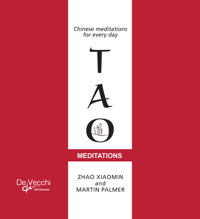
Taoist meditation is an essential aspect of spiritual practice in the Taoist tradition. Focused on harmony with nature and the Universe, it offers a path to inner peace and deep understanding of oneself and the world around us. Unlike other forms of meditation, it emphasizes flow and transformation, mimicking the natural movement of the Tao, the universal force. In Taoist literature, such as Lao Tzu's "Tao Te Ching", these principles are explored and guided, allowing for rewarding and enlightening practice. This book on Taoist meditation will be a valuable addition for anyone looking to deepen their understanding of these ancient concepts and integrate meditation into their daily life.
Das E-Book können Sie in Legimi-Apps oder einer beliebigen App lesen, die das folgende Format unterstützen:
Seitenzahl: 57
Veröffentlichungsjahr: 2024
Ähnliche




















Chinese meditations
for every day
ZHAO XIAOMIN
and
MARTIN PALMER
The author or publisher cannot be held responsible for the information (formulas, recipes, techniques, etc.) contained in the text, even though the utmost care has been taken in the writing of this work. In the case of specific - often unique - problems of each particular reader, it is advisable to consult a qualified person to obtain the most complete, accurate and up-to-date information possible. EDITORIAL DE VECCHI, S. A. U.
© Editorial De Vecchi, S. A. 2024
© [2024] Confidential Concepts International Ltd., Ireland
Subsidiary company of Confidential Concepts Inc, USA
ISBN: 978-1-63919-794-1
The current Penal Code provides: “Anyone who, for profit and to the detriment of a third party, reproduces, plagiarizes, distributes or publicly communicates, in whole or in part, a literary, artistic or scientific work, or its transformation, interpretation or artistic performance fixed in any medium or communicated by any means, without the authorization of the holders of the corresponding intellectual property rights or their assigns, shall be liable to imprisonment for a term of six months to two years or a fine of six to twenty-four months. The same penalty shall be imposed on anyone who intentionally imports, exports or stores copies of such works or productions or performances without the said authorization.
Contents
Introduction
The Way of the Tao
Introduction
The actual remains are tiny, fragile and, at first sight, appear insignificant. They lie in a museum, close to the ancient Chinese city of Xian. How they have managed to survive for over 5,000 years is a miracle itself, for the fragments are made of pottery and lay buried and unknown for millennia …
It was in the 1950s that the Neolithic village of Banpo was unearthed, one of the most complete examples of such an early Chinese settlement. Among the finds were the usual kinds of materials and artefacts: pots, bone implements, stone axes and the remains of the huts. The decorations on the pots are astonishingly beautiful, made up of complex – almost abstract – designs of fish, birds, and even human faces.
Yet, exciting as these are, perhaps the most challenging and unexpected discoveries would have gone unnoticed if it had not been for sharp-eyed archaeologists. On such sites, masses of bits of broken pottery are always uncovered. But, uniquely at this site, pieces were found on which simple and, as yet, unexplained signs were engraved, cut deep into the fragments. It is clear that they are words or characters and, as such, form the earliest example of symbolic written language ever found in China. But why were they each inscribed on separate pieces of pottery, all roughly the same size – about one inch across? The answer lies in divination.
THE WISDOM OF CHANCE
It seems that these earliest words of Chinese formed part of an ancient divinatory system: the characters would all be put together into a pot, and the fortune-teller would then ask the deities a question. One or two (or possibly more) of the inscribed pieces would then be drawn from the pot at random, and the signs interpreted to give a reading – a response from the deities to the question asked.
This is the essence of Chinese wisdom or divination: it is essentially about chance. Those looking for a system which will tell you exactly what to do will not find it, for that is not how the Chinese systems work. Chinese philosophy has always stressed that while certain things in life are fixed – when and where you are born, for example – the rest of life is for you to determine. In the end, you can become whom you wish, if you truly decide to be a certain kind of person. This is reflected in the famous ancient Chinese Examination System, the structure of which meant that, in theory, even the poorest child from a remote part of China could, through hard work, become prime minister.
The heart of Chinese divination is the seeking of wisdom. To do this you need to abandon all attempts at logic and reason and instead allow the greater wisdom of the Tao – of Nature itself – to break through. This happens when you allow chance to dictate the guidance you need. The 5,000-year-old fragments of pottery are examples of allowing random choice to dictate the reading. Today, instead of pulling bits of marked pottery from a pot, many Chinese will just open a book of poems at random and be guided by the verses they encounter. Both systems are as good as each other, for in the end what this randomness, this chance, allows is for a wisdom greater than our own to ‘break in’ upon us, and thus help us to explore anew the issues which concern or excite us, and upon which we feel the need for guidance.
THE MEDITATION STONES
Here, these two systems have been brought together in the form of meditation stones. The eight characters used on the stones are, in essence, a distillation of Chinese philosophical wisdom. The first three embody the cosmos: Tao is the ultimate force, or nature, of existence, while yin and yang are the two primal forces of the universe. Total opposites, yin is female, wet, cold, winter, while yang is male, dry, hot, summer. Locked in perpetual struggle, they contain the seed of each other within them – thus winter gives way to summer and summer gives way to winter. This dynamic is what keeps the world spinning.
The remaining five characters are the five elements of Chinese philosophy. These elements are the stuff of this world – water, fire, wood, metal and earth. This fusion of the cosmic three and the elemental five forces brings to bear the most fundamental aspects of Chinese thought to provide a doorway into wisdom and perception, and offer guidance for our lives today.
The Way of the Tao
The character for ‘Tao’ in Chinese is one you will see in any town or city, for it simply means ‘road’ or ‘street’. Thus ‘Beijing Tao’ translates as ‘Beijing Road’. Yet, while it has this straightforward meaning, over the millennia of Chinese history this simple word has come to be the most mysterious and spiritually charged of all Chinese characters – so mysterious that it defies description, as Lao Tzu wrote in the Taoist classic, Tao Te Ching, over 2,000 years ago:
The Tao that can be talked about is not the true Tao.
The name that can be named is not the eternal Name.
What can have happened to a word meaning ‘road’ to turn it into something so astonishingly powerful?
THE EVOLUTION OF TAO




