


139,99 €
Mehr erfahren.
- Herausgeber: Thieme Medical Publishers
- Kategorie: Fachliteratur
- Sprache: Englisch
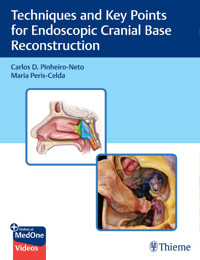
The quintessential guide to endoscopic skull base reconstruction from multidisciplinary experts
Due to close collaboration between otorhinolaryngologists and neurosurgeons, endoscopic endonasal brain surgery has become part of the surgical armamentarium for successful treatment of various cranial base pathologies. Today, it is considered the gold standard surgical technique for many types of skull base tumors. Techniques and Key Points for Endoscopic Cranial Base Reconstruction by pioneering otorhinolaryngologist Carlos D. Pinheiro-Neto and neurosurgeon Maria Peris-Celda, co-editor of Thieme's acclaimed Rhoton's Atlas of Head, Neck, and Brain, encompasses the most important endoscopic cranial base reconstruction techniques performed in the last two decades. The book features contributions from an impressive group of additional experts in this field.
Comprised of 26 reader-friendly chapters divided into seven sections, the book starts with discussion of general principles of endoscopic cranial base reconstruction. Sections II through VI provide step-by-step descriptions of reconstructive approaches utilizing diverse flaps including nasoseptal, intranasal, extranasal, and free grafts, followed by free flaps. The final section details management of seven challenging cases that enrich practical clinical experience, from free flap reconstruction to recalcitrant cerebrospinal fluid leak.
Key Highlights
- Decision-making rationales and pearls regarding selection of the most efficacious reconstructive techniques.
- Consistently formatted chapters feature a succinct review of anatomical concepts integral to each procedure, detailed descriptions for each surgical step, and alternative options.
- High-quality and meticulous anatomical dissections performed at the editors' anatomy laboratory and beautiful illustrations depict the flow of operations essential to understanding surgical nuances.
- Nineteen narrated videos visually demonstrate techniques and consolidate learning.
This must-have, comprehensive resource will help skull base surgeons master the latest techniques, avoid complications, and achieve improved outcomes for their patients.
This book includes complimentary access to a digital copy on https://medone.thieme.com.
Das E-Book können Sie in Legimi-Apps oder einer beliebigen App lesen, die das folgende Format unterstützen:
Veröffentlichungsjahr: 2022
Ähnliche



















To access the additional media content available with this e-book via Thieme MedOne, please use the code and follow the instructions provided at the back of the e-book.
Techniques and Key Points for Endoscopic Cranial Base Reconstruction
Carlos D. Pinheiro-Neto, MD, PhDAssociate ProfessorDepartment of Otorhinolaryngology/Head and Neck SurgeryMayo ClinicRochester, Minnesota, USA
Maria Peris-Celda, MD, PhDAssociate ProfessorDepartment of NeurosurgeryMayo ClinicRochester, Minnesota, USA
250 illustrations
ThiemeNew York • Stuttgart • Delhi • Rio de Janeiro
Library of Congress Cataloging-in-Publication Data is available from the publisher
© 2022. Thieme. All rights reserved
Thieme Medical Publishers, Inc.
333 Seventh Avenue, 18th Floor,
New York, NY 10001, USA
www.thieme.com
+1 800 782 3488, [email protected]
Illustrations: Jennifer Pryll
Cover design: © Thieme
Cover images source: © Carlos D. Pinheiro-Neto and
Maria Peris-Celda
(© to all artwork in the book remains with the authors. All reproductions
of the artwork will need to have permission from the
authors to publish or use it in any form.)
Typesetting by DiTech Process Solutions, India
Printed in USA by King Printing Company, Inc. 5 4 3 2 1
ISBN: 978-1-68420-232-4
Also available as an e-book: eISBN: 978-1-68420-233-1 ePUB: 978-1-63853-701-4
Important note: Medicine is an ever-changing science undergoing continual development. Research and clinical experience are continually expanding our knowledge, in particular our knowledge of proper treatment and drug therapy. Insofar as this book mentions any dosage or application, readersmay rest assured that the authors, editors, and publishers have made every effort to ensure that such references are in accordance with the state of knowledge at the time of production of the book.
Nevertheless, this does not involve, imply, or express any guarantee or responsibility on the part of the publishers in respect to any dosage instructions and forms of applications stated in the book. Every user is requested to examine carefully the manufacturers’ leaflets accompanying each drug and to check, if necessary in consultation with a physician or specialist, whether the dosage schedules mentioned therein or the contraindications stated by the manufacturers differ from the statements made in the present book. Such examination is particularly important with drugs that are either rarely used or have been newly released on the market. Every dosage schedule or every form of application used is entirely at the user’s ownriskand responsibility. The authors and publishers request every user to report to the publishers any discrepancies or inaccuracies noticed. If errors in this work are found after publication, errata will be posted at www.thieme.com on the product description page.
Some of the product names, patents, and registered designs referred to in this book are in fact registered trademarks or proprietary names even though specific reference to this fact is not always made in the text. Therefore, the appearance of a name without designation as proprietary is not to be construed as a representation by the publisher that it is in the public domain.
Thieme addresses people of all gender identities equally. We encourage our authors to use gender-neutral or gender-equal expressions wherever the context allows.
This book, including all parts thereof, is legally protected by copyright. Any use, exploitation, or commercialization outside the narrow limits set by copyright legislation, without the publisher’s consent, is illegal and liable to prosecution. This applies in particular to photostat reproduction, copying, mimeographing, preparation of microfilms, and electronic data processing and storage.
Tomy father, Dr. Sebastião Diógenes Pinheiro, for being an example of father, friend, physician, and professor. Thank you for showing me the fascinating world of the otorhinolaryngology and being the ultimate model of dedi1cation to the patients.
To my mother, Erineide, for the love, constant presence, and major efforts in my early education.
To my family for the unconditional love and support.
Carlos D. Pinheiro-Neto, MD, PhD
To my past, present, and future patients for the immense privilege to be involved in their care.
To those who donate their bodies for the study of anatomy and their families for their generosity that allows us to train, develop, and perfect new and safer surgical techniques.
To the memory of Professor A.L. Rhoton and his legacy to strive for more accurate, gentle, and safe surgeries.
Tomy beloved family, especiallymy parents Antonio and Maria, whose generosity and support are beyond comprehension.
Maria Peris-Celda, MD, PhD
Contents
Videos
Foreword
Preface
Acknowledgments
Contributors
Section I Introduction
1Principles of Endoscopic Cranial Base Reconstruction
Tyler Kenning, Laura Salgado-Lopez, Maria Peris-Celda, and Carlos D. Pinheiro-Neto
1.1Introduction
1.2Fundamentals of Endonasal Reconstruction
1.3Repair Options
1.4Vascularized Reconstruction
1.5Reconstruction Decalogue
2Operative Planning and Treatment Algorithm
Serdar Aydin, Carlos D. Pinheiro-Neto, and Maria Peris-Celda
2.1Introduction
2.2Preoperative Planning
2.3Perioperative and Intraoperative Considerations
2.4Treatment Algorithm
2.5Postoperative Considerations
2.5.1Inpatient Care
2.5.2Outpatient Care
Section II Nasoseptal Flap and Variations
3Standard Nasoseptal Flap
Carlos D. Pinheiro-Neto, Luciano C. P. C. Leonel, Natalia C. Rezende, and Maria Peris-Celda
3.1Anatomy
3.2Fundamentals
3.3Indications
3.4Limitations
3.5Surgical Technique (Videos 3.1 and 3.2)
3.5.1Harvest
3.5.2Reconstruction
3.6Postoperative Care
3.7Managing Complications
4Rescue Nasoseptal Flap
Carlos D. Pinheiro-Neto, Luciano C. P. C. Leonel, and Maria Peris-Celda
4.1Fundamentals
4.2Indications
4.3Limitations
4.4Surgical Technique (Video 4.1)
4.5Postoperative Care
4.6Complications
5Extended Nasoseptal Flap
Carlos D. Pinheiro-Neto, Luciano C. P. C. Leonel, and Maria Peris-Celda
5.1Fundamentals
5.2Indications
5.3Limitations
5.4Surgical Technique (Video 5.1)
5.4.1Harvest
5.4.2Reconstruction
5.5Postoperative Care
5.5.1One-Week Postoperative Visit
5.5.2One-Month Postoperative Visit
5.5.3Four-Month Postoperative Visit
5.6Complications
6Nasoseptal Flap Pedicle Release
Carlos D. Pinheiro-Neto, Luciano C. P. C. Leonel, and Maria Peris-Celda
6.1Anatomy
6.2Fundamentals
6.3Indications
6.4Limitations
6.5Surgical Technique (Videos 6.1 and 6.2)
6.5.1360-Degree Bone Removal around the SPA Foramen (Osseous Release)
6.5.2Ipsilateral Transpterygoid Approach
6.5.3360-Degree Circumferential Incision in the Periosteum of the PPF around the SPA (Periosteal Release)
6.6Postoperative Care
6.6.1One-Week Postoperative Visit
6.6.2One-Month Postoperative Visit
6.7Complications
7Composite Cartilagomucosal Nasoseptal Flap
Carlos D. Pinheiro-Neto, Luciano C. P. C. Leonel, and Maria Peris-Celda
7.1Fundamentals
7.2Indications
7.3Limitations
7.4Surgical Technique (Video 7.1)
7.4.1Flap Harvest
7.4.2Reconstruction
7.5Postoperative Care
7.6Complications
8Resurface of the Septum Donor Site
Carlos D. Pinheiro-Neto and Maria Peris-Celda
8.1Fundamentals
8.2Indications
8.3Limitations
8.3.1Reverse Contralateral NSF
8.3.2Inferior Meatal Flap
8.4Surgical Technique
8.4.1Reverse Contralateral NSF
8.4.2Inferior Meatal Flap (Video 8.1)
8.5Postoperative Care
8.6Complications
8.7Free Mucosal Grafts
Section III Other Intranasal Flaps
9Middle Turbinate Flap
Carlos D. Pinheiro-Neto, Luciano C. P. C. Leonel, and Maria Peris-Celda
9.1Anatomy
9.2Fundamentals
9.3Indications
9.4Limitations
9.5Surgical Technique
9.5.1Harvest
9.5.2Reconstruction
9.6Postoperative Care
9.7Complications
10Posterior-Based Lateral Nasal Wall Flaps
Carl H. Snyderman and Paul A. Gardner
10.1Anatomy
10.2Fundamentals
10.3Indications
10.4Limitations
10.5Surgical Technique
10.5.1Standard Posterior LNWF ▶ [60] (Videos 10.1 and 10.2)
10.5.2Extended Posterior LNWF
10.5.3Extended Posterior LNWF with Nasal Septum
10.6Postoperative Care
10.7Complications
11Anterior-Based Lateral Nasal Wall Flaps
Carlos D. Pinheiro-Neto, Luciano C. P. C. Leonel, and Maria Peris-Celda
11.1Anatomy
11.2Fundamentals
11.3Indications
11.4Limitations
11.5Surgical Technique
11.5.1Harvest (Video 11.1)
11.5.2Reconstruction
11.6Postoperative Care
11.7Complications
Section IV Extranasal Flaps
12Pericranial Flap
Laura Salgado-Lopez, Maria Peris-Celda, and Carlos D. Pinheiro-Neto
12.1Anatomy
12.2Fundamentals
12.3Indications
12.4Limitations
12.5Surgical Technique
12.5.1Pericranial Flap Harvest via Coronal Approach
12.5.2Pericranial Flap Harvest via Endoscopic Approach
12.6Postoperative Care
12.7Complications
13Temporoparietal Fascia Flap
Carlos D. Pinheiro-Neto, Luciano C. P. C. Leonel, and Felipe S. G. Fortes
13.1Anatomy
13.2Fundamentals
13.3Indications
13.4Limitations
13.5Surgical Technique
13.5.1Endoscopic Infratemporal Fossa Approach
13.5.2Temporoparietal Fascia Flap Harvest and Transposition
13.5.3Reconstruction
13.6Postoperative Care
13.7Complications
14Composite Extranasal Flaps: Osteopericranial and Osteotemporoparietal Fascia Flaps
Carlos D. Pinheiro-Neto and Maria Peris-Celda
14.1Anatomy
14.2Fundamentals
14.3Indications
14.4Limitations
14.5Surgical Technique
14.5.1Harvest
14.5.2Reconstruction
14.6Postoperative Care
14.7Complications
15Temporalis Muscle Flap
Roberto M. Soriano and C. Arturo Solares
15.1Anatomy
15.2Fundamentals
15.3Indications
15.4Limitations
15.5Surgical Technique
15.5.1Widening of Pterygoid Passage
15.5.2Temporalis Muscle Flap Harvest
15.5.3Flap Transposition and Inset
15.6Postoperative Care
15.7Complications
16Other Extranasal Flaps: Facial Artery Buccinator Flap and Palatal Flap
Garret W. Choby
16.1Anatomy
16.2Fundamentals
16.3Indications
16.4Limitations
16.5Surgical Technique
16.6Postoperative Care
16.7Complications
Section V Free Grafts
17Mucosal Grafts
Ramón Moreno-Luna, Maria Peris-Celda, and Carlos D. Pinheiro-Neto
17.1Fundamentals
17.2Indications
17.3Limitations
17.4Surgical Technique
17.4.1Nasal Floor Free Mucosal Graft (Videos 17.1 and 17.2)
17.4.2Middle Turbinate Free Mucosal Graft
17.4.3Nasal Septum Free Mucosal Graft
17.4.4Inferior Turbinate Free Mucosal Graft
17.4.5Lateral Nasal Wall Free Mucosal Graft (Anterior)
17.5Postoperative Care
17.6Complications
17.6.1Nasal Floor Free Mucosal Graft
17.6.2Middle Turbinate Free Mucosal Graft
17.6.3Nasal Septum Free Mucosal Graft
17.6.4Inferior Turbinate Free Mucosal Graft
17.6.5Lateral Nasal Wall Free Mucosal Graft (Anterior)
18Nonmucosal Grafts: Fat, Muscle, Fascia Lata, and Septal Cartilage
Laura Salgado-Lopez, Maria Peris-Celda, and Carlos D. Pinheiro-Neto
18.1Anatomy
18.2Fundamentals
18.3Indications
18.4Limitations
18.5Surgical Technique
18.6Postoperative Care
18.7Complications
Section VI Free Flaps
19Endoscopic Cranial Base Free Flap Reconstruction
Akina Tamaki, Abdulaziz Alrasheed, Daniel Prevedello, Enver Ozer, Ricardo L. Carrau, and Stephen Y. Kang
19.1Anatomy
19.2Fundamentals
19.3Indications
19.4Limitations
19.5Surgical Technique (Video 19.1)
19.5.1Preparation of Recipient Site
19.5.2Free Flap Harvest
19.5.3Free Flap Inset
19.6Postoperative Care
19.7Complications
Section VII Challenging Cases
20Free Flap Reconstruction
Adedamola Adepoju, Courtney Carpenter, Maria Peris-Celda, and Carlos D. Pinheiro-Neto
20.1Case Description
20.1.1Presentation
20.1.2Surgical Procedure (Video 20.1)
20.1.3Postoperative Course
20.2Challenges
20.3Discussion
20.4Alternatives
20.5Conclusions
20.6Reference
21Galeal-Frontalis Muscle Flap
Adedamola Adepoju, Tyler Kenning, Maria Peris-Celda, and Carlos D. Pinheiro-Neto
21.1Case Description
21.1.1Presentation
21.1.2Surgical Procedure
21.1.3Postoperative Course
21.2Challenges
21.3Discussion
21.4Alternatives
21.5Conclusions
22Necrotic Pericranial Scalp Flap
Carl H. Snyderman and Paul A. Gardner
22.1Case Description
22.1.1Presentation
22.1.2Surgical Procedure
22.1.3Postoperative Course
22.2Challenges
22.3Discussion
22.4Alternatives
22.5Conclusions
23Necrotic Nasoseptal Flap
Carl H. Snyderman and Paul A. Gardner
23.1Case Description
23.1.1Presentation
23.1.2Surgical Procedure
23.1.3Postoperative Course
23.2Challenges
23.3Discussion
23.4Alternatives
23.5Conclusions
24What to Do When a Nasoseptal Flap Is Not Perfusing?
Jamie J. Van Gompel, Janalee Stokken, and Salomon Cohen Cohen
24.1Case Description
24.1.1Presentation
24.1.2Surgical Procedure
24.1.3Postoperative Course
24.2Challenges
24.3Discussion
24.4Alternatives
24.5Conclusion
25Persistent Subcutaneous/Epidural Pneumocephalus Following Skull Base Surgery
Michael J. Link, Maria Peris-Celda, and Garret W. Choby
25.1Case Description
25.1.1Presentation
25.1.2Surgical Procedure
25.1.3Postoperative Course
25.1.4Surgical Repair
25.2Challenges
25.3Discussion
25.4Alternatives
25.5Conclusions
26Recalcitrant Cerebrospinal Fluid Leak
Abdulaziz Alrasheed, Akina Tamaki, Daniel Prevedello, Stephen Y. Kang, Enver Ozer, Mathew Old, Nolan Seim, Amit Agrawal, and Ricardo L. Carrau
26.1Case Description
26.1.1Presentation
26.1.2Surgical Procedure (Video 26.1)
26.1.3Postoperative Course
26.2Challenges
26.3Discussion
26.4Alternatives
26.5Conclusion
Index
Videos
Video 3.1:
Nasoseptal flap harvest and inset for reconstruction after anterior cranial base resection.
Video 3.2:
Reconstruction of suprasellar defect after resection of craniopharyngioma using inlay–onlay fascia lata button graft and onlay nasoseptal flap.
Video 3.3:
Nasoseptal flap incision along the nasal dorsum mucosa using endoscopic microscissors.
Video 4.1:
Rescue flap incision during a transsphenoidal approach.
Video 5.1:
Extended nasoseptal flap.
Video 6.1:
Nasoseptal flap pedicle release into the pterygopalatine fossa and dissection of the maxillary artery.
Video 6.2:
Nasoseptal flap pedicle release for reconstruction after partial rhinectomy.
Video 7.1:
Composite cartilagomucosal nasoseptal flap for reconstruction of suprasellar defect.
Video 8.1:
Inferior meatal flap to resurface the septum donor site after harvest of nasoseptal flap.
Video 10.1:
Posterior-based lateral nasal wall flap.
Video 10.2:
Inferior turbinate/lateral nasal wall flap for reconstruction of clival osteoradionecrosis with exposed carotid stent and coil.
Video 11.1:
Anterior-based lateral nasal wall flap.
Video 15.1:
Anatomical dissection of temporalis muscle flap.
Video 17.1:
Nasal floor free mucosal graft for reconstruction of sellar defect after pituitary tumor resection.
Video 17.2:
Nasal floor free mucosal graft for repair of chronic post-traumatic CSF leak.
Video 18.1:
Preparation of the fascia lata button graft on the surgical back table and inset of the graft for reconstruction of suprasellar defect.
Video 19.1:
Vastus lateralis free tissue transfer for endoscopic reconstruction of anterior cranial base defect.
Video 20.1:
Endoscopic anterior cranial base reconstruction with vastus lateralis muscle free flap. Inset through a maxillotomy approach.
Video 26.1:
Endoscopic cranial base reconstruction with vastus lateralis muscle free flap. Inset through a retropharyngeal corridor.
Foreword
Endoscopic endonasal surgery has become the new paradigm for the management of a variety of neoplastic and non-neoplastic conditions of the cranial base. The techniques have been widely adopted by skull base surgeons across surgical disciplines. As skull base teams gain experience and ascend the learning curve, they are more able to address large and complex pathologies that need more robust reconstruction of dural defects.
The early years of endoscopic endonasal surgery were plagued by a high postoperative cerebrospinal fluid leak rate. The advent of the vascularized nasoseptal flap for reconstruction was a major advance, with a dramatic and sudden decrease in postoperative cerebrospinal fluid leak rates. The initial publication describing the Hadad- Bassagasteguy flap in 2006 continues to be one of the most highly cited papers in skull base surgery. Subsequent literature reviews have confirmed the benefit of vascularized reconstruction of skull base defects. Multiple variations and refinements of the nasoseptal flap have been introduced subsequently along with a greater appreciation for other vascularized flaps, both local and regional. The lateral nasal wall flap (inferior turbinate flap) and extracranial pericrapericranial flap are examples of local and regional flaps that were developed to provide a reconstructive alternative when a nasoseptal flap is not available while minimizing morbidity.
Carlos D. Pinheiro-Neto and Maria Peris-Celda have succeeded in bringing together all the reconstructive techniques that are needed by the modern skull base surgeon, whether they are doing an open or endoscopic or combined approach. The chapters are organized in a succinct bulleted format that highlights essential information efficiently but still captures nuanced description of surgical technique. This format is optimal for quick reference and most conducive to learning. The chapters are lavishly illustrated with superb anatomical dissections using fully injected specimens from the laboratory of Pinheiro-Neto and Celda. The drawings are beautifully rendered and provide clear illustrations of reconstructive concepts. An added feature of this book is inclusion of challenging cases that anticipate the complications and reconstructive dilemmas bornout of experience. This textbook is an essential addition to the bookshelf of every skull base surgeon.
Carl Snyderman, MD, MBA
Foreword
In the past two decades, endoscopic endonasal cranial base surgery has become part of the surgical armamentarium to successfully treat a variety of cranial base pathologies. Currently, it is considered the gold standard surgical technique for many types of tumors. The evolution of a completely new surgical approach was only possible because of the close collaboration between otorhinolarygologists and neurosurgeons. A key limiting factor encountered early during this process was the high rates of postoperative cerebrospinal fluid (CSF) leak. In 2006, Gustavo Hadad and Luis Bassagasteguy from Argentina in association with Ricardo Carrau, Amin Kassam, and Carl Snyderman from the University of Pittsburgh published the first vascularized flap for endoscopic cranial base reconstruction. The nasoseptal flap revolutionized the field and allowed further advance in endoscopic skull base surgery, decreasing dramatically the postoperative CSF leak rates. Since then, numerous other flaps and modifications of techniques in endoscopic cranial base reconstruction have been published in the literature.
This project aims to compile in a unique book the most important endoscopic reconstructive surgical techniques published in the past two decades. This book is composed of 26 chapters divided into 7 sections. Section I provides an overviewof general principles to be followed in endoscopic cranial base reconstruction and resources to help decide the best technique for each type of skull base defect. Sections II to VI provide descriptions of each surgical technique, stepby- step, in a bullet format to make the reading more productive and to the point. Each chapter starts with a brief review of the important anatomical concepts for the surgical technique. Every nuance of each surgical step is described in detail and alternatives are provided. The surgical description is enriched with high-quality pictures and drawings illustrating the steps of the operation. Narrated videos are provided to demonstrate the technique and consolidate the learning. After reviewing the most important surgical techniques currently available for cranial base reconstruction, the reader will be able to acquire some practical clinical experience from difficult clinical examples in Section VII. This final section provides description of seven challenging cases managed by different and experienced skull base teams.
We hope this work serves as a practical reconstructive resource to the endoscopic skull base surgeon.
Carlos D. Pinheiro-Neto, MD, PhD Maria Peris-Celda, MD, PhD
Acknowledgments
We are indebted to Jennifer Pryll for her effort and dedication to performillustrations that make complex techniques easier to understand.
Wewould like to thank Shipra Sehgal and the rest of the Thieme team for their dedication and commitment to the publication of this book.
Carlos D. Pinheiro-Neto, MD, PhD Maria Peris-Celda, MD, PhD
Contributors
Adedamola Adepoju, MD
Neurosurgeon
Department of Neurosurgery
CHI St. Vincent Arkansa Neuroscience Institute
Sherwood, Arkansas, USA
Amit Agrawal, MD
Associate Professor
Department of Otolaryngology – Head and Neck Surgery
The James Cancer Hospital and Solove Research Institute
The Ohio State University Wexner Medical Center
Columbus, Ohio, USA
Abdulaziz Alrasheed, MD
Clinical Fellow
Department of Otolaryngology – Head and Neck Surgery
The James Cancer Hospital and Solove Research Institute
The Ohio State University Wexner Medical Center
Columbus, Ohio, USA
Serdar Aydin, MD
Research Fellow
Department of Neurosurgery, Albany Medical Center
Albany, New York, USA
Courtney Carpenter, MD
Assistant Professor of Plastic Surgery
Albany Medical Center
Albany, New York, USA
Ricardo L. Carrau, MD, MBA
Professor
Department of Otolaryngology – Head and Neck Surgery;
Lynne Shepard Jones Chair in Head and Neck Oncology;
Director of the Comprehensive Skull Base Surgery Program
The Ohio State University Medical Center;
Co-Director
Anatomy Laboratory Toward Visuospatial Surgical
Innovations in Otolaryngology and Neurosurgery
(ALT-VISION)
The Ohio State University Wexner Medical Center
Columbus, Ohio, USA
Garret W. Choby, MD
Associate Professor
Rhinology and Skull Base Surgery;
Chair of Quality
Department of Otolaryngology – Head and Neck Surgery,
Joint Appointment
Department of Neurologic Surgery
Mayo Clinic
Rochester, Minnesota, USA
Salomon Cohen Cohen, MD
Resident
Department of Neurosurgery
Mayo Clinic
Rochester, Minnesota, USA
Felipe S. G. Fortes, MD, PhD
Otolaryngologist and Facial Plastic Surgeon, Clinica Fortes
São Paulo, Brazil
Paul A. Gardner, MD
Professor and Peter J. Janetta Endowed Chair
Department of Neurological Surgery
University of Pittsburgh School of Medicine;
Co-Director
Center for Cranial Base Surgery
University of Pittsburgh Medical Center
Pittsburgh, Pennsylvania, USA
Stephen Y. Kang, MD
Head and Neck Surgeon
Department of Otolaryngology – Head and Neck Surgery
The James Cancer Hospital and Solove Research Institute
The Ohio State University Wexner Medical Center
Columbus, Ohio, USA
Tyler Kenning, MD
Neurosurgeon
Piedmont Heathcare
Atlanta, Georgia, USA
Luciano C. P. C. Leonel, PhD
Research Fellow
Department of Neurosurgery
Mayo Clinic
Rochester, Minnesota, USA
Michael J. Link, MD
Professor
Departments of Neurologic Surgery and
Otorhinolaryngology
Mayo Clinic
Rochester, Minnesota, USA
Ramon Moreno-Luna, MD, PhD
Otolaryngologist
Rhinology and Skull Base Unit
University Hospital Virgen de la Macarena
Seville, Spain
Mathew Old, MD
Associate Professor
Department of Otolaryngology – Head and Neck Surgery
The James Cancer Hospital and Solove Research Institute
The Ohio State University Wexner Medical Center
Columbus, Ohio, USA
Enver Ozer, MD
Professor
Department of Otolaryngology – Head and Neck Surgery
Wexner Medical Center
The James Cancer Hospital and Solove Research Institute,
The Ohio State University
Columbus, Ohio, USA
Maria Peris-Celda, MD, PhD
Associate Professor
Department of Neurosurgery
Mayo Clinic
Rochester, Minnesota, USA
Carlos D. Pinheiro-Neto, MD, PhD
Associate Professor
Department of Otorhinolaryngology/Head and Neck
Surgery
Mayo Clinic
Rochester, Minnesota, USA
Daniel Prevedello, MD
Professor
Department of Neurological Surgery
The James Cancer Hospital and Solove Research Institute
The Ohio State University Wexner Medical Center
Columbus, Ohio, USA
Natalia C. Rezende, MD
Research Fellow
Department of Neurosurgery
Mayo Clinic
Rochester, Minnesota, USA
Laura Salgado-Lopez, MD
Research Fellow
Department of Neurosurgery
Mount Sinai Hospital
New York, New York, USA
Nolan Seim, MD
Assistant Professor
Department of Otolaryngology – Head and Neck Surgery
The James Cancer Hospital and Solove Research Institute
The Ohio State University Wexner Medical Center
Columbus, Ohio, USA
Carl H. Snyderman, MD, MBA
Professor
Department of Otolaryngology
University of Pittsburgh School of Medicine;
Co-Director
Center for Cranial Base Surgery
University of Pittsburgh Medical Center
Pittsburgh, Pennsylvania, USA
C. Arturo Solares, MD, FACS, MD, FACS
Professor of Otolaryngology and Neurosurgery;
Director, Skull Base Surgery
Emory University
Atlanta, Georgia, USA
Roberto M. Soriano, MD
Research Fellow
Department of Otolaryngology – Head and Neck Surgery
Emory University
Atlanta, Georgia, USA
Janalee Stokken, MD
Associate Professor
Department of Otolaryngology – Head and Neck Surgery
Mayo Clinic
Rochester, Minnesota, USA
Akina Tamaki, MD
Assistant Professor
Department of Otolaryngology
Case Western Reserve University
University Hospitals Cleveland Medical Center
Cleveland, Ohio, USA
Jamie J. Van Gompel, MD, FAANS
Professor in Neurosurgery and Otorhinolaryngology;
Program Director
International Neurosurgery Fellowship;
Associate Program Director
Neurosurgical Skull Base Oncology Fellowship
Mayo Clinic
Rochester, Minnesota, USA
Section I
Introduction
1 Principles of Endoscopic Cranial Base Reconstruction
2 Operative Planning and Treatment Algorithm
1 Principles of Endoscopic Cranial Base Reconstruction
Tyler Kenning, Laura Salgado-Lopez, Maria Peris-Celda, and Carlos D. Pinheiro-Neto
1.1 Introduction
Endonasal approaches to the cranial base have not only permitted access to an increasingly vast range of pathology but have also brought new surgical challenges.
Reconstruction after cranial base surgery separates the sinonasal and intracranial compartments, preventing postoperative cerebrospinal fluid (CSF) fistulas, and limiting the morbidity and mortality.
The goals for repair of the cranial base include the elimination of dead space, providing structural support, contour and function of the cranial base, and protection and preservation of intracranial and orbital contents.
Beyond the need for reoperation and further repair, reconstruction failures have the potential for significant morbidity: meningitis, subdural hemorrhage, intracranial abscess, hydrocephalus, pneumocephalus, and even death. 1 Delayed complications include epistaxis, chronic rhinosinusitis, and sinonasal mucocele formation. 2




