


59,99 €
Mehr erfahren.
- Herausgeber: John Wiley & Sons
- Kategorie: Fachliteratur
- Sprache: Englisch
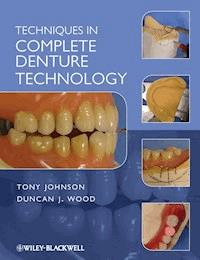
This practical manual focuses on the discipline of complete denture technology. It sets out the ideal properties of complete dentures, and provides the reader with techniques for achieving these when carrying out any stage in the production process. Procedures are clearly set out in step-by-step format and fully illustrated with clinical photographs.
Techniques in Complete Denture Technology discusses all the various elements that are essential for optimum denture provision, including fit, retention, stability, occlusion, muscular control, aesthetics and materials. It is essential reading for dental technicians, clinical dental technicians and maxillo-facial prosthetists, as well as providing a valuable resource for dentists and students.
KEY FEATURES
- Provides techniques for achieving the ideal properties of complete dentures
- Discusses fit, retention, stability, occlusion, muscular control, aesthetics and materials
- Full of easy to follow step-by-step procedures
- Written by an experienced and established author team
- Highly illustrated with full colour clinical photos
Sie lesen das E-Book in den Legimi-Apps auf:
Seitenzahl: 167
Veröffentlichungsjahr: 2012
Ähnliche



















Table of Contents
Cover
Title page
Copyright page
Preface
Chapter 1 INTRODUCTION
Chapter 2 PRE-PROSTHETIC TREATMENT
What’s wrong with the old denture?
Modifying the denture
Chapter 3 ACHIEVING A GOOD WORKING MODEL
Can I work with primary models?
Designing a customised impression tray
Selecting an impression tray and material
Producing customised trays
Secondary impressions and working models
Chapter 4 OCCLUSAL REGISTRATION
Introduction
Design of registration rims
Construction of registration rims
Occlusal registration
Gothic arch tracing
Gothic arch tracing device construction
Chapter 5 OCCLUSION, ARTICULATORS AND FACEBOWS
Balanced occlusion
Lingualised occlusion
Types of articulator
Types of facebow
Procedure for using a Denar facebow
Procedure for using a Condylator facebow
Split cast mounting technique
Recording the condylar angle in conjunction with gothic arch tracing using a Gerber facebow
Transferring the condylar angle recordings to the articulator
Chapter 6 AESTHETICS
Duplicating aesthetics
Selecting denture teeth
Characterising teeth
Denture teeth
Digital photography
Chapter 7 POSITIONING THE DENTURE TEETH
Anatomical landmarks and aids used to position denture teeth
Retaining the registration information
Design of the occlusion
Setting teeth in natural occlusion
Setting teeth in lingualised occlusion
Limiting the occlusal table
Dealing with limited space
Providing stability in protrusive excursions
Stability
Chapter 8 GINGIVAL CONTOURING AND POLISHED SURFACES
Sulcus
Denture base
Buccal and lingual flange extension
Buccal and lingual flange contour (polished surface shape)
Palate
Gingival contour
Chapter 9 PROCESSING DENTURES
Ideal properties
Acrylic types
Processing problems
Flasking dentures
Bonding to artificial teeth
Injection moulding
Gingival staining techniques
Chapter 10 FINISHING DENTURES
Chapter 11 SPECIAL TECHNIQUES
Neutral zone dentures
Implant-retained complete dentures
Index
This edition first published 2012
© 2012 by Tony Johnson and Duncan J. Wood
Wiley-Blackwell is an imprint of John Wiley & Sons, formed by the merger of Wiley’s global Scientific, Technical and Medical business with Blackwell Publishing.
Registered office: John Wiley & Sons, Ltd, The Atrium, Southern Gate, Chichester, West Sussex, PO19 8SQ, UK
Editorial offices: 9600 Garsington Road, Oxford, OX4 2DQ, UK
The Atrium, Southern Gate, Chichester, West Sussex, PO19 8SQ, UK
2121 State Avenue, Ames, Iowa 50014-8300, USA
For details of our global editorial offices, for customer services and for information about how to apply for permission to reuse the copyright material in this book please see our website at www.wiley.com/wiley-blackwell.
The right of the author to be identified as the author of this work has been asserted in accordance with the UK Copyright, Designs and Patents Act 1988.
All rights reserved. No part of this publication may be reproduced, stored in a retrieval system, or transmitted, in any form or by any means, electronic, mechanical, photocopying, recording or otherwise, except as permitted by the UK Copyright, Designs and Patents Act 1988, without the prior permission of the publisher.
Designations used by companies to distinguish their products are often claimed as trademarks. All brand names and product names used in this book are trade names, service marks, trademarks or registered trademarks of their respective owners. The publisher is not associated with any product or vendor mentioned in this book. This publication is designed to provide accurate and authoritative information in regard to the subject matter covered. It is sold on the understanding that the publisher is not engaged in rendering professional services. If professional advice or other expert assistance is required, the services of a competent professional should be sought.
Library of Congress Cataloging-in-Publication Data
Johnson, Tony (Anthony Phillip)
Techniques in complete denture technology / Tony Johnson, Duncan J. Wood.
p. ; cm.
Includes bibliographical references and index.
ISBN 978-1-4051-7909-6 (pbk. : alk. paper)
ISBN 978-1-1182-3425-9 (epub)
ISBN 978-1-1182-3295-8 (mobi)
I. Wood, Duncan J. II. Title.
[DNLM: 1. Denture, Complete. 2. Technology, Dental–methods. WU 530]
617.6'92–dc23
2011042661
A catalogue record for this book is available from the British Library.
Wiley also publishes its books in a variety of electronic formats. Some content that appears in print may not be available in electronic books.
Preface
As the dental profession becomes more successful in delaying complete edentulism in patients until much later in their lives, it also brings with it greater problems in providing these older patients with satisfactory complete dentures. More understanding of all aspects of complete denture provision will be needed to achieve satisfactory outcomes for these patients.
The technical aspects of complete denture provision are very often given brief consideration in publications relating to complete denture provision. This side of complete denture provision, however, often has a major impact on the success or failure of the dentures.
This book is intended for all student dentists and technicians, clinicians, clinical dental technicians and technicians who have an interest in complete denture provision, with the hope that it may stimulate new ideas and improve technique when considering the technical aspects of denture construction.
We would like to thank the following people who either provided or modelled for the pictures that appear in this text. First we thank Mr Peter Bridgwood for kindly allowing the use of his image and Dr Hannah Barnes for providing clinical pictures. We also appreciate the help given by David Wildgoose, Eleanor Stone, Laura Peacock, Sebastian Wilkins, Micheal Spencer, Daniel Leung, Lisa Smith, Christopher Povey and Anna Burrows.
Tony Johnson
Duncan Wood
Chapter 1
INTRODUCTION
This text will set out the ideal properties of complete dentures, and provide you with techniques for achieving these when carrying out any stage in the production process. Dentures should function well and look good. The denture wearer may value function over aesthetics or vice versa, but failure to establish a minimal requisite will lead to disappointment.
What do we mean by function well? Dentures should be comfortable, retentive, stable when biting together in any position, and restore the speech.
What do we mean by look good? Dentures should replace the teeth and the resorbed bone, resulting in natural looking anterior teeth, support of the soft tissues and restoration of any loss in vertical dimension.
Establishing function and aesthetics may be challenging in some cases, this text aims to provide the solutions to ensure the reader understands and can provide the various elements that are essential for optimum denture provision. This text will help the reader evaluate, design and provide the following requirements.
Fit:
This is a result of impression technique, impression materials, model materials, processing method, denture base material and final fitting.
Retention:
This results from fit and forming a border seal. Providing retention may prove difficult for lower dentures where stability and muscular control must be optimised to compensate.
Stability is Dependent upon Fit and Occlusion.
Establishing a balanced occlusion is key to maintaining stability and in turn the border seal. Lower dentures are particularly vulnerable to instability as a result of poor retention. Here the occlusal table should be designed to provide optimum load distribution in order to seat the denture.
Occlusion of the Denture Teeth
may be established as a conventional balanced occlusion or as a lingualised scheme, each should result in multiple tooth contacts around the denture, providing stability in any position.
Muscular Control
provides long-term retention of the denture and is aided by the positioning of the teeth in the neutral zone and by the considered shaping of the polished surfaces of the denture.
Aesthetics
of dentures are undoubtedly subjective, however examples from nature provide simple rules to follow where no record of the natural teeth exist.
Materials
used for the production of artificial teeth exhibit a range of mechanical properties and as such should be chosen to suit the patient requirements and the desired working life of the denture. Denture base material should also be chosen to suit the required strength and aesthetics.
Chapter 2
PRE-PROSTHETIC TREATMENT
What’s Wrong with the Old Denture?
Fulfilling the requirements of function and aesthetics is challenging enough, so why not make use of the clues that exist before commencing work? Take a look at the existing denture.
Assess the denture’s Retention
Has it gradually deteriorated?Is the extension of the denture correct?Is there a continuous border seal?Is there any mobile mucosa?Is It Stable?
Is the occlusal table optimally designed?Are the teeth in the neutral zone?Are there any premature contacts on closing?Is the patient functioning from centric relation?Is there a balanced occlusion?Is there stability in protrusion?How does It Work Aesthetically?
Should the anterior aesthetics be duplicated?Is there significant wear?Has the patient ever liked it?Is there a record of the natural teeth?Is the vertical dimension correct?How Well does It Function?
Is the patient comfortable, stable and functioning from centric relation?Is the vertical dimension correct and will any increase be tolerated?When assessing an existing denture, some features will be simple and quick to assess, confirm or even correct. Others may require further investigation prior to undertaking the task of producing a denture.
Modifying the Denture
Modifying an existing denture to correct basic errors, test new positions or dimensions may be possible even if a number of problems exist. Alternatively, a copy of the existing denture can be made and the modifications tried out on this.
The following simple adjustments can be tried to diagnose problems with retention, stability, function and aesthetics.
Retention
Extend the denture base to cover the entire denture-bearing area chairside using light-curing material such as Triad VLC. Figure 1a shows an inadequately extended denture and Figure 1b shows extension provided with autopolymerising polymethyl methacrylate (PMMA) resin.If the the extension is satisfactory it can be relined either chairside or via the laboratory.Figure 1
Stability
Remove premature contacts and establish balanced occlusion. Premature contacts are easily removed chairside; establishing a balanced occlusion may require a check-record procedure on an articulator.Decrease the occlusal table by removing the most posterior teeth. This will help in several ways. First, there are fewer tooth contacts to establish, making the dentures easier to adjust. Second, there is less risk of the masticatory contacts being over the slope of the alveolar, which may be acting to dislodge the denture. As shown in Figure 2, leaving off the last molars that would be placed over the sloping parts of the lower ridges will improve stability. Finally, the contacts are further away from the condyles, which allows a greater tolerance when adjusting contacts (i.e. less accuracy is required).Figure 2
Function
Increase the vertical dimension on existing dentures. This may serve two purposes. First, it may allow muscles to relax and the condyles to seat optimally in centric relation. If a patient has been posturing forwards, the lateral pterygoid muscle may shorten and allow the disc to fill the space behind the condylar head. Second, if a large increase in vertical dimension is required, the ‘new’ dimension may be tested prior to commencing treatment.Use self-curing acrylic on the occlusal surfaces of the teeth (premolar and molar only) to create an open bite. This could also be corrected using copy dentures. In Figure 3a, worn posterior teeth have created an over closed appearance. A trial temporary vertical dimension can be provided using autopolymerising PMMA resin placed onto the premolar and molar teeth as shown in Figure 3b,c.Figure 3
Aesthetics
Use modelling wax. It is difficult to show a patient what can be achieved with a denture without actually making a trail denture. The effect of increase in vertical dimension and additional lip support or tooth length can be demonstrated with the addition of modelling wax to the existing denture, but the results are limited.Have mould guides available. Having mould guides available in conjunction with a good-quality working mould guide as shown in Figure 4 may help. A three-dimensional mould guide provides the clinician and patient with the best opportunity to select the correct teeth required and seeing the various mould options arranged in different ways can be very helpful for both patients and clinicians when deciding upon the aesthetics required. Remember that pictures of the teeth options shown in mould guides (Figures 4b,c) are useful but never as good as looking at a set of the actual teeth in a working mould guide (Figure 4a). The best demonstration is to have some case studies available for the patient to see.Identify any presenting problems at an early stage, discussing the limitations will help set realistic expectations for the final dentures.Figure 4
Lesen Sie weiter in der vollständigen Ausgabe!
Lesen Sie weiter in der vollständigen Ausgabe!
Lesen Sie weiter in der vollständigen Ausgabe!
Lesen Sie weiter in der vollständigen Ausgabe!
Lesen Sie weiter in der vollständigen Ausgabe!
Lesen Sie weiter in der vollständigen Ausgabe!
Lesen Sie weiter in der vollständigen Ausgabe!
Lesen Sie weiter in der vollständigen Ausgabe!
Lesen Sie weiter in der vollständigen Ausgabe!




