


6,99 €
Mehr erfahren.
- Herausgeber: Open Book Publishers
- Sprache: Englisch
In Tennyson’s Poems: New Textual Parallels, R. H. Winnick identifies more than a thousand previously unknown instances in which Tennyson phrases of two or three to as many as several words are similar or identical to those occurring in prior works by other hands—discoveries aided by the proliferation of digitized texts and the related development of powerful search tools over the three decades since the most recent major edition of Tennyson’s poems was published.
Each of these instances may be deemed an allusion (meant to be recognized as such and pointing, for definable purposes, to a particular antecedent text), an echo (conscious or not, deliberate or not, meant to be noticed or not, meaningful or not), or merely accidental. Unless accidental, Winnick writes, these new textual parallels significantly expand our knowledge both of Tennyson’s reading and of his thematic intentions and artistic technique. Coupled with the thousand-plus textual parallels previously reported by Christopher Ricks and other scholars, he says, they suggest that a fundamental and lifelong aspect of Tennyson’s art was his habit of echoing any work, ancient or modern, which had the potential to enhance the resonance or deepen the meaning of his poems.
The new textual parallels Winnick has identified point most often to the King James Bible and to such canonical authors as Shakespeare, Milton, Dryden, Pope, Thomson, Cowper, Shelley, Byron, and Wordsworth. But they also point to many authors rarely if ever previously cited in Tennyson editions and studies, including Michael Drayton, Richard Blackmore, Isaac Watts, Erasmus Darwin, John Ogilvie, Anna Lætitia Barbauld, Letitia Elizabeth Landon, John Wilson, and—with surprising frequency—Felicia Hemans.
Tennyson’s Poems: New Textual Parallels is thus a major new resource for Tennyson scholars and students, an indispensable adjunct to the 1987 edition of Tennyson’s complete poems edited by Christopher Ricks.
Das E-Book können Sie in Legimi-Apps oder einer beliebigen App lesen, die das folgende Format unterstützen:
Veröffentlichungsjahr: 2019
Ähnliche



















TENNYSON’S POEMS: NEW TEXTUAL PARALLELS
Tennyson’s Poems: New Textual Parallels
R. H. Winnick
https://www.openbookpublishers.com
Copyright © 2019 by R. H. Winnick
This work is licensed under a Creative Commons Attribution 4.0 International license (CC BY 4.0). This license allows you to share, copy, distribute and transmit the work; to adapt the work and to make commercial use of the work provided that attribution is made to the author (but not in any way which suggests that the author endorses you or your use of the work). Attribution should include the following information:
R. H. Winnick, Tennyson’s Poems: New Textual Parallels. Cambridge, UK: Open Book Publishers, 2019. https://doi.org/10.11647/OBP.0161
In order to access detailed and updated information on the license, please visit https://www.openbookpublishers.com/product/944#copyright
Further details about CC BY licenses are available at http://creativecommons.org/licenses/by/4.0/
Digital material and resources associated with this volume are available at https://www.openbookpublishers.com/product/944#resources
Every effort has been made to identify and contact copyright holders and any omission or error will be corrected if notification is made to the publisher.
ISBN Paperback: 978-1-78374-661-3
ISBN Hardback: 978-1-78374-662-0
ISBN Digital (PDF): 978-1-78374-663-7
ISBN Digital ebook (epub): 978-1-78374-664-4
ISBN Digital ebook (mobi): 978-1-78374-665-1
DOI: 10.11647/OBP.0161
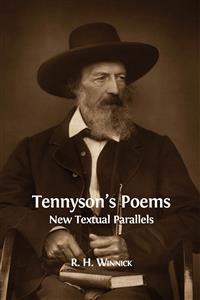
Cover image: ‘Alfred, Lord Tennyson’ by Herbert Rose Barraud. Carbon print, ca. 1888, NPG x26788 © National Portrait Gallery, London.
Cover design by Anna Gatti.
All paper used by Open Book Publishers is SFI (Sustainable Forestry Initiative) and PEFC (Programme for the Endorsement of Forest Certification Schemes ) Certified.
For Christopher Ricks
Contents
Numbers and alphanumerics (such as ‘1A’) before poem titles are those assigned by Christopher Ricks in his 1987 edition of Tennyson’s complete poems (see Preface). An asterisk following a poem number indicates that the poem appears in both the selected and the complete Ricks edition; its absence, that the poem appears only in the latter.
Preface
1
1A
Three Translations of Horace
17
1
Translation of Claudian’s ‘Rape of Proserpine’
18
2
The Devil and the Lady
24
3
Armageddon
30
4
The Coach of Death, A Fragment
35
5
Memory [Memory! dear enchanter!]
36
8
Remorse
37
9
The Dell of E—
37
10
Anthony and Cleopatra
39
16
‘Did not thy roseate lips outvie’
39
26
On Sublimity
39
27
Time: An Ode
41
30
The Walk at Midnight
41
45
‘Oh! ye wild winds, that roar and rave’
42
46
Babylon
42
47
Love [Almighty Love!]
43
48
Exhortation to the Greeks
44
50
‘Come hither, canst thou tell me if this skull’
44
51
The Dying Man to His Friend
45
54A
‘The musky air was mute’
45
55
The Outcast
45
58A
The Invasion of Russia by Napoleon Buonaparte
46
59
Playfellow Winds
48
61
Home
48
62
‘Among some Nations Fate hath placed too far’
48
63
To Poesy [O God, make this age great]
49
64
The Lark
49
67
Timbuctoo
49
73*
Mariana
50
75
Madeline
50
78*
Supposed Confessions of a Second-Rate Sensitive Mind
51
79
The Burial of Love
53
83
Recollections of the Arabian Nights
53
84
Ode to Memory
53
87
Adeline
56
88*
A Character
57
91
The Poet
58
95
Hero to Leander
60
99
The Grasshopper
60
101
Chorus, in an Unpublished Drama, Written Very Early
60
106
To a Lady Sleeping
61
107
Sonnet [Could I outwear my present state of woe]
62
108
Sonnet [Though Night hath climbed her peak of highest noon]
63
109
Sonnet [Shall the hag Evil die with child of Good]
63
110
Sonnet [The pallid thunderstricken sigh for gain]
65
124
Amy
65
126
Memory [Ay me!]
65
127
Ode: O Bosky Brook
66
128
Perdidi Diem
68
130
Sense and Conscience
69
132
‘In deep and solemn dreams’
70
140
Lines on Cambridge of 1830
70
143
A Fragment [Where is the Giant of the Sun]
71
144
‘O wake ere I grow jealous of sweet Sleep’
71
145
‘The constant spirit of the world exults’
71
146
Sonnet [When that rank heat of evil’s tropic day]
72
151
Sonnet [There are three things which fill my heart with sighs]
72
153
The Lover’s Tale
73
155
‘My life is full of weary days’
75
158
‘If I were loved, as I desire to be’
75
159*
The Lady of Shalott
75
160*
Mariana in the South
77
161
Eleänore
78
162
The Miller’s Daughter
81
163*
Fatima
81
164*
Œnone
83
166*
To — . With the Following Poem [The Palace of Art]
85
167*
The Palace of Art
86
169
The Hesperides
88
170*
The Lotos-Eaters
88
171
Rosalind
89
172
‘My Rosalind, my Rosalind’
89
173*
A Dream of Fair Women
90
174
Song [Who can say]
91
175
Margaret
91
176
Kate
91
179
To — [As when with downcast eyes]
93
185
Sonnet [Alas! how weary are my human eyes]
94
190
‘Pierced through with knotted thorns of barren pain’
94
192
The Ruined Kiln
95
193
The Progress of Spring
95
194
‘Hail Briton!’
96
200
Early Spring [1833]
97
207
The Ante-Chamber
98
208
The Gardener’s Daughter; Or, The Pictures
98
209*
The Two Voices
99
210*
St Simeon Stylites
104
212
St Agnes’ Eve
104
214
‘Hark! the dogs howl!’
104
215
Whispers
105
216*
On a Mourner
106
217*
Ulysses
107
218*
Tithon
109
219
Tiresias
110
220
Semele
112
223
Youth
112
225*
The Epic [Morte d’Arthur]
112
227*
‘Oh! that ’twere possible’
113
233
‘Fair is that cottage in its place’
114
238
‘I loving Freedom for herself’
114
240
The Blackbird
114
241*
The Day-Dream
115
246
Lady Clara Vere de Vere
118
250
Sonnet [Ah, fade not yet from out the green arcades]
118
251
To Rosa
119
254
Three Sonnets to a Coquette
119
255
Sonnet [How thought you that this thing could captivate?]
119
257
The Voyage
119
259
The Flight
122
263
‘The tenth of April! is it not?’
123
265*
A Farewell
123
267
Will Waterproof’s Lyrical Monologue
123
270
Amphion
124
271*
Locksley Hall
124
275*
Edwin Morris or, The Lake
126
276*
The Golden Year
127
276A
‘Wherefore, in these dark ages of the Press’
128
277*
The Vision of Sin
129
279
Love and Duty
132
285B
The Wanderer
132
286*
The Princess, A Medley
133
289
To — , After Reading a Life and Letters
145
290
The Losing of the Child
147
291
The Sailor Boy
147
296*
In Memoriam A. H. H.
148
297
To the Vicar of Shiplake
185
299*
To the Queen
185
300
‘Little bosom not yet cold’
186
301*
To E. L., on His Travels in Greece
186
306
The Third of February, 1852
187
307
Hands All Round! [1852]
187
308
Suggested by Reading an Article in a Newspaper
187
310*
Will
188
311*
The Daisy
189
312*
To the Rev. F. D. Maurice
189
313
The Brook
190
316*
Maud, A Monodrama
192
317
The Letters
197
324*
Tithonus
198
329
Ode Sung at the Opening of the International Exhibition
198
330*
Enoch Arden
199
337
Aylmer’s Field 1793
202
339
A Dedication
205
353
The Higher Pantheism
205
355
Lucretius
205
363
To the Rev. W. H. Brookfield
206
367
Prefatory Sonnet to the ‘Nineteenth Century’
207
377*
Prefatory Poem to My Brother’s Sonnets
207
383
De Profundis
208
386
Sir John Oldcastle, Lord Cobham
208
390
Prologue to General Hamley [The Charge of the Heavy Brigade]
209
392
Epilogue [The Charge of the Heavy Brigade]
209
394*
To Virgil
209
395
The Throstle
210
398*
To E. FitzGerald
210
399
Poets and their Bibliographies
210
400*
The Dead Prophet
210
407
Freedom
211
410
The Fleet
211
413
Vastness
211
415
The Ancient Sage
212
417*
Locksley Hall Sixty Years After
212
420
Demeter and Persephone
212
424
Happy, The Leper’s Bride
214
425*
To Mary Boyle
214
426*
Far — Far — Away
215
427*
To the Marquis of Dufferin and Ava
215
431
Merlin and the Gleam
216
441
The Death of Œnone
217
443
St Telemachus
217
454
Kapiolani
218
462*
Crossing the Bar
218
Idylls of the King
464*
The Coming of Arthur
218
465*
Gareth and Lynette
219
466*
The Marriage of Geraint
220
467*
Geraint and Enid
221
468*
Balin and Balan
221
469*
Merlin and Vivien
222
470*
Lancelot and Elaine
222
471*
The Holy Grail
223
472*
Pelleas and Ettarre
223
473*
The Last Tournament
224
474*
Guinevere
226
475*
The Passing of Arthur
226
Alphabetical Index of Tennyson Poems Discussed
227
Index of Antecedent Writers and Works Discussed
233
Preface
© 2019 R. H. Winnick, CC BY 4.0 https://doi.org/10.11647/OBP.0161.01
The most recent major edition of Tennyson’s complete poems, the three-volume second (1987) edited by Christopher Ricks,1 cites more than twelve hundred instances in which phrases and short passages of as few as two or three and as many as several words therein are similar or identical to those occurring in prior works by other hands.2 Thanks to the proliferation of digitized texts and the related development of powerful search tools over the three decades since that edition was produced, it has become possible to search for such textual parallels far more widely and effectively than ever before and to find, in Tennyson’s case, hundreds more. Like those previously identified, each of these new instances may be deemed an allusion (meant to be recognized as such and pointing, for definable purposes, to a particular antecedent text), an echo (conscious or not, deliberate or not, meant to be noticed or not, meaningful or not), or merely accidental. Unless accidental, these new textual parallels may not only tell us more about Tennyson’s reading but shed further light on his thematic intentions and artistic technique.3
Not surprisingly given his lifelong sensitivity to what he took to be, and what at times were in fact, questions about the originality of his work—beginning with an unsigned review of his recently published Poems (Moxon, 1833) in the New Monthly Magazine accusing him of having ‘filled half his pages with the most glaring imitations’;4 and including, thirteen years later, Sir Edward Bulwer-Lytton’s scornful reference to the ‘borrowed notes’ and ‘purloin’d conceits’ of ‘School-Miss Alfred’ in The New Timon. A Romance of London (Colburn, 1846)—Tennyson himself usually and often vehemently denied (with occasional exceptions, most of them noted in the Eversley edition of his poems and plays)5 that his poems contained any conscious and deliberate echoes of any such prior works at all. The most galling attack, and the one that prompted his most intense and sustained response, came late in his life, long after he was named Poet Laureate, long after his verse had won him fame, fortune, and all but universal admiration, and, ironically, from a scholar-critic who claimed to hold him and his poetry in high regard.
When John Churton Collins published the first of three installments of ‘A New Study of Tennyson’ in the January 1880 issue of The Cornhill Magazine6—including in it, based on his wide reading and prodigious if imperfect memory, nearly a hundred instances in which Tennyson seemed to him to have derived phrases, lines, passages, even whole poems from an assortment of earlier, mostly classical authors—Tennyson filled the margins of his copy7 with comments generally ranging from denial to outrage. Alongside two lines from his Mariana,said by Collins to have been adapted from two lines, ‘scarcely less beautiful’, of the Latin poet Cinna, Tennyson wrote: ‘I read this for the first time’; alongside five others, ‘not known to me’;8 alongside six, ‘nonsense’; alongside three, ‘no’, or ‘no, close as it seems’; alongside five, ‘!!’ or ‘!!!’; and so on. (In three instances, it should be noted, Tennyson’s marginal comment was ‘possibly’.) If, as seems unlikely, he took the trouble to both read and mark up parts two and three of Collins’s Cornhill pieces, his copies and any marginal comments they contained seem not to have survived.
Tennyson’s annoyance with Collins, and insistence on the originality of his poems, found further expression in some of his subsequent correspondence and conversation.
In an 1882 letter to S. E. Dawson, author of a study on one of those poems,9 he wrote:
I thank you for your able and thoughtful essay on The Princess. […] Your explanatory notes are very much to the purpose, and I do not object to your finding parallelisms. They must always occur. A man (a Chinese scholar) some time ago wrote to me saying that in an unknown, untranslated Chinese poem there were two whole lines of mine almost word for word.10 Why not? Are not human eyes all over the world looking at the same objects, and must there not consequently be coincidences of thought and impressions and expressions? It is scarcely possible for any one to say or write anything in this late time of the world to which, in the rest of the literature of the world, a parallel could not somewhere be found. But when you say that this passage or that was suggested by Wordsworth or Shelley or another, I demur; and more, I wholly disagree.
and added:
[T]here is, I fear, a prosaic set growing up among us, editors of booklets, book-worms, index-hunters, or men of great memories and no imagination, who impute themselves to the poet, and so believe that he, too, has no imagination, but is for ever poking his nose between the pages of some old volume in order to see what he can appropriate. They will not allow one to say ‘Ring the bell’ without finding that we have taken it from Sir P. Sidney, or even to use such a simple expression as the ocean ‘Roars’, without finding out the precise verse in Homer or Horace from which we have plagiarised it (fact).11
‘He was always very sensitive to the remarks of the critics, whether they attacked his powers of observation or denied him any originality’, wrote one friend a few years after the poet’s death.
One especially annoyed him by suggesting sources from which he had copied or borrowed similes and expressions, often mentioning writers whom Tennyson declared that he had never read or heard of, and quite ignoring the fact that the same thought can strike various people at different times, and that it is not necessary to hunt for the source of all that a poet gives us, if only we will allow that poet some powers of imagination of his own.
‘They allow me nothing,’ he once said to me. ‘For instance, “The deep moans round with many voices.” “The deep,” Byron; “moans,” Horace; “many voices,” Homer; and so on.’12
Another, recounting a visit to Farringford with her husband in January 1892 (Tennyson died that October), wrote:
Next day we walked up at about 12.20 to accompany him in his morning walk. Montagu and he were in front, Hallam Tennyson and I behind. Montagu tells me how he was indignant with Z. for charging him with general plagiarism, in particular about Lactantius and other classics, ‘of whom,’ he said, ‘I haven’t read a word.’ Also, of taking from Sophocles, ‘whom I never read since I was a young man’; and of his owing his ‘moanings of the sea’ to Horace’s gementis litora Bospori. Some one charged him with having stolen the ‘In Memoriam’ metre from some very old poet of whom he had never heard.13
In an earlier but still late conversation, the translator, literary historian, and critic Edmund Gosse, one of whose books Collins had savaged in print since their last meeting,14 visited the Tennysons at Aldworth in 1888. In one account by Gosse, as recorded by his biographer,
He arrived in the afternoon and was sent out into the garden, where he found a large party; tea spread out at a trestle table, Tennyson at one end of it, and an empty chair near the other. To this he crept, hoping to escape notice, but in vain. Tennyson boomed out at him, ‘Well, Gosse, would you like to know what I think of Churton Collins?’ This was worse than anything he had anticipated. He managed to mumble that he would. ‘I think,’ Tennyson went on, ‘he’s a Louse on the Locks of Literature.’ The phrase from such a source was infinitely restoring.15
In another, contained in an August 1888 letter to his wife—the discrepancy first noticed and reported by Ricks16—Gosse wrote that Tennyson had asked him ‘How’s Churton Collins?’ and without waiting for an answer added: ‘Would you like to know what I think of him?’ When Gosse said he would, Tennyson continued: ‘Well! He’s a jackass. That’s what he is. But don’t say I said so.’17 Whatever Tennyson’s actual words, the first of the two phrases stuck, even supplying the subtitle of Anthony Kearney’s solid and sympathetic biography of Collins, published in 1986.18
Tennyson’s continuing ire was understandable and not entirely unwarranted. Rather than recording in a matter-of-fact, nonjudgmental manner the many instances he had identified in which Tennyson phrases, lines, and passages seemed to him to echo or be borrowed from a broad range of mostly classical poets, Collins added insult to what Tennyson could only perceive as injury by implying, while claiming to think no such thing, that the textual parallels to be found in his poems showed Tennyson often to be at best (where foreign-language works were involved) a gifted translator of Greek, Roman, and Italian literature and at worst (where they were not) a plagiarist on a grand scale.
Collins began Part I of his Cornhill study—the one to which Tennyson would add his marginal comments—with a long paragraph ostensibly about not Tennyson but Virgil:
Those who may happen to be familiar with the Saturnalia of Macrobius will remember that one of the most delightful episodes in that pleasant work are [sic] the two books in which Eustathius and Furius Albinus estimate the extent of Virgil’s obligations to his predecessors. Eustathius having concluded a long and elaborate review of the passages in the Greek poets of which the great Roman had availed himself, Furius Albinus proceeds to trace him through Latin literature. He was half afraid, he said, to produce the formidable list of passages appropriated by the poet, because he might be exposing his favourite ‘to the censure of the malignant and unlearned.’ Remembering, however, that such parallels as he was about to point out have been common to poets of all ages, and haughtily observing that what Virgil condescended to borrow became him much more than the original owner—to say nothing of that owner becoming in some cases immortalised by the theft—Furius plunges into his theme. Between them these Langbaines of the fifth century made Conington very uncomfortable towards the end of the nineteenth; but if their disclosures have materially impaired Virgil’s claims to originality, they have illustrated his faultless taste, his nice artistic sense, his delicate touch, his consummate literary skill. They initiated a new branch of study, they divulged a fruitful secret.19
He began the next with an affirmation by denial:
Without going so far as the thief in Albumazar, when he says,
This poet is that poet’s plagiary,
And he a third’s till they all end in Homer,
it is still interesting and necessary to remember that there have appeared in all literatures, at a certain point in their development, a class of poets who are essentially imitative and reflective.
And, three sentences later, he came down to cases:
Torquato Tasso, [Thomas] Gray, and Mr. Tennyson are, perhaps, the most striking types in the modern world. Of all these Virgil, Tasso, and the Laureate are undoubtedly the most distinguished.
What poet as sensitive to any questioning of his originality as was Tennyson would not have been deeply offended by these comments?20
Collins concluded Part I of his study with a paragraph once again claiming to find no fault with Tennyson’s compositional practices. It began:
Here we must pause, though we have by no means exhausted our list of these interesting and instructive parallel passages. It would be absurd and presumptuous to conclude that any of the similarities which have been pointed out were deliberate or even conscious imitations. In Mr. Tennyson’s own noble words, we moderns are ‘the heirs of all the ages.’21 We live amid wealth as prodigally piled up as the massive and innumerable treasure-trove of Spenser’s ‘rich strond.’
In parts two and three of A New Study and in his Illustrations of Tennyson, Collins continued to document what he regarded as Tennyson’s debt to his predecessors and to do so in ways that, if he read them, Tennyson could only have deemed more wormwood. Collins came closest to an outright accusation of plagiarism in the penultimate chapter of Illustrations, where, on page 163, he arrived at Tennyson’s late poem Columbus,written and published in 1880:
With regard to this poem a serious charge of plagiarism was brought against the poet by Mr. Eric Mackay, who pointed out that it is little more than an adaptation of a poem entitled Columbus at Seville written by a Mr. Joseph Ellis, and published by Pickering in 1869, and in 1876. A comparison between Tennyson’s poem and Mr. Ellis’s certainly seems to prove beyond doubt that the Poet Laureate not only got the whole framework of his poem from Mr. Ellis’s, but has appropriated many of Mr. Ellis’s ideas and details. If the resemblances between the poems are coincidences, it would be difficult to match coincidences so extraordinary in the whole history of literary parallels. Of one thing there can be no doubt, that the first edition of Mr. Ellis’s poem appeared eleven years, and the second four years, before Tennyson’s.
Was Tennyson, then, despite his denials, a serial plagiarist? Did Collins, despite his assertions to the contrary, think him so? As to the first question what can, I think, be said is that Tennyson’s repeated insistence that he only rarely consciously and deliberately borrowed anything from anyone is as questionable as Collins’s repeated insistence that he believed the same thing.22 Based on the enormous number of textual parallels to prior works to be found in Tennyson’s poems—those previously identified, plus those first reported in this study—a fundamental and lifelong aspect of Tennyson’s art would seem to have been his habit of echoing any work, ancient or modern, which he had read and at least half-consciously recalled, that his creative intelligence told him would enhance the resonance or deepen the meaning of his poems.
These textual parallels do not, in my view, reflect a lack of imagination or a want of originality, but an imagination of enormous range and power that regarded everything he had ever read, as well as the world around him, the people he knew, the people he loved (or didn’t), and his own personal and emotional experience, as the raw material of his art. If Tennyson’s lifelong practice of crafting poems in this manner left and leaves him susceptible, however unjustly, to the charge of plagiarism, so be it. The fact remains that in doing so, Tennyson masterfully created some of the most memorable and original poems ever written in the English language.23 That this is so has often been observed, beginning with Arthur Hallam,
Originality of observation seems to cost nothing to our author’s liberal genius; he lavishes images of exquisite accuracy and elaborate splendour, as a common writer throws about metaphorical truisms, and exhausted tropes.24
and also, among others, by John Wilson Croker, reviewing Tennyson’s Poems (1833):
We pass by several songs, sonnets, and small pieces, all of singular merit, to arrive at a class, we may call them, of three poems derived from mythical sources — Œnone, the Hesperides, and the Lotos-eaters. But though the subjects are derived from classical antiquity, Mr. Tennyson treats them with so much originality that he makes them exclusively his own.25
by Robert Browning,
‘Tennyson suspected of plagiarism!’ I once heard Browning say, when this subject was mentioned: ‘Why, you might as well suspect the Rothschilds of picking pockets’.26
by Robert Pattison,
If Tennyson is in fact another Vergil, he is so because he treats his sources in the same way the Roman poet treats his: as the evidences of a plastic tradition to be evolved through the cultural process of poetry. The author of the Aeneid ransacked ancient culture to produce a distinct and wholly original epitome of the world as he saw it. Tennyson used the tradition in exactly this Vergilian way.27
and by Theodore Redpath:
Tennyson could, I believe, have afforded to rest on his real originality; but it is, I suppose, understandable that he should have been sufficiently moved to permit himself to call Churton Collins ‘a louse on the locks of literature’ or ‘a jackass’, whichever, if either, was the description of Collins that he communicated to Edmund Gosse at that tea-party at Aldworth in the summer of 1886.28
As for Collins, what matters about his work on Tennyson more than his questioning of Tennyson’s originality is the extraordinary range of his reading in classical and modern literature and his seeming ability to recall and compare to every poem in the Tennyson canon everything he had ever read. Tennyson disputed or dismissed nearly all of Collins’s findings (those, at least, in the first Cornhill article), and others, myself included, may deem some of those findings less than convincing. But Collins’s accomplishment in identifying so many credible examples of Tennyson’s textual parallels—and in doing so a century before the arrival of digitized texts and online search tools—can only be called remarkable.
In this study, having made extensive use of those digitized texts and search tools to complement my own far less than photographic memory, I am pleased to present my findings. In purely quantitative terms, out of the total of nearly five hundred poems to which Christopher Ricks assigned numeric or alphanumeric designations in his three-volume edition of Tennyson, some one hundred eighty contain one or more phrases or short passages bearing a strong, previously undocumented resemblance to, and in most instances exactly matching, corresponding phrases and passages in poems, plays, and other works by Tennyson’s literary and other predecessors (including the King James Version of the Bible) from classical to modern times. The total number of phrases and short passages in Tennyson poems newly found to have one or more such textual antecedents—including antecedents matching Tennyson’s actual language more closely than any previously adduced—is just over seven hundred fifty. And, reflecting the fact that many of these phrases and short passages occur verbatim or very nearly so two or more times in works that predate him, the total number of textual antecedents discussed in this study is double that number, or more than fifteen hundred items.
Most of the poets and others to whose works (in English, sometimes in Greek, Latin, or Italian, often in translation) these newly identified textual parallels appear to point are already familiar names in Tennyson editions and studies: Blake, Byron, Campbell, Coleridge, Cowper, Dante, Dryden, Homer, Horace, Keats, Macpherson/Ossian, Milton, James Montgomery, Robert Montgomery, Moore, Ovid, Petrarch, Pope, Scott, Shakespeare, Shelley, Southey, Spenser, Thomson, Virgil, Thomas Warton, Wordsworth, and Young, to name just a few.29
But many others whose works also appear to be recognizably, often perfectly, and sometimes repeatedly echoed in the new examples have made few if any prior appearances in such editions and studies. They include, among others, Anna Lætitia (née Aikin) Barbauld, Richard Blackmore, Erasmus Darwin, Michael Drayton, Charles Abraham Elton, Thomas Gisborne, Letitia Elizabeth Landon, John Langhorne, John Ogilvie, Richard Polwhele, Eleanor Anne Porden, Mary Robinson, Charlotte Smith, John Wilson (except, writing as ‘Christopher North’, as a critic of Tennyson’s poetry) and, in particular, Felicia Hemans, recognizable echoes of whose lyric and narrative poems—be they conscious and deliberate, accidental, or somewhere in between—occur in Tennyson’s, by my count, just over forty times.
Given the large number of textual parallels noted in this study, an extended analysis of the critical significance of each one was clearly out of the question. I have therefore in most instances based my approach to such parallels on that usually taken by Ricks in his complete and selected editions. As in those editions, however, where a given textual parallel called for more extensive discussion, my comments on it are accordingly expanded. I hope and expect that Tennyson scholars will have more to say about many of these new textual parallels and what they signify in future Tennyson studies.
In cases where two or more antecedent poems, plays, or other works contain phrases or short passages with equally plausible claims to having suggested or supplied corresponding language in a Tennyson poem, I have presented up to several such antecedent instances, in chronological order, without arbitrarily selecting or preferring one over others. Readers may decide for themselves which if any of the quoted examples Tennyson is likely to have had in mind.
Also, in many instances—particularly those involving less familiar and readily available pre-Tennyson (‘pre-T.’) poems—rather than quoting only the specific words of an antecedent phrase, I have aimed to provide enough text from its own and sometimes neighboring lines to give readers a better sense of its immediate context and why Tennyson may have found it of interest or relevance in writing his own poem.
Numbers before the titles of Tennyson poems are those assigned by Ricks. An asterisk following a poem number indicates that the poem appears in both the selected (one-volume) and the complete (three-volume) Ricks editions; the absence of an asterisk, that it appears only in the latter. Dates in parentheses following the titles of Tennyson poems indicate when, if known, he wrote the poem in question (wr); or, if not, when it was first published (pub). Dates given for antecedent works discussed are of first publication, not composition. Unless otherwise stated, all books cited were first published in London. All emphasis in quoted text is original, not added.
Books known to have been in the library of Tennyson’s father, George Clayton Tennyson, at Somersby or owned and/or read by the poet himself and later acquired by or deposited in the Tennyson Research Centre, City Library, Lincoln, England, as listed in volume one of Tennyson in Lincoln: A Catalogue of the Collections in the Research Centre compiled by Nancie Campbell(Lincoln: Tennyson Society, 1971)—hereinafter ‘Lincoln’—are identified as such. It should be kept in mind, however, that as the Cataloguer’s Notes on pp. xv–xvi of that volume point out, many of the books once owned by Tennyson or members of his family were dispersed during or after his lifetime,30 and that some of the books held by the Centre when the catalogue was prepared were subsequently sold; so that a book’s absence from the catalogue or the collection should not be taken to mean that Tennyson could not once have owned and/or read it and echoed it in his work.
R. H. Winnick Princeton, New Jersey
1 The Poems of Tennyson; in three volumes; second edition incorporating the Trinity College manuscripts, ed. by Christopher Ricks (Harlow, Essex: Longman, 1987). Along with the first, one-volume edn (Longman, 1969), Ricks edited Tennyson: A Selected Edition incorporating the Trinity College manuscripts (Longman, 1989), a revised edn of which was published by Pearson Longman in 2007 and reissued by Routledge in 2014.
2 I base this figure on W. David Shaw’s count of the textual parallels (all of which Shaw calls ‘allusions’) cited by Ricks in his 1969 edn of Tennyson’s poems. As Shaw writes in Tennyson’s Style (Ithaca and London: Cornell University Press, 1976), p. 27: ‘The greatest number of allusions are to the Bible (a total of 272), followed, in order, by Milton, 213; Shakespeare, 155; Shelley, 129; Keats, 86; Horace, 57; Malory, 47; Virgil, 44; Lucretius, 38; Homer, 37; Gray, 29; Spenser, 27; Pope, 26; Wordsworth, 25; Ovid, 20. (I have omitted poets with fewer than twenty references.)’ Shaw’s count of these textual parallels totals 1205.
3 In his preface to the second, three-volume edn, Ricks writes (p. xix): ‘The footnotes cite many parallel passages. As in any annotated edition these illustrate a range of possible likenesses. At one end is conscious allusion to another poet; then unconscious reminiscence; then phrasing which is only an analogue and not a source. Some of the instances cited here are probably analogues, not sources, but they are cited because Tennyson’s phrasing can be illuminated by the comparison.’ Ricks’s comments are also applicable to the textual parallels cited in this study.
4 ‘The Faults of Recent Poets’, New Monthly Magazine,vol. 37, no. 145 (Jan. 1833), 69–74 (70); cited by Edgar Finley Shannon, Jr., in Tennyson and the Reviewers: A Study of His Literary Reputation and of the Influence of the Critics upon His Poetry 1827–1851 (Cambridge, Mass.: Harvard University Press, 1952), p. 38.
5 The Works of Tennyson, 9 vols., annotated by Alfred Tennyson, edited by his elder son Hallam Tennyson (London: Macmillan, 1907–8); hereinafter cited as Eversley.
6 John Churton Collins, ‘A New Study of Tennyson’, The Cornhill Magazine, vol. 41, no. 241 (Jan. 1880), 36–50. Part II appeared under the same title in The Cornhill, vol. 42, no. 247 (July 1880), 17–35; and Part III in The Cornhill, vol. 44, no. 259 (July 1881), 87–106. Collins’s Cornhill articles were later incorporated into his Illustrations of Tennyson (London: Chatto & Windus, 1891), which, as discussed below, added more instances of Tennyson’s supposed echoes and borrowings. Other subsequent compilations of such echoes and borrowings include Wilfred P. Mustard, Classical Echoes in Tennyson (New York and London: Macmillan, 1904); G. G. Loane, ‘Echoes in Tennyson,’ in his Echoes in Tennyson, and Other Essays (London: Stockwell, n.d. [1928]), pp. 3–11; and E. A. Mooney, Jr., ‘Tennyson’s Earliest Shakspere Parallels’, Shakespeare Association Bulletin, vol. 15, no. 2 (Apr. 1940), 118–24.
7 Preserved in the Tennyson collection of the Central Library, Lincoln; summarized by H. P. Sucksmith in ‘Tennyson on the Nature of His Own Poetic Genius: Some Recently Discovered Marginalia’, Renaissance and Modern Studies, vol. 11, no. 1 (1967), 84–89; and also selectively cited in the Ricks editions of Tennyson’s poems.
8 In at least two instances, as Ricks points out, Tennyson denied prior knowledge of a source cited by Collins, then later, in the notes to Eversley, cited it himself. Alongside Collins’s citation of Callimachus, Lavacrum Palladis, line 72, as the source of line 24 of Œnone, Tennyson wrote: ‘not known to me’; but the same line of Callimachus is cited in connection with the same line of Œnone in Eversley, vol. 1, p. 360. Similarly, alongside Collins’s suggestion of Inferno xv 95–96 as the source of the refrain ‘Turn, Fortune, turn thy wheel’ in lines 347–58 of The Marriage of Geraint, Tennyson wrote ‘!!!’; but the same lines are cited in Eversley, vol. 5, p. 470.
9 S. E. Dawson, A Study; with Critical and Explanatory Notes, of Alfred Tennyson’s Poem The Princess (Montreal: Dawson Brothers, 1882).
10 The man, an English missionary in China, was the Rev. Arthur Evans Moule, to whom, on 6 Jan. 1880, Tennyson had sent a letter reading in its entirety: ‘Dear Sir I thank you for your book and your quotation from the Chinese Poet. No man can write a single passage to which a parallel one may not be found somewhere in the literature of the world. Yours very faithfully A. Tennyson’. From The Letters of Alfred Lord Tennyson, ed. by Cecil Y. Lang and Edgar F. Shannon, Jr., vol. 3 (Cambridge, Mass.: Harvard University Press, 1990), p. 183.
11 The letter, dated 21 Nov. 1882, first appeared in vol. 1 of Hallam’s two-volume Alfred Lord Tennyson, a Memoir By His Son (London: Macmillan, 1897; hereinafter, ‘Memoir’), pp. 256–57, and again, with minor textual variations, in Eversley, vol. 4, pp. 238–42.
12 Rev. H. D. Rawnsley, Memories of the Tennysons (Glasgow: MacLehose, 1900), pp. 138–39. Hallam recorded a similar complaint in Memoir, vol. 2, p. 385: ‘He himself had been “most absurdly accused of plagiarizing,” e.g. “The moanings of the homeless sea,” “moanings” from Horace, “homeless” from Shelley. “As if no one else had heard the sea moan except Horace.”’
13 The account, by Mrs. Montagu Butler, appears as ‘Visit to Farringford, January 1892’ in Tennyson and His Friends, ed. by Hallam Tennyson (London: Macmillan, 1911), pp. 216–21.
14 Collins’s review of Gosse’s From Shakespeare to Pope: An Inquiry Into the Causes and Phenomena of the Rise of Classical Poetry in England (Cambridge: Cambridge University Press, 1885) ran in The Quarterly Review, vol. 163, no. 326 (Oct. 1886), 289–329. See the discussion of this episode in Anthony Kearney, John Churton Collins: The Louse on the Locks of Literature (Edinburgh: Scottish Academic Press, 1986), pp. 52–69.
15 Evan Charteris, The Life and Letters of Sir Edmund Gosse (London: William Heinemann, 1931), pp. 196–97.
16 In Notes and Queries, vol. 208 (Mar. 1963), 112–13.
17 The possibility that Gosse changed Tennyson’s words to better wound Collins is discussed by Ann Thwaite in her Edmund Gosse: A Literary Landscape, 1849–1928 (London: Secker & Warburg, 1984), pp. 295–97.
18 See note 14. See also Kearney, ‘Making Tennyson a Classic: Churton Collins’ Illustrations of Tennyson in Context’, Victorian Poetry, vol. 30, no. 1 (Spring 1992), 75–82; Phyllis Grosskurth, ‘Churton Collins: Scourge of the Late Victorians’, University of Toronto Quarterly, vol. 34, no. 3 (Apr. 1965), 254–68; and William H. Pritchard, ‘John Churton Collins: Forgotten Man of Letters’, Yale Review, vol. 90, no. 4 (Oct. 2008), 87–105.
19 Collins, A New Study, Part I, 36. Gerard Langbaine (1656–92), author of An Account of the English Dramatic Poets (1691); John Conington (1825–69), English classical scholar and translator of the Aeneid.
20 Or by others that followed, as on page 37,
Mr. Tennyson has now, by general consent, taken his place among English classics; he too will have, like Virgil and Tasso, his critics and his commentators; and, unless we are much mistaken, one of the most important and fruitful departments of their labour will be that of tracing his obligations to his predecessors, of illustrating his wondrous assimilative skill, his tact, his taste, his learning.
page 39,
The noble verses which open In Memoriam are obviously a transfusion, so to speak, of some verses of Lord Herbert’s brother, George Herbert, who appears to be a favourite with the Laureate. A comparison of Herbert’s first stanza with the opening of Mr. Tennyson’s poem will at once illustrate the fine art of the latter poet, and the peculiar manner in which he has, more or less unconsciously no doubt, availed himself of his predecessor’s poem.
page 40,
It would of course be absurd to assert that these resemblances are conscious imitations, but, as they lie within the compass of [the first] forty-four lines [of In Memoriam], they are at least curious enough to be pointed out.
page 43,
The whole of this piece is little else than a translation of the noble passage about the mood in which man is fitted for communion with his God in Jeremy Taylor’s Fifth Golden Grove Sermon.
page 45,
For the fine idea at the end of Œnone, it would seem also that he is indebted to another of the Elizabethan dramatists, and, with due deference to the genius of the later poet [Tennyson], how feebly do his verses echo the massive majesty of Shakespeare’s greatest follower [Webster]!
page 47,
In truth, the Poet Laureate’s debts to Homer and Virgil would make in themselves an interesting dissertation. In Eleänore he has laid both Sappho and Horace under contribution. To the latter he is indebted for the beautiful picture and the suggestive touch in ‘His bow-string slackened[,] languid love, / Leaning his cheek upon his hand, &c.’ […] To the former he is indebted for all the passage which succeeds ‘My heart a charmed slumber keeps,’ which is an almost literal translation of the greater part of Sappho’s incomparable ode, filtered perhaps through Catullus.
and page 48:
The adaptations from Theocritus in the passage beginning ‘All the land …. smelt of the coming summer,’ to the end of the paragraph, in The Gardener’s Daughter, must be obvious to every scholar.
21 A modification and misapplication of Tennyson’s ironic lines 177–78 in Locksley Hall: ‘Mated with a squalid savage—what to me were sun or clime? / I the heir of all the ages, in the foremost files of time—’.
22 In a footnote on pp. xxxvii–xxxviii of the Introduction to his revised edn of The Early Poems of Alfred Lord Tennyson (London: Methuen, 1901), Collins continued to insist that his writings on Tennyson, including in Illustrations, did not constitute a charge of plagiarism: ‘And may I here take the opportunity of pointing out that nothing could have been farther from my intention in that book than what has so often been most unfairly attributed to it, namely, an attempt to show that a charge of plagiarism might be justly urged against Tennyson. No honest critic, who had even cursorily inspected the book, could so utterly misrepresent its purpose.’
23 Among the best examinations of Tennyson’s allusive practices and purposes, Collins’s insinuations, and related topics is the chapter on Tennyson in Christopher Ricks, Allusion to the Poets (Oxford: Oxford University Press, 2002), pp. 179–216—first published as ‘Tennyson Inheriting the Earth’ in Studies in Tennyson, ed. by Hallam Tennyson (London: Macmillan, 1981), pp. 66–104. See also Robert Pattison, Tennyson and Tradition (Cambridge, Mass. and London: Harvard University Press, 1979), esp. chap. 1, ‘Tennyson and the Uses of Tradition’, pp. 1–14; Theodore Redpath, ‘Tennyson and the Literature of Greece and Rome’ in Studies in Tennyson, pp. 105–30; Robert Douglas-Fairhurst, ‘Shakespeare’s Weeds: Tennyson, Elegy and Allusion’, in Victorian Shakespeare, ed. by Gail Marshall and Adrian Poole, 2 vols. (Basingstoke: Palgrave Macmillan, 2004), vol. 2, pp. 114–30; Douglas-Fairhurst’s ‘Introduction’ in Tennyson Among the Poets: Bicentenary Essays, ed. by Robert Douglas-Fairhurst and Seamus Perry (Oxford: Oxford University Press, 2009), pp. 1–13, esp. pp. 5–7; and, in the same volume, Christopher Decker, ‘Tennyson’s Limitations’, pp. 57–75.
24 ‘On Some of the Characteristics of Modern Poetry, and on the Lyrical Poems of Alfred Tennyson’, The Englishman’s Magazine,vol. 1, no. 5 (Aug. 1831), 616–28, reviewing Tennyson’s Poems, Chiefly Lyrical (1830).
25 J. W. Croker, ‘Poems by Alfred Tennyson’, The Quarterly Review, vol. 49, no. 97 (Apr. 1833), 81–96. Repr. in Tennyson: The Critical Heritage, ed. by John D. Jump (London: Routledge & Kegan Paul, 1967), pp. 66–83.
26 Quoted by W. E. H. Lecky in Memoir,vol. 2, p. 204; also by Ricks in Allusion to the Poets, p. 179.
27 Pattison, Tennyson and Tradition, pp. 2–3.
28 Redpath, ‘Tennyson and the Literature of Greece and Rome’, p. 111.
29 For a full-length study focused entirely on Tennyson’s echoes of, and borrowings from, a single canonical author, see Jayne Thomas, Tennyson Echoing Wordsworth (Edinburgh: Edinburgh University Press, 2019). Thomas argues that Wordsworth both informs and deforms Tennyson’s major poetry, but is integral to the later poet’s sense of his own poetic identity.
30 An entry (Item 2595) in the section of Lincoln devoted to the library of T.’s poet-brother Charles Tennyson (later Charles Tennyson Turner) is instructive. It lists as one of that library’s holdings vol. 2 of the two-volume 1829 Whittaker edn of the works of Theocritus, Bion, and Moschus, in Greek and Latin, then quotes a note written by Charles on that volume’s inside front board: ‘Charles Turner, Friday 14 January, 1848. 2 volumes bought of Alfred, at his clearing off of duplicate and old books, some time ago.’ Another entry (Item 86) in the section of Lincoln devoted to the library of George Clayton Tennyson is similarly instructive. It lists one of the several partial or complete edns of the works of Cicero in that library, then quotes a note, also presumably by Charles, on the fly-leaf of vol. 1: ‘E. libris G. C. Tennyson, Coll. St. Johan. Cantabr. E. libris Alfred Tennyson. Trin. Coll. Cantabr. E. libris Caroli [i.e., Charles] Turner, taken with a lot of others, in a clearance of old books, of which partly, Alfred had duplicates.’
The Textual Parallels
© 2019 R. H. Winnick, CC BY 4.0 https://doi.org/10.11647/OBP.0161.02
1A Three Translations of Horace1 (wr c. 1822)
i 8. ‘And this praetexta’s purple shade’. While the purple of his translation comes directly from line 7 (‘per hoc inane purpurae decus precor’) of Horace’s fifth epode, which ‘concerns the preparation for the ritual murder of a young boy, kidnapped by the witch Canidia’,2 T.’s purple shade suggests he may also have had in mind Wordsworth’s An Evening Walk, Addressed to a Young Lady, lines 102–3 of which read, in the poem as published in the 1793 and subsequent versions, ‘There, objects, by the searching beams betrayed, / Come forth, and here retire in purple shade’; or perhaps Mary Robinson’s Sight. Inscribed to John Taylor, Esq. Oculist to His Majesty. (also first published in 1793) 52–54: ‘Then what to him avails the varying year, / The orient morn, or evening’s purple shade, / That robes Creation in a garb of rest?’
ii 27. ‘The mazy dance—the power of love.’ For mazy dance,cp. Thomas Moore, Lalla Rookh: An Oriental Tale (1817), Part I (‘The Veiled Prophet of Khorassan’), p. 60: ‘He sees a group of female forms advance, / Some chain’d together in the mazy dance’.3




