


6,99 €
Mehr erfahren.
- Herausgeber: Open Book Publishers
- Kategorie: Geisteswissenschaft
- Sprache: Englisch
This major new study of the textual parallels that permeate James Joyce’s three most widely read works––'Dubliners', 'A Portrait of the Artist as a Young Man', and 'Ulysses'––documents and discusses some eight hundred instances, just over seven hundred of them in 'Ulysses' alone, of previously unrecognized, unidentified, or misidentified echoes, most of them verbatim, of antecedent texts ranging from major and minor works of English, Irish, Italian, French and other literatures to the poems, plays, popular songs, hymns, comic operas, triple-deckers, dime novels, penny dreadfuls, and print advertisements of his own day.
By meticulously identifying hundreds of previously unknown instances of such intertextual echoes, such conscious or unconscious literary borrowings, Winnick’s study complements prior works on Joyce’s allusive practices by, among others, Weldon Thornton, Don Gifford, and, most recently and comprehensively, Sam Slote, Marc A. Mamigonian, and John Turner, shedding important new light on Joyce’s reading, thematic intentions, and creative technique.
Das E-Book können Sie in Legimi-Apps oder einer beliebigen App lesen, die das folgende Format unterstützen:
Veröffentlichungsjahr: 2025
Ähnliche



















JOYCE’S CHOICES
Joyce’s Choices
New Textual Parallels in James Joyce’s Dubliners,A Portrait of the Artist as a Young Man, and Ulysses
R. H. Winnick
https://www.openbookpublishers.com
©2025 R.H. Winnick
This work is licensed under a Creative Commons Attribution-NonCommercial 4.0 International (CC BY-NC 4.0) license. This license allows you to share, copy, distribute and transmit the text; to adapt the text for non-commercial purposes providing attribution is made to the author (but not in any way that suggests that the author endorses you or your use of the work). Attribution should include the following information:
R.H. Winnick, Joyce’s Choices: New Textual Parallels in James Joyce’s ‘Dubliners’, ‘A Portrait of the Artist as a Young Man’, and ‘Ulysses’. Cambridge, UK: Open Book Publishers, 2025, https://doi.org/10.11647/OBP.0429
Further details about CC BY-NC licenses are available at https://creativecommons.org/licenses/by-nc/4.0/
All external links were active at the time of publication unless otherwise stated and have been archived via the Internet Archive Wayback Machine at https://archive.org/web
Digital material and resources associated with this volume are available at https://doi.org/10.11647/OBP.0429#resources
Information about any revised edition of this work will be provided at https://doi.org/10.11647/OBP.0429
ISBN Paperback 978-1-80511-414-7
ISBN Hardback 978-1-80511-415-4
ISBN PDF 978-1-80511-416-1
ISBN HTML 978-1-80511-418-5
ISBN EPUB 978-1-80511-417-8
DOI: 10.11647/OBP.0429
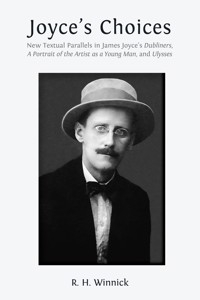
Cover image: James Joyce (1915), photo by Alex Ehrenzweig, https://commons.wikimedia.org/wiki/File:James_Joyce_by_Alex_Ehrenzweig,_1915_cropped.jpg
Cover design: Jeevanjot Kaur Nagpal
For Margot Norris
Table of Contents
About the Author
Preface
I.DUBLINERS
The Sisters
An Encounter
Araby
Eveline
After the Race
Two Gallants
A Little Cloud
Counterparts
A Painful Case
Ivy Day in the Committee Room
A Mother
Grace
The Dead
II.A PORTRAIT OF THE ARTIST
Portrait, Chapter 1
Portrait, Chapter 2
Portrait, Chapter 3
Portrait, Chapter 4
Portrait, Chapter 5
III.ULYSSES
1. ‘Telemachus’
2. ‘Nestor’
3. ‘Proteus’
4. ‘Calypso’
5. ‘Lotus-Eaters’
6. ‘Hades’
7. ‘Aeolus’
8. ‘Lestrygonians’
9. ‘Scylla and Charybdis’
10. ‘Wandering Rocks’
11. ‘Sirens’
12. ‘Cyclops’
13. ‘Nausicaa’
14. ‘Oxen of the Sun’
15. ‘Circe’
16. ‘Eumaeus’
17. ‘Ithaca’
18. ‘Penelope’
Select Bibliography
Index of Antecedent Writers and Works Discussed
About the Author
R. H. Winnick earned his Ph.D. in English and American Literature from Princeton University in 1976, receiving dissertation credit for his co-authorship, as a graduate student, of Robert Frost: The Later Years, 1938–1963 (Holt, Rinehart and Winston, 1977), vol. 3 of the late Lawrance Thompson’s Pulitzer Prize-winning (for vol. 2) ‘official’ Frost biography. He next researched an authorized biography of the American poet, playwright, educator, journalist, and statesman Archibald MacLeish and edited Letters of Archibald MacLeish, 1907 to 1982 (Houghton Mifflin, 1983). Winnick’s third book, Tennyson’s Poems: New Textual Parallels, published in 2019 by Open Book Publishers, documented more than a thousand previously unrecognized, unidentified, or misidentified textual parallels in the work of that poet. He has also published sixteen article-length studies on Chaucer, Sidney, Shakespeare, Melville, Clough, Hardy, and Larkin, appearing in, among other journals, The Chaucer Review, Nineteenth-Century Literature, Literary Imagination, The Hardy Review, and About Larkin.
Preface
Over the past half century, James Joyce’s three most widely read works—Dubliners (1914), A Portrait of the Artist as a Young Man (1916), and Ulysses (1922)—have been the subject of four major book-length studies entirely devoted to annotating one or more of them: Weldon Thornton’s Allusions in ‘Ulysses’: An Annotated List (Chapel Hill: University of North Carolina Press, 1968); Don Gifford’s Joyce Annotated: Notes for ‘Dubliners’ and ‘A Portrait of the Artist as a Young Man’, second edition, revised and enlarged (Berkeley: University of California Press, 1982); Gifford’s (with Robert J. Seidman) Ulysses Annotated: Notes for James Joyce’s ‘Ulysses’, second edition, revised and enlarged (Berkeley: University of California Press, 1988); and, most recently and comprehensively, the nearly fourteen-hundred-page Annotations to James Joyce’s ‘Ulysses’ (Oxford: Oxford University Press, 2022), by Sam Slote, Marc A. Mamigonian, and John Turner (hereinafter, ‘SMT’). One might reasonably suppose, after these four studies plus several extensively annotated editions of the works themselves, not to mention a century of other book- and article-length Joyce scholarship, that little remains to be found and said about the textual parallels—otherwise known as allusions, borrowings, echoes, and the like—that Dubliners, Portrait, and Ulysses contain.1 Further examination of the three works at the level of phrases as short as two or three to as many as several words, however, coupled with a far-ranging search of the printed works that came before, facsimiles of which are now widely available in digitized and searchable form, together reveal a total of more than eight hundred previously unrecognized, unidentified, or (in my view) misidentified textual parallels—including some sixty in Dubliners, some forty in Portrait, and just over seven hundred in Ulysses, all of them matching Joyce’s language verbatim or very nearly so—which singly and together shed new light on Joyce’s reading, thematic intentions, and creative technique.
The main title of this study reflects my belief that the textual parallels to antecedent works found in such abundance in Dubliners, Portrait, and Ulysses,2 far from being accidental and incidental, were largely if not entirely conscious and deliberate, reflecting Joyce’s voracious reading from an early age, at home, in school and college, at the bookshops and bookstalls he patronized and the libraries he frequented in Dublin, Trieste, Zurich, Paris, and elsewhere in Europe;3 his ear for and interest in the Anglo-Irish speech patterns and expressions of his family, friends, acquaintances, and community; his prodigious memory;4 and, no less important, his longtime practice of jotting down on the slips of paper he always carried with him any word, phrase, or passage he came across—in antecedent texts ranging from major and minor works of English, Irish, Scottish, French, German, Italian, Latin, Norwegian, Russian, and other literatures to the poems, plays, popular songs, street ballads, comic operas, triple-deckers, dime novels, penny dreadfuls, print advertisements, and other genres of his own day, as well as in any number of literary anthologies, general encyclopedias, and phrase dictionaries—that he found note-worthy and thought he might find use for in something he was then writing or might someday write.
These slips of paper, which must once have numbered in the tens of thousands,5 were organized over time into subcategories by various criteria, and were subsequently reorganized into successively smaller, more usable groupings.6 As the Joyces traveled from country to country across Europe in search of a safe haven, needed income, and a congenial environment in the years before, during, and after the so-called Great War, many of these noteslips, notesheets, and notebooks were lost or left behind, with only a fraction of the total believed to have survived. But much that he had read, remembered, and recorded found its way into his fiction.
Similarly, what is known of Joyce’s personal libraries in Dublin, Trieste, Zurich, Paris, and elsewhere, which must once have totaled thousands of volumes, has been published in catalogues issued by the libraries owning them (or what remains of them) in those cities or elsewhere.7 But here again, many of the titles Joyce once owned were sold, lost, or left behind,8 as a result of which one of the best available ways to reconstruct his reading—apart from mentions of particular titles in his (again) surviving correspondence, sales receipts, and other documentary material—is from verbatim or nearly verbatim echoes of phrases of various lengths from that reading in his own published works, including (among others) Dubliners, Portrait, and Ulysses.
As for the subtitle of this book, I first employed the term ‘textual parallel’, which had previously occurred from time to time mostly in exegetical and linguistic studies, as an alternative to the more common but less clearly defined ‘allusion’ six years ago at the suggestion of Christopher Ricks, in whose definitive edition of the complete poems of Tennyson I had found more than a thousand previously undocumented instances.9 In the Prefatory Note to his Allusion to the Poets (Oxford: Oxford University Press, 2002), Ricks had earlier written, on pp. 3–4 (italics in the original):
There are distinctions to be philosophized about: borrowings, parallels, sources, echoes, allusions. If you ask a philosopher whether there exists any indispensable account of allusion, he or she has a way of implicating you in implicatures, or of referring you to his or her work on referring—which is not the same as allusion. And although to speak of an allusion is always to predicate a source (and you cannot call into play something of which you have never heard), a source may not be an allusion, for it may not be called into play; it may be scaffolding such as went to the building but does not constitute any part of the building.10 Readers always have to decide—if they accept that such-and-such is indeed a source for certain lines—whether it is also more than a source, being part not only of the making of the poem but of its meaning.And so, in my discussion of Joyce’s prose as in Ricks’s discussion of poetry, while I often have occasion to speak of a phrase in Joyce echoing, or possibly being borrowed from or pointing to, an antecedent work of prose or poetry that may or may not have been its source, I have consistently refrained from declaring unequivocally that any given phrase in Joyce is from, or is an allusion to, a similar or even identical phrase in an antecedent work or that any such antecedent work was necessarily Joyce’s source. Readers of this study are, of course, free to decide for themselves which, if any, of the textual parallels discussed in it may or do constitute allusions on Joyce’s part, and which, if any, of the antecedent texts discussed, even when they match Joyce’s language verbatim (as most of them do) and even when they appear to be the only antecedent to do so, were necessarily his source, but it is always possible that Joyce came up with the phrase out of the blue, or heard it somewhere, or read it in some work which has not yet found its way into searchable and findable form.
I should add that in many instances I have found more than one antecedent text perfectly or all but perfectly matching Joyce’s language. If two or more such antecedent texts have what appear to me to be roughly equal claims to have been the one Joyce had in mind, I note them both or all, in chronological order. I generally ignore, or mention only in passing, antecedent phrases that occur more than three or four times; being so common, any such phrase may have become so familiar that Joyce was as likely to have picked it up at a neighborhood park or pub as in anything he chanced or chose to read.
Beyond his practice of jotting down notes by the thousand to remind himself later of words, phrases, and passages he had found of interest when he first read or heard them, what else has been and can be said about Joyce’s reading habits?
In My Brother’s Keeper: James Joyce’s Early Years (New York: Viking Press, 1958), his brother and confidant Stanislaus Joyce (1884–1955) writes, on p. 79 of the 2003 Da Capo Press edition:
He devoured books, while I was a slow reader. It sometimes surprised me, however, to find both that my brother remembered little or nothing of most of the books he read so voraciously and that at need he could make good use of the one or two things he did remember from his reading. He read quickly, and if the book or author did not appeal to him he forgot them both. If a book did, on the contrary, make some impression on him, he tried to read as many by the same writer as he could lay his hands on.In ‘James Joyce and the Middlebrow’, chap. 8 of New Quotatoes (see note 6 above), Wim Van Mierlo observes on p. 142 (italics in the original):
Although his consumption of belles-lettres may have slowed down somewhat in later life, [Joyce’s] reading habits never substantially changed: he read widely and eclectically. Despite this, I cannot claim to see any specific strategy in his book collecting habits. What is certain is that he did not always acquire books with a view of using them for his writing. Like most of us, he purchased books on impulse simply because they spoke to him in one way or another. […] The writers we encounter in his libraries and notebooks, many of whom enjoyed wide popularity, produced for the most part unchallenging, realistic prose; the sort of writing that can be classed as middlebrow.In ‘A Library of Indistinction’, chap. 1 of the same volume, Daniel Ferrer writes on p. 11 (italics in the original):
It was particularly important for the young Joyce, as a déclassé, to build what [the French sociologist Pierre] Bourdieu calls “cultural capital” as a compensation for the loss of other forms of capital. Erecting a library, a virtual library of distinction, was a way to restore his status or acquire a new one. As (former) bluffers, we can sympathize with Stephen Dedalus (who probably represents Joyce adequately in this respect): “reading two pages apiece of seven books every night” (U 3.136) is a quick and easy way to acquire a vast field of quotable references.Ferrer adds, on p. 14:
Whereas Stephen Dedalus was “Reading two pages apiece of seven books every night” (“I was young”, he tells us [U 3.136–37]), Joyce often read books very superficially, as his notetaking proves: skimming, reading only the bold or the italicized words, or the footnotes.It goes without saying, or should, that—notwithstanding whatever shortcuts he employed to amass the word- and phrase-hoard which provided raw materials for much of his art—Joyce was extraordinarily well read, did have a prodigious memory, knew the Bible (both the King James and Douay-Rheims versions), Shakespeare’s plays, and other canonical and theological works of Western literature backwards and forwards, and had clearly read carefully and thoughtfully, cover to cover, hundreds of other major and minor works of prose, poetry, and drama, among them—as the present study suggests or appears further to confirm—works by (among others) Alcott, Arnold, Austen, Balzac, Baudelaire, Charlotte Brontë, Emily Brontë, Burns, Byron, Carlyle, Cervantes, Conrad, Cowper, Dante, Defoe, Dickens, Dostoevsky, Dryden, George Eliot, Goethe, Goldsmith, Hardy, Hawthorne, Hugo, Ibsen, Samuel Johnson, Ben Jonson, Keats, George Macdonald, Malory, Marlowe, Milton, Schiller, Sir Walter Scott, Shelley, Smollett, Sterne, Stevenson, Swift, Swinburne, Tennyson, Thackeray, Tolstoy, Trollope, Turgenev, Wordsworth, Yeats, Zola—and doubtless those by hundreds of others, canonical and noncanonical, from which he crafted, with consummate artistry, some of the twentieth century’s most masterful, memorable, and original literary works.
Interestingly, notwithstanding that originality—Ulysses and Finnegans Wake are surely among the most imaginative and original novels ever written—Ellmann notes in the 1982 edition of his Joyce biography, p. 661, that Joyce ‘often agreed with [the Italian philosopher Giambattista] Vico [1668–1744] that “imagination is nothing but the working over of what is remembered”’, and that he said to his friend the English painter and writer Frank Budgen (1882–1971), as Budgen himself reports in Myselves When Young (London: Oxford University Press, 1970), p. 187, ‘Imagination is memory’. Hugh Kenner observes, in the revised edition of his seminal study Ulysses (Baltimore: The Johns Hopkins University Press, 1987), p. 50: ‘Joyce writes nothing that is not already written. Like the Homer of Samuel Butler’s imagination he does not like inventing, chiefly because he thinks human beings seldom invent, and the painful scene is unwritten because its silences will have outscreamed its speeches.’ As has been noted by SMT and others, Joyce observed in a letter of 3 January 1931 to his friend the American modernist composer George Antheil (1900–1959) that he was ‘quite content to go down to posterity as a scissors and paste man for that seems to me a harsh but not unjust description.’11 And Ellmann, on p. xv of his Introduction to Stanislaus Joyce’s My Brother’s Keeper (2003 edition), writes: ‘Inspired cribbing was always part of James’s talent; his gift was for transforming material, not for originating it, and Stanislaus was the first of a series of people on whom he leaned for ideas.’ Ellmann then quotes (misquotes, actually) a remark of Joyce’s mentioned on p. 364 of Budgen’s James Joyce and the Making of ‘Ulysses’ and Other Writings (London, 1972): ‘When you get an idea, have you ever noticed what I can make of it?’
On p. xxiii of their Introduction, SMT observe:
In Ulysses, Joyce’s covert citations and borrowings come from a wide variety of sources, from the obscure to the mundane: from Queen Victoria’s published diaries to numerous advertisements to a Hopalong Cassidy novel to a fetish magazine for transvestites. It is not within the scope of the present volume to comprehensively catalogue all of Joyce’s known borrowings, but we hope to provide a wide enough range in order to help illustrate the variety of Joyce’s aesthetics of ‘stolentelling’.12The variety of textual parallels reported and discussed in this study is comparably wide, ranging from a six-word phrase in the story ‘Grace’ in Dubliners, a ‘young man in a cycling suit’, that previously and apparently uniquely occurred (twice) in the first English-language edition of the Russian writer Leo Tolstoy’s (1828–1910) last major novel, Resurrection (London, 1900)—which, as indicated above, Joyce is known to have read—to another six-word phrase in episode 15 (‘Circe’) of Ulysses, ‘little jobs that make mother pleased’, which previously and apparently uniquely occurred in a print advert for the Fluxite Soldering Set. As was the case for SMT in their volume, a comprehensive catalogue of all of Joyce’s previously identified textual parallels in addition to those newly identified here was beyond the scope of my study. My primary objective, as stated above, has been to document as many new textual parallels as I have been able to identify, including both the several hundred whose possible sources have never been adduced and the considerable number of others in which the sources previously adduced seem to me less plausible than those I have since found.
Like Thornton in several respects, I do not discuss difficult, archaic, slang, foreign, or other words, phrases, or passages unless they figure in a specific textual parallel; nor, with the same proviso, do I discuss for their own sake any political, historical, cultural, religious, theological, Theosophical, or other references, or any characters in one or more of the three books in question, whether or not based on real people. I do not trace Stephen’s, Bloom’s, or any other character’s steps in and around Dublin, or seek to demonstrate Joyce’s exacting verisimilitude in his representation of that city. Like Thornton, Gifford, SMT, and other annotators of Joyce’s works, I have little to say about how the textual parallels discussed in this study may bear upon one or another literary theory, past or present, beyond noting that Joyce’s allusive practices, particularly in Ulysses and Finnegans Wake, have often been cited in critical discussions of intertextuality, one of the core concepts of such theory.13 My attention here is entirely focused on textual, not literary, parallels; so, for example, I have nothing to say about the many literary parallels linking Joyce’s Ulysses to Homer’s Odyssey. With few exceptions, I offer no interpretive comments.14 Also with few exceptions, I do not claim to know which textual parallels are allusive, which ones Joyce expected some or many of his readers to recognize, and which ones he crafted for the purpose of stumping most or all of those readers or solely for his own private amusement.
Many of the textual parallels discussed in this study involve antecedent works likely to be deemed noncanonical. To spare readers, to the extent possible, the task of tracking down hard or digitized copies of such relatively minor, rare, and/or hard to find works, I have generally provided longer excerpts from such works than I do for more familiar, more readily available canonical ones.
Since (as discussed above) so many of the noteslips, notesheets, and notebooks Joyce created, and so many of the books and other printed material he once owned, were subsequently sold, lost, or left behind—and since Joyce is believed to have owned and/or read hundreds of books for which there is no documentary record—I do not infer from the absence of such documentary evidence that he could not have owned and/or read any work in which a textual parallel occurs. The textual parallels linking Joyce’s writings to such antecedent texts are, as stated above, themselves in my view a powerful form of documentary evidence. As Michael Groden observes in his UlyssesinFocus:Genetic,Textual,andPersonalViews (Gainesville: University of Florida Press, 2010), p. 127: ‘Many of [Joyce’s] notes for Ulysses point to his reading, and scholars have also determined much of his reading from the published text alone.’
Similarly, I am often inclined to take with a grain of salt claims that a particular surviving noteslip or notesheet definitively establishes the source of a given Joycean phrase, particularly when the content of the noteslip or notesheet bears little or no resemblance to the purported source text—and even more particularly when a Joycean phrase or short passage perfectly or all but perfectly matches a phrase occurring in one or more antecedent works not represented in any surviving noteslip, notesheet, or notebook.
I have not knowingly made, and have deliberately avoided making, use of any Artificial Intelligence or Digital Humanities tools in preparing this study—my principal research tool has been the pre-AI version of Google Advanced Search; my principal online resources: HathiTrust Digital Library and the Internet Archive (at archive.org)—and I have in every instance repeatedly checked facsimile copies of first editions or the earliest available editions wherever applicable, but never including transcriptions, of the antecedent works I cite to ensure the accuracy of all quotations, including the spelling, punctuation, and spacing of all quotations as they originally appeared. Beginning but by no means ending with careful readings and rereadings of Thornton, Gifford, and SMT, as well as of every annotated edition of Dubliners, Portrait, and Ulysses and of every major study discussing textual parallels in Joyce to prior works of song, fiction, poetry, drama, and other genres, I have done my best to ensure that every textual parallel offered as new in this study is indeed new. If any of the new textual parallels discussed herein are found to be, in fact, old, I offer my apologies for any such errors.
After comparing, on p. xxxix of the introductory section mentioned above, the differing approaches of Thornton and Gifford, SMT continue (italics in the original): ‘We have decided to refrain from indicating mistakes in the earlier volumes of annotation because such critical vituperation would ultimately be unhelpful (and probably uninteresting) to our readers. In places where our annotations differ from Gifford and Seidman’s and Thornton’s, it can be assumed that such differences are considered.’
My own approach, in instances where one or more of the antecedents I cite perfectly or more nearly match a phrase in Joyce than does an antecedent previously cited based on a perceived verbal resemblance, a surviving noteslip, or otherwise, I so state in my commentary, not in a spirit of ‘critical vituperation’ but simply for the information and convenience of my readers, by enabling them to more easily compare and consider which of the adduced antecedents is more likely to have been the one Joyce had in mind.
Thornton writes on p. 4 of his Introduction:
In compiling this list [of allusions in Ulysses], I have aimed at completeness in the areas of literature, philosophy, theology, history, the fine arts, and popular and folk music. Inadequately as this aim may be realized, such an attempt is now possible because of the prior work of such scholars as Stuart Gilbert, Joseph Prescott, William Schutte, William York Tindall, M. J. C. Hodgart and Mabel Worthington, and Robert M. Adams. My debt to these and to many others is obvious. The present list, however, is more than a compilation of previously discovered allusions, for it attempts to be complete, and consequently it contains many allusions never listed before as well as some which have been only partially or mistakenly identified by earlier scholars.Six decades after Thornton published those words in the first book-length study of what he called allusions in Ulysses, three years after the publication of the mammoth and enormously valuable volume produced by Slote, Mamigonian, and Turner, and even with the addition of the several hundred new textual parallels reported in this study, it seems clear to me that more, perhaps many more, textual parallels in Joyce’s Dubliners, APortraitoftheArtistasaYoungMan, Ulysses, and no doubt in other of his works, remain to be found. Doing so will require continued study of those works and continuing exploration of the universe of printed works that came before, aided but not supplanted by whatever technological tools and resources are available to scholars of this and future generations.
R. H. Winnick
Princeton, New Jersey
1 Annotated editions of Dubliners include those edited by Terence Brown (1992), John Wyse Jackson and Bernard McGinley (1993), Robert Scholes and A. Walton Litz (1996), Jeri Johnson (2000), and Margot Norris (2006). Annotated editions of A Portrait of the Artist as a Young Man include those edited by Chester G. Anderson (1968), Seamus Deane (1992), Jeri Johnson (2000), John Paul Riquelme (2007), and Marc A. Mamigonian and John Turner (2018). Annotated editions of Ulysses include The Cambridge Centenary ‘Ulysses’: The 1922 Text with Essays and Notes, edited by Catherine Flynn (2022). Further bibliographical details on these and other editions and studies may be found in the Select Bibliography that begins on p. 387.
2 Among the many apposite comments on that abundance: Stuart Gilbert, in James Joyce’s ‘Ulysses’: A Study (London: Faber & Faber, 1930; repr. New York: Knopf, 1952), refers on p. 22 of the latter edition to ‘the thousand and one correspondences and allusions with which the book is studded’; and R. Brandon Kershner, in ‘Dialogical and Intertextual Joyce’, Palgrave Advances in James Joyce Studies, ed. Jean-Michel Rabaté (Basingstoke: Palgrave Macmillan, 2004), 183–202, p. 183, writes: ‘It is arguable that, more than the work of any other major author, Joyce’s writings are permeated by quotations, citations, literary allusions, and other traces of texts and voices.’
3 A voracity suggested by Joyce’s letter dated 28 February 1905 to his brother Stanislaus from Pola, Austria, reading in part (titles italicized, bracketed details and some commas moved or added): ‘I have read the Sorrows of Satan [by Marie Corelli (London, 1895)], A Difficult Matter (Mrs Lovett Cameron) [(London, 1898)], The Sea Wolves (Max Pemberton) [(London, 1894)], Resurrection and Tales (Tolstoy)[the former as translated by Louise Maude (London, 1900); the latter possibly referring to Tales from Tolstoi and/or More Tales from Tolstoi, both as translated by R. Nisbet Bain, both published in London in, respectively, 1901 and 1902], Good Mrs Hypocrite (Rita [Mrs Desmond Humphreys (London, 1899)]), [The] Tragedy of Korosko (Conan Doyle)[(London, 1898)], Visits of Elizabeth (Elinor Glyn) [(London, 1900)], and Ziska[, The Problem of a Wicked Soul, by Marie Corelli (London, 1897)]—all these read, it may be supposed, since his previous surviving letter to Stanislaus dated 7 February 1905. See Letters of James Joyce (New York: The Viking Press, 1966), ed. Richard Ellmann—hereinafter, Letters—vol. 2, pp. 82–83.
4 In his ‘Introduction: Composition, Text, and Editing’ to the Norton Critical Edition of Joyce’s Portrait—a revised excerpt from the ‘Introduction’ to A Portrait of the Artist as a Young Man, ed. by Hans Walter Gabler with Walter Hettche (New York and London: Garland, 1993)—Gabler writes, on p. xix: ‘In Zurich, within neutral Switzerland, he was cut off from all the notes and manuscripts he had left behind in war-embroiled Trieste. Yet from a prodigious memory—a faculty that was essential to Joyce’s writing throughout his life—he reprovided flawlessly words and sentences missing in the Egoist installments [of Portrait]; with great determination, he insisted on an entirely uncensored text for the book publication.’
5 Richard Ellmann writes in his biography James Joyce (New York: Oxford University Press, 1959), p. 558, that Joyce’s friend the American artist Myron Nutting (1890–1972), then living in Paris, ‘was surprised to see Joyce sorting out old notes for Ulysses in February 1923, especially when Joyce announced proudly that the unused notes weighed twelve kilos’—equal to more than 26 pounds.
6 In ‘The Economy of Joyce’s Notetaking’—chap. 9, pp. 163–70, of New Quotatoes: Joycean Exogenesis in the Digital Age, ed. by Ronan Crowley and Dirk Van Hulle (Leiden: Brill Rodopi, 2016), https://doi.org/10.1163/9789004319622—Sam Slote writes, on p. 164: ‘[W]e can see that Joyce’s notetaking progressed through various discrete stages: notes taken directly from his reading would then be selected and copied into other notebooks, where they would be categorised under various headings (either by subject or by episode), and then these might be further re-copied and re-sorted into other notebooks or notesheets before eventually winding up in a draft of the text.’
7 See Tristan Power, ‘Joyce’s Ulysses Library’ in Studies in Bibliography, vol. 60 (2018), 229–250, https://doi.org/10.1353/sib.2018.0005, and especially note 1 on p. 229, which lists the principal repositories of Joyce materials and the publications describing them as of its year of publication. For a book-length discussion of Joyce’s personal library while he lived in Trieste, see Michael Patrick Gillespie, Inverted Volumes Improperly Arranged: James Joyce and His Trieste Library (Ann Arbor: UMI Research Press, 1983). In The Cambridge Companion to ‘Ulysses’, edited by Sean Latham (Cambridge: Cambridge University Press, 2014), https://doi.org/10.1017/cco9781139696425.003, Michael Groden observes in chap. 1, ‘Writing Ulysses’, pp. 4–5: ‘The surviving material covers an extraordinarily wide range. Major collections exist at the British Library, the University at Buffalo, the National Library of Ireland, and Cornell and Yale universities, with smaller collections at Harvard, Princeton, and Southern Illinois universities; the universities of Texas, Tulsa, and Wisconsin-Milwaukee; the Rosenbach Museum and Library; the Huntington Library; the New York Public Library; and University College Dublin.’
8 See Power, ‘Joyce’s Ulysses Library’, p. 229: ‘There is a great amount of evidence for the books read by Joyce from 1914 to 1922 while he was writing Ulysses. […] Six hundred items survive in the Nelly Joyce collection [at the Harry Ransom Humanities Research Center (The University of Texas at Austin)], almost all of which are genuine works belonging to Joyce from his Trieste library. Besides these, ninety further titles have been obtained from the external evidence of Joyce’s shelf inventory and bookstore bills during this period, but estimates of the library suggest that it contained at least another five hundred books, which have left few if any documentary traces that are external to the novel itself.’
9 See R. H. Winnick, Tennyson’sPoems:NewTextualParallels (Open Book Publishers, 2019), available for downloading or accessing online at https://doi.org/10.11647/OBP.0161
10 Ezra Pound, in his ‘Paris Letter’ to The Dial, vol. 72, no. 6 (June 1922), 623–29—rpt. in Literary Essays of Ezra Pound, ed. T. S. Eliot (Norfolk, Conn.: New Directions, 1954), 403–09—employed a similar metaphor in discussing the Homeric framework of Ulysses: ‘These correspondences are part of Joyce’s medievalism and are chiefly his own affair, a scaffold, a means of construction, justified by the result, and justifiable by it only.’ See also A. Walton Litz, The Art of James Joyce: Method and Design in ‘Ulysses’ and ‘Finnegans Wake’ (London: Oxford University Press, 1961), p. 21.
11Letters, I, 297.
12 The final word, a play on ‘storytelling’, occurs in the sentence ‘The last word in stolentelling!’ on p. 424 of the first edition of Finnegans Wake published by Faber and Faber, London, and The Viking Press, New York, 4 May 1939, and on the same page of all subsequent editions based on it.
13 Book-, chapter-, and article-length discussions of intertextuality—a term coined in 1966 by the Bulgarian-French philosopher and literary critic Julia Kristeva (b. 1941) that defined every text as a ‘mosaic of quotations’—include, among many others, Graham Allen, Intertextuality. Third edn (London and New York: Routledge, 2022), https://doi.org/10.4324/9781003223795; Scarlett Baron, The Birth of Intertextuality: The Riddle of Creativity (London and New York: Routledge, 2020), https://doi.org/10.4324/9780203711057; William Irwin, ‘Against Intertextuality’, Philosophy and Literature vol. 28, no. 2 (Oct. 2004), 227–42; R. Brandon Kershner, ‘Intertextuality’, chap. 12 in The Cambridge Companion to ‘Ulysses’, ed. Sean Latham (Cambridge: Cambridge University Press, 2014), 171–83, https://doi.org/10.1017/cco9781139696425.017; and Mary Orr, Intertextuality: Debates and Contexts (Cambridge: Polity, 2003).
14 In this regard, I commend and concur with SMT’s comment on p. xx of their introductory section ‘On the Uses and Disadvantages of Annotations for Ulysses’: ‘Ulysses is a work of art, its annotations are a work of scholarship. And so, by definition, annotations alone will never fully comprehend Joyce’s novel: they are simply an aid for the reader to do so. In annotating, we have tried to follow Fritz Senn’s comment [in his InductiveScrutinies, ed. Christine O’Neill (Dublin: Lilliput, 1995), p. 234] that “[n]otes should enable interpretations, not predispose them”. It is thus not the place of the annotations to offer interpretations of the text, but rather to simply provide information and enable readers to find their own interpretations without predisposing or ordaining them.’
I.
DUBLINERS
The Sisters1
©2025 R.H. Winnick, CC BY-NC 4.0 https://doi.org/10.11647/OBP.0429.01
Dub, Sisters, line 181: solemn and copious
From a passage in which the story’s nameless boy narrator describes the body of the now-coffined Father Flynn, and a sentence in that passage reading ‘There he lay, solemn and copious, vested as for the altar, his large hands loosely retaining a chalice’, the highlighted phrase had previously occurred in Thirty Sermons, on the Life of David, and on the Twenty-Third and Thirty-Second Psalms (Dublin, 1847), by the Rev. C[harles]. M[arlay]. Fleury, preached by the author, he notes in the book’s dedicatory letter, before the congregation of the Molyneux Asylum Chapel, Dublin. The passage containing the phrase occurs in Fleury’s Sermon III, which takes as its text 1 Samuel xvi 19 (‘Wherefore Saul sent messengers unto Jesse, and said, Send me David thy son, which is with the sheep’) and, as its theme, ‘the formal induction of David into the office for which he was selected’. It reads in part, on pp. 28–30:
Here is a volume of wisdom opened to us. We have a double calling––one to future dignity in God’s set time, another to present duty in our earthly state. […] Our wisdom, then, our duty, our religion, is to realise, by sober contemplation, the heaven that awaits us. We have not here to follow the guidance of mere fancy ; we have not here the deceitful rule of passion, to observe which will paint a paradise, according to each man’s peculiar lust. We have the solemn and copious narrative of revelation ; the history of successive periods yet to come ; of gradation above gradation in eternal glory for the saints ; of resurrection joy, millennial glory with Christ, abiding favour with the Father ; of physical happiness, as well as filial consolations ; of a promised land, a better country, a heavenly city, of many mansions.If, as seems at least possible and at most likely, Joyce chose to borrow and reuse Fleury’s phrase in this passage describing the boy-narrator’s encounter with the body of his late friend, he may have done so as an implicit reproach if not condemnation of Flynn for ‘follow[ing] the guidance of mere fancy’, for observing ‘the deceitful rule of passion’, and for allowing his ‘peculiar lust’ for the boy to interfere with his priestly duty to lead him not into a pederastic relationship but to salvation, heaven, and God.
An Encounter
©2025 R.H. Winnick, CC BY-NC 4.0 https://doi.org/10.11647/OBP.0429.02
Dub, Encounter, line 50: one of my consciences
Completed by 18 September 1905, this ninth-composed, second-placed of Dubliners’ fifteen tales revolves around the planned adventure of three schoolboys—the unnamed narrator, Leo Dillon, and ‘a boy named Mahony’—to skip school for a day and make their way east across Dublin toward the Pigeon House Generation Station off Sandymount. Before the appointed day, Dillon—who fails to show up for the adventure and thereby forfeits the sixpence he had paid in advance to participate in it—is scolded by the schoolmaster-priest Father Butler for having hidden in his pocket an issue of a weekly children’s story-paper, The Halfpenny Marvel, featuring a tale Joyce refers to as The Apache Chief.2 The boy narrator later reflects, in lines 48–50 of the story as published in Margot Norris’s Norton Critical Edition (on which all line references in the Dubliners section of this study are based): ‘This rebuke during the sober hours of school paled much of the glory of the wild west for me and the confused puffy face of Leo Dillon awakened one of my consciences.’
The phrase ‘one of my consciences’ seems to have occurred only once before Joyce’s use of it, in ‘The Canon with Two Consciences’, a short story by the English author and editor Edward Howard (1793–1841) published in The New Monthly Magazine (London)3, vol. 55 (Mar. 1839), 366–79. The paragraph in which the phrase occurs, on p. 374, and for context the one immediately preceding it, read:
“ Let the palings be coloured with any hue you like, my children, but the red ochre must be procured ; for such is the wicked degeneracy of this world, that something beside the palings must also be coloured. When you have done this, Scipio, you will repair to the Pope’s vicar at the cathedral town, and take him this letter, which is to request that his holiness will condescend to acquaint me in what manner he would have the wealth disposed that I have collected in the service of the church. “ I have now,” he continued, but abstractedly, as if he were speaking only to himself, “ got well rid of one of my consciences, and the one that remains to me is a good pillow-smoother, and a healthy opiate […].”4
Araby
©2025 R.H. Winnick, CC BY-NC 4.0 https://doi.org/10.11647/OBP.0429.03
Dub, Araby, line 219: driven and derided by vanity
Completed in October 1905, this eleventh-written, third-placed of Dubliners’ fifteen tales ends, at lines 218–20, with the (again) unnamed boy who is its protagonist and narrator bitterly disappointed by the failure of the bazaar—to which he travels alone with very little money and at which he arrives near closing time—to meet his high expectations, and by his own failure to bring back from it a promised souvenir to give to his friend Mangan’s also unnamed sister, for whom he feels the first powerful stirrings of adolescent love. The story’s final paragraph reads in its entirety: ‘Gazing up into the darkness I saw myself as a creature driven and derided by vanity: and my eyes burned with anguish and anger.’
Critical comment on the quoted passage has tended to focus on the boy’s ‘anguish and anger’, with relatively little attention paid to his sense of being ‘driven and derided by vanity’. As to the latter phrase, ‘driven and derided’ seems to have occurred only twice before Joyce’s use of it: first, in a review signed ‘T. P. K.’ of the third edition of Thomas Taylor’s Life of William Cowper, Esq. (London, 1833), published in the Dublin-based Christian Examiner and Church of Ireland Magazine, vol. 3, no. 28 (Feb. 1834), 73–88, the second paragraph of which, condemning Taylor’s all-too-faithful representation of Cowper’s long struggle with mental illness, reads in part:
But his friends and admirers will not have it so ; they are determined that a monument shall be raised to his honour ; they have erected a pillar on his grave, and have sculptured thereon more frightful forms than any that ever barbarous superstition daubed upon the legend of her savage, self-tormenting, and fiend-encountering saints ; sullen and haggard Melancholy ; Madness with eyes out-bursting from his shaven head, with foaming mouth and chained and writhing limbs ; deep-damned Despair and Suicide, driven and derided by torturing demons ; and many monstrous and mysterious things, that the heart sickens to look upon, and the tongue refuses to describe !
and next, in chap. 9 of the triple-decker novel Folle-Farine (London, 1871), by the English author Maria Louise Ramé (1839–1908) as ‘Ouida’, with, in vol. 3 (of 3), 211–12:
The wondrous promise swept her fancy for the moment on the strong current of its imagery, as a river sweeps a leaf. This empire hers ?—hers ?—when all mankind had driven and derided her and shunned her sight and touch, and cursed and flouted her, and barely thought her worthy to be called “ thou dog ! ”
Eveline
©2025 R.H. Winnick, CC BY-NC 4.0 https://doi.org/10.11647/OBP.0429.04
Dub, Eveline, lines 1–2: watching the evening invade the avenue
First published in The Irish Homestead (Dublin) for 10 September 1904, this second-composed, fourth-placed of Dubliners’ tales memorably begins with a striking and much-remarked metaphor: ‘She sat at the window watching the evening invade the avenue.’ Joyce may himself have found the metaphor memorable and striking, for a version of it had previously appeared in the second paragraph of a story by Charles Ollier (1788–1859)—the English publisher (of Keats and Shelley, among others) and author—published in the London edition of Bentley’s Miscellany, vol. 10 (Dec. 1841), 564–75, under the title ‘The Night-Shriek: A Tale for December’. The story begins:
Few aspects of external nature are more impressive than a wintry landscape. In the morning, the sun’s gleam over a wide expanse of unsullied snow, its rays glittering on the rime-loaded branches of trees, which, as the wind stirs them, nod and wave fantastically like plumes of white feathers,—the lustrous icicles that droop from the eaves of barns and sheds,—the congealed and glassy streams,—and the merry sportsman and his dog,—all these give a joyous effect to a country prospect, even when the year is dying of age and cold.
But this cheerful appearance is very brief. Noon has not long passed before the sullen shades of evening invade the landscape : the sun, like a meagre ghost, fades away in a pale and vapoury gloom, leaving to the world nothing but the blank, dark, and dumb night.After the Race
©2025 R.H. Winnick, CC BY-NC 4.0 https://doi.org/10.11647/OBP.0429.05
This third-composed, fifth-placed of Dubliners’ tales, first published in the 17 December 1904 issue of The Irish Homestead, begins with a paragraph describing the reaction of ‘clumps’—scornfully pejorative word—of onlookers as a succession of motorcars returning from a multinational competition in Bally Shannon, Ireland (based on an actual race which took place there on 2 July 1903), speed past them on their way back to Dublin:
The cars came scudding in towards Dublin, running evenly like pellets in the groove of the Naas Road. At the crest of the hill at Inchicore sightseers had gathered in clumps to watch the cars careering homeward and through this channel of poverty and inaction the continent sped its wealth and industry. Now and again the clumps of people raised the cheer of the gratefully oppressed.
As discussed below, two of the paragraph’s phrases—‘poverty and inaction’ and ‘gratefully oppressed’—occur verbatim in previously published works.
Dub, Race, lines 4–5: poverty and inaction
Joyce could have encountered this phrase in any of several antecedent works, the earliest of which may have been the book-length entry on the history of Scotland in the 1796 and subsequent editions of the EncyclopædiaBritannica. In vol. 17 of Moore’s Dublin Edition of the Encyclopædia (Dublin, 1796), a section discussing the so-called Ridolphi plot of 1571–72—a failed Catholic conspiracy to overthrow Queen Elizabeth I and replace her with Mary, Queen of Scots—reads in part, on p. 81:
Ridolphi, whose ability was inspirited by motives of religion and interest, exerted all his eloquence and address to engage the duke [of Norfolk] to put himself at the head of a rebellion against his sovereign. He represented to him, that there could not be a season more proper than the present for atchieving the overthrow of Elizabeth. Many persons who had enjoyed authority and credit under her predecessor were much disgusted ; the Roman Catholics were numerous and incensed ; the younger sons of the gentry were languishing in poverty and inaction in every quarter of the kingdom ; and there were multitudes disposed to insurrection from restlessness, the love of change, and the ardour of enterprise.
One of the many subsequent instances of the same phrase occurs in the English historian John Richard Green’s (1837–1883) A Short History of the English People (London, 1874), where chap. 7 (‘The Reformation’), section 5 (‘The England of Elizabeth’), reads in part, on p. 386:
But in the reign of Elizabeth the poverty and inaction to which the North had been doomed since the fall of the Roman rule begins at last to be broken. We see the first signs of the coming revolution which has transferred English manufactures and English wealth to the north of the Mersey and the Humber, in the mention which now meets us of the friezes of Manchester, the coverlets of York, and the dependence of Halifax on its cloth-trade.Dub, Race, lines 6–7: the cheer of the gratefully oppressed
Commenting on this phrase, Jackson and McGinley, on p. 35 of their edition of Dubliners, note that ‘This sardonic detail recalls that when Queen Alexandra visited Dublin with Edward VII in 1904, she observed of the crowds that “the poorer they are the more they cheer”.’5 Perhaps so, but it appears that the only pre-Dubliners instance of ‘gratefully oppressed’ is the one found in the anonymous essay ‘Social Prayer’ published in The Christian Witness and Church Members’ Magazine (London), a Protestant (Congregational) journal, vol. 18 (1861), 150–52, with, on p. 151:
In all ages and countries the outpouring of the Holy Spirit has been accompanied with special regard to the ordinance of social prayer. The effect of such outpouring has everywhere been the establishment of prayer meetings. Whether in the regions of Paganism or of Popery, whether among Episcopalian or Presbyterian Protestants, the result has been uniformly the same—a result requiring neither law, nor precept, nor persuasion, to bring it about, and which nothing could delay or prevent. This fact is admirably exemplified in the history of Methodism, both in Britain and America. The Spirit of God has ever been a Spirit of prayer in the souls of men ; and, when largely imparted, always a Spirit of social as well as private prayer. When men are baptized with the Holy Ghost, they are drawn together by a power which they cannot resist, and gratefully oppressed by a feeling of gracious emotion which seeks relief in the exercise of social supplication.
Dub, Race, line 96: the machinery of human nerves
In lines 95–97 of this tale the narrator writes: ‘The journey laid a magical finger on the genuine pulse of life and gallantly the machinery of human nerves strove to answer the bounding courses of the swift blue animal’—that is, of Ségouin’s motorcar. Coincidentally or not, ‘the machinery of human nerves’ had previously and apparently uniquely occurred pre-Joyce in chap. 21, p. 206, of Mr. Salt: A Novel, by the American financial journalist and author Will Payne (1865–1954), published in Boston and New York in October 1903 (though the date on the title page was 1904), just over a year before Joyce’s story was itself first published:
Esther had seen two or three of these periods of stress in the office, when the machinery of human nerves, driven by the president’s ruthless will, quivered and strained to the breaking point. She understood it was no time for her little affair.
Two Gallants
©2025 R.H. Winnick, CC BY-NC 4.0 https://doi.org/10.11647/OBP.0429.13
Dub, Gallants, line 19: cunning enjoyment
Written in the winter of 1905–06, sixth-placed in the volume, this tale of the womanizer Corley (whose name, the narrator indicates, was locally pronounced ‘Whorely’) and his friend the leech Lenehan contains, in its second paragraph, a sentence that includes the highlighted phrase: ‘[Lenehan’s] eyes, twinkling with cunning enjoyment, glanced at every moment towards his companion’s face.’ The first of what appear to be two pre-Joyce instances of the phrase occurs in the novel Speculation (London, 1834) by the English poet, novelist, historian, and travel writer Julia Pardoe (1806–1862), vol. 1 (of 3), chap. 15, whose first paragraph, on pp. 262–63, reads in part:
Two or three individuals whom they passed, looked towards the young barrister with a low smile of cunning enjoyment, as though they comprehended his employment, and felt no disposition to interfere with it ; and even while Harcourt loathed the look of vulgar understanding which they cast on him, he nevertheless felt more assured in his impertinence.The phrase recurs in the popular and prolific Scottish novelist Mrs Margaret Oliphant’s (1828–1897) YoungMusgrave (London, 1877),6 vol. 1 (of 3), chap. 23 (‘Mary’), where a passage on p. 33 finds Mary Musgrave, the unmarried forty-year-old daughter of Squire Musgrave and manager of his estate, thinking about the country parson, Mr. Pennithorne, whose love for her is as mild and hopeless as the man himself:
Her own existence had no exciting source of joy in it, but how far it was from being unhappy ! Had she been unhappy she would have scoffed at herself. What ! so many things to enjoy, so many good and pleasant circumstances around, and not happy ! Would not that have been a disgrace to any woman ? So she was apt to think Mr. Pennithorne extracted a certain cunning enjoyment from that vain love for herself which had been so visionary at all times, and which he persuaded himself had saddened his life.Dub, Gallants, lines 328–29: pangs and thrills
At lines 326–29 of the story, Lenehan is waiting pensively to see if Corley has succeeded in getting an unnamed slavey whom he has apparently seduced to steal a gold coin—perhaps on Lenehan’s behalf—from her elderly and well-to-do employer: ‘His mind became active again. He wondered had Corley managed it successfully. He wondered if he had asked her yet or if he would leave it to the last. He suffered all the pangs and thrills of his friend’s situation as well as those of his own.’
The phrase ‘pangs and thrills’ seems to have occurred only twice before Joyce’s use of it: first in the tale entitled ‘Dumb Friends’ from the English children’s author Frances Freeling Broderip’s (1830–1878) story collection Way-side Fancies (London, 1857), with, on p. 189:
And then the little cot, where the round rosy face lay at night, when you made your usual pilgrimage to it. The coverlet thrown half off, and showing the round, mottled, healthy limbs of the little sleeper. And, oh ! if that white nest was afterwards exchanged for a deeper and colder one, beneath the green sod of the churchyard, by its little tenant, with what pangs and thrills of memory did you afterwards look on it, and yet love it too well to part with it.
and next in the English journalist, author, and publisher’s reader S[tephen]. W[atson]. Fullom’s (1818–1872) The Mystery of the Soul: A Search into Man’s Origin, Nature, and Destiny (London, 1865), chap. 7 of which (‘Of Man’s Sensations, Emotions, Qualities, and Passions, Exhibiting the Distinctness of the Body and Mind, and the Nature of Their Association’) has, on p. 136, a paragraph containing same phrase:
The first quality of life is sensation. It is as necessary to brutes as to man, to the beetle as the giant, and impresses all organisms in a greater or less degree, the higher having a full measure, and the lowest barely a touch. It forms the backbone of Man, his frame’s pillar, and spreads conductors through its every part ; whence the operation is so thorough that the whole system may be convulsed by a sound. Indeed, the same effect may be produced by a thought ; for the thread of our sensations is as the web of a spider, and “ feels along the line ”—feels with a delicacy reached in no other being, either in pain or pleasure. Nor could we expect less ; for our pangs and thrills are more than bodily : they penetrate to the mind.
A Little Cloud
©2025 R.H. Winnick, CC BY-NC 4.0 https://doi.org/10.11647/OBP.0429.14
Dub, Cloud, line 21: a shabby and necessitous guise
In lines 20–22 of this fourteenth-composed, eighth-placed tale, which Joyce wrote in Trieste in the first half of 1906, the law clerk known as Little Chandler awaits the arrival from London of the newspaperman Ignatius Gallaher (another self-proclaimed womanizer), whom he has not seen in eight years: ‘The friend whom he had known under a shabby and necessitous guise had become a brilliant figure on the London press.’
The first of what seem to be the only two pre-Joyce instances of ‘shabby and necessitous’ occurred in the Scottish writer, colonial entrepreneur, and political and social commentator John Galt’s (1779–1839) novel The Majolo: A Tale (London, 1816), vol. 2 (of 2), chap. 5, p. 39:
“ The interior squalor of the town was suitable to its physiognomy. A promiscuous multitude of the meanest and ugliest of the human race sweltered in the streets. The military had a shabby and necessitous look ; the reverse of every thing I had heard of English soldiers ; who, whatever was subtracted from their military qualities, were generally supposed to resemble the pampered Prætorians of the Romans more than any other troops in modern Europe.[”]
and the second, in the penny dreadful Boys of the World Story-Teller (London), vol. 1, no. 11 (1 Dec. 1869), in which chap. 2 (‘The Fence’s Crib’) of the anonymous tale ‘The Coiner’s Fate’ has, on p. 50, the following passage:
Within, however, a quarter of an hour after the departure of her husband, Mrs. Sugden, disguised in very shabby and necessitous-looking clothes, hurriedly left the Camberwell villa by the garden-gate, and hurrying to the nearest cab-stand, entered a four-wheeler, and whispering her instructions to the driver, was driven rapidly away.
Joyce’s ‘guise’, which follows ‘shabby and necessitous’ in his tale’s quoted phrase, may have been suggested by ‘disguised’ in the passage above from ‘The Coiner’s Fate’.
Dub, Cloud, lines 52–53: a present joy
In lines 48–53, having walked past ‘[a] horde of grimy children’ (lines 45–46) on his way to meet Gallaher, Little Chandler, Joyce writes, ‘gave them no thought. He picked his way deftly through all that minute verminlike life and under the shadow of the gaunt spectral mansions in which the old nobility of Dublin had roistered. No memory of the past touched him, for his mind was full of a present joy.’
For the phrase ‘memory of the past’ Gifford and others cite the song ‘There Is a Flower That Bloometh’ from Act 3 of the opera Maritana (1845), libretto by the English playwright Edward Fitzball (1793–1873) and music by the Irish composer and pianist William Vincent Wallace (1812–1865). Neither Gifford nor anyone else seems to have noted, however, that the phrase ‘a present joy’ in the same passage had also occurred previously, most often in evangelical works, but also including in the English poet William Wordsworth’s (1770–1850) The Prelude; Or, Growth of a Poet’s Mind, reading, in Book First (‘Introduction: Childhood and School-time’), lines 46–50 of the 1850 version:
Thus far, O Friend ! did I, not used to make
A present joy the matter of a song,
Pour forth that day my soul in measured strains
That would not be forgotten, and are here
Recorded[.]
and in the English novelist and poet Mary Ann Evans’s (1819–1880), as ‘George Eliot’, novella The Lifted Veil, first published anonymously in Blackwood’s Edinburgh Magazine, vol. 86, no. 525 (July 1859), 24–48, republished two decades later in The Works of George Eliot: Silas Marner, The Lifted Veil, Brother Jacob (Edinburgh and London, 1878), and containing the following paragraph spoken by the clairvoyant Latimer at the beginning of chap. 2 on p. 310 of the latter version:
Before the autumn was at an end, and while the brown leaves still stood thick on the beeches in our park, my brother and Bertha were engaged to each other, and it was understood that their marriage was to take place early in the next spring. In spite of the certainty I had felt from that moment on the bridge at Prague, that Bertha would one day be my wife, my constitutional timidity and distrust had continued to benumb me, and the words in which I had sometimes premeditated a confession of my love, had died away unuttered. The same conflict had gone on within me as before—the longing for an assurance of love from Bertha’s lips, the dread lest a word of contempt and denial should fall upon me like a corrosive acid. What was the conviction of a distant necessity to me ? l trembled under a present glance, I hungered after a present joy, I was clogged and chilled by a present fear. And so the days passed on : I witnessed Bertha’s engagement and heard her marriage discussed as if I were under a conscious nightmare—knowing it was a dream that would vanish, but feeling stifled under the grasp of hard-clutching fingers.The phrase ‘present joy’ minus the indefinite article also previously occurred in a poem by Queen Elizabeth I (1533–1603), written sometime between 1568 and 1571, that begins ‘The doubt of future foes exiles my present joy’; in the elegy on Queen Elizabeth entitled ‘Our Present Sorrow, and Our Present Joy’ (1603) by Robert Fletcher (fl. 1603), the English ‘Yeoman purveyor of carriages’ to Queen Elizabeth and later to James VI and I, and author of The Nine English Worthies; or Famous and Worthy Princes of England (London, 1606); and in the Scottish poet Robert Pollok’s (1798–1827) The Course of Time: A Poem, in Ten Books (London, 1827), book 1, line 464: ‘Sorrows remembered sweeten present joy.’
Dub, Cloud, line 70: low fugitive laughter
In lines 67–71, still making his way toward Corless’s and his rendezvous there with Gallaher, Little Chandler, the narrator reports, ‘chose the darkest and narrowest streets and, as he walked boldly forward, the silence that was spread about his footsteps troubled him, the wandering silent figures troubled him, and at times a sound of low fugitive laughter made him tremble like a leaf.’ The phrase ‘low fugitive laughter’ in that passage may have been suggested by the English writer and essayist Thomas De Quincey’s (1785–1859) Suspiria de Profundis, a collection of short essays, first published in Blackwood’s in the spring and summer of 1845 and later that year in book form, as a sequel to his Confessions of an English Opium-Eater, which had first been published anonymously in the September and October 1821 issues of The London Magazine before its publication in book form (London, 1822). The paragraph in which the phrase occurs, in the section of the Suspiria called (in the Blackwood’s version) “The Palimpsest of the Human Brain,” reads on pp. 741–42 of the June 1845 issue of Blackwood’s (with its how, its why, and its had italicized in the original):
Fancy not, reader, that this tumult of images, illustrative or allusive, moves under any impulse or purpose of mirth. It is but the coruscation of a restless understanding, often made ten times more so by irritation of the nerves, such as you will first learn to comprehend (its how and its why) some stage or two ahead. The image, the memorial, the record, which for me is derived from a palimpsest, as to one great fact in our human being, and which immediately I will show you, is but too repellent of laughter ; or, even if laughter had




