


7,00 €
Mehr erfahren.
- Herausgeber: Amsterdam Publishers
- Kategorie: Geisteswissenschaft
- Serie: Secrets of van Gogh
- Sprache: Englisch
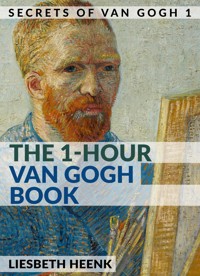
An excellent introduction to Van Gogh's fascinating Life and Work
Everyone is familiar with paintings such as "The Sunflowers” and “Starry Night” by Vincent van Gogh. The intense vibrant colours and wavy brushworks will almost tell you immediately that the work is by the master. But what do you actually know about his life filled with hardships and sorrow?
This book is a smooth introduction to the life and work of Van Gogh, written by an expert who draws from the vast number of letters written by the artist himself to his brother Theo, family and friends, to illustrate how he bravely faced life, art and mental illness.
If you are an art lover and want to gain a greater appreciation for one of the most fascinating artists of all time, this book is recommended. By investing only one hour of your time you will gain a whole new perspective on Van Gogh's life and work.
A very accessible introduction to understanding the art of Vincent Van Gogh.
Das E-Book können Sie in Legimi-Apps oder einer beliebigen App lesen, die das folgende Format unterstützen:
Seitenzahl: 66
Veröffentlichungsjahr: 2019
Ähnliche



















THE 1-HOUR VAN GOGH BOOK
COMPLETE VAN GOGH BIOGRAPHY FOR BEGINNERS
LIESBETH HEENK
Author: Liesbeth Heenk
Publisher: Art Publications, The Netherlands
ISBN 9789492371362 (paperback)
ISBN 9789492371355 (ebook)
Copyright © Liesbeth Heenk. All rights reserved. No part of this publication may be reproduced without the prior written permission of the author.
CONTENTS
Tragedy and Success
The black sheep of the family
A touching kind of toiling
The Hague: on the road to success?
Large, shaggy dog with wet paws
The right time and the right place?
High times and low times in Arles
The asylum in Saint-Rémy
The end in Auvers
No modern art without Van Gogh
When did Van Gogh become famous?
The letters: world literature
About the author
Further reading
TRAGEDY AND SUCCESS
Vincent van Gogh has gained worldwide recognition as an artist, his work sells for millions and Van Gogh paintings rank amongst the best and most powerful ever made. During only ten years time he managed to produce over 800 paintings and about a thousand drawings. Despite this large oeuvre, produced under difficult conditions, he only sold one painting and some drawings. The fact that his life was such a tragedy is stressed even more by the success of his work.
In 1890, the year he died, Van Gogh was on the brink of a breakthrough as an artist. Yet, he felt depressed by the fact that he had still hardly sold anything. His brother Theo was happily married and focused more on his wife and new born son. In addition, Van Gogh felt that his livelihood was at risk because of troubles at the Paris art firm of Goupil where Theo worked as a manager. And he feared that his illness would come back and would eventually prevent him from working at all. In a fit of desperation he took his life.
Van Gogh was denied the pride and satisfaction of selling his work, and noticing that his art really meant something to people. For this is what he really cared for: to make a valuable contribution to society by producing work that would offer consolation. Van Gogh felt that he had to 'earn' the life he was given and sacrificed his life to accomplish his mission.
As soon as Van Gogh had decided to be an artist, he pursued his goals passionately and without compromise. His decision was unconditional, accepting the implication of social isolation. Had he not chosen to become an artist, he might have turned into a lonely and dejected person anyway due to his inability to conform to social conventions.
He was an unsociable, stubborn man - tough on others, but also on himself. According to his younger brother Theo:
"There's something in the way he talks that makes people either love him or hate him [...] because he spares nothing or no one."
He was also a sensitive and difficult person with little patience for people who did not see things the way he did. While Van Gogh was a great writer, he was inept at expressing himself verbally. And above all, a lonely soul, someone who desperately longed for friendship. He would only ever find this with his brother Theo, but even that relationship was an uneasy one at times.
Van Gogh's mental breakdowns have often been regarded as the consequence of his artistic brilliance, conforming to the image we have of the artist as a mad genius. However, his illness appears to have been a form of epilepsy, unrelated to having artistic capabilities. Rather than benefiting from his 'madness', it hindered him in producing art. When he had a seizure he could not work at all. Perhaps being ill stimulated him to work as hard as possible, fearing he would not be granted much time.
Vincent van Gogh, Selfportrait with straw hat, oil on canvas, Paris, July-August 1887 © Van Gogh Museum Amsterdam (Vincent van Gogh Foundation)
THE BLACK SHEEP OF THE FAMILY
Van Gogh chose to become an artist after exploring various other options. In 1880, having failed as an apprentice in the art firm established by his uncle, but also as a teacher, evangelist and as a bookseller, Van Gogh, at the age of 27, finally found his true vocation.
His parents had almost given up hope that their eldest son would lead an acceptable middle-class life, but when Theo suggested to his brother to become an artist, or rather, to become a draughtsman, Van Gogh was enthusiastic and committed to turning it into a success:
“I will fight my battle, and sell my life dearly, and try to win.”
For the first three years, he concentrated on making drawings, relying heavily on teaching manuals, after which he also started to paint. He didn't just draw, but he practised almost incessantly, driven by a fanatical fervor, as if he was making up for lost time.
Van Gogh was fully aware that his path was a difficult one, for he lacked talent! Where others were able to draw as if it was a second nature, he struggled, being anything but a genius or a born artist.
Daughter of Jacob Meyer (after Bargue), pencil and ink on paper, Etten, July 1881 © Kröller-Müller Museum, Otterlo
Despite some art classes he took in Belgium, and later in The Hague and Paris, he would largely remain a self-taught artist, blossoming late and working tenaciously to achieve a certain quality.
In nine out of ten cases, proportions are wrong in his early drawings, which are wooden and artificial. At first, his watercolors were equally unexciting - the paint surface is muddy and thick. Interestingly, he would later regard his inability to make anatomically correct drawings and paintings as deliberate attempts to create something that was more true than recreating reality. Van Gogh took his time - and, looking at his work, he indeed needed that time - to get rid of a host of technical obstacles before he was able to create ‘Art’.
Vincent van Gogh, Digger, charcoal, chalk and watercolor on paper, Etten, October 1881 © Van Gogh Museum Amsterdam (Vincent van Gogh Foundation)
But perhaps this is one of the aspects that is so touching - he was a hard worker determined to achieve what he wanted, whatever the cost. Not everyone is able to immediately paint at the high level of Rembrandt or Michelangelo when starting out as an artist. Some people have more of a natural aptitude than others. On the other hand, the intensity of the work eventually created is a wholly different thing. Works of art by technically extremely able artists are not necessarily moving. Van Gogh's art, no matter how 'incorrect' it may be, always manages to strike a chord.
A TOUCHING KIND OF TOILING
Van Gogh took the decision to become an artist when he was working as an evangelist in the poor mining district of The Borinage in Belgium. He copied prints from drawing manuals and tried to master the technique of drawing. At the end of April 1881, he returned to his parental home, the vicarage in Etten, a village in Brabant, the Netherlands, where he worked from a room in the annexe. There he made dozens of drawings of figures and of the rural Brabant landscape, which he all regarded as exercises.
Drawing he rightly considered to be the backbone of all art. Later on, he would feel secure enough to start working with watercolor and oil paint. Although the drawings are stiff, awkward and clumsy in proportion and show his struggles to get volume into the bodies, and to render the perspective correctly, they already reveal an attempt at uncovering the essence of a subject.




