


3,49 €
Mehr erfahren.
- Herausgeber: Neil Sharp
- Kategorie: Fachliteratur
- Sprache: Englisch
Do you want to live the ultimate life of freedom, flexibility, and endless amounts of income? If so then keep reading…
Do you have problems getting started with day trading or stock investing? Not knowing how to reduce your risks when investing? Choosing the best stocks to trade? Or even selecting the best time to trade? If you do, within this book many of the
top leaders in the field have shared their knowledge on how to overcome these problems and more, most of which have
10+ years worth of experience.
In The Advanced Stock Market and Day Trading Guide, you will discover:
- A simple trick you can do to find the most profitable stocks to trade and invest in!
- The best day trading strategies for making the most money in the shortest amount of time!
- The one method you should follow for becoming a successful trader and investor!
- Why selecting the best time to trade and invest can help you double the amount you make in a day!
- Understanding why some people will lose money investing in the stock market!
- And much, much more.
The proven methods and pieces of knowledge are so easy to follow. Even if you’ve never tried stock trading and investing before, you will still be able to get to a high level of success.
So, if you don’t just want to transform your bank account but instead revolutionize your life, then click “ Buy Now” in the top right corner NOW!
Das E-Book können Sie in Legimi-Apps oder einer beliebigen App lesen, die das folgende Format unterstützen:
Veröffentlichungsjahr: 2020
Ähnliche













Neil Sharp
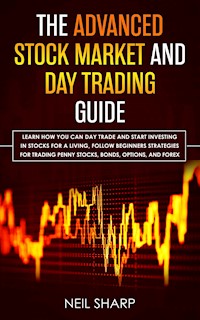
The Advanced Stock Market and Day Trading Guide
Table of contents
The Advanced Stock Market Investing Guide
Introduction
Chapter 1: The Importance of Investing
Chapter 2: Stock Market Fundamentals
Chapter 3: Investment Vehicles
Chapter 4: Day Trading
Chapter 5: The Language of Investing
Chapter 6: Starting from Scratch: How to Grow Like the Pros
Chapter 7: Governance
Chapter 8: How to Win the Stock Market Game
Chapter 9: Advanced Trading Strategies
Conclusion
The Advanced Day Trading Guide
The Advanced Stock Market Investing Guide
Follow This Step by Step Beginners Trading Guide for Learning How to Trade Penny Stocks, Bonds, Options, Forex, and Shares; to Become a Stock Trader Today!
By Neil Sharp
Introduction
Congratulations on purchasing “The Advanced Stock Market Investing Guide : Follow This Step by Step Beginners Trading Guide for Learning How to Trade Penny Stocks, Bonds, Options, Forex, and Shares; to Become a Stock Trader Today!” Great care was taken in ensuring that the information contained herein is not only useful but relevant.
The following pages contain a trove of actionable information and advice which the average individual can put into practice in order to become a stock trader. Since this is a rather extensive topic, the contents of each chapter have been boiled down to their essence. This means that there is no fluff; just the good stuff.
Also, great care has been taken to ensure that the concepts described throughout this book are explained in a clear, plain language that is devoid of complicated business jargon. As such, this book isn’t about sounding smart – it’s about actually being smart!
I am sure that you have chosen this book because you are interested in finding out how you can make more money than you are today. And there is nothing wrong with that! In fact, I commend your desire to earn a better living and provide a higher quality of life for your loved ones.
The main objective of this book is to provide you with a guide filled with relevant information that will allow you to become a stock trader and actually make money.
If you are looking for practice examples of how financial markets work, then you have come to the right place.
Each chapter covers one fundamental area of stock trading.
First, we will take a close look at the importance of investing and how you can make money in financial markets by choosing your investments wisely.
Then, we will have an in-depth discussion of the different investment vehicles available to you. This means that you will learn about how these investments work, the pitfalls that come with them, and how you can make money.
Next, we will look into day trading. This is a key chapter since it will enable you to get a good sense of what it takes to become a stock trader. Through analysis and insight, you will be able to make up your mind and decide if day trading is for you.
If you feel that day trading isn’t your thing, there are also two chapters based on investment strategies that you can implement without actually getting your hands dirty. These strategies are meant to put your money to work without taking up too much of your time.
Also, we will discuss how legislation and taxes can play a role in your investment strategy. In particular, we will have an in-depth discussion on how reckless investment practices led to the financial crisis of 2008.
Finally, we will go over the lives of some of the most famous investor in history. The stories of these individuals are meant to inspire you, but also provide you with role models that you can emulate. These are not flamboyant traders like those seen in Hollywood movies. These are ordinary folks that made it big through hard work and savvy investment.
So, what are you waiting for?
Let’s jump right in and learn how to become a stock trader today!
Chapter 1: The Importance of Investing
“ Money doesn’t grow on trees.”
Have you ever heard that expression? I’m sure you have.
And, it’s true.
Nevertheless, money does grow, just in a different sense.
Most folks obtain money through their jobs. When a person gets a job, they are compensated for the work they do. Whatever the work that is done, the person receives a sum of money in exchange.
That money is then used to acquire the goods and services needed in order to live. Some folks manage to save some of their earnings at the end of the month, some break even, and some are in a hole.
This cycle of working for money ties the earnings of an individual to their work. So, the more they work, the more they earn at least in theory.
Some folks choose to go through life working, paying their taxes and perhaps collecting a pension at the end of their career.
Other folks choose to blow all their money and end up poor at the end of their productive lives.
Other folks choose to invest part of their money.
In economic terms, investing is the result of saving. When a person saves money, that surplus amount of money is eligible for investment since the person doesn’t actually need to spend. If they did, then they wouldn’t have saved it.
Unless an individual chooses to dig a hole in the ground and bury their savings, money tends to find its way to investors.
One simple example of this is leaving money in the bank.
The money that is deposited into a bank account will make its way to investors through what is called “fractional reserve lending.”
This concept indicates that the money that is deposited by customers into a bank is eligible to be loaned out to other customers. So, when a customer comes to the bank and asks for a loan, the bank can loan out the money deposited by the other customers.
By law, banks are required to keep a fraction of that money in the vault for customers who want to make a withdrawal. Hence, fractional reserve lending means that banks must keep a small part of their customers’ deposits and may loan out the rest.
This is a simple example of how savings translate into investment.
On the whole, investment is needed to drive a country’s economy. Under a capitalist system, the more money circulates, the more good and services change hands. In addition, the more money that ends up in people’s pockets.
That’s why burying your savings in the backyard will kill any economic momentum.
As an individual, investing represents an opportunity to make money grow literally.
The most commonly known type of investment is a bank account.
Bank accounts will pay an amount of money called “interest” calculated on how much money a customer has deposited in that bank.
Other common types of investments are 401(k)’s or even businesses. These investments use money to make more money.
A 401(k) is essentially a bank account in which an employee contributes money to it every month. The financial institution that secures the 401(k) will take that money and invest it in other ventures. The money that financial institution makes is what is used to pay off the interest accrued by that 401(k).
If an individual chooses to invest in a business, the profits earned from that business will also make money grow.
Over time, money invested may generate enough income to a point where it can fund a person’s lifestyle. This is the main purpose of saving up for retirement. You may also hear about those individuals who have “retired early.”
In essence, retiring means that you no longer have to work in order to finance your lifestyle. And this can be done through investing.
Now, that takes us into what is known as the stock market.
The stock market, or financial markets for that matter, enable individual investors to take their money and put it to work. The series of financial instruments and vehicles available to investors allows them to earn money from placing their surplus earnings in the hands of individuals who will make use of that money.
By investing in the stock market, investors are not looking to pursue business opportunities that imply the production of goods and services. These are speculative activities that are based on “paper assets.” In other words, there are no tangible objects at play. Rather, the investments made are in buying and selling assets which will produce a yield.
This yield is basically the profits made on investments in financial markets.
For those individuals who seek to secure their future, grow their net worth or achieve the lifestyle they have always dreamed about, then investing in financial markets is a plausible way of achieving this.
However, investing in financial markets is no easy task for those who don’t know what they are doing. For those who do, they are able to navigate the waters of the system and use it to their advantage.
Of course, becoming an expert at trading in financial markets takes some time and training. But with the right coaching and information, becoming an expert is a lot easier than you might think. The important thing is to have the willingness to put in the time and effort it takes to learn.
The benefits of investing outweigh the risks by far as long as you know what you are doing. This is why investing in the stock market is not recommended for individuals who do not have the know-how and are not willing to seek qualified financial advice.
But by reading this guide, you will be able to take your own investment strategy and maximize your chances at making it.
Will you be the next Wall Street millionaire?
Maybe!
And I use the word “maybe” because it’s up to you to make the right choices based on accurate information, a strong “gut” and common sense.
In the next chapter, we will take a closer look at how financial markets work.
Chapter 2: Stock Market Fundamentals
The words “stock market” are two of the most magical words in the English language.
To some, the stock market has been a source of great wealth and opportunity. To others, these words have meant headaches and stress.
The fact of the matter is that much of the stress and anxiety that comes from investing in the stock market comes from a lack of understanding into its nature. Often, you will hear much information and advice regarding the stocks and other financial assets. However, the so-called experts and pundits on television do little to actually explain the fundamentals of investing.
Investing in financial markets does not have to become stressful, even if it may be painful at times. With the right understanding of how financial markets work, you can begin to invest wisely and successfully. That is why it is necessary to lay some groundwork.
In this chapter, we will cover the basics and fundamentals of financial markets. We will take a deep look into definitions of the most important concepts pertaining to investing in financial markets. Moreover, the information contained herein should be considered as a guide, a road map if you will, on how to navigate through the various investment vehicles and instruments available to the average investor.
It is important to note that this chapter is not so much about providing financial advice on what the best investment vehicles are, but rather, it is about having a holistic approach on the various types of financial assets at the disposal of the average investor.
Also, it is worth noting that the term “average investor” refers to a regular individual who is looking to put some of the hard-earned cash into equities, bonds or any other assets. We are not considering the large, institutional investors, such as investment banks of hedge funds, as they play under different rules and circumstances.
As such, the average investor is someone who is looking to take advantage of the opportunities the market affords and multiply their savings into a greater amount that can serve as income down the road. Furthermore, large, institutional investors dabble in derivates markets. This is something that we will refer to throughout this book, but we will not be touching upon in too much detail as we are focused on getting you off the ground.
So, buckle up. This chapter is filled with concepts, definitions, and above all, actionable information which will surely open your eyes into the realm of possibilities available in the stock market. Most importantly, you will be able to form your own, informed opinion about what is available to you as an average investor. That way, you can begin planning your investment strategy right off the bat!
Definition of financial markets
The stock market, or equities market, is one of several different markets that make up a greater sum known as “financial markets.”
In essence, financial markets are a place (either physical or virtual) where lenders, investors, borrowers, and buyers come together to buy and sell equities, securities, derivatives, commodities, bonds or financial assets such as mutual funds or exchange-traded funds (ETFs).
Let’s take a closer look at each item:
Equities: These are shares of publicly traded companies that are available on major indices such as the Dow Jones, Nasdaq and the S&P 500 in the United States. There are also other major financial markets throughout the world in countries such as Japan, Germany, Spain, and the UK.
Securities: The are debt instruments which lenders can package and sell to investors. For example, banks can package mortgages and sell them to hedge funds who get a return on their investment from the interest paid by borrowers.
Derivative: These are complex financial instruments mainly available to institutional investors. Derivates, as its name suggests, are instruments which are “derived” from an underlying asset. These instruments are often high-risk and may represent a high-risk, high reward proposition for investors.
Commodities: These are investments into physical goods such as oil, agricultural products, precious metals or any other physical good produced by companies.
Mutual funds: This is a pool of money collected by a financial institution from investors which is then used to buy and sell a portfolio of financial assets. The return on the entire portfolio of investors is then distributed among the total pool of investors.
Exchange Traded Funds: These funds are similar to mutual funds with the difference that there is an underlying asset to the fund. For instance, oil can be traded by way of an ETF. An investor can buy into an oil ETF and collect a return from the profits in oil prices.
Bonds: These are debt instruments issued by sovereign governments or private corporations. The bond market is the biggest financial market in the world. Some countries, like the United States, allow private citizens to purchase government bonds while other countries sell them on international financial markets only to institutional investors.
The financial instruments mentioned above are called “paper assets” as they represent investments of cash into vehicles which are not physically tangible. Except for commodities, financial assets are essentially represented by certificates which are proof of ownership. Moreover, many of these investments are not represented by cold, hard cash, but rather, are represented by money in digital form.
ETFs for commodities such as oil, precious metals (gold and silver), industrial metals (copper, tin, aluminum), agricultural products (sugar, coffee, corn, cattle), or energy products (coal, natural gas) may or may not come along with a physical allocation. What that means is that if the ETF contract does not specify that the investor will take physical delivery of the commodity, then the investor will only receive a monetary payment corresponding to the investment made.
Conversely, when an ETF contract does specify a physical allocation, the investor may choose to take physical delivery of the commodity specified in the contract. So, the investor can cash out by receiving sacks of coffee instead of a check for the monetary amount indicated in the contract.
Now, let’s move on to a more in-depth definition of each financial instrument.
Equities
Equities are the most-commonly known financial assets.
This is what is commonly referred to as the “stock market.”
In essence, stocks are “shares” of a company which any investor can purchase. Each share is a proportion of ownership of that specific company. For example, if a company issues 1000 shares, then 50% ownership of that company would represent ownership of 500 shares. By the same token, one share represents ownership of that company, albeit in a minuscule proportion.
When a company is formed, corporate law requires it to be “incorporated.” This means that the company must become a formal legal entity. This means that a regular “mom and pop” business does not qualify as it is most likely a sole proprietorship. Hence, small businesses do not fall into this category.
One thing about small business though: hedge funds invest in what is called “private equities.” That means that they buy into companies which are not publicly traded. Think of “Shark Tank” when considering private equities. These are entrepreneurs or startup companies that have a significant value proposition which investors want to get into at its early stages so they can clean up when the company grows.
So, when a company reaches a point when they are large enough to draw considerable interest from larger, institutional investments such as hedge funds and investment banks (also sovereign wealth funds may throw their hat in the ring), the company will enter a process called its “initial public offering” or IPO.
In the IPO process, all of the owners of the company, which is still private, decide they will put their shares for sale to anyone who chooses to purchase them. The valuation of those shares depends on the company’s profit outlook.
For instance, if ABC Company decides to “go public,” the company must be valued. The actual book value of the company is irrelevant as investors are paying for the dividends they will earn per share. So, if the company is highly profitable, then the shareholders, at the time of the IPO, will have an asking price for their shares.
Let’s say that the asking price is $100 per share. This asking price is tested in the market to gauge interest at that price point. If the company is red-hot, investors may signal, by word of mouth, if they are willing to pay that much, or even more. Also, investors may feel the valuation is too high, and they would be willing to pay less.
Next, an authorized broker, usually a large investment bank such as Merrill Lynch or JP Morgan in the United States, will “underwrite” the IPO. In other words, they will present ABC Company’s shares to the market. This is like having a middle-man sell the shares of the company to investors.
Derivatives come into play here, since IPO underwriters must have another financial institution insure the IPO. The insurance needs to be included in case something goes wrong and the deal falls through. For example, fraudulent activity is discovered, or an event of significant impact disrupts the company’s operations. As such, insurance protects investors’ money going into the deal.
The entire IPO process is supervised by the Securities and Exchange Commission (SEC) in the United States in order to ensure that the entire process has been done according to regulations. Every country that has financial markets will have their own regulatory agency.
Once the IPO is ready, the company will enter one of the financial markets available in the world. Not all companies are traded in the United States. American companies may choose to be traded on international markets such as in London or Hong Kong. Companies from outside the United States may choose to be included in American stock exchanges.
Once the IPO has gone public, then the shares are up for sale. This is when brokerage firms and other investment institutions can choose to scoop up the shares. This is where the early investors clean up.
Let’s assume that XYZ capital funded ABC Company and provided them with seed capital at its outset. They invested $10,000 in exchange for 100 shares. That works out to $100 a share. The IPO valuation of ABC Company was listed at $1,000 a share. When ABC Company went public, XYZ capital received $1000 per share when it originally paid $100.
This example is not uncommon but not frequent.
The average investor will jump into the race well after the IPO.
While shares of all publicly traded companies are technically available to anyone with the cash to invest, they are not always up for sale.
For instance, if XYZ Capital holds 100 shares of Apple, they may choose to simply sit on them and not sell. Perhaps they are waiting for the price to go up and then turn around and sell them. Or, the company has not posted strong earnings and XYZ Capital is waiting for Apple to rebound before deciding to sell.
This brings up to the next point: the price of shares on the open market is set by supply and demand.
In economic terms, demand is driven by the amount of money available to invest. This money comes from two main sources: the average investor, that is, mon and pop who have some extra money set aside and would like to put it to work, and institutional investors.
Institutional investors are hedge funds, investment banks or even sovereign wealth fund.
A hedge fund is a “club” of wealthy individuals who pool their money together. The hedge fund itself is a financial institution which is in charge of managing the money to the benefit of its members. Needless to say, hedge funds are thirsty for profits and will always demand higher yields, and higher returns. In addition, hedge funds tend to be cowboys, that is, they will take on the highest amount of risk, if and when, they pay off is commensurate to the risk.
Investment banks are more traditional financial institutions such as Merrill Lynch, or JP Morgan in the United States, or huge international banks such as HSBC, Scotiabank, Deutsche Bank, Credit Suisse to name a few. These aren’t necessarily banks in the traditional sense of the word, that is, a savings and loan bank, but rather, these are formal wealth management companies that are governed by the prevailing financial regulations of the country in which they are incorporated.




