


3,49 €
Mehr erfahren.
- Herausgeber: Neil Sharp
- Kategorie: Fachliteratur
- Sprache: Englisch
Do you want to live a life of freedom, flexibility and endless amounts of income? If so then keep reading…
Do you have problems choosing the correct stocks to trade? Reducing your risk when trading? Knowing the best strategies for day trading? Or even selecting the best time to trade? If you do, within this book many of the
top leaders in the field have shared their knowledge on hot overcome these problems and more, most of which have
10+ years worth experience.
In The Advanced Day Trading Guide, you will discover:
- A simple trick you can do to find the most profitable stocks to day trade!
- The best day trading strategies for making the most money in the shortest amount of time!
- The one method you should follow for becoming a successful day trader!
- Why selecting the best time to trade can help you double the amount you make in a day!
- Understanding why some people will fail to make money day trading!
- And much, much more.
The proven methods and pieces of knowledge are so easy to follow. Even if you’ve never heard of Day trading before, you will still be able to get to a high level of success.
So, if you don’t just want to transform your bank account but instead revolutionize your life, then click “ Add to cart” in the top right corner NOW!
Das E-Book können Sie in Legimi-Apps oder einer beliebigen App lesen, die das folgende Format unterstützen:
Veröffentlichungsjahr: 2020
Ähnliche












Neil Sharp
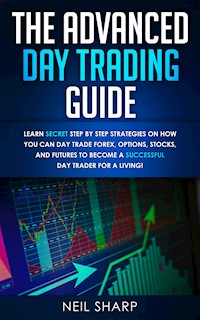
The Advanced Day Trading Guide
Table of contents
Introduction
Chapter 1: The fundamentals of day trading
Chapter 2: Trading basics
Chapter 3: Setting up a brokerage account
Chapter 4: How to choose the right stocks
Chapter 5: The best time to trade
Chapter 6: Reducing risk in day trading
Chapter 7: Day trading strategies
Chapter 8: Advanced trading strategies
Chapter 9: Tips for completing a successful trade
Conclusion
Introduction
Thank you for buying “The Advanced Day Trading Guide: Learn Secret Step by Step Strategies on How You Can Day Trade Forex, Options, Stocks, and Futures to Become a Successful Day Trader for a Living!” I greatly appreciate the interest you have taken in learning more on how you can become a successful day trader.
This book is a guide which will help you to make up your mind, once and for all, on becoming a day trader for a living.
I know that you have a lot of questions. And, I also know that you may be unsure if this is the right job for you.
The fact is that day trading has enabled many individuals to become financially independent and provide for their families while getting away from the rat race.
I know that might sound too good to be true.
But it’s not.
It’s a dream that many of us have had. But only a few of us have been able to make it come true. Now, it’s your turn to make it real.
How can you become a successful day trader for a living?
Well, that’s what this guide is about!
In this guide, you will learn about every aspect that you need to know in order to make your first trade. Also, I have taken great care in ensuring that the information contained herein is relevant and up to date. So, you can rest assured that you will be getting solid advice on investing in financial markets.
I would also encourage you to follow up on the information in this book.
Since constant research and learning are two fundamental actions of successful traders, I would encourage you to find as many sources of information as you can in order to make informed decisions.
With that in mind, let’s find out what information is available to you so that you may build a killer investment strategy.
I hope you are as eager as I am to get started.
So, here we go!
Chapter 1: The fundamentals of day trading
Day trading is just like any other career you could choose. However, not many folks understand how it works. You may have heard many people talk about how potentially lucrative it can be. In fact, you may even know someone who has made a living out of day trading.
In this chapter, we're going to be taking a closer look at how you can make day trading a full-time career which can not only pay for your basic needs and help fund your lifestyle. In addition, day trading can become lucrative enough to fund your retirement. More importantly, day trading is a means for you to achieve financial freedom and security.
So, let's take a closer look at what it takes to become a successful day trader.
Characteristics of a day trader
In order to become a successful day trader, an individual needs to have six basic traits. These traits will enable a day trader to become successful and the chief the results they are looking to produce.
Characteristic #1: Discipline
Discipline is by far the most important trait that any day trader can have. Discipline is what enables a day-trader to maintain focus during their day-to-day activities. In addition, focus is very important when market conditions are adverse.
By being disciplined, a day trader can be sure that they will be consistent in the way they carry out their investment strategy. This is very important since developing a solid investment strategy is not enough to become successful if the traitor cannot be consistent and stick to it.
Also, discipline is about establishing a routine and being able to follow through on the objectives set forth at the outset. Successful day traders are able to set up schedule and consistently carry out the activities that will lead them to identifying potential opportunities such as conducting research on a regular basis.
However, discipline isn't just about establishing a routine and following through on an investment plan. Discipline is also about having the restraint to avoid following trends and falling into psychological pitfalls. For example, a hot stock might be sought after by many investors. Therefore, discipline can be exercised in refraining from jumping in headfirst along with other investors who are driving up the price indiscriminately.
Discipline is also manifest in an investor's attitude by understanding that investment opportunities require a specific amount of research and time to develop. This approach implies resisting the temptation of hitting a home run or finding a magic bullet. Of course, there is always the temptation of trying to make one huge train that can make you rich. While that is certainly possible, it is highly unlikely.
Consequently, day traders must have the discipline to do nothing when there are no good opportunities available, and they must also have the discipline to act with prudence when allocating their resources into potential Investments.
Another important aspect of discipline is respecting the buy and sell points set forth in an investment strategy. When evaluating a potential investment, investors must be disciplined enough to purchase when the price falls to their expected level and not before. In addition, investors must exercise even more discipline in selling when an investment reaches their target sell point. As such, discipline is perhaps the most important factor when making a decision to sell.
When selling, there is always the expectation that the price of an investment may go up further. So, discipline enables an investor to sell at a point where they will feel comfortable with their returns and avoid waiting too long and possibly missing out on a great opportunity.
The same can be said about purchasing. Discipline is a great way of counteracting a phenomenon known as “the fear of missing out.” The fear of missing out consists in wanting to take advantage of investment opportunities that will yield considerable results. Thus, an individual may jump into an investment simply because they must act quickly lest they miss a great investment opportunity. This rash behavior can lead to risky Investments and exposure to potential losses.
Characteristic #2: Patience
The second characteristic that we will discuss is patience.
Patience is the perfect partner to discipline. What discipline, patience is about an Investor's attitude. Most individuals are looking to get rich quick. This is especially true when individual investors have ambitious goals and targets they wish to meet as soon as possible. And while there's nothing wrong with wanting to get ahead quickly, a lack of patience may cloud and investors judgment.
Patience is a virtue.
Patience is what distinguishes mature and savvy traders from reckless and immature ones. A lack of patience can lead investors to making poor choices regarding investment opportunities. This is true in cases where markets, or any other type of investments, are "hot." In such cases, other investors may be manipulating the price of a stock, asset, or commodity, to a point where other investors believe the time to act is now.
It is certainly possible to find yourself in a position where you must act quickly. Nevertheless, patience is a key factor in understanding that it might not be the best moment to get into that particular investment. In fact, you may have to exercise patience in order to wait for a stock to fall to the price that you have sent in your investment strategy. Likewise, you must exercise patience in waiting for a stock's value to rise to a point where you feel comfortable in selling.
A word of caution on being patient: investors often confuse being patient with holding on to an investment for too long. In this case, you might find yourself in a position where you may have to cut your losses. When you find yourself in a position where an investment does not seem likely to rebound after a string of losses, it might be best the dump that stock and cut your losses.
However, if you were considering a more long-term approach, then you may have to exercise even more patience in waiting for your investments to rebound. A good example of this is when you have invested in a mutual fund or an index fund. These funds are typically tied to a market's overall performance. Therefore, you may need to wait for the market to ride out a downturn so that you can begin to make money again.
At the end of the day, it all boils down to having a clear investment strategy which can outline the parameters by which you will hold your decisions accountable to. Patience is the trait that will enable you to keep a cool head while markets and individual assets go through the typical ups and downs that come with trading financial assets.
Characteristic #3: Flexibility
Another key characteristic that we will discuss in this chapter is flexibility.
Flexibility is one of the most important characteristics an investor can possess. Flexibility is about the attitude which, in essence, means rolling with the punches. Unlike other careers, investing in financial markets and instruments is a highly unpredictable and volatile endeavor. This is especially true when markets are under uncertain economic conditions. These uncertain conditions can become further compounded by an unclear political landscape.
This is why investors must always have an open mind. By being flexible and adaptable, investors can see the forest for the trees. They will be able to analyze and understand the data in front of them and realize where market trends are heading. In that regard, understanding data in market trends will enable investors to adjust their strategies accordingly.
Let's consider an example.
An investor has set a short-term strategy in which this investor has decided to get into an oil ETF. Current market analysis supposes that oil prices will remain stable for the foreseeable future. At the very least, fluctuations in oil prices are not expected to be significant for the remainder of the year. Suddenly, political instability has hit one of the major oil-producing countries. This implies a significant shift in the outlook for oil prices. The new outlook for oil prices contemplates a significant jump in prices.
This scenario presents potential investment decisions.
The first would be to buy further into the current oil ETF. Since the outlook is for prices to increase significantly, allocating further resources into the oil ETF would lead to further gains. This seems like a logical and reasonable investment decision.
The second investment decision would be to hold the current investment position in the oil ETF and wait for the market to skyrocket. At that point, an investor would consider selling their position in that ETF and collecting their winnings.




